Thematic Analysis For
Qualitative Research
Contents
2
 Research Design and its types
 Research Paradigm
 Saunders’ Research Onion Model
 Qualitative data analysis tools
 Assignments
Research Design
 Quantitative Research
 Qualitative Research
 Mixed Method
3
Quantitative Research
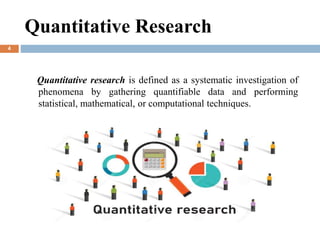
Quantitative research is defined as a systematic investigation of
phenomena by gathering quantifiable data and performing
statistical, mathematical, or computational techniques.
4
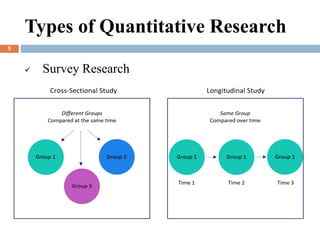
Types of Quantitative Research
 Survey Research
5
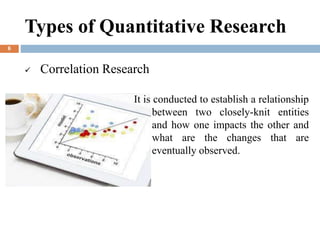
It is conducted to establish a relationship
between two closely-knit entities
and how one impacts the other and
what are the changes that are
eventually observed.
 Correlation Research
Types of Quantitative Research
6
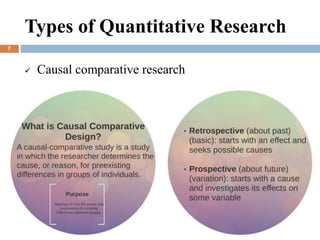
 Causal comparative research
Types of Quantitative Research
7
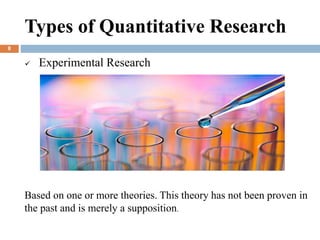
 Experimental Research
Types of Quantitative Research
Based on one or more theories. This theory has not been proven in
the past and is merely a supposition.
8
Qualitative Research
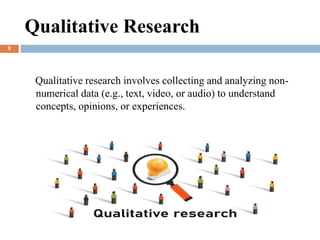
Qualitative research involves collecting and analyzing non-
numerical data (e.g., text, video, or audio) to understand
concepts, opinions, or experiences.
9
Types of Qualitative Research
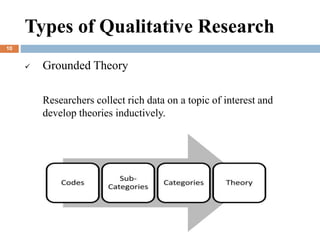
 Grounded Theory
Researchers collect rich data on a topic of interest and
develop theories inductively.
10
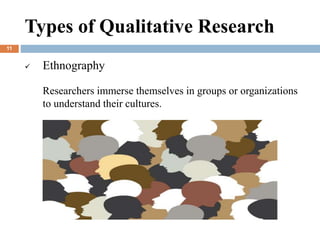
 Ethnography
Researchers immerse themselves in groups or organizations
to understand their cultures.
Types of Qualitative Research
11
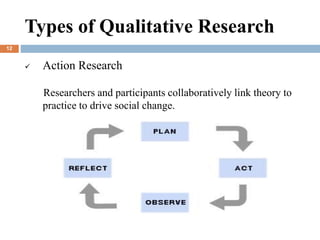
 Action Research
Researchers and participants collaboratively link theory to
practice to drive social change.
Types of Qualitative Research
12
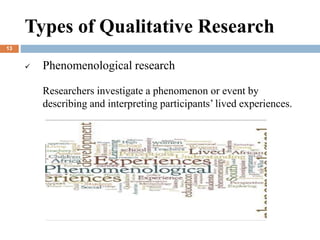
 Phenomenological research
Researchers investigate a phenomenon or event by
describing and interpreting participants’ lived experiences.
Types of Qualitative Research
13
 Narrative Research
Researchers examine how stories are told to understand how
participants perceive and make sense of their experiences.
Types of Qualitative Research
14
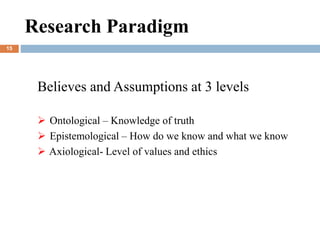
Research Paradigm
Believes and Assumptions at 3 levels
 Ontological – Knowledge of truth
 Epistemological – How do we know and what we know
 Axiological- Level of values and ethics
15
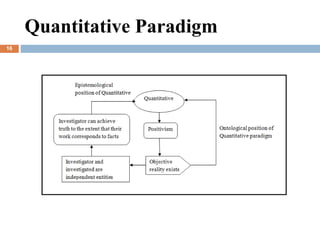
Quantitative Paradigm
16
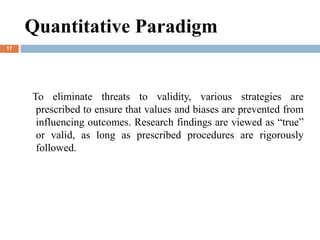
To eliminate threats to validity, various strategies are
prescribed to ensure that values and biases are prevented from
influencing outcomes. Research findings are viewed as “true”
or valid, as long as prescribed procedures are rigorously
followed.
Quantitative Paradigm
17
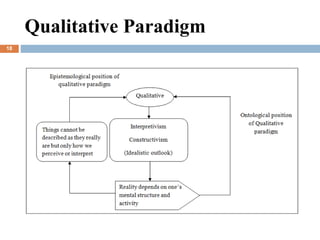
Qualitative Paradigm
18
Qualitative methodological foundations lie on the following
epistemological premise: an inquirer can only offer his or her
interpretation of the interpretations of others (based on their
values, interests, and purpose)
Qualitative Paradigm
19
Saunders’ Research Onion Model
20
 Layer 1: Research Philosophies
 Positivism –one reality, universal, objective
 Critical Realism/Post-positivism -multi-layered (actual and real),
causal
 Interpretivism/Social Constructivism –multiple realities, context
based, subjective
 Post-modernism/Advocacy –emancipatory, extremely nominal
 Pragmatism –practical solutions with available knowledge
Saunders’ Research Onion Model
21
 Layer 2: Approach to Theory Development
 Deduction – Begin with a theory and aim to build on it through
research
 Induction – Generating theories from research
 Abduction - It starts with an observation or set of observations and
then seeks to find the simplest and most likely conclusion from the
observations
Saunders’ Research Onion Model
22
 Layer 3: Methodological choices
 Mono Quantitative
 Mono Qualitative
 Multi-method Quantitative (more than one Quan)
 Multi-method Qualitative (more than one Qual)
 Mixed method (both used sequentially or concurrently)
Saunders’ Research Onion Model
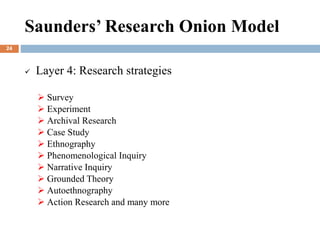
23
 Layer 4: Research strategies
 Survey
 Experiment
 Archival Research
 Case Study
 Ethnography
 Phenomenological Inquiry
 Narrative Inquiry
 Grounded Theory
 Autoethnography
 Action Research and many more
Saunders’ Research Onion Model
24
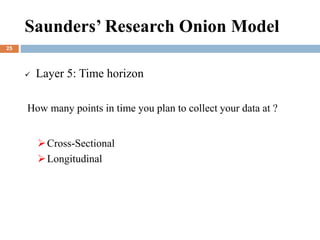
 Layer 5: Time horizon
How many points in time you plan to collect your data at ?
Cross-Sectional
Longitudinal
Saunders’ Research Onion Model
25
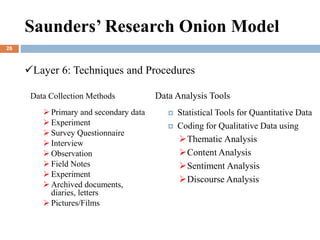
Data Collection Methods
 Primary and secondary data
 Experiment
 Survey Questionnaire
 Interview
 Observation
 Field Notes
 Experiment
 Archived documents,
diaries, letters
 Pictures/Films
Saunders’ Research Onion Model
Data Analysis Tools
 Statistical Tools for Quantitative Data
 Coding for Qualitative Data using
Thematic Analysis
Content Analysis
Sentiment Analysis
Discourse Analysis
Layer 6: Techniques and Procedures
26
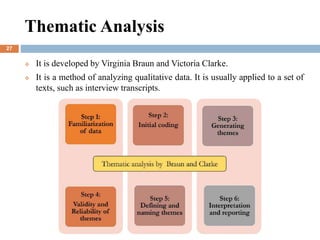
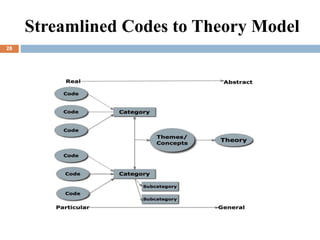
Thematic Analysis
 It is developed by Virginia Braun and Victoria Clarke.
 It is a method of analyzing qualitative data. It is usually applied to a set of
texts, such as interview transcripts.
27
Streamlined Codes to Theory Model
28
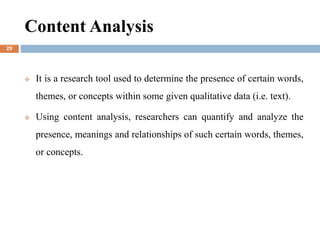
Content Analysis
 It is a research tool used to determine the presence of certain words,
themes, or concepts within some given qualitative data (i.e. text).
 Using content analysis, researchers can quantify and analyze the
presence, meanings and relationships of such certain words, themes,
or concepts.
29
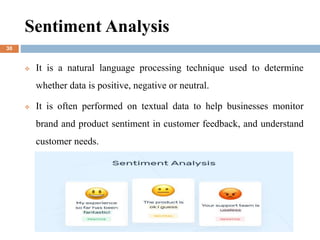
Sentiment Analysis
 It is a natural language processing technique used to determine
whether data is positive, negative or neutral.
 It is often performed on textual data to help businesses monitor
brand and product sentiment in customer feedback, and understand
customer needs.
30
Discourse Analysis
 It is sometimes defined as the analysis of language 'beyond the
sentence'.
 The study of smaller bits of language, such as sounds (phonetics
and phonology), parts of words (morphology), meaning
(semantics), and the order of words in sentences (syntax).
31
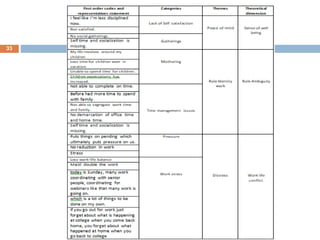
Assignments
Sample Transcripts excerpts for Coding
 What aspects of your home life has changed now when compared
to pre -lockdown time when you used to work at workplace?
32
33
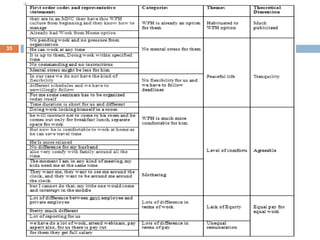
Assignments
Sample Transcripts excerpts for Coding
 How would you compare your work-from-home experience with
that of your spouse?
34
35
Thank You
36

Thematic Analysis for Qualitative Research.pptx

  • 1.
  • 2.
    Contents 2  Research Designand its types  Research Paradigm  Saunders’ Research Onion Model  Qualitative data analysis tools  Assignments
  • 3.
    Research Design  QuantitativeResearch  Qualitative Research  Mixed Method 3
  • 4.
    Quantitative Research Quantitative researchis defined as a systematic investigation of phenomena by gathering quantifiable data and performing statistical, mathematical, or computational techniques. 4
  • 5.
    Types of QuantitativeResearch  Survey Research 5
  • 6.
    It is conductedto establish a relationship between two closely-knit entities and how one impacts the other and what are the changes that are eventually observed.  Correlation Research Types of Quantitative Research 6
  • 7.
     Causal comparativeresearch Types of Quantitative Research 7
  • 8.
     Experimental Research Typesof Quantitative Research Based on one or more theories. This theory has not been proven in the past and is merely a supposition. 8
  • 9.
    Qualitative Research Qualitative researchinvolves collecting and analyzing non- numerical data (e.g., text, video, or audio) to understand concepts, opinions, or experiences. 9
  • 10.
    Types of QualitativeResearch  Grounded Theory Researchers collect rich data on a topic of interest and develop theories inductively. 10
  • 11.
     Ethnography Researchers immersethemselves in groups or organizations to understand their cultures. Types of Qualitative Research 11
  • 12.
     Action Research Researchersand participants collaboratively link theory to practice to drive social change. Types of Qualitative Research 12
  • 13.
     Phenomenological research Researchersinvestigate a phenomenon or event by describing and interpreting participants’ lived experiences. Types of Qualitative Research 13
  • 14.
     Narrative Research Researchersexamine how stories are told to understand how participants perceive and make sense of their experiences. Types of Qualitative Research 14
  • 15.
    Research Paradigm Believes andAssumptions at 3 levels  Ontological – Knowledge of truth  Epistemological – How do we know and what we know  Axiological- Level of values and ethics 15
  • 16.
  • 17.
    To eliminate threatsto validity, various strategies are prescribed to ensure that values and biases are prevented from influencing outcomes. Research findings are viewed as “true” or valid, as long as prescribed procedures are rigorously followed. Quantitative Paradigm 17
  • 18.
  • 19.
    Qualitative methodological foundationslie on the following epistemological premise: an inquirer can only offer his or her interpretation of the interpretations of others (based on their values, interests, and purpose) Qualitative Paradigm 19
  • 20.
  • 21.
     Layer 1:Research Philosophies  Positivism –one reality, universal, objective  Critical Realism/Post-positivism -multi-layered (actual and real), causal  Interpretivism/Social Constructivism –multiple realities, context based, subjective  Post-modernism/Advocacy –emancipatory, extremely nominal  Pragmatism –practical solutions with available knowledge Saunders’ Research Onion Model 21
  • 22.
     Layer 2:Approach to Theory Development  Deduction – Begin with a theory and aim to build on it through research  Induction – Generating theories from research  Abduction - It starts with an observation or set of observations and then seeks to find the simplest and most likely conclusion from the observations Saunders’ Research Onion Model 22
  • 23.
     Layer 3:Methodological choices  Mono Quantitative  Mono Qualitative  Multi-method Quantitative (more than one Quan)  Multi-method Qualitative (more than one Qual)  Mixed method (both used sequentially or concurrently) Saunders’ Research Onion Model 23
  • 24.
     Layer 4:Research strategies  Survey  Experiment  Archival Research  Case Study  Ethnography  Phenomenological Inquiry  Narrative Inquiry  Grounded Theory  Autoethnography  Action Research and many more Saunders’ Research Onion Model 24
  • 25.
     Layer 5:Time horizon How many points in time you plan to collect your data at ? Cross-Sectional Longitudinal Saunders’ Research Onion Model 25
  • 26.
    Data Collection Methods Primary and secondary data  Experiment  Survey Questionnaire  Interview  Observation  Field Notes  Experiment  Archived documents, diaries, letters  Pictures/Films Saunders’ Research Onion Model Data Analysis Tools  Statistical Tools for Quantitative Data  Coding for Qualitative Data using Thematic Analysis Content Analysis Sentiment Analysis Discourse Analysis Layer 6: Techniques and Procedures 26
  • 27.
    Thematic Analysis  Itis developed by Virginia Braun and Victoria Clarke.  It is a method of analyzing qualitative data. It is usually applied to a set of texts, such as interview transcripts. 27
  • 28.
    Streamlined Codes toTheory Model 28
  • 29.
    Content Analysis  Itis a research tool used to determine the presence of certain words, themes, or concepts within some given qualitative data (i.e. text).  Using content analysis, researchers can quantify and analyze the presence, meanings and relationships of such certain words, themes, or concepts. 29
  • 30.
    Sentiment Analysis  Itis a natural language processing technique used to determine whether data is positive, negative or neutral.  It is often performed on textual data to help businesses monitor brand and product sentiment in customer feedback, and understand customer needs. 30
  • 31.
    Discourse Analysis  Itis sometimes defined as the analysis of language 'beyond the sentence'.  The study of smaller bits of language, such as sounds (phonetics and phonology), parts of words (morphology), meaning (semantics), and the order of words in sentences (syntax). 31
  • 32.
    Assignments Sample Transcripts excerptsfor Coding  What aspects of your home life has changed now when compared to pre -lockdown time when you used to work at workplace? 32
  • 33.
  • 34.
    Assignments Sample Transcripts excerptsfor Coding  How would you compare your work-from-home experience with that of your spouse? 34
  • 35.
  • 36.