Focus Group Discussions
“ No cross-talk means sharing your experience, concerns, feelings, opinions, and hopes related to a particular issue or topic without referring to, or reacting to, any other group member’s sharing and without evaluating what has previously been said.”
Focus Group Discussions “ group depth interviews” or “focused interviews” Developed shortly after WWII Initially used by the entertainment industry  Eventually came into widespread use in consumer market research
Characteristics of Focus Groups Agreement is not necessary or even desired in the focus group Homogeneity, not heterogeneity, is most often sought Used as a research/evaluation tool Issues discussed are limited Groups are small (8-12) Multiple groups are conducted Neutral Facilitator Duration: 1 ½ to 2 hours Responses are recorded in detail Questions are pre-formulated
Consider using an FGD when… Presence of power differential Gap exists between professionals and target audience Need to investigate complex behavior and motivations Need to find out degree of consensus on a topic Need for friendly research method Insights are needed
Do NOT use FGD’s when… Primary intent is not research Group discussion is not an appropriate forum Topic is not appropriate for participants Researcher has lost control over critical aspects of study Statistical data is required Researcher cannot ensure confidentiality of sensitive information
Advantages of FGD’s Captures real life data in a social environment Flexible High face validity Speedy results Economical Researcher can increase sample size for qualitative research
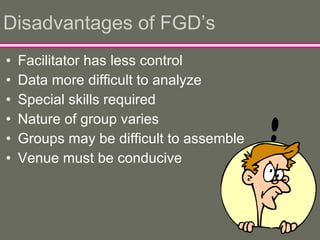
Disadvantages of FGD’s Facilitator has less control Data more difficult to analyze Special skills required Nature of group varies Groups may be difficult to assemble Venue must be conducive
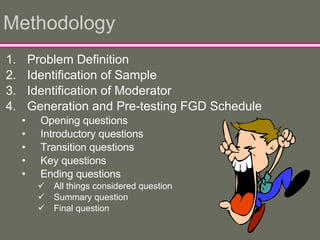
Methodology Problem Definition Identification of Sample Identification of Moderator Generation and Pre-testing FGD Schedule Opening questions Introductory questions Transition questions Key questions Ending questions All things considered question Summary question Final question
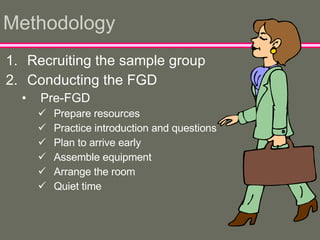
Methodology Recruiting the sample group Conducting the FGD Pre-FGD Prepare resources Practice introduction and questions Plan to arrive early Assemble equipment Arrange the room Quiet time
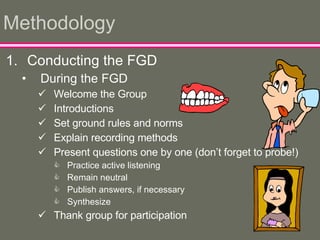
Methodology Conducting the FGD During the FGD Welcome the Group Introductions Set ground rules and norms Explain recording methods Present questions one by one (don’t forget to probe!) Practice active listening Remain neutral Publish answers, if necessary Synthesize  Thank group for participation
Activity Members of the hospitality industry have hired you to define the ideal romantic getaway.  Given the limited time you have to complete the first phase of the project, you have decided to conduct focus group discussions to gather your data.
Methodology Conducting the FGD Dealing with Problem Situations Monopolizing Tangents Private conversations Jokes Disagreeing Distractions Doing own work Time schedules/tardiness Non-participation Discussion gets out of hand
Methodology Analysis and Interpretation of data Four ways: Transcript based Tape based Note-based Memory based Content Analysis Consider the words Consider the context Consider the internal consistency Consider the intensity of comments Consider the specificity of responses Find the big ideas
Methodology Writing the Report Introduction Statement of the Problem Results or Findings Major Themes Limitations Implications of Data/Recommendations
Sources: Krueger, Richard A. (1994).  Focus groups: A practical guide for applied research  (2 nd  ed.). Thousand Oaks, CA: Sage Publications. Stewart, David W., & Shamdasani, Prem N. (1990).  Focus groups:  Theory and practice  (Applied Social Research Methods Series., Vol. 2). Thousand Oaks, CA: Sage Publications. The Facilitator’s Fieldbook.

Focus Group Discussion (Fgd)

  • 1.
  • 2.
    “ No cross-talkmeans sharing your experience, concerns, feelings, opinions, and hopes related to a particular issue or topic without referring to, or reacting to, any other group member’s sharing and without evaluating what has previously been said.”
  • 3.
    Focus Group Discussions“ group depth interviews” or “focused interviews” Developed shortly after WWII Initially used by the entertainment industry Eventually came into widespread use in consumer market research
  • 4.
    Characteristics of FocusGroups Agreement is not necessary or even desired in the focus group Homogeneity, not heterogeneity, is most often sought Used as a research/evaluation tool Issues discussed are limited Groups are small (8-12) Multiple groups are conducted Neutral Facilitator Duration: 1 ½ to 2 hours Responses are recorded in detail Questions are pre-formulated
  • 5.
    Consider using anFGD when… Presence of power differential Gap exists between professionals and target audience Need to investigate complex behavior and motivations Need to find out degree of consensus on a topic Need for friendly research method Insights are needed
  • 6.
    Do NOT useFGD’s when… Primary intent is not research Group discussion is not an appropriate forum Topic is not appropriate for participants Researcher has lost control over critical aspects of study Statistical data is required Researcher cannot ensure confidentiality of sensitive information
  • 7.
    Advantages of FGD’sCaptures real life data in a social environment Flexible High face validity Speedy results Economical Researcher can increase sample size for qualitative research
  • 8.
    Disadvantages of FGD’sFacilitator has less control Data more difficult to analyze Special skills required Nature of group varies Groups may be difficult to assemble Venue must be conducive
  • 9.
    Methodology Problem DefinitionIdentification of Sample Identification of Moderator Generation and Pre-testing FGD Schedule Opening questions Introductory questions Transition questions Key questions Ending questions All things considered question Summary question Final question
  • 10.
    Methodology Recruiting thesample group Conducting the FGD Pre-FGD Prepare resources Practice introduction and questions Plan to arrive early Assemble equipment Arrange the room Quiet time
  • 11.
    Methodology Conducting theFGD During the FGD Welcome the Group Introductions Set ground rules and norms Explain recording methods Present questions one by one (don’t forget to probe!) Practice active listening Remain neutral Publish answers, if necessary Synthesize Thank group for participation
  • 12.
    Activity Members ofthe hospitality industry have hired you to define the ideal romantic getaway. Given the limited time you have to complete the first phase of the project, you have decided to conduct focus group discussions to gather your data.
  • 13.
    Methodology Conducting theFGD Dealing with Problem Situations Monopolizing Tangents Private conversations Jokes Disagreeing Distractions Doing own work Time schedules/tardiness Non-participation Discussion gets out of hand
  • 14.
    Methodology Analysis andInterpretation of data Four ways: Transcript based Tape based Note-based Memory based Content Analysis Consider the words Consider the context Consider the internal consistency Consider the intensity of comments Consider the specificity of responses Find the big ideas
  • 15.
    Methodology Writing theReport Introduction Statement of the Problem Results or Findings Major Themes Limitations Implications of Data/Recommendations
  • 16.
    Sources: Krueger, RichardA. (1994). Focus groups: A practical guide for applied research (2 nd ed.). Thousand Oaks, CA: Sage Publications. Stewart, David W., & Shamdasani, Prem N. (1990). Focus groups: Theory and practice (Applied Social Research Methods Series., Vol. 2). Thousand Oaks, CA: Sage Publications. The Facilitator’s Fieldbook.