INTRODUCTION
Skin
Eyes
Brain
Heart
Lung
Kidney
Liver
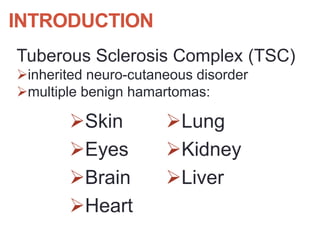
Tuberous Sclerosis Complex (TSC)
inherited neuro-cutaneous disorder
multiple benign hamartomas:
GENETICS
 Autosomal dominant
 Incidence 1 : 5000 livebirths
 Mutation in
 TSC-1 (Hamartin) or
 TSC-2 (Tuberin)
 +ve family history in 7 – 37%
Cell Proliferation
complex
hamartin
TSC1
tuberin
TSC2
Hamartin-Tuberin complex
Central regulator of cell cycle
TSC: loss of
inhibition
to cell cycle
Diagnostic criteria
Major Features
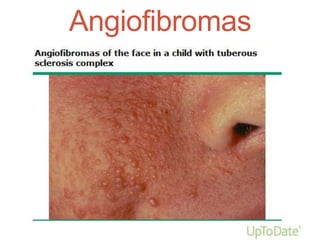
 Facial angiofibromas
or forehead plaque
 Non-traumatic
ungual or periungual
fibroma
 Hypomelanotic
macules
 Shagreen patch
 Multiple retinal
nodular hamartomas
 Cortical tuber
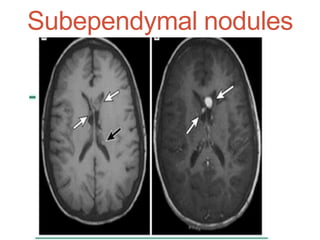
 Subependymal
nodule
 Subependymal giant
cell astrocytoma
 Cardiac
rhabdomyoma
 Lymphangio-
myomatosis
 Renal
angiomyolipoma
Minor Features
Multiple pits in dental
enamel
Hamartomatous rectal
polyps
Bone cysts
Cerebral white matter
migration lines
Gingival fibromas
Non-renal hamartoma
Retinal achromic
patch
"Confetti" skin lesions
Multiple renal cysts
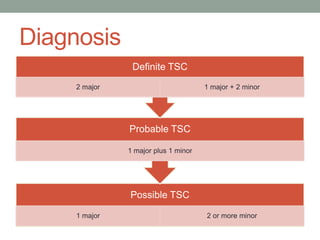
Diagnosis
Possible TSC
1 major 2 or more minor
Probable TSC
1 major plus 1 minor
Definite TSC
2 major 1 major + 2 minor
DERMATOLOGICAL
LESIONS:
81-95%
Angiofibromas
Fibrous plaque
Ash leaf spots
Periungual & subangual
fibromas
BRAIN LESIONS
90%
Glioneuronal hamartomas
Subependymal nodules
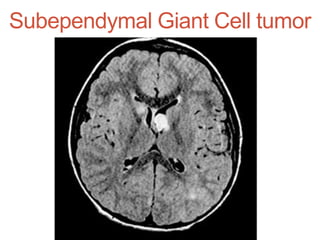
Subependymal Giant Cell tumor
Clinically:
 Epilepsy affecting 80 – 90%
 infantile spasms
 simple or complex partial seizures
 EEG +ve in 75 % of patients
 Cognitive deficits 44 – 65%
 Autism and behavioral problems
Diagnostic
features
associated
with increase
morbidity
New
symptoms
or
papilledema
Hydrocephalus
Serial
imaging
showing
growth of
lesions
RENAL
MANIFESTATIONS
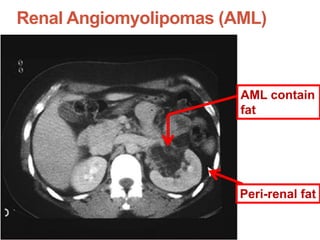
Renal Angiomyolipomas (AML)
Frequency in TSC patients: ~ 40 – 70 %
Renal Angiomyolipomas (AML)
 Asymptomatic in most cases
 Symptoms
 bleeding
 mass effect
 2 histological types:
 Classic
 Epithelioid
 Diagnosis : demonstration of FAT in
the Tumor
Renal Angiomyolipomas (AML)
AML contain
fat
Peri-renal fat
Treatment of AML
Prophylactic surgery?
 Size ≥4cm to prevent bleeding
 High vascularity and/or
aneurysm ≥ 5mm
 High suspicion of malignancy
Treatment of AML
Therapeutic interventions
 Nephron sparing surgery
 Selective renal artery embolization
 Radiofrequency ablation
 Radical nephrectomy
Potential issues in women
 Female sex hormones promote
growth of renal AMLs and their
hemorrhagic complications during
pregnancy
 Frequency of U/S surveillance
should increase
Renal cystic disease
 The 2nd most common renal
manifestation in TSC
 3 types :
 Singe or multiple renal cysts
 TSC2/PKD1 contiguous gene
syndrome
 Glomerulocytic kidney disease
Chronic kidney disease
In absence of large AML, patients
may develop:
 CKD
 subnephrotic proteinuria
 hypertension
 ESRD
Renal biopsy often reveals FSGS
OPHTHALMIC
MANIFESTATIONS
Retinal hamartoma
Calcified
hamartoma
CARDIOPULMONARY
Cardiac Rhabdomyoma
 detected on prenatal US
 Benign tumor usually
undergo spontaneous
regression
Pulmonary (LAM)
 Lymphangio-
leiomyomatosis
 Manifestations are
similar to those with
interstitial lung
disease
Management
Everolimus
Pulmonary
Cosmetic
Renal AML
Seizure control
EVEROLIMUS
 FDA approved mTOR after ExIST-2 trail
 50% reduction in AML volume in 3 month
 Dose : 10 mg od for 38 weeks
 Candidates :
 patients with renal AML plus other organ
affected
 Rapidly growing AMLs
 Patients who underwent nephrectomy or
embolization
Cell Proliferation
complex
hamartin
TSC1
tuberin
TSC2
Hamartin-Tuberin complex
Central regulator of cell cycle
TSC: loss of
inhibition
to cell cycle
EVEROLIMUS
Prognosis
 TSC is progressive
 Cause of death:
 status epilepticus
 renal disease
 Surveillance : every 2 years
 mental, physical examination
 MRI brain
 U/S abdomen
 ECHO
THANK YOU

Tuberous Sclerosis Complex With Renal AML 2

Editor's Notes

  • #5 Targets for mTOR regulation of translational initiation and elongation. AMPK = AMP-activated kinase. TSC1 and TSC2 = Tuberous sclerosis tumor suppressors 1 (hamartin) and 2 (tuberin); Rheb = Ras homolog enriched in brain; PKB/Akt = protein kinase B; 4EBP1 = eIF-4E binding protein; p70S6K = 70kDa ribosomal protein S6 kinase, also called S6K; eEF2K = eukaryotic elongation factor 2 kinase.
  • #34 M tor : mailman target of rapamycin
  • #35 Targets for mTOR regulation of translational initiation and elongation. AMPK = AMP-activated kinase. TSC1 and TSC2 = Tuberous sclerosis tumor suppressors 1 (hamartin) and 2 (tuberin); Rheb = Ras homolog enriched in brain; PKB/Akt = protein kinase B; 4EBP1 = eIF-4E binding protein; p70S6K = 70kDa ribosomal protein S6 kinase, also called S6K; eEF2K = eukaryotic elongation factor 2 kinase.