Budd-Chiari syndrome
INTRODUCTION
Pathophysiologic process that results in an
interruption or diminution of the normal flow of
blood out of the liver, However, as commonly
used, the Budd-Chiari syndrome implies
thrombosis of the hepatic veins and/or the
intrahepatic or suprahepatic inferior vena cava.
ETIOLOGY
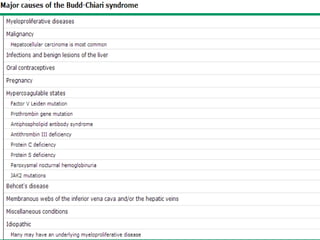
An underlying disorder can be identified in over
80 % of patients with the Budd-Chiari
syndrome.
More than one thrombotic risk factors are
present in many patients; 46 % had more than
one risk factor in one series
A 2009 guideline from the American Association for the
Study of Liver Diseases recommends the following
approach for investigating causes of Budd-Chiari
Syndrome:
• Evaluate for space occupying lesions or malignant
tumors compressing or invading the hepatic venous
outflow tract with sonography, CT scan, or MRI.
• Seek evidence for ulcerative colitis, celiac disease, and
systemic diseases.
• Routinely evaluate for multiple, concurrent risk factors
for thrombosis.
CLINICAL MANIFESTATIONS
One of the largest published series included a total of 237 patients who had been
treated at four centers (in the United States, the Netherlands, and France)
between 1984 and 2001. The following observations were made:
• The median age was 35 (range 13 to 76)
• 67 % were female
• An overt myeloproliferative disorder was present in 23 % (the
majority of whom had polycythemia vera)
• The two most common symptoms were ascites (84 %) and
hepatomegaly (76 %); 11 patients (5 %) were asymptomatic
• The hepatic outflow obstruction was in the hepatic veins (62 %)
inferior vena cava (7 %) or both (31 %); 34 patients (14 %) had
associated portal vein thrombosis
Acute disease
• Commonly in women.
• Patients usually present with severe right upper
quadrant pain
• Hepatomegaly. Jaundice and ascites often develop
rapidly.
• Ascites is detectable by ultrasound in more than 90
percent of patients. Variceal bleeding may also
occur
• Serum aminotransferase concentrations can range
from 100 to 200 int. unit/L to more than 600
int. unit/L
Subacute and chronic disease
• Present for several weeks to more than six months prior to clinical
presentation
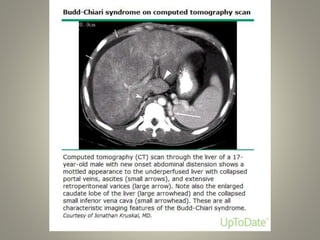
• Hypertrophy of the caudate lobe of the liver
• Cirrhosis may have developed in the chronically congested liver.
• Patients may then develop ascites, which may be massive.
• Hepatomegaly and abdominal pain are also common.
• encephalopathy is infrequent.
• Hepatopulmonary syndrome has been described in up to 28 % of
patients.
• normal or mild to moderate elevation of serum aminotransferases,
alkaline phosphat.
• Jaundice is rare.
Diagnosis
• Doppler ultrasonography
• CT scan
• Magnetic resonance imaging
• Venography
• Arteriography
• Liver biopsy
liver biopsy
• In 2009 AASLD recommended liver biopsy
ONLY when hepatic venous outflow
obstruction cannot be demonstrated by non
invasive imaging
11
Management
Medical therapy
• Supportive: ascites
• Anticoagulation: AASLD recommend
anticoagulation only in patients with chronic
and subacute disease with well compensated
liver.
• Thrombolytic therapy: NOT in chronic Bud
Chiari and ONLY in patients in whom the clot
is well defined on venography
Surgical options
• Angioplasty
• TIPS
• Surgical shunts
• Liver Transplantation
14

Budd chiari syndrome

  • 1.
  • 2.
    INTRODUCTION Pathophysiologic process thatresults in an interruption or diminution of the normal flow of blood out of the liver, However, as commonly used, the Budd-Chiari syndrome implies thrombosis of the hepatic veins and/or the intrahepatic or suprahepatic inferior vena cava.
  • 3.
    ETIOLOGY An underlying disordercan be identified in over 80 % of patients with the Budd-Chiari syndrome. More than one thrombotic risk factors are present in many patients; 46 % had more than one risk factor in one series
  • 5.
    A 2009 guidelinefrom the American Association for the Study of Liver Diseases recommends the following approach for investigating causes of Budd-Chiari Syndrome: • Evaluate for space occupying lesions or malignant tumors compressing or invading the hepatic venous outflow tract with sonography, CT scan, or MRI. • Seek evidence for ulcerative colitis, celiac disease, and systemic diseases. • Routinely evaluate for multiple, concurrent risk factors for thrombosis.
  • 6.
    CLINICAL MANIFESTATIONS One ofthe largest published series included a total of 237 patients who had been treated at four centers (in the United States, the Netherlands, and France) between 1984 and 2001. The following observations were made: • The median age was 35 (range 13 to 76) • 67 % were female • An overt myeloproliferative disorder was present in 23 % (the majority of whom had polycythemia vera) • The two most common symptoms were ascites (84 %) and hepatomegaly (76 %); 11 patients (5 %) were asymptomatic • The hepatic outflow obstruction was in the hepatic veins (62 %) inferior vena cava (7 %) or both (31 %); 34 patients (14 %) had associated portal vein thrombosis
  • 7.
    Acute disease • Commonlyin women. • Patients usually present with severe right upper quadrant pain • Hepatomegaly. Jaundice and ascites often develop rapidly. • Ascites is detectable by ultrasound in more than 90 percent of patients. Variceal bleeding may also occur • Serum aminotransferase concentrations can range from 100 to 200 int. unit/L to more than 600 int. unit/L
  • 8.
    Subacute and chronicdisease • Present for several weeks to more than six months prior to clinical presentation • Hypertrophy of the caudate lobe of the liver • Cirrhosis may have developed in the chronically congested liver. • Patients may then develop ascites, which may be massive. • Hepatomegaly and abdominal pain are also common. • encephalopathy is infrequent. • Hepatopulmonary syndrome has been described in up to 28 % of patients. • normal or mild to moderate elevation of serum aminotransferases, alkaline phosphat. • Jaundice is rare.
  • 9.
    Diagnosis • Doppler ultrasonography •CT scan • Magnetic resonance imaging • Venography • Arteriography • Liver biopsy
  • 11.
    liver biopsy • In2009 AASLD recommended liver biopsy ONLY when hepatic venous outflow obstruction cannot be demonstrated by non invasive imaging 11
  • 12.
  • 13.
    Medical therapy • Supportive:ascites • Anticoagulation: AASLD recommend anticoagulation only in patients with chronic and subacute disease with well compensated liver. • Thrombolytic therapy: NOT in chronic Bud Chiari and ONLY in patients in whom the clot is well defined on venography
  • 14.
    Surgical options • Angioplasty •TIPS • Surgical shunts • Liver Transplantation 14