Dr. ahmed
Abdulghani MD
DEFINITION
 Common chronic disorder of
the airways that is complex and
characterized by variable and
recurring symptoms, airflow
obstruction, bronchial
hyperresponsiveness, and an
underlying inflammation
CLINICAL
FEATURES
Asthma is diagnosed before
the age of seven years in
approximately 75 percent of
cases but Asthma may
develop at any age, although
new-onset asthma is less
frequent in older adults
compared to other age groups.
HISTORY
A pattern of respiratory symptoms
that occur following exposure to
triggers (eg, allergen, exercise,
viral infection) and resolve with
trigger avoidance or asthma
medication is typical of asthma.
Some patients will report all three
of the classic symptoms of asthma,
while others may report only one
or two:
Wheeze (high-pitched whistling sound, usually
upon exhalation)
Cough (often worse at night)
Shortness of breath or difficulty breathing
Certain historical features heighten the probability
of asthma:
 Episodic symptoms
Characteristic triggers
Personal or family history of atopy
History of asthmatic symptoms as a child
PHYSICAL
FINDINGS
Widespread, high-pitched, musical
wheezes are a characteristic
feature of asthma,
Physical findings that
suggest severe airflow obstruction
in asthma include tachypnea,
tachycardia, prolonged expiratory
phase of respiration, Use of the
accessory muscles of breathing
(eg, sternocleidomastoid) during
inspiration and a pulsus
paradoxus (greater than 12
mmHg fall in systolic blood
pressure during inspiration
EVALUATION
 Pulmonary function testing: critical tools in the diagnosis of
asthma
 No blood tests are available that can determine the presence or
absence of asthma or gauge its severity. However, a complete
blood count (CBC) with differential white blood cell analysis to
screen for eosinophilia or significant anemia may be helpful in
certain cases
 Measurement of total serum IgE levels is indicated in patients
with moderate-to-severe persistent asthma when considering
treatment with anti-IgE monoclonal antibody (omalizumab) or
when allergic bronchopulmonary aspergillosis is suspected
 Allergy skin tests are performed to a panel of indoor and
outdoor aeroallergens.
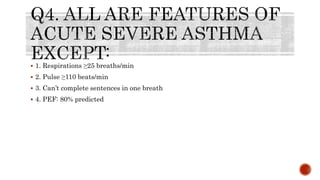
 Can’t complete sentences in one breath
 Respirations ≥25 breaths/min
 Pulse ≥110 beats/min
 Peak expiratory flow rate: 33-50% predicted
chest radiograph for new-onset moderate-to-severe asthma in adults over age 40 to
exclude the occasional alternative diagnosis that may mimic asthma, patients
presenting with features that are atypical for asthma, including any of the following:
●Fever
●Chronic purulent sputum production
●Persistently localized wheezing
●Hemoptysis
●Weight loss
●Clubbing
●Inspiratory crackles
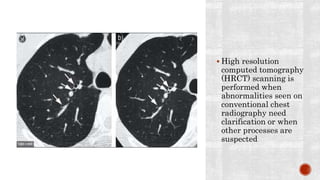
 High resolution
computed tomography
(HRCT) scanning is
performed when
abnormalities seen on
conventional chest
radiography need
clarification or when
other processes are
suspected
TREATMEN
T
GOALS OF ASTHMA TREATMENT:
Reduce impairment (intensity and
frequency):
 Freedom from frequent or troublesome
symptoms of asthma (cough, chest
tightness, wheezing, or shortness of
breath)
 Minimal need (≤2 days per week) of
inhaled short acting beta agonists
(SABAs) to relieve symptoms
 Few night-time awakenings (≤2 nights
per month) due to asthma
 Optimization of lung function
 Maintenance of normal daily activities,
including work or school attendance and
participation in athletics and exercise
 MONITORING PATIENTS WITH ASTHMA: routine follow-up visits for patients
with active asthma are recommended, at a frequency of every one to six months,
depending upon the severity of asthma. The aspects of the patient's asthma that
should be assessed at each visit include the following: signs and symptoms,
pulmonary function, quality of life, exacerbations, adherence with treatment,
medication side effects, and patient satisfaction with care.
 well-controlled asthma is characterized by daytime symptoms no more than twice
per week and nighttime symptoms no more than twice per month
PATIENT EDUCATION:
Patients must learn how to monitor their symptoms
and pulmonary function; they must understand
what triggers their asthma attacks and how to
avoid or decrease exposure to these triggers; and
they must understand what medicine to take and
how to use inhalers properly
 CONTROLLING TRIGGERS AND CONTRIBUTING CONDITIONS
upper respiratory tract illnesses, physical exertion, hormonal fluctuations, and
extreme emotion,
Inhaled allergens
Comorbid conditions (COPD, allergic bronchopulmonary aspergillosis,
gastroesophageal reflux, obesity)
Medications – Non-selective beta-blockers
Complications of influenza
Complications of pneumococcal infection
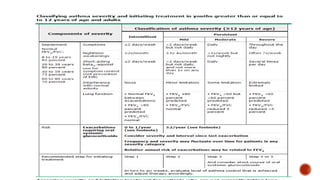
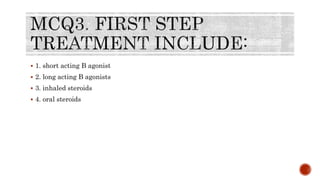
 Intermittent (Step 1) — Patients with mild intermittent
asthma are best treated with a quick-acting inhaled beta-2-
selective adrenergic agonist, taken as needed for relief of
symptoms
 Mild persistent (Step 2): low dose inhaled glucocorticoid,
Alternative strategies: leukotriene receptor
antagonists, theophylline, and cromoglycates
 Moderate persistent (Step 3): the preferred therapies are either
low-doses of an inhaled glucocorticoid plus a long-acting
inhaled beta agonist (LABA), or medium doses of an inhaled
glucocorticoid
 Severe persistent (Step 4 or 5): the preferred treatments are
medium (Step 4) or high (Step 5) doses of an inhaled glucocorticoid,
in combination with a long-acting inhaled beta-agonist, For patients
whose asthma is inadequately controlled on high-dose inhaled GCs
and LABAs, the anti-IgE therapy omalizumab or Monoclonal
antibodies (mepolizumab and reslizumab) antagoinst interleukin-5
(IL-5)
DENTAL
IMPLICATIONS
CASE
Patient 30 years old female own pets ,diagnosed with
asthma since she was 8 years old
medication history : an inhaled corticosteroid in
combination with a LABA , theophylline, an
anticholinergic agent and an inhaled short-acting β2
agonists. patients best peak flow at the clinic is 405
L/minute. admitted to hospital with an acute asthma
exacerbation. had two other admissions for asthma in the
last few months
Symptoms increasing wheeze, cough, yellow sputum and
chest tightness.
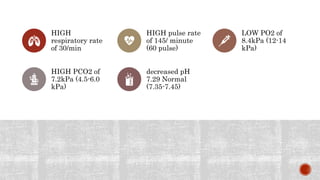
HIGH
respiratory rate
of 30/min
HIGH pulse rate
of 145/ minute
(60 pulse)
LOW PO2 of
8.4kPa (12-14
kPa)
HIGH PCO2 of
7.2kPa (4.5-6.0
kPa)
decreased pH
7.29 Normal
(7.35-7.45)
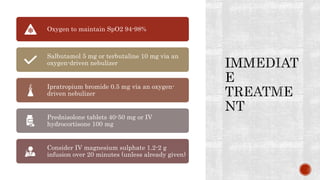
Oxygen to maintain SpO2 94-98%
Salbutamol 5 mg or terbutaline 10 mg via an
oxygen-driven nebulizer
Ipratropium bromide 0.5 mg via an oxygen-
driven nebulizer
Prednisolone tablets 40-50 mg or IV
hydrocortisone 100 mg
Consider IV magnesium sulphate 1.2-2 g
infusion over 20 minutes (unless already given)
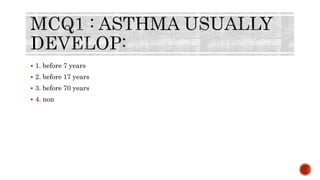
 1. before 7 years
 2. before 17 years
 3. before 70 years
 4. non
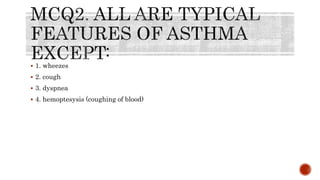
 1. wheezes
 2. cough
 3. dyspnea
 4. hemoptesysis (coughing of blood)
 1. short acting B agonist
 2. long acting B agonists
 3. inhaled steroids
 4. oral steroids
 1. Respirations ≥25 breaths/min
 2. Pulse ≥110 beats/min
 3. Can’t complete sentences in one breath
 4. PEF: 80% predicted
Bronchial asthma updated

Bronchial asthma updated

  • 2.
  • 3.
    DEFINITION  Common chronicdisorder of the airways that is complex and characterized by variable and recurring symptoms, airflow obstruction, bronchial hyperresponsiveness, and an underlying inflammation
  • 4.
    CLINICAL FEATURES Asthma is diagnosedbefore the age of seven years in approximately 75 percent of cases but Asthma may develop at any age, although new-onset asthma is less frequent in older adults compared to other age groups.
  • 5.
    HISTORY A pattern ofrespiratory symptoms that occur following exposure to triggers (eg, allergen, exercise, viral infection) and resolve with trigger avoidance or asthma medication is typical of asthma. Some patients will report all three of the classic symptoms of asthma, while others may report only one or two: Wheeze (high-pitched whistling sound, usually upon exhalation) Cough (often worse at night) Shortness of breath or difficulty breathing
  • 6.
    Certain historical featuresheighten the probability of asthma:  Episodic symptoms Characteristic triggers Personal or family history of atopy History of asthmatic symptoms as a child
  • 7.
    PHYSICAL FINDINGS Widespread, high-pitched, musical wheezesare a characteristic feature of asthma, Physical findings that suggest severe airflow obstruction in asthma include tachypnea, tachycardia, prolonged expiratory phase of respiration, Use of the accessory muscles of breathing (eg, sternocleidomastoid) during inspiration and a pulsus paradoxus (greater than 12 mmHg fall in systolic blood pressure during inspiration
  • 8.
    EVALUATION  Pulmonary functiontesting: critical tools in the diagnosis of asthma  No blood tests are available that can determine the presence or absence of asthma or gauge its severity. However, a complete blood count (CBC) with differential white blood cell analysis to screen for eosinophilia or significant anemia may be helpful in certain cases  Measurement of total serum IgE levels is indicated in patients with moderate-to-severe persistent asthma when considering treatment with anti-IgE monoclonal antibody (omalizumab) or when allergic bronchopulmonary aspergillosis is suspected  Allergy skin tests are performed to a panel of indoor and outdoor aeroallergens.
  • 9.
     Can’t completesentences in one breath  Respirations ≥25 breaths/min  Pulse ≥110 beats/min  Peak expiratory flow rate: 33-50% predicted
  • 10.
    chest radiograph fornew-onset moderate-to-severe asthma in adults over age 40 to exclude the occasional alternative diagnosis that may mimic asthma, patients presenting with features that are atypical for asthma, including any of the following: ●Fever ●Chronic purulent sputum production ●Persistently localized wheezing ●Hemoptysis ●Weight loss ●Clubbing ●Inspiratory crackles
  • 11.
     High resolution computedtomography (HRCT) scanning is performed when abnormalities seen on conventional chest radiography need clarification or when other processes are suspected
  • 12.
    TREATMEN T GOALS OF ASTHMATREATMENT: Reduce impairment (intensity and frequency):  Freedom from frequent or troublesome symptoms of asthma (cough, chest tightness, wheezing, or shortness of breath)  Minimal need (≤2 days per week) of inhaled short acting beta agonists (SABAs) to relieve symptoms  Few night-time awakenings (≤2 nights per month) due to asthma  Optimization of lung function  Maintenance of normal daily activities, including work or school attendance and participation in athletics and exercise
  • 13.
     MONITORING PATIENTSWITH ASTHMA: routine follow-up visits for patients with active asthma are recommended, at a frequency of every one to six months, depending upon the severity of asthma. The aspects of the patient's asthma that should be assessed at each visit include the following: signs and symptoms, pulmonary function, quality of life, exacerbations, adherence with treatment, medication side effects, and patient satisfaction with care.  well-controlled asthma is characterized by daytime symptoms no more than twice per week and nighttime symptoms no more than twice per month
  • 14.
    PATIENT EDUCATION: Patients mustlearn how to monitor their symptoms and pulmonary function; they must understand what triggers their asthma attacks and how to avoid or decrease exposure to these triggers; and they must understand what medicine to take and how to use inhalers properly
  • 15.
     CONTROLLING TRIGGERSAND CONTRIBUTING CONDITIONS upper respiratory tract illnesses, physical exertion, hormonal fluctuations, and extreme emotion, Inhaled allergens Comorbid conditions (COPD, allergic bronchopulmonary aspergillosis, gastroesophageal reflux, obesity) Medications – Non-selective beta-blockers Complications of influenza Complications of pneumococcal infection
  • 18.
     Intermittent (Step1) — Patients with mild intermittent asthma are best treated with a quick-acting inhaled beta-2- selective adrenergic agonist, taken as needed for relief of symptoms  Mild persistent (Step 2): low dose inhaled glucocorticoid, Alternative strategies: leukotriene receptor antagonists, theophylline, and cromoglycates  Moderate persistent (Step 3): the preferred therapies are either low-doses of an inhaled glucocorticoid plus a long-acting inhaled beta agonist (LABA), or medium doses of an inhaled glucocorticoid
  • 19.
     Severe persistent(Step 4 or 5): the preferred treatments are medium (Step 4) or high (Step 5) doses of an inhaled glucocorticoid, in combination with a long-acting inhaled beta-agonist, For patients whose asthma is inadequately controlled on high-dose inhaled GCs and LABAs, the anti-IgE therapy omalizumab or Monoclonal antibodies (mepolizumab and reslizumab) antagoinst interleukin-5 (IL-5)
  • 20.
  • 23.
    CASE Patient 30 yearsold female own pets ,diagnosed with asthma since she was 8 years old medication history : an inhaled corticosteroid in combination with a LABA , theophylline, an anticholinergic agent and an inhaled short-acting β2 agonists. patients best peak flow at the clinic is 405 L/minute. admitted to hospital with an acute asthma exacerbation. had two other admissions for asthma in the last few months Symptoms increasing wheeze, cough, yellow sputum and chest tightness.
  • 24.
    HIGH respiratory rate of 30/min HIGHpulse rate of 145/ minute (60 pulse) LOW PO2 of 8.4kPa (12-14 kPa) HIGH PCO2 of 7.2kPa (4.5-6.0 kPa) decreased pH 7.29 Normal (7.35-7.45)
  • 25.
    Oxygen to maintainSpO2 94-98% Salbutamol 5 mg or terbutaline 10 mg via an oxygen-driven nebulizer Ipratropium bromide 0.5 mg via an oxygen- driven nebulizer Prednisolone tablets 40-50 mg or IV hydrocortisone 100 mg Consider IV magnesium sulphate 1.2-2 g infusion over 20 minutes (unless already given)
  • 26.
     1. before7 years  2. before 17 years  3. before 70 years  4. non
  • 27.
     1. wheezes 2. cough  3. dyspnea  4. hemoptesysis (coughing of blood)
  • 28.
     1. shortacting B agonist  2. long acting B agonists  3. inhaled steroids  4. oral steroids
  • 29.
     1. Respirations≥25 breaths/min  2. Pulse ≥110 beats/min  3. Can’t complete sentences in one breath  4. PEF: 80% predicted

Editor's Notes