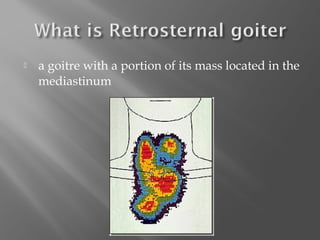
   a goitre with a portion of its mass located in the
    mediastinum
   Primary intra-thoracic goitres arise from aberrant thyroid
    tissue which is ectopically located in the mediastinum,
    receive their blood supply from mediastinal vessels and are
    not connected to the cervical thyroid. They are rare,
    representing less than 1% of all RGs
   Secondary RGs develop from the thyroid located in its
    normal cervical site. Downward migration of the thyroid
    into the mediastinum is facilitated by negative intra-thoracic
    pressure, gravity, traction forces during swallowing and the
    presence of anatomical barriers preventing the enlargement
    in other directions (thyroid cartilage, vertebral bodies, strap
    muscles, especially in patients with a short, large neck).
    These secondary RGs are, characteristically, in continuity
    with the cervical portion of the gland and receive their
    blood supply, depending on cervical vessels, almost always
    through branches of the inferior thyroid artery.
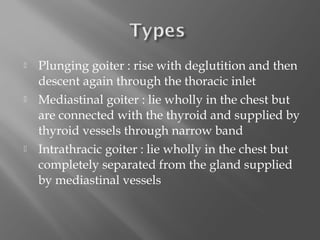
   Plunging goiter : rise with deglutition and then
    descent again through the thoracic inlet
   Mediastinal goiter : lie wholly in the chest but
    are connected with the thyroid and supplied by
    thyroid vessels through narrow band
   Intrathracic goiter : lie wholly in the chest but
    completely separated from the gland supplied
    by mediastinal vessels
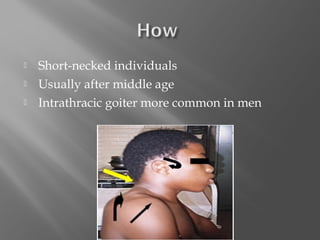
   Short-necked individuals
   Usually after middle age
   Intrathracic goiter more common in men
   May remain symptomless for years
   Dyspnea due to displacing and compressing on
    the trachea
   The Dyspnea aggravated by any posture that
    reduces the thoracic inlet as lying down or
    flexion the neck
   The patient prefer to spend the night in a chair
   Some time they miss diagnosed as asthmatic
   Sometimes there is dysphagia
   Inspection
   Palpation : thyroid gland enlarged
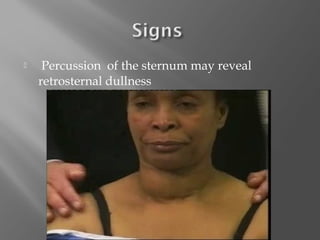
    Percussion of the sternum may reveal
    retrosternal dullness
   X-ray
   X-ray
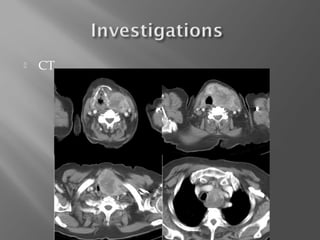
   CT
   CT
   CT
   Tc99m
   Fiberscope
   Thyroidectomy is the only line of treatment
   Mostly via cervical approach , rarely a median
    sternotmy is required
   Devascularization is done via the neck from
    which the retrosternal portion derived its blood
    supply
   Special care should be exerted to avoid injury
    of the recurrent laryngeal nerves during the
    delivery of retrosternal goter
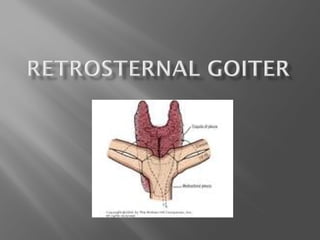
Retrosternal goiter

Retrosternal goiter

  • 2.
    a goitre with a portion of its mass located in the mediastinum
  • 3.
    Primary intra-thoracic goitres arise from aberrant thyroid tissue which is ectopically located in the mediastinum, receive their blood supply from mediastinal vessels and are not connected to the cervical thyroid. They are rare, representing less than 1% of all RGs  Secondary RGs develop from the thyroid located in its normal cervical site. Downward migration of the thyroid into the mediastinum is facilitated by negative intra-thoracic pressure, gravity, traction forces during swallowing and the presence of anatomical barriers preventing the enlargement in other directions (thyroid cartilage, vertebral bodies, strap muscles, especially in patients with a short, large neck). These secondary RGs are, characteristically, in continuity with the cervical portion of the gland and receive their blood supply, depending on cervical vessels, almost always through branches of the inferior thyroid artery.
  • 4.
    Plunging goiter : rise with deglutition and then descent again through the thoracic inlet  Mediastinal goiter : lie wholly in the chest but are connected with the thyroid and supplied by thyroid vessels through narrow band  Intrathracic goiter : lie wholly in the chest but completely separated from the gland supplied by mediastinal vessels
  • 5.
    Short-necked individuals  Usually after middle age  Intrathracic goiter more common in men
  • 6.
    May remain symptomless for years  Dyspnea due to displacing and compressing on the trachea  The Dyspnea aggravated by any posture that reduces the thoracic inlet as lying down or flexion the neck  The patient prefer to spend the night in a chair  Some time they miss diagnosed as asthmatic  Sometimes there is dysphagia
  • 7.
    Inspection
  • 8.
    Palpation : thyroid gland enlarged
  • 9.
    Percussion of the sternum may reveal retrosternal dullness
  • 10.
    X-ray
  • 11.
    X-ray
  • 12.
    CT
  • 13.
    CT
  • 14.
    CT
  • 15.
    Tc99m
  • 16.
    Fiberscope
  • 17.
    Thyroidectomy is the only line of treatment  Mostly via cervical approach , rarely a median sternotmy is required  Devascularization is done via the neck from which the retrosternal portion derived its blood supply  Special care should be exerted to avoid injury of the recurrent laryngeal nerves during the delivery of retrosternal goter