M2Prof. Dr. S Sundar’s UnitCase PresentationA case of QuadriparesisPresented by Dr.DeepuSebin
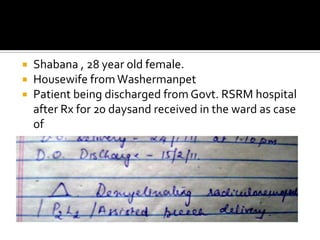
Shabana , 28 year old female.Housewife from WashermanpetPatient being discharged from Govt. RSRM hospital after Rx for 20 daysandreceived in the ward as case of
Clinical History in briefShe was an apparently normal ,except for her thin built .First complaint started 1.5 years back as gradually progressing  weakness of all four limbs .For which she was treated in a local Hospital with Drugs and IV injections.The weakness lasted for 2 weeks and she gradually recovered with treatment.She was not on any long term drugs.
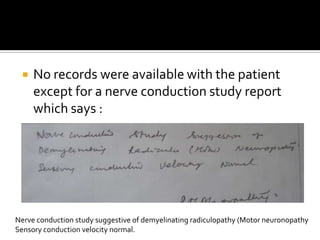
No records were available with the patient except for a nerve conduction study report which says :Nerve conduction study suggestive of demyelinatingradiculopathy (Motor neuronopathySensory conduction velocity normal.
She was symptom free since this first onset of weakness and conceived for the second time.Antenatal period was uneventfulHowever on day 2 pospartumshe started experiencing some weakness of her limbs and body
At presentationComplains of weakness of both upper and lower limbs, progressing over 2 daysIn upper limbsShe has difficulty in mixing food, holding objects, also difficulty is raising arm overhead, combing etcIn lower limbDifficulty in gripping chappals, Climbing stairs and sitting up from squatting positions ( All simultaneously)She was confined to bed because of the weakness. History of difficulty in turning side to side in bed, history of difficulty in lifting the neck +No higher mental function defects in historyNo history suggestive of cranial nerve involvementNo sensory, bowel or bladder involvementPatient complained of breathing difficulty. Present even at rest , no orthopnea or PNDNo h/o of fever or fever preceding the illness
Past H/oSimilar illness 1.5 years back, probably treated as Demyelinating diseaseNo h/o PTB,CAD,DM,SHTPersonal historyIn Lactation amenorrheaMixed dietFamily HistoryNil Specific
Clinical ExaminationPatient is thinly built and poorly nourishedConscious, Oriented, Mod dehydrated, AfebrileDyspneic , TachypneicPR = 110/min BP = 110/70Resp Rate: 36/min
General ExaminationNo pallor, Icterus, cynosis, cubbing, LNE, pedal odema, Thyroid - NormalCVS NormalRS – NormalP/A Normal
CNSHMF – NormalCrN – NormalSpinomotorBulk – Tone-  decrease b/lPowerUL  B/LProximal	   4-/5Distal     	  4-/5LL  B/LProximal	3/5Distal	3/5
ReflexesBJ		+		+TJ		+		+SJ		+		-KJ		++		++AJ		+		+Superficial refexes  present B/LPlantar flexor B/L
Sensory examination – NormalCerebellum – NormalSkull & Spine -Normal No signs of meningeal irritation
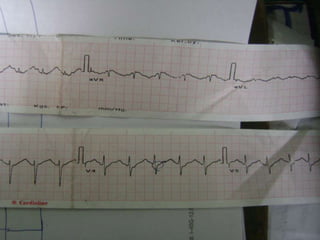
ECG
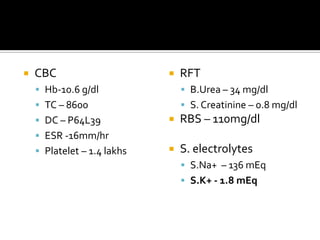
CBCHb-10.6 g/dlTC – 8600DC – P64L39ESR -16mm/hrPlatelet – 1.4 lakhsRFTB.Urea – 34 mg/dlS. Creatinine – 0.8 mg/dlRBS – 110mg/dlS. electrolytesS.Na+  – 136 mEqS.K+ - 1.8 mEq
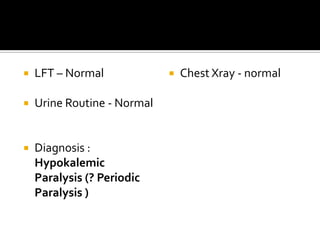
LFT – NormalUrine Routine - NormalDiagnosis : Hypokalemic Paralysis (? Periodic Paralysis )Chest Xray - normal
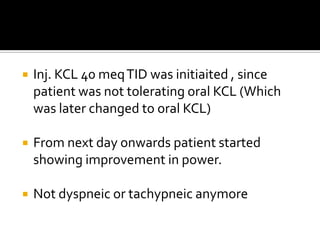
Inj. KCL 40 meq TID was initiaited , since patient was not tolerating oral KCL (Which was later changed to oral KCL)From next day onwards patient started showing improvement in power.Not dyspneic or tachypneic anymore
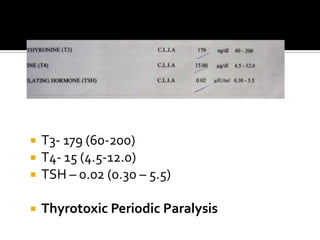
T3- 179 (60-200)T4- 15 (4.5-12.0)TSH – 0.02 (0.30 – 5.5)Thyrotoxic Periodic Paralysis
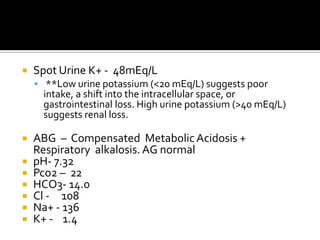
Spot Urine K+ -  48mEq/L **Low urine potassium (<20 mEq/L) suggests poor intake, a shift into the intracellular space, or gastrointestinal loss. High urine potassium (>40 mEq/L) suggests renal loss.ABG  –  Compensated  Metabolic Acidosis + Respiratory  alkalosis. AG normalpH- 7.32Pco2 –  22 HCO3- 14.0Cl -     108Na+ - 136K+ -    1.4
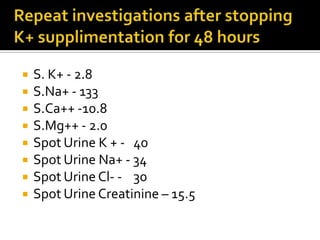
Repeat investigations after stopping K+ supplimentation for 48 hoursS. K+ - 2.8S.Na+ - 133S.Ca++ -10.8S.Mg++ - 2.0Spot Urine K+ -   40Spot Urine Na+ - 34Spot Urine Cl- -    30Spot Urine Creatinine – 15.5
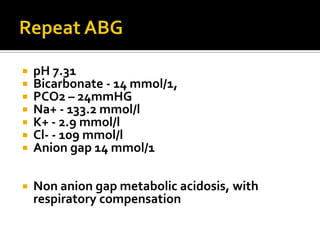
Repeat ABGpH 7.31Bicarbonate - 14 mmol/1, PCO2 – 24mmHGNa+ - 133.2 mmol/lK+ - 2.9 mmol/lCl- - 109 mmol/lAnion gap 14 mmol/1Non anion gap metabolic acidosis, with respiratory compensation
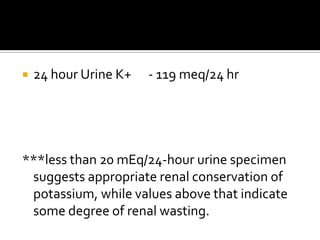
24 hour Urine K+      - 119 meq/24 hr***less than 20 mEq/24-hour urine specimen suggests appropriate renal conservation of potassium, while values above that indicate some degree of renal wasting.
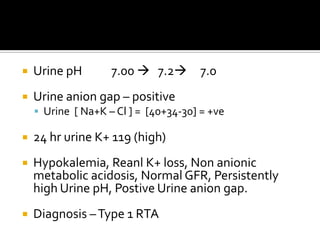
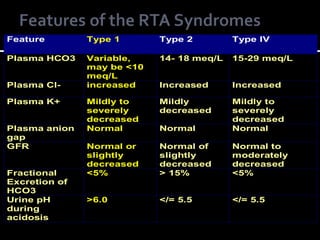
Urine pH          7.00    7.2     7.0Urine anion gap – positive Urine  [ Na+K – Cl ] =  [40+34-30] = +veHypokalemia,   Renal K+ loss,  Non anionic metabolic acidosis,   Normal GFR,  Persistently high Urine pH,   Positive Urine anion gap.Diagnosis – Type 1 RTA
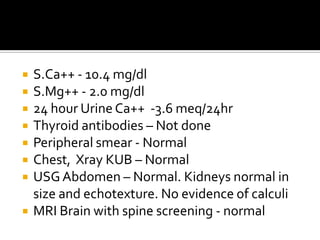
S.Ca++ - 10.4 mg/dlS.Mg++ - 2.0 mg/dl24 hour Urine Ca++  -3.6 meq/24hrThyroid antibodies – Not donePeripheral smear - NormalChest,  Xray KUB – NormalUSG Abdomen – Normal. Kidneys normal in size and echotexture. No evidence of calculiMRI Brain with spine screening - normal
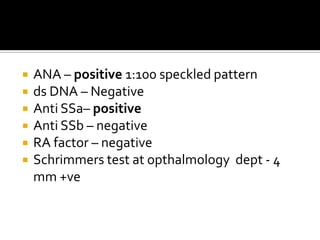
ANA – positive 1:100 speckled patternds DNA – NegativeAnti SSa– positiveAnti SSb – negativeRA factor – negativeSchrimmers test at opthalmology  dept - 4 mm +ve
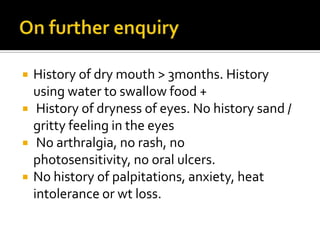
On further enquiryHistory of dry mouth > 3months. History using water to swallow food + History of dryness of eyes. No history sand / gritty feeling in the eyes No arthralgia, no rash, no photosensitivity, no oral ulcers.No history of palpitations, anxiety, heat intolerance or wt loss.
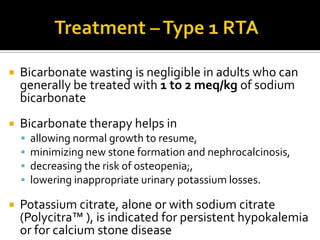
Final DiagnosisHypokalemic Periodic ParalysisRenal Tubular Acidosis Type 1Probable Sjogren SyndromeHyperthyroidismOn treatment withT. Carbimazole 5mg   2-2-2SypKCl 15 ml TIDBicarb Powder  3  sachets/dayTo review for Rpt electrolytes, ABG and further evaluation for Sjogren Syndrome (Lip Biopsy).
THYROTOXICOSIS AND RENAL TUBULAR ACIDOSIS PRESENTING ASHYPOKALAEMIC PARALYSISC. C. SZETO, C. C. CHOW, K. Y. LI, T. C. KO, V. T. F. YEUNG and C. S. COCKRAMDepartment of Medicine, Prince of Wales Hospital, The Chinese University of HongHypokalemic Paralysis : which is which Atals of Rhuematology
                                QWhat is causing the periodic paralysis, Hyperthyroidism or Renal Tubular Acidosis  or both ?Why there were no symptoms of hyperthyroidism in this patient ?Why the initial nerve conduction study showed  Motor Demyelination ?What awaits the patient ?
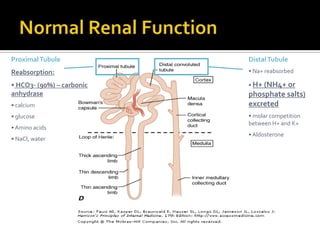
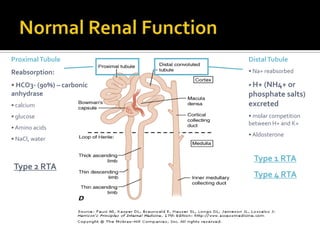
                             RTAThe normal renal response to acidemia (Acid Load) is toreabsorb all of the filtered bicarbonate in PCTand to increase hydrogen excretion (DT) primarily by enhancing the excretion of ammonium ions in the urine in Distal Tubules.
Normal Renal FunctionProximal TubuleReabsorption:  HCO3- (90%) – carbonic anhydrase
 calcium
 glucose
 Amino acids
NaCl, waterDistal Tubule Na+ reabsorbed
H+ (NH4+ or phosphate salts) excreted
 molar competition between H+ and K+
AldosteroneNormal Renal FunctionProximal TubuleReabsorption:  HCO3- (90%) – carbonic anhydrase
 calcium
 glucose
 Amino acids
NaCl, waterDistal Tubule Na+ reabsorbed
H+ (NH4+ or phosphate salts) excreted
 molar competition between H+ and K+
AldosteroneType 1 RTAType 4 RTAType 2 RTA
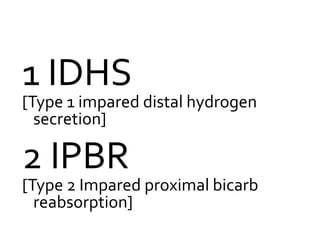
1 IDHS[Type 1 impared distal hydrogen secretion]2 IPBR[Type 2 Impared proximal bicarbreabsorption]
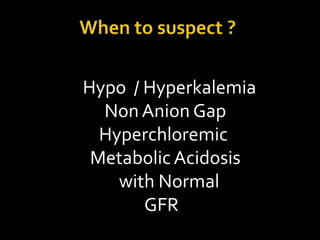
               When to suspect ?Hypo  / Hyperkalemia  Non Anion GapHyperchloremic  Metabolic Acidosis    with Normal GFR
Types of RTADistal or type 1 RTAProximal or type 2 RTAHypoaldosteronism or type 4 RTAWhat happened to Type3 RTA ?Although initially used to describe a transiently severe form of type 1 RTA in infants, the term type 3 RTA is now most often applied to a rare autosomal recessive syndrome (resulting from carbonic anhydrase II deficiency)
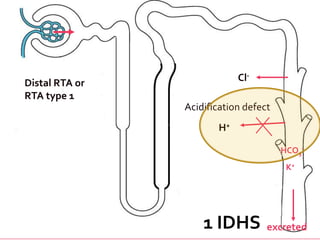
Type 1 RTA - DISTALDistal (type 1) RTA is Reduction in net secretion of H+ therefore ammonium secretion in the collecting tubules. The impairment in hydrogen ion secretion is manifested as an abnormally high (greater than 5.5) urine pH during systemic acidosis.Decreased proton pump (H-ATPase) activity Increased luminal membrane permeability with backleak of hydrogen ions Diminished distal tubular sodium reabsorption which reduces the electrical gradient for proton secretion
Cl-Distal RTA or RTA type 1Acidification defectH+HCO3-K+1 IDHS excreted
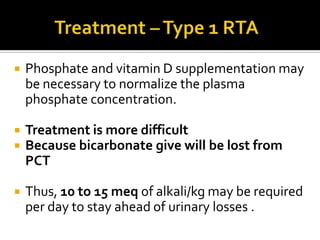
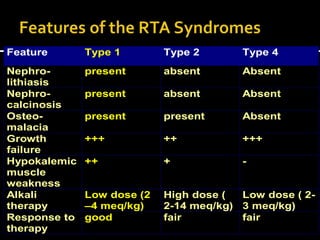
Type 1 RTA - DISTALDistal RTA It is often associated with hypercalciuria due to the effects of chronic acidosis on both bone resorption and the renal tubular reabsorption of calcium. Hypercalciuria contributes to the development of nephrolithiasis and nephrocalcinosis.
Major causes of type I (distal) renal tubular acidosis Primary Idiopathic, sporadic ,FamilialSecondary Sjögren's syndrome HypercalciuriaRheumatoid arthritis HyperglobulinemiaIfosfamide , Amphotericin BCirrhosis Systemic lupus erythematosus (may be hyperkalemic) Sickle cell anemia (may be hyperkalemic) Obstructive uropathy (may be hyperkalemic) Lithium carbonate Renal transplantation
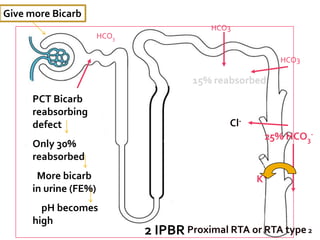
Type 2 RTA - PROXIMALProximal (type 2) RTA may occasionally present as an isolated defect, but is more commonly associated with generalized proximal tubular dysfunction called the Fanconi syndrome. In addition to bicarbonaturia, generalized proximal dysfunction may be associated with one or more of the following: glucosuria, phosphaturia, uricosuria, aminoaciduria, and tubular proteinuria.
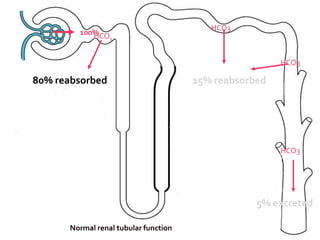
HCO3100%HCO3HCO380% reabsorbed15% reabsorbedHCO35% excretedNormal renal tubular function
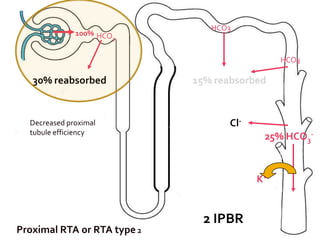
HCO3100%HCO3HCO330% reabsorbed15% reabsorbedCl-Decreased proximal tubule efficiency25% HCO3-K+2 IPBRProximal RTA or RTA type 2
Major causes of type 2 (proximal) renal tubular acidosis with or without the Fanconi syndromePrimary disorders  -Idiopathic, sporadic  Familial disorders CystinosisTyrosinemiaHereditary fructose intolerance  GalactosemiaGlycogen storage disease (type I) Wilson's disease  Acquired disorders Multiple myeloma IfosfamideCarbonic anhydrase inhibitors AmyloidosisHeavy metals Vitamin D deficiency Renal transplantation Paroxysmal nocturnal hemoglobinuria
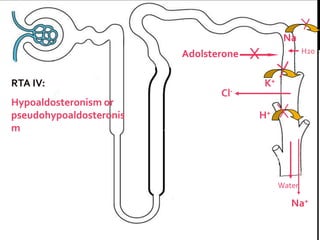
Type 4 RTAEnd organ target failure or low aldosterone:Lost of sodium – hyponatremiaRetention or decreased excretion of potassium - hyperkalemiaAbsorption of chloride – hyperchloremiaDecreased excretion of acids – metabolic acidosisLoss of fluid - dehydration
NaH20AdolsteroneK+RTA IV:Hypoaldosteronism or pseudohypoaldosteronismCl-H+WaterNa+
Aldosterone deficiency Primary Primary adrenal insufficiency Congenital adrenal hyperplasia, particularly 21-hydroxylase deficiency Isolated aldosteronesynthase deficiency  Heparin and low molecular weight heparin HyporeninemichypoaldosteronismRenal disease, most often diabetic nephropathy  Volume expansion, as in acute glomerulonephritisAngiotensin converting enzyme inhibitors , Nonsteroidalantiinflammatory drugs ,Cyclosporine HHIV infection Some cases of obstructive uropathyAldosterone resistance Drugs which close the collecting tubule sodium channel AmilorideSpironolactone ,Triamterene ,Trimethoprim (usually in high doses) ,PentamidineTubulointerstitial disease PseudohypoaldosteronismDistal chloride shunt
Lab Diagnosis of Type 1 & 2 RTAHypokalemiaABG showing non anionic gap metabolic acidosis24 hour Urine K+ > 40  showing kidney are losing K+ inspite of  low serum K+  *Renal Loss*
Urine pH Patients without RTA and normal renal function, the urine pH should be below 5.0 to 5.3 when metabolic acidosis is present. Type : 1In most cases of type 1 RTA, the urine pH is persistently above 5.3, reflecting the primary defect in distal acidification.Type : 2Varies
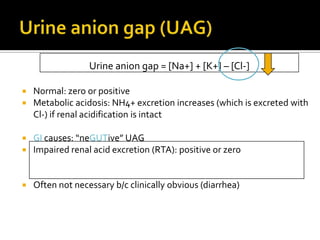
Urine Ammonium ExcretionUrine Anion Gap is Urine  Na+K – ClType 1 RTA – IDHS – positive Anion Gap
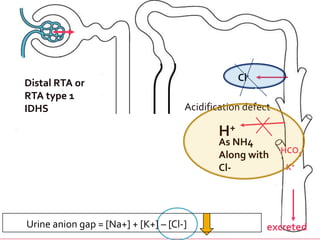
Cl-Distal RTA or RTA type 1IDHSAcidification defectH+As NH4Along with Cl-HCO3-K+Urine anion gap = [Na+] + [K+] – [Cl-] excreted
Urine Anion GapThe urine AG has a negative value in most patients with a normal AG metabolic acidosis due to the appropriate increase in urinary ammonium in an attempt to excrete the excess acid .Ammonium is an unmeasured cation; as a result, an increase in its excretion as NH4Cl will lead to a rise in the urine Cl concentration and a negative urine AG, usually ranging from -20 to -50 meq/L.In comparison, patients with renal failure, type 1 (distal) renal tubular acidosis (RTA), or hypoaldosteronism (type 4 RTA) are unable to excrete ammonium normally. As a result, the urine AG will have a positive value . ( due to decresedCl- excretion into urine)
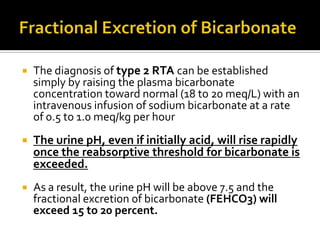
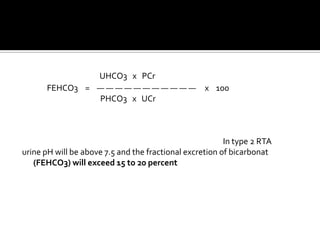
Fractional Excretion of BicarbonateThe diagnosis of type 2 RTA can be established simply by raising the plasma bicarbonate concentration toward normal (18 to 20 meq/L) with an intravenous infusion of sodium bicarbonate at a rate of 0.5 to 1.0 meq/kg per hourThe urine pH, even if initially acid, will rise rapidly once the reabsorptive threshold for bicarbonate is exceeded.As a result, the urine pH will be above 7.5 and the fractional excretion of bicarbonate (FEHCO3) will exceed 15 to 20 percent.

A Case of Quadriparesis

  • 1.
    M2Prof. Dr. SSundar’s UnitCase PresentationA case of QuadriparesisPresented by Dr.DeepuSebin
  • 2.
    Shabana , 28year old female.Housewife from WashermanpetPatient being discharged from Govt. RSRM hospital after Rx for 20 daysandreceived in the ward as case of
  • 3.
    Clinical History inbriefShe was an apparently normal ,except for her thin built .First complaint started 1.5 years back as gradually progressing weakness of all four limbs .For which she was treated in a local Hospital with Drugs and IV injections.The weakness lasted for 2 weeks and she gradually recovered with treatment.She was not on any long term drugs.
  • 4.
    No records wereavailable with the patient except for a nerve conduction study report which says :Nerve conduction study suggestive of demyelinatingradiculopathy (Motor neuronopathySensory conduction velocity normal.
  • 5.
    She was symptomfree since this first onset of weakness and conceived for the second time.Antenatal period was uneventfulHowever on day 2 pospartumshe started experiencing some weakness of her limbs and body
  • 6.
    At presentationComplains ofweakness of both upper and lower limbs, progressing over 2 daysIn upper limbsShe has difficulty in mixing food, holding objects, also difficulty is raising arm overhead, combing etcIn lower limbDifficulty in gripping chappals, Climbing stairs and sitting up from squatting positions ( All simultaneously)She was confined to bed because of the weakness. History of difficulty in turning side to side in bed, history of difficulty in lifting the neck +No higher mental function defects in historyNo history suggestive of cranial nerve involvementNo sensory, bowel or bladder involvementPatient complained of breathing difficulty. Present even at rest , no orthopnea or PNDNo h/o of fever or fever preceding the illness
  • 7.
    Past H/oSimilar illness1.5 years back, probably treated as Demyelinating diseaseNo h/o PTB,CAD,DM,SHTPersonal historyIn Lactation amenorrheaMixed dietFamily HistoryNil Specific
  • 8.
    Clinical ExaminationPatient isthinly built and poorly nourishedConscious, Oriented, Mod dehydrated, AfebrileDyspneic , TachypneicPR = 110/min BP = 110/70Resp Rate: 36/min
  • 9.
    General ExaminationNo pallor,Icterus, cynosis, cubbing, LNE, pedal odema, Thyroid - NormalCVS NormalRS – NormalP/A Normal
  • 10.
    CNSHMF – NormalCrN– NormalSpinomotorBulk – Tone- decrease b/lPowerUL B/LProximal 4-/5Distal 4-/5LL B/LProximal 3/5Distal 3/5
  • 11.
  • 12.
    Sensory examination –NormalCerebellum – NormalSkull & Spine -Normal No signs of meningeal irritation
  • 13.
  • 14.
    CBCHb-10.6 g/dlTC –8600DC – P64L39ESR -16mm/hrPlatelet – 1.4 lakhsRFTB.Urea – 34 mg/dlS. Creatinine – 0.8 mg/dlRBS – 110mg/dlS. electrolytesS.Na+ – 136 mEqS.K+ - 1.8 mEq
  • 15.
    LFT – NormalUrineRoutine - NormalDiagnosis : Hypokalemic Paralysis (? Periodic Paralysis )Chest Xray - normal
  • 16.
    Inj. KCL 40meq TID was initiaited , since patient was not tolerating oral KCL (Which was later changed to oral KCL)From next day onwards patient started showing improvement in power.Not dyspneic or tachypneic anymore
  • 18.
    T3- 179 (60-200)T4-15 (4.5-12.0)TSH – 0.02 (0.30 – 5.5)Thyrotoxic Periodic Paralysis
  • 19.
    Spot Urine K+- 48mEq/L **Low urine potassium (<20 mEq/L) suggests poor intake, a shift into the intracellular space, or gastrointestinal loss. High urine potassium (>40 mEq/L) suggests renal loss.ABG – Compensated Metabolic Acidosis + Respiratory alkalosis. AG normalpH- 7.32Pco2 – 22 HCO3- 14.0Cl - 108Na+ - 136K+ - 1.4
  • 20.
    Repeat investigations afterstopping K+ supplimentation for 48 hoursS. K+ - 2.8S.Na+ - 133S.Ca++ -10.8S.Mg++ - 2.0Spot Urine K+ - 40Spot Urine Na+ - 34Spot Urine Cl- - 30Spot Urine Creatinine – 15.5
  • 21.
    Repeat ABGpH 7.31Bicarbonate- 14 mmol/1, PCO2 – 24mmHGNa+ - 133.2 mmol/lK+ - 2.9 mmol/lCl- - 109 mmol/lAnion gap 14 mmol/1Non anion gap metabolic acidosis, with respiratory compensation
  • 22.
    24 hour UrineK+ - 119 meq/24 hr***less than 20 mEq/24-hour urine specimen suggests appropriate renal conservation of potassium, while values above that indicate some degree of renal wasting.
  • 23.
    Urine pH 7.00  7.2 7.0Urine anion gap – positive Urine [ Na+K – Cl ] = [40+34-30] = +veHypokalemia, Renal K+ loss, Non anionic metabolic acidosis, Normal GFR, Persistently high Urine pH, Positive Urine anion gap.Diagnosis – Type 1 RTA
  • 24.
    S.Ca++ - 10.4mg/dlS.Mg++ - 2.0 mg/dl24 hour Urine Ca++ -3.6 meq/24hrThyroid antibodies – Not donePeripheral smear - NormalChest, Xray KUB – NormalUSG Abdomen – Normal. Kidneys normal in size and echotexture. No evidence of calculiMRI Brain with spine screening - normal
  • 25.
    ANA – positive1:100 speckled patternds DNA – NegativeAnti SSa– positiveAnti SSb – negativeRA factor – negativeSchrimmers test at opthalmology dept - 4 mm +ve
  • 26.
    On further enquiryHistoryof dry mouth > 3months. History using water to swallow food + History of dryness of eyes. No history sand / gritty feeling in the eyes No arthralgia, no rash, no photosensitivity, no oral ulcers.No history of palpitations, anxiety, heat intolerance or wt loss.
  • 27.
    Final DiagnosisHypokalemic PeriodicParalysisRenal Tubular Acidosis Type 1Probable Sjogren SyndromeHyperthyroidismOn treatment withT. Carbimazole 5mg 2-2-2SypKCl 15 ml TIDBicarb Powder 3 sachets/dayTo review for Rpt electrolytes, ABG and further evaluation for Sjogren Syndrome (Lip Biopsy).
  • 28.
    THYROTOXICOSIS AND RENALTUBULAR ACIDOSIS PRESENTING ASHYPOKALAEMIC PARALYSISC. C. SZETO, C. C. CHOW, K. Y. LI, T. C. KO, V. T. F. YEUNG and C. S. COCKRAMDepartment of Medicine, Prince of Wales Hospital, The Chinese University of HongHypokalemic Paralysis : which is which Atals of Rhuematology
  • 29.
    QWhat is causing the periodic paralysis, Hyperthyroidism or Renal Tubular Acidosis or both ?Why there were no symptoms of hyperthyroidism in this patient ?Why the initial nerve conduction study showed Motor Demyelination ?What awaits the patient ?
  • 30.
    RTAThe normal renal response to acidemia (Acid Load) is toreabsorb all of the filtered bicarbonate in PCTand to increase hydrogen excretion (DT) primarily by enhancing the excretion of ammonium ions in the urine in Distal Tubules.
  • 31.
    Normal Renal FunctionProximalTubuleReabsorption: HCO3- (90%) – carbonic anhydrase
  • 32.
  • 33.
  • 34.
  • 35.
  • 36.
    H+ (NH4+ orphosphate salts) excreted
  • 37.
    molar competitionbetween H+ and K+
  • 38.
    AldosteroneNormal Renal FunctionProximalTubuleReabsorption: HCO3- (90%) – carbonic anhydrase
  • 39.
  • 40.
  • 41.
  • 42.
  • 43.
    H+ (NH4+ orphosphate salts) excreted
  • 44.
    molar competitionbetween H+ and K+
  • 45.
  • 46.
    1 IDHS[Type 1impared distal hydrogen secretion]2 IPBR[Type 2 Impared proximal bicarbreabsorption]
  • 47.
    When to suspect ?Hypo / Hyperkalemia Non Anion GapHyperchloremic Metabolic Acidosis with Normal GFR
  • 48.
    Types of RTADistalor type 1 RTAProximal or type 2 RTAHypoaldosteronism or type 4 RTAWhat happened to Type3 RTA ?Although initially used to describe a transiently severe form of type 1 RTA in infants, the term type 3 RTA is now most often applied to a rare autosomal recessive syndrome (resulting from carbonic anhydrase II deficiency)
  • 49.
    Type 1 RTA- DISTALDistal (type 1) RTA is Reduction in net secretion of H+ therefore ammonium secretion in the collecting tubules. The impairment in hydrogen ion secretion is manifested as an abnormally high (greater than 5.5) urine pH during systemic acidosis.Decreased proton pump (H-ATPase) activity Increased luminal membrane permeability with backleak of hydrogen ions Diminished distal tubular sodium reabsorption which reduces the electrical gradient for proton secretion
  • 50.
    Cl-Distal RTA orRTA type 1Acidification defectH+HCO3-K+1 IDHS excreted
  • 51.
    Type 1 RTA- DISTALDistal RTA It is often associated with hypercalciuria due to the effects of chronic acidosis on both bone resorption and the renal tubular reabsorption of calcium. Hypercalciuria contributes to the development of nephrolithiasis and nephrocalcinosis.
  • 52.
    Major causes oftype I (distal) renal tubular acidosis Primary Idiopathic, sporadic ,FamilialSecondary Sjögren's syndrome HypercalciuriaRheumatoid arthritis HyperglobulinemiaIfosfamide , Amphotericin BCirrhosis Systemic lupus erythematosus (may be hyperkalemic) Sickle cell anemia (may be hyperkalemic) Obstructive uropathy (may be hyperkalemic) Lithium carbonate Renal transplantation
  • 53.
    Type 2 RTA- PROXIMALProximal (type 2) RTA may occasionally present as an isolated defect, but is more commonly associated with generalized proximal tubular dysfunction called the Fanconi syndrome. In addition to bicarbonaturia, generalized proximal dysfunction may be associated with one or more of the following: glucosuria, phosphaturia, uricosuria, aminoaciduria, and tubular proteinuria.
  • 54.
    HCO3100%HCO3HCO380% reabsorbed15% reabsorbedHCO35%excretedNormal renal tubular function
  • 55.
    HCO3100%HCO3HCO330% reabsorbed15% reabsorbedCl-Decreasedproximal tubule efficiency25% HCO3-K+2 IPBRProximal RTA or RTA type 2
  • 56.
    Major causes oftype 2 (proximal) renal tubular acidosis with or without the Fanconi syndromePrimary disorders -Idiopathic, sporadic Familial disorders CystinosisTyrosinemiaHereditary fructose intolerance GalactosemiaGlycogen storage disease (type I) Wilson's disease Acquired disorders Multiple myeloma IfosfamideCarbonic anhydrase inhibitors AmyloidosisHeavy metals Vitamin D deficiency Renal transplantation Paroxysmal nocturnal hemoglobinuria
  • 57.
    Type 4 RTAEndorgan target failure or low aldosterone:Lost of sodium – hyponatremiaRetention or decreased excretion of potassium - hyperkalemiaAbsorption of chloride – hyperchloremiaDecreased excretion of acids – metabolic acidosisLoss of fluid - dehydration
  • 58.
    NaH20AdolsteroneK+RTA IV:Hypoaldosteronism orpseudohypoaldosteronismCl-H+WaterNa+
  • 59.
    Aldosterone deficiency PrimaryPrimary adrenal insufficiency Congenital adrenal hyperplasia, particularly 21-hydroxylase deficiency Isolated aldosteronesynthase deficiency Heparin and low molecular weight heparin HyporeninemichypoaldosteronismRenal disease, most often diabetic nephropathy Volume expansion, as in acute glomerulonephritisAngiotensin converting enzyme inhibitors , Nonsteroidalantiinflammatory drugs ,Cyclosporine HHIV infection Some cases of obstructive uropathyAldosterone resistance Drugs which close the collecting tubule sodium channel AmilorideSpironolactone ,Triamterene ,Trimethoprim (usually in high doses) ,PentamidineTubulointerstitial disease PseudohypoaldosteronismDistal chloride shunt
  • 60.
    Lab Diagnosis ofType 1 & 2 RTAHypokalemiaABG showing non anionic gap metabolic acidosis24 hour Urine K+ > 40 showing kidney are losing K+ inspite of low serum K+ *Renal Loss*
  • 61.
    Urine pH Patientswithout RTA and normal renal function, the urine pH should be below 5.0 to 5.3 when metabolic acidosis is present. Type : 1In most cases of type 1 RTA, the urine pH is persistently above 5.3, reflecting the primary defect in distal acidification.Type : 2Varies
  • 62.
    Urine Ammonium ExcretionUrineAnion Gap is Urine Na+K – ClType 1 RTA – IDHS – positive Anion Gap
  • 63.
    Cl-Distal RTA orRTA type 1IDHSAcidification defectH+As NH4Along with Cl-HCO3-K+Urine anion gap = [Na+] + [K+] – [Cl-] excreted
  • 64.
    Urine Anion GapTheurine AG has a negative value in most patients with a normal AG metabolic acidosis due to the appropriate increase in urinary ammonium in an attempt to excrete the excess acid .Ammonium is an unmeasured cation; as a result, an increase in its excretion as NH4Cl will lead to a rise in the urine Cl concentration and a negative urine AG, usually ranging from -20 to -50 meq/L.In comparison, patients with renal failure, type 1 (distal) renal tubular acidosis (RTA), or hypoaldosteronism (type 4 RTA) are unable to excrete ammonium normally. As a result, the urine AG will have a positive value . ( due to decresedCl- excretion into urine)
  • 65.
    Fractional Excretion ofBicarbonateThe diagnosis of type 2 RTA can be established simply by raising the plasma bicarbonate concentration toward normal (18 to 20 meq/L) with an intravenous infusion of sodium bicarbonate at a rate of 0.5 to 1.0 meq/kg per hourThe urine pH, even if initially acid, will rise rapidly once the reabsorptive threshold for bicarbonate is exceeded.As a result, the urine pH will be above 7.5 and the fractional excretion of bicarbonate (FEHCO3) will exceed 15 to 20 percent.