EVALUATION OF
WRIST & HAND
DR. UTKARSH SHAHI
ASSISTANT PROFESSOR
DEPARTMENT OF ORTHOPAEDICS
INTRODUCTION: Hand and Wrist
 Series of complex, delicately balanced joints
 Function is integral to every act of daily living
 Most active portion of the upper extremity
 The least protected joints
 Extremely vulnerable to injury
 Difficult and complex examination
 Diagnosis often vague
 If no fracture = “wrist strain or sprain”
 Bilateral comparison useful
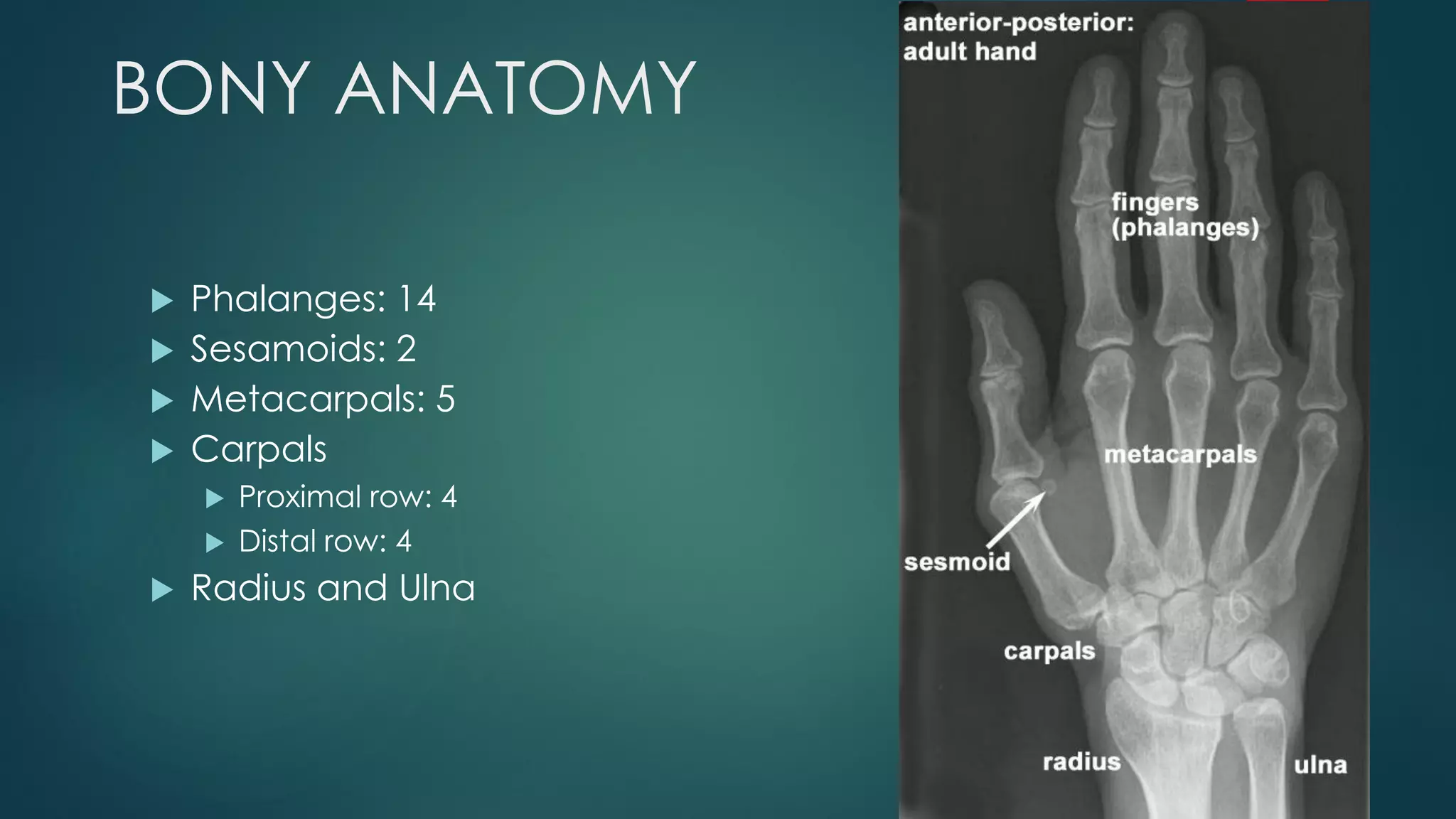
BONY ANATOMY
 Phalanges: 14
 Sesamoids: 2
 Metacarpals: 5
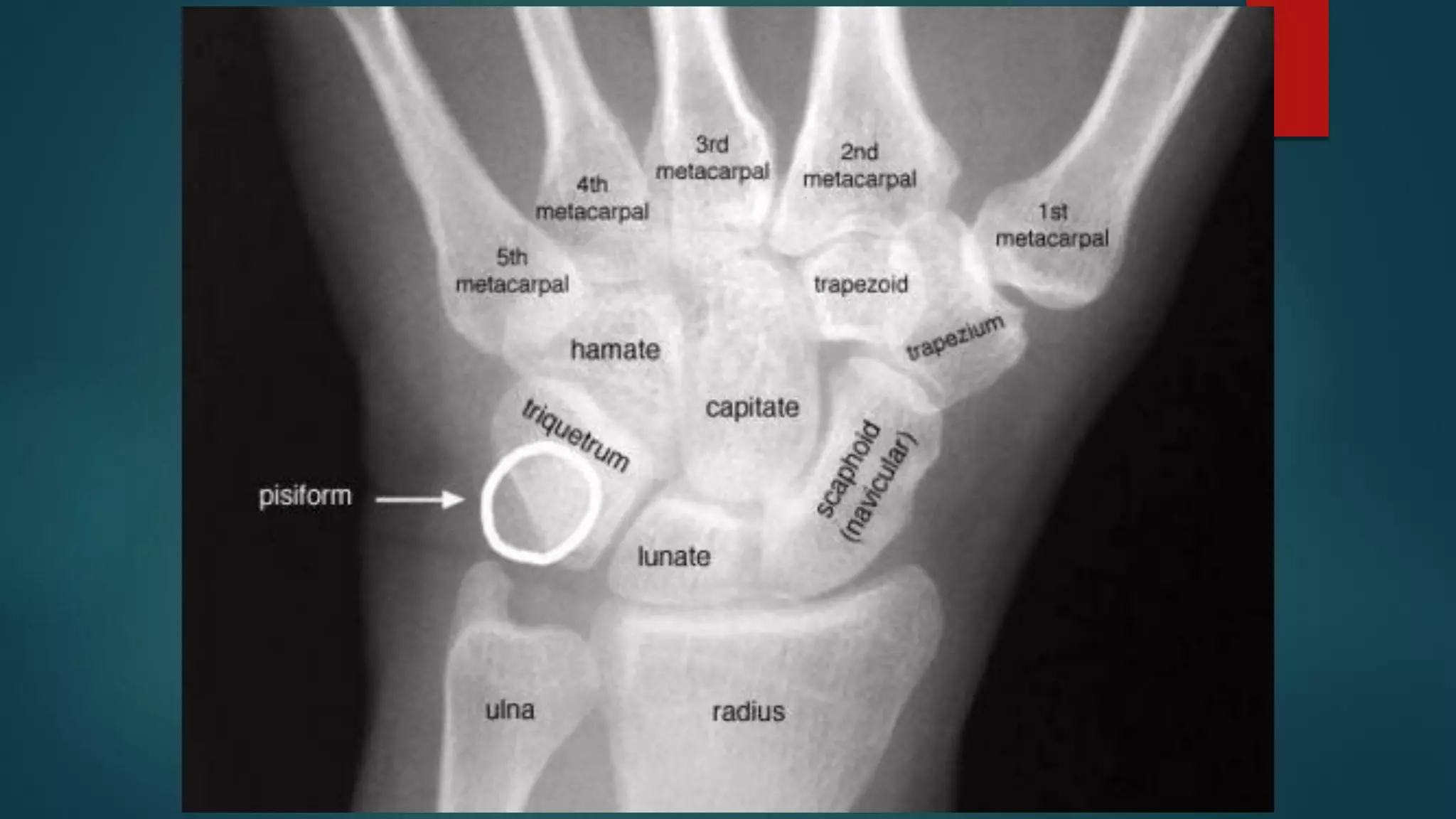
 Carpals
 Proximal row: 4
 Distal row: 4
 Radius and Ulna
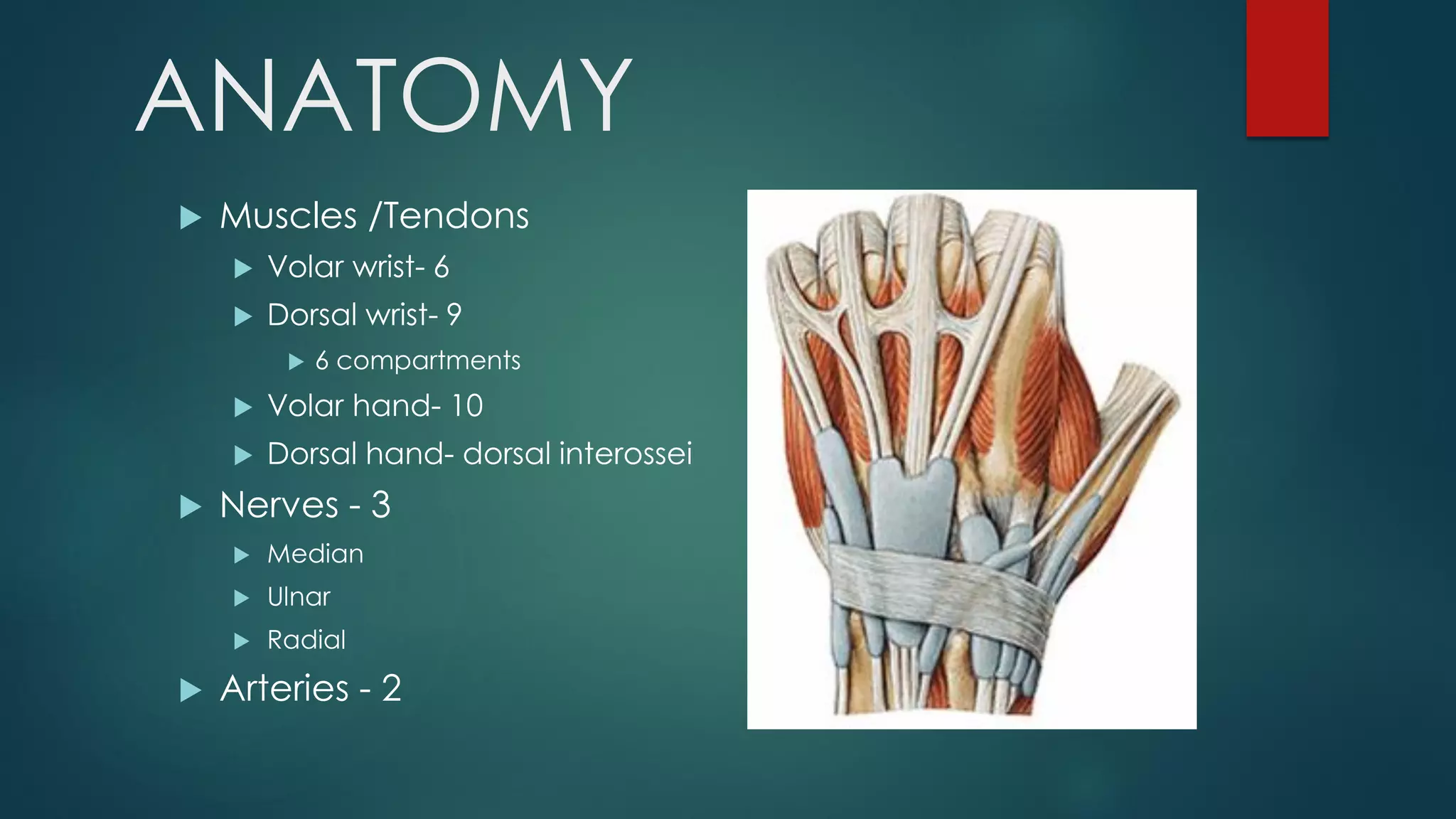
ANATOMY
 Muscles /Tendons
 Volar wrist- 6
 Dorsal wrist- 9
 6 compartments
 Volar hand- 10
 Dorsal hand- dorsal interossei
 Nerves - 3
 Median
 Ulnar
 Radial
 Arteries - 2
WRIST AND HAND CONDITIONS
Injury and mechanical derangement.
Congenital and developmental abnormalities.
Infection and inflammation.
Arthritis and rheumatic disorders.
Metabolic and endocrine disorders.
Tumours and lesions that mimic them.
Neurological disorders and muscle weakness.
HISTORY TAKING
PATIENT DETAILS CHIEF COMPLAINTS
HISTORY OF PRESENT ILLNESS PAST HISTORY
FAMILY HISTORY PERSONAL HISTORY
TREATMENT HISTORY NEGATIVE HISTORY
HISTORY
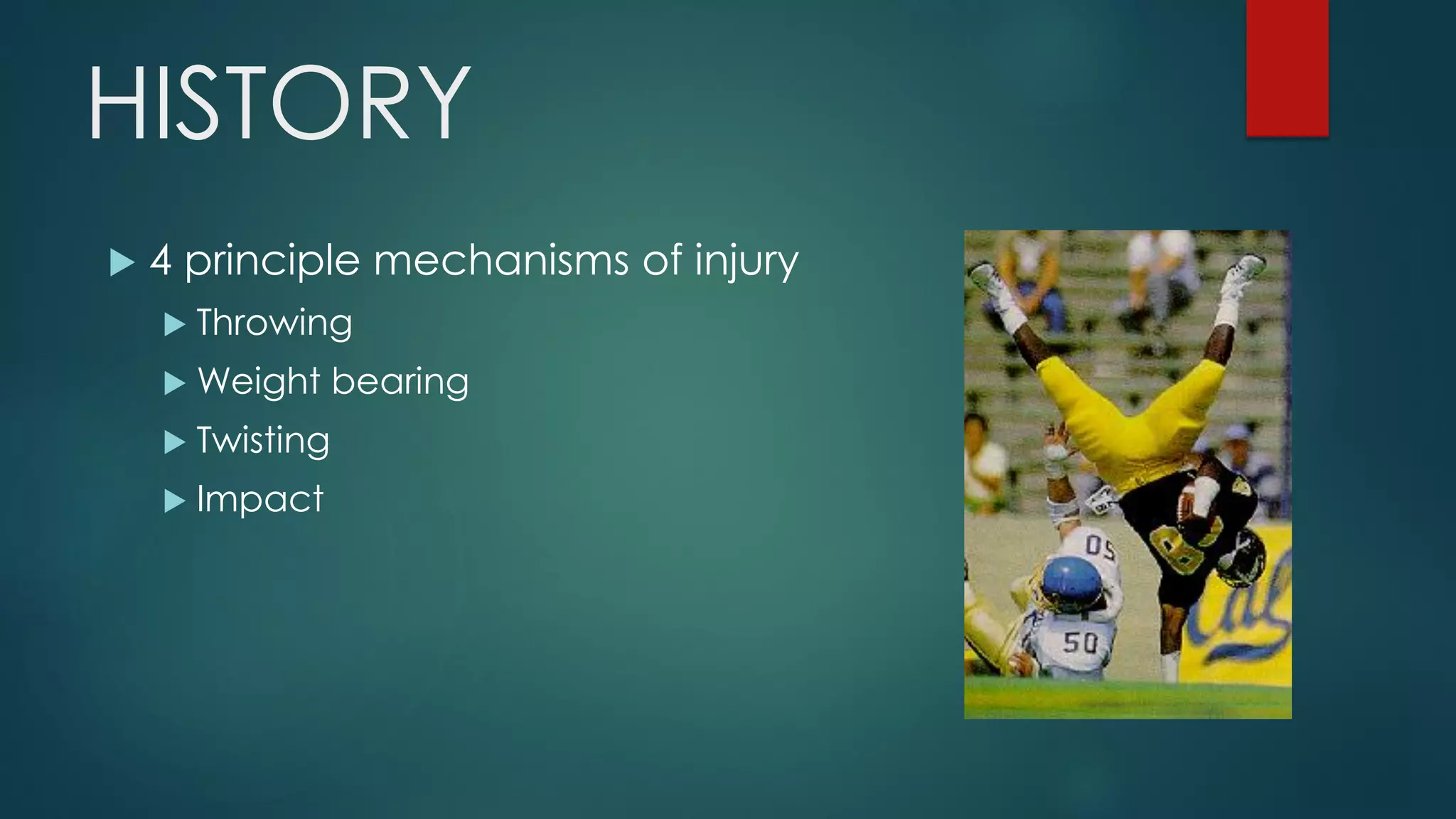
 4 principle mechanisms of injury
 Throwing
 Weight bearing
 Twisting
 Impact
COMPLAINTS
PAIN
STIFFNESSSWELLING
DEFORMITY
WEAKNESS INSTABILITY
PARASTHESIA LOSS OF FUNCTION
PAIN
Site Time and mode of onset
Severity or Intensity Character or Nature
Progression Referred pain
Aggravating factors Relieving factors
Any diurnal variation Any seasonal variation
PAIN
 The extent of reference is governed by a number of factors.
 The depth of the structure beneath the skin.
 The position of the structure within the dermatome.
 The severity of the lesion
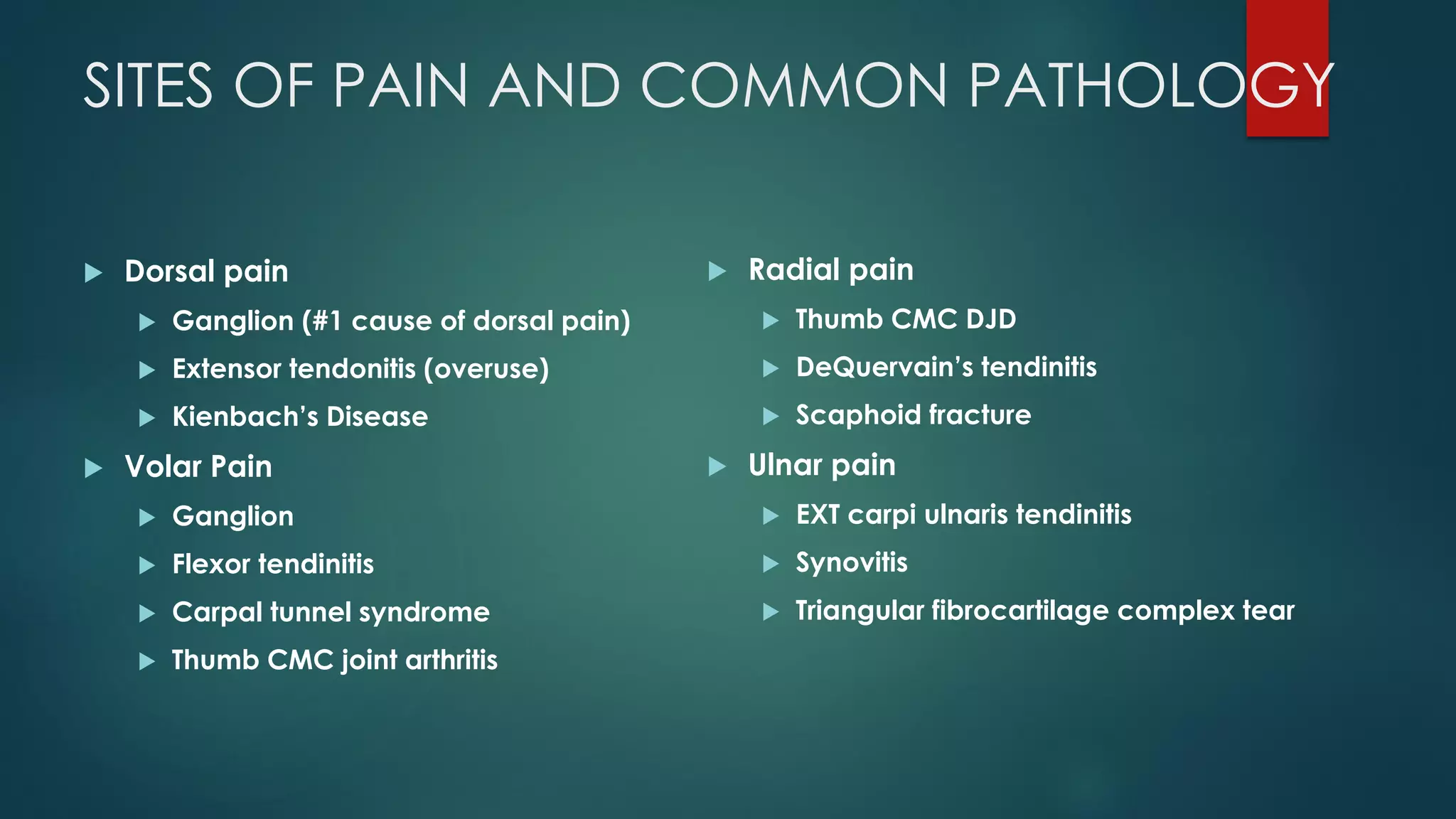
SITES OF PAIN AND COMMON PATHOLOGY
 Dorsal pain
 Ganglion (#1 cause of dorsal pain)
 Extensor tendonitis (overuse)
 Kienbach’s Disease
 Volar Pain
 Ganglion
 Flexor tendinitis
 Carpal tunnel syndrome
 Thumb CMC joint arthritis
 Radial pain
 Thumb CMC DJD
 DeQuervain’s tendinitis
 Scaphoid fracture
 Ulnar pain
 EXT carpi ulnaris tendinitis
 Synovitis
 Triangular fibrocartilage complex tear
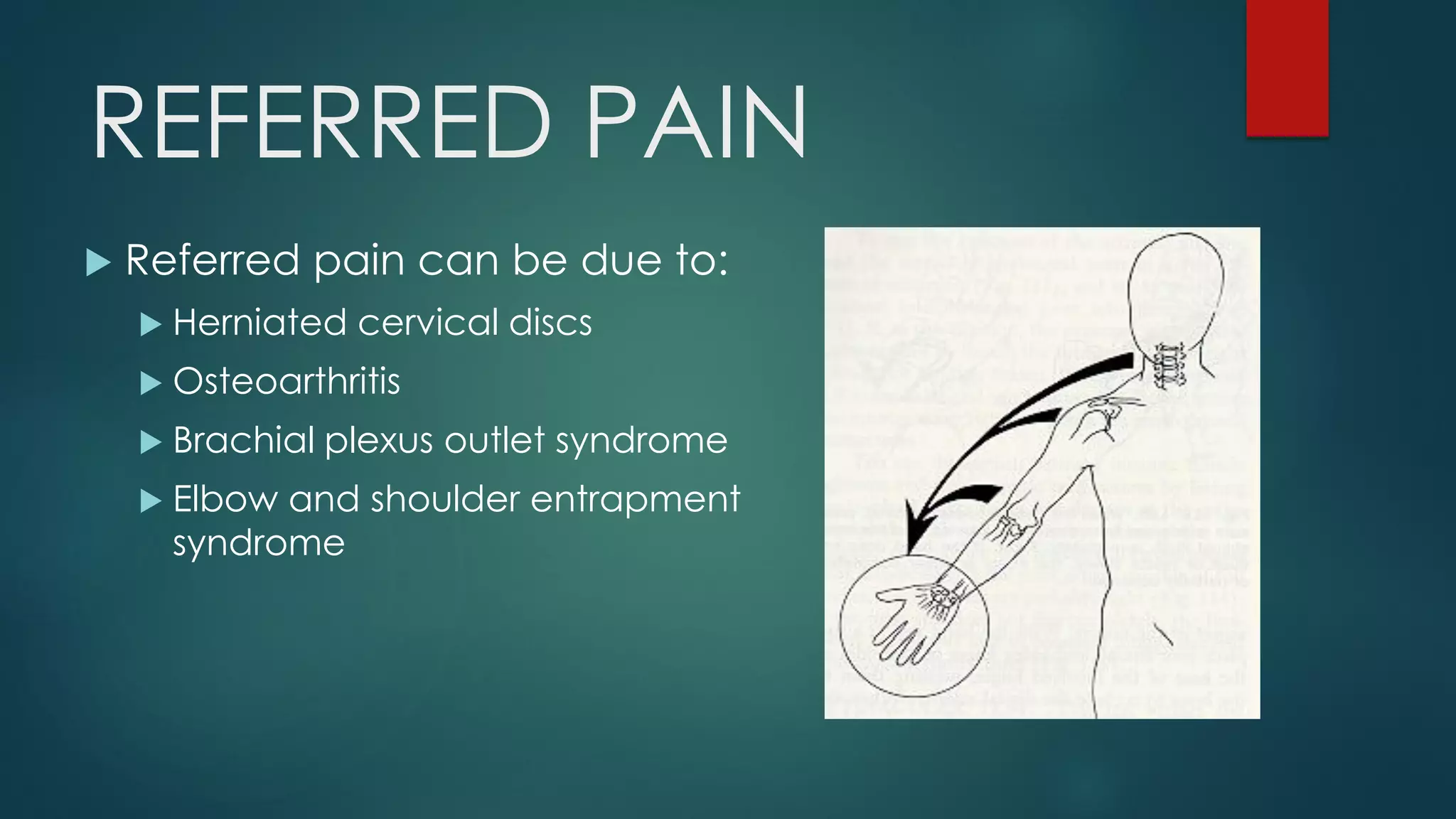
REFERRED PAIN
 Referred pain can be due to:
 Herniated cervical discs
 Osteoarthritis
 Brachial plexus outlet syndrome
 Elbow and shoulder entrapment
syndrome
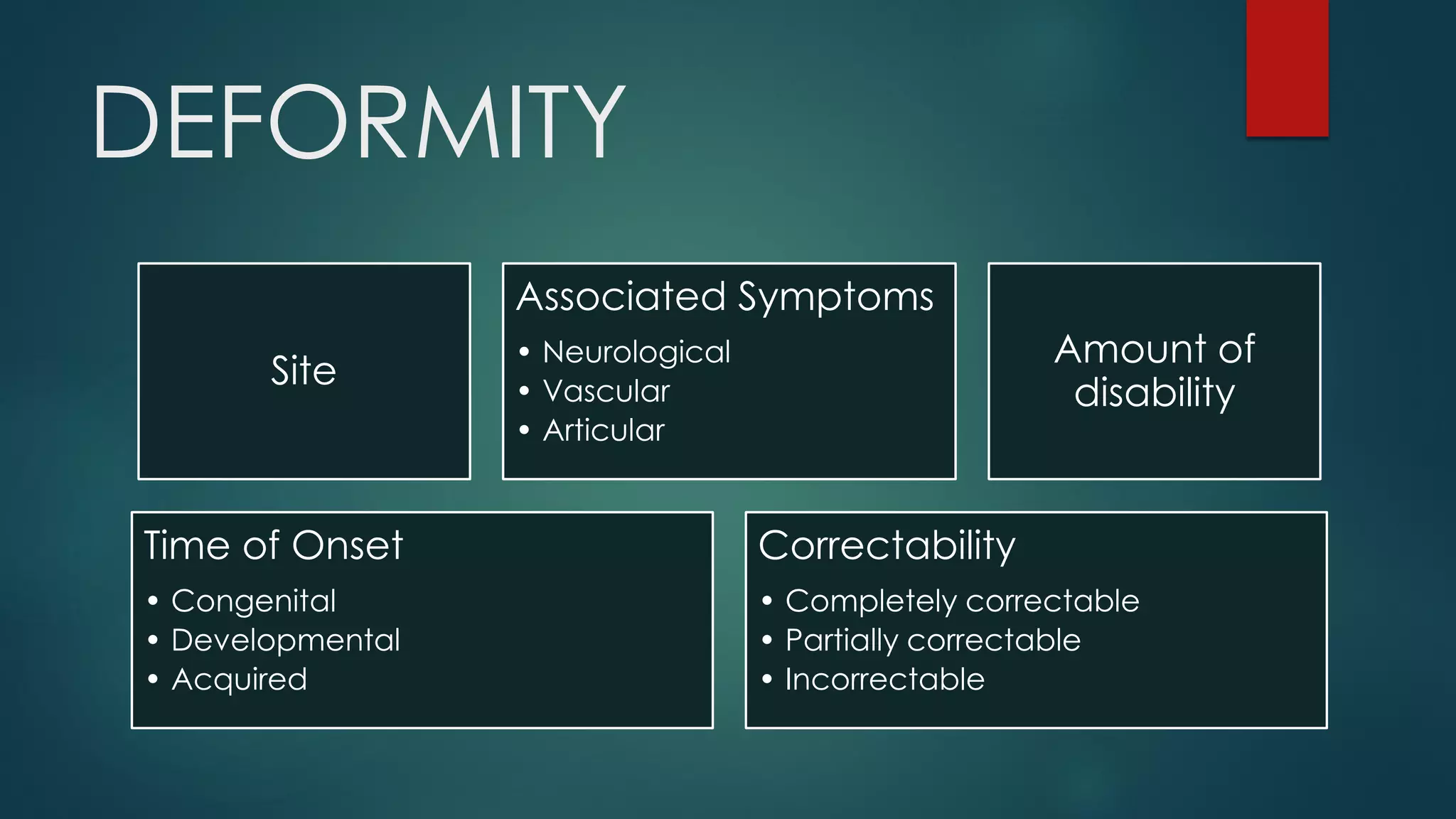
DEFORMITY
Site
Associated Symptoms
• Neurological
• Vascular
• Articular
Amount of
disability
Time of Onset
• Congenital
• Developmental
• Acquired
Correctability
• Completely correctable
• Partially correctable
• Incorrectable
STIFFNESS
Generalised Localised
Locking Ankylosis
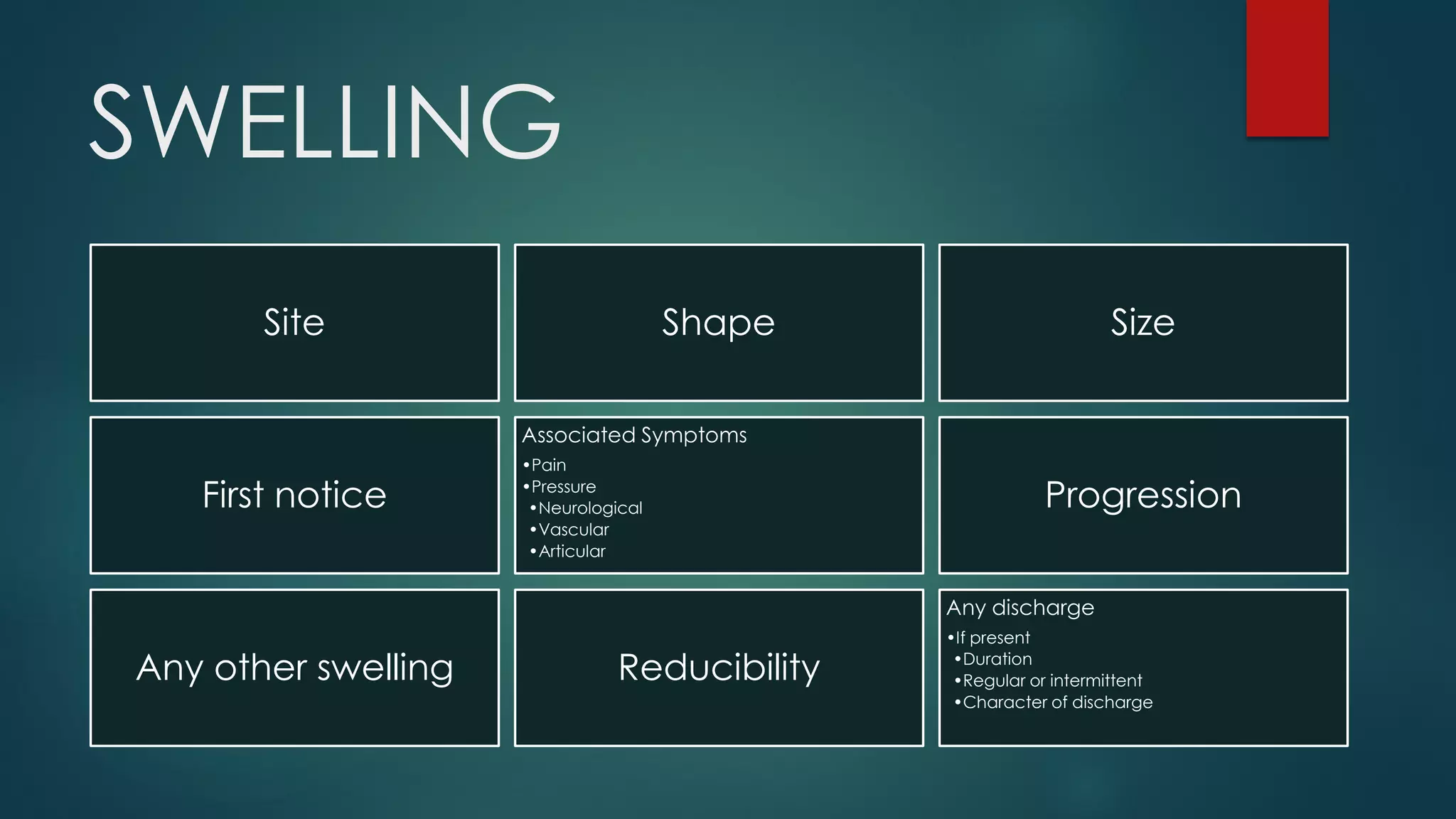
SWELLING
Site Shape Size
First notice
Associated Symptoms
•Pain
•Pressure
•Neurological
•Vascular
•Articular
Progression
Any other swelling Reducibility
Any discharge
•If present
•Duration
•Regular or intermittent
•Character of discharge
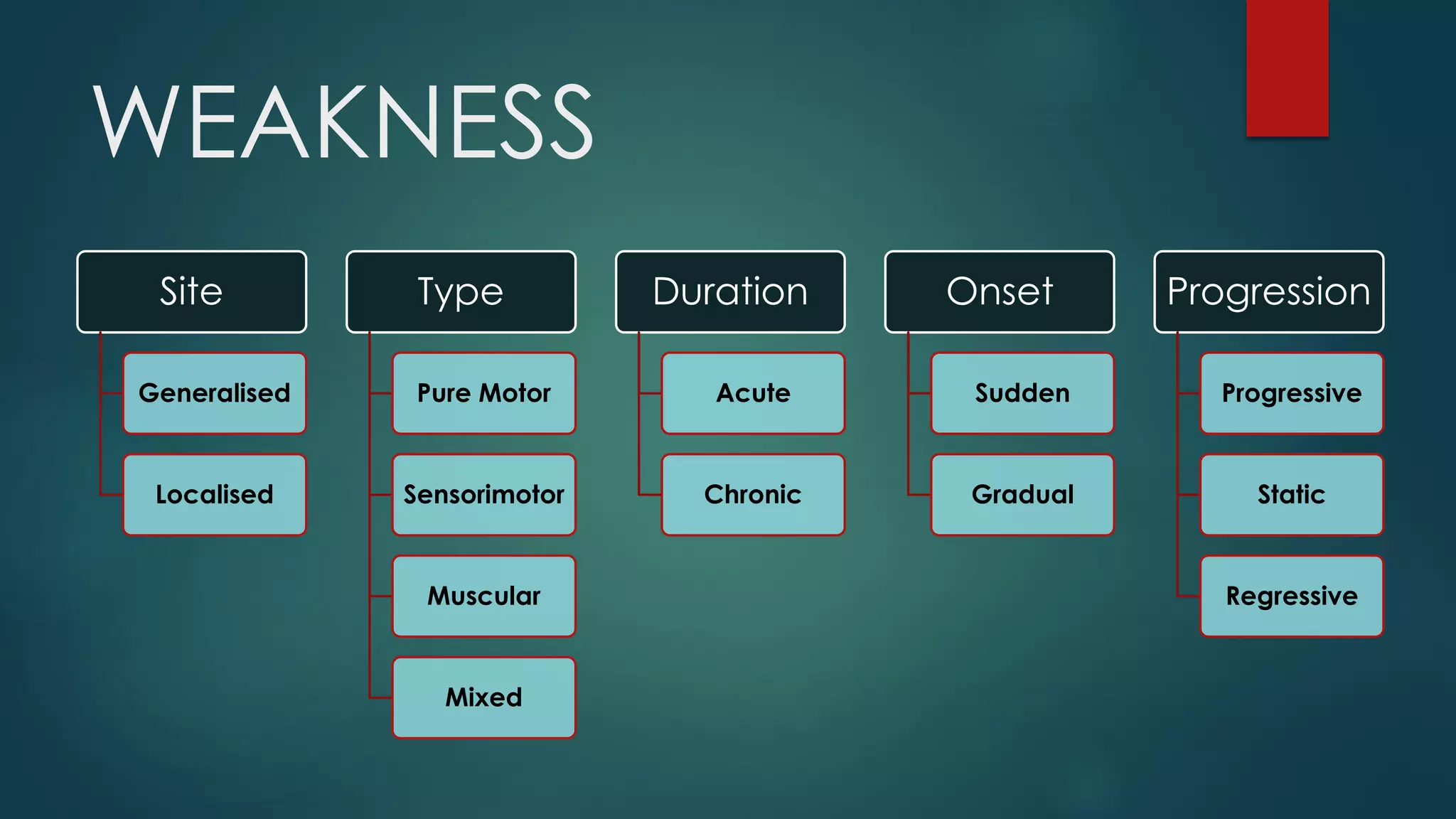
WEAKNESS
Site
Generalised
Localised
Type
Pure Motor
Sensorimotor
Muscular
Mixed
Duration
Acute
Chronic
Onset
Sudden
Gradual
Progression
Progressive
Static
Regressive
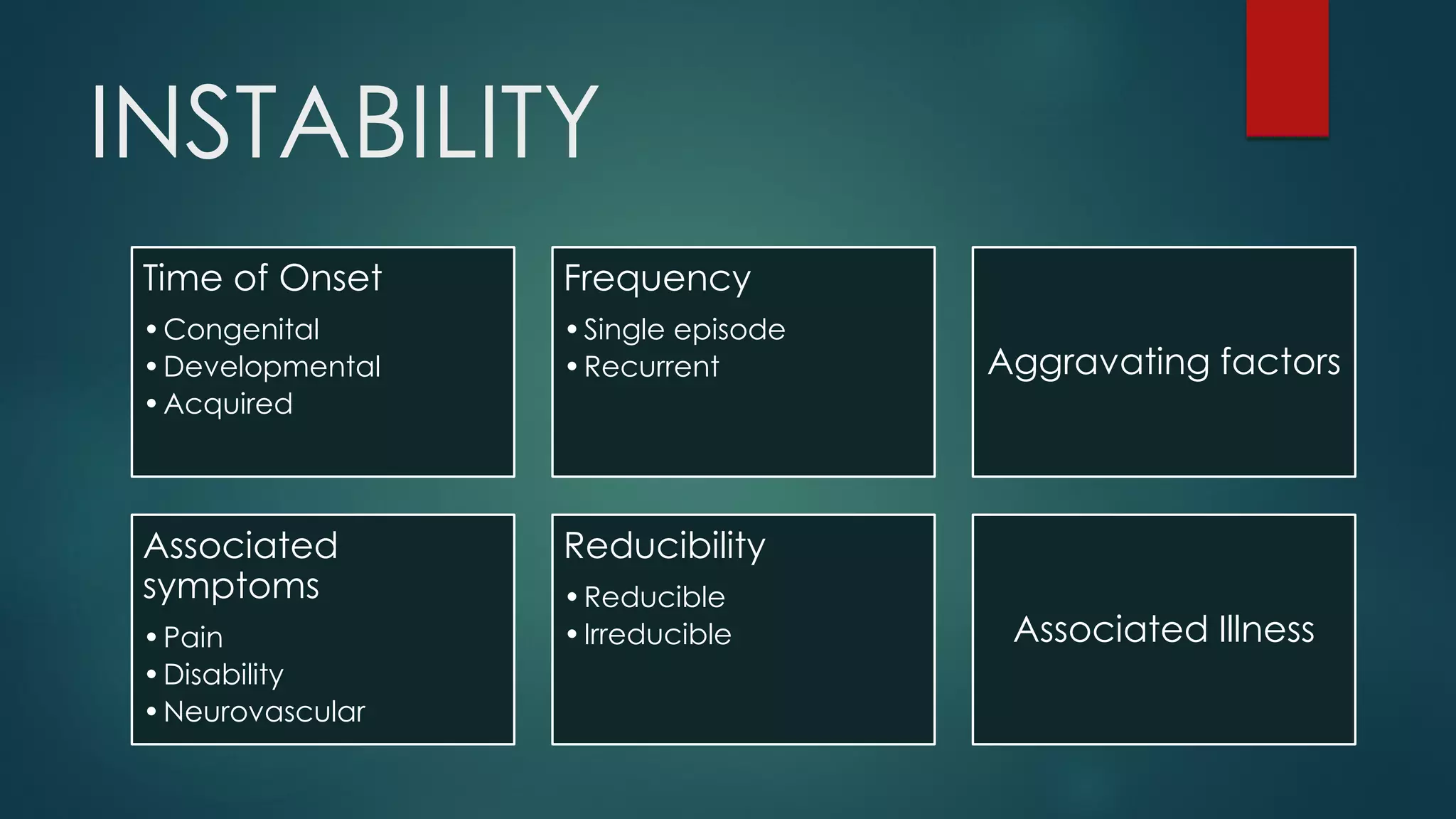
INSTABILITY
Time of Onset
•Congenital
•Developmental
•Acquired
Frequency
•Single episode
•Recurrent Aggravating factors
Associated
symptoms
•Pain
•Disability
•Neurovascular
Reducibility
•Reducible
•Irreducible Associated Illness
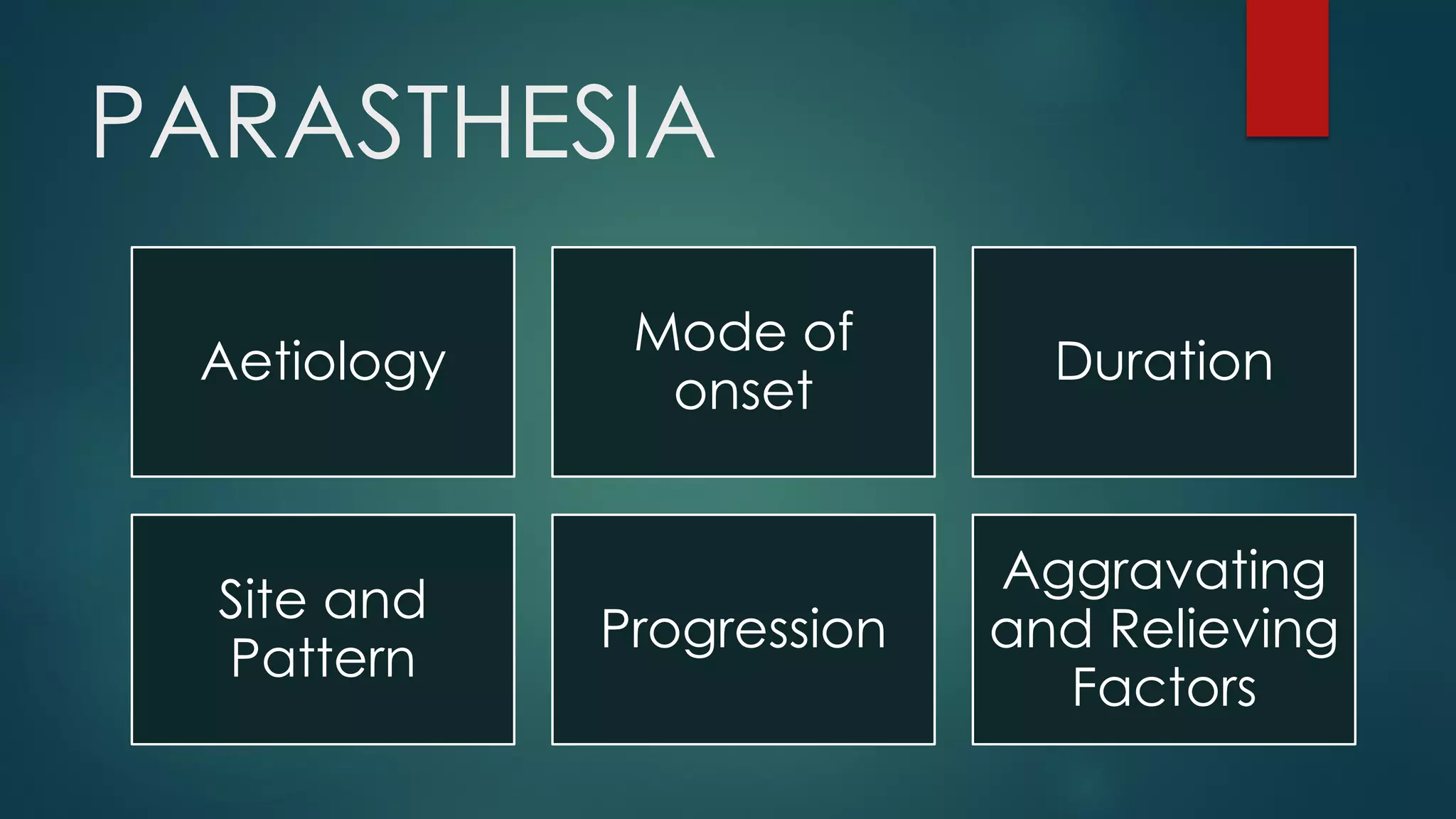
PARASTHESIA
Aetiology
Mode of
onset
Duration
Site and
Pattern
Progression
Aggravating
and Relieving
Factors
LOSS OF FUNCTION
Mode of onset
• Sudden
• Gradual
Duration
• Congenital
• Chronic
• Acute
Involved region
and function(s)
Progression
Associated
features
DIFFERENTIAL DIAGNOSIS
1. _ _ _ _ _ _ _ _ _ _ _ _ _ _ _ _ _ _ _ _ _ _ _ _
2. _ _ _ _ _ _ _ _ _ _ _ _ _ _ _ _ _ _ _ _ _ _ _ _
3. _ _ _ _ _ _ _ _ _ _ _ _ _ _ _ _ _ _ _ _ _ _ _ _
4. _ _ _ _ _ _ _ _ _ _ _ _ _ _ _ _ _ _ _ _ _ _ _ _
5. _ _ _ _ _ _ _ _ _ _ _ _ _ _ _ _ _ _ _ _ _ _ _ _
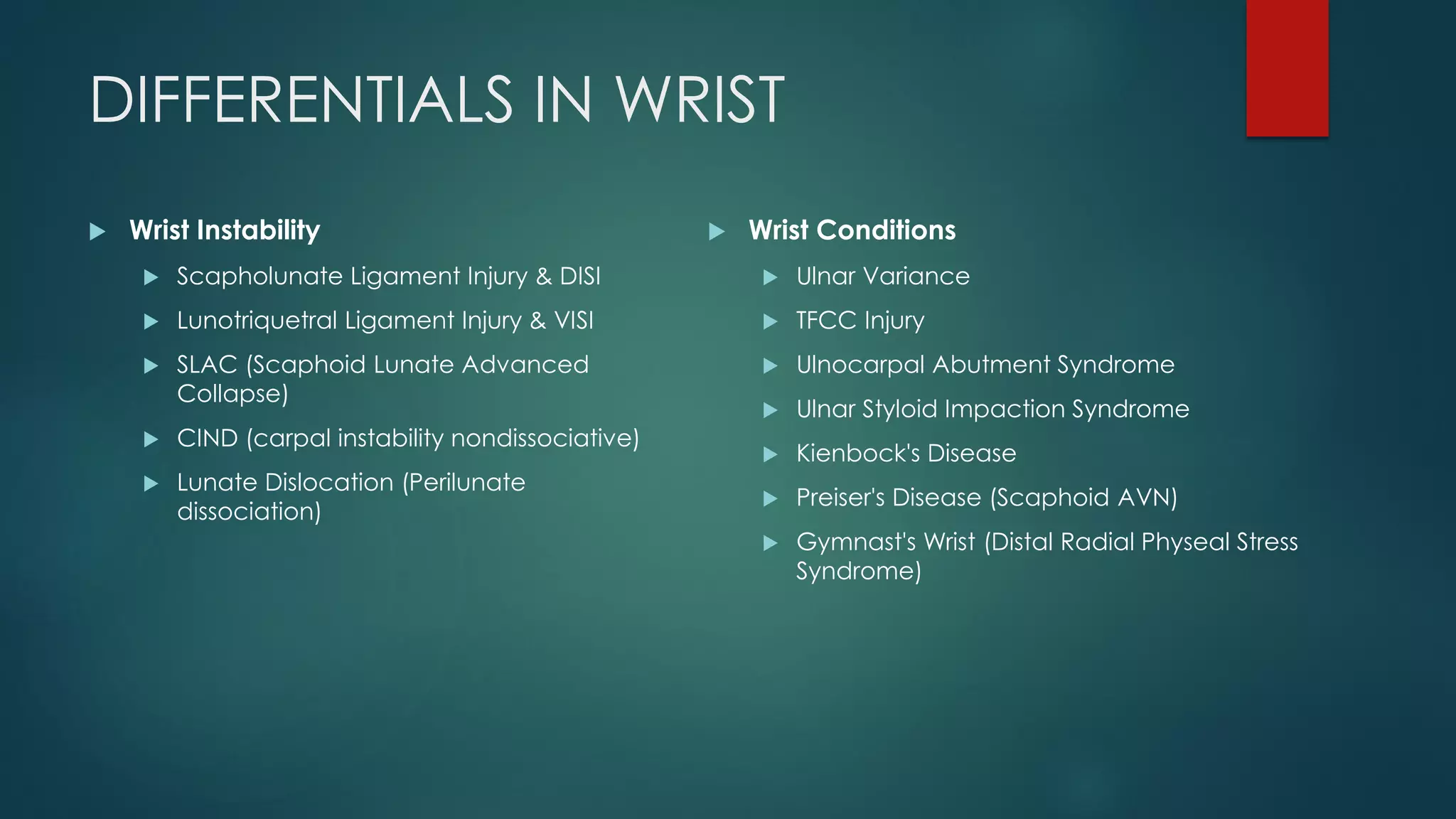
DIFFERENTIALS IN WRIST
 Wrist Instability
 Scapholunate Ligament Injury & DISI
 Lunotriquetral Ligament Injury & VISI
 SLAC (Scaphoid Lunate Advanced
Collapse)
 CIND (carpal instability nondissociative)
 Lunate Dislocation (Perilunate
dissociation)
 Wrist Conditions
 Ulnar Variance
 TFCC Injury
 Ulnocarpal Abutment Syndrome
 Ulnar Styloid Impaction Syndrome
 Kienbock's Disease
 Preiser's Disease (Scaphoid AVN)
 Gymnast's Wrist (Distal Radial Physeal Stress
Syndrome)
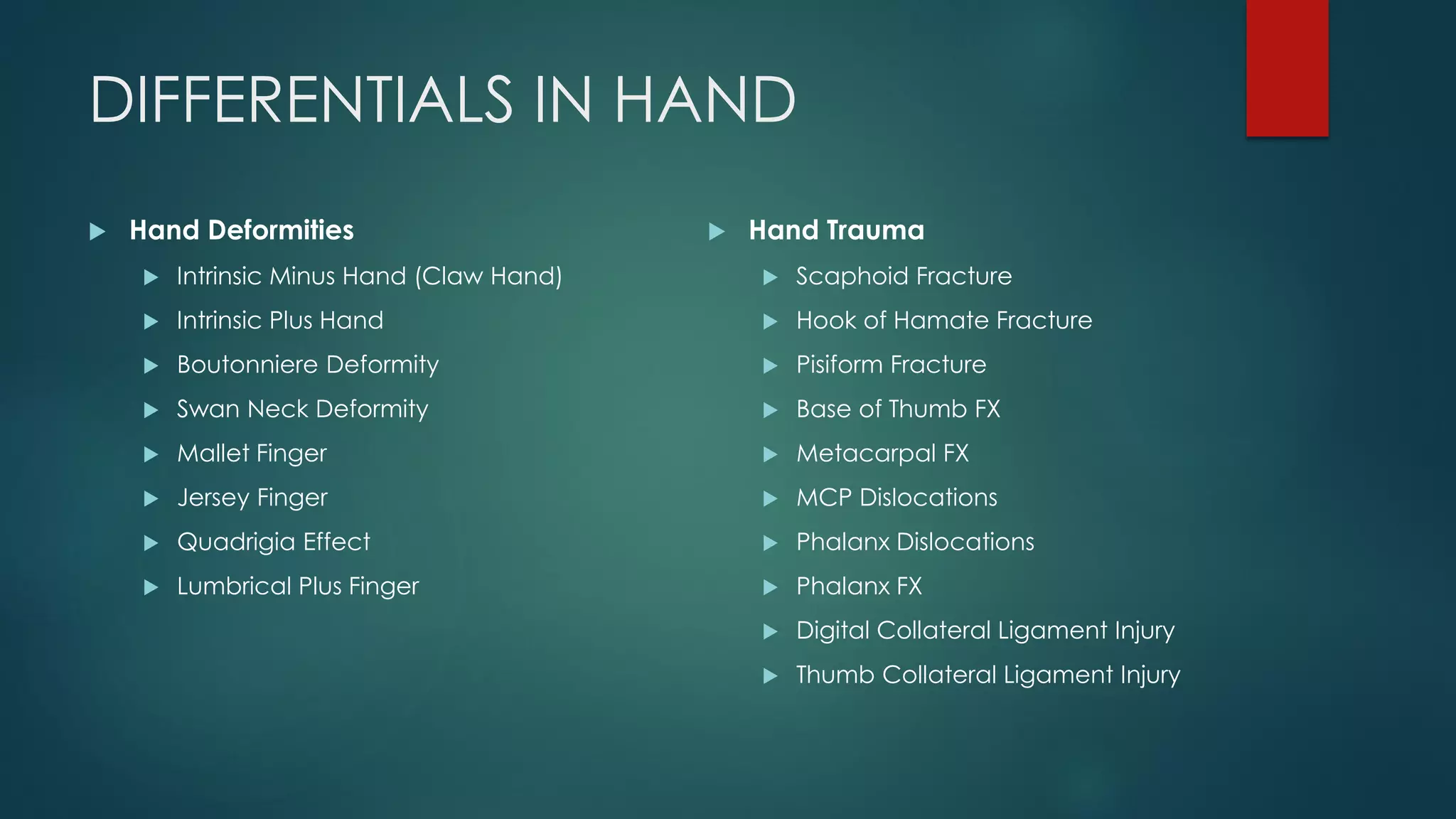
DIFFERENTIALS IN HAND
 Hand Deformities
 Intrinsic Minus Hand (Claw Hand)
 Intrinsic Plus Hand
 Boutonniere Deformity
 Swan Neck Deformity
 Mallet Finger
 Jersey Finger
 Quadrigia Effect
 Lumbrical Plus Finger
 Hand Trauma
 Scaphoid Fracture
 Hook of Hamate Fracture
 Pisiform Fracture
 Base of Thumb FX
 Metacarpal FX
 MCP Dislocations
 Phalanx Dislocations
 Phalanx FX
 Digital Collateral Ligament Injury
 Thumb Collateral Ligament Injury
DIFFERENTIALS IN HAND
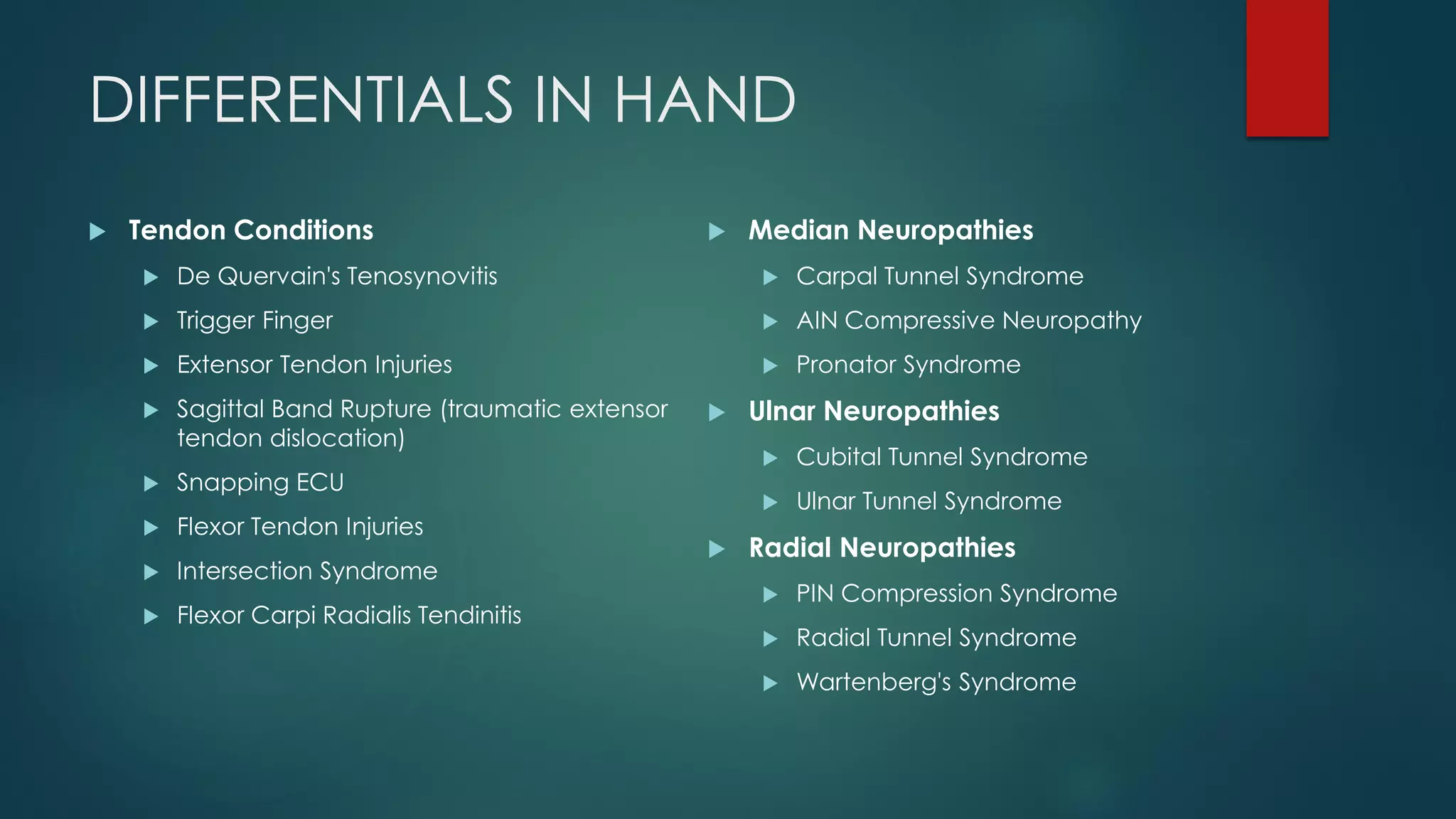
 Tendon Conditions
 De Quervain's Tenosynovitis
 Trigger Finger
 Extensor Tendon Injuries
 Sagittal Band Rupture (traumatic extensor
tendon dislocation)
 Snapping ECU
 Flexor Tendon Injuries
 Intersection Syndrome
 Flexor Carpi Radialis Tendinitis
 Median Neuropathies
 Carpal Tunnel Syndrome
 AIN Compressive Neuropathy
 Pronator Syndrome
 Ulnar Neuropathies
 Cubital Tunnel Syndrome
 Ulnar Tunnel Syndrome
 Radial Neuropathies
 PIN Compression Syndrome
 Radial Tunnel Syndrome
 Wartenberg's Syndrome
DIFFERENTIALS IN HAND
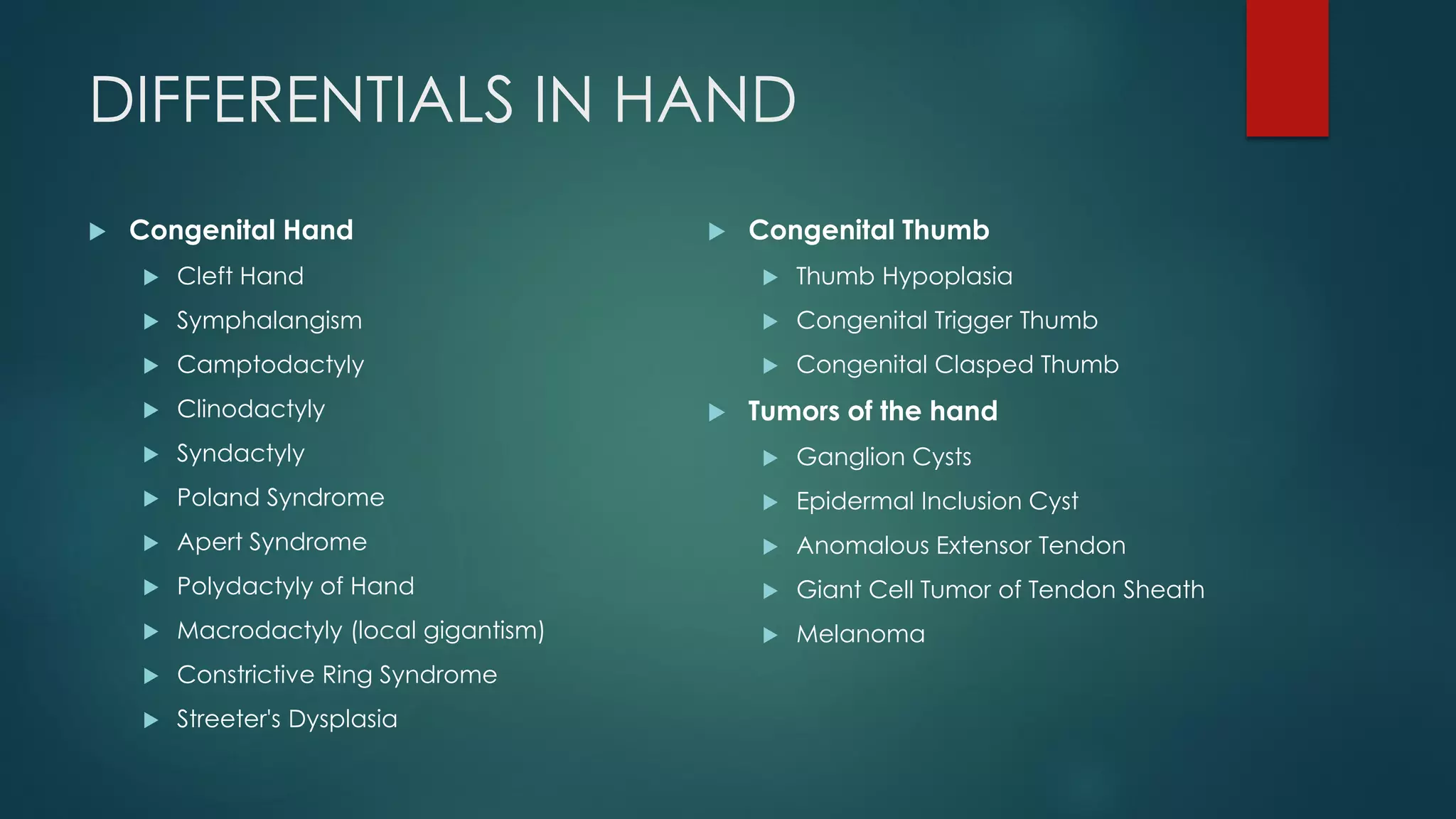
 Congenital Hand
 Cleft Hand
 Symphalangism
 Camptodactyly
 Clinodactyly
 Syndactyly
 Poland Syndrome
 Apert Syndrome
 Polydactyly of Hand
 Macrodactyly (local gigantism)
 Constrictive Ring Syndrome
 Streeter's Dysplasia
 Congenital Thumb
 Thumb Hypoplasia
 Congenital Trigger Thumb
 Congenital Clasped Thumb
 Tumors of the hand
 Ganglion Cysts
 Epidermal Inclusion Cyst
 Anomalous Extensor Tendon
 Giant Cell Tumor of Tendon Sheath
 Melanoma
OTHER DIFFERENTIALS IN WRIST AND HAND
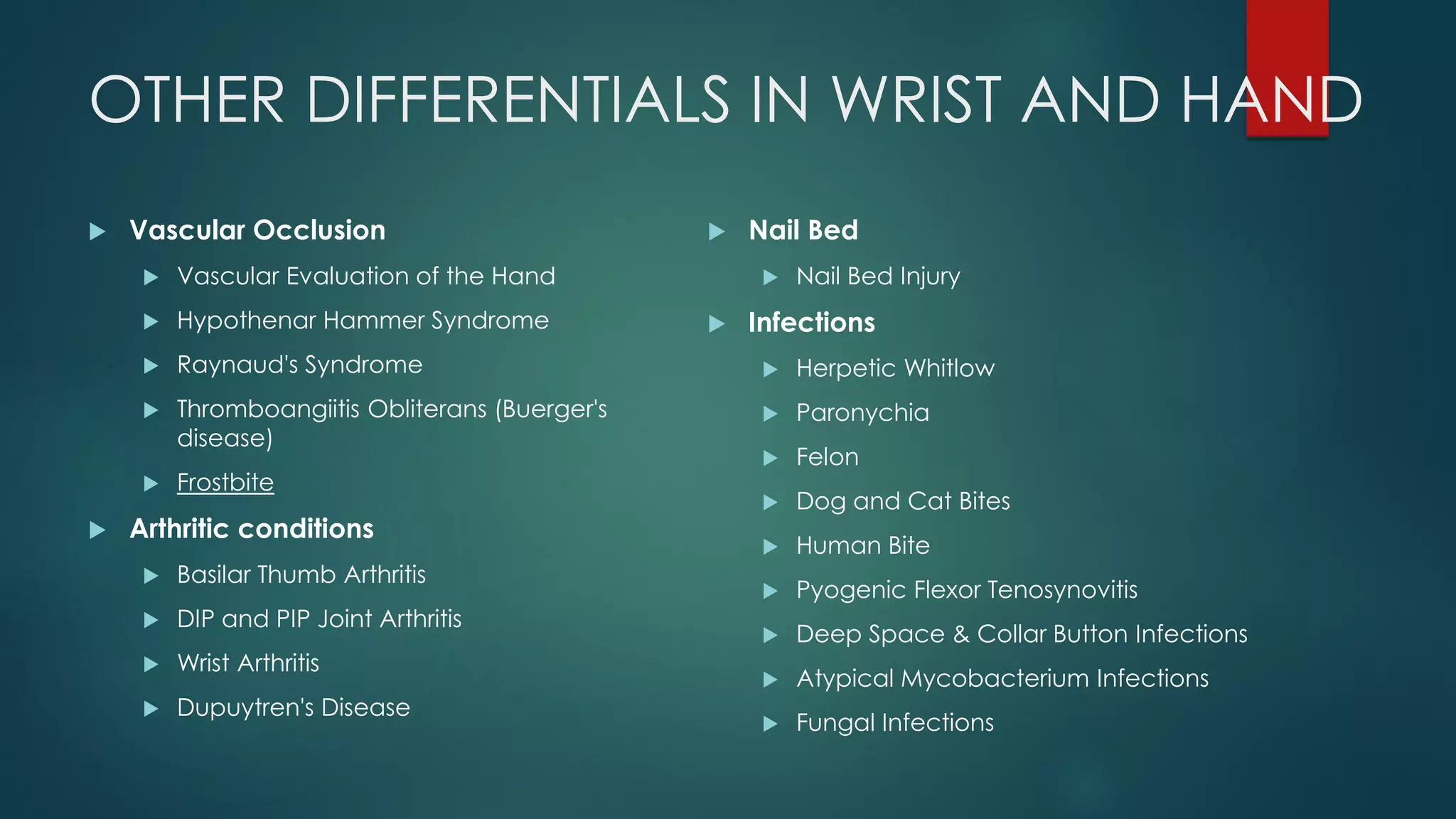
 Vascular Occlusion
 Vascular Evaluation of the Hand
 Hypothenar Hammer Syndrome
 Raynaud's Syndrome
 Thromboangiitis Obliterans (Buerger's
disease)
 Frostbite
 Arthritic conditions
 Basilar Thumb Arthritis
 DIP and PIP Joint Arthritis
 Wrist Arthritis
 Dupuytren's Disease
 Nail Bed
 Nail Bed Injury
 Infections
 Herpetic Whitlow
 Paronychia
 Felon
 Dog and Cat Bites
 Human Bite
 Pyogenic Flexor Tenosynovitis
 Deep Space & Collar Button Infections
 Atypical Mycobacterium Infections
 Fungal Infections
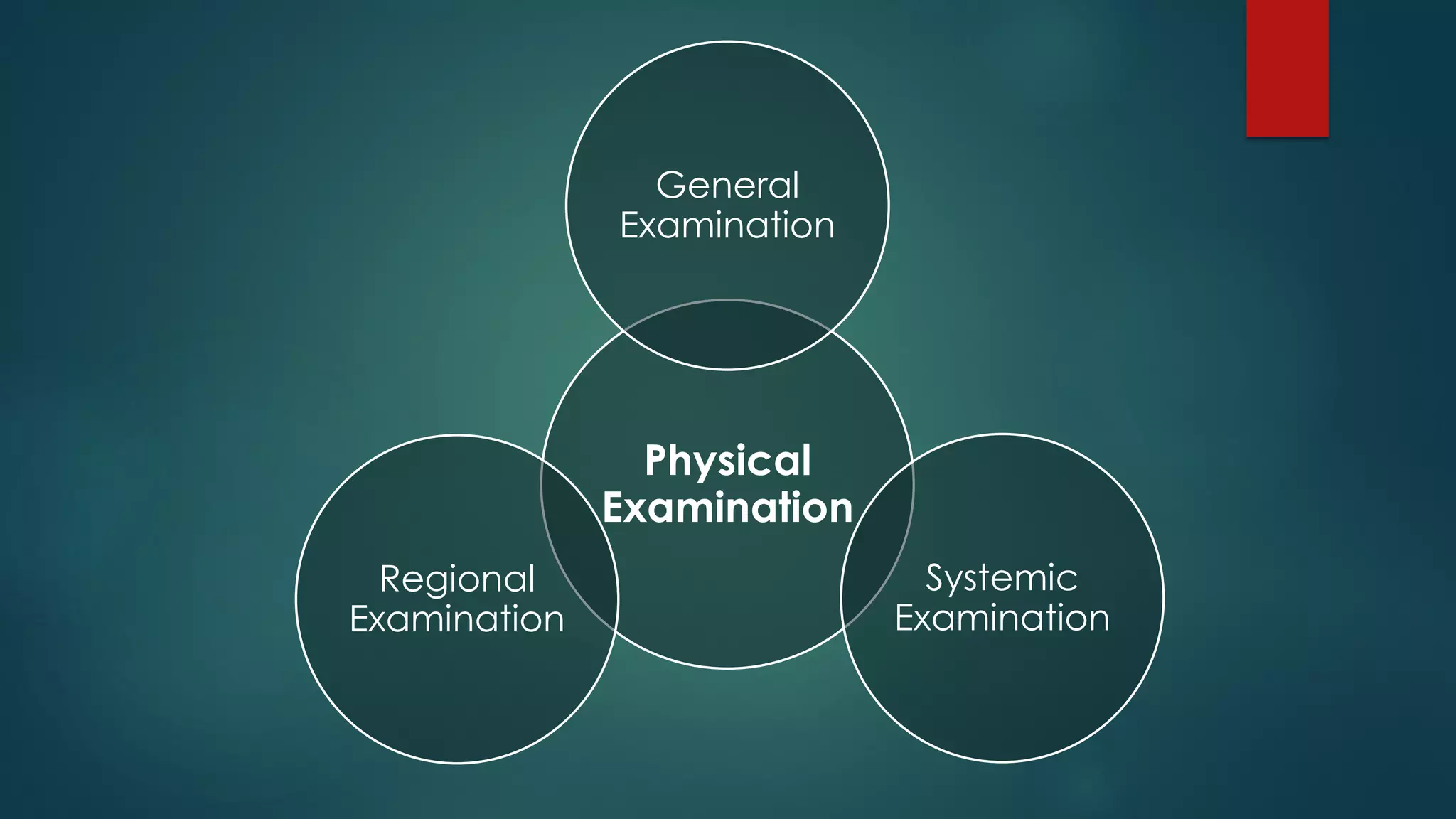
Physical
Examination
General
Examination
Systemic
Examination
Regional
Examination
PHYSICAL EXAM - GENERAL
 Develop a standard routine
 Alleviate the patient's fears
 Adequate exposure - bilateral
 Compare both sides
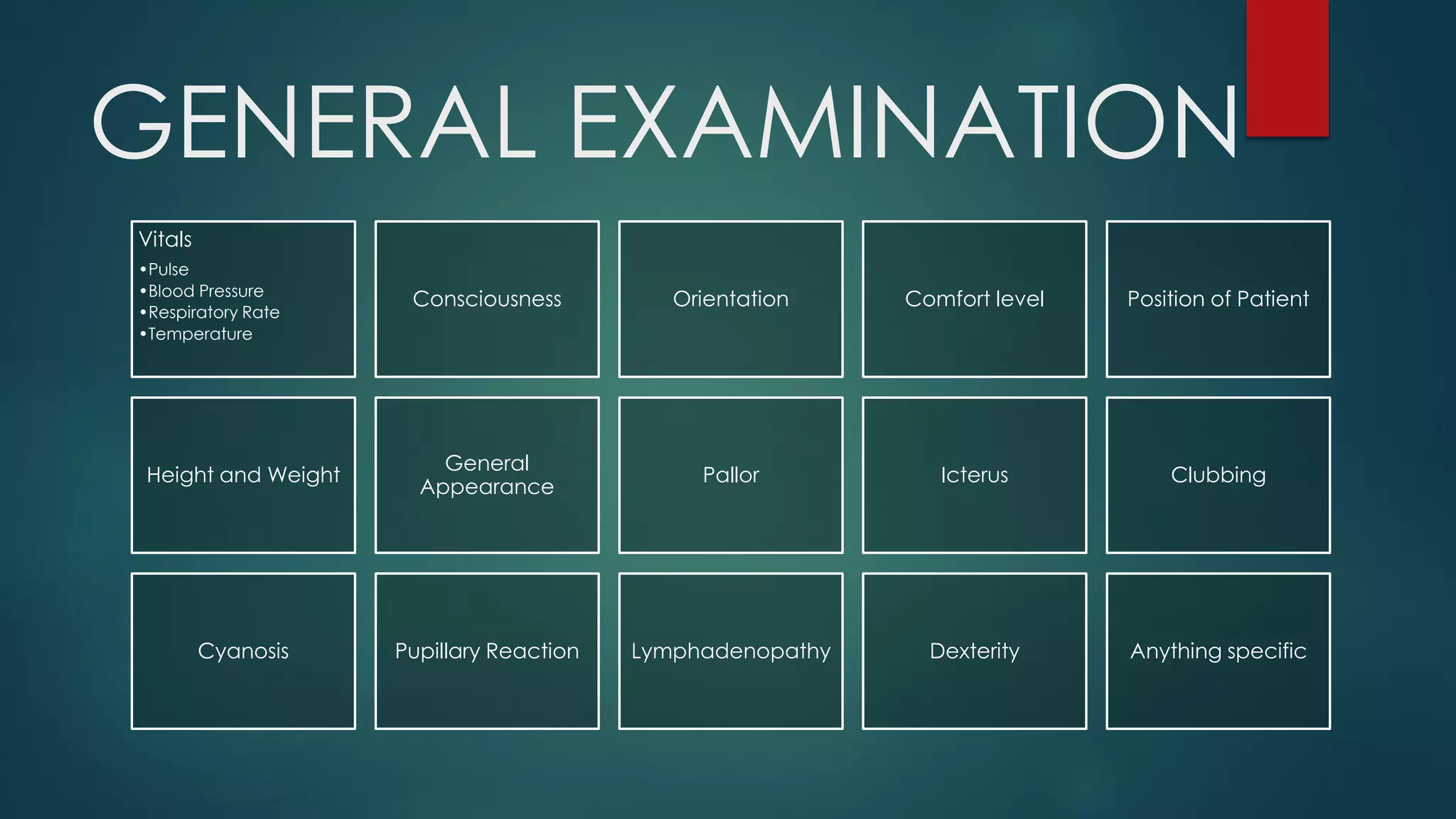
GENERAL EXAMINATION
Vitals
•Pulse
•Blood Pressure
•Respiratory Rate
•Temperature
Consciousness Orientation Comfort level Position of Patient
Height and Weight
General
Appearance
Pallor Icterus Clubbing
Cyanosis Pupillary Reaction Lymphadenopathy Dexterity Anything specific
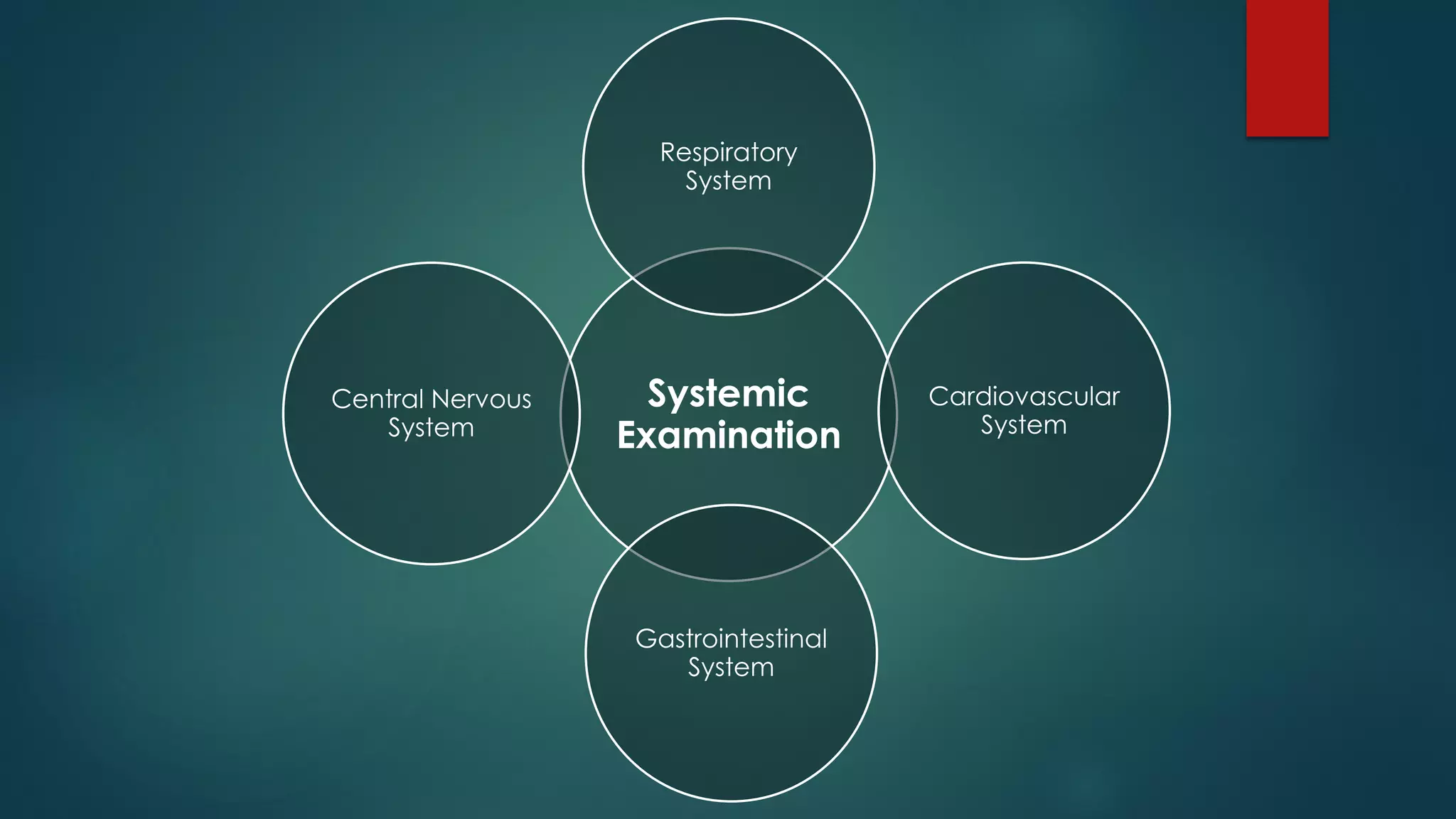
Systemic
Examination
Respiratory
System
Cardiovascular
System
Gastrointestinal
System
Central Nervous
System
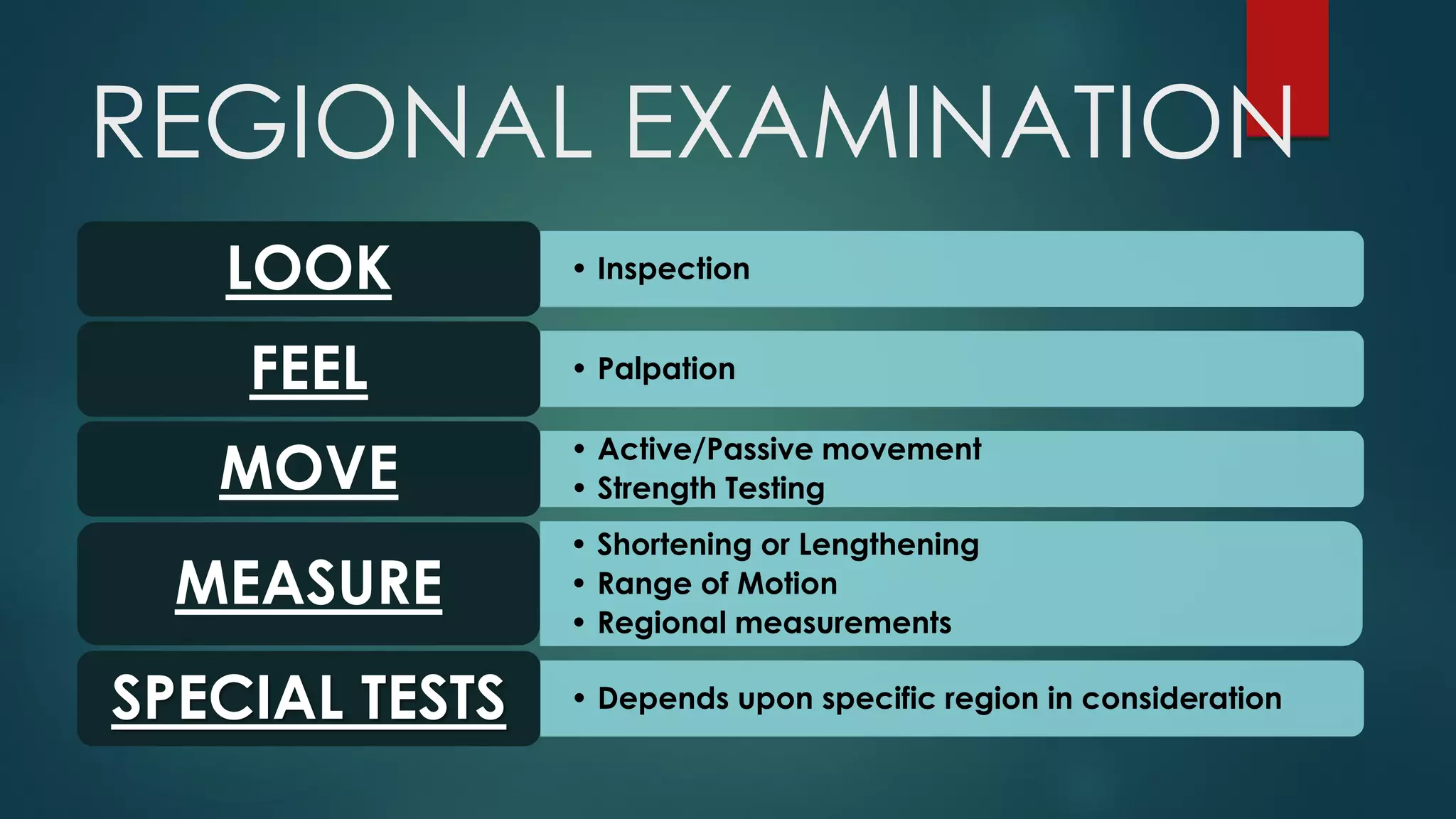
REGIONAL EXAMINATION
• InspectionLOOK
• PalpationFEEL
• Active/Passive movement
• Strength TestingMOVE
• Shortening or Lengthening
• Range of Motion
• Regional measurements
MEASURE
• Depends upon specific region in considerationSPECIAL TESTS
INSPECTION
 Observe upper extremity as patient enters room
 Examine hand in function
 Deformities
 Attitude of the hand
INSPECTION
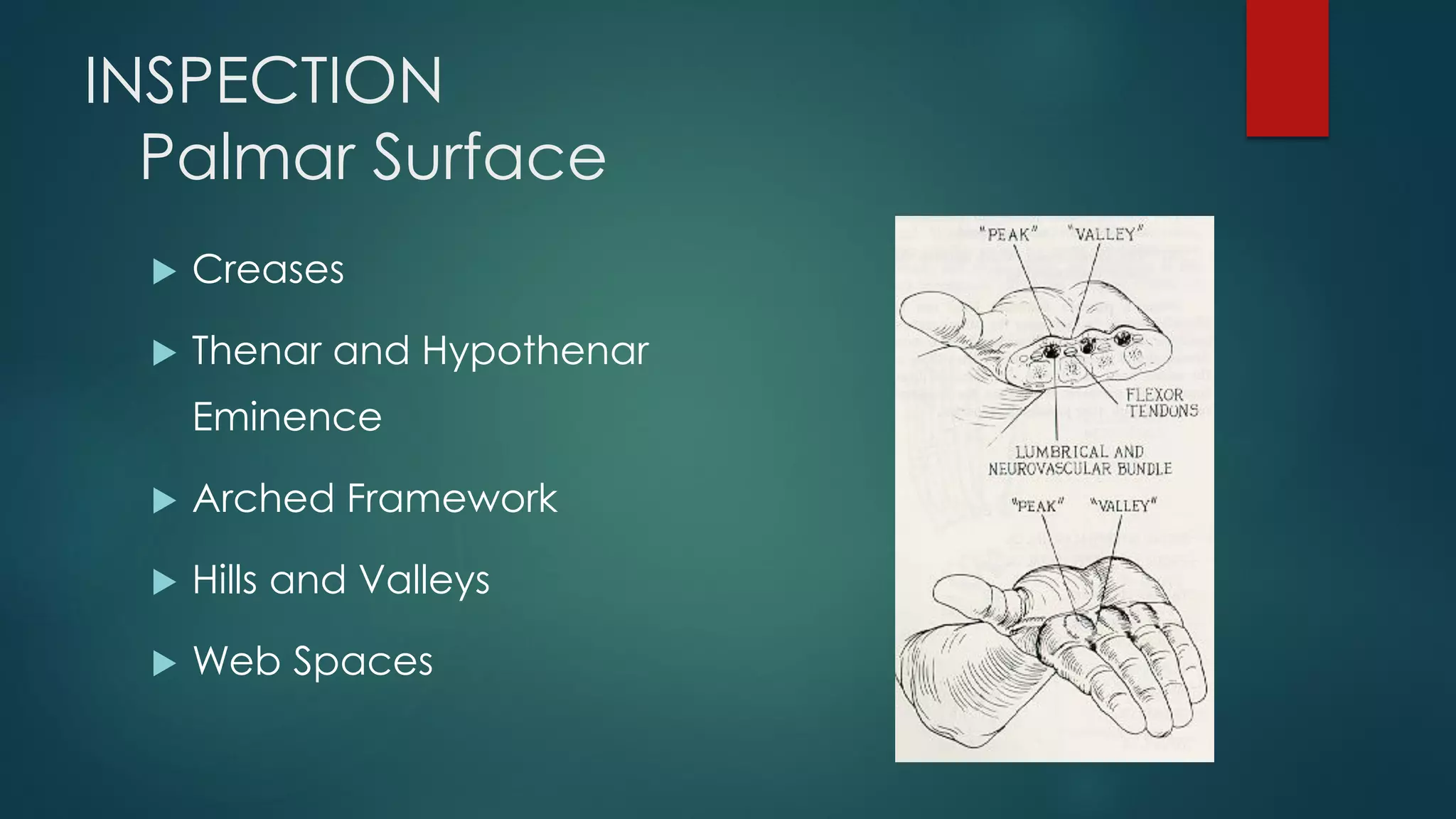
Palmar Surface
 Creases
 Thenar and Hypothenar
Eminence
 Arched Framework
 Hills and Valleys
 Web Spaces
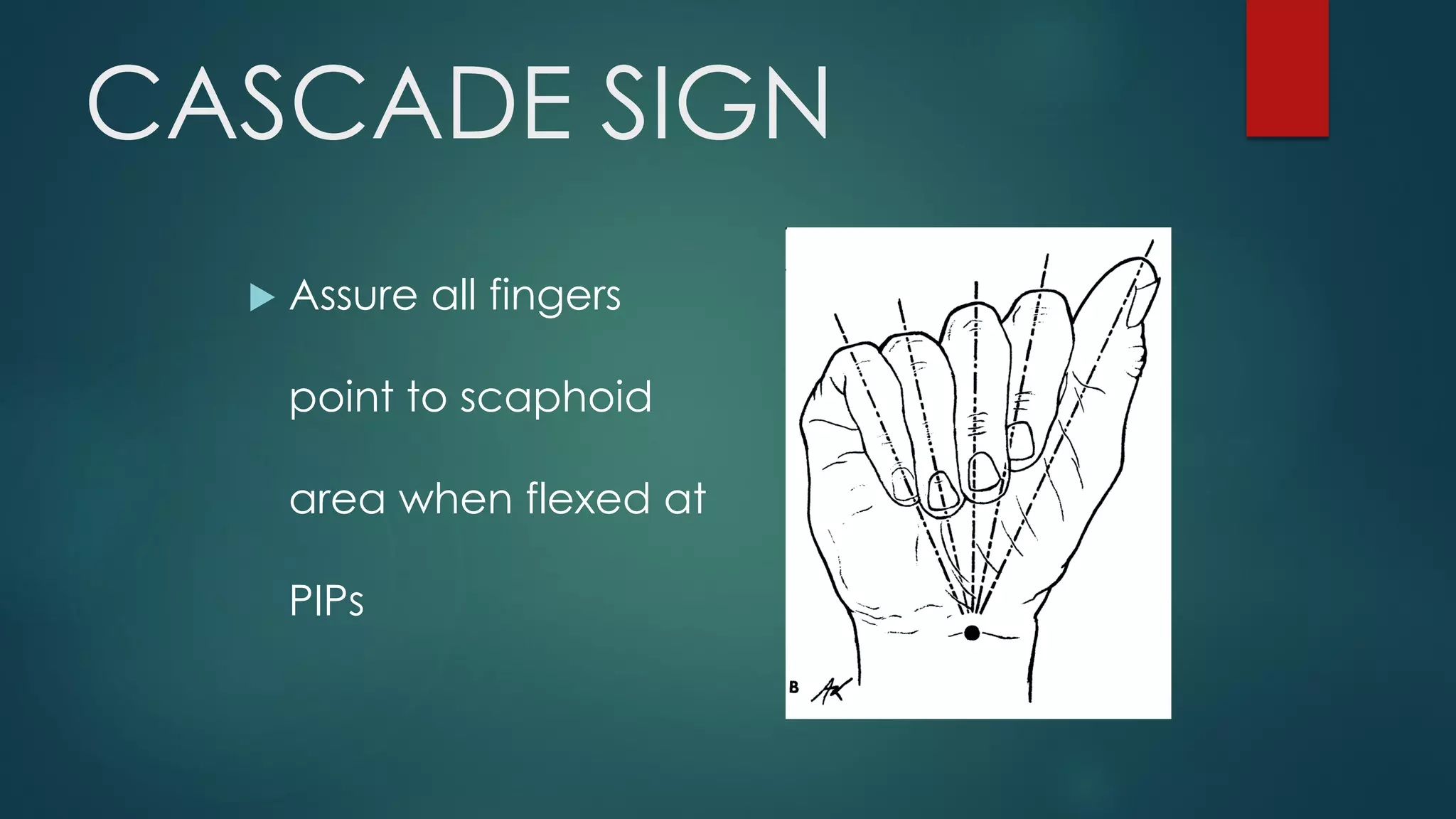
CASCADE SIGN
 Assure all fingers
point to scaphoid
area when flexed at
PIPs
INSPECTION OF DORSAL HAND AND WRIST
 Hills and Valleys
 Height of metacarpal heads
 Finger nails
 Pale or white=anemia or circulatory
 Spoon shaped=fungal infection
 Clubbed=respiratory or congenital heart
 Deformities
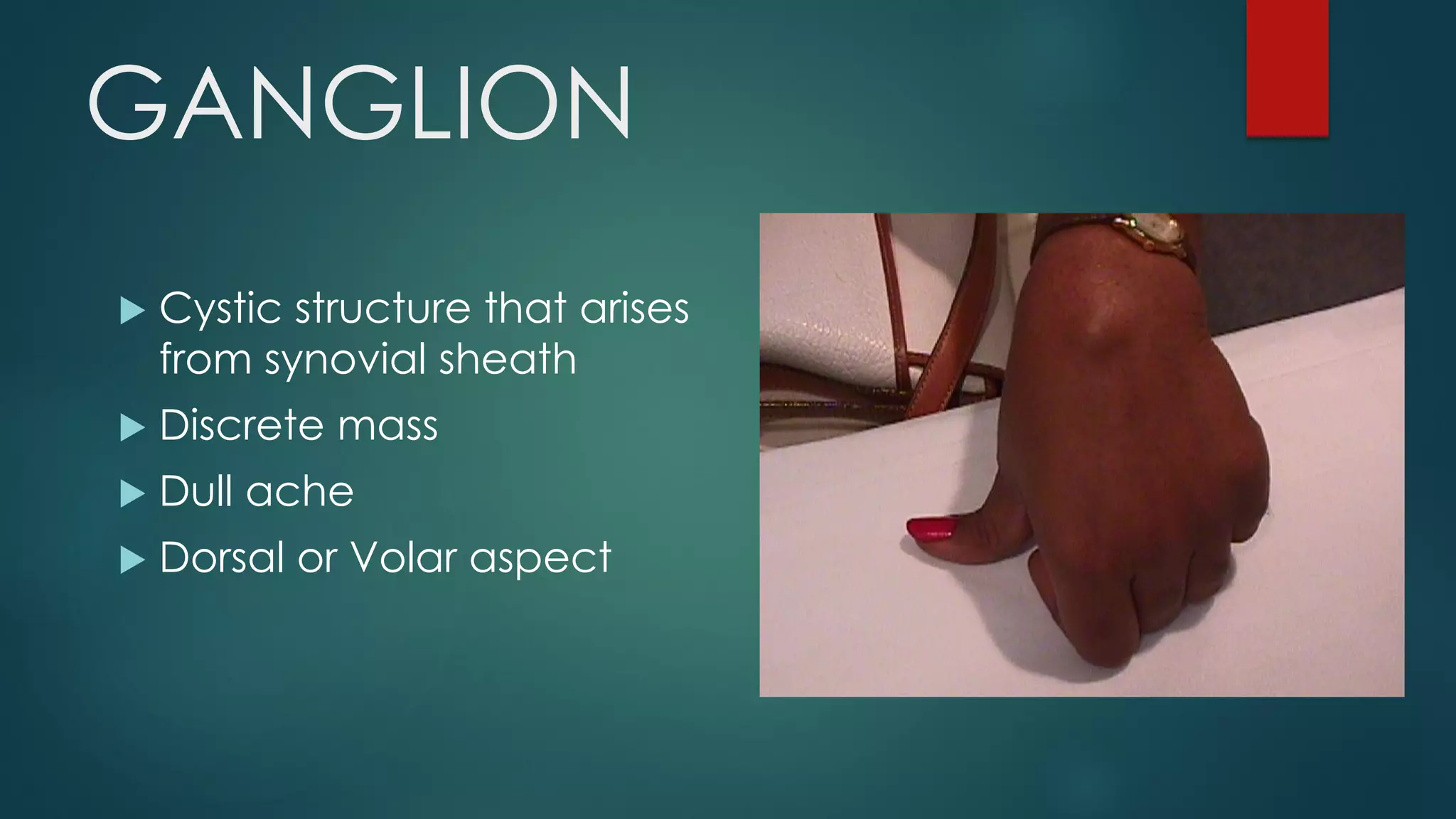
GANGLION
 Cystic structure that arises
from synovial sheath
 Discrete mass
 Dull ache
 Dorsal or Volar aspect
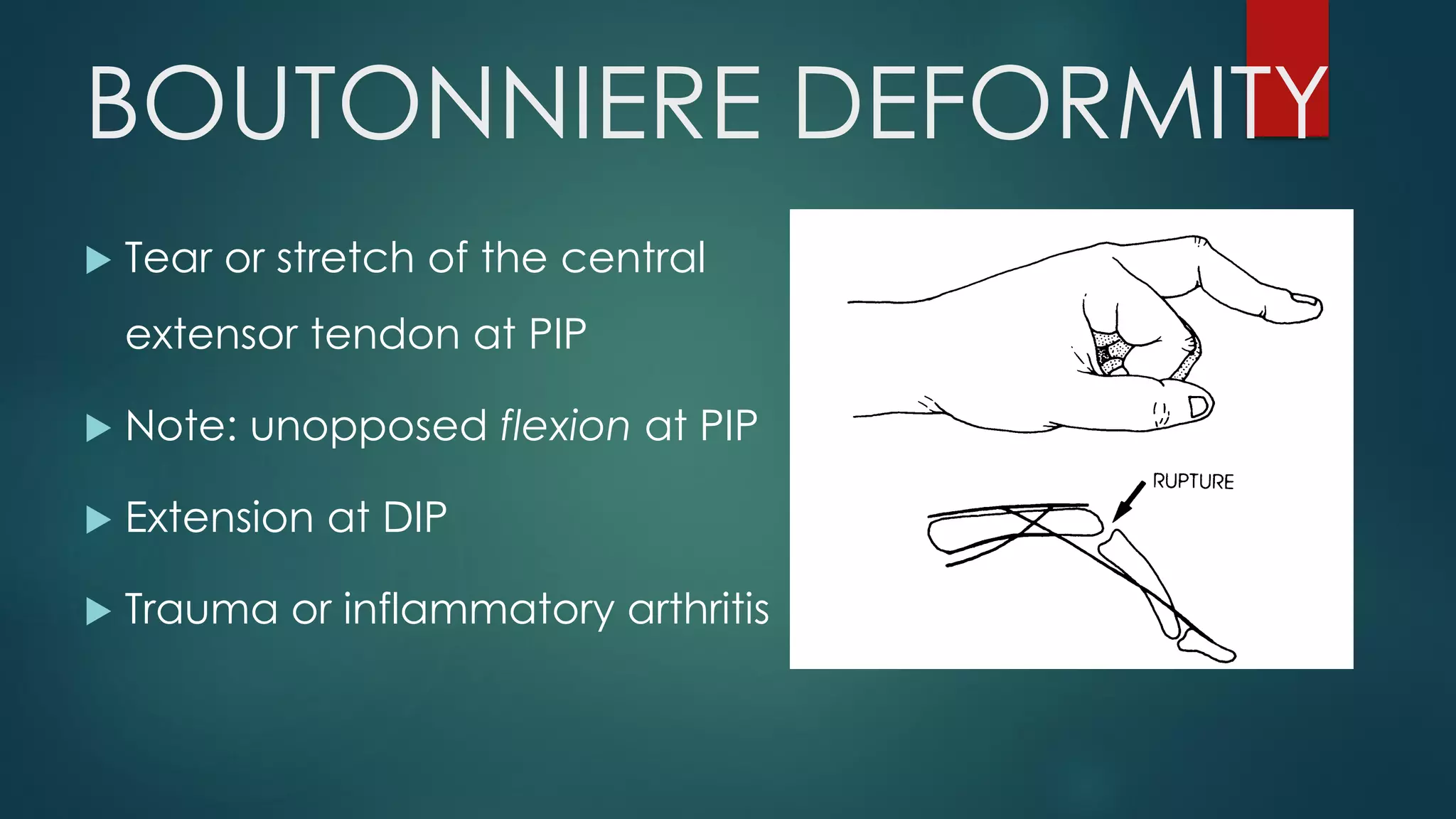
BOUTONNIERE DEFORMITY
 Tear or stretch of the central
extensor tendon at PIP
 Note: unopposed flexion at PIP
 Extension at DIP
 Trauma or inflammatory arthritis
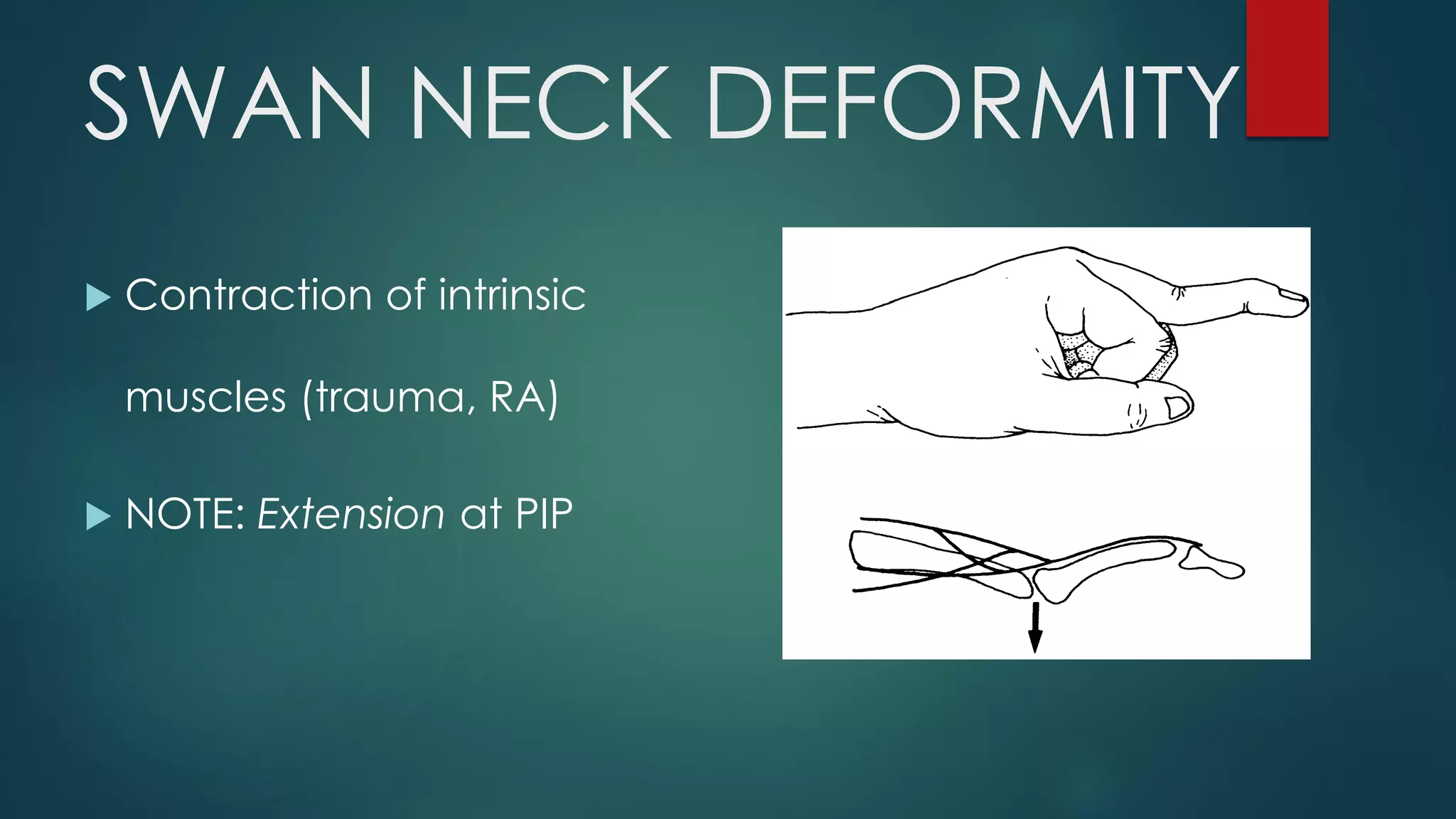
SWAN NECK DEFORMITY
 Contraction of intrinsic
muscles (trauma, RA)
 NOTE: Extension at PIP
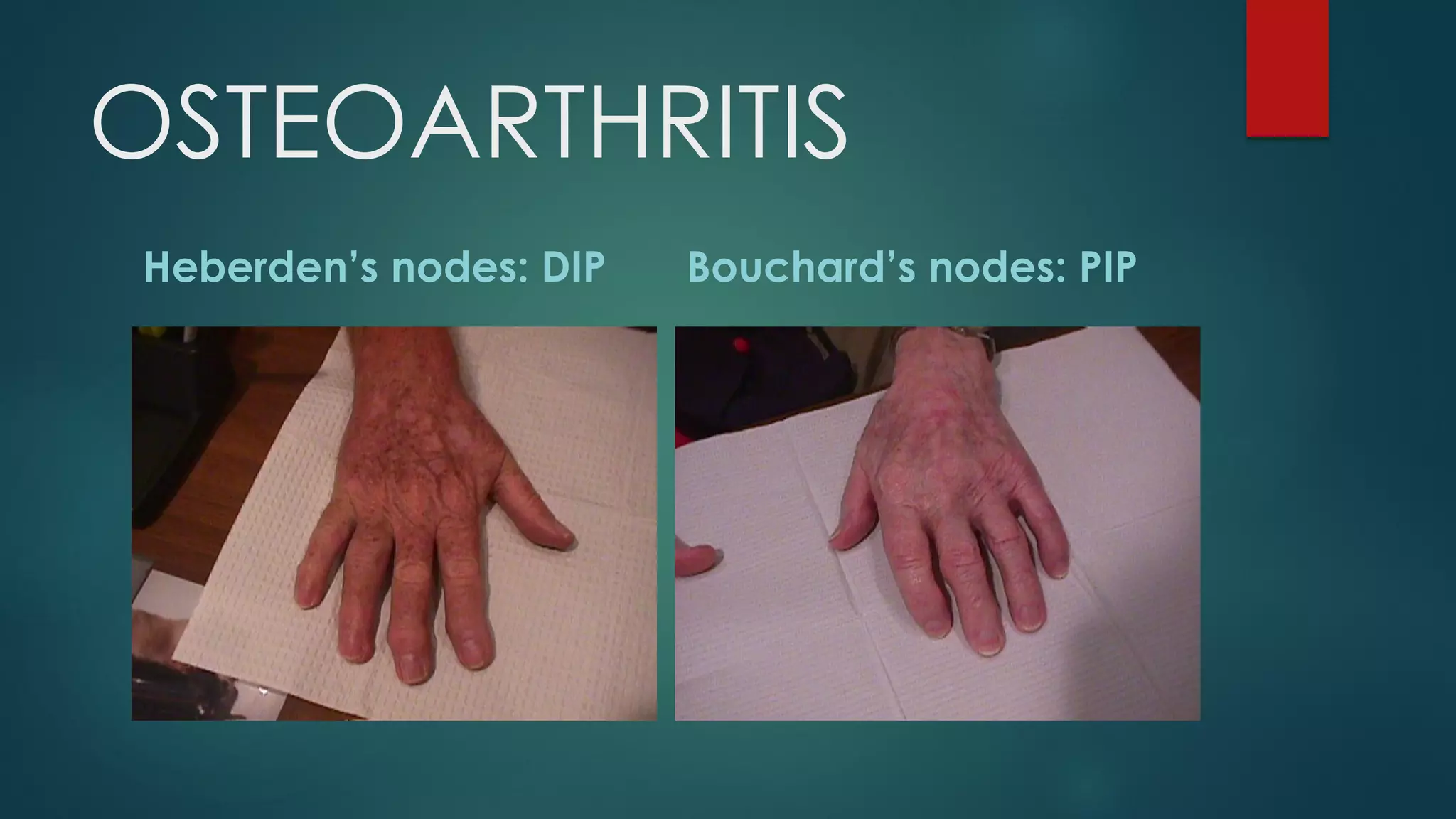
OSTEOARTHRITIS
Heberden’s nodes: DIP Bouchard’s nodes: PIP
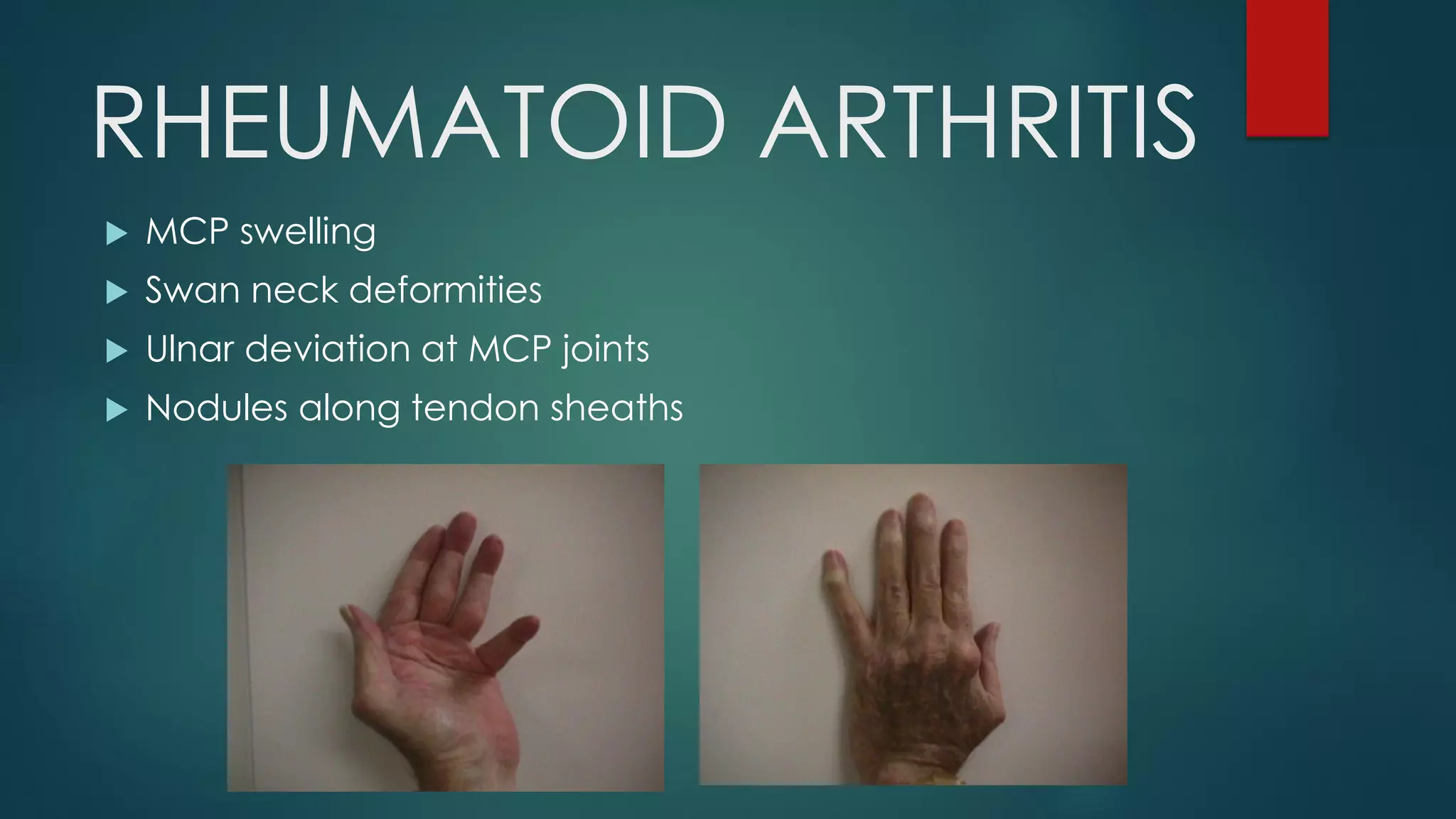
RHEUMATOID ARTHRITIS
 MCP swelling
 Swan neck deformities
 Ulnar deviation at MCP joints
 Nodules along tendon sheaths
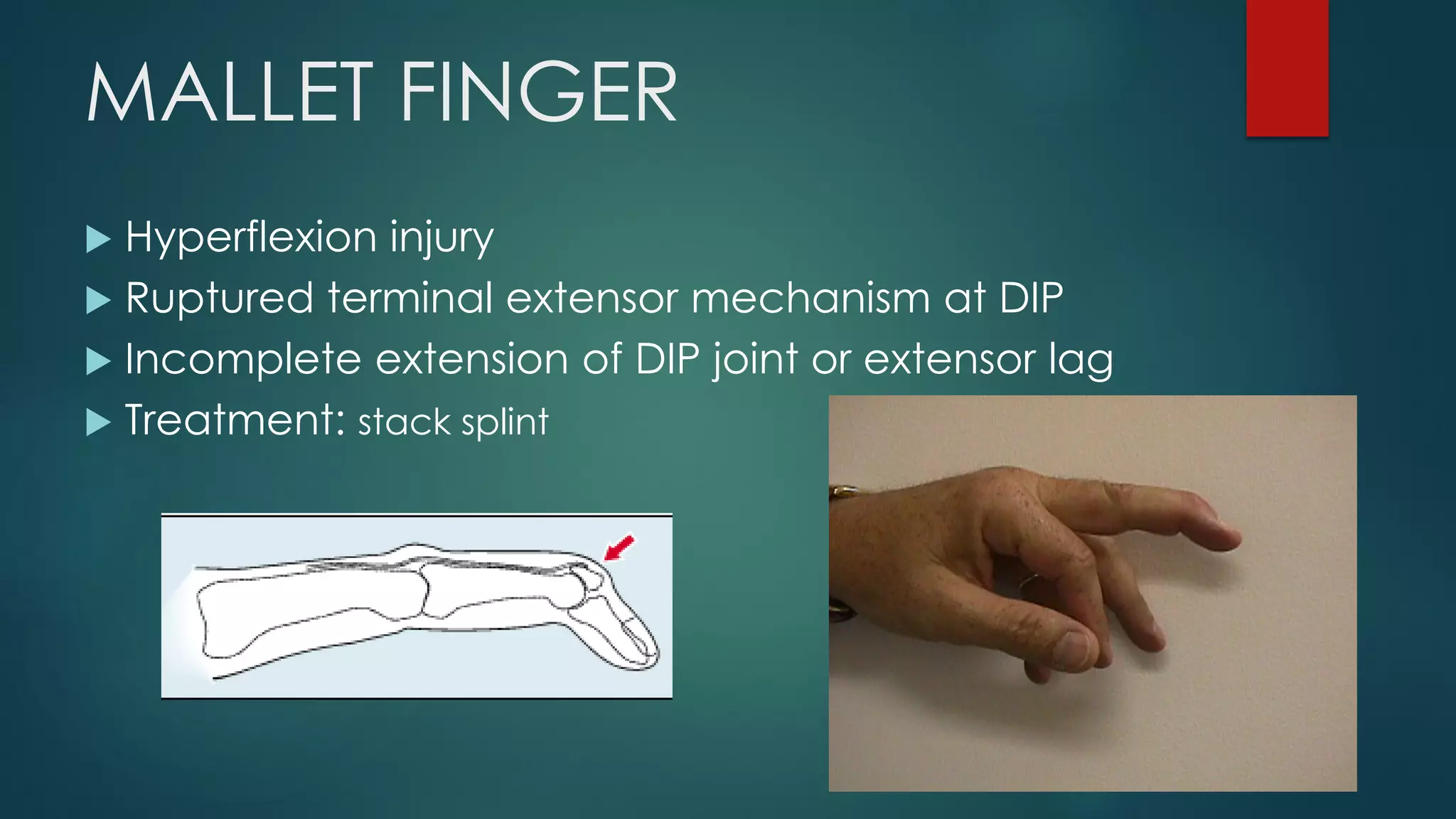
MALLET FINGER
 Hyperflexion injury
 Ruptured terminal extensor mechanism at DIP
 Incomplete extension of DIP joint or extensor lag
 Treatment: stack splint
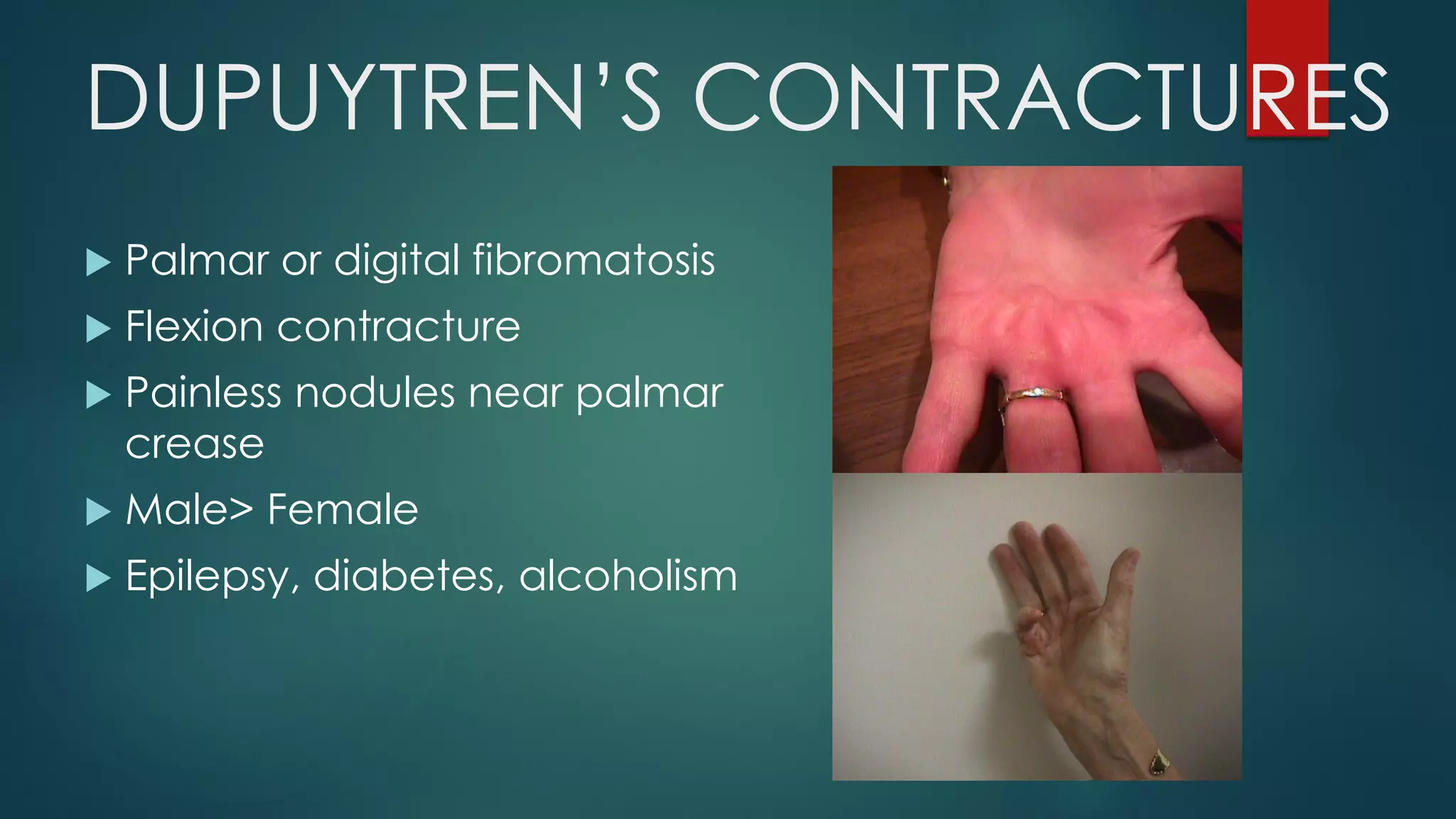
DUPUYTREN’S CONTRACTURES
 Palmar or digital fibromatosis
 Flexion contracture
 Painless nodules near palmar
crease
 Male> Female
 Epilepsy, diabetes, alcoholism
PALPATION OF WRIST DORSUM
 Radial Styloid
 Scaphoid
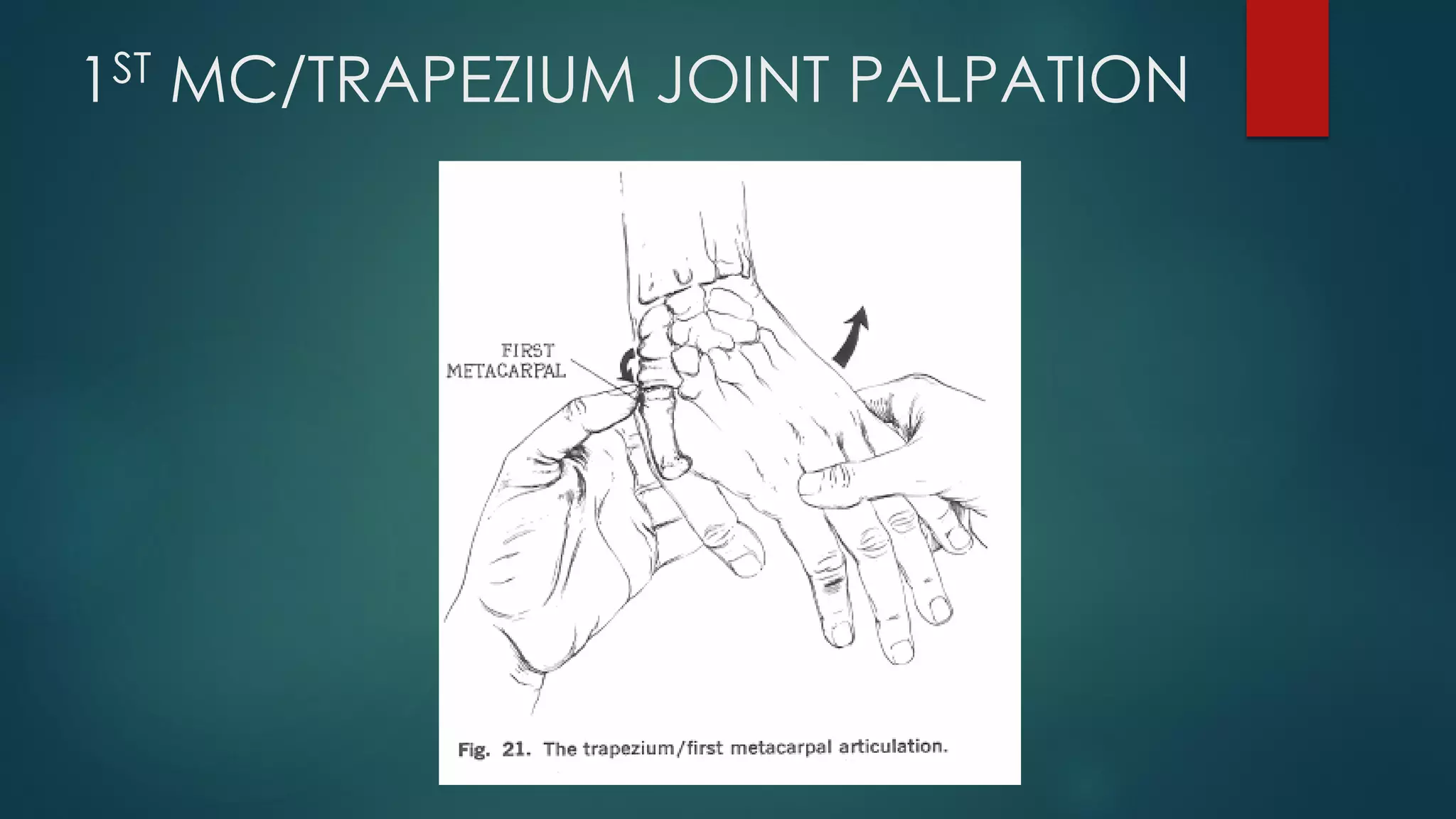
 1st MC/Trapezium jt
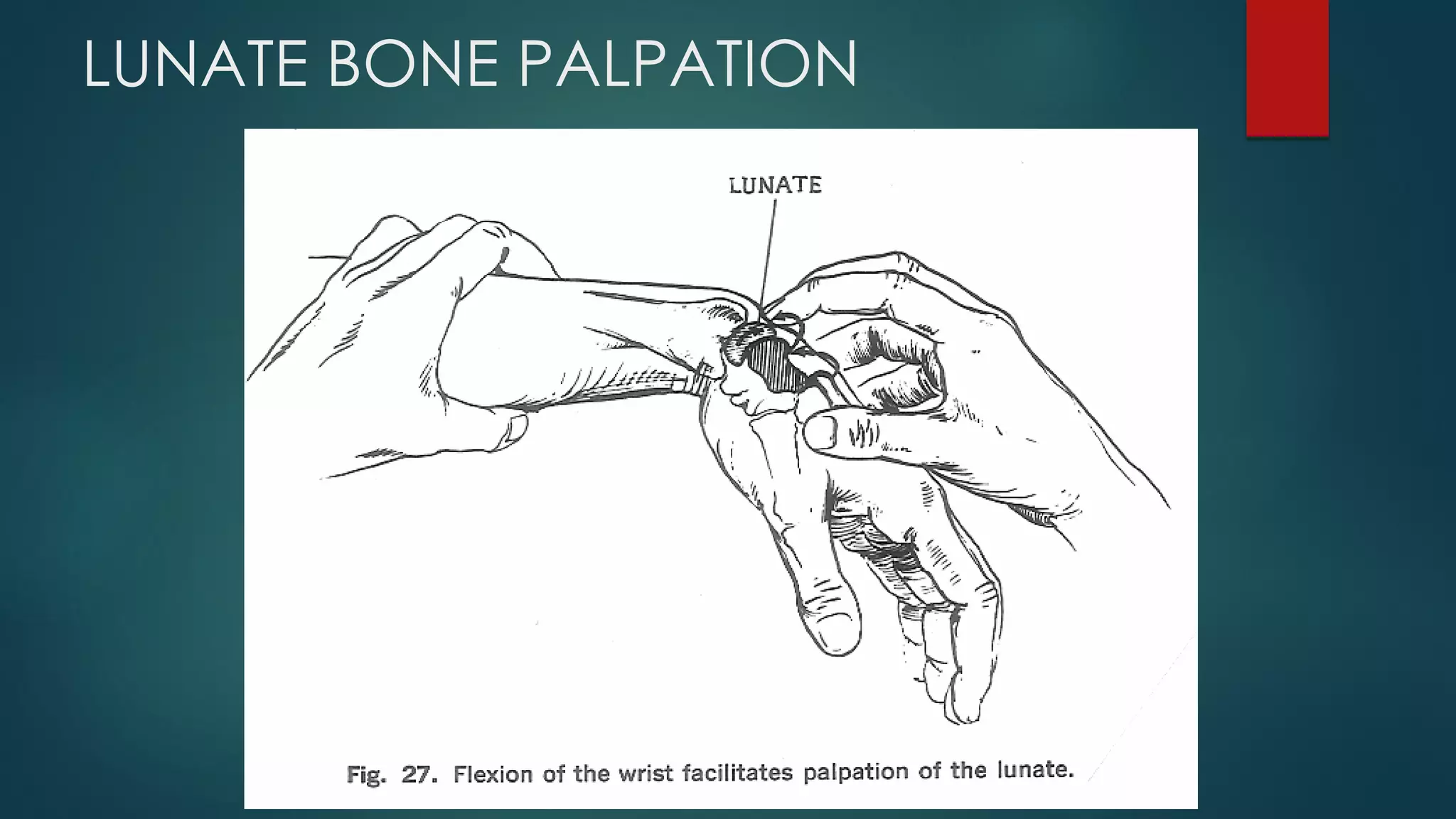
 Lunate
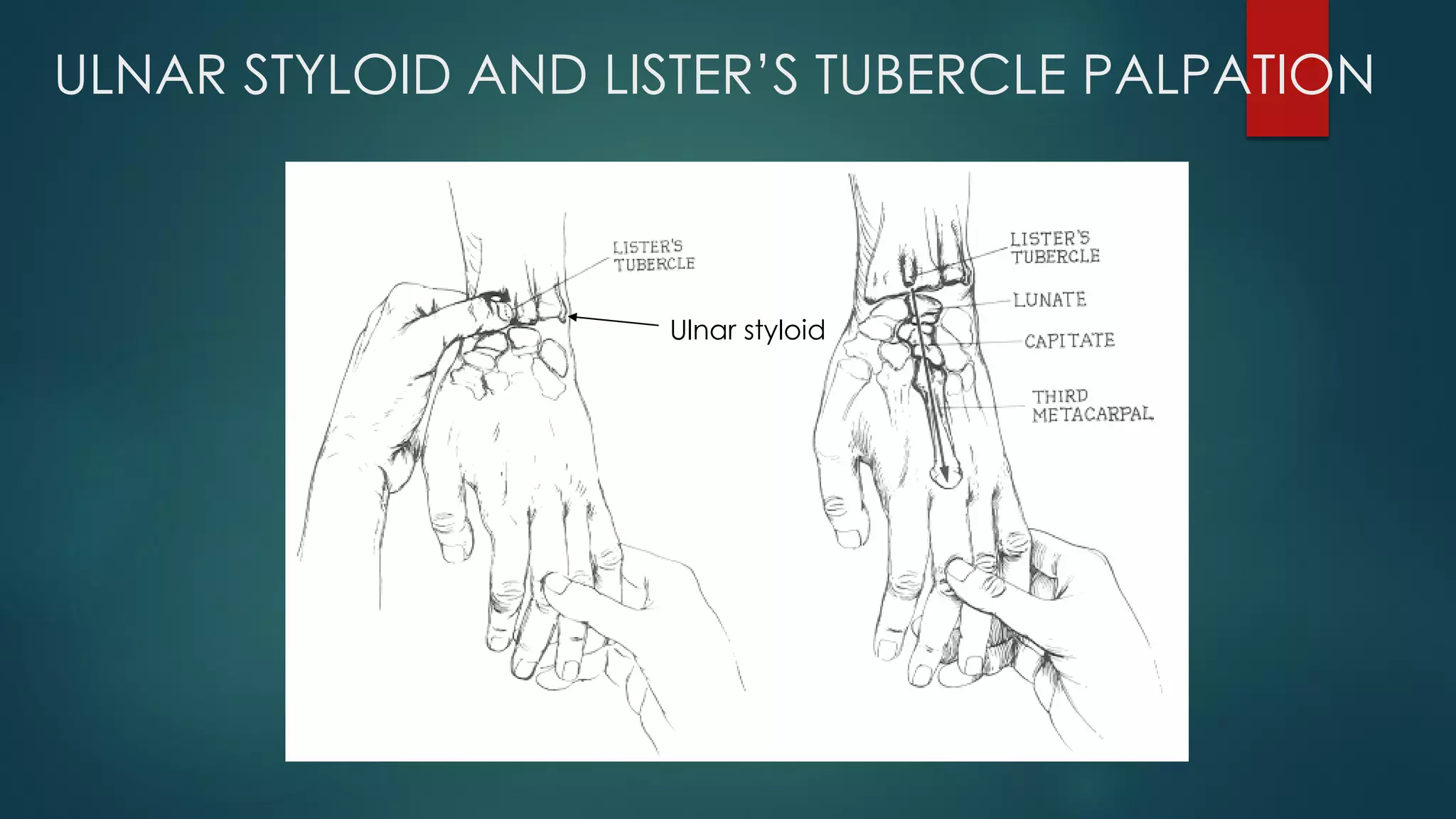
 Lister’s Tubercle
 Ulnar Styloid
 TFCC
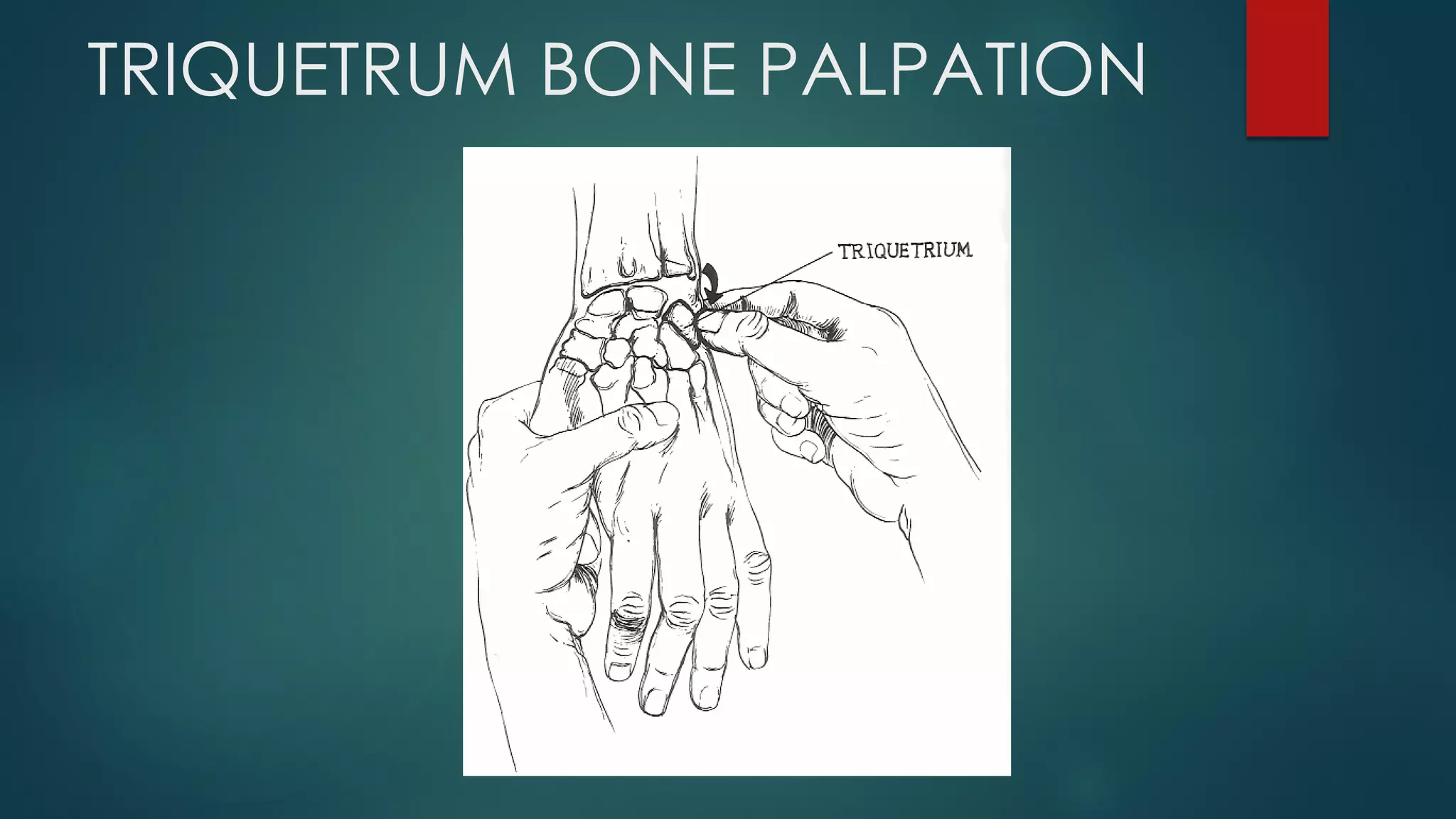
 Triquetrum
 Pisiform
 Hook of Hamate
 Guyon’s Tunnel
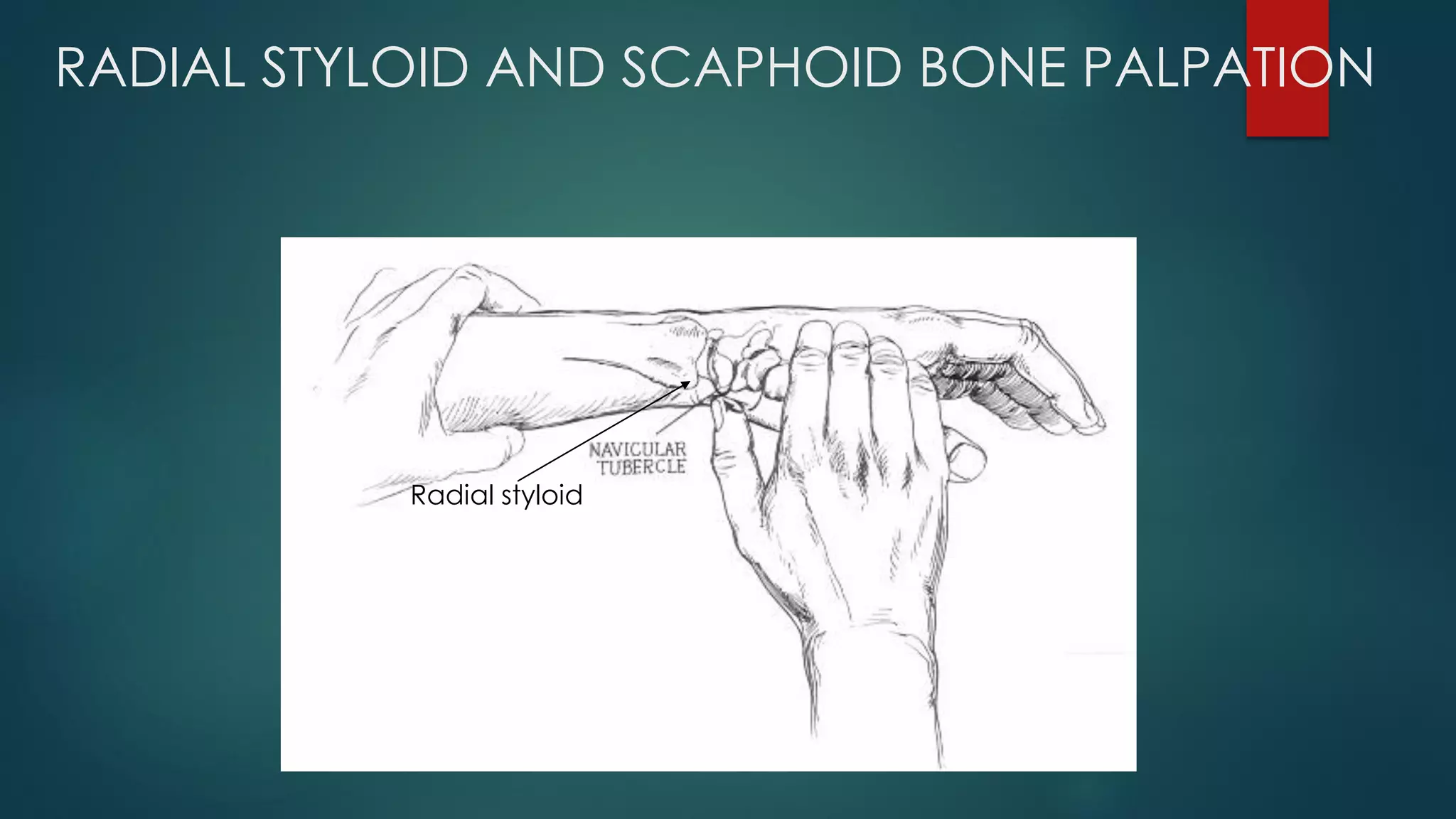
RADIAL STYLOID AND SCAPHOID BONE PALPATION
Radial styloid
SCAPHOID FRACTURE
 Painful, swollen wrist after a fall
 Tenderness in snuffbox
 High frequency of nonunion and avascular necrosis
 Initial x-rays often unremarkable
1ST MC/TRAPEZIUM JOINT PALPATION
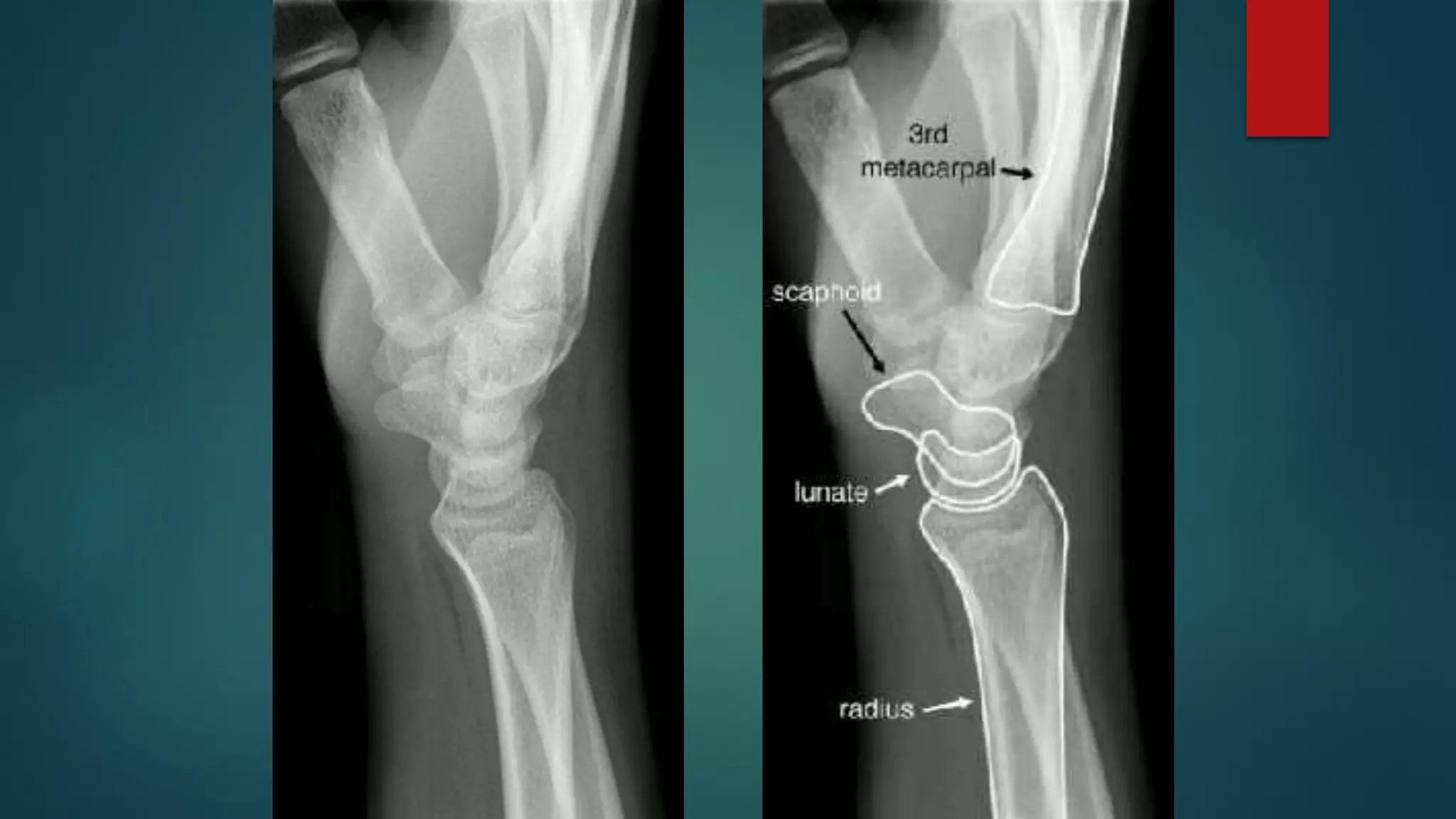
LUNATE BONE PALPATION
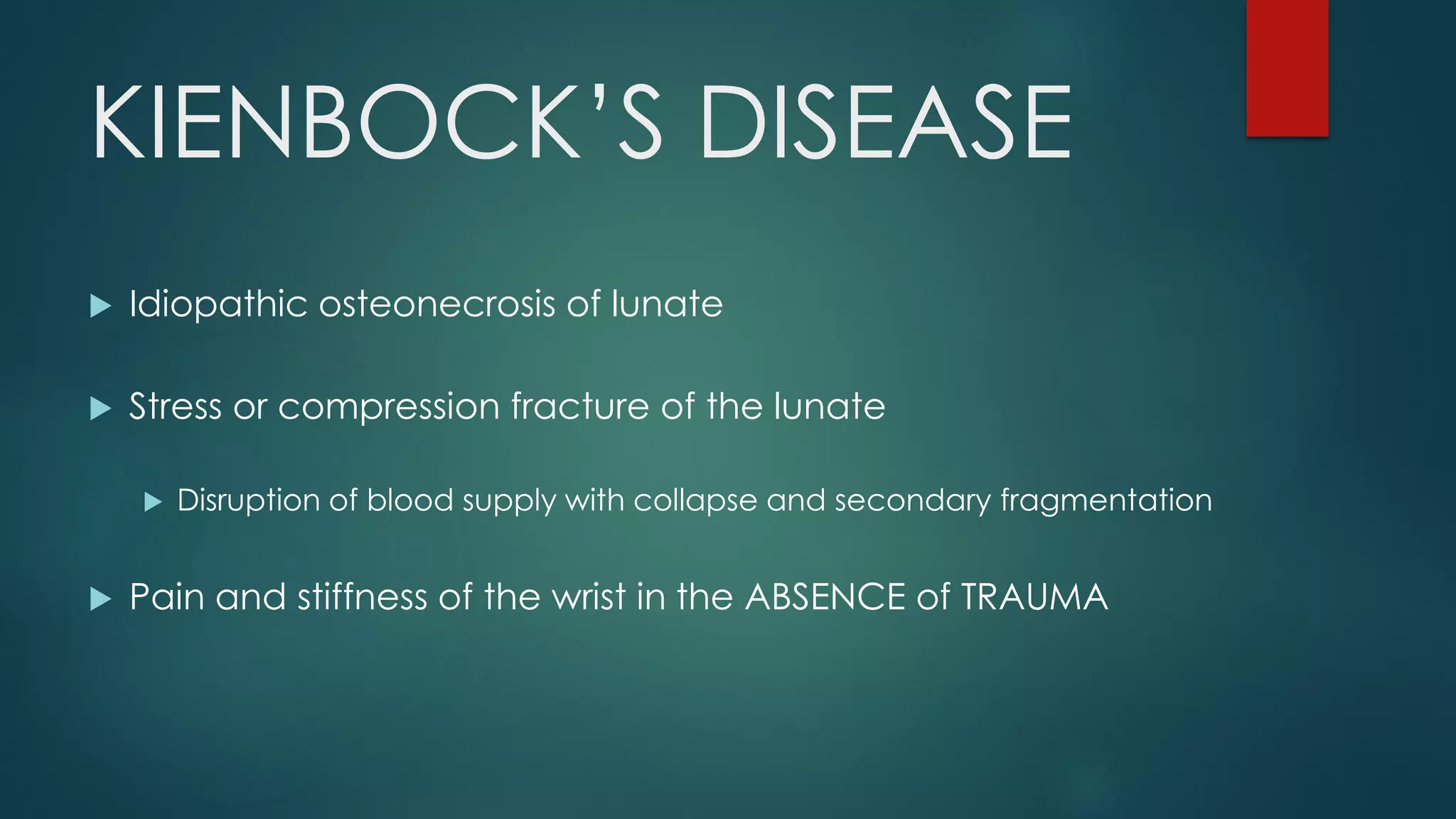
KIENBOCK’S DISEASE
 Idiopathic osteonecrosis of lunate
 Stress or compression fracture of the lunate
 Disruption of blood supply with collapse and secondary fragmentation
 Pain and stiffness of the wrist in the ABSENCE of TRAUMA
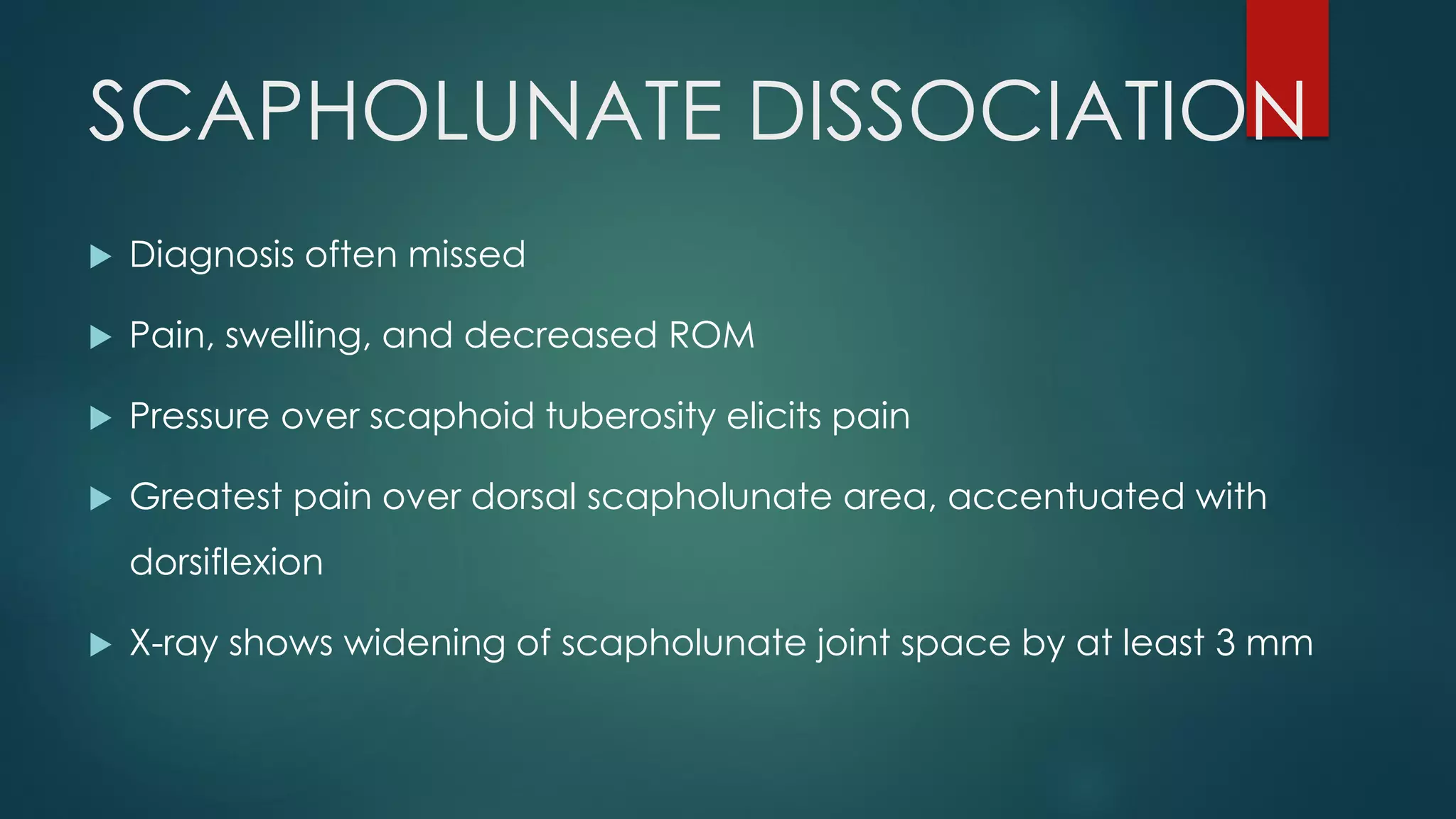
SCAPHOLUNATE DISSOCIATION
 Diagnosis often missed
 Pain, swelling, and decreased ROM
 Pressure over scaphoid tuberosity elicits pain
 Greatest pain over dorsal scapholunate area, accentuated with
dorsiflexion
 X-ray shows widening of scapholunate joint space by at least 3 mm
ULNAR STYLOID AND LISTER’S TUBERCLE PALPATION
Ulnar styloid
TRIQUETRUM BONE PALPATION
TRIQUETRUM FRACTURE
 2nd most common carpal fracture
 Fall onto outstretched hand with wrist in dorsiflexion and ulnar deviation
 Swelling and tenderness over the dorsal ulnar aspect of the wrist
PALPATION OF HANDBONE
Metacarpals - 5
Phalanges - 14
Palpate for swelling, tenderness
Assess for symmetry
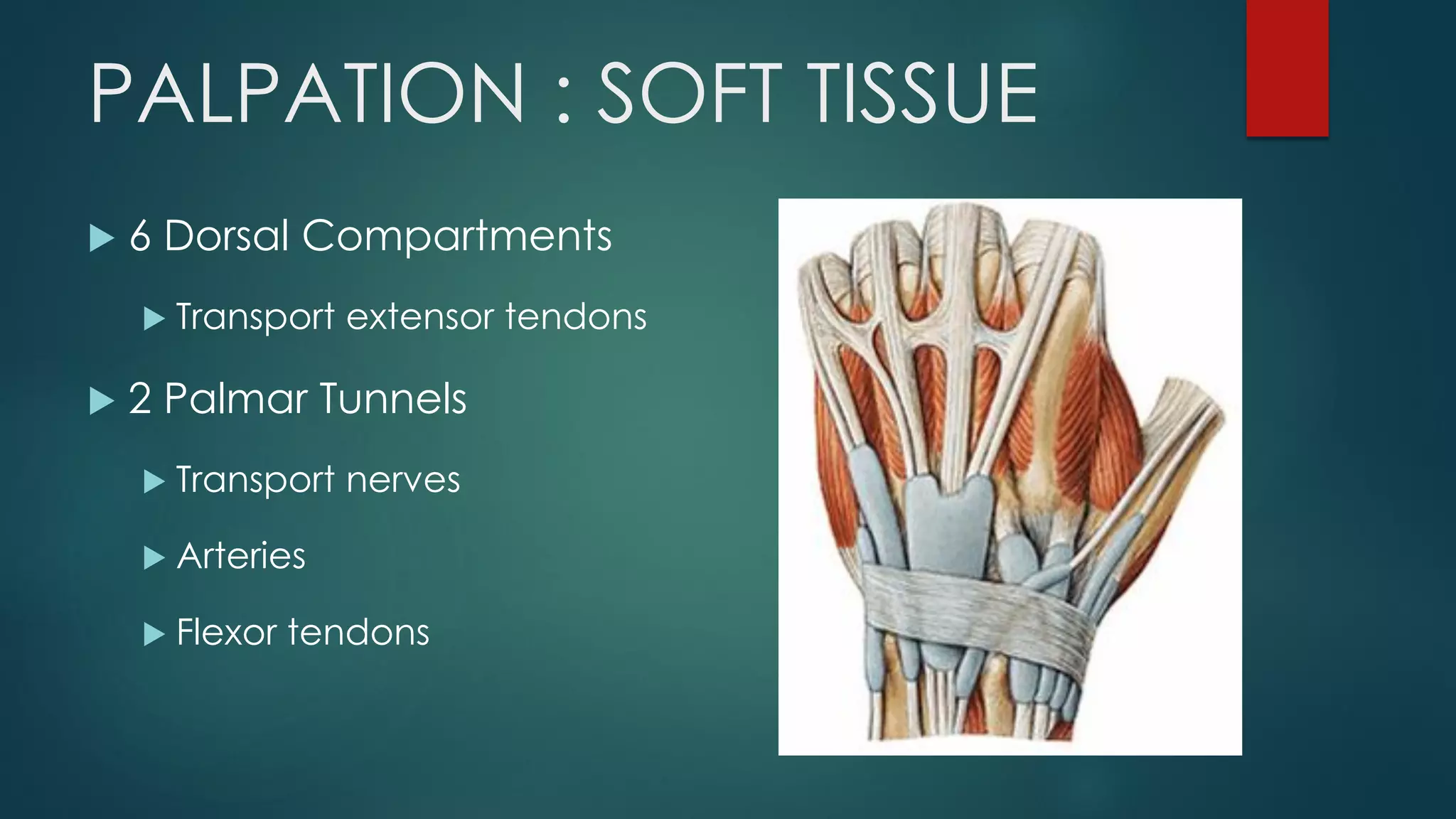
PALPATION : SOFT TISSUE
 6 Dorsal Compartments
 Transport extensor tendons
 2 Palmar Tunnels
 Transport nerves
 Arteries
 Flexor tendons
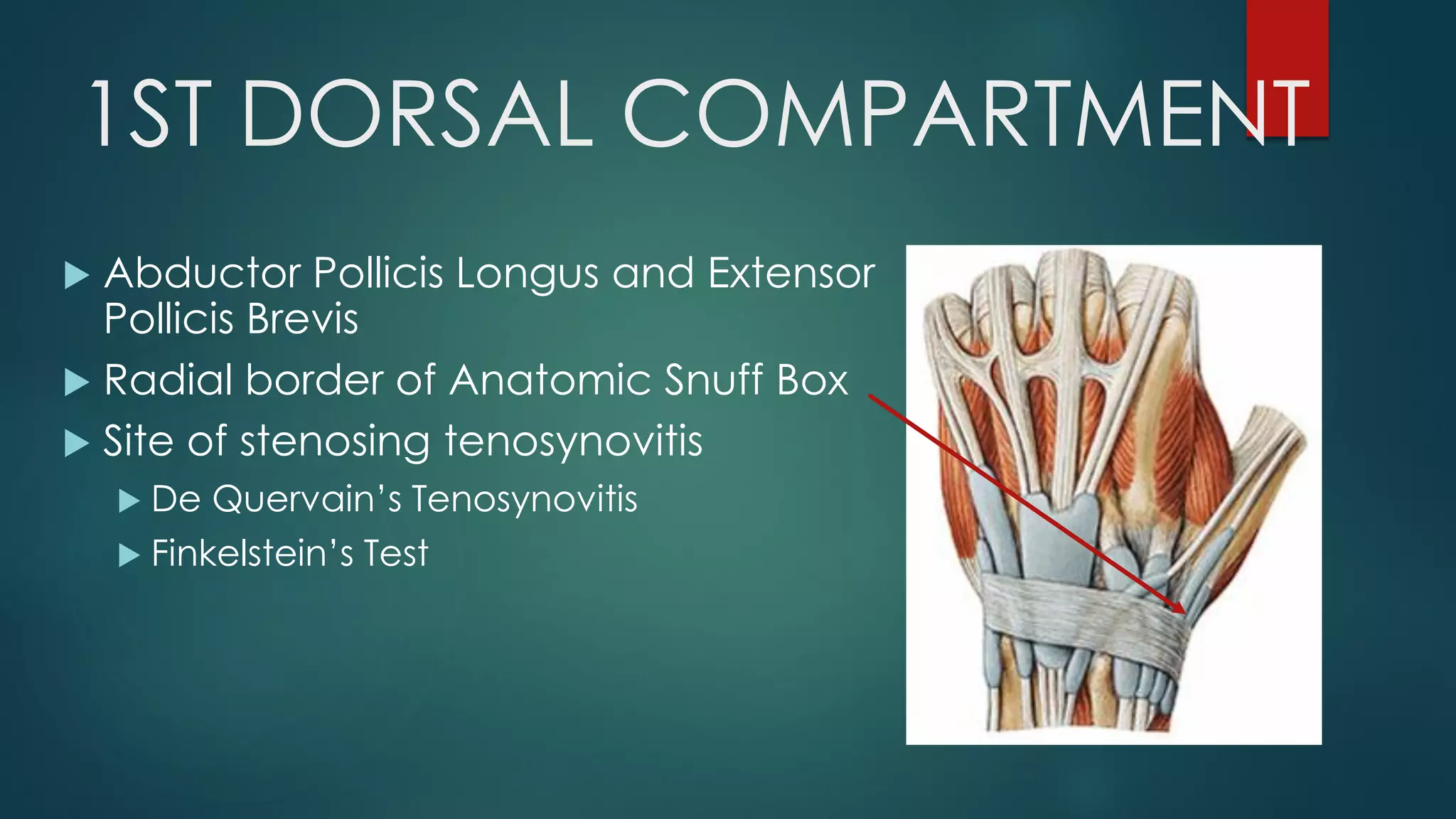
1ST DORSAL COMPARTMENT
 Abductor Pollicis Longus and Extensor
Pollicis Brevis
 Radial border of Anatomic Snuff Box
 Site of stenosing tenosynovitis
 De Quervain’s Tenosynovitis
 Finkelstein’s Test
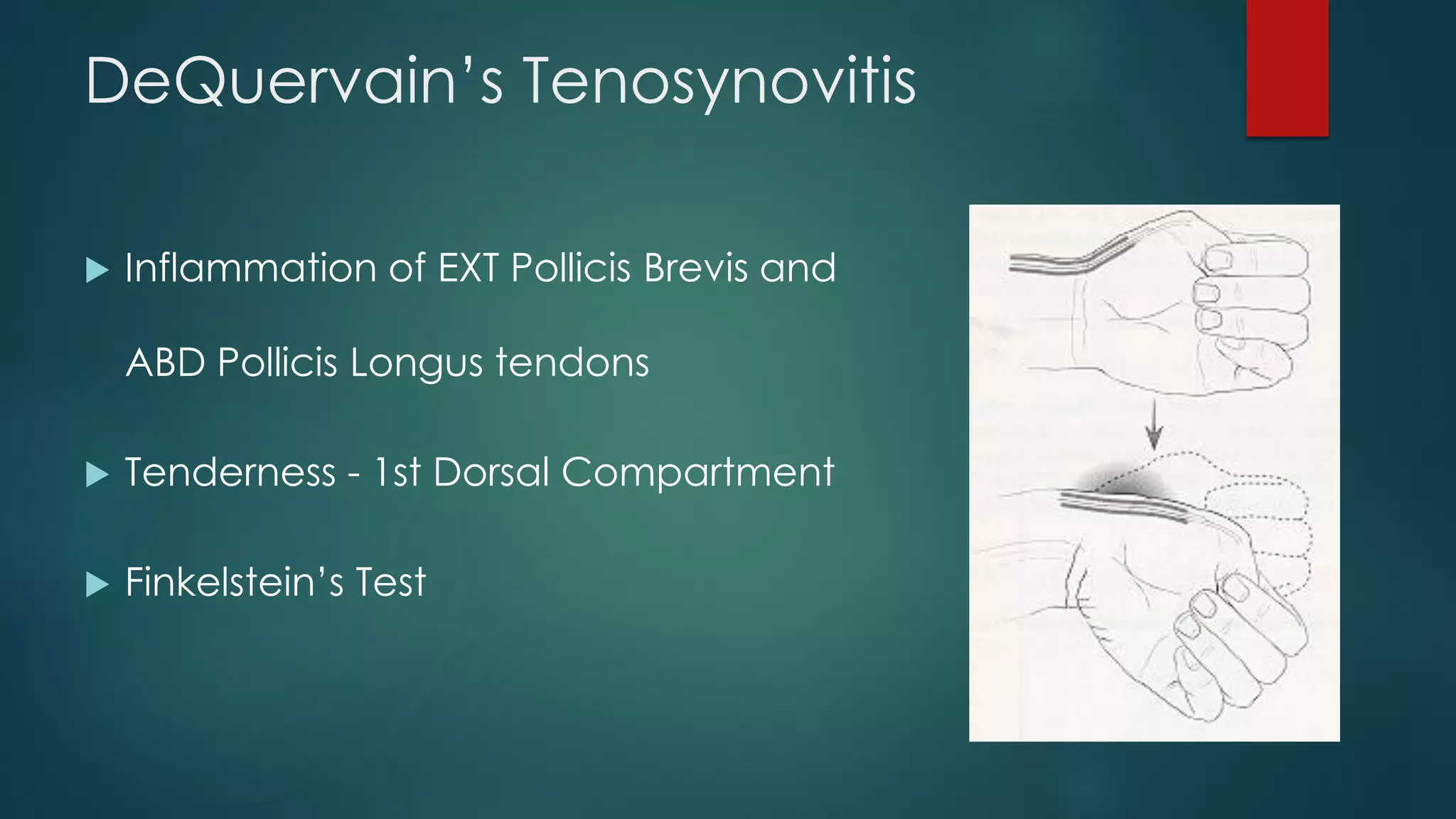
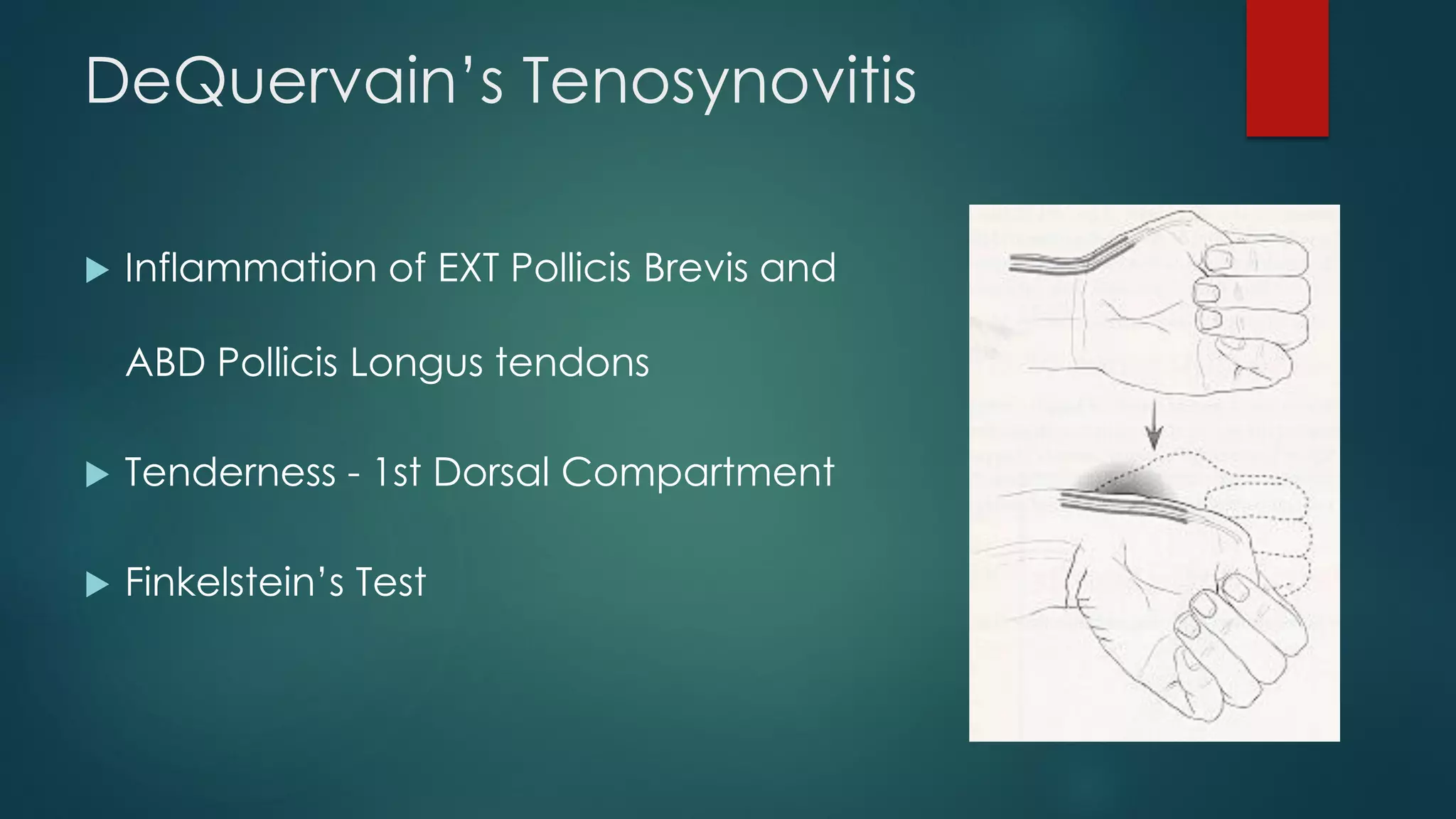
DeQuervain’s Tenosynovitis
 Inflammation of EXT Pollicis Brevis and
ABD Pollicis Longus tendons
 Tenderness - 1st Dorsal Compartment
 Finkelstein’s Test
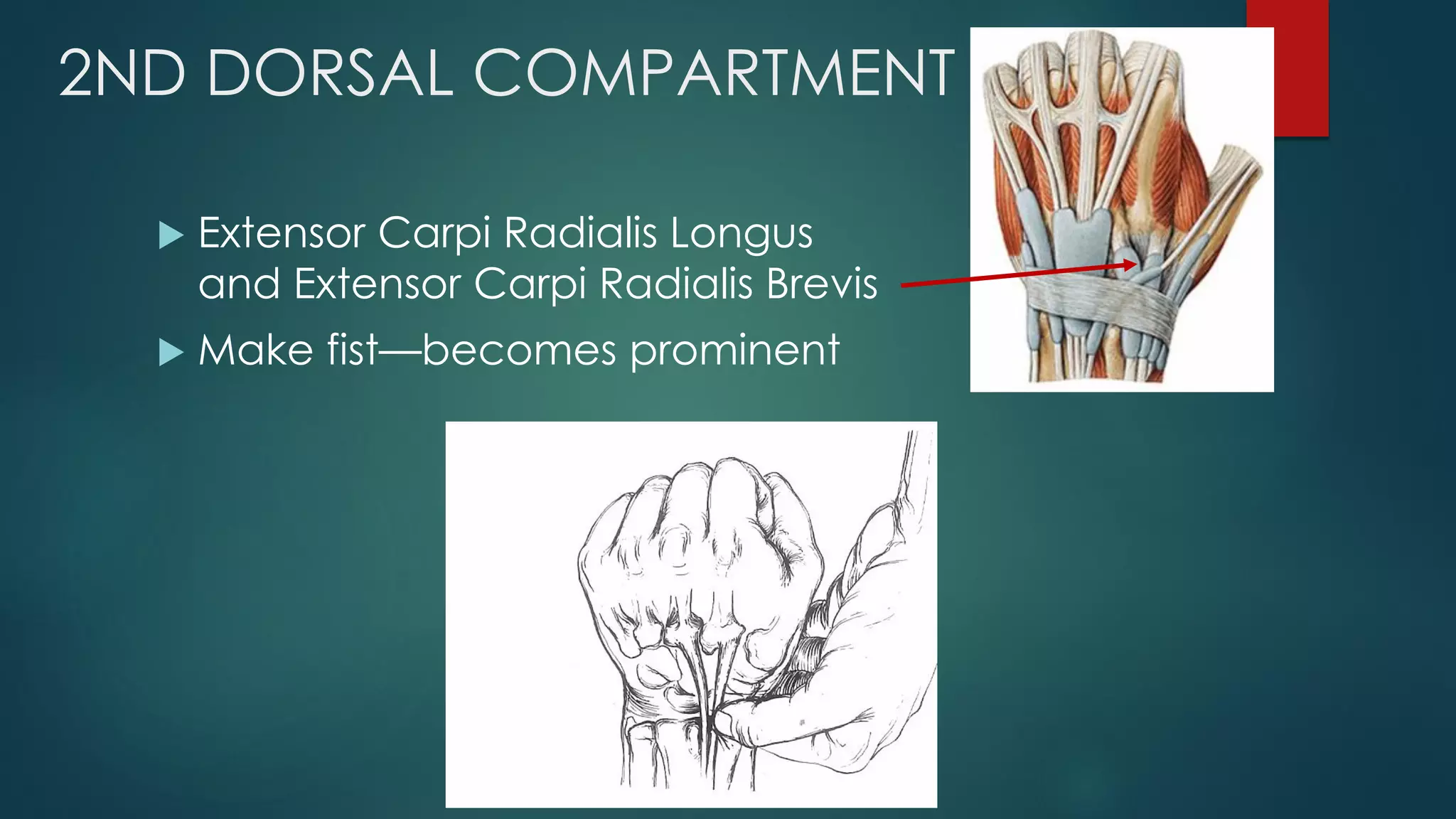
2ND DORSAL COMPARTMENT
 Extensor Carpi Radialis Longus
and Extensor Carpi Radialis Brevis
 Make fist—becomes prominent
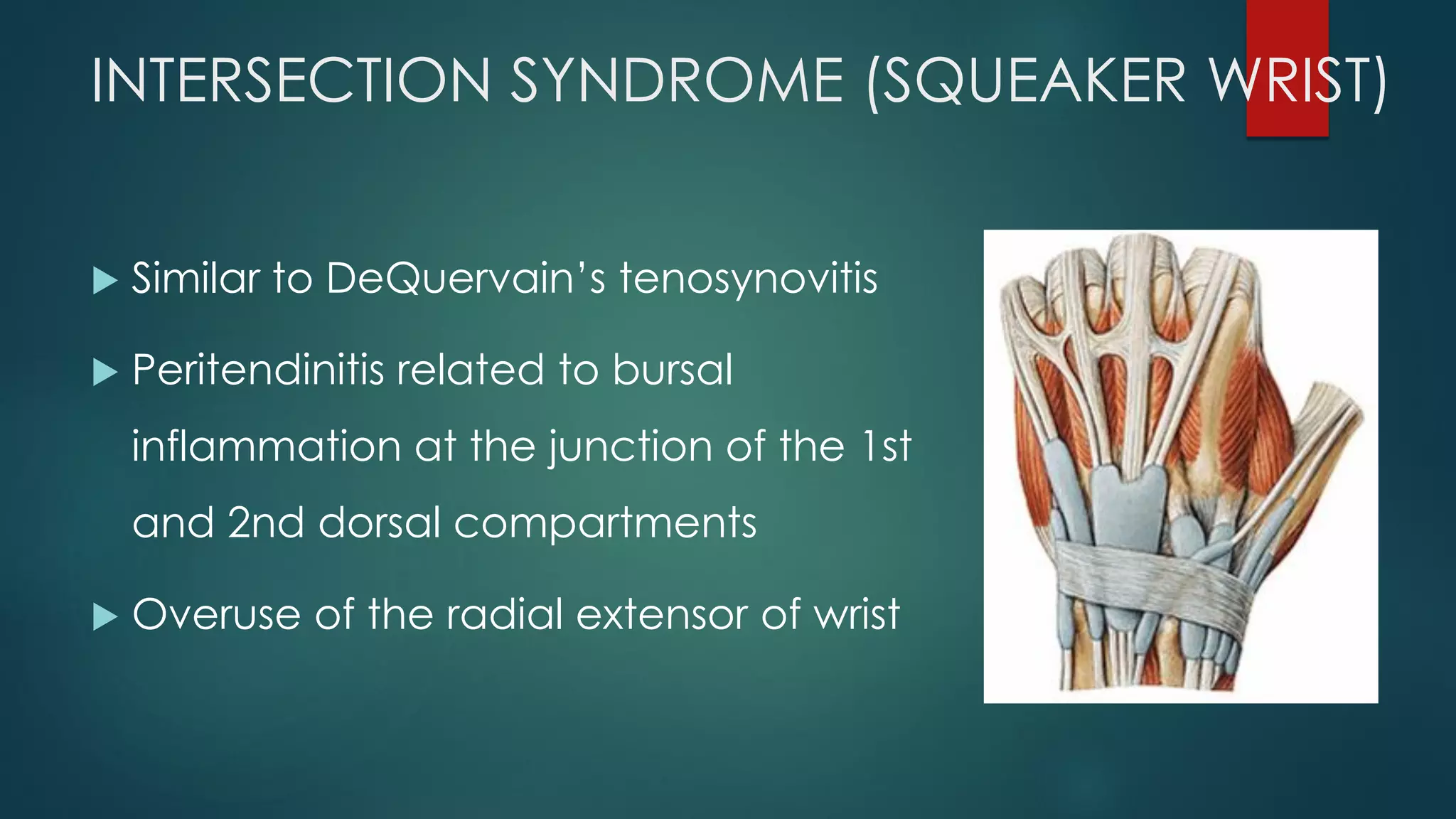
INTERSECTION SYNDROME (SQUEAKER WRIST)
 Similar to DeQuervain’s tenosynovitis
 Peritendinitis related to bursal
inflammation at the junction of the 1st
and 2nd dorsal compartments
 Overuse of the radial extensor of wrist
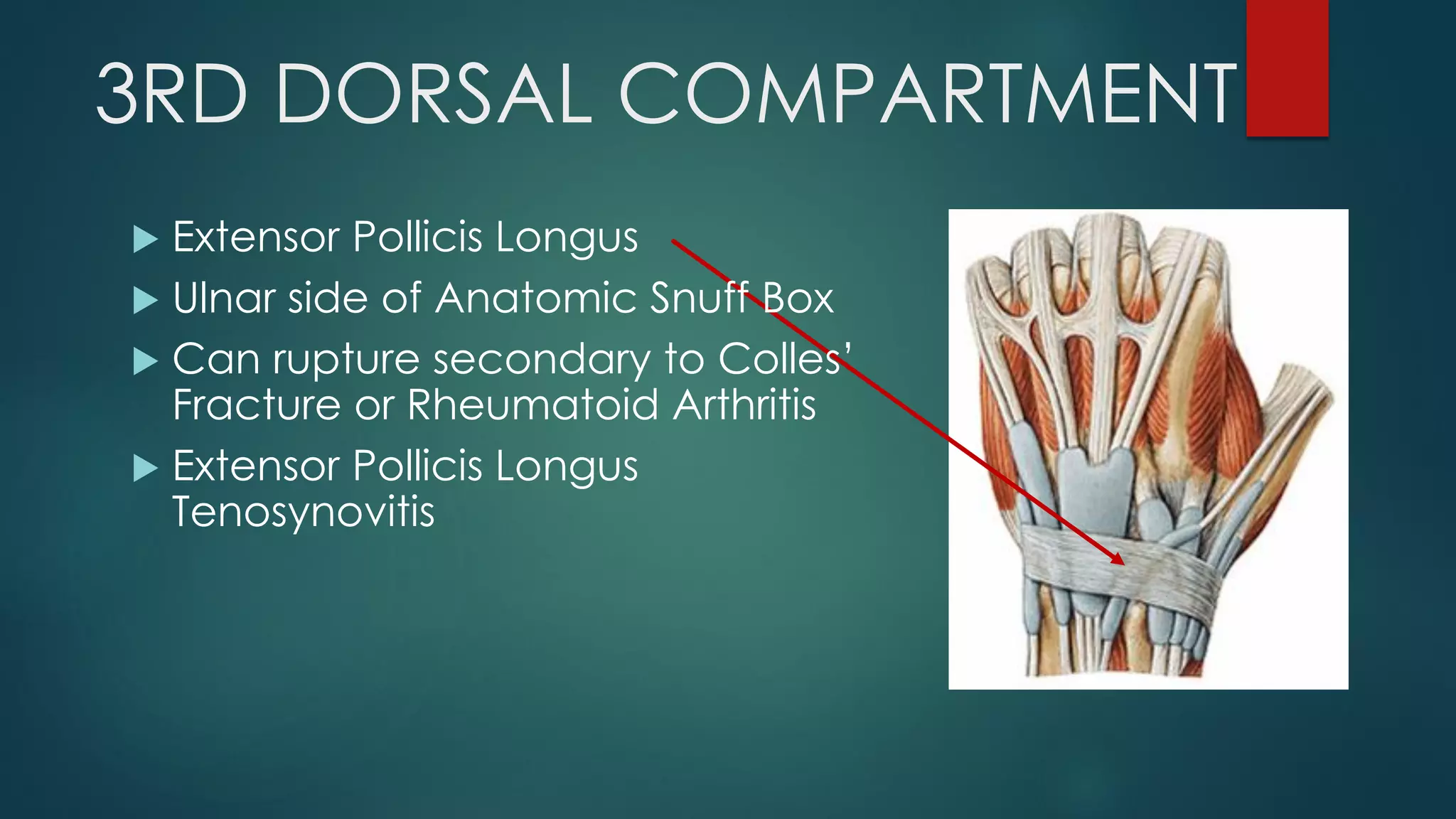
3RD DORSAL COMPARTMENT
 Extensor Pollicis Longus
 Ulnar side of Anatomic Snuff Box
 Can rupture secondary to Colles’
Fracture or Rheumatoid Arthritis
 Extensor Pollicis Longus
Tenosynovitis
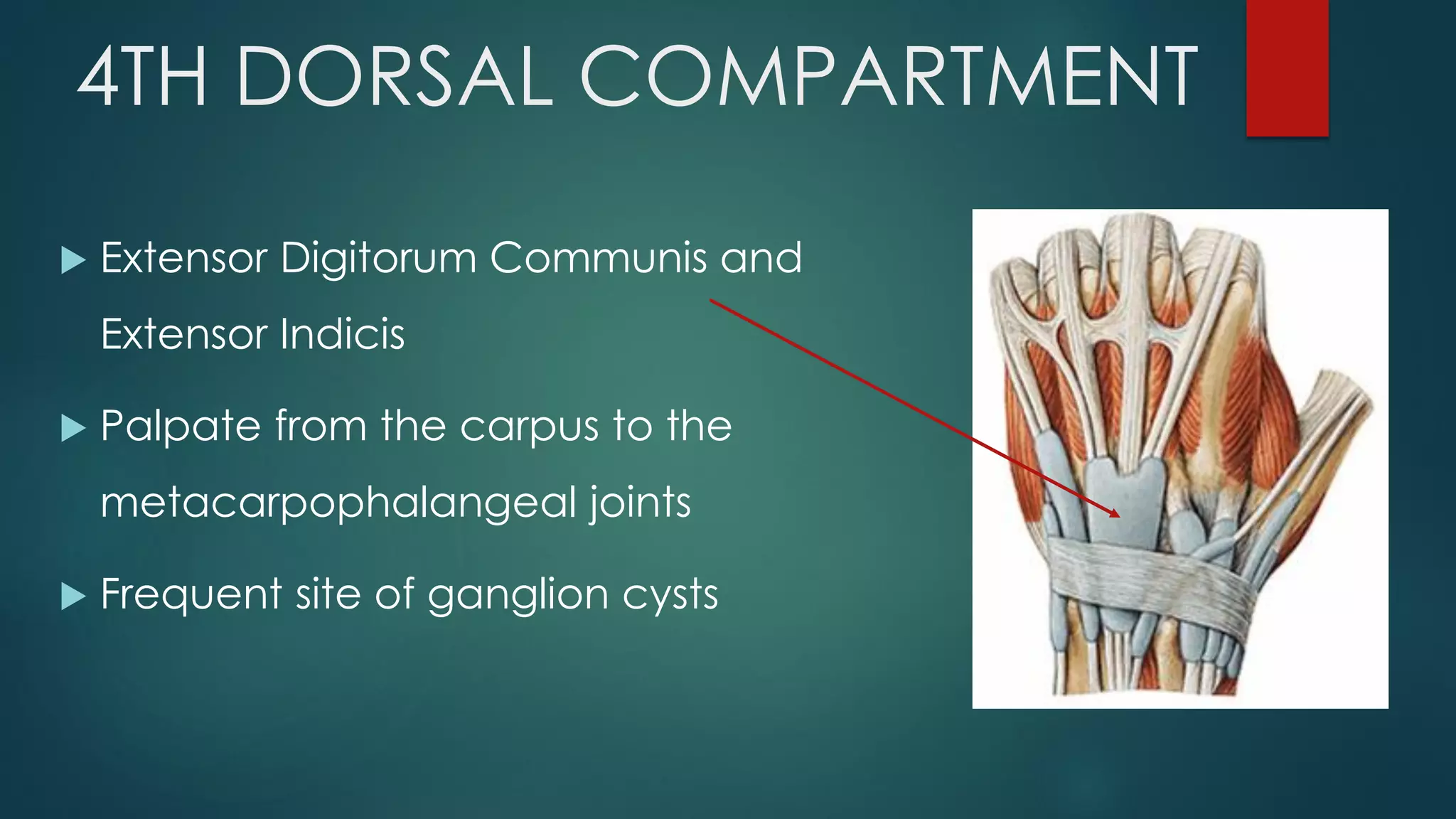
4TH DORSAL COMPARTMENT
 Extensor Digitorum Communis and
Extensor Indicis
 Palpate from the carpus to the
metacarpophalangeal joints
 Frequent site of ganglion cysts
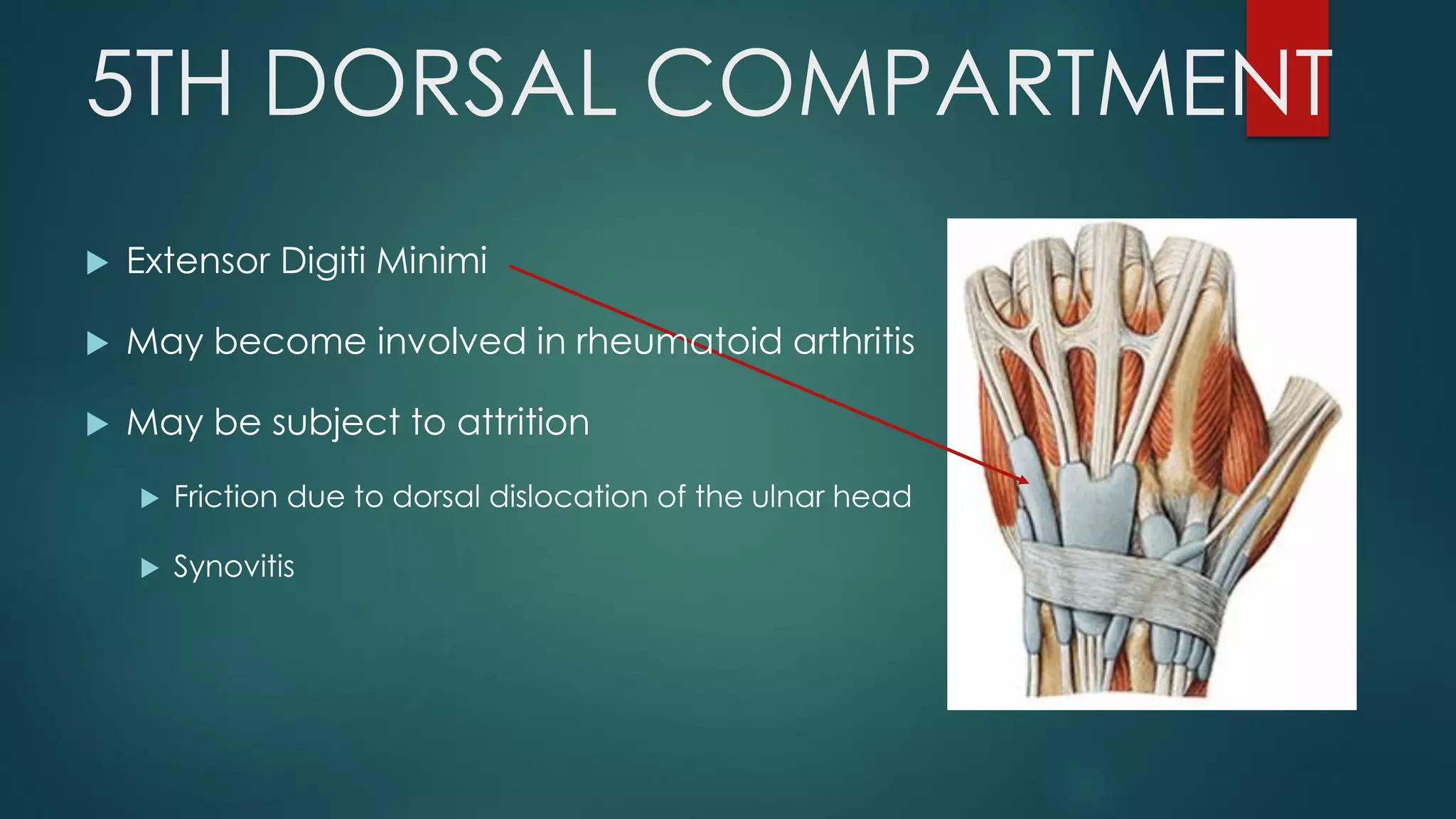
5TH DORSAL COMPARTMENT
 Extensor Digiti Minimi
 May become involved in rheumatoid arthritis
 May be subject to attrition
 Friction due to dorsal dislocation of the ulnar head
 Synovitis
6TH DORSAL COMPARTMENT
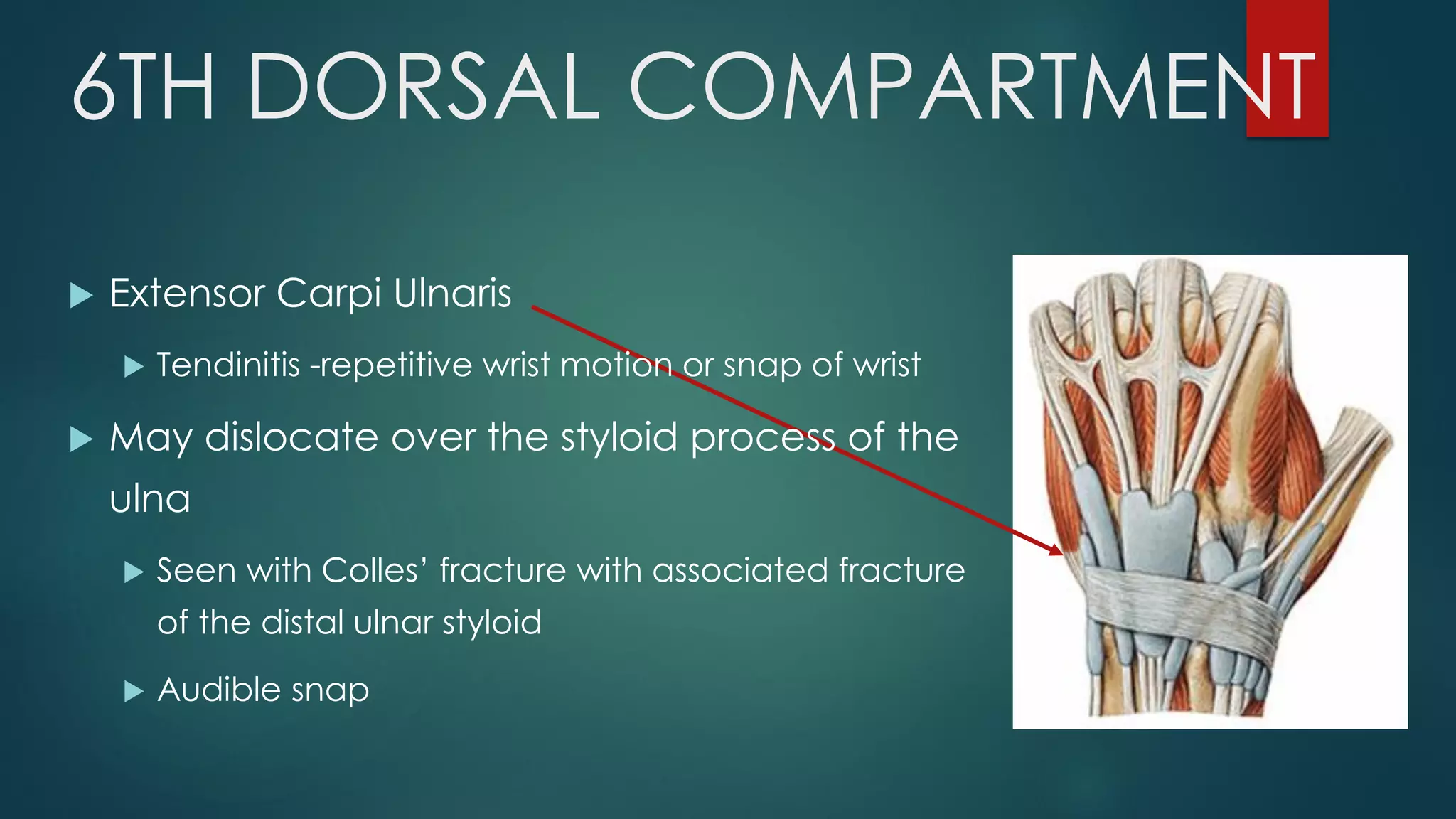
 Extensor Carpi Ulnaris
 Tendinitis -repetitive wrist motion or snap of wrist
 May dislocate over the styloid process of the
ulna
 Seen with Colles’ fracture with associated fracture
of the distal ulnar styloid
 Audible snap
EXTENSOR CARPI ULNARIS TENOSYNOVITIS & SUBLUXATION
 6th Dorsal Compartment
 Second most common site of tenosynovitis (after DeQuervain’s)
 Common in racket and rowing sports
 Pain and tenderness with ulnar deviation
 Suspect subluxation when clicking on ulnar side of forearm
PALPATION: PALMAR ASPECT
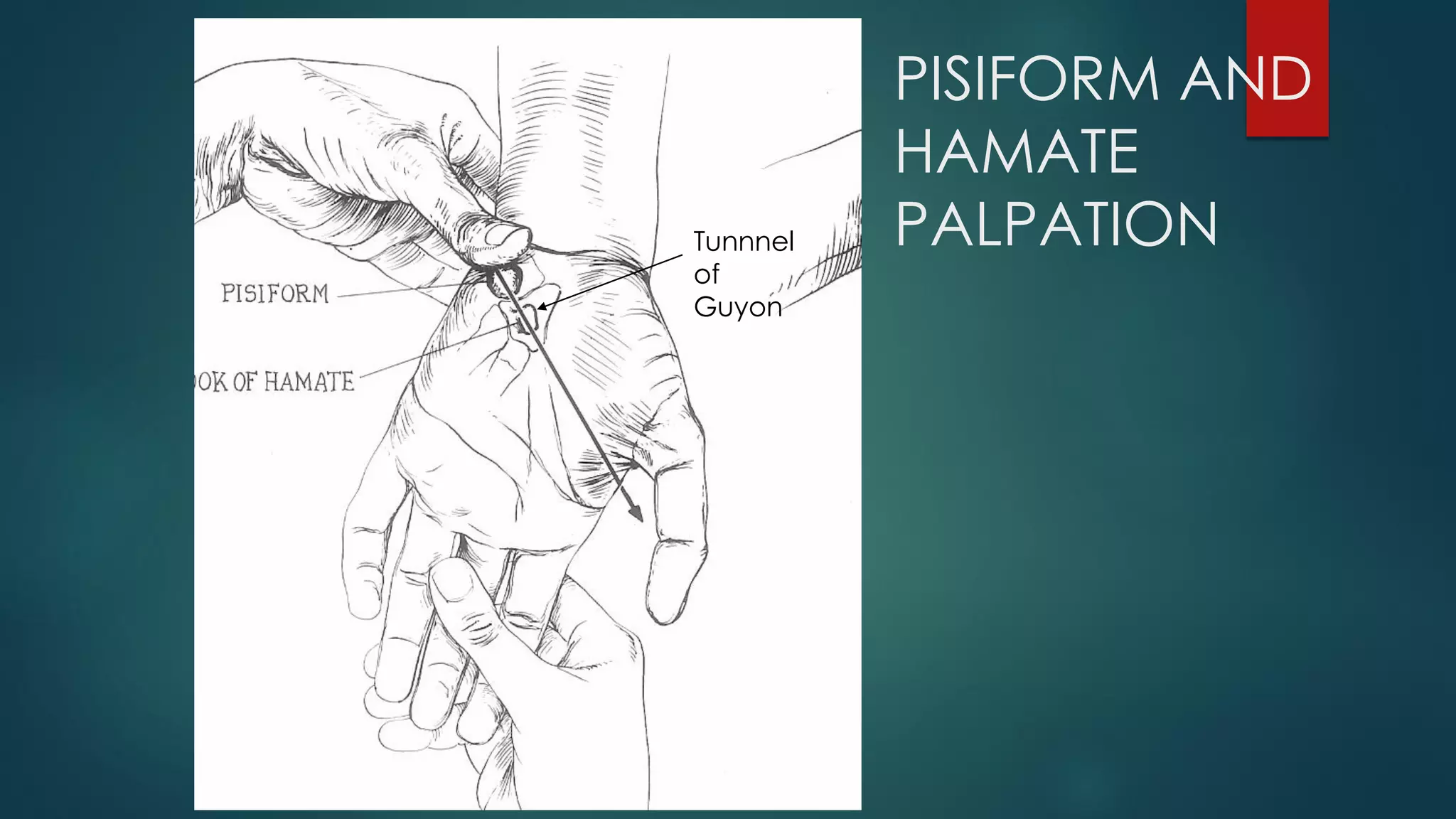
 Pisiform and Hamate
 Tunnel of Guyon
 Ulnar Artery
 Carpal Tunnel
 Flexor Carpi Radialis
 Flexor Carpi Ulnaris
PISIFORM AND
HAMATE
PALPATIONTunnnel
of
Guyon
HAMATE HOOK FRACTURE
 Frequently misdiagnosed as tendonitis or sprain
 Pain, swelling, and tenderness over hypothenar eminence
 Suspect when patient complains of painful griping and swinging
TUNNEL OF GUYON
 Depression between pisiform and hook of hamate
 Contains ulnar nerve and artery
 Site of compression injuries
 unusually tender if pathology is present
ULNAR NERVE COMPRESSION
 Tunnel of Guyon
 Seen in direct or repetitive trauma, fractures of hamate or pisiform,
or sports related
 Operating a jackhammer
 repetitive power gripping (ex. Cycling)
 Pain, weakness, paresthesias in ulnar sensory distribution
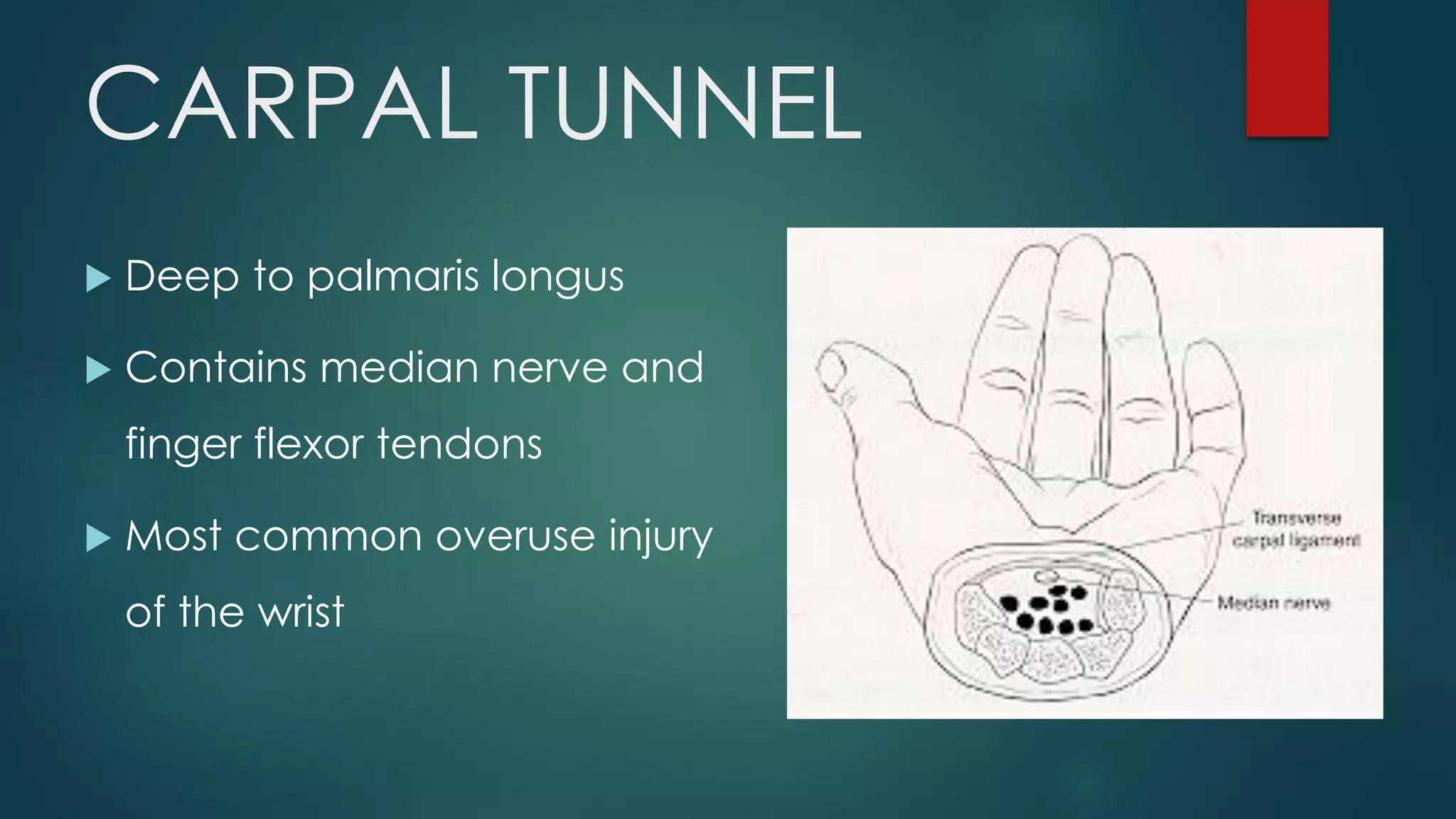
CARPAL TUNNEL
 Deep to palmaris longus
 Contains median nerve and
finger flexor tendons
 Most common overuse injury
of the wrist
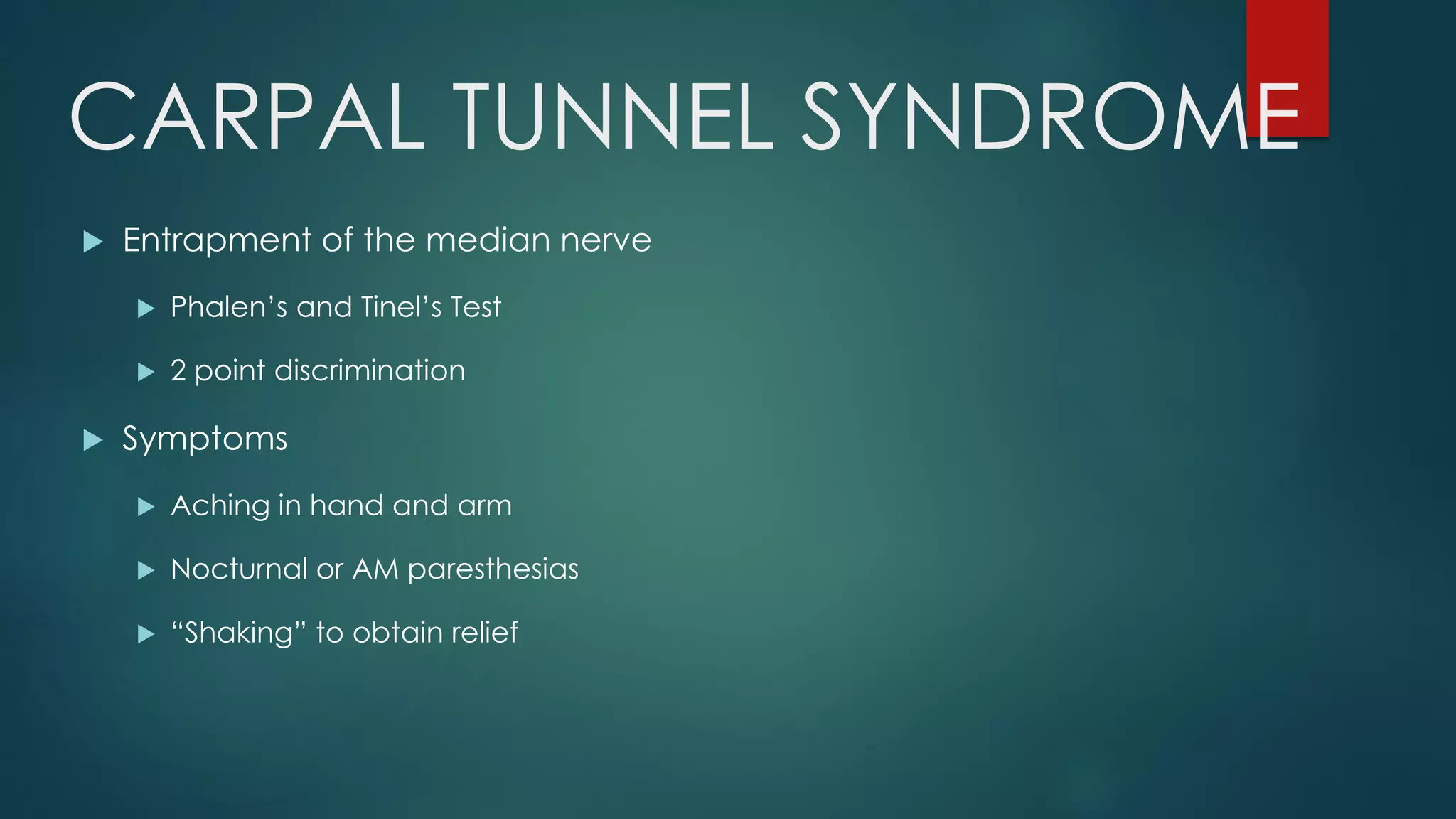
CARPAL TUNNEL SYNDROME
 Entrapment of the median nerve
 Phalen’s and Tinel’s Test
 2 point discrimination
 Symptoms
 Aching in hand and arm
 Nocturnal or AM paresthesias
 “Shaking” to obtain relief
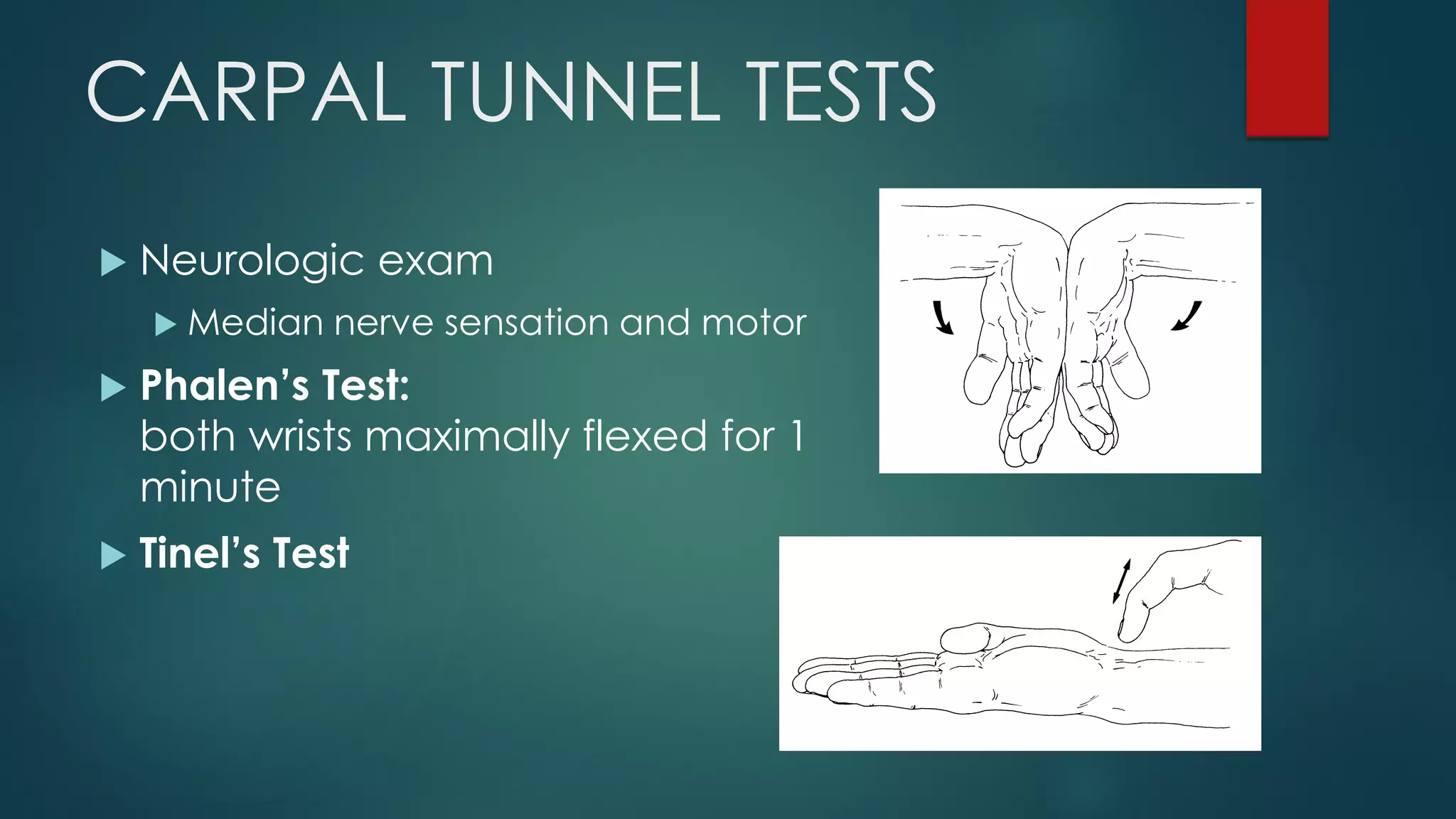
CARPAL TUNNEL TESTS
 Neurologic exam
 Median nerve sensation and motor
 Phalen’s Test:
both wrists maximally flexed for 1
minute
 Tinel’s Test
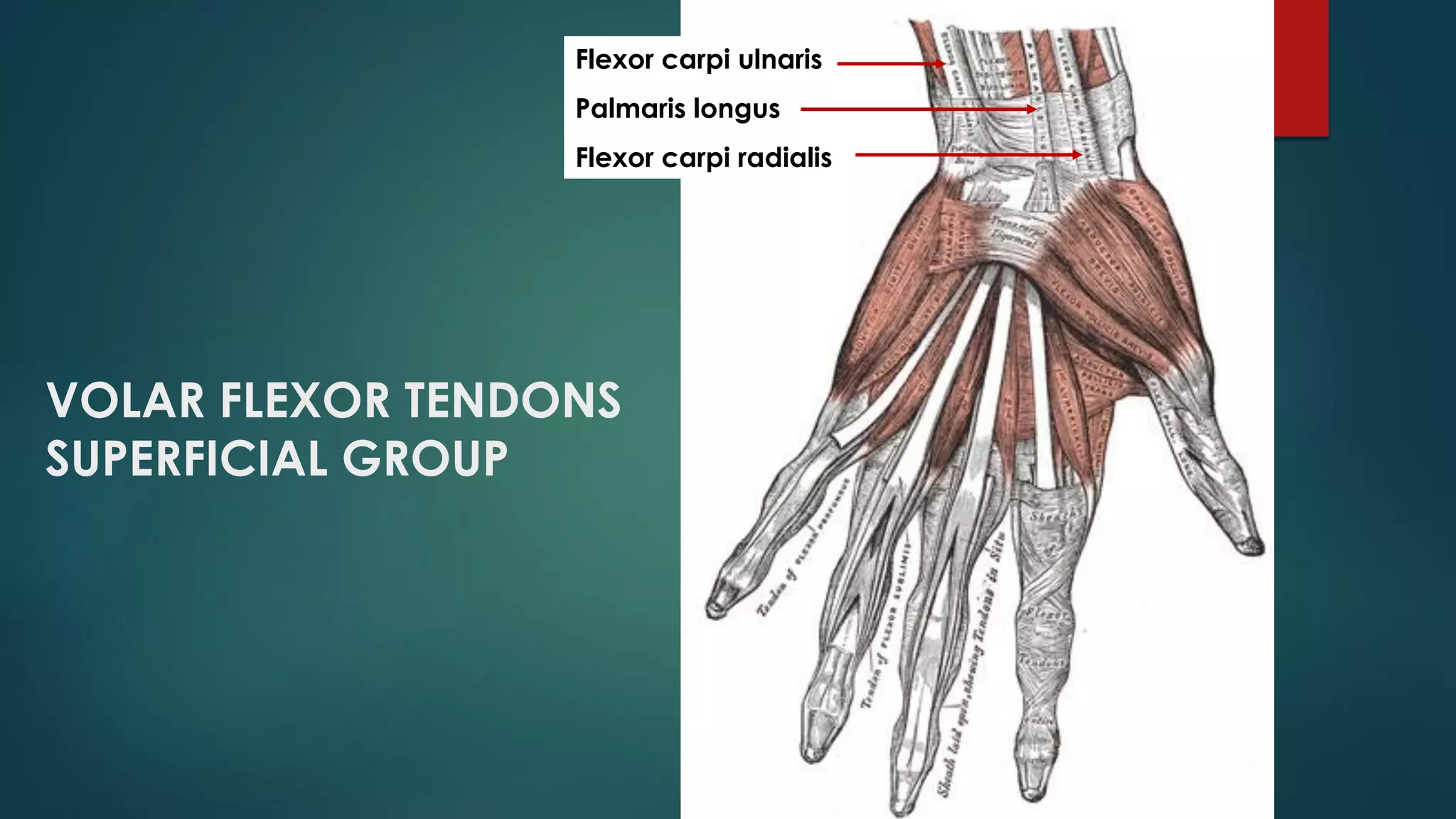
VOLAR FLEXOR TENDONS
SUPERFICIAL GROUP
Flexor carpi ulnaris
Palmaris longus
Flexor carpi radialis
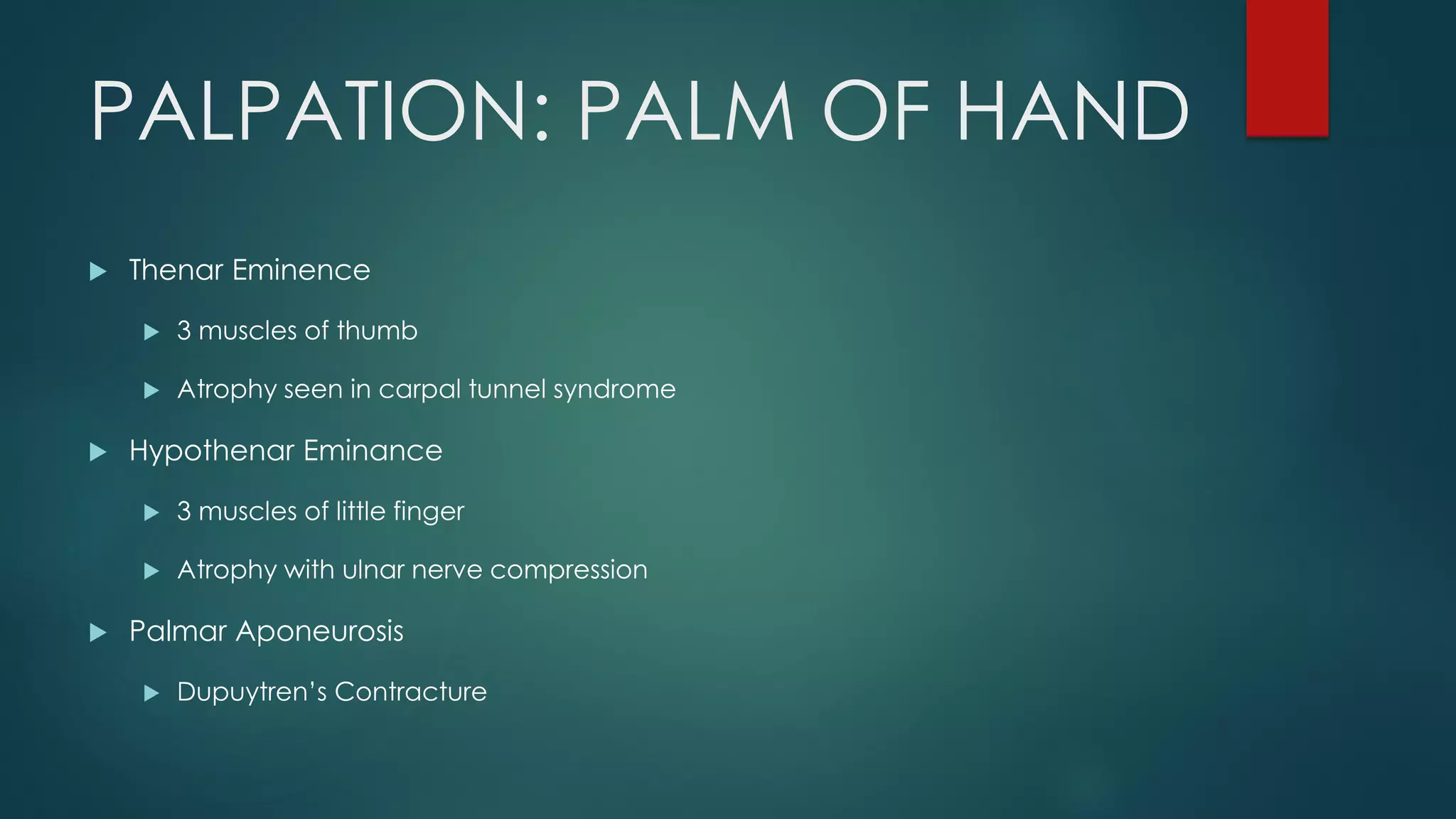
PALPATION: PALM OF HAND
 Thenar Eminence
 3 muscles of thumb
 Atrophy seen in carpal tunnel syndrome
 Hypothenar Eminance
 3 muscles of little finger
 Atrophy with ulnar nerve compression
 Palmar Aponeurosis
 Dupuytren’s Contracture
PALPATION OF FINGERS
 Finger Flexor Tendons
 Trigger Finger- sudden audible snapping with movement of one of the fingers
 Extensor Tendons
 Tufts of Fingers
 Felon- local infection
 Paronychia- hangnail infection
RANGE OF MOTION
 Active range of motion
 Passive range of motion if unable to actively move joint
 Bilateral comparison
 To determine degrees of restriction
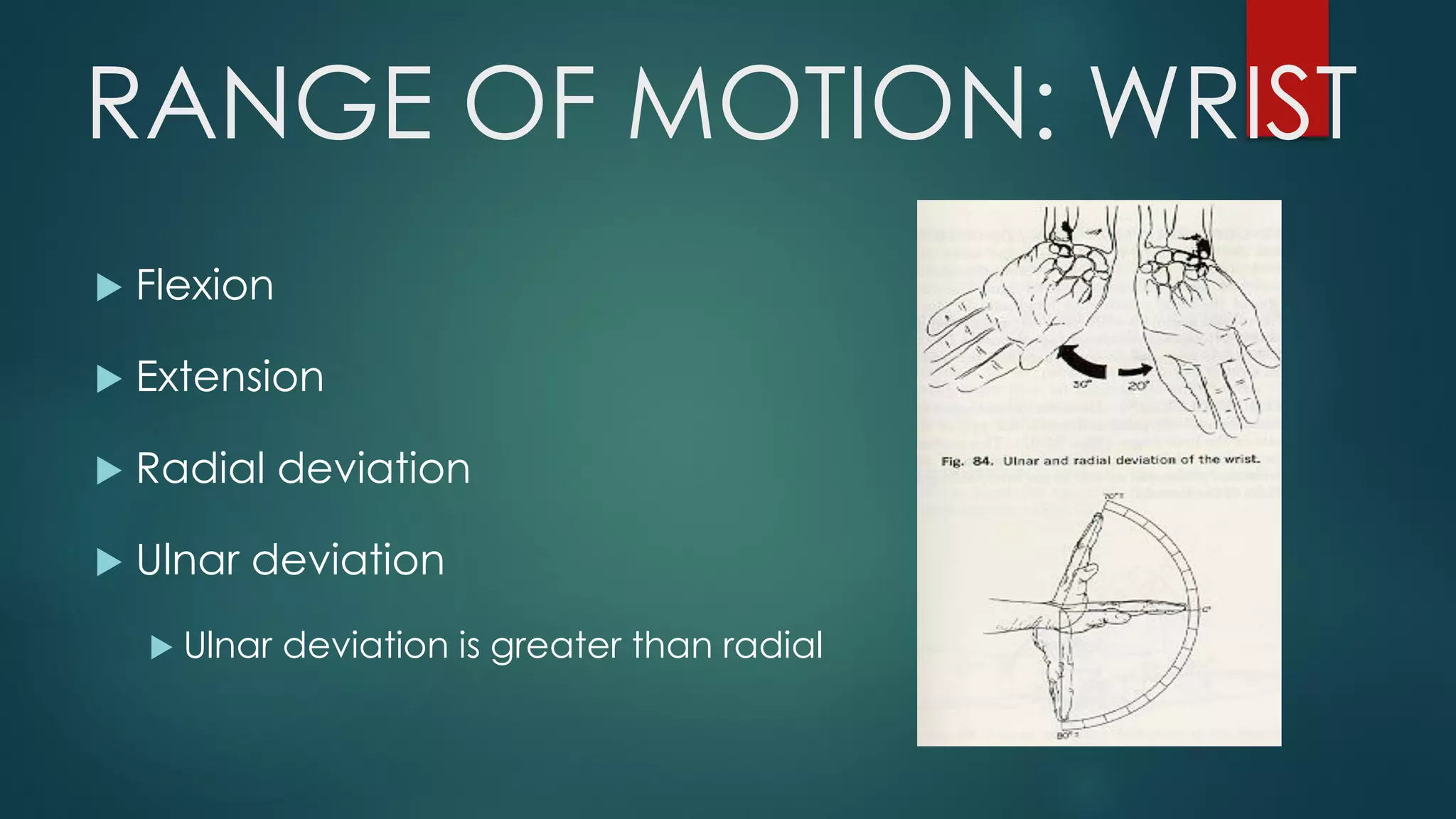
RANGE OF MOTION: WRIST
 Flexion
 Extension
 Radial deviation
 Ulnar deviation
 Ulnar deviation is greater than radial
RANGE OF MOTION: FINGERS
 Flexion/extension at MCP, PIP, DIP
Tight fist and open
Do all fingers work in unison
 Abduction/Adduction at MCP
Spread fingers apart and then back together
RANGE OF MOTION: THUMB
 Thumb flexion/extension at MCP and IP
 Touch pad at base of little finger
 Thumb Abduction/Adduction at carpometacarpal joint
 Opposition
 Touch tip of thumb to tip of each finger
SPECIALTEST
Tap/Percussion Test
MP Torsion/Grind/Compression Test
Transverse Compression Test
Finkelstein Test
Phalen Test
Tinel's Sign Test (Radial & Ulnar Nerve)
Bunnel Littler Test
Murphy's Sign Test
Valgus (Ulnar) Stress Test
Varus (Radial) Stress Test
Froment's Sign Test
Digital Allen's Test
Long Finger Flexion Test
DeQuervain’s Tenosynovitis
 Inflammation of EXT Pollicis Brevis and
ABD Pollicis Longus tendons
 Tenderness - 1st Dorsal Compartment
 Finkelstein’s Test
CARPAL TUNNEL TESTS
 Neurologic exam
 Median nerve sensation and motor
 Phalen’s Test:
both wrists maximally flexed for 1
minute
 Tinel’s Test
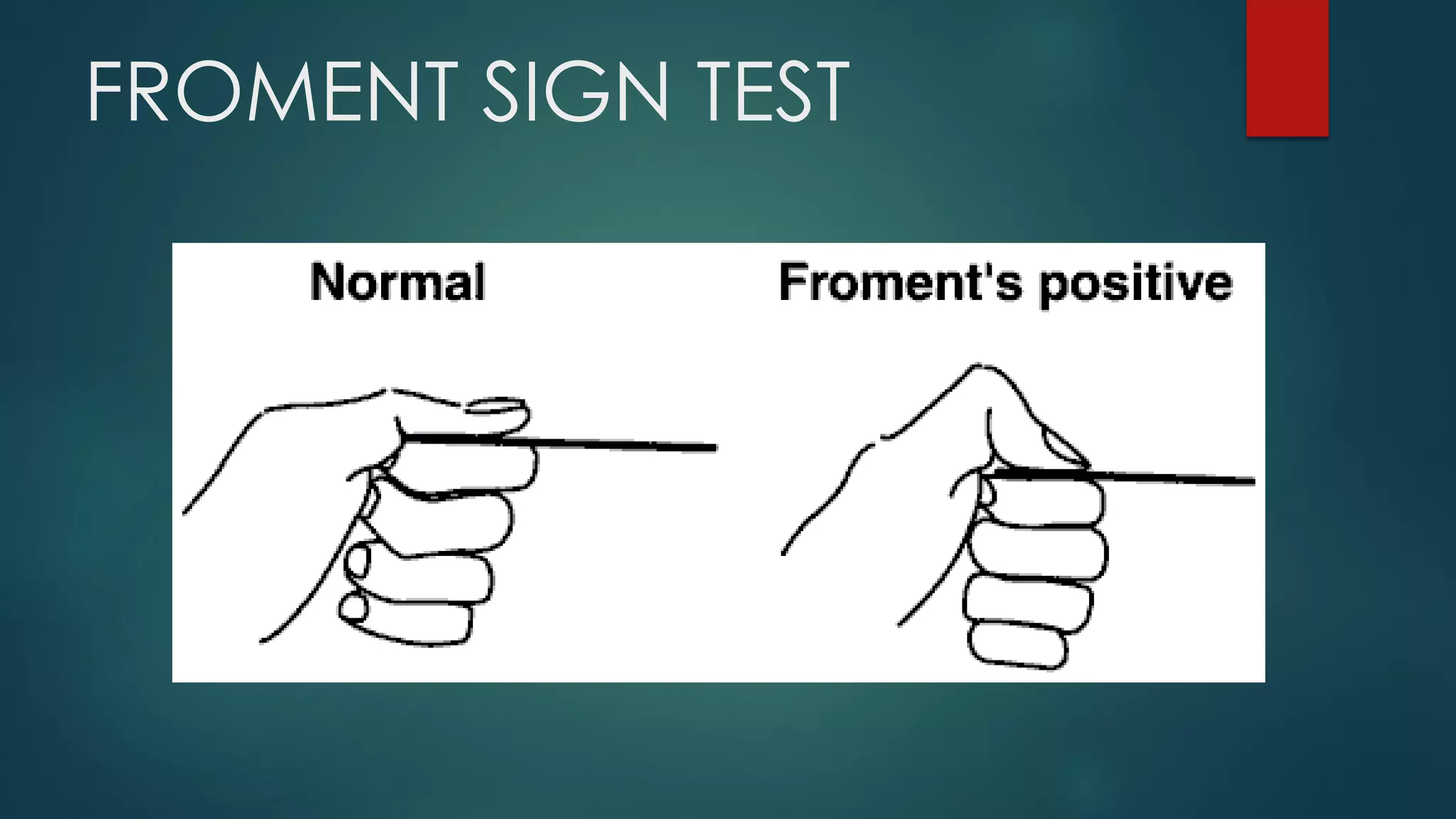
FROMENT SIGN TEST
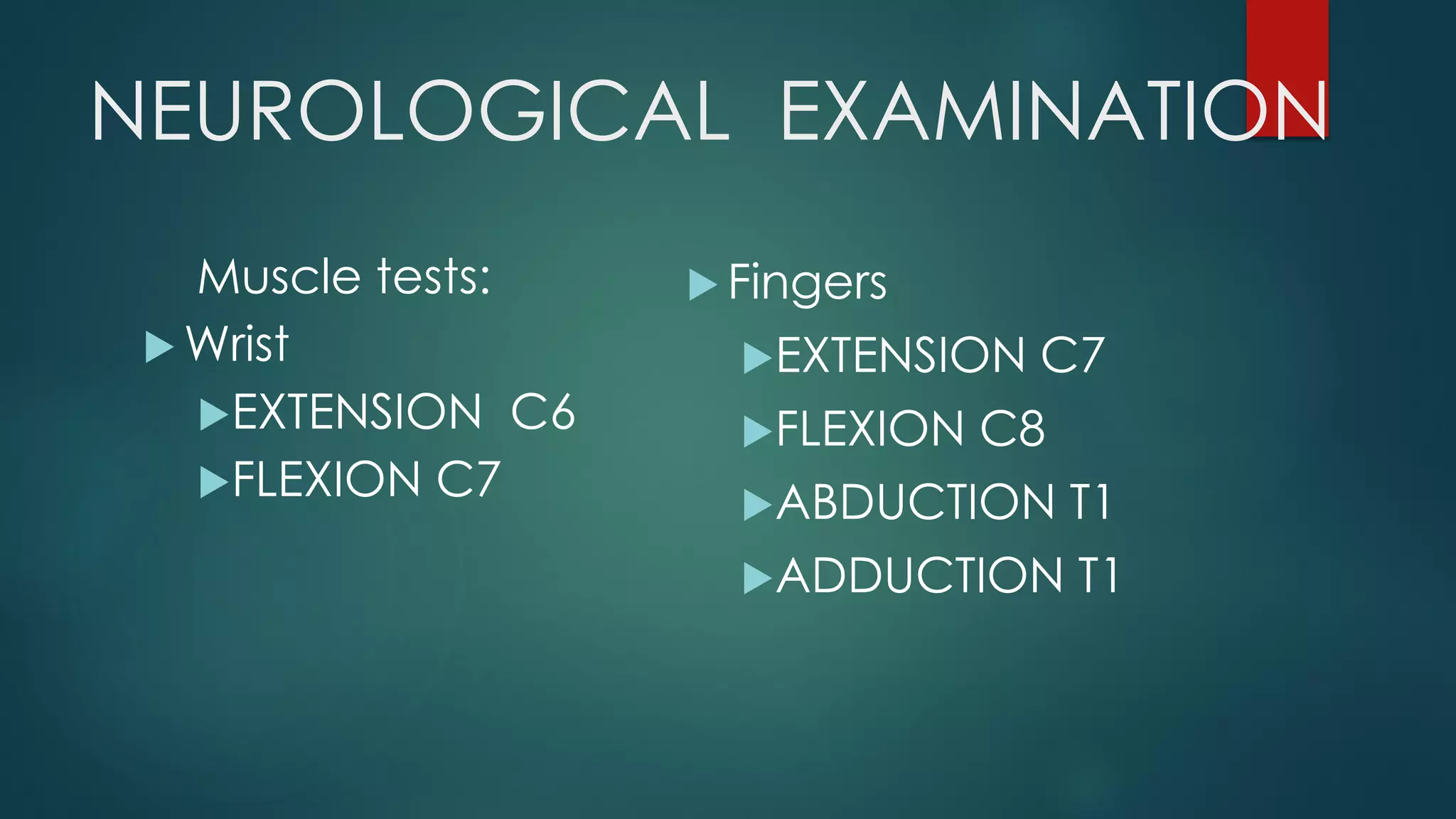
NEUROLOGICAL EXAMINATION
Muscle tests:
 Wrist
EXTENSION C6
FLEXION C7
 Fingers
EXTENSION C7
FLEXION C8
ABDUCTION T1
ADDUCTION T1
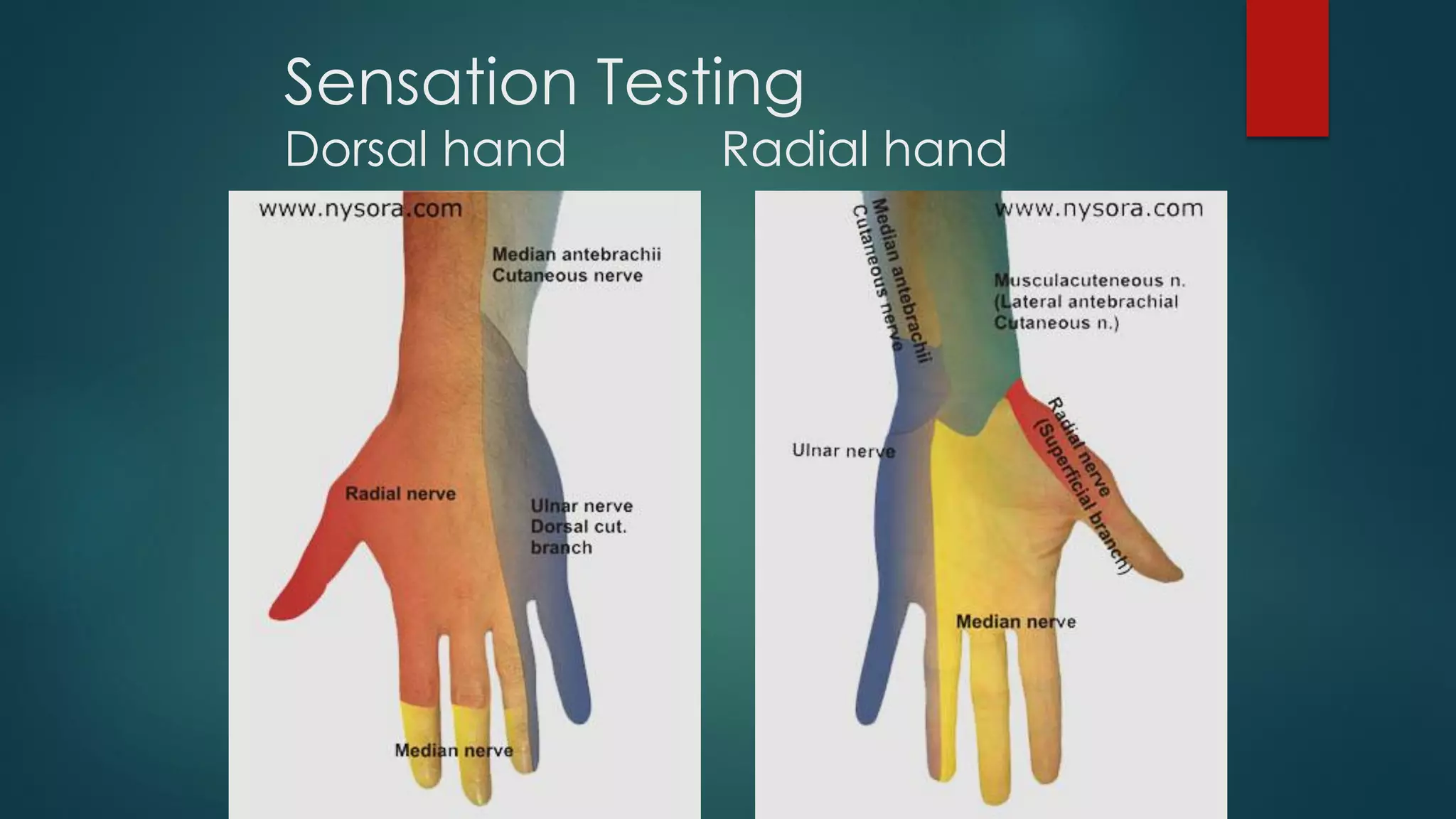
Sensation Testing
Dorsal hand Radial hand
THE END
THANK YOU

PS SESSION : ELBOW WRIST AND HAND EXAMINATION PART 2

  • 1.
    EVALUATION OF WRIST &HAND DR. UTKARSH SHAHI ASSISTANT PROFESSOR DEPARTMENT OF ORTHOPAEDICS
  • 2.
    INTRODUCTION: Hand andWrist  Series of complex, delicately balanced joints  Function is integral to every act of daily living  Most active portion of the upper extremity  The least protected joints  Extremely vulnerable to injury  Difficult and complex examination  Diagnosis often vague  If no fracture = “wrist strain or sprain”  Bilateral comparison useful
  • 3.
    BONY ANATOMY  Phalanges:14  Sesamoids: 2  Metacarpals: 5  Carpals  Proximal row: 4  Distal row: 4  Radius and Ulna
  • 6.
    ANATOMY  Muscles /Tendons Volar wrist- 6  Dorsal wrist- 9  6 compartments  Volar hand- 10  Dorsal hand- dorsal interossei  Nerves - 3  Median  Ulnar  Radial  Arteries - 2
  • 7.
    WRIST AND HANDCONDITIONS Injury and mechanical derangement. Congenital and developmental abnormalities. Infection and inflammation. Arthritis and rheumatic disorders. Metabolic and endocrine disorders. Tumours and lesions that mimic them. Neurological disorders and muscle weakness.
  • 8.
    HISTORY TAKING PATIENT DETAILSCHIEF COMPLAINTS HISTORY OF PRESENT ILLNESS PAST HISTORY FAMILY HISTORY PERSONAL HISTORY TREATMENT HISTORY NEGATIVE HISTORY
  • 9.
    HISTORY  4 principlemechanisms of injury  Throwing  Weight bearing  Twisting  Impact
  • 10.
  • 11.
    PAIN Site Time andmode of onset Severity or Intensity Character or Nature Progression Referred pain Aggravating factors Relieving factors Any diurnal variation Any seasonal variation
  • 12.
    PAIN  The extentof reference is governed by a number of factors.  The depth of the structure beneath the skin.  The position of the structure within the dermatome.  The severity of the lesion
  • 13.
    SITES OF PAINAND COMMON PATHOLOGY  Dorsal pain  Ganglion (#1 cause of dorsal pain)  Extensor tendonitis (overuse)  Kienbach’s Disease  Volar Pain  Ganglion  Flexor tendinitis  Carpal tunnel syndrome  Thumb CMC joint arthritis  Radial pain  Thumb CMC DJD  DeQuervain’s tendinitis  Scaphoid fracture  Ulnar pain  EXT carpi ulnaris tendinitis  Synovitis  Triangular fibrocartilage complex tear
  • 14.
    REFERRED PAIN  Referredpain can be due to:  Herniated cervical discs  Osteoarthritis  Brachial plexus outlet syndrome  Elbow and shoulder entrapment syndrome
  • 15.
    DEFORMITY Site Associated Symptoms • Neurological •Vascular • Articular Amount of disability Time of Onset • Congenital • Developmental • Acquired Correctability • Completely correctable • Partially correctable • Incorrectable
  • 16.
  • 17.
    SWELLING Site Shape Size Firstnotice Associated Symptoms •Pain •Pressure •Neurological •Vascular •Articular Progression Any other swelling Reducibility Any discharge •If present •Duration •Regular or intermittent •Character of discharge
  • 18.
  • 19.
    INSTABILITY Time of Onset •Congenital •Developmental •Acquired Frequency •Singleepisode •Recurrent Aggravating factors Associated symptoms •Pain •Disability •Neurovascular Reducibility •Reducible •Irreducible Associated Illness
  • 20.
  • 21.
    LOSS OF FUNCTION Modeof onset • Sudden • Gradual Duration • Congenital • Chronic • Acute Involved region and function(s) Progression Associated features
  • 22.
    DIFFERENTIAL DIAGNOSIS 1. __ _ _ _ _ _ _ _ _ _ _ _ _ _ _ _ _ _ _ _ _ _ _ 2. _ _ _ _ _ _ _ _ _ _ _ _ _ _ _ _ _ _ _ _ _ _ _ _ 3. _ _ _ _ _ _ _ _ _ _ _ _ _ _ _ _ _ _ _ _ _ _ _ _ 4. _ _ _ _ _ _ _ _ _ _ _ _ _ _ _ _ _ _ _ _ _ _ _ _ 5. _ _ _ _ _ _ _ _ _ _ _ _ _ _ _ _ _ _ _ _ _ _ _ _
  • 23.
    DIFFERENTIALS IN WRIST Wrist Instability  Scapholunate Ligament Injury & DISI  Lunotriquetral Ligament Injury & VISI  SLAC (Scaphoid Lunate Advanced Collapse)  CIND (carpal instability nondissociative)  Lunate Dislocation (Perilunate dissociation)  Wrist Conditions  Ulnar Variance  TFCC Injury  Ulnocarpal Abutment Syndrome  Ulnar Styloid Impaction Syndrome  Kienbock's Disease  Preiser's Disease (Scaphoid AVN)  Gymnast's Wrist (Distal Radial Physeal Stress Syndrome)
  • 24.
    DIFFERENTIALS IN HAND Hand Deformities  Intrinsic Minus Hand (Claw Hand)  Intrinsic Plus Hand  Boutonniere Deformity  Swan Neck Deformity  Mallet Finger  Jersey Finger  Quadrigia Effect  Lumbrical Plus Finger  Hand Trauma  Scaphoid Fracture  Hook of Hamate Fracture  Pisiform Fracture  Base of Thumb FX  Metacarpal FX  MCP Dislocations  Phalanx Dislocations  Phalanx FX  Digital Collateral Ligament Injury  Thumb Collateral Ligament Injury
  • 25.
    DIFFERENTIALS IN HAND Tendon Conditions  De Quervain's Tenosynovitis  Trigger Finger  Extensor Tendon Injuries  Sagittal Band Rupture (traumatic extensor tendon dislocation)  Snapping ECU  Flexor Tendon Injuries  Intersection Syndrome  Flexor Carpi Radialis Tendinitis  Median Neuropathies  Carpal Tunnel Syndrome  AIN Compressive Neuropathy  Pronator Syndrome  Ulnar Neuropathies  Cubital Tunnel Syndrome  Ulnar Tunnel Syndrome  Radial Neuropathies  PIN Compression Syndrome  Radial Tunnel Syndrome  Wartenberg's Syndrome
  • 26.
    DIFFERENTIALS IN HAND Congenital Hand  Cleft Hand  Symphalangism  Camptodactyly  Clinodactyly  Syndactyly  Poland Syndrome  Apert Syndrome  Polydactyly of Hand  Macrodactyly (local gigantism)  Constrictive Ring Syndrome  Streeter's Dysplasia  Congenital Thumb  Thumb Hypoplasia  Congenital Trigger Thumb  Congenital Clasped Thumb  Tumors of the hand  Ganglion Cysts  Epidermal Inclusion Cyst  Anomalous Extensor Tendon  Giant Cell Tumor of Tendon Sheath  Melanoma
  • 27.
    OTHER DIFFERENTIALS INWRIST AND HAND  Vascular Occlusion  Vascular Evaluation of the Hand  Hypothenar Hammer Syndrome  Raynaud's Syndrome  Thromboangiitis Obliterans (Buerger's disease)  Frostbite  Arthritic conditions  Basilar Thumb Arthritis  DIP and PIP Joint Arthritis  Wrist Arthritis  Dupuytren's Disease  Nail Bed  Nail Bed Injury  Infections  Herpetic Whitlow  Paronychia  Felon  Dog and Cat Bites  Human Bite  Pyogenic Flexor Tenosynovitis  Deep Space & Collar Button Infections  Atypical Mycobacterium Infections  Fungal Infections
  • 28.
  • 29.
    PHYSICAL EXAM -GENERAL  Develop a standard routine  Alleviate the patient's fears  Adequate exposure - bilateral  Compare both sides
  • 30.
    GENERAL EXAMINATION Vitals •Pulse •Blood Pressure •RespiratoryRate •Temperature Consciousness Orientation Comfort level Position of Patient Height and Weight General Appearance Pallor Icterus Clubbing Cyanosis Pupillary Reaction Lymphadenopathy Dexterity Anything specific
  • 31.
  • 32.
    REGIONAL EXAMINATION • InspectionLOOK •PalpationFEEL • Active/Passive movement • Strength TestingMOVE • Shortening or Lengthening • Range of Motion • Regional measurements MEASURE • Depends upon specific region in considerationSPECIAL TESTS
  • 33.
    INSPECTION  Observe upperextremity as patient enters room  Examine hand in function  Deformities  Attitude of the hand
  • 34.
    INSPECTION Palmar Surface  Creases Thenar and Hypothenar Eminence  Arched Framework  Hills and Valleys  Web Spaces
  • 35.
    CASCADE SIGN  Assureall fingers point to scaphoid area when flexed at PIPs
  • 36.
    INSPECTION OF DORSALHAND AND WRIST  Hills and Valleys  Height of metacarpal heads  Finger nails  Pale or white=anemia or circulatory  Spoon shaped=fungal infection  Clubbed=respiratory or congenital heart  Deformities
  • 37.
    GANGLION  Cystic structurethat arises from synovial sheath  Discrete mass  Dull ache  Dorsal or Volar aspect
  • 38.
    BOUTONNIERE DEFORMITY  Tearor stretch of the central extensor tendon at PIP  Note: unopposed flexion at PIP  Extension at DIP  Trauma or inflammatory arthritis
  • 39.
    SWAN NECK DEFORMITY Contraction of intrinsic muscles (trauma, RA)  NOTE: Extension at PIP
  • 40.
  • 41.
    RHEUMATOID ARTHRITIS  MCPswelling  Swan neck deformities  Ulnar deviation at MCP joints  Nodules along tendon sheaths
  • 42.
    MALLET FINGER  Hyperflexioninjury  Ruptured terminal extensor mechanism at DIP  Incomplete extension of DIP joint or extensor lag  Treatment: stack splint
  • 43.
    DUPUYTREN’S CONTRACTURES  Palmaror digital fibromatosis  Flexion contracture  Painless nodules near palmar crease  Male> Female  Epilepsy, diabetes, alcoholism
  • 44.
    PALPATION OF WRISTDORSUM  Radial Styloid  Scaphoid  1st MC/Trapezium jt  Lunate  Lister’s Tubercle  Ulnar Styloid  TFCC  Triquetrum  Pisiform  Hook of Hamate  Guyon’s Tunnel
  • 45.
    RADIAL STYLOID ANDSCAPHOID BONE PALPATION Radial styloid
  • 46.
    SCAPHOID FRACTURE  Painful,swollen wrist after a fall  Tenderness in snuffbox  High frequency of nonunion and avascular necrosis  Initial x-rays often unremarkable
  • 47.
  • 48.
  • 49.
    KIENBOCK’S DISEASE  Idiopathicosteonecrosis of lunate  Stress or compression fracture of the lunate  Disruption of blood supply with collapse and secondary fragmentation  Pain and stiffness of the wrist in the ABSENCE of TRAUMA
  • 50.
    SCAPHOLUNATE DISSOCIATION  Diagnosisoften missed  Pain, swelling, and decreased ROM  Pressure over scaphoid tuberosity elicits pain  Greatest pain over dorsal scapholunate area, accentuated with dorsiflexion  X-ray shows widening of scapholunate joint space by at least 3 mm
  • 51.
    ULNAR STYLOID ANDLISTER’S TUBERCLE PALPATION Ulnar styloid
  • 52.
  • 53.
    TRIQUETRUM FRACTURE  2ndmost common carpal fracture  Fall onto outstretched hand with wrist in dorsiflexion and ulnar deviation  Swelling and tenderness over the dorsal ulnar aspect of the wrist
  • 54.
    PALPATION OF HANDBONE Metacarpals- 5 Phalanges - 14 Palpate for swelling, tenderness Assess for symmetry
  • 55.
    PALPATION : SOFTTISSUE  6 Dorsal Compartments  Transport extensor tendons  2 Palmar Tunnels  Transport nerves  Arteries  Flexor tendons
  • 56.
    1ST DORSAL COMPARTMENT Abductor Pollicis Longus and Extensor Pollicis Brevis  Radial border of Anatomic Snuff Box  Site of stenosing tenosynovitis  De Quervain’s Tenosynovitis  Finkelstein’s Test
  • 57.
    DeQuervain’s Tenosynovitis  Inflammationof EXT Pollicis Brevis and ABD Pollicis Longus tendons  Tenderness - 1st Dorsal Compartment  Finkelstein’s Test
  • 58.
    2ND DORSAL COMPARTMENT Extensor Carpi Radialis Longus and Extensor Carpi Radialis Brevis  Make fist—becomes prominent
  • 59.
    INTERSECTION SYNDROME (SQUEAKERWRIST)  Similar to DeQuervain’s tenosynovitis  Peritendinitis related to bursal inflammation at the junction of the 1st and 2nd dorsal compartments  Overuse of the radial extensor of wrist
  • 60.
    3RD DORSAL COMPARTMENT Extensor Pollicis Longus  Ulnar side of Anatomic Snuff Box  Can rupture secondary to Colles’ Fracture or Rheumatoid Arthritis  Extensor Pollicis Longus Tenosynovitis
  • 61.
    4TH DORSAL COMPARTMENT Extensor Digitorum Communis and Extensor Indicis  Palpate from the carpus to the metacarpophalangeal joints  Frequent site of ganglion cysts
  • 62.
    5TH DORSAL COMPARTMENT Extensor Digiti Minimi  May become involved in rheumatoid arthritis  May be subject to attrition  Friction due to dorsal dislocation of the ulnar head  Synovitis
  • 63.
    6TH DORSAL COMPARTMENT Extensor Carpi Ulnaris  Tendinitis -repetitive wrist motion or snap of wrist  May dislocate over the styloid process of the ulna  Seen with Colles’ fracture with associated fracture of the distal ulnar styloid  Audible snap
  • 64.
    EXTENSOR CARPI ULNARISTENOSYNOVITIS & SUBLUXATION  6th Dorsal Compartment  Second most common site of tenosynovitis (after DeQuervain’s)  Common in racket and rowing sports  Pain and tenderness with ulnar deviation  Suspect subluxation when clicking on ulnar side of forearm
  • 65.
    PALPATION: PALMAR ASPECT Pisiform and Hamate  Tunnel of Guyon  Ulnar Artery  Carpal Tunnel  Flexor Carpi Radialis  Flexor Carpi Ulnaris
  • 66.
  • 67.
    HAMATE HOOK FRACTURE Frequently misdiagnosed as tendonitis or sprain  Pain, swelling, and tenderness over hypothenar eminence  Suspect when patient complains of painful griping and swinging
  • 68.
    TUNNEL OF GUYON Depression between pisiform and hook of hamate  Contains ulnar nerve and artery  Site of compression injuries  unusually tender if pathology is present
  • 69.
    ULNAR NERVE COMPRESSION Tunnel of Guyon  Seen in direct or repetitive trauma, fractures of hamate or pisiform, or sports related  Operating a jackhammer  repetitive power gripping (ex. Cycling)  Pain, weakness, paresthesias in ulnar sensory distribution
  • 70.
    CARPAL TUNNEL  Deepto palmaris longus  Contains median nerve and finger flexor tendons  Most common overuse injury of the wrist
  • 71.
    CARPAL TUNNEL SYNDROME Entrapment of the median nerve  Phalen’s and Tinel’s Test  2 point discrimination  Symptoms  Aching in hand and arm  Nocturnal or AM paresthesias  “Shaking” to obtain relief
  • 72.
    CARPAL TUNNEL TESTS Neurologic exam  Median nerve sensation and motor  Phalen’s Test: both wrists maximally flexed for 1 minute  Tinel’s Test
  • 73.
    VOLAR FLEXOR TENDONS SUPERFICIALGROUP Flexor carpi ulnaris Palmaris longus Flexor carpi radialis
  • 74.
    PALPATION: PALM OFHAND  Thenar Eminence  3 muscles of thumb  Atrophy seen in carpal tunnel syndrome  Hypothenar Eminance  3 muscles of little finger  Atrophy with ulnar nerve compression  Palmar Aponeurosis  Dupuytren’s Contracture
  • 75.
    PALPATION OF FINGERS Finger Flexor Tendons  Trigger Finger- sudden audible snapping with movement of one of the fingers  Extensor Tendons  Tufts of Fingers  Felon- local infection  Paronychia- hangnail infection
  • 76.
    RANGE OF MOTION Active range of motion  Passive range of motion if unable to actively move joint  Bilateral comparison  To determine degrees of restriction
  • 77.
    RANGE OF MOTION:WRIST  Flexion  Extension  Radial deviation  Ulnar deviation  Ulnar deviation is greater than radial
  • 78.
    RANGE OF MOTION:FINGERS  Flexion/extension at MCP, PIP, DIP Tight fist and open Do all fingers work in unison  Abduction/Adduction at MCP Spread fingers apart and then back together
  • 79.
    RANGE OF MOTION:THUMB  Thumb flexion/extension at MCP and IP  Touch pad at base of little finger  Thumb Abduction/Adduction at carpometacarpal joint  Opposition  Touch tip of thumb to tip of each finger
  • 81.
    SPECIALTEST Tap/Percussion Test MP Torsion/Grind/CompressionTest Transverse Compression Test Finkelstein Test Phalen Test Tinel's Sign Test (Radial & Ulnar Nerve) Bunnel Littler Test Murphy's Sign Test Valgus (Ulnar) Stress Test Varus (Radial) Stress Test Froment's Sign Test Digital Allen's Test Long Finger Flexion Test
  • 82.
    DeQuervain’s Tenosynovitis  Inflammationof EXT Pollicis Brevis and ABD Pollicis Longus tendons  Tenderness - 1st Dorsal Compartment  Finkelstein’s Test
  • 83.
    CARPAL TUNNEL TESTS Neurologic exam  Median nerve sensation and motor  Phalen’s Test: both wrists maximally flexed for 1 minute  Tinel’s Test
  • 84.
  • 85.
    NEUROLOGICAL EXAMINATION Muscle tests: Wrist EXTENSION C6 FLEXION C7  Fingers EXTENSION C7 FLEXION C8 ABDUCTION T1 ADDUCTION T1
  • 86.
  • 87.