NEUROCUTANEOUS
SYNDROME
Guide-Dr.Karan Joshi
References:-
• Nelson-Textbook of Pediatrics 19th Edition
• Rudolph-textbook of Pediatrics 21st Edition
• Illustrated synopsis of Dermatology and
sexually transmitted diseases- 3rd
Edition….Neena Khanna
• Medscape.com
OUTLINE-
• Introduction
• Various Syndromes
• Epidemiology
• Etiology
• Clinical Features
• Diagnosis
• Treatment
INTRODUCTION
 Heterogenous group of disorders
characterised by the abnormalities of
integument and CNS.
 Mostly familial.
 Defect in differentiation in primitive
ectoderm .
The various syndromes include-
• Neurofibromatosis
• Tuberous Sclerosis
• Sturge Weber Syndrome
• Von Hippel Lindau Syndrome
• PHACE Syndrome
• Linear nevus Syndrome
• Incontinentia Pigmenti
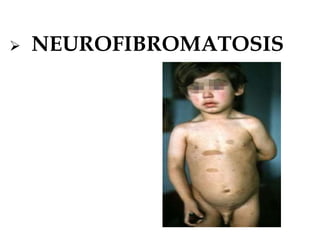
 NEUROFIBROMATOSIS
INTRODUCTION-
 NF1 and NF2 are autosomal dominant.
 50% of cases having no family history.
 NF1 is also called Von Recklinghausen disease.
 NF2 is also called bilateral acoustic
neurofibromatosis
ETIOLOGY
 NF1 is caused by DNA mutations located on the long arm
of chromosome 17
 NF2 is caused by DNA mutations located in the middle of
the long arm of chromosome 22
EPIDEMIOLOGY AND DEMOGRAPHICS
 NF 1 is the most common neurocutaneous
syndrome, affecting approximately 1/3000
persons.
 NF 2 occurs in about 1/50,000
 Equally affects males and females.
COMMON FEATURES
&
PRESENTATION
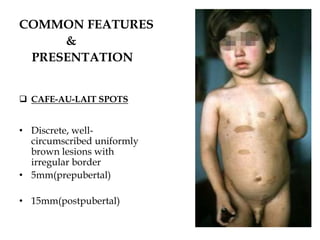
 CAFE-AU-LAIT SPOTS
• Discrete, well-
circumscribed uniformly
brown lesions with
irregular border
• 5mm(prepubertal)
• 15mm(postpubertal)
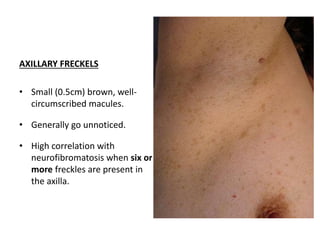
AXILLARY FRECKELS
• Small (0.5cm) brown, well-
circumscribed macules.
• Generally go unnoticed.
• High correlation with
neurofibromatosis when six or
more freckles are present in
the axilla.
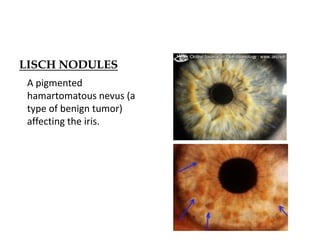
LISCH NODULES
A pigmented
hamartomatous nevus (a
type of benign tumor)
affecting the iris.
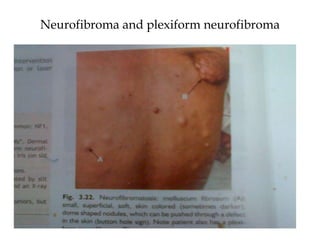
Neurofibroma and plexiform neurofibroma
Common features of NF2 include:
 Hearing loss and tinnitus
 Cataracts
 Headache
 Unsteady gait
 Cutaneous neurofibromas
 Café-au-lait macules (1%)
DIAGNOSTIC CRITERIA
NF1 is diagnosed if any 2 of the following 7 are
present:-
» Six or more café-au-lait macules >5 mm in prepubertal
patients and >15 mm in postpubertal patients
» Two or more neurofibromas of any type or one
plexiform neurofibroma
» Axillary or inguinal freckling
» Optic glioma
» Two or more Lisch nodules
» Sphenoid wing dysplasia or cortical thinning of long
bones, with or without pseudarthrosis
» A first-degree relative (parent, sibling, or child) with
NF1 based on the previous criteria
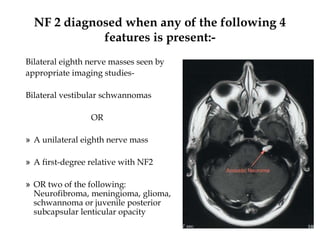
NF 2 diagnosed when any of the following 4
features is present:-
Bilateral eighth nerve masses seen by
appropriate imaging studies-
Bilateral vestibular schwannomas
OR
» A unilateral eighth nerve mass
» A first-degree relative with NF2
» OR two of the following:
Neurofibroma, meningioma, glioma,
schwannoma or juvenile posterior
subcapsular lenticular opacity
WORKUP AND TREATMENT
• Genetic counselling
• Molecular testing
• MRI
MANAGEMENT-
• Supportive &Symptomatic
• Neurologic and educational testing
• Close & disciplinary follow up
• Surgical
All symptomatic cases( visual disturbance,proptosis,
raised ICT) should be assesed without any delay
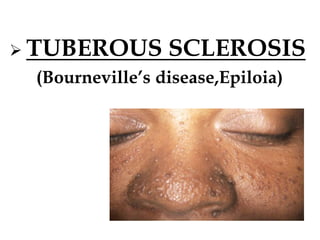
 TUBEROUS SCLEROSIS
(Bourneville’s disease,Epiloia)
INTRODUCTION
• The classic clinical Triad is Skin lesions in association with
Epilepsy and Mental retardation.
• Multisystemic disorder.
ETIOLOGY AND EPIDEMIOLOGY
• Autosomal dominant disorder
• Frequency 1/6,000
• Mutations occur on chromosome 9q34 (TSC1) and 16p13.3
(TSC2). TSC1 gene encode hamartin and TSC2 encodes
tuberin
• Half of cases are due to new mutations.
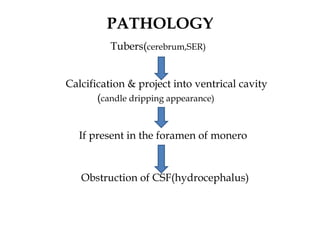
PATHOLOGY
Tubers(cerebrum,SER)
Calcification & project into ventrical cavity
(candle dripping appearance)
If present in the foramen of monero
Obstruction of CSF(hydrocephalus)
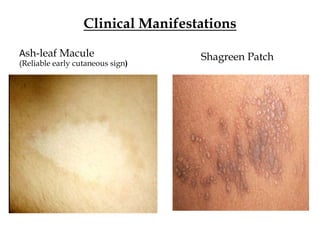
Clinical Manifestations
Ash-leaf Macule
(Reliable early cutaneous sign)
Shagreen Patch
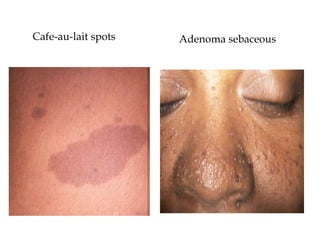
Cafe-au-lait spots Adenoma sebaceous
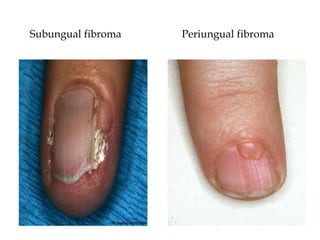
Subungual fibroma Periungual fibroma
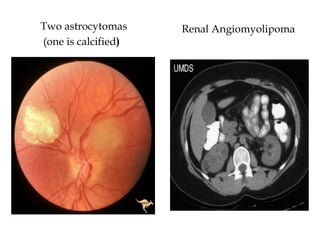
Two astrocytomas
(one is calcified)
Renal Angiomyolipoma
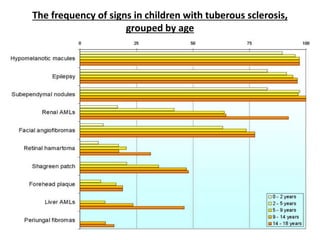
The frequency of signs in children with tuberous sclerosis,
grouped by age
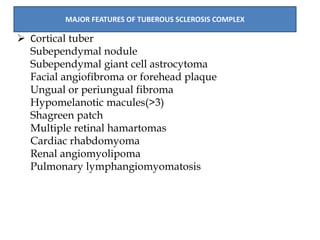
 Cortical tuber
Subependymal nodule
Subependymal giant cell astrocytoma
Facial angiofibroma or forehead plaque
Ungual or periungual fibroma
Hypomelanotic macules(>3)
Shagreen patch
Multiple retinal hamartomas
Cardiac rhabdomyoma
Renal angiomyolipoma
Pulmonary lymphangiomyomatosis
MAJOR FEATURES OF TUBEROUS SCLEROSIS COMPLEX
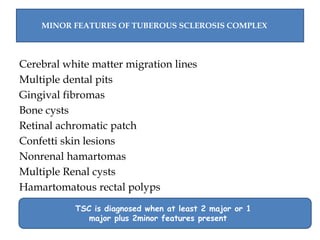
Cerebral white matter migration lines
Multiple dental pits
Gingival fibromas
Bone cysts
Retinal achromatic patch
Confetti skin lesions
Nonrenal hamartomas
Multiple Renal cysts
Hamartomatous rectal polyps
MINOR FEATURES OF TUBEROUS SCLEROSIS COMPLEX
TSC is diagnosed when at least 2 major or 1
major plus 2minor features present
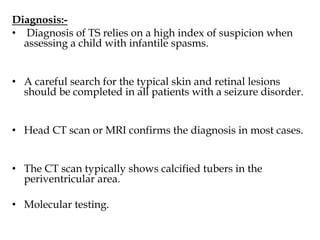
Diagnosis:-
• Diagnosis of TS relies on a high index of suspicion when
assessing a child with infantile spasms.
• A careful search for the typical skin and retinal lesions
should be completed in all patients with a seizure disorder.
• Head CT scan or MRI confirms the diagnosis in most cases.
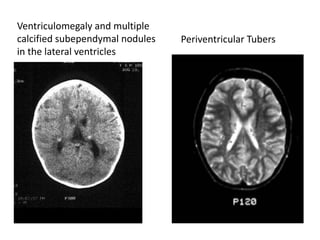
• The CT scan typically shows calcified tubers in the
periventricular area.
• Molecular testing.
Ventriculomegaly and multiple
calcified subependymal nodules
in the lateral ventricles
Periventricular Tubers
 MANAGEMENT:-
 Control seizures
 Infantile spasms associated with TSC, should be
given viagabatrin.
 Prognosis:
 75% of patients with tuberous sclerosis die before the
age of 25 yr, most commonly as a complication of:
– Epilepsy
– Intercurrent infection
– Cardiac failure
– Pulmonary fibrosis
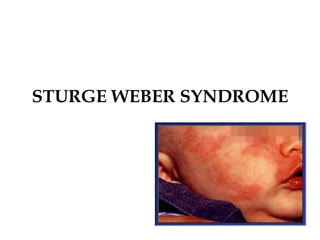
STURGE WEBER SYNDROME
INTRODUCTION-
• Occurs sporadically, with a frequency of approximately
1/50,000 and consists of:
• Facial capillary malformation (port-wine stain)
• Leptomeningeal angioma
Patient presents with-
• Seizures
• Hemiparesis
• Transient Stroke
• Headache
• Developmental delay
Clinical manifestations
• The facial nevus is present at birth,mostly unilateral and always
involves the upper face and eyelid.
• Unilateral in 70% and ipsilateral to the venous angioma of the pia
• Even when the facial nevus is bilateral,the pial angioma is usually
unilateral
• Buphthalmos and glaucoma of the ipsilateral eye are a common
complication
• Seizures
• Hemiparesis
• Mental retardation and learning disabilities(50%)
Diagnosis
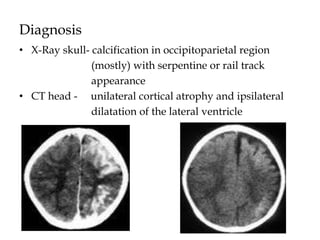
• X-Ray skull- calcification in occipitoparietal region
(mostly) with serpentine or rail track
appearance
• CT head - unilateral cortical atrophy and ipsilateral
dilatation of the lateral ventricle
• Ophthalmologic evaluation( ROACH SCALE)
Type I: Both facial and leptomeningeal angiomas,
may have glaucoma
Type II: Facial Angioma alone,may have glaucoma
Type III: Isolated leptomeningeal angiomas, no
glaucoma
Management
• Treat seizure
• Hemispherectomy or lobectomy
• Regular measurements of intraocular
pressure with a tenonometer is indicated.
• Flashlamp-pulsed laser therapy
• Special educational facilities
VON HIPPEL LINDAU DISEASE
• Autosomal dominant
• Affects many organs include cerebellum, spinal cord,
medulla, retina, kidney, pancreas, and epididymis.
• Gene mapped in VHL is chromosome 3p25.
• The major neurologic features include
– Cerebellar hemangioblastomas
– Retinal angiomas
• Patients with cerebellar hemangioblastoma(25%)have
retinal angiomas
• Vision is unaffected
• Retinal detachment and visual loss.
MANAGEMENT
• Retinal angiomas should be treated with
photocoagulation and cryocoagulation
• Regular follow-up and appropriate imaging studies
Renal carcinoma is the most common cause of
death
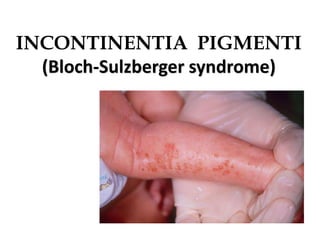
INCONTINENTIA PIGMENTI
(Bloch-Sulzberger syndrome)
INTRODUCTION
• X-linked, dominantly inherited disorder of skin
pigmentation associated with CNS, ocular, and
dental abnormalities.
• Female carriers may have features of stage IV
and dental abnormalities
• Lethal in the majority of affected males
• Nuclear factor kappa B essential modulator
(NEMO) is located at Xq28.
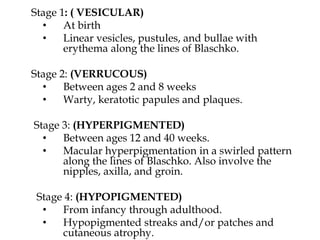
Stage 1: ( VESICULAR)
• At birth
• Linear vesicles, pustules, and bullae with
erythema along the lines of Blaschko.
Stage 2: (VERRUCOUS)
• Between ages 2 and 8 weeks
• Warty, keratotic papules and plaques.
Stage 3: (HYPERPIGMENTED)
• Between ages 12 and 40 weeks.
• Macular hyperpigmentation in a swirled pattern
along the lines of Blaschko. Also involve the
nipples, axilla, and groin.
Stage 4: (HYPOPIGMENTED)
• From infancy through adulthood.
• Hypopigmented streaks and/or patches and
cutaneous atrophy.
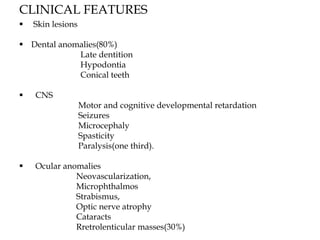
CLINICAL FEATURES
 Skin lesions
 Dental anomalies(80%)
Late dentition
Hypodontia
Conical teeth
 CNS
Motor and cognitive developmental retardation
Seizures
Microcephaly
Spasticity
Paralysis(one third).
 Ocular anomalies
Neovascularization,
Microphthalmos
Strabismus,
Optic nerve atrophy
Cataracts
Rretrolenticular masses(30%)
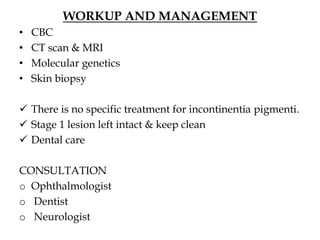
WORKUP AND MANAGEMENT
• CBC
• CT scan & MRI
• Molecular genetics
• Skin biopsy
 There is no specific treatment for incontinentia pigmenti.
 Stage 1 lesion left intact & keep clean
 Dental care
CONSULTATION
o Ophthalmologist
o Dentist
o Neurologist
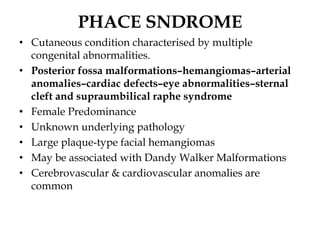
PHACE SNDROME
• Cutaneous condition characterised by multiple
congenital abnormalities.
• Posterior fossa malformations–hemangiomas–arterial
anomalies–cardiac defects–eye abnormalities–sternal
cleft and supraumbilical raphe syndrome
• Female Predominance
• Unknown underlying pathology
• Large plaque-type facial hemangiomas
• May be associated with Dandy Walker Malformations
• Cerebrovascular & cardiovascular anomalies are
common
LINEAR NEVUS SYNDROME
• Characterized by a facial nevus and neurodevelopmental
abnormalities.
• Nevus is located on the forehead and nose
• Midline in its distribution.
PATHLOGY-
Facial nevus includes 3 stages-
1st- Infancy
Alopecia
Hypoplastic sebaceous glands
2nd-Puberty
Hyperplastic sebaceous glands
3rd-Later in life
Tumors(15-20%)
CLINICAL FEATURES-
• Skin
Facial nevus
• CNS
Seizures
Hemiparesis
Mental retardation
• Occular
Esotropia
Coloboma(iris &choroid)
Homonymous hemianopia
• Others
COA,VSD,Wilms tumor,nephroblastoma,scoliosis,
bony hypertrophy
WORKUP AND MANAGEMENT
 CT scan & MRI
 EEG
 No specific treatment
 Treat seizures
 Multidisciplinary approach
THANKS
Dr.Yashomati Parte

Neurocutaneous

  • 1.
  • 2.
    References:- • Nelson-Textbook ofPediatrics 19th Edition • Rudolph-textbook of Pediatrics 21st Edition • Illustrated synopsis of Dermatology and sexually transmitted diseases- 3rd Edition….Neena Khanna • Medscape.com
  • 3.
    OUTLINE- • Introduction • VariousSyndromes • Epidemiology • Etiology • Clinical Features • Diagnosis • Treatment
  • 4.
    INTRODUCTION  Heterogenous groupof disorders characterised by the abnormalities of integument and CNS.  Mostly familial.  Defect in differentiation in primitive ectoderm .
  • 5.
    The various syndromesinclude- • Neurofibromatosis • Tuberous Sclerosis • Sturge Weber Syndrome • Von Hippel Lindau Syndrome • PHACE Syndrome • Linear nevus Syndrome • Incontinentia Pigmenti
  • 6.
  • 7.
    INTRODUCTION-  NF1 andNF2 are autosomal dominant.  50% of cases having no family history.  NF1 is also called Von Recklinghausen disease.  NF2 is also called bilateral acoustic neurofibromatosis ETIOLOGY  NF1 is caused by DNA mutations located on the long arm of chromosome 17  NF2 is caused by DNA mutations located in the middle of the long arm of chromosome 22
  • 8.
    EPIDEMIOLOGY AND DEMOGRAPHICS NF 1 is the most common neurocutaneous syndrome, affecting approximately 1/3000 persons.  NF 2 occurs in about 1/50,000  Equally affects males and females.
  • 9.
    COMMON FEATURES & PRESENTATION  CAFE-AU-LAITSPOTS • Discrete, well- circumscribed uniformly brown lesions with irregular border • 5mm(prepubertal) • 15mm(postpubertal)
  • 10.
    AXILLARY FRECKELS • Small(0.5cm) brown, well- circumscribed macules. • Generally go unnoticed. • High correlation with neurofibromatosis when six or more freckles are present in the axilla.
  • 11.
    LISCH NODULES A pigmented hamartomatousnevus (a type of benign tumor) affecting the iris.
  • 12.
  • 13.
    Common features ofNF2 include:  Hearing loss and tinnitus  Cataracts  Headache  Unsteady gait  Cutaneous neurofibromas  Café-au-lait macules (1%)
  • 14.
    DIAGNOSTIC CRITERIA NF1 isdiagnosed if any 2 of the following 7 are present:- » Six or more café-au-lait macules >5 mm in prepubertal patients and >15 mm in postpubertal patients » Two or more neurofibromas of any type or one plexiform neurofibroma » Axillary or inguinal freckling » Optic glioma » Two or more Lisch nodules » Sphenoid wing dysplasia or cortical thinning of long bones, with or without pseudarthrosis » A first-degree relative (parent, sibling, or child) with NF1 based on the previous criteria
  • 15.
    NF 2 diagnosedwhen any of the following 4 features is present:- Bilateral eighth nerve masses seen by appropriate imaging studies- Bilateral vestibular schwannomas OR » A unilateral eighth nerve mass » A first-degree relative with NF2 » OR two of the following: Neurofibroma, meningioma, glioma, schwannoma or juvenile posterior subcapsular lenticular opacity
  • 16.
    WORKUP AND TREATMENT •Genetic counselling • Molecular testing • MRI MANAGEMENT- • Supportive &Symptomatic • Neurologic and educational testing • Close & disciplinary follow up • Surgical All symptomatic cases( visual disturbance,proptosis, raised ICT) should be assesed without any delay
  • 17.
  • 18.
    INTRODUCTION • The classicclinical Triad is Skin lesions in association with Epilepsy and Mental retardation. • Multisystemic disorder. ETIOLOGY AND EPIDEMIOLOGY • Autosomal dominant disorder • Frequency 1/6,000 • Mutations occur on chromosome 9q34 (TSC1) and 16p13.3 (TSC2). TSC1 gene encode hamartin and TSC2 encodes tuberin • Half of cases are due to new mutations.
  • 19.
    PATHOLOGY Tubers(cerebrum,SER) Calcification & projectinto ventrical cavity (candle dripping appearance) If present in the foramen of monero Obstruction of CSF(hydrocephalus)
  • 20.
    Clinical Manifestations Ash-leaf Macule (Reliableearly cutaneous sign) Shagreen Patch
  • 21.
  • 22.
  • 23.
    Two astrocytomas (one iscalcified) Renal Angiomyolipoma
  • 24.
    The frequency ofsigns in children with tuberous sclerosis, grouped by age
  • 25.
     Cortical tuber Subependymalnodule Subependymal giant cell astrocytoma Facial angiofibroma or forehead plaque Ungual or periungual fibroma Hypomelanotic macules(>3) Shagreen patch Multiple retinal hamartomas Cardiac rhabdomyoma Renal angiomyolipoma Pulmonary lymphangiomyomatosis MAJOR FEATURES OF TUBEROUS SCLEROSIS COMPLEX
  • 26.
    Cerebral white mattermigration lines Multiple dental pits Gingival fibromas Bone cysts Retinal achromatic patch Confetti skin lesions Nonrenal hamartomas Multiple Renal cysts Hamartomatous rectal polyps MINOR FEATURES OF TUBEROUS SCLEROSIS COMPLEX TSC is diagnosed when at least 2 major or 1 major plus 2minor features present
  • 27.
    Diagnosis:- • Diagnosis ofTS relies on a high index of suspicion when assessing a child with infantile spasms. • A careful search for the typical skin and retinal lesions should be completed in all patients with a seizure disorder. • Head CT scan or MRI confirms the diagnosis in most cases. • The CT scan typically shows calcified tubers in the periventricular area. • Molecular testing.
  • 28.
    Ventriculomegaly and multiple calcifiedsubependymal nodules in the lateral ventricles Periventricular Tubers
  • 29.
     MANAGEMENT:-  Controlseizures  Infantile spasms associated with TSC, should be given viagabatrin.  Prognosis:  75% of patients with tuberous sclerosis die before the age of 25 yr, most commonly as a complication of: – Epilepsy – Intercurrent infection – Cardiac failure – Pulmonary fibrosis
  • 30.
  • 31.
    INTRODUCTION- • Occurs sporadically,with a frequency of approximately 1/50,000 and consists of: • Facial capillary malformation (port-wine stain) • Leptomeningeal angioma Patient presents with- • Seizures • Hemiparesis • Transient Stroke • Headache • Developmental delay
  • 32.
    Clinical manifestations • Thefacial nevus is present at birth,mostly unilateral and always involves the upper face and eyelid. • Unilateral in 70% and ipsilateral to the venous angioma of the pia • Even when the facial nevus is bilateral,the pial angioma is usually unilateral • Buphthalmos and glaucoma of the ipsilateral eye are a common complication • Seizures • Hemiparesis • Mental retardation and learning disabilities(50%)
  • 33.
    Diagnosis • X-Ray skull-calcification in occipitoparietal region (mostly) with serpentine or rail track appearance • CT head - unilateral cortical atrophy and ipsilateral dilatation of the lateral ventricle
  • 34.
    • Ophthalmologic evaluation(ROACH SCALE) Type I: Both facial and leptomeningeal angiomas, may have glaucoma Type II: Facial Angioma alone,may have glaucoma Type III: Isolated leptomeningeal angiomas, no glaucoma
  • 35.
    Management • Treat seizure •Hemispherectomy or lobectomy • Regular measurements of intraocular pressure with a tenonometer is indicated. • Flashlamp-pulsed laser therapy • Special educational facilities
  • 36.
    VON HIPPEL LINDAUDISEASE • Autosomal dominant • Affects many organs include cerebellum, spinal cord, medulla, retina, kidney, pancreas, and epididymis. • Gene mapped in VHL is chromosome 3p25. • The major neurologic features include – Cerebellar hemangioblastomas – Retinal angiomas
  • 37.
    • Patients withcerebellar hemangioblastoma(25%)have retinal angiomas • Vision is unaffected • Retinal detachment and visual loss. MANAGEMENT • Retinal angiomas should be treated with photocoagulation and cryocoagulation • Regular follow-up and appropriate imaging studies Renal carcinoma is the most common cause of death
  • 38.
  • 39.
    INTRODUCTION • X-linked, dominantlyinherited disorder of skin pigmentation associated with CNS, ocular, and dental abnormalities. • Female carriers may have features of stage IV and dental abnormalities • Lethal in the majority of affected males • Nuclear factor kappa B essential modulator (NEMO) is located at Xq28.
  • 40.
    Stage 1: (VESICULAR) • At birth • Linear vesicles, pustules, and bullae with erythema along the lines of Blaschko. Stage 2: (VERRUCOUS) • Between ages 2 and 8 weeks • Warty, keratotic papules and plaques. Stage 3: (HYPERPIGMENTED) • Between ages 12 and 40 weeks. • Macular hyperpigmentation in a swirled pattern along the lines of Blaschko. Also involve the nipples, axilla, and groin. Stage 4: (HYPOPIGMENTED) • From infancy through adulthood. • Hypopigmented streaks and/or patches and cutaneous atrophy.
  • 41.
    CLINICAL FEATURES  Skinlesions  Dental anomalies(80%) Late dentition Hypodontia Conical teeth  CNS Motor and cognitive developmental retardation Seizures Microcephaly Spasticity Paralysis(one third).  Ocular anomalies Neovascularization, Microphthalmos Strabismus, Optic nerve atrophy Cataracts Rretrolenticular masses(30%)
  • 42.
    WORKUP AND MANAGEMENT •CBC • CT scan & MRI • Molecular genetics • Skin biopsy  There is no specific treatment for incontinentia pigmenti.  Stage 1 lesion left intact & keep clean  Dental care CONSULTATION o Ophthalmologist o Dentist o Neurologist
  • 43.
    PHACE SNDROME • Cutaneouscondition characterised by multiple congenital abnormalities. • Posterior fossa malformations–hemangiomas–arterial anomalies–cardiac defects–eye abnormalities–sternal cleft and supraumbilical raphe syndrome • Female Predominance • Unknown underlying pathology • Large plaque-type facial hemangiomas • May be associated with Dandy Walker Malformations • Cerebrovascular & cardiovascular anomalies are common
  • 44.
    LINEAR NEVUS SYNDROME •Characterized by a facial nevus and neurodevelopmental abnormalities. • Nevus is located on the forehead and nose • Midline in its distribution. PATHLOGY- Facial nevus includes 3 stages- 1st- Infancy Alopecia Hypoplastic sebaceous glands 2nd-Puberty Hyperplastic sebaceous glands 3rd-Later in life Tumors(15-20%)
  • 45.
    CLINICAL FEATURES- • Skin Facialnevus • CNS Seizures Hemiparesis Mental retardation • Occular Esotropia Coloboma(iris &choroid) Homonymous hemianopia • Others COA,VSD,Wilms tumor,nephroblastoma,scoliosis, bony hypertrophy
  • 46.
    WORKUP AND MANAGEMENT CT scan & MRI  EEG  No specific treatment  Treat seizures  Multidisciplinary approach
  • 47.