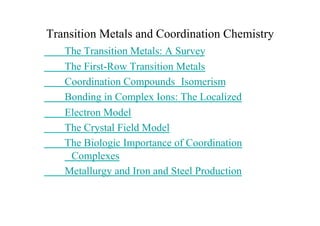
The Transition Metals:A Survey
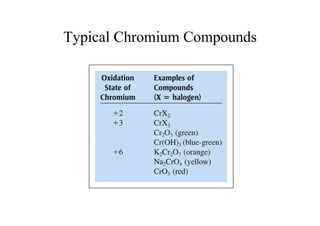
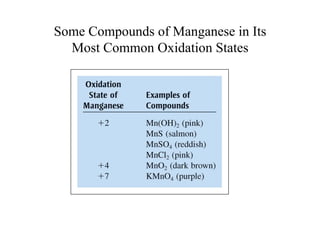
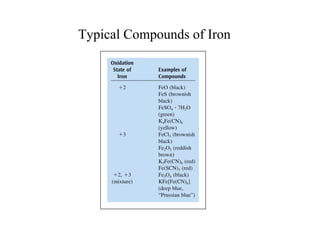
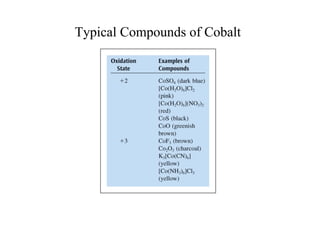
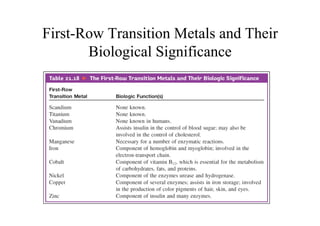
The First-Row Transition Metals
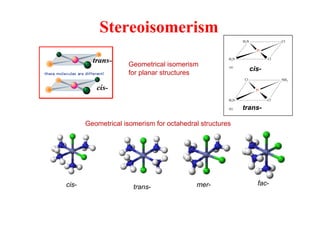
Coordination Compounds Isomerism
Bonding in Complex Ions: The Localized
Electron Model
The Crystal Field Model
The Biologic Importance of Coordination
Complexes
Metallurgy and Iron and Steel Production
Transition Metals and Coordination Chemistry
2.
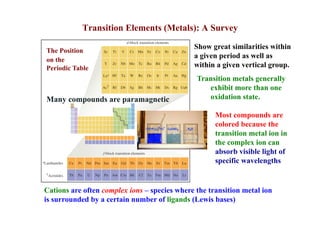
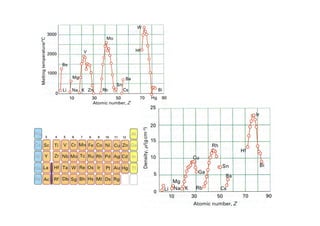
Transition Elements (Metals):A Survey
Show great similarities within
a given period as well as
within a given vertical group.
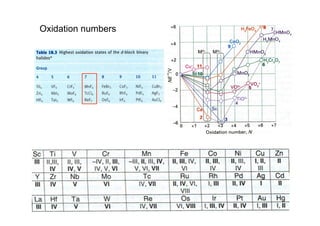
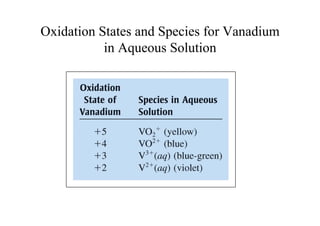
Transition metals generally
exhibit more than one
oxidation state.
Cations are often complex ions – species where the transition metal ion
is surrounded by a certain number of ligands (Lewis bases)
Most compounds are
colored because the
transition metal ion in
the complex ion can
absorb visible light of
specific wavelengths
The Position
on the
Periodic Table
Many compounds are paramagnetic
3.
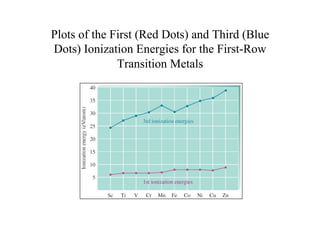
Plots of theFirst (Red Dots) and Third (Blue
Dots) Ionization Energies for the First-Row
Transition Metals
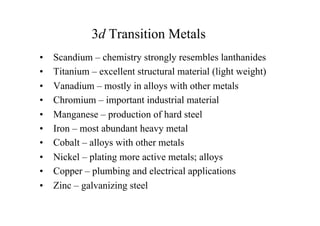
• Scandium –chemistry strongly resembles lanthanides
• Titanium – excellent structural material (light weight)
• Vanadium – mostly in alloys with other metals
• Chromium – important industrial material
• Manganese – production of hard steel
• Iron – most abundant heavy metal
• Cobalt – alloys with other metals
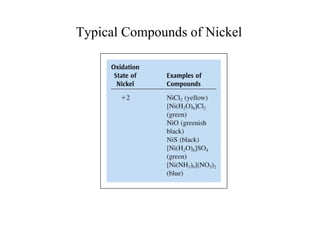
• Nickel – plating more active metals; alloys
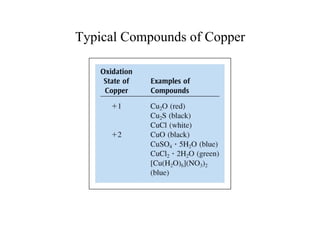
• Copper – plumbing and electrical applications
• Zinc – galvanizing steel
3d Transition Metals
Noble metals
- platinumgroup (Ru, Os, Rh, Ir, Pd, Pt) – together
with Pt in Pt ores (e. g. Sperrylite, PtAs2)
- Coinage metals (Cu, Ag, Au)
- Resistent w.r.t. oxidation
- Strong metallic bond and high values of IE
- Price – abundance/utilization (e. g. abundance of
Rh and Pd similar, but Rh is 20x more expensive
because of the use in car catalysers)
- Aqua regia (Lúčavka kráľovská) (conc. HNO3 + conc. HCl, molar r. 1:3) –
able to dissolve Au a Pt:
- Au(s) + NO3
-(aq) + 4 Cl-(aq) + 4 H3O+ [AuCl4]-(aq) + NO(g) + 6 H2O(l)
- Oxidation states stability irregular: CuI, CuII, AgI, AuI a AuIII
- In a water solution: 2 Cu+(aq) Cu(s) + Cu2+(aq)
3 Au+(aq) 2Au(s) + Au3+(aq)
17.
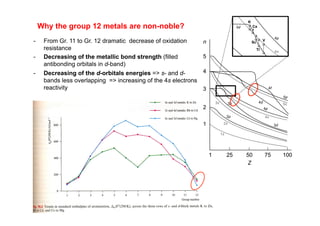
Why the group12 metals are non-noble?
- From Gr. 11 to Gr. 12 dramatic decrease of oxidation
resistance
- Decreasing of the metallic bond strength (filled
antibonding orbitals in d-band)
- Decreasing of the d-orbitals energies => s- and d-
bands less overlapping => increasing of the 4s electrons
reactivity
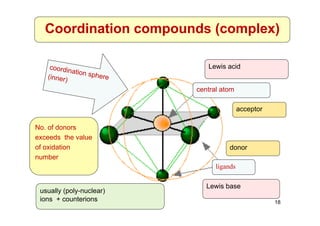
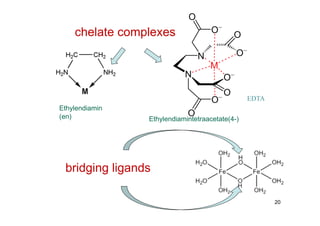
A Coordination Compound
•Typically consists of a complex ion and counterions (anions or cations
as needed to produce a neutral compound):
e.g. [Co(NH3)5Cl]Cl2 [Fe(en)2(NO2)2]2SO4 K3Fe(CN)6
Ligands:
monodentate – a single donor atom (H2O, CN-, F- … )
polydentate – their geometry enables to occupy
(bi-, tri- ...) more than a single coordination position
several donor atoms (chelate agents)
(e.g. ethylendiamin H2N-CH2-CH2-NH2)
Coordination number: number of donor atoms
coordinated in the inner sphere
Rules for NamingCoordination Compounds
1. Cation is named before the anion.
“chloride” goes last (the counterion)
2. Ligands are named before the metal ion.
ammonia (ammine) and chlorine
(chlorido) named before cobalt
[Co(NH3)5Cl]Cl2
22.
Rules for NamingCoordination Compounds
3. For negatively charged ligands, an “o” is
added to the root name of an anion (such as
fluorido, bromido, chlorido, etc.).
4. The prefixes mono-, di-, tri-, etc., are used to
denote the number of simple ligands.
penta ammine
[Co(NH3)5Cl]Cl2
23.
Rules for NamingCoordination Compounds
5. The oxidation state of the central metal ion is
designated by a Roman numeral:
cobalt (III)
6. When more than one type of ligand is present,
they are named alphabetically:
pentaamminechlorido
[Co(NH3)5Cl]Cl2
24.
Rules for NamingCoordination Compounds
7. If the complex ion has a negative charge, the
suffix “ate” is added to the name of the metal.
The correct name is:
pentaamminechloridocobalt(III) chloride
[Co(NH3)5Cl]Cl2
25.
Exercise
Name the followingcoordination
compounds.
(a) [Co(H2O)6]Br3 (b) Na2[PtCl4]
(a) Hexaaquacobalt(III) bromide
(b) Sodium tetrachloroplatinate(II)
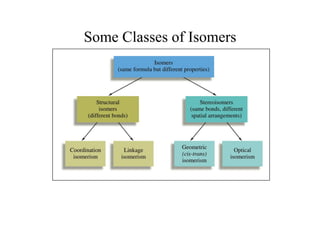
Structural Isomerism
• CoordinationIsomerism:
Composition of the complex ion
varies.
[Cr(NH3)5SO4]Br and
[Cr(NH3)5Br]SO4
• Linkage Isomerism:
Composition of the complex ion is
the same, but the point of
attachment of at least one of the
ligands differs.
Linkage Isomerism of NO2
–
Nitrito-N-
Nitrito-O-
Electron Configurations
• First-rowtransition metal ions do not
have 4s electrons.
Energy of the 3d orbitals is less than that of
the 4s orbital.
Ti: [Ar]4s23d2
Ti3+: [Ar]3d1
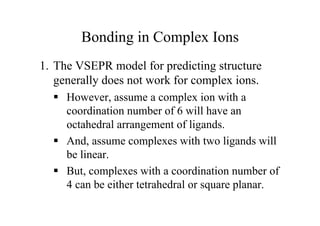
Bonding in ComplexIons
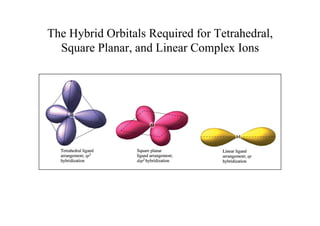
1. The VSEPR model for predicting structure
generally does not work for complex ions.
However, assume a complex ion with a
coordination number of 6 will have an
octahedral arrangement of ligands.
And, assume complexes with two ligands will
be linear.
But, complexes with a coordination number of
4 can be either tetrahedral or square planar.
Bonding in ComplexIons
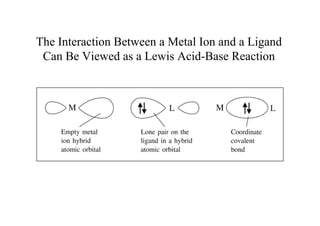
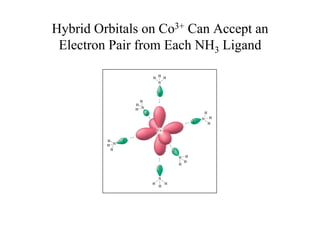
2. The interaction between a metal ion and a
ligand can be viewed as a Lewis acid–base
reaction with the ligand donating a lone pair
of electrons to an empty orbital of the metal
ion to form a coordinate covalent bond.
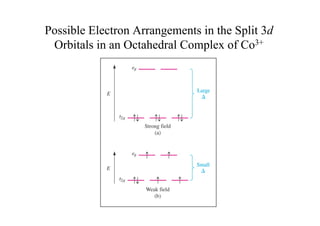
• Focuses onthe effect of ligands on the
energies of the d orbitals of metals.
Assumptions
1. Ligands are negative point charges.
2. Metal–ligand bonding is entirely ionic:
• strong-field (low–spin):
large splitting of d orbitals
• weak-field (high–spin):
small splitting of d orbitals
Crystal Field Model
45.
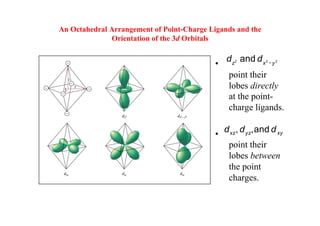
An Octahedral Arrangementof Point-Charge Ligands and the
Orientation of the 3d Orbitals
•
point their
lobes directly
at the point-
charge ligands.
•
point their
lobes between
the point
charges.
46.
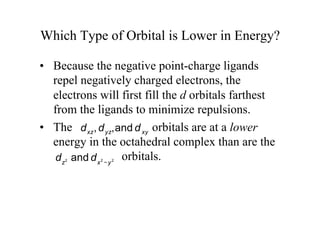
Which Type ofOrbital is Lower in Energy?
• Because the negative point-charge ligands
repel negatively charged electrons, the
electrons will first fill the d orbitals farthest
from the ligands to minimize repulsions.
• The orbitals are at a lower
energy in the octahedral complex than are the
orbitals.
47.
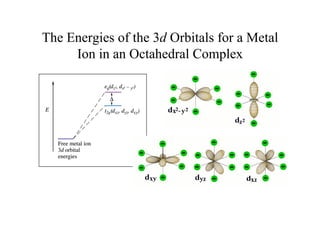
The Energies ofthe 3d Orbitals for a Metal
Ion in an Octahedral Complex
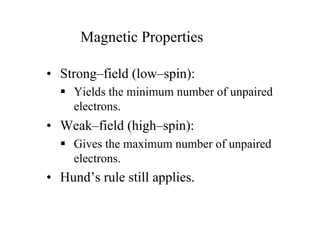
Magnetic Properties
• Strong–field(low–spin):
Yields the minimum number of unpaired
electrons.
• Weak–field (high–spin):
Gives the maximum number of unpaired
electrons.
• Hund’s rule still applies.
50.
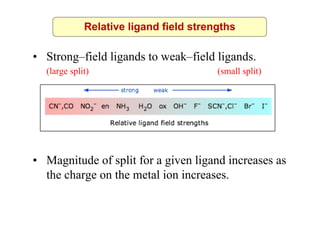
• Strong–field ligandsto weak–field ligands.
(large split) (small split)
• Magnitude of split for a given ligand increases as
the charge on the metal ion increases.
Relative ligand field strengths
51.
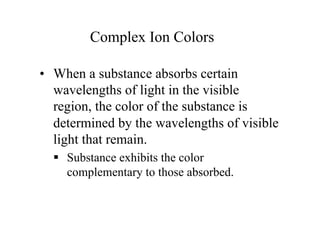
Complex Ion Colors
•When a substance absorbs certain
wavelengths of light in the visible
region, the color of the substance is
determined by the wavelengths of visible
light that remain.
Substance exhibits the color
complementary to those absorbed.
52.
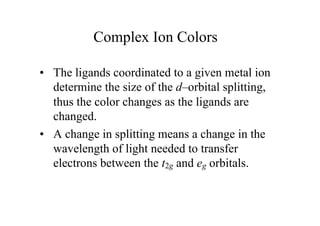
Complex Ion Colors
•The ligands coordinated to a given metal ion
determine the size of the d–orbital splitting,
thus the color changes as the ligands are
changed.
• A change in splitting means a change in the
wavelength of light needed to transfer
electrons between the t2g and eg orbitals.
53.
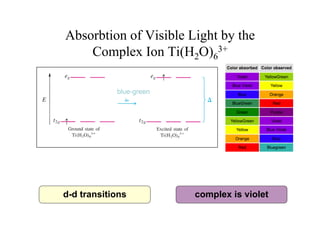
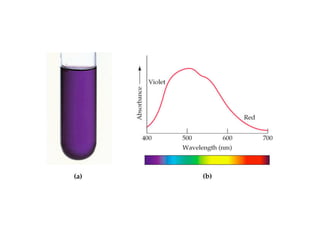
Absorbtion of VisibleLight by the
Complex Ion Ti(H2O)6
3+
d-d transitions
blue-green
complex is violet
55.
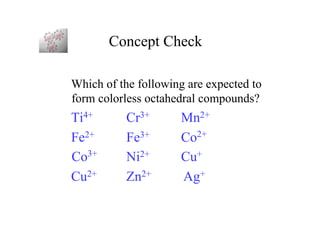
Concept Check
Which ofthe following are expected to
form colorless octahedral compounds?
Ti4+ Cr3+ Mn2+
Fe2+ Fe3+ Co2+
Co3+
Ni2+ Cu+
Cu2+ Zn2+ Ag+
56.
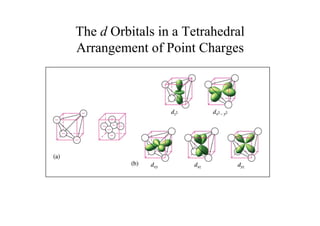
Tetrahedral Arrangement
• Noneof the 3d orbitals “point at the ligands”.
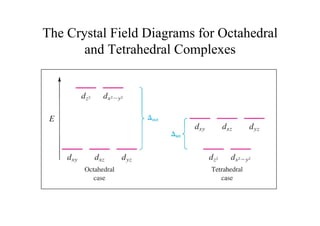
Difference in energy between the split d orbitals
is significantly less.
• d–orbital splitting will be opposite to that for
the octahedral arrangement.
Weak–field case (high–spin) always applies.
57.
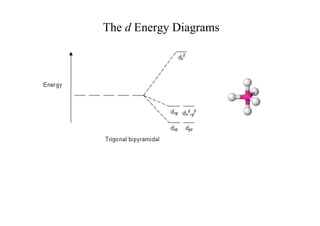
The d Orbitalsin a Tetrahedral
Arrangement of Point Charges
Concept Check
Consider theCrystal Field Model
(CFM).
a) Which is lower in energy, d–orbital
lobes pointing toward ligands or
between? Why?
b) The electrons in the d–orbitals – are
they from the metal or the ligands?
62.
Concept Check
Consider theCrystal Field Model
(CFM).
c) Why would electrons choose to pair up
in d–orbitals instead of being in
separate orbitals?
d) Why is the predicted splitting in
tetrahedral complexes smaller than in
octahedral complexes?
63.
Concept Check
Using theCrystal Field Model, sketch
possible electron arrangements for the
following. Label one sketch as strong
field and one sketch as weak field.
a) Ni(NH3)6
2+
b) Fe(CN)6
3–
c) Co(NH3)6
3+
64.
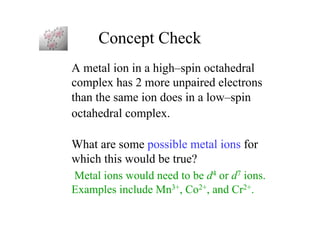
Concept Check
A metalion in a high–spin octahedral
complex has 2 more unpaired electrons
than the same ion does in a low–spin
octahedral complex.
What are some possible metal ions for
which this would be true?
Metal ions would need to be d4 or d7 ions.
Examples include Mn3+, Co2+, and Cr2+.
• Metal ioncomplexes are used in humans
for the transport and storage of oxygen,
as electron-transfer agents, as catalysts,
and as drugs.
Transition Metal Complexes in
Biological Molecules
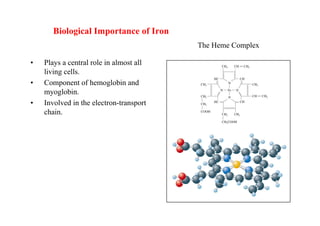
Biological Importance ofIron
• Plays a central role in almost all
living cells.
• Component of hemoglobin and
myoglobin.
• Involved in the electron-transport
chain.
The Heme Complex
69.
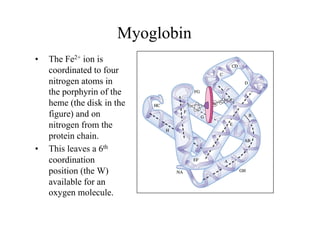
Myoglobin
• The Fe2+ion is
coordinated to four
nitrogen atoms in
the porphyrin of the
heme (the disk in the
figure) and on
nitrogen from the
protein chain.
• This leaves a 6th
coordination
position (the W)
available for an
oxygen molecule.
70.
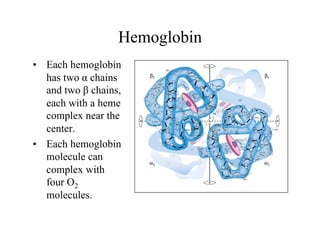
Hemoglobin
• Each hemoglobin
hastwo α chains
and two β chains,
each with a heme
complex near the
center.
• Each hemoglobin
molecule can
complex with
four O2
molecules.
71.
Metallurgy
• Process ofseparating a metal from its ore
and preparing it for use.
• Steps:
Mining
Pretreatment of the ore
Reduction to the free metal
Purification of the metal (refining)
Alloying
Abundance and isolation
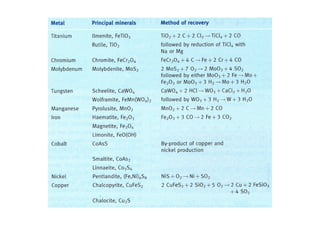
-Ln – except for Pm quite abundant in the Earth‘s crust (most Ce)
- main source phosohate ores, mainly monazite ((Ln,Th)PO4)
- Separation of Ln3+ ions – complicated (except Ce and Eu that can be oxidized
to Ce4+, or reduced to Eu2+); multistep extractions – using water/organic
- Ln metals by electrolysis of molten chlorides
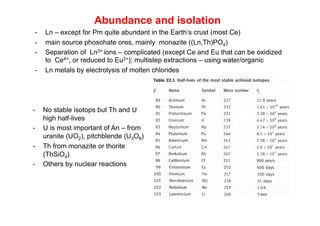
- No stable isotops but Th and U
high half-lives
- U is most important of An – from
uranite (UO2), pitchblende (U3O8)
- Th from monazite or thorite
(ThSiO4)
- Others by nuclear reactions
76.
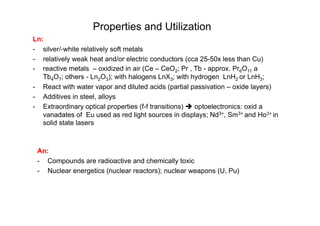
Properties and Utilization
Ln:
-silver/-white relatively soft metals
- relatively weak heat and/or electric conductors (cca 25-50x less than Cu)
- reactive metals – oxidized in air (Ce – CeO2; Pr , Tb - approx. Pr6O11 a
Tb4O7; others - Ln2O3); with halogens LnX3; with hydrogen LnH2 or LnH3;
- React with water vapor and diluted acids (partial passivation – oxide layers)
- Additives in steel, alloys
- Extraordinary optical properties (f-f transitions) optoelectronics: oxid a
vanadates of Eu used as red light sources in displays; Nd3+, Sm3+ and Ho3+ in
solid state lasers
An:
- Compounds are radioactive and chemically toxic
- Nuclear energetics (nuclear reactors); nuclear weapons (U, Pu)
77.
Ln Compounds
- LnIIIpreference – valence electron s2 and d1
- f electrons are strongly attracted by the nucleus and do not exceed
the closed [Xe] shells.
- Atypic oxidation states rrely to stable configurations of the f subshells
(f0, f7, f14)
- e.g. Ce3+ can be oxidized to Ce4+ (a strong oxidizer)
coordination numbers in ionic crystals and/or complex compounds
are relatively high (higher than for d-elements) – typically 7-8
LnF3 CeF4

![Noble metals
- platinum group (Ru, Os, Rh, Ir, Pd, Pt) – together
with Pt in Pt ores (e. g. Sperrylite, PtAs2)
- Coinage metals (Cu, Ag, Au)
- Resistent w.r.t. oxidation
- Strong metallic bond and high values of IE
- Price – abundance/utilization (e. g. abundance of
Rh and Pd similar, but Rh is 20x more expensive
because of the use in car catalysers)
- Aqua regia (Lúčavka kráľovská) (conc. HNO3 + conc. HCl, molar r. 1:3) –
able to dissolve Au a Pt:
- Au(s) + NO3
-(aq) + 4 Cl-(aq) + 4 H3O+ [AuCl4]-(aq) + NO(g) + 6 H2O(l)
- Oxidation states stability irregular: CuI, CuII, AgI, AuI a AuIII
- In a water solution: 2 Cu+(aq) Cu(s) + Cu2+(aq)
3 Au+(aq) 2Au(s) + Au3+(aq)](https://image.slidesharecdn.com/generalnoteontransitionmetals-250611095247-8a6935ad/85/GENERAL-NOTE-ON-TRANSITION-METALSbest-pdf-16-320.jpg)
![A Coordination Compound
• Typically consists of a complex ion and counterions (anions or cations
as needed to produce a neutral compound):
e.g. [Co(NH3)5Cl]Cl2 [Fe(en)2(NO2)2]2SO4 K3Fe(CN)6
Ligands:
monodentate – a single donor atom (H2O, CN-, F- … )
polydentate – their geometry enables to occupy
(bi-, tri- ...) more than a single coordination position
several donor atoms (chelate agents)
(e.g. ethylendiamin H2N-CH2-CH2-NH2)
Coordination number: number of donor atoms
coordinated in the inner sphere](https://image.slidesharecdn.com/generalnoteontransitionmetals-250611095247-8a6935ad/85/GENERAL-NOTE-ON-TRANSITION-METALSbest-pdf-19-320.jpg)
![Rules for Naming Coordination Compounds
1. Cation is named before the anion.
“chloride” goes last (the counterion)
2. Ligands are named before the metal ion.
ammonia (ammine) and chlorine
(chlorido) named before cobalt
[Co(NH3)5Cl]Cl2](https://image.slidesharecdn.com/generalnoteontransitionmetals-250611095247-8a6935ad/85/GENERAL-NOTE-ON-TRANSITION-METALSbest-pdf-21-320.jpg)
![Rules for Naming Coordination Compounds
3. For negatively charged ligands, an “o” is
added to the root name of an anion (such as
fluorido, bromido, chlorido, etc.).
4. The prefixes mono-, di-, tri-, etc., are used to
denote the number of simple ligands.
penta ammine
[Co(NH3)5Cl]Cl2](https://image.slidesharecdn.com/generalnoteontransitionmetals-250611095247-8a6935ad/85/GENERAL-NOTE-ON-TRANSITION-METALSbest-pdf-22-320.jpg)
![Rules for Naming Coordination Compounds
5. The oxidation state of the central metal ion is
designated by a Roman numeral:
cobalt (III)
6. When more than one type of ligand is present,
they are named alphabetically:
pentaamminechlorido
[Co(NH3)5Cl]Cl2](https://image.slidesharecdn.com/generalnoteontransitionmetals-250611095247-8a6935ad/85/GENERAL-NOTE-ON-TRANSITION-METALSbest-pdf-23-320.jpg)
![Rules for Naming Coordination Compounds
7. If the complex ion has a negative charge, the
suffix “ate” is added to the name of the metal.
The correct name is:
pentaamminechloridocobalt(III) chloride
[Co(NH3)5Cl]Cl2](https://image.slidesharecdn.com/generalnoteontransitionmetals-250611095247-8a6935ad/85/GENERAL-NOTE-ON-TRANSITION-METALSbest-pdf-24-320.jpg)
![Exercise
Name the following coordination
compounds.
(a) [Co(H2O)6]Br3 (b) Na2[PtCl4]
(a) Hexaaquacobalt(III) bromide
(b) Sodium tetrachloroplatinate(II)](https://image.slidesharecdn.com/generalnoteontransitionmetals-250611095247-8a6935ad/85/GENERAL-NOTE-ON-TRANSITION-METALSbest-pdf-25-320.jpg)
![Structural Isomerism
• Coordination Isomerism:
Composition of the complex ion
varies.
[Cr(NH3)5SO4]Br and
[Cr(NH3)5Br]SO4
• Linkage Isomerism:
Composition of the complex ion is
the same, but the point of
attachment of at least one of the
ligands differs.
Linkage Isomerism of NO2
–
Nitrito-N-
Nitrito-O-](https://image.slidesharecdn.com/generalnoteontransitionmetals-250611095247-8a6935ad/85/GENERAL-NOTE-ON-TRANSITION-METALSbest-pdf-27-320.jpg)
![Concept Check
Does [Co(en)2Cl2]Cl exhibit
geometrical isomerism?
Yes
Does it exhibit optical isomerism?
Trans form – No
Cis form – Yes
Explain.](https://image.slidesharecdn.com/generalnoteontransitionmetals-250611095247-8a6935ad/85/GENERAL-NOTE-ON-TRANSITION-METALSbest-pdf-31-320.jpg)
![Electron Configurations
• Example
V: [Ar]4s23d3
Fe: [Ar]4s23d6
• Exceptions: Cr and Cu
Cr: [Ar]4s13d5
Cu: [Ar]4s13d10](https://image.slidesharecdn.com/generalnoteontransitionmetals-250611095247-8a6935ad/85/GENERAL-NOTE-ON-TRANSITION-METALSbest-pdf-32-320.jpg)
![Electron Configurations
• First-row transition metal ions do not
have 4s electrons.
Energy of the 3d orbitals is less than that of
the 4s orbital.
Ti: [Ar]4s23d2
Ti3+: [Ar]3d1](https://image.slidesharecdn.com/generalnoteontransitionmetals-250611095247-8a6935ad/85/GENERAL-NOTE-ON-TRANSITION-METALSbest-pdf-33-320.jpg)
![Concept Check
What is the expected electron
configuration of Sc+?
Explain.
[Ar]3d2](https://image.slidesharecdn.com/generalnoteontransitionmetals-250611095247-8a6935ad/85/GENERAL-NOTE-ON-TRANSITION-METALSbest-pdf-34-320.jpg)
![41
Valence bond theory with hybrid AO in most cases
enables explanation of the structure
coord. No. form of coord. sphere examples
2 – SP linear [CuCl2]- [Ag(S2O3)2]3-
4 – SP3 [Co(NCS)4]2- [NiCl4]2-
D3S tetrahedron [BF3(NH3)]
4 – DSP2 [Mn(H2O)4]2+ [PdCl4]2-
SP2D square [Pd(NH3)4] 2+ Ni(CN)4]2-
6 – D2SP3 [Fe(H2O)6]2+
SP3D2 octahedron [Fe(CN)6]3- [FeF6]3-
[PdCl6]2-
Coordination compounds: bonds/structure](https://image.slidesharecdn.com/generalnoteontransitionmetals-250611095247-8a6935ad/85/GENERAL-NOTE-ON-TRANSITION-METALSbest-pdf-41-320.jpg)
![paramagnetic [NiCl4]2- unpaired electrons
Ni(II) -[NiCl4]2–
Ni2+
sp3
42
28Ni
3d 4s 4p
High-spin complex](https://image.slidesharecdn.com/generalnoteontransitionmetals-250611095247-8a6935ad/85/GENERAL-NOTE-ON-TRANSITION-METALSbest-pdf-42-320.jpg)
![diamagnetic [Ni(CN)4]2- paired electrons
Ni(II) -[Ni(CN)4]2–
Ni
3d 4s 4p
Ni2+
dsp2
43
Ni2+
valence
Low-spin complex](https://image.slidesharecdn.com/generalnoteontransitionmetals-250611095247-8a6935ad/85/GENERAL-NOTE-ON-TRANSITION-METALSbest-pdf-43-320.jpg)
![Concept Check
Between [Mn(CN)6]3– and
[Mn(CN)6]4– which is more likely
to be high spin? Why?
25Mn](https://image.slidesharecdn.com/generalnoteontransitionmetals-250611095247-8a6935ad/85/GENERAL-NOTE-ON-TRANSITION-METALSbest-pdf-65-320.jpg)
![f-elements (lanthanides [Ln] a actinides [An])
(Th, U) natural
Low variability of chemical properties](https://image.slidesharecdn.com/generalnoteontransitionmetals-250611095247-8a6935ad/85/GENERAL-NOTE-ON-TRANSITION-METALSbest-pdf-74-320.jpg)
![Ln Compounds
- LnIII preference – valence electron s2 and d1
- f electrons are strongly attracted by the nucleus and do not exceed
the closed [Xe] shells.
- Atypic oxidation states rrely to stable configurations of the f subshells
(f0, f7, f14)
- e.g. Ce3+ can be oxidized to Ce4+ (a strong oxidizer)
coordination numbers in ionic crystals and/or complex compounds
are relatively high (higher than for d-elements) – typically 7-8
LnF3 CeF4](https://image.slidesharecdn.com/generalnoteontransitionmetals-250611095247-8a6935ad/85/GENERAL-NOTE-ON-TRANSITION-METALSbest-pdf-77-320.jpg)


![Polymer [ बहुलक ] Chemistry Notes PDF - Irfanullah Mehar - JJ Sir Chemistry.pdf](https://cdn.slidesharecdn.com/ss_thumbnails/polymerchemistrynotespdf-irfanullahmehar-jjsirchemistry-260210172118-3f9b37f7-thumbnail.jpg?width=640&height=640&fit=bounds)


