Dr. Geeta Tewari
Department of Chemistry
D. S. B. Campus
Kumaun University, Nainital
Email: geeta_k@rediffmail.com
Metal π Complexes, Part 8,
Metal Dioxygen Complexes
CC BY-SA 3.0
Introduction
https://commons.wikimedia.org/wiki/File:Valence_orbitals_of_oxygen_atom_and_dioxygen_molecule_(diagram).svg
Forms of dioxygen
 Half-filled antibonding molecular orbitals in O2.
 O2 exists in several charged forms due to half filled
antibonding pi orbitals.
 Addition of one electron to O2 gives rise to the superoxide ion
(O2
-).
 Two electron addition converts O2 to the peroxide ion (O2
2-).
 The bond order and inter-nuclear distances (O-O) are affected
by the charge on the O2 molecule.
 The inter-nuclear distance (bond order) is highest in O2
2-.
Reactions of dioxygen
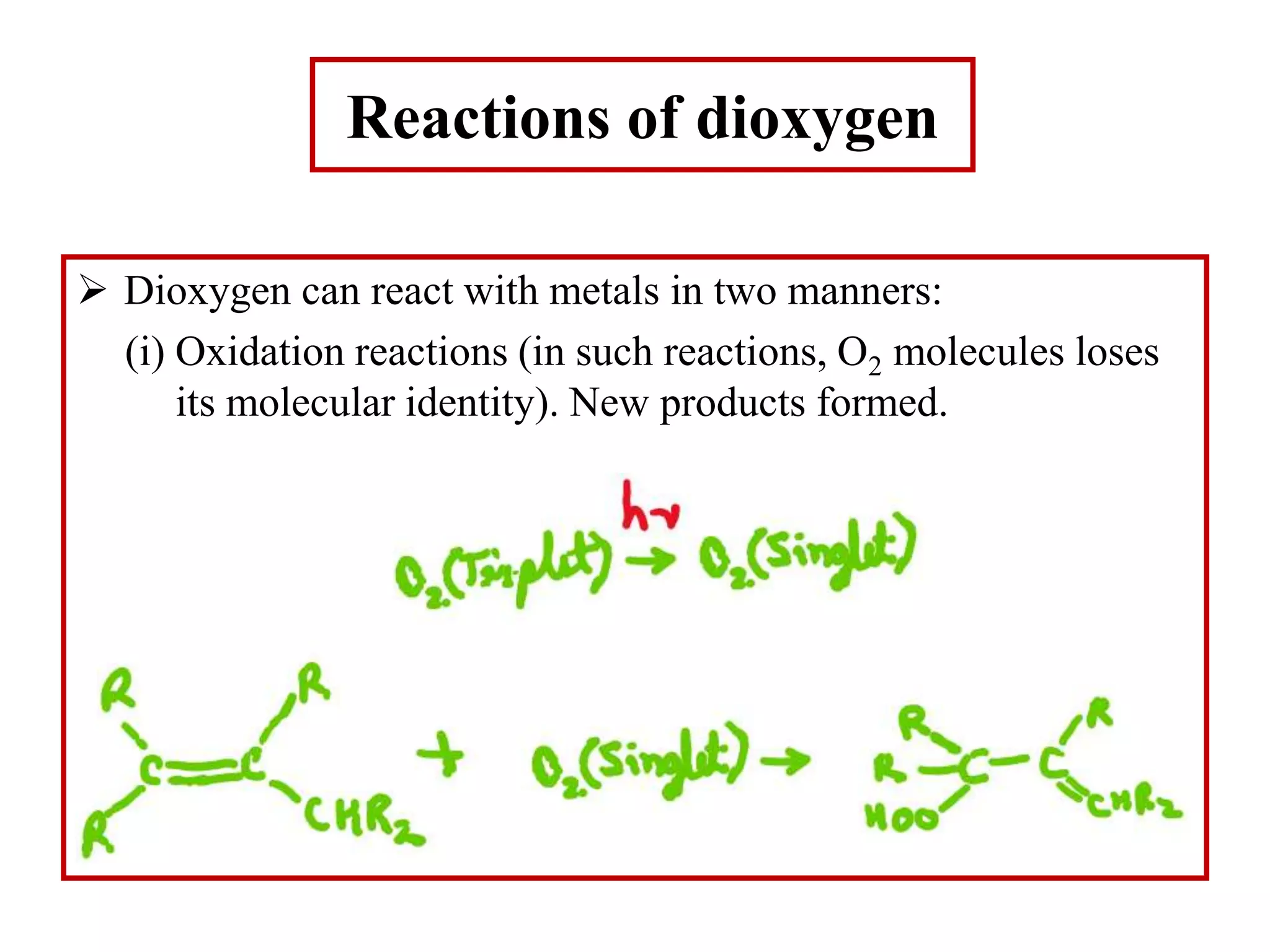
 Dioxygen can react with metals in two manners:
(i) Oxidation reactions (in such reactions, O2 molecules loses
its molecular identity). New products formed.
(ii) Oxygenation reactions (do not lose its identity).
 The reaction of dioxygen with a complex to
incorporate the dioxygen ligand is called
oxygenation.
 O2 does not lose its identity. Reverse of
oxygenation process plays an important role in
biological processes.
 This reaction occurs in hemoglobin and myoglobin
molecules.
Reactions of dioxygen
Classification of dioxygen complexes
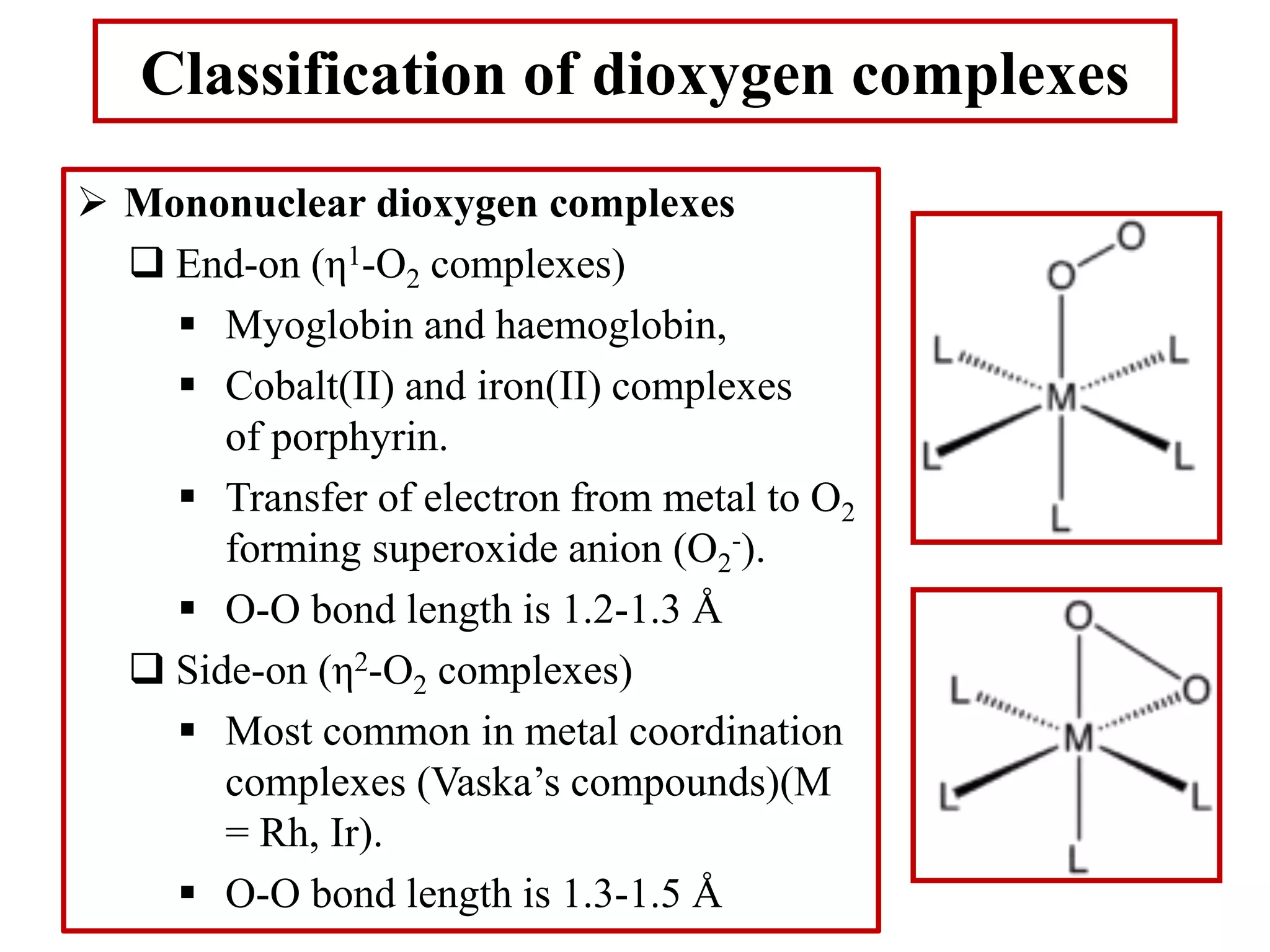
 Mononuclear dioxygen complexes
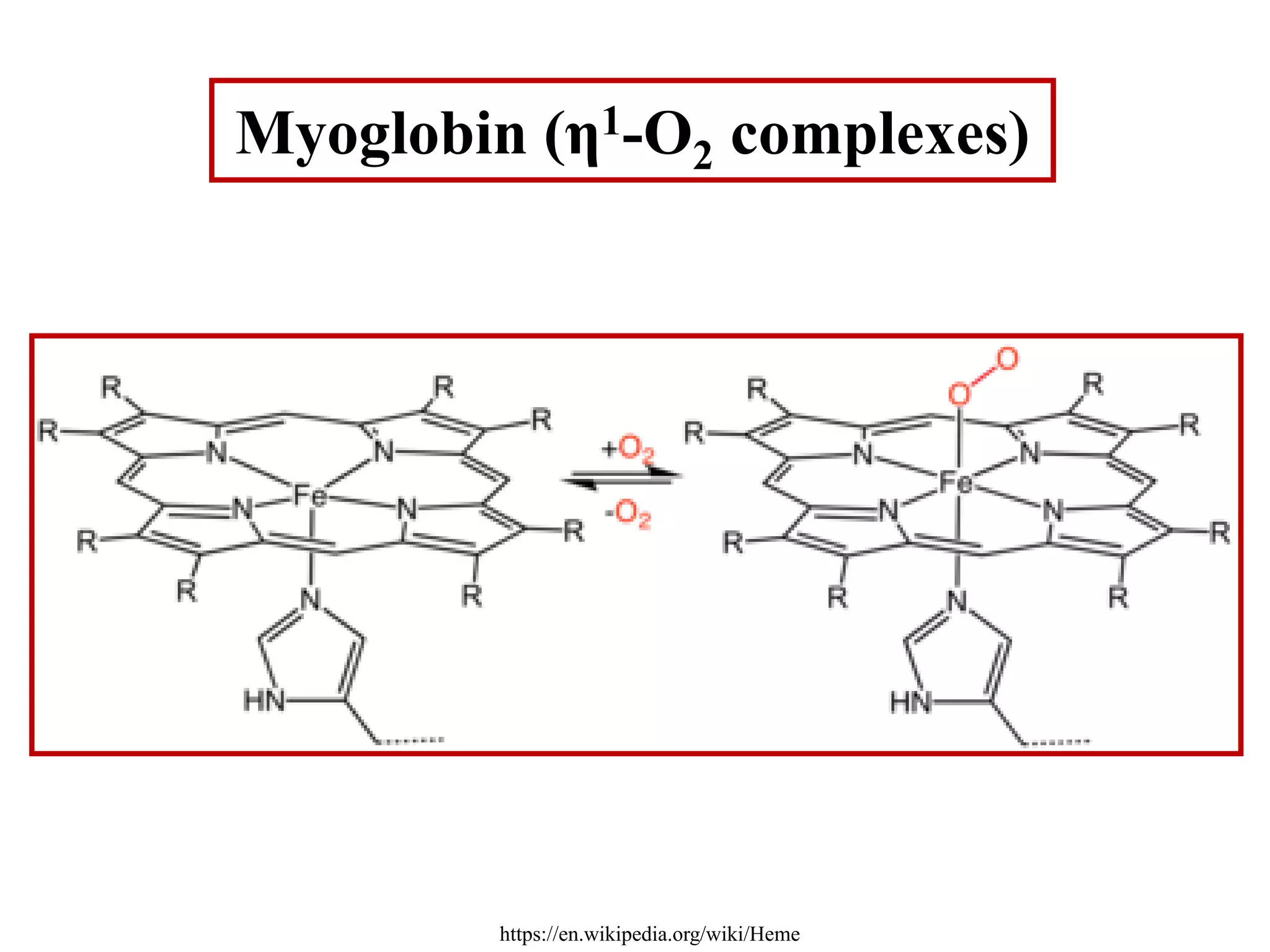
 End-on (η1-O2 complexes)
 Myoglobin and haemoglobin,
 Cobalt(II) and iron(II) complexes
of porphyrin.
 Transfer of electron from metal to O2
forming superoxide anion (O2
-).
 O-O bond length is 1.2-1.3 Å
 Side-on (η2-O2 complexes)
 Most common in metal coordination
complexes (Vaska’s compounds)(M
= Rh, Ir).
 O-O bond length is 1.3-1.5 Å
Myoglobin (η1-O2 complexes)
https://en.wikipedia.org/wiki/Heme
η2-O2 Complexes
Trans- Ir(PPh3)2(CO)Cl + O2
Benzene
Ir
PPh3
PPh3
O
Cl
OC
O
2 e− redox process
 This reaction is reversible.
 Diamagnetic dioxygen complexes of Fe, Ru, Rh, Ir,
Ni, Pd and Pt have also been synthesized.
 The metal atom and dioxygen ligand form an
isosceles triangle in metal dioxygen complexes.
M
O
O
 The O-O bond length in dioxygen complexes varies from 1.31
Å -1.63 Å.
 This variation generally depends on the electron density at the
metal atom, which further depends markedly on the other
ligands present in the complex.
 There is a close correlation between the degree of
reversibility of the reaction and the O–O bond length.
 The compound having the longest O–O bonds are formed
irreversibly.
 When in a dioxygen, the dioxygen binds reversibly,
the complexes are called as synthetic oxygen
carriers.
 The irreversible dioxygen binding causes oxidation of
metal ion (oxidation from lower oxidation state to
higher oxidation state) and these are useful
compounds for homogeneous catalytic oxidations.
Reversibly formed Irreversibly formed
Ir
O
O
PPh3
PPh3
CO
Cl
Ir
O
O
PPh3
PPh3
CO
I
1.47 A0
1.30 A0
Rh+
PPh2
H2
C
PPh2
Ph2P
H2C
Ph2P
H2C
C
H2
O
O
1.42 A0
Ir
PPh2
Ph2P
H2C
H2
C
PPh2
Ph2P
H2C
C
H2
O
O
1.63 A0
The reaction of hydrogen peroxide with aqueous titanium(IV)
gives a brightly colored peroxy complex which is a useful test for
titanium and hydrogen peroxide.
 Dinuclear dioxygen complexes
The binding modes in dinuclear dioxygen complexes are μ2-η2,η2
(peroxo), μ2-η1,η1 (superoxo), and μ2-η1,η2 (superoxo and
peroxo).
Uses of dioxygen complexes
 Dioxygen complexes are the precursors of complexes with
other oxygenic ligands.
• Metal oxo compounds formed due to the cleavage of the
O–O bond after complexation.
• Reduction of dioxygen complexes by metals generates
hydroperoxo (ROOH) complexes.
• The reduction of O2 by metal catalysts is a key half-
reaction in fuel cells.
 Synthetic dioxygen complexes are synthetic oxygen carriers
and used in homogeneous catalysis.
 The reversible binding of O2 to metal complexes is used as a
means to purify oxygen from air.
Thank You

Dioxygen complexes, dioxygen as ligand

  • 1.
    Dr. Geeta Tewari Departmentof Chemistry D. S. B. Campus Kumaun University, Nainital Email: geeta_k@rediffmail.com Metal π Complexes, Part 8, Metal Dioxygen Complexes CC BY-SA 3.0
  • 2.
  • 4.
  • 6.
    Forms of dioxygen Half-filled antibonding molecular orbitals in O2.  O2 exists in several charged forms due to half filled antibonding pi orbitals.  Addition of one electron to O2 gives rise to the superoxide ion (O2 -).  Two electron addition converts O2 to the peroxide ion (O2 2-).  The bond order and inter-nuclear distances (O-O) are affected by the charge on the O2 molecule.  The inter-nuclear distance (bond order) is highest in O2 2-.
  • 7.
    Reactions of dioxygen Dioxygen can react with metals in two manners: (i) Oxidation reactions (in such reactions, O2 molecules loses its molecular identity). New products formed.
  • 8.
    (ii) Oxygenation reactions(do not lose its identity).  The reaction of dioxygen with a complex to incorporate the dioxygen ligand is called oxygenation.  O2 does not lose its identity. Reverse of oxygenation process plays an important role in biological processes.  This reaction occurs in hemoglobin and myoglobin molecules. Reactions of dioxygen
  • 9.
    Classification of dioxygencomplexes  Mononuclear dioxygen complexes  End-on (η1-O2 complexes)  Myoglobin and haemoglobin,  Cobalt(II) and iron(II) complexes of porphyrin.  Transfer of electron from metal to O2 forming superoxide anion (O2 -).  O-O bond length is 1.2-1.3 Å  Side-on (η2-O2 complexes)  Most common in metal coordination complexes (Vaska’s compounds)(M = Rh, Ir).  O-O bond length is 1.3-1.5 Å
  • 10.
  • 11.
    η2-O2 Complexes Trans- Ir(PPh3)2(CO)Cl+ O2 Benzene Ir PPh3 PPh3 O Cl OC O 2 e− redox process
  • 12.
     This reactionis reversible.  Diamagnetic dioxygen complexes of Fe, Ru, Rh, Ir, Ni, Pd and Pt have also been synthesized.  The metal atom and dioxygen ligand form an isosceles triangle in metal dioxygen complexes. M O O
  • 13.
     The O-Obond length in dioxygen complexes varies from 1.31 Å -1.63 Å.  This variation generally depends on the electron density at the metal atom, which further depends markedly on the other ligands present in the complex.  There is a close correlation between the degree of reversibility of the reaction and the O–O bond length.  The compound having the longest O–O bonds are formed irreversibly.
  • 14.
     When ina dioxygen, the dioxygen binds reversibly, the complexes are called as synthetic oxygen carriers.  The irreversible dioxygen binding causes oxidation of metal ion (oxidation from lower oxidation state to higher oxidation state) and these are useful compounds for homogeneous catalytic oxidations.
  • 15.
    Reversibly formed Irreversiblyformed Ir O O PPh3 PPh3 CO Cl Ir O O PPh3 PPh3 CO I 1.47 A0 1.30 A0 Rh+ PPh2 H2 C PPh2 Ph2P H2C Ph2P H2C C H2 O O 1.42 A0 Ir PPh2 Ph2P H2C H2 C PPh2 Ph2P H2C C H2 O O 1.63 A0
  • 16.
    The reaction ofhydrogen peroxide with aqueous titanium(IV) gives a brightly colored peroxy complex which is a useful test for titanium and hydrogen peroxide.
  • 17.
     Dinuclear dioxygencomplexes The binding modes in dinuclear dioxygen complexes are μ2-η2,η2 (peroxo), μ2-η1,η1 (superoxo), and μ2-η1,η2 (superoxo and peroxo).
  • 18.
    Uses of dioxygencomplexes  Dioxygen complexes are the precursors of complexes with other oxygenic ligands. • Metal oxo compounds formed due to the cleavage of the O–O bond after complexation. • Reduction of dioxygen complexes by metals generates hydroperoxo (ROOH) complexes. • The reduction of O2 by metal catalysts is a key half- reaction in fuel cells.  Synthetic dioxygen complexes are synthetic oxygen carriers and used in homogeneous catalysis.  The reversible binding of O2 to metal complexes is used as a means to purify oxygen from air.
  • 19.