Dr. Mishu Singh
Department of Chemistry
M. P. Govt. P.G. College, Hardoi
www.mpgpgcollegehardoi.in
www.mishchemworld/wix.com
GENERAL PRINCIPLES AND
PROCESSES OF ISOLATION OF
ELEMENTS
METALLURGY
1
The process of extraction of metals form their ores.
Extraction depends on physical and chemical properties of metal
Metallurgy
Dr. Mishu Singh 2
Mode of occurrence of elements in nature
 Native State: Not attacked by moisture, oxygen or carbon dioxide.
C, S, Au, Pt, Noble gases etc.
Combined State: Present in combined state in nature.
In the form of carbonates, oxides, sulphides etc.
Bauxite- Al2O3 & Haematite- Fe2O3 (oxide
Copper pyrite- CuFeS2, Zinc blende- ZnS ( Sulphide)
Calamine- ZnCO3 ( Carbonate)
Dr. Mishu Singh 3
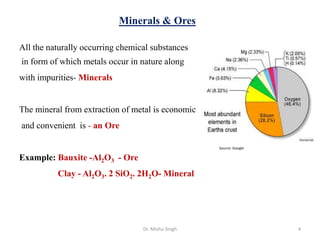
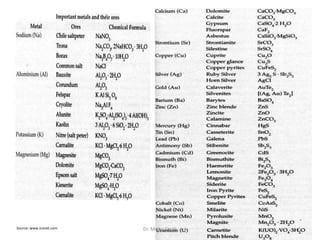
Minerals & Ores
All the naturally occurring chemical substances
in form of which metals occur in nature along
with impurities- Minerals
The mineral from extraction of metal is economic
and convenient is - an Ore
Example: Bauxite -Al2O3 - Ore
Clay - Al2O3. 2 SiO2. 2H2O- Mineral
Source: Google
Dr. Mishu Singh 4
Source: www.iconet.com Dr. Mishu Singh 5
Dr. Mishu Singh 6
Types of Metallurgical Processes
1. Pyrometallurgy Extraction of metals takes place at very high temperature.
Cu, Fe, Zn, Sn, etc .. are extracted by this method.
2. Bydrometallurgical process: In this method, metals are extracted by the use
of their aqueous solution. Ag and Au are extracted by this method.
3.Electrometallurgical process Na, K, Li, Ca, etc., are extracted from their
molten salt solution through electrolytic method.
Metallurgical Operations
1.Crushing and grinding of the ore
2.Concentration / Ore- dressing
3.Conversion of the concentrated ore into metal oxide / De- electronation
4.Reduction or electronation of metal oxide into metal
5.Refining
Dr. Mishu Singh 7
Dr. Mishu Singh 8
Crushing and Grinding of the ore:
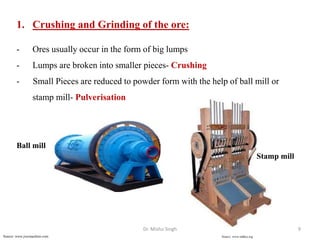
1. Crushing and Grinding of the ore:
- Ores usually occur in the form of big lumps
- Lumps are broken into smaller pieces- Crushing
- Small Pieces are reduced to powder form with the help of ball mill or
stamp mill- Pulverisation
Source: www.mdhca.orgSource: www.jxscmachine.com
Ball mill
Stamp mill
Dr. Mishu Singh 9
Dr. Mishu Singh 10
Concentration of the ore:
2. Concentration of the ore:
-In addition to the impurities of other minerals, ores are usually associated with
earthy & siliceous impurities – Gangue or Matrix
- Removal of such impurities from the ore is called Concentration or Dressing
of an ore
- Concentration is done by the following methods
A. Hand Picking
B. Hydraulic Washing/ Levigation / Gravity Separation
C. Froth floatation
D. Electromagnetic Separation
E. Electrostatic separation
F. Leaching
Dr. Mishu Singh 11
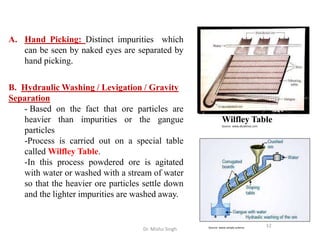
A. Hand Picking: Distinct impurities which
can be seen by naked eyes are separated by
hand picking.
B. Hydraulic Washing / Levigation / Gravity
Separation
- Based on the fact that ore particles are
heavier than impurities or the gangue
particles
-Process is carried out on a special table
called Wilfley Table.
-In this process powdered ore is agitated
with water or washed with a stream of water
so that the heavier ore particles settle down
and the lighter impurities are washed away.
Wilfley Table
Source: www.doubtnut.com
Source: www.simply.science
Dr. Mishu Singh
12
Dr. Mishu Singh 13
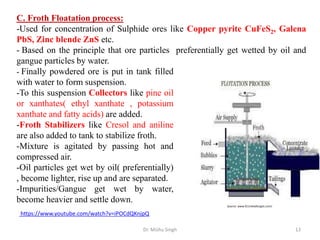
C. Froth Floatation process:
-Used for concentration of Sulphide ores like Copper pyrite CuFeS2, Galena
PbS, Zinc blende ZnS etc.
- Based on the principle that ore particles preferentially get wetted by oil and
gangue particles by water.
https://www.youtube.com/watch?v=iPOCdQKnjpQ
Source: www.911metallurgist.com/
- Finally powdered ore is put in tank filled
with water to form suspension.
-To this suspension Collectors like pine oil
or xanthates( ethyl xanthate , potassium
xanthate and fatty acids) are added.
-Froth Stabilizers like Cresol and aniline
are also added to tank to stabilize froth.
-Mixture is agitated by passing hot and
compressed air.
-Oil particles get wet by oil( preferentially)
, become lighter, rise up and are separated.
-Impurities/Gangue get wet by water,
become heavier and settle down.
Dr. Mishu Singh 14
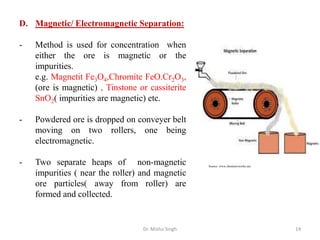
D. Magnetic/ Electromagnetic Separation:
- Method is used for concentration when
either the ore is magnetic or the
impurities.
e.g. Magnetit Fe3O4,Chromite FeO.Cr2O3,
(ore is magnetic) , Tinstone or cassiterite
SnO2( impurities are magnetic) etc.
- Powdered ore is dropped on conveyer belt
moving on two rollers, one being
electromagnetic.
- Two separate heaps of non-magnetic
impurities ( near the roller) and magnetic
ore particles( away from roller) are
formed and collected.
Source: www.chemistryworks.net
Dr. Mishu Singh 15
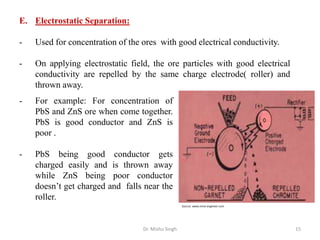
E. Electrostatic Separation:
- Used for concentration of the ores with good electrical conductivity.
- On applying electrostatic field, the ore particles with good electrical
conductivity are repelled by the same charge electrode( roller) and
thrown away.
- For example: For concentration of
PbS and ZnS ore when come together.
PbS is good conductor and ZnS is
poor .
- PbS being good conductor gets
charged easily and is thrown away
while ZnS being poor conductor
doesn’t get charged and falls near the
roller.
Source: www.mine-engineer.com
Dr. Mishu Singh 16
F. Leaching:
The process consists of treating the powdered ore with
suitable reagent to react with ore not the impurities.
For example:
1. Leaching of Bauxite - Baeyer’s process (commercially it is
being carried out for red bauxite not for the white bauxite).
2. Leaching of Silver and Gold - Mac Arthur Forest Cyanide
Process
Dr. Mishu Singh 17
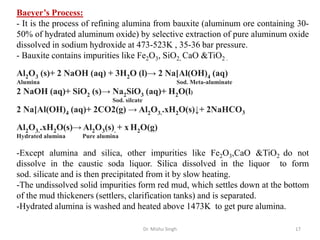
Baeyer’s Process:
- It is the process of refining alumina from bauxite (aluminum ore containing 30-
50% of hydrated aluminum oxide) by selective extraction of pure aluminum oxide
dissolved in sodium hydroxide at 473-523K , 35-36 bar pressure.
- Bauxite contains impurities like Fe2O3, SiO2, CaO &TiO2 .
Al2O3 (s)+ 2 NaOH (aq) + 3H2O (l)→ 2 Na[Al(OH)4 (aq)
Alumina Sod. Meta-aluminate
2 NaOH (aq)+ SiO2 (s)→ Na2SiO3 (aq)+ H2O(l)
Sod. silcate
2 Na[Al(OH)4 (aq)+ 2CO2(g) → Al2O3..xH2O(s)↓+ 2NaHCO3
Al2O3..xH2O(s)→ Al2O3(s). + x H2O(g)
Hydrated alumina Pure alumina
-Except alumina and silica, other impurities like Fe2O3,CaO &TiO2 do not
dissolve in the caustic soda liquor. Silica dissolved in the liquor to form
sod. silicate and is then precipitated from it by slow heating.
-The undissolved solid impurities form red mud, which settles down at the bottom
of the mud thickeners (settlers, clarification tanks) and is separated.
-Hydrated alumina is washed and heated above 1473K to get pure alumina.
Dr. Mishu Singh 18
Cyanide Leaching of Silver and Gold - Mac Arthur Forest Cyanide Process
- Cyanide leaching is the most important process developed for extraction of
precious metals like Au & Ag as it produces pure metal as a final product.
- In the process Argentite or Native Au or Ag is treated with 0.5% NaCN or
KCN solution.
-Metals gets oxidized and forms soluble cyanide complex.
4 M+ 8 CN- + 2H2O+ O2→ 4[M(CN)2
-]+ 4 OH-
(air)
a. For Silver:
(i)When native Silver metal is taken for the process-
4 Ag+ 8 NaCN + 2H2O+ O2→ 4 Na[Ag(CN)2]+ 4 NaOH
(air)
(ii)When Argentite or silver glance (Ag2S) is taken, the initial reaction of
formation of soluble silver complex formed is reversible. Here, the current
of air oxidizes Na2S to Na2SO4
Ag2S+ 4 NaCN 2 Na[Ag(CN)2]+ Na2S
Sod. Dicyanoargentite(I)
Soluble complex
b. For Gold:
4 Au+ 8 KCN + 2H2O+ O2→ 4K[M(CN)2]+ 4 KOH
(air)
Dr. Mishu Singh 19
Conversion of the concentrated ore into
metal oxide or
De- electronation
Dr. Mishu Singh 20
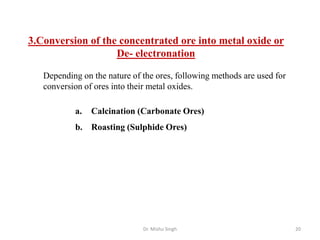
3.Conversion of the concentrated ore into metal oxide or
De- electronation
Depending on the nature of the ores, following methods are used for
conversion of ores into their metal oxides.
a. Calcination (Carbonate Ores)
b. Roasting (Sulphide Ores)
Dr. Mishu Singh 21
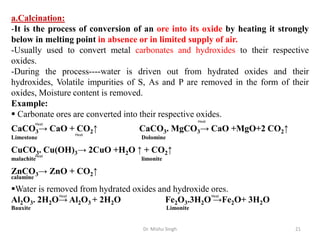
a.Calcination:
-It is the process of conversion of an ore into its oxide by heating it strongly
below in melting point in absence or in limited supply of air.
-Usually used to convert metal carbonates and hydroxides to their respective
oxides.
-During the process----water is driven out from hydrated oxides and their
hydroxides, Volatile impurities of S, As and P are removed in the form of their
oxides, Moisture content is removed.
Example:
 Carbonate ores are converted into their respective oxides.
CaCO3→ CaO + CO2↑ CaCO3. MgCO3→ CaO +MgO+2 CO2↑
Limestone Dolomine
CuCO3. Cu(OH)3→ 2CuO +H2O ↑ + CO2↑
malachite limonite
ZnCO3→ ZnO + CO2↑
calamine
Water is removed from hydrated oxides and hydroxide ores.
Al2O3. 2H2O→ Al2O3 + 2H2O Fe2O3.3H2O →Fe2O+ 3H2O
Bauxite Limonite
Heat
Heat
Heat
Heat
Heat Heat
Dr. Mishu Singh 22
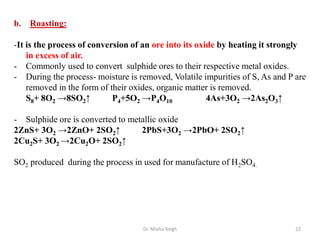
b. Roasting:
-It is the process of conversion of an ore into its oxide by heating it strongly
in excess of air.
- Commonly used to convert sulphide ores to their respective metal oxides.
- During the process- moisture is removed, Volatile impurities of S, As and P are
removed in the form of their oxides, organic matter is removed.
S8+ 8O2 →8SO2↑ P4+5O2 →P4O10 4As+3O2 →2As2O3↑
- Sulphide ore is converted to metallic oxide
2ZnS+ 3O2 →2ZnO+ 2SO2↑ 2PbS+3O2 →2PbO+ 2SO2↑
2Cu2S+ 3O2 →2Cu2O+ 2SO2↑
SO2 produced during the process in used for manufacture of H2SO4.
Dr. Mishu Singh 23
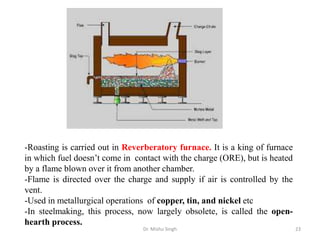
-Roasting is carried out in Reverberatory furnace. It is a king of furnace
in which fuel doesn’t come in contact with the charge (ORE), but is heated
by a flame blown over it from another chamber.
-Flame is directed over the charge and supply if air is controlled by the
vent.
-Used in metallurgical operations of copper, tin, and nickel etc
-In steelmaking, this process, now largely obsolete, is called the open-
hearth process.
Dr. Mishu Singh 24
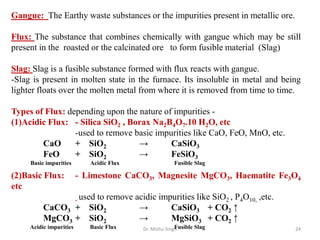
Gangue: The Earthy waste substances or the impurities present in metallic ore.
Flux: The substance that combines chemically with gangue which may be still
present in the roasted or the calcinated ore to form fusible material (Slag)
Slag: Slag is a fusible substance formed with flux reacts with gangue.
-Slag is present in molten state in the furnace. Its insoluble in metal and being
lighter floats over the molten metal from where it is removed from time to time.
Types of Flux: depending upon the nature of impurities -
(1)Acidic Flux: - Silica SiO2 , Borax Na2B4O7.10 H2O, etc
-used to remove basic impurities like CaO, FeO, MnO, etc.
CaO + SiO2 → CaSiO3
FeO + SiO2 → FeSiO3
Basic impurities Acidic Flux Fusible Slag
(2)Basic Flux: - Limestone CaCO3, Magnesite MgCO3, Haematite Fe3O4
etc
- used to remove acidic impurities like SiO2 , P4O10, ,etc.
CaCO3 + SiO2 → CaSiO3 + CO2 ↑
MgCO3 + SiO2 → MgSiO3 + CO2 ↑
Acidic impurities Basic Flux Fusible Slag
Dr. Mishu Singh 25
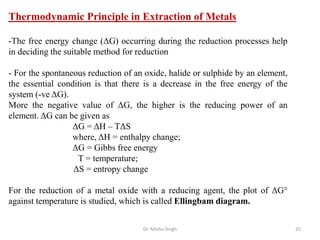
Thermodynamic Principle in Extraction of Metals
-The free energy change (ΔG) occurring during the reduction processes help
in deciding the suitable method for reduction
- For the spontaneous reduction of an oxide, halide or sulphide by an element,
the essential condition is that there is a decrease in the free energy of the
system (-ve ΔG).
More the negative value of ΔG, the higher is the reducing power of an
element. ΔG can be given as
ΔG = ΔH – TΔS
where, ΔH = enthalpy change;
ΔG = Gibbs free energy
T = temperature;
ΔS = entropy change
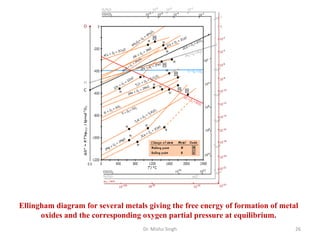
For the reduction of a metal oxide with a reducing agent, the plot of ΔG°
against temperature is studied, which is called Ellingbam diagram.
Dr. Mishu Singh 26
Ellingham diagram for several metals giving the free energy of formation of metal
oxides and the corresponding oxygen partial pressure at equilibrium.
Dr. Mishu Singh 27
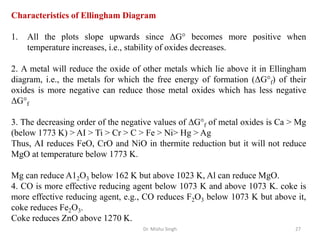
Characteristics of Ellingham Diagram
1. All the plots slope upwards since ΔG° becomes more positive when
temperature increases, i.e., stability of oxides decreases.
2. A metal will reduce the oxide of other metals which lie above it in Ellingham
diagram, i.e., the metals for which the free energy of formation (ΔG°f) of their
oxides is more negative can reduce those metal oxides which has less negative
ΔG°f
3. The decreasing order of the negative values of ΔG°f of metal oxides is Ca > Mg
(below 1773 K) > AI > Ti > Cr > C > Fe > Ni> Hg > Ag
Thus, AI reduces FeO, CrO and NiO in thermite reduction but it will not reduce
MgO at temperature below 1773 K.
Mg can reduce A12O3 below 162 K but above 1023 K, Al can reduce MgO.
4. CO is more effective reducing agent below 1073 K and above 1073 K. coke is
more effective reducing agent, e.g., CO reduces F2O3 below 1073 K but above it,
coke reduces Fe2O3.
Coke reduces ZnO above 1270 K.
Dr. Mishu Singh 28
Reduction/electronation of metal oxide into metal
Dr. Mishu Singh 29
4. Reduction or electronation of metal oxide into metal
Roasted or calcinated ore is reduced with suitable reducing agent depending
upon the reactivity of the metal.
Highly reactive metals like Na, K, Ca, Mg, Al, etc are reduced by electrolytic
method.
Less reactive metals like Zn, Fe, Pb, Sn, Cr, etc can be reduced by reducing
agents like C( Coke) or carbon monoxide CO.
MxOy + y C→ x M + y CO (carbon - reducing agent)
MxO + CO →x M + CO2 (carbon monoxide - reducing agent)
The process of extraction of metal form metal oxide with carbon ( coke/
charcoal/carbon monoxide) is called Smelting.
Metals can be used as reducing agents. For example:
Mn, Al, Zn Cu, Fe etc are used for reduction of Al2O3, ZnO, FeO, Cu2O, etc.
The relative tendency of these metals to act as reducing agents is
Mg>Al>Zn>Fe>Cu
The process of extraction of metal from metal oxide by heating it with
suitable reducing agent is called Pyrometallurgy
Dr. Mishu Singh 30
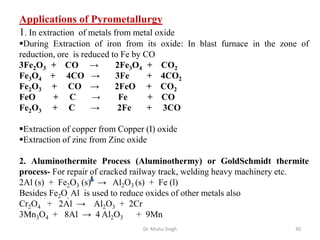
Applications of Pyrometallurgy
1. In extraction of metals from metal oxide
During Extraction of iron from its oxide: In blast furnace in the zone of
reduction, ore is reduced to Fe by CO
3Fe2O3 + CO → 2Fe3O4 + CO2
Fe3O4 + 4CO → 3Fe + 4CO2
Fe2O3 + CO → 2FeO + CO2
FeO + C → Fe + CO
Fe2O3 + C → 2Fe + 3CO
Extraction of copper from Copper (I) oxide
Extraction of zinc from Zinc oxide
2. Aluminothermite Process (Aluminothermy) or GoldSchmidt thermite
process- For repair of cracked railway track, welding heavy machinery etc.
2Al (s) + Fe2O3 (s) → Al2O3 (s) + Fe (l)
Besides Fe2O, Al is used to reduce oxides of other metals also
Cr2O4 + 2Al → Al2O3 + 2Cr
3Mn3O4 + 8Al → 4 Al2O3 + 9Mn
Dr. Mishu Singh 31
Refining
Dr. Mishu Singh 32
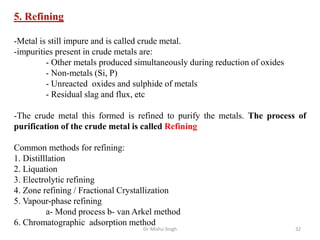
5. Refining
-Metal is still impure and is called crude metal.
-impurities present in crude metals are:
- Other metals produced simultaneously during reduction of oxides
- Non-metals (Si, P)
- Unreacted oxides and sulphide of metals
- Residual slag and flux, etc
-The crude metal this formed is refined to purify the metals. The process of
purification of the crude metal is called Refining
Common methods for refining:
1. Distilllation
2. Liquation
3. Electrolytic refining
4. Zone refining / Fractional Crystallization
5. Vapour-phase refining
a- Mond process b- van Arkel method
6. Chromatographic adsorption method
Dr. Mishu Singh 33
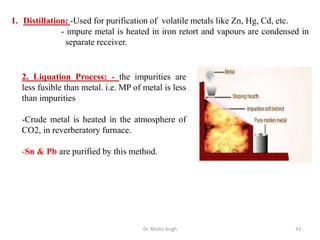
1. Distillation: -Used for purification of volatile metals like Zn, Hg, Cd, etc.
- impure metal is heated in iron retort and vapours are condensed in
separate receiver.
2. Liquation Process: - the impurities are
less fusible than metal. i.e. MP of metal is less
than impurities
-Crude metal is heated in the atmosphere of
CO2, in reverberatory furnace.
-Sn & Pb are purified by this method.
Dr. Mishu Singh 34
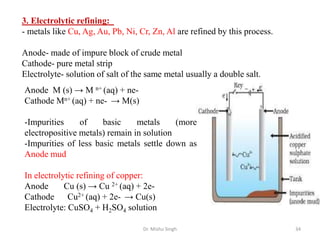
3. Electrolytic refining:
- metals like Cu, Ag, Au, Pb, Ni, Cr, Zn, Al are refined by this process.
Anode- made of impure block of crude metal
Cathode- pure metal strip
Electrolyte- solution of salt of the same metal usually a double salt.
Anode M (s) → M n+ (aq) + ne-
Cathode Mn+ (aq) + ne- → M(s)
-Impurities of basic metals (more
electropositive metals) remain in solution
-Impurities of less basic metals settle down as
Anode mud
In electrolytic refining of copper:
Anode Cu (s) → Cu 2+ (aq) + 2e-
Cathode Cu2+ (aq) + 2e- → Cu(s)
Electrolyte: CuSO4 + H2SO4 solution
Dr. Mishu Singh 35
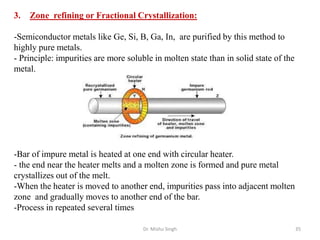
3. Zone refining or Fractional Crystallization:
-Semiconductor metals like Ge, Si, B, Ga, In, are purified by this method to
highly pure metals.
- Principle: impurities are more soluble in molten state than in solid state of the
metal.
-Bar of impure metal is heated at one end with circular heater.
- the end near the heater melts and a molten zone is formed and pure metal
crystallizes out of the melt.
-When the heater is moved to another end, impurities pass into adjacent molten
zone and gradually moves to another end of the bar.
-Process in repeated several times
Dr. Mishu Singh 36
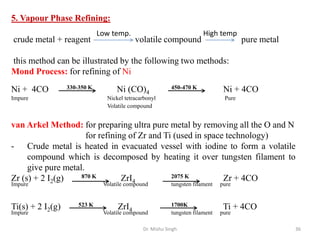
5. Vapour Phase Refining:
crude metal + reagent volatile compound pure metal
this method can be illustrated by the following two methods:
Mond Process: for refining of Ni
Ni + 4CO 330-350 K Ni (CO)4
450-470 K Ni + 4CO
Impure Nickel tetracarbonyl Pure
Volatile compound
van Arkel Method: for preparing ultra pure metal by removing all the O and N
for refining of Zr and Ti (used in space technology)
- Crude metal is heated in evacuated vessel with iodine to form a volatile
compound which is decomposed by heating it over tungsten filament to
give pure metal.
Zr (s) + 2 I2(g) 870 K ZrI4
2075 K Zr + 4CO
Impure Volatile compound tungsten filament pure
Ti(s) + 2 I2(g) 523 K ZrI4
1700K Ti + 4CO
Impure Volatile compound tungsten filament pure
Low temp. High temp
Dr. Mishu Singh 37
5. hromatographic method :
-Adsorption chromatography is generally used.
-The impure metal is dissolved in a suitable solvent and the solution is allowed
to run slowly into an adsorbent column packed with alumina (Al2O3).
-The metal and the impurities present are adsorbed at different rates. These are
then eluted with suitable eluent (solvent).
-In this method weakly adsorbed component is eluted first and the strongly
adsorbed component is eluted afterwards.
Dr. Mishu Singh 38
Continue………

Metallurgy

  • 1.
    Dr. Mishu Singh Departmentof Chemistry M. P. Govt. P.G. College, Hardoi www.mpgpgcollegehardoi.in www.mishchemworld/wix.com GENERAL PRINCIPLES AND PROCESSES OF ISOLATION OF ELEMENTS METALLURGY 1
  • 2.
    The process ofextraction of metals form their ores. Extraction depends on physical and chemical properties of metal Metallurgy Dr. Mishu Singh 2
  • 3.
    Mode of occurrenceof elements in nature  Native State: Not attacked by moisture, oxygen or carbon dioxide. C, S, Au, Pt, Noble gases etc. Combined State: Present in combined state in nature. In the form of carbonates, oxides, sulphides etc. Bauxite- Al2O3 & Haematite- Fe2O3 (oxide Copper pyrite- CuFeS2, Zinc blende- ZnS ( Sulphide) Calamine- ZnCO3 ( Carbonate) Dr. Mishu Singh 3
  • 4.
    Minerals & Ores Allthe naturally occurring chemical substances in form of which metals occur in nature along with impurities- Minerals The mineral from extraction of metal is economic and convenient is - an Ore Example: Bauxite -Al2O3 - Ore Clay - Al2O3. 2 SiO2. 2H2O- Mineral Source: Google Dr. Mishu Singh 4
  • 5.
  • 6.
    Dr. Mishu Singh6 Types of Metallurgical Processes 1. Pyrometallurgy Extraction of metals takes place at very high temperature. Cu, Fe, Zn, Sn, etc .. are extracted by this method. 2. Bydrometallurgical process: In this method, metals are extracted by the use of their aqueous solution. Ag and Au are extracted by this method. 3.Electrometallurgical process Na, K, Li, Ca, etc., are extracted from their molten salt solution through electrolytic method.
  • 7.
    Metallurgical Operations 1.Crushing andgrinding of the ore 2.Concentration / Ore- dressing 3.Conversion of the concentrated ore into metal oxide / De- electronation 4.Reduction or electronation of metal oxide into metal 5.Refining Dr. Mishu Singh 7
  • 8.
    Dr. Mishu Singh8 Crushing and Grinding of the ore:
  • 9.
    1. Crushing andGrinding of the ore: - Ores usually occur in the form of big lumps - Lumps are broken into smaller pieces- Crushing - Small Pieces are reduced to powder form with the help of ball mill or stamp mill- Pulverisation Source: www.mdhca.orgSource: www.jxscmachine.com Ball mill Stamp mill Dr. Mishu Singh 9
  • 10.
    Dr. Mishu Singh10 Concentration of the ore:
  • 11.
    2. Concentration ofthe ore: -In addition to the impurities of other minerals, ores are usually associated with earthy & siliceous impurities – Gangue or Matrix - Removal of such impurities from the ore is called Concentration or Dressing of an ore - Concentration is done by the following methods A. Hand Picking B. Hydraulic Washing/ Levigation / Gravity Separation C. Froth floatation D. Electromagnetic Separation E. Electrostatic separation F. Leaching Dr. Mishu Singh 11
  • 12.
    A. Hand Picking:Distinct impurities which can be seen by naked eyes are separated by hand picking. B. Hydraulic Washing / Levigation / Gravity Separation - Based on the fact that ore particles are heavier than impurities or the gangue particles -Process is carried out on a special table called Wilfley Table. -In this process powdered ore is agitated with water or washed with a stream of water so that the heavier ore particles settle down and the lighter impurities are washed away. Wilfley Table Source: www.doubtnut.com Source: www.simply.science Dr. Mishu Singh 12
  • 13.
    Dr. Mishu Singh13 C. Froth Floatation process: -Used for concentration of Sulphide ores like Copper pyrite CuFeS2, Galena PbS, Zinc blende ZnS etc. - Based on the principle that ore particles preferentially get wetted by oil and gangue particles by water. https://www.youtube.com/watch?v=iPOCdQKnjpQ Source: www.911metallurgist.com/ - Finally powdered ore is put in tank filled with water to form suspension. -To this suspension Collectors like pine oil or xanthates( ethyl xanthate , potassium xanthate and fatty acids) are added. -Froth Stabilizers like Cresol and aniline are also added to tank to stabilize froth. -Mixture is agitated by passing hot and compressed air. -Oil particles get wet by oil( preferentially) , become lighter, rise up and are separated. -Impurities/Gangue get wet by water, become heavier and settle down.
  • 14.
    Dr. Mishu Singh14 D. Magnetic/ Electromagnetic Separation: - Method is used for concentration when either the ore is magnetic or the impurities. e.g. Magnetit Fe3O4,Chromite FeO.Cr2O3, (ore is magnetic) , Tinstone or cassiterite SnO2( impurities are magnetic) etc. - Powdered ore is dropped on conveyer belt moving on two rollers, one being electromagnetic. - Two separate heaps of non-magnetic impurities ( near the roller) and magnetic ore particles( away from roller) are formed and collected. Source: www.chemistryworks.net
  • 15.
    Dr. Mishu Singh15 E. Electrostatic Separation: - Used for concentration of the ores with good electrical conductivity. - On applying electrostatic field, the ore particles with good electrical conductivity are repelled by the same charge electrode( roller) and thrown away. - For example: For concentration of PbS and ZnS ore when come together. PbS is good conductor and ZnS is poor . - PbS being good conductor gets charged easily and is thrown away while ZnS being poor conductor doesn’t get charged and falls near the roller. Source: www.mine-engineer.com
  • 16.
    Dr. Mishu Singh16 F. Leaching: The process consists of treating the powdered ore with suitable reagent to react with ore not the impurities. For example: 1. Leaching of Bauxite - Baeyer’s process (commercially it is being carried out for red bauxite not for the white bauxite). 2. Leaching of Silver and Gold - Mac Arthur Forest Cyanide Process
  • 17.
    Dr. Mishu Singh17 Baeyer’s Process: - It is the process of refining alumina from bauxite (aluminum ore containing 30- 50% of hydrated aluminum oxide) by selective extraction of pure aluminum oxide dissolved in sodium hydroxide at 473-523K , 35-36 bar pressure. - Bauxite contains impurities like Fe2O3, SiO2, CaO &TiO2 . Al2O3 (s)+ 2 NaOH (aq) + 3H2O (l)→ 2 Na[Al(OH)4 (aq) Alumina Sod. Meta-aluminate 2 NaOH (aq)+ SiO2 (s)→ Na2SiO3 (aq)+ H2O(l) Sod. silcate 2 Na[Al(OH)4 (aq)+ 2CO2(g) → Al2O3..xH2O(s)↓+ 2NaHCO3 Al2O3..xH2O(s)→ Al2O3(s). + x H2O(g) Hydrated alumina Pure alumina -Except alumina and silica, other impurities like Fe2O3,CaO &TiO2 do not dissolve in the caustic soda liquor. Silica dissolved in the liquor to form sod. silicate and is then precipitated from it by slow heating. -The undissolved solid impurities form red mud, which settles down at the bottom of the mud thickeners (settlers, clarification tanks) and is separated. -Hydrated alumina is washed and heated above 1473K to get pure alumina.
  • 18.
    Dr. Mishu Singh18 Cyanide Leaching of Silver and Gold - Mac Arthur Forest Cyanide Process - Cyanide leaching is the most important process developed for extraction of precious metals like Au & Ag as it produces pure metal as a final product. - In the process Argentite or Native Au or Ag is treated with 0.5% NaCN or KCN solution. -Metals gets oxidized and forms soluble cyanide complex. 4 M+ 8 CN- + 2H2O+ O2→ 4[M(CN)2 -]+ 4 OH- (air) a. For Silver: (i)When native Silver metal is taken for the process- 4 Ag+ 8 NaCN + 2H2O+ O2→ 4 Na[Ag(CN)2]+ 4 NaOH (air) (ii)When Argentite or silver glance (Ag2S) is taken, the initial reaction of formation of soluble silver complex formed is reversible. Here, the current of air oxidizes Na2S to Na2SO4 Ag2S+ 4 NaCN 2 Na[Ag(CN)2]+ Na2S Sod. Dicyanoargentite(I) Soluble complex b. For Gold: 4 Au+ 8 KCN + 2H2O+ O2→ 4K[M(CN)2]+ 4 KOH (air)
  • 19.
    Dr. Mishu Singh19 Conversion of the concentrated ore into metal oxide or De- electronation
  • 20.
    Dr. Mishu Singh20 3.Conversion of the concentrated ore into metal oxide or De- electronation Depending on the nature of the ores, following methods are used for conversion of ores into their metal oxides. a. Calcination (Carbonate Ores) b. Roasting (Sulphide Ores)
  • 21.
    Dr. Mishu Singh21 a.Calcination: -It is the process of conversion of an ore into its oxide by heating it strongly below in melting point in absence or in limited supply of air. -Usually used to convert metal carbonates and hydroxides to their respective oxides. -During the process----water is driven out from hydrated oxides and their hydroxides, Volatile impurities of S, As and P are removed in the form of their oxides, Moisture content is removed. Example:  Carbonate ores are converted into their respective oxides. CaCO3→ CaO + CO2↑ CaCO3. MgCO3→ CaO +MgO+2 CO2↑ Limestone Dolomine CuCO3. Cu(OH)3→ 2CuO +H2O ↑ + CO2↑ malachite limonite ZnCO3→ ZnO + CO2↑ calamine Water is removed from hydrated oxides and hydroxide ores. Al2O3. 2H2O→ Al2O3 + 2H2O Fe2O3.3H2O →Fe2O+ 3H2O Bauxite Limonite Heat Heat Heat Heat Heat Heat
  • 22.
    Dr. Mishu Singh22 b. Roasting: -It is the process of conversion of an ore into its oxide by heating it strongly in excess of air. - Commonly used to convert sulphide ores to their respective metal oxides. - During the process- moisture is removed, Volatile impurities of S, As and P are removed in the form of their oxides, organic matter is removed. S8+ 8O2 →8SO2↑ P4+5O2 →P4O10 4As+3O2 →2As2O3↑ - Sulphide ore is converted to metallic oxide 2ZnS+ 3O2 →2ZnO+ 2SO2↑ 2PbS+3O2 →2PbO+ 2SO2↑ 2Cu2S+ 3O2 →2Cu2O+ 2SO2↑ SO2 produced during the process in used for manufacture of H2SO4.
  • 23.
    Dr. Mishu Singh23 -Roasting is carried out in Reverberatory furnace. It is a king of furnace in which fuel doesn’t come in contact with the charge (ORE), but is heated by a flame blown over it from another chamber. -Flame is directed over the charge and supply if air is controlled by the vent. -Used in metallurgical operations of copper, tin, and nickel etc -In steelmaking, this process, now largely obsolete, is called the open- hearth process.
  • 24.
    Dr. Mishu Singh24 Gangue: The Earthy waste substances or the impurities present in metallic ore. Flux: The substance that combines chemically with gangue which may be still present in the roasted or the calcinated ore to form fusible material (Slag) Slag: Slag is a fusible substance formed with flux reacts with gangue. -Slag is present in molten state in the furnace. Its insoluble in metal and being lighter floats over the molten metal from where it is removed from time to time. Types of Flux: depending upon the nature of impurities - (1)Acidic Flux: - Silica SiO2 , Borax Na2B4O7.10 H2O, etc -used to remove basic impurities like CaO, FeO, MnO, etc. CaO + SiO2 → CaSiO3 FeO + SiO2 → FeSiO3 Basic impurities Acidic Flux Fusible Slag (2)Basic Flux: - Limestone CaCO3, Magnesite MgCO3, Haematite Fe3O4 etc - used to remove acidic impurities like SiO2 , P4O10, ,etc. CaCO3 + SiO2 → CaSiO3 + CO2 ↑ MgCO3 + SiO2 → MgSiO3 + CO2 ↑ Acidic impurities Basic Flux Fusible Slag
  • 25.
    Dr. Mishu Singh25 Thermodynamic Principle in Extraction of Metals -The free energy change (ΔG) occurring during the reduction processes help in deciding the suitable method for reduction - For the spontaneous reduction of an oxide, halide or sulphide by an element, the essential condition is that there is a decrease in the free energy of the system (-ve ΔG). More the negative value of ΔG, the higher is the reducing power of an element. ΔG can be given as ΔG = ΔH – TΔS where, ΔH = enthalpy change; ΔG = Gibbs free energy T = temperature; ΔS = entropy change For the reduction of a metal oxide with a reducing agent, the plot of ΔG° against temperature is studied, which is called Ellingbam diagram.
  • 26.
    Dr. Mishu Singh26 Ellingham diagram for several metals giving the free energy of formation of metal oxides and the corresponding oxygen partial pressure at equilibrium.
  • 27.
    Dr. Mishu Singh27 Characteristics of Ellingham Diagram 1. All the plots slope upwards since ΔG° becomes more positive when temperature increases, i.e., stability of oxides decreases. 2. A metal will reduce the oxide of other metals which lie above it in Ellingham diagram, i.e., the metals for which the free energy of formation (ΔG°f) of their oxides is more negative can reduce those metal oxides which has less negative ΔG°f 3. The decreasing order of the negative values of ΔG°f of metal oxides is Ca > Mg (below 1773 K) > AI > Ti > Cr > C > Fe > Ni> Hg > Ag Thus, AI reduces FeO, CrO and NiO in thermite reduction but it will not reduce MgO at temperature below 1773 K. Mg can reduce A12O3 below 162 K but above 1023 K, Al can reduce MgO. 4. CO is more effective reducing agent below 1073 K and above 1073 K. coke is more effective reducing agent, e.g., CO reduces F2O3 below 1073 K but above it, coke reduces Fe2O3. Coke reduces ZnO above 1270 K.
  • 28.
    Dr. Mishu Singh28 Reduction/electronation of metal oxide into metal
  • 29.
    Dr. Mishu Singh29 4. Reduction or electronation of metal oxide into metal Roasted or calcinated ore is reduced with suitable reducing agent depending upon the reactivity of the metal. Highly reactive metals like Na, K, Ca, Mg, Al, etc are reduced by electrolytic method. Less reactive metals like Zn, Fe, Pb, Sn, Cr, etc can be reduced by reducing agents like C( Coke) or carbon monoxide CO. MxOy + y C→ x M + y CO (carbon - reducing agent) MxO + CO →x M + CO2 (carbon monoxide - reducing agent) The process of extraction of metal form metal oxide with carbon ( coke/ charcoal/carbon monoxide) is called Smelting. Metals can be used as reducing agents. For example: Mn, Al, Zn Cu, Fe etc are used for reduction of Al2O3, ZnO, FeO, Cu2O, etc. The relative tendency of these metals to act as reducing agents is Mg>Al>Zn>Fe>Cu The process of extraction of metal from metal oxide by heating it with suitable reducing agent is called Pyrometallurgy
  • 30.
    Dr. Mishu Singh30 Applications of Pyrometallurgy 1. In extraction of metals from metal oxide During Extraction of iron from its oxide: In blast furnace in the zone of reduction, ore is reduced to Fe by CO 3Fe2O3 + CO → 2Fe3O4 + CO2 Fe3O4 + 4CO → 3Fe + 4CO2 Fe2O3 + CO → 2FeO + CO2 FeO + C → Fe + CO Fe2O3 + C → 2Fe + 3CO Extraction of copper from Copper (I) oxide Extraction of zinc from Zinc oxide 2. Aluminothermite Process (Aluminothermy) or GoldSchmidt thermite process- For repair of cracked railway track, welding heavy machinery etc. 2Al (s) + Fe2O3 (s) → Al2O3 (s) + Fe (l) Besides Fe2O, Al is used to reduce oxides of other metals also Cr2O4 + 2Al → Al2O3 + 2Cr 3Mn3O4 + 8Al → 4 Al2O3 + 9Mn
  • 31.
    Dr. Mishu Singh31 Refining
  • 32.
    Dr. Mishu Singh32 5. Refining -Metal is still impure and is called crude metal. -impurities present in crude metals are: - Other metals produced simultaneously during reduction of oxides - Non-metals (Si, P) - Unreacted oxides and sulphide of metals - Residual slag and flux, etc -The crude metal this formed is refined to purify the metals. The process of purification of the crude metal is called Refining Common methods for refining: 1. Distilllation 2. Liquation 3. Electrolytic refining 4. Zone refining / Fractional Crystallization 5. Vapour-phase refining a- Mond process b- van Arkel method 6. Chromatographic adsorption method
  • 33.
    Dr. Mishu Singh33 1. Distillation: -Used for purification of volatile metals like Zn, Hg, Cd, etc. - impure metal is heated in iron retort and vapours are condensed in separate receiver. 2. Liquation Process: - the impurities are less fusible than metal. i.e. MP of metal is less than impurities -Crude metal is heated in the atmosphere of CO2, in reverberatory furnace. -Sn & Pb are purified by this method.
  • 34.
    Dr. Mishu Singh34 3. Electrolytic refining: - metals like Cu, Ag, Au, Pb, Ni, Cr, Zn, Al are refined by this process. Anode- made of impure block of crude metal Cathode- pure metal strip Electrolyte- solution of salt of the same metal usually a double salt. Anode M (s) → M n+ (aq) + ne- Cathode Mn+ (aq) + ne- → M(s) -Impurities of basic metals (more electropositive metals) remain in solution -Impurities of less basic metals settle down as Anode mud In electrolytic refining of copper: Anode Cu (s) → Cu 2+ (aq) + 2e- Cathode Cu2+ (aq) + 2e- → Cu(s) Electrolyte: CuSO4 + H2SO4 solution
  • 35.
    Dr. Mishu Singh35 3. Zone refining or Fractional Crystallization: -Semiconductor metals like Ge, Si, B, Ga, In, are purified by this method to highly pure metals. - Principle: impurities are more soluble in molten state than in solid state of the metal. -Bar of impure metal is heated at one end with circular heater. - the end near the heater melts and a molten zone is formed and pure metal crystallizes out of the melt. -When the heater is moved to another end, impurities pass into adjacent molten zone and gradually moves to another end of the bar. -Process in repeated several times
  • 36.
    Dr. Mishu Singh36 5. Vapour Phase Refining: crude metal + reagent volatile compound pure metal this method can be illustrated by the following two methods: Mond Process: for refining of Ni Ni + 4CO 330-350 K Ni (CO)4 450-470 K Ni + 4CO Impure Nickel tetracarbonyl Pure Volatile compound van Arkel Method: for preparing ultra pure metal by removing all the O and N for refining of Zr and Ti (used in space technology) - Crude metal is heated in evacuated vessel with iodine to form a volatile compound which is decomposed by heating it over tungsten filament to give pure metal. Zr (s) + 2 I2(g) 870 K ZrI4 2075 K Zr + 4CO Impure Volatile compound tungsten filament pure Ti(s) + 2 I2(g) 523 K ZrI4 1700K Ti + 4CO Impure Volatile compound tungsten filament pure Low temp. High temp
  • 37.
    Dr. Mishu Singh37 5. hromatographic method : -Adsorption chromatography is generally used. -The impure metal is dissolved in a suitable solvent and the solution is allowed to run slowly into an adsorbent column packed with alumina (Al2O3). -The metal and the impurities present are adsorbed at different rates. These are then eluted with suitable eluent (solvent). -In this method weakly adsorbed component is eluted first and the strongly adsorbed component is eluted afterwards.
  • 38.
    Dr. Mishu Singh38 Continue………