Power Transformer
By
Ashvani Shukla
C&I
BGR ENERGY
1
Introduction
 Definition of Transformer
 Electrical power transformer is a static device which
transforms electrical energy from one circuit to
another without any direct electrical connection and
with the help of mutual induction between two
windings. It transforms power from one circuit to
another without changing its frequency but may be in
different voltage level.
This is a very short and simple definition of
transformer, as we will go through this portion of
tutorial related to electrical power transformer, we
will understand more clearly and deeply "what is
transformer ?" and basic theory of transformer.
Transformer 2
 Working Principle of Transformer
 The working principle of transformer is very simple. It depends upon
Faraday's law of electromagnetic induction. Actually,
mutual induction between two or more winding is responsible for
transformation action in an electrical transformer. Faraday's Laws of
Electromagnetic Induction
 According to these Faraday's laws,
"Rate of change of flux linkage with respect to time is directly
proportional to the induced EMF in a conductor or coil".
 Basic Theory of Transformer
 Say you have one winding which is supplied by an alternating
electrical source. The alternating current through the winding
produces a continually changing flux or alternating flux that surrounds
the winding. If any other winding is brought nearer to the previous
one, obviously some portion of this flux will link with the second. As
this flux is continually changing in its amplitude and direction, there
must be a change in flux linkage in the second winding or coil.
According to Faraday's law of electromagnetic induction, there must
be an EMF induced in the second. If the circuit of the later winding is
closed, there must be an current flowing through it. This is the
simplest form of electrical power transformer and this is the most
basic of working principle of transformer.
Transformer 3
 Or better understanding, we are trying to repeat the above
explanation in a more brief way here. Whenever we apply alternating
current to an electric coil, there will be an alternating flux
surrounding that coil. Now if we bring another coil near the first one,
there will be an alternating flux linkage with that second coil. As the
flux is alternating, there will be obviously a rate of change in flux
linkage with respect to time in the second coil. Naturally emf will be
induced in it as per Faraday's law of electromagnetic induction. This
is the most basic concept of the theory of transformer.
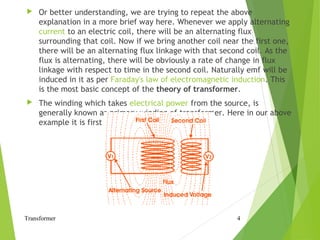
 The winding which takes electrical power from the source, is
generally known as primary winding of transformer. Here in our above
example it is first winding.
Transformer 4
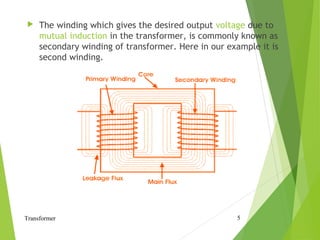
 The winding which gives the desired output voltage due to
mutual induction in the transformer, is commonly known as
secondary winding of transformer. Here in our example it is
second winding.
Transformer 5
 The above mentioned form of transformer is
theoretically possible but not practically, because in
open air very tiny portion of the flux of the first
winding will link with second; so the current that
flows through the closed circuit of later, will be so
small in amount that it will be difficult to measure.
 The rate of change of flux linkage depends upon the
amount of linked flux with the second winding. So,
it is desired to be linked to almost all flux of
primary winding to the secondary winding. This is
effectively and efficiently done by placing one low
reluctance path common to both of the winding.
This low reluctance path is core of transformer,
through which maximum number of flux produced by
the primary is passed through and linked with the
secondary winding. This is the most basic theory of
transformer.
Transformer 6
 Main Constructional Parts of Transformer
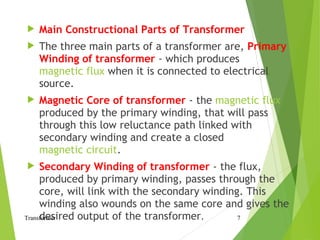
 The three main parts of a transformer are, Primary
Winding of transformer - which produces
magnetic flux when it is connected to electrical
source.
 Magnetic Core of transformer - the magnetic flux
produced by the primary winding, that will pass
through this low reluctance path linked with
secondary winding and create a closed
magnetic circuit.
 Secondary Winding of transformer - the flux,
produced by primary winding, passes through the
core, will link with the secondary winding. This
winding also wounds on the same core and gives the
desired output of the transformer.Transformer 7
8
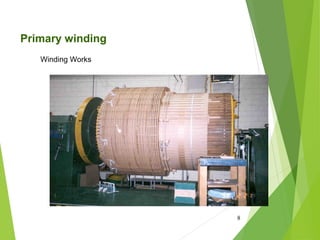
Primary winding
Winding Works
9
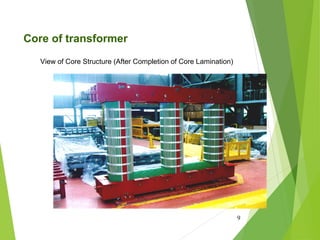
Core of transformer
View of Core Structure (After Completion of Core Lamination)
10
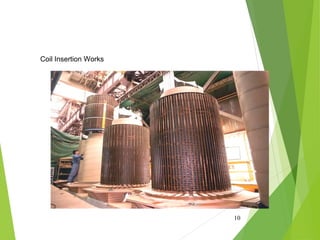
Coil Insertion Works
11
View of Core and Coil Assembly Works
12
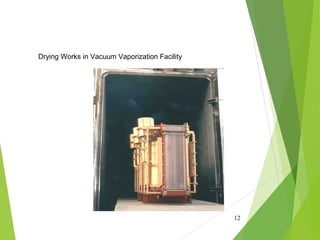
Drying Works in Vacuum Vaporization Facility
13
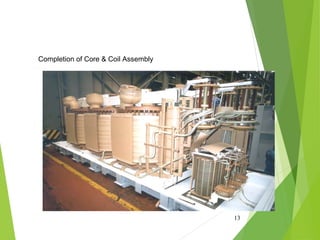
Completion of Core & Coil Assembly
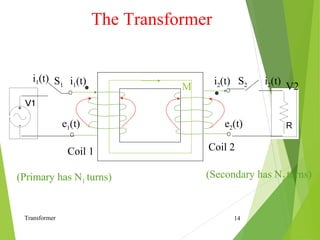
Transformer 14
Coil 1
i1(t) i2(t)
Coil 2
M
e1(t) e2(t)
S1 S2
i1(t) i2(t)
The Transformer
(Primary has N1 turns) (Secondary has N2 turns)
V2
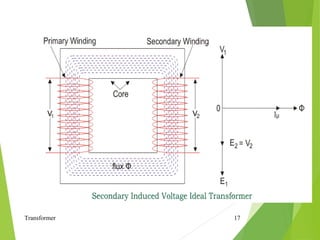
 Emf Equation of Transformer
 EMF Equation of transformer can be established in
a very easy way. Actually in
electrical power transformer, one alternating
electrical source is applied to the primary winding
and due to this, magnetizing current flowing through
the primary winding which produces alternating flux
in the core of transformer. This flux links with both
primary and secondary windings. As this flux is
alternating in nature, there must be a rate of
change of flux. According to Faraday's law of
electromagnetic induction if any coil or conductor
links with any changing flux, there must be an
induced emf in it.Transformer 15
 As the current source to primary is sinusoidal, the
flux induced by it will be also sinusoidal. Hence, the
function of flux may be considered as a sine
function.
 Mathematically, derivative of that function will give
a function for rate of change of flux linkage with
respect to time. This later function will be a cosine
function since d(sinθ)/dt = cosθ.
 So, if we derive the expression for rms value of this
cosine wave and multiply it with number of turns of
the winding, we will easily get the expression for
rms value of induced emf of that winding.
 In this way, we can easily derive the emf equation
of transformer.
Transformer 16
Transformer 17
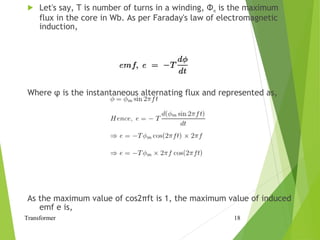
 Let's say, T is number of turns in a winding, Φm is the maximum
flux in the core in Wb. As per Faraday's law of electromagnetic
induction,
Where φ is the instantaneous alternating flux and represented as,
As the maximum value of cos2πft is 1, the maximum value of induced
emf e is,
Transformer 18
Transformer 19
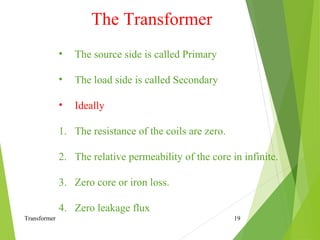
• The source side is called Primary
• The load side is called Secondary
• Ideally
1. The resistance of the coils are zero.
2. The relative permeability of the core in infinite.
3. Zero core or iron loss.
4. Zero leakage flux
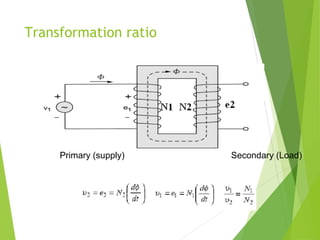
The Transformer
Transformation ratio
Primary (supply) Secondary (Load)
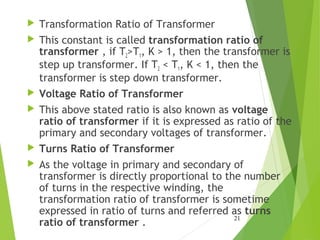
 Transformation Ratio of Transformer
 This constant is called transformation ratio of
transformer , if T2>T1, K > 1, then the transformer is
step up transformer. If T2 < T1, K < 1, then the
transformer is step down transformer.
 Voltage Ratio of Transformer
 This above stated ratio is also known as voltage
ratio of transformer if it is expressed as ratio of the
primary and secondary voltages of transformer.
 Turns Ratio of Transformer
 As the voltage in primary and secondary of
transformer is directly proportional to the number
of turns in the respective winding, the
transformation ratio of transformer is sometime
expressed in ratio of turns and referred as turns
ratio of transformer .
21
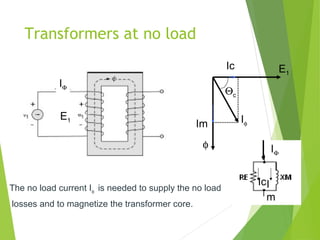
Transformers at no load
The no load current Iφ is needed to supply the no load
losses and to magnetize the transformer core.
φ
Im
Ic E1
Iφ
Θc
E1
IΦ
IΦ
IcI
m
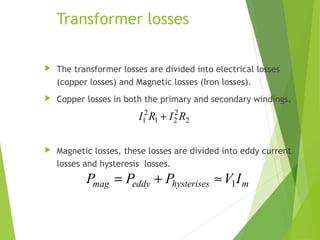
Transformer losses
 The transformer losses are divided into electrical losses
(copper losses) and Magnetic losses (Iron losses).
 Copper losses in both the primary and secondary windings.
 Magnetic losses, these losses are divided into eddy current
losses and hysteresis losses.
2
2
21
2
1 RIRI +
mhysteriseseddymag IVPPP 1≈+=
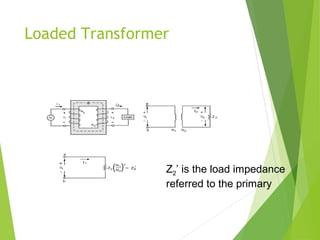
Loaded Transformer
Z2’ is the load impedance
referred to the primary
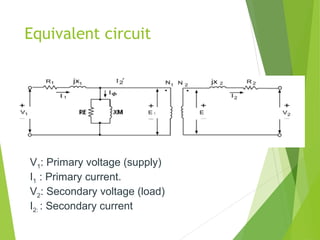
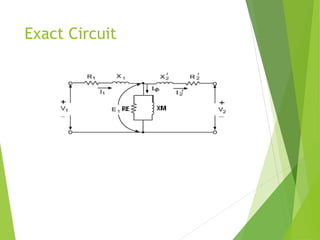
Equivalent circuit
V1: Primary voltage (supply)
I1 : Primary current.
V2: Secondary voltage (load)
I2: : Secondary current
Exact Circuit
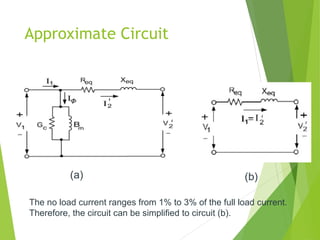
Approximate Circuit
The no load current ranges from 1% to 3% of the full load current.
Therefore, the circuit can be simplified to circuit (b).
(a) (b)
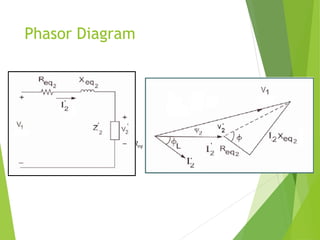
Phasor Diagram
)('
2
'
21 eqeq jXRIVV ++=
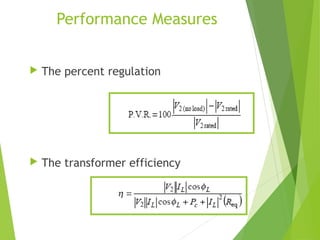
Performance Measures
 The percent regulation
 The transformer efficiency
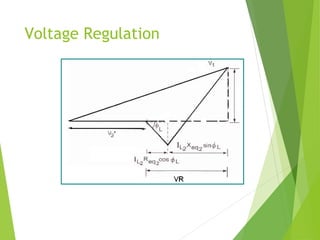
Voltage Regulation
φφ sincos '
2
'
2
'
21 eqeq XIRIVVVR +≈−=
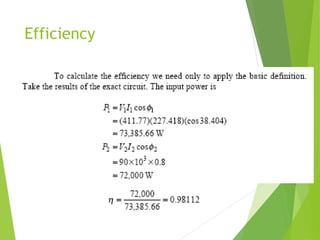
Efficiency
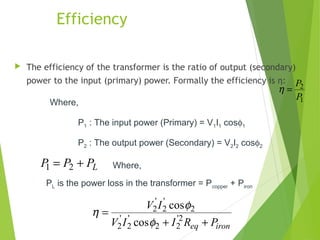
 The efficiency of the transformer is the ratio of output (secondary)
power to the input (primary) power. Formally the efficiency is η:
1
2
P
P
=η
LPPP += 21
Where,
P2 : The output power (Secondary) = V2I2 cosφ2
P1 : The input power (Primary) = V1I1 cosφ1
Where,
PL is the power loss in the transformer = Pcopper + Piron
ironeq PRIIV
IV
++
= 2'
22
'
2
'
2
2
'
2
'
2
cos
cos
φ
φ
η
Example
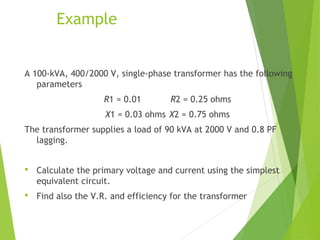
A 100-kVA, 400/2000 V, single-phase transformer has the following
parameters
R1 = 0.01 R2 = 0.25 ohms
X1 = 0.03 ohms X2 = 0.75 ohms
The transformer supplies a load of 90 kVA at 2000 V and 0.8 PF
lagging.
 Calculate the primary voltage and current using the simplest
equivalent circuit.
 Find also the V.R. and efficiency for the transformer
Solution
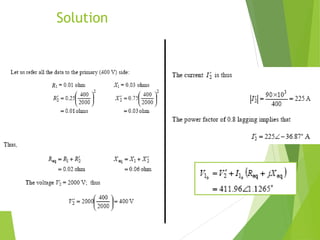
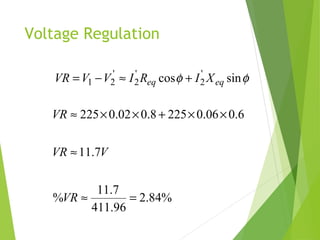
Voltage Regulation
φφ sincos '
2
'
2
'
21 eqeq XIRIVVVR +≈−=
%84.2
96.411
7.11
%
7.11
6.006.02258.002.0225
=≈
≈
××+××≈
VR
VVR
VR
Efficiency

Transformer

  • 1.
  • 2.
    Introduction  Definition ofTransformer  Electrical power transformer is a static device which transforms electrical energy from one circuit to another without any direct electrical connection and with the help of mutual induction between two windings. It transforms power from one circuit to another without changing its frequency but may be in different voltage level. This is a very short and simple definition of transformer, as we will go through this portion of tutorial related to electrical power transformer, we will understand more clearly and deeply "what is transformer ?" and basic theory of transformer. Transformer 2
  • 3.
     Working Principleof Transformer  The working principle of transformer is very simple. It depends upon Faraday's law of electromagnetic induction. Actually, mutual induction between two or more winding is responsible for transformation action in an electrical transformer. Faraday's Laws of Electromagnetic Induction  According to these Faraday's laws, "Rate of change of flux linkage with respect to time is directly proportional to the induced EMF in a conductor or coil".  Basic Theory of Transformer  Say you have one winding which is supplied by an alternating electrical source. The alternating current through the winding produces a continually changing flux or alternating flux that surrounds the winding. If any other winding is brought nearer to the previous one, obviously some portion of this flux will link with the second. As this flux is continually changing in its amplitude and direction, there must be a change in flux linkage in the second winding or coil. According to Faraday's law of electromagnetic induction, there must be an EMF induced in the second. If the circuit of the later winding is closed, there must be an current flowing through it. This is the simplest form of electrical power transformer and this is the most basic of working principle of transformer. Transformer 3
  • 4.
     Or betterunderstanding, we are trying to repeat the above explanation in a more brief way here. Whenever we apply alternating current to an electric coil, there will be an alternating flux surrounding that coil. Now if we bring another coil near the first one, there will be an alternating flux linkage with that second coil. As the flux is alternating, there will be obviously a rate of change in flux linkage with respect to time in the second coil. Naturally emf will be induced in it as per Faraday's law of electromagnetic induction. This is the most basic concept of the theory of transformer.  The winding which takes electrical power from the source, is generally known as primary winding of transformer. Here in our above example it is first winding. Transformer 4
  • 5.
     The windingwhich gives the desired output voltage due to mutual induction in the transformer, is commonly known as secondary winding of transformer. Here in our example it is second winding. Transformer 5
  • 6.
     The abovementioned form of transformer is theoretically possible but not practically, because in open air very tiny portion of the flux of the first winding will link with second; so the current that flows through the closed circuit of later, will be so small in amount that it will be difficult to measure.  The rate of change of flux linkage depends upon the amount of linked flux with the second winding. So, it is desired to be linked to almost all flux of primary winding to the secondary winding. This is effectively and efficiently done by placing one low reluctance path common to both of the winding. This low reluctance path is core of transformer, through which maximum number of flux produced by the primary is passed through and linked with the secondary winding. This is the most basic theory of transformer. Transformer 6
  • 7.
     Main ConstructionalParts of Transformer  The three main parts of a transformer are, Primary Winding of transformer - which produces magnetic flux when it is connected to electrical source.  Magnetic Core of transformer - the magnetic flux produced by the primary winding, that will pass through this low reluctance path linked with secondary winding and create a closed magnetic circuit.  Secondary Winding of transformer - the flux, produced by primary winding, passes through the core, will link with the secondary winding. This winding also wounds on the same core and gives the desired output of the transformer.Transformer 7
  • 8.
  • 9.
    9 Core of transformer Viewof Core Structure (After Completion of Core Lamination)
  • 10.
  • 11.
    11 View of Coreand Coil Assembly Works
  • 12.
    12 Drying Works inVacuum Vaporization Facility
  • 13.
    13 Completion of Core& Coil Assembly
  • 14.
    Transformer 14 Coil 1 i1(t)i2(t) Coil 2 M e1(t) e2(t) S1 S2 i1(t) i2(t) The Transformer (Primary has N1 turns) (Secondary has N2 turns) V2
  • 15.
     Emf Equationof Transformer  EMF Equation of transformer can be established in a very easy way. Actually in electrical power transformer, one alternating electrical source is applied to the primary winding and due to this, magnetizing current flowing through the primary winding which produces alternating flux in the core of transformer. This flux links with both primary and secondary windings. As this flux is alternating in nature, there must be a rate of change of flux. According to Faraday's law of electromagnetic induction if any coil or conductor links with any changing flux, there must be an induced emf in it.Transformer 15
  • 16.
     As thecurrent source to primary is sinusoidal, the flux induced by it will be also sinusoidal. Hence, the function of flux may be considered as a sine function.  Mathematically, derivative of that function will give a function for rate of change of flux linkage with respect to time. This later function will be a cosine function since d(sinθ)/dt = cosθ.  So, if we derive the expression for rms value of this cosine wave and multiply it with number of turns of the winding, we will easily get the expression for rms value of induced emf of that winding.  In this way, we can easily derive the emf equation of transformer. Transformer 16
  • 17.
  • 18.
     Let's say,T is number of turns in a winding, Φm is the maximum flux in the core in Wb. As per Faraday's law of electromagnetic induction, Where φ is the instantaneous alternating flux and represented as, As the maximum value of cos2πft is 1, the maximum value of induced emf e is, Transformer 18
  • 19.
    Transformer 19 • Thesource side is called Primary • The load side is called Secondary • Ideally 1. The resistance of the coils are zero. 2. The relative permeability of the core in infinite. 3. Zero core or iron loss. 4. Zero leakage flux The Transformer
  • 20.
  • 21.
     Transformation Ratioof Transformer  This constant is called transformation ratio of transformer , if T2>T1, K > 1, then the transformer is step up transformer. If T2 < T1, K < 1, then the transformer is step down transformer.  Voltage Ratio of Transformer  This above stated ratio is also known as voltage ratio of transformer if it is expressed as ratio of the primary and secondary voltages of transformer.  Turns Ratio of Transformer  As the voltage in primary and secondary of transformer is directly proportional to the number of turns in the respective winding, the transformation ratio of transformer is sometime expressed in ratio of turns and referred as turns ratio of transformer . 21
  • 22.
    Transformers at noload The no load current Iφ is needed to supply the no load losses and to magnetize the transformer core. φ Im Ic E1 Iφ Θc E1 IΦ IΦ IcI m
  • 23.
    Transformer losses  Thetransformer losses are divided into electrical losses (copper losses) and Magnetic losses (Iron losses).  Copper losses in both the primary and secondary windings.  Magnetic losses, these losses are divided into eddy current losses and hysteresis losses. 2 2 21 2 1 RIRI + mhysteriseseddymag IVPPP 1≈+=
  • 24.
    Loaded Transformer Z2’ isthe load impedance referred to the primary
  • 25.
    Equivalent circuit V1: Primaryvoltage (supply) I1 : Primary current. V2: Secondary voltage (load) I2: : Secondary current
  • 26.
  • 27.
    Approximate Circuit The noload current ranges from 1% to 3% of the full load current. Therefore, the circuit can be simplified to circuit (b). (a) (b)
  • 28.
  • 29.
    Performance Measures  Thepercent regulation  The transformer efficiency
  • 30.
    Voltage Regulation φφ sincos' 2 ' 2 ' 21 eqeq XIRIVVVR +≈−=
  • 31.
    Efficiency  The efficiencyof the transformer is the ratio of output (secondary) power to the input (primary) power. Formally the efficiency is η: 1 2 P P =η LPPP += 21 Where, P2 : The output power (Secondary) = V2I2 cosφ2 P1 : The input power (Primary) = V1I1 cosφ1 Where, PL is the power loss in the transformer = Pcopper + Piron ironeq PRIIV IV ++ = 2' 22 ' 2 ' 2 2 ' 2 ' 2 cos cos φ φ η
  • 32.
    Example A 100-kVA, 400/2000V, single-phase transformer has the following parameters R1 = 0.01 R2 = 0.25 ohms X1 = 0.03 ohms X2 = 0.75 ohms The transformer supplies a load of 90 kVA at 2000 V and 0.8 PF lagging.  Calculate the primary voltage and current using the simplest equivalent circuit.  Find also the V.R. and efficiency for the transformer
  • 33.
  • 34.
    Voltage Regulation φφ sincos' 2 ' 2 ' 21 eqeq XIRIVVVR +≈−= %84.2 96.411 7.11 % 7.11 6.006.02258.002.0225 =≈ ≈ ××+××≈ VR VVR VR
  • 35.