SVCE
1
EE 2353
HIGH VOLTAGE ENGINEERING
D.ELANGOVAN M.E.,
AP / EEE
SVCE
Lecture# 2
UNIT 4 – Measurements of AC High Voltages
SVCE
2
Unit 4 Measurements
MEASUREMENT OF HIGH DC VOLTAGES
Series Resistance micro ammeter
 Resistance potential divider
 Generating Voltmeters
 Sphere Gaps
SVCE
3
Unit 4 Measurements
MEASUREMENT OF HIGH AC VOLTAGES
 Series impedance voltmeter
 Potential Transformers (CVT)
 Electrostatic Voltmeters
 Potential Dividers
 Sphere gaps
SVCE
4
Unit 4 Measurements
MEASUREMENT OF HIGH AC HIGH FREQUENCY &
IMPULSE VOLTAGES
 Potential Dividers (R & C)
 Peak voltmeters
 Sphere gaps
SVCE
5
Unit 4 MEASUREMENT OF HIGH DC VOLTAGES
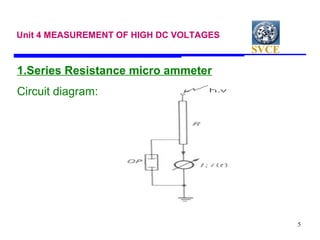
1.Series Resistance micro ammeter
Circuit diagram:
SVCE
6
Unit 4 MEASUREMENT OF HIGH DC VOLTAGES
1.Series Resistance micro ammeter
Construction:
A large value of resistance (few hundreds of mega
ohms) is connected in series with uA
Protective device (Zenor diode, neon glow
tube)connected across the uA
SVCE
7
Unit 4 MEASUREMENT OF HIGH DC VOLTAGES
1.Series Resistance micro ammeter
operation
R should be high
High DC voltage is applied
Voltage drop across the resistance
The current flowing thro’ R is measured in uA
SVCE
8
Unit 4 MEASUREMENT OF HIGH DC VOLTAGES
1.Series Resistance micro ammeter
Note:
Voltage V=IR
Drop in Ammeter is negligible
R should be chosen such that 1 to 10 uA is
allowed for full scale deflection
500 kv can be measured
Accuracy : 0.2%
SVCE
9
Unit 4 MEASUREMENT OF HIGH DC VOLTAGES
1.Series Resistance micro ammeter
Need for protective device
If R fails, heavy current will flow thro’ uA
To divert protective device is used
SVCE
10
Unit 4 MEASUREMENT OF HIGH DC VOLTAGES
1.Series Resistance micro ammeter
Drawbacks
More power dissipation
Temperature effects
SVCE
11
Unit 4 MEASUREMENT OF HIGH DC VOLTAGES
2.Resistance potential divider
Need
To avoid high loading of R
Another resistor is added
SVCE
12
Unit 4 MEASUREMENT OF HIGH DC VOLTAGES
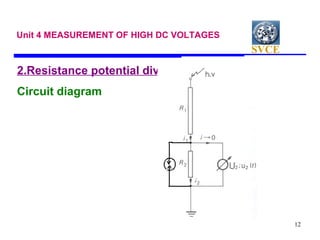
2.Resistance potential divider
Circuit diagram
SVCE
13
Unit 4 MEASUREMENT OF HIGH DC VOLTAGES
2.Resistance potential divider
Construction
R1 R2 connected in series
Voltage is measured across R2
SVCE
14
Unit 4 MEASUREMENT OF HIGH DC VOLTAGES
2.Resistance potential divider
Operation
DC voltages are measured using resistance voltage divider
R2 <<< R1
High DC voltage applied.
Drop across R1
Measure the voltage directly across R2
SVCE
15
Unit 4 MEASUREMENT OF HIGH DC VOLTAGES
2.Resistance potential divider
Note
Power Dissipation in resistor R1
Need for cooling
Series connection of resistors
SVCE
16
Unit 4 MEASUREMENT OF HIGH DC VOLTAGES
3.Generating Voltmeter
Principle
Variable electrostatic generator which generates a
current proportional to the applied external voltage
SVCE
17
Unit 4 MEASUREMENT OF HIGH DC VOLTAGES
3.Generating Voltmeter
Time variant capacitance system can be developed
between the high voltage electrode and earthed
electrode, then current flowing to earth electrode
will be a measure of the voltage
SVCE
18
Unit 4 MEASUREMENT OF HIGH DC VOLTAGES
3.Generating Voltmeter
Connect High voltage source to disc electrode H
L1,L2,L3 are earthed electrode
The L1 has vanes and its rotated at constant speed
The rotor vanes of L1 periodically cover and uncover the
static sensing electrode L3
Capacitance between H & L3 changes periodically
SVCE
19
Unit 4 MEASUREMENT OF HIGH DC VOLTAGES
3.Generating Voltmeter
The shape and No of vanes of L1,L2 are designed
that they produce sinusoidal variation in the
capacitance
The generated ac current is rectified and read by
a moving coil instrument
SVCE
20
Unit 4 Measurements
MEASUREMENT OF HIGH AC VOLTAGES
 Series impedance voltmeter
 Potential Dividers
Electrostatic Voltmeters
 Potential Transformers (CVT)
Sphere gaps
SVCE
21
Unit 4 MEASUREMENT OF HIGH AC VOLTAGES
Potential Dividers
1.R Dividers
 Power loss
 Temperature Effects
2.Series impedance
3.C dividers
SVCE
22
Unit 4 MEASUREMENT OF HIGH AC VOLTAGES
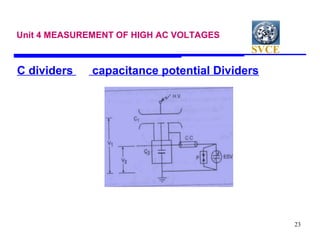
C dividers
Series capacitance Dividers
Apply the voltage
Drop Across C
Charging Current s measured using Micro
ammeter
SVCE
23
Unit 4 MEASUREMENT OF HIGH AC VOLTAGES
C dividers capacitance potential Dividers
SVCE
24
Unit 4 MEASUREMENT OF HIGH AC VOLTAGES
C dividers capacitance potential Dividers
Need to measure
1.Withstand-RMS voltage
2.Breakdown-Peak voltage
RMS = Peak/√2 for only sine wave
SVCE
25
Unit 4 MEASUREMENT OF HIGH AC VOLTAGES
Peak value measurement
1.Chubb-Frotscue method ( Series capacitor peak
voltmeter)
2.Peak voltmeter with potential voltmeter(Davis ,
Bowdler ,stand ring circuit)
3.Digital peak voltmeter
4.Sphere gap
SVCE
26
Unit 4 MEASUREMENT OF HIGH AC VOLTAGES
RMS value measurement
1.Peak voltmeter with potential voltmeter(Davies ,
Bowdler ,stand ring circuit)
2.Electrostatic voltmeter
SVCE
27
Unit 4 MEASUREMENT OF HIGH AC VOLTAGES
Peak value measurement
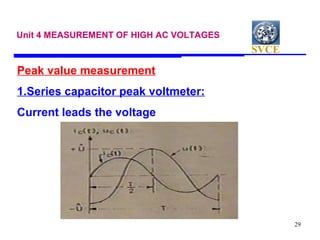
1.Series capacitor peak voltmeter:
Principle
Measure of charging current
Ic=VὡC
Construction
Stand. Capacitor Diode & Meter
SVCE
28
Unit 4 MEASUREMENT OF HIGH AC VOLTAGES
1.Series capacitor peak voltmeter:
Operation
Apply voltage
Charging current is rectified by
D1 and measured
Other half cycle no conduction
SVCE
29
Unit 4 MEASUREMENT OF HIGH AC VOLTAGES
Peak value measurement
1.Series capacitor peak voltmeter:
Current leads the voltage
SVCE
30
Unit 4 MEASUREMENT OF HIGH AC VOLTAGES
Peak value measurement
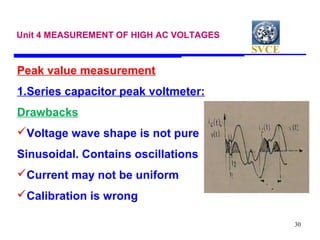
1.Series capacitor peak voltmeter:
Drawbacks
Voltage wave shape is not pure
Sinusoidal. Contains oscillations
Current may not be uniform
Calibration is wrong
SVCE
31
Unit 4 MEASUREMENT OF HIGH AC VOLTAGES
Peak voltmeter with potential voltmeter(Davis ,
Bowdler ,stand ring circuit)
SVCE
32
Unit 4 MEASUREMENT OF HIGH AC VOLTAGES
Peak voltmeter with potential voltmeter(Davis ,
Bowdler ,stand ring circuit)
The voltage to be measured is applied across
C1&C2 divider.
The voltage appears on C2 is rectified into DC
and charge the Cs.
Meter read the peak value of C2
Multiplying Divider ratio we can get the voltage to
be measured
SVCE
33
Unit 4 MEASUREMENT OF HIGH AC VOLTAGES
Peak voltmeter with potential voltmeter(Davis ,
Bowdler ,stand ring circuit)
Discharge Error
Rest Charge Error
SVCE
34
Unit 4 MEASUREMENT OF HIGH AC VOLTAGES
RMS value measurement
1.Peak voltmeter with potential voltmeter(Davis ,
Bowdler ,stand ring circuit)
SVCE
35
Unit 4 MEASUREMENT OF HIGH AC VOLTAGES
Electrostatic Voltmeter
Principle
Force between the parallel plate electrodes is given
by
F=1/2 €V2
A/D2
SVCE
36
Unit 4 MEASUREMENT OF HIGH AC VOLTAGES
RMS value measurement
Electrostatic Voltmeter
SVCE
37
Unit 4 MEASUREMENT OF HIGH AC VOLTAGES
Electrostatic Voltmeter
Construction
HV Electrode insulated
from earth
LV electrode – central point is
movable
Light beam
Scale
SVCE
38
Unit 4 MEASUREMENT OF HIGH AC VOLTAGES
Electrostatic Voltmeter
Operation
High voltage is applied
Due to electrostatic forces
deflection of rotating
Element
Light focused on the mirror
Gets reflected & measured
SVCE
39
Unit 4 MEASUREMENT OF HIGH AC VOLTAGES
Electrostatic Voltmeter
Drawback
For a Constant distance d, the sensitivity is small
Advantage
No source loading
Continuous Reading also possible

Measurement of high_voltage_and_high_currentunit_iv_full_version

  • 1.
    SVCE 1 EE 2353 HIGH VOLTAGEENGINEERING D.ELANGOVAN M.E., AP / EEE SVCE Lecture# 2 UNIT 4 – Measurements of AC High Voltages
  • 2.
    SVCE 2 Unit 4 Measurements MEASUREMENTOF HIGH DC VOLTAGES Series Resistance micro ammeter  Resistance potential divider  Generating Voltmeters  Sphere Gaps
  • 3.
    SVCE 3 Unit 4 Measurements MEASUREMENTOF HIGH AC VOLTAGES  Series impedance voltmeter  Potential Transformers (CVT)  Electrostatic Voltmeters  Potential Dividers  Sphere gaps
  • 4.
    SVCE 4 Unit 4 Measurements MEASUREMENTOF HIGH AC HIGH FREQUENCY & IMPULSE VOLTAGES  Potential Dividers (R & C)  Peak voltmeters  Sphere gaps
  • 5.
    SVCE 5 Unit 4 MEASUREMENTOF HIGH DC VOLTAGES 1.Series Resistance micro ammeter Circuit diagram:
  • 6.
    SVCE 6 Unit 4 MEASUREMENTOF HIGH DC VOLTAGES 1.Series Resistance micro ammeter Construction: A large value of resistance (few hundreds of mega ohms) is connected in series with uA Protective device (Zenor diode, neon glow tube)connected across the uA
  • 7.
    SVCE 7 Unit 4 MEASUREMENTOF HIGH DC VOLTAGES 1.Series Resistance micro ammeter operation R should be high High DC voltage is applied Voltage drop across the resistance The current flowing thro’ R is measured in uA
  • 8.
    SVCE 8 Unit 4 MEASUREMENTOF HIGH DC VOLTAGES 1.Series Resistance micro ammeter Note: Voltage V=IR Drop in Ammeter is negligible R should be chosen such that 1 to 10 uA is allowed for full scale deflection 500 kv can be measured Accuracy : 0.2%
  • 9.
    SVCE 9 Unit 4 MEASUREMENTOF HIGH DC VOLTAGES 1.Series Resistance micro ammeter Need for protective device If R fails, heavy current will flow thro’ uA To divert protective device is used
  • 10.
    SVCE 10 Unit 4 MEASUREMENTOF HIGH DC VOLTAGES 1.Series Resistance micro ammeter Drawbacks More power dissipation Temperature effects
  • 11.
    SVCE 11 Unit 4 MEASUREMENTOF HIGH DC VOLTAGES 2.Resistance potential divider Need To avoid high loading of R Another resistor is added
  • 12.
    SVCE 12 Unit 4 MEASUREMENTOF HIGH DC VOLTAGES 2.Resistance potential divider Circuit diagram
  • 13.
    SVCE 13 Unit 4 MEASUREMENTOF HIGH DC VOLTAGES 2.Resistance potential divider Construction R1 R2 connected in series Voltage is measured across R2
  • 14.
    SVCE 14 Unit 4 MEASUREMENTOF HIGH DC VOLTAGES 2.Resistance potential divider Operation DC voltages are measured using resistance voltage divider R2 <<< R1 High DC voltage applied. Drop across R1 Measure the voltage directly across R2
  • 15.
    SVCE 15 Unit 4 MEASUREMENTOF HIGH DC VOLTAGES 2.Resistance potential divider Note Power Dissipation in resistor R1 Need for cooling Series connection of resistors
  • 16.
    SVCE 16 Unit 4 MEASUREMENTOF HIGH DC VOLTAGES 3.Generating Voltmeter Principle Variable electrostatic generator which generates a current proportional to the applied external voltage
  • 17.
    SVCE 17 Unit 4 MEASUREMENTOF HIGH DC VOLTAGES 3.Generating Voltmeter Time variant capacitance system can be developed between the high voltage electrode and earthed electrode, then current flowing to earth electrode will be a measure of the voltage
  • 18.
    SVCE 18 Unit 4 MEASUREMENTOF HIGH DC VOLTAGES 3.Generating Voltmeter Connect High voltage source to disc electrode H L1,L2,L3 are earthed electrode The L1 has vanes and its rotated at constant speed The rotor vanes of L1 periodically cover and uncover the static sensing electrode L3 Capacitance between H & L3 changes periodically
  • 19.
    SVCE 19 Unit 4 MEASUREMENTOF HIGH DC VOLTAGES 3.Generating Voltmeter The shape and No of vanes of L1,L2 are designed that they produce sinusoidal variation in the capacitance The generated ac current is rectified and read by a moving coil instrument
  • 20.
    SVCE 20 Unit 4 Measurements MEASUREMENTOF HIGH AC VOLTAGES  Series impedance voltmeter  Potential Dividers Electrostatic Voltmeters  Potential Transformers (CVT) Sphere gaps
  • 21.
    SVCE 21 Unit 4 MEASUREMENTOF HIGH AC VOLTAGES Potential Dividers 1.R Dividers  Power loss  Temperature Effects 2.Series impedance 3.C dividers
  • 22.
    SVCE 22 Unit 4 MEASUREMENTOF HIGH AC VOLTAGES C dividers Series capacitance Dividers Apply the voltage Drop Across C Charging Current s measured using Micro ammeter
  • 23.
    SVCE 23 Unit 4 MEASUREMENTOF HIGH AC VOLTAGES C dividers capacitance potential Dividers
  • 24.
    SVCE 24 Unit 4 MEASUREMENTOF HIGH AC VOLTAGES C dividers capacitance potential Dividers Need to measure 1.Withstand-RMS voltage 2.Breakdown-Peak voltage RMS = Peak/√2 for only sine wave
  • 25.
    SVCE 25 Unit 4 MEASUREMENTOF HIGH AC VOLTAGES Peak value measurement 1.Chubb-Frotscue method ( Series capacitor peak voltmeter) 2.Peak voltmeter with potential voltmeter(Davis , Bowdler ,stand ring circuit) 3.Digital peak voltmeter 4.Sphere gap
  • 26.
    SVCE 26 Unit 4 MEASUREMENTOF HIGH AC VOLTAGES RMS value measurement 1.Peak voltmeter with potential voltmeter(Davies , Bowdler ,stand ring circuit) 2.Electrostatic voltmeter
  • 27.
    SVCE 27 Unit 4 MEASUREMENTOF HIGH AC VOLTAGES Peak value measurement 1.Series capacitor peak voltmeter: Principle Measure of charging current Ic=VὡC Construction Stand. Capacitor Diode & Meter
  • 28.
    SVCE 28 Unit 4 MEASUREMENTOF HIGH AC VOLTAGES 1.Series capacitor peak voltmeter: Operation Apply voltage Charging current is rectified by D1 and measured Other half cycle no conduction
  • 29.
    SVCE 29 Unit 4 MEASUREMENTOF HIGH AC VOLTAGES Peak value measurement 1.Series capacitor peak voltmeter: Current leads the voltage
  • 30.
    SVCE 30 Unit 4 MEASUREMENTOF HIGH AC VOLTAGES Peak value measurement 1.Series capacitor peak voltmeter: Drawbacks Voltage wave shape is not pure Sinusoidal. Contains oscillations Current may not be uniform Calibration is wrong
  • 31.
    SVCE 31 Unit 4 MEASUREMENTOF HIGH AC VOLTAGES Peak voltmeter with potential voltmeter(Davis , Bowdler ,stand ring circuit)
  • 32.
    SVCE 32 Unit 4 MEASUREMENTOF HIGH AC VOLTAGES Peak voltmeter with potential voltmeter(Davis , Bowdler ,stand ring circuit) The voltage to be measured is applied across C1&C2 divider. The voltage appears on C2 is rectified into DC and charge the Cs. Meter read the peak value of C2 Multiplying Divider ratio we can get the voltage to be measured
  • 33.
    SVCE 33 Unit 4 MEASUREMENTOF HIGH AC VOLTAGES Peak voltmeter with potential voltmeter(Davis , Bowdler ,stand ring circuit) Discharge Error Rest Charge Error
  • 34.
    SVCE 34 Unit 4 MEASUREMENTOF HIGH AC VOLTAGES RMS value measurement 1.Peak voltmeter with potential voltmeter(Davis , Bowdler ,stand ring circuit)
  • 35.
    SVCE 35 Unit 4 MEASUREMENTOF HIGH AC VOLTAGES Electrostatic Voltmeter Principle Force between the parallel plate electrodes is given by F=1/2 €V2 A/D2
  • 36.
    SVCE 36 Unit 4 MEASUREMENTOF HIGH AC VOLTAGES RMS value measurement Electrostatic Voltmeter
  • 37.
    SVCE 37 Unit 4 MEASUREMENTOF HIGH AC VOLTAGES Electrostatic Voltmeter Construction HV Electrode insulated from earth LV electrode – central point is movable Light beam Scale
  • 38.
    SVCE 38 Unit 4 MEASUREMENTOF HIGH AC VOLTAGES Electrostatic Voltmeter Operation High voltage is applied Due to electrostatic forces deflection of rotating Element Light focused on the mirror Gets reflected & measured
  • 39.
    SVCE 39 Unit 4 MEASUREMENTOF HIGH AC VOLTAGES Electrostatic Voltmeter Drawback For a Constant distance d, the sensitivity is small Advantage No source loading Continuous Reading also possible