REPORT ON POSTGRADUATE
EXPERIENCE
SUBMITTED FOR
REGISTRATION APPLICATION
WITH
THE ENGINEERS REGISTRATION
BOARD
BY:
GAENAMELE M. GANAMOTSE
Report word count is 2,901 Words
1 | P a g e
EMPLOYMENT RECORD
I joined Botswana Power Corporation as a Graduate Engineer in
February 2002 where I went through a three year Graduate Training
Program. The first year of this program was a general engineering
training covering all business units and all departments of the
corporation and the objective was to get a general over view of all
operations of the company and how they are interrelated.
In March 2003 I started a two year Directed Objective Training in
Metering and Energy Management. This training had detailed
objectives which I had to achieve before I could be appointed to a
substantive position. The main objectives were; to attain the required
competences in the design, operation and maintenance of the electrical
network and the design, installation and commissioning of metering
and energy management systems. Over and above that I was expected
to undergo and pass training to do high voltage switching up to 66kV. I
successfully completed this training in April 2005 and was appointed
Assistant Distribution Engineer – Metering & Energy Management.
In October 2007 I was promoted to the position of Area Supply Engineer
for Maun, responsible for the operations and maintenance of the
electrical network and equipment in the area and later transferred to
2 | P a g e
Gaborone in September 2009 as Area Supply Engineer for Mochudi,
Ramotswa & Molepolole.
From August 2011 to June 2012 I was self-employed as an Energy
ManagementConsultant. My job was to do energy audits, bill auditing
and establishment of energy management programs.
In June 2012 I joined BCL Mine as an Electrical Maintenance
Superintendent where I was the legally appointed Electrical Engineer
under section 13(1) of the Mines, Quarries, Works and Machinery Act,
responsiblefor the operation and maintenance of the electrical network
and associated production equipment.
In October 2014 I joined Tati Nickel Mining Company as a Section
Manager Electrical, responsible for the operation and maintenance of
all electrical equipment in the mine lease area. I am also the legally
appointed electrical engineer under regulation 13(1) of the Mines,
Quarries, Works and Machinery Act.
3 | P a g e
EXPERIENCE RECORD
BCL LIMITED – ELECTRICAL SUPERINTENDENT
June 2012 to Oct 2014
As an electrical superintendentfor metals production I was responsible
for the day to day operations and maintenance of the plant electrical
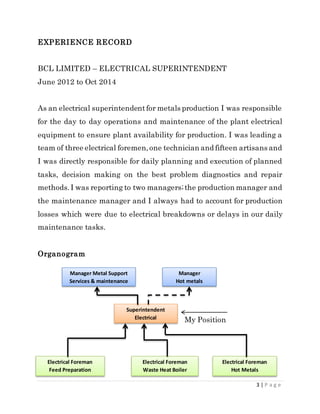
equipment to ensure plant availability for production. I was leading a
team of three electrical foremen,one technician and fifteen artisans and
I was directly responsible for daily planning and execution of planned
tasks, decision making on the best problem diagnostics and repair
methods.I was reporting to two managers;the production manager and
the maintenance manager and I always had to account for production
losses which were due to electrical breakdowns or delays in our daily
maintenance tasks.
Organogram
My Position
Manager Metal Support
Services & maintenance
Manager
Hot metals
Superintendent
Electrical
Electrical Foreman
Feed Preparation
Electrical Foreman
Waste Heat Boiler
Electrical Foreman
Hot Metals
4 | P a g e
Some of the critical tasks that I carried out on a daily basis as part of
my responsibilities are as follows;
9MVA ELECTRIC FURNACE TRANSFORMER REPAIR
Introduction
This project involved the complete rewinding and modification of a
9MVA electric furnace transformer for the installation of a new
VACUTAP VR VCRIII 400Y-72.5/C-18 35 3W On Load tap changer.
Project Background
BCL has three 9MVA transformers for the electric furnace. Two of these
units are in operation while the third is a spare. The spare transformer
had a faulty tap changer and needed to be repaired but these
transformers are old and spares are no longer available in the market.
The only option was to install a newer version tap changer which
required a complete rewindingof the transformerand transformer tank
modification for it to fit.
My involvement with the project
(MEA)
I was the Project Initiator and Project Manager for this project. I did
the project business case, project scope, project budget, application for
expenditure which included project cash flow estimates and I was also
part of the team that did the tender adjudications.
5 | P a g e
(COM)
After the project was awarded I held a project kickoff meeting with the
contractor and other stakeholders and subsequent project progress
meetings. I sent regular updates to management by email on the
progress made and challenges encountered. After the repair was done I
went for the factory inspection tests and approved the job as having
been done properly.
Project Challenges
(EVA)
The other challenge was that the mine was going to be left completely
without a spare electric furnace transformer and should one of the two
in service fail there was going to be some serious production losses and
this was big risk. In mitigation I looked for a 9MVA furnace
transformer in the market that we could hire but I could not find
anything and it became evident that we will have to live with the risk,
so I decided that we increase the frequency of maintenance on the in-
service transformers from quarterly to monthly to try and manage the
risk.
550V MCC BOARD REPLACEMENT
I was the project manager for this project and the project scope was to
design, manufacture, test, supply, deliver, install and commission a
Motor Control Centre (MCC) to replace the old one in the Smelter 550V
Substation CB507.The installation ofthese panels was to be done with
minimal process plant interruptions.
6 | P a g e
After the panels were manufactured, I sent a team for factory
acceptance tests to ensure that the MCC panels were manufactured
according to specification. The contractor could not come for the MCC
installation their order did not include the installation part.
(RFD)
I made a decision to do the installation with internal resources without
plant interruptions and I put up a team of technicians and artisans to
start the project. I drew a project plan on how we are going to do the
installation and I did a schedule and allocated people tasks and
durations. It was difficult because no one believed we will manage
including some in the team. My major challenge was to convince the
team that the project was executable with proper planning and
dedication. I was assisted by the fact that I had chosen a good team
leader who wanted to see the project done. Our first task was to run
temporaryalternative supplies to feed all the drives which were getting
supply from this board.We then started dismantlingand removal of the
old panels, rigging in and installation of the new panels, aligning the
panels and connection of the bus bars and finally we started connection
and termination of supply cables. During commissioning I personally
supervised the teams to ensure that the change over from temporary
supply to the new board was quick and safe and to assist in resolving
commissioning problems in time. I had two teams’ working day and
night shifts and I supervised both crews during commissioning.
7 | P a g e
Challenges
The main challenges were as follows;
 The substation was located on the first floor of the plant making
rigging very difficult as the Otis Lift which was to be used for
lifting was far away from the substation entrance and the space
to maneuver jack trollies was a challenge.
 We had demolished the door to create enough space for the
panels to go in and out and since the substation was on top of
the electric furnaces which were running there was too much
fumes and heat coming into the work area and making the area
unbearable to work in.
 Some cables had fallen down and were hanging above the
furnace making accessing them very difficult without switching
off the furnace.
 There were stories going around suggesting that the project was
going to fail and people will be fired and this demotivated the
team.
Solutions
(COM)
 I held daily progress meetings with my teams to address issues of
safety and task allocations and review of progress made using
Microsoft Project and Gantt chat
 I led HIRA sessions every morning to identify risks and come up
with mitigations in line with BCL safety procedures.
 I encouraged the team to do continuous risk assessmentas the job
progresses and new challenges arises
8 | P a g e
 I constantly communicated progress and challenges by email to
all stake holders including management and requested for plant
stoppages when we needed it.
 I constantly encouraged the team to believe in themselves and
assured them that the project is going to be a success
 I listened and addressed complaints about team members who
were not putting enough effort and encouraged them to work
hard, sometimes I redeployed them where they had interest and
could be better utilized.
(JUD)
 I hired a local contractor to assist with rigging which was now
delaying the project as the internal riggers were over stretched
 I provided a suction fan to suck away the fumes from the
substation.
 I requested a mobile crane to lift the panels up the front of the
substation entrance where there was enough space to pull them
in to the substation with jack trollies.
This project was completed successfullyand it came out in the company
bulletin with a picture of the team with management.
9 | P a g e
SELF EMPLOYED – ENERGY MANAGEMENT CONSULTANT
August 2011 to May 2012
I have worked with a couple of companies as an energy management
consultant but the highlight of my consultancy work was when I was
engaged by CadburyBotswana to assist them with their electricity bills
which were very high at the time.
(PRO)
I did a bill auditing where I analyzed their electricity bills for the past
two years using Energy Lens software. I plotted their energy and
maximum demand trends and I also looked at the load factor during the
same period. I identified from the trends that the electricity bills for
Cadbury were not consistent; they ranged from P113, 000.00 to P405,
000.00. I then looked at the production data and tried to correlate it
with the energy consumption patterns butthere was no correlation.The
next step I did an audit of the metering installation where I found that
the multiplication factor as per the installation does not correspond
with what is used for billing and the tariff category used for billing was
also not in line with the installation. At this stage I had now identified
the problem of the high bills as wrong multiplication factor applied and
incorrect tariff category.
(DDS)
I now calculated the financial losses as a result of the errors and
approached the utility company where I presented my findings, I met a
lot of resistance which was mainly due to lack of understanding but I
took them through my analytical methods and how I arrived at my
10 | P a g e
conclusions. We also went to site and verified that tariff category and
multiplication factor used for billing are not accurate. The errors were
rectified and Cadbury was refunded close to One million pula.
After the success of the bill auditingproject I was engaged as a resident
energy managementconsultantto assist the company with sustainable
energy management initiatives and some of the projects I carried out
are as follows;
Energy Management Initiatives
Metering scheme design and installation of meters
The first step in energy management is being able to see what is
happening as you cannot manage what you can’t see.
(PRO)
I started by analyzingthe factory’s single line diagram to determine all
significant loads and where they are fed from, I identified possible
metering points for effective energy monitoring and accounting. I then
designed metering circuits for all the identified points taking into
account cable sizes, bus bar sizes, space in the panels and cable routes
to come up with a project scope, material required and project
estimates. A contractor was engaged to do the installation as per the
specification and I was involved in the management of quality
assurance, safety and project commissioning.
11 | P a g e
Bill Verification
(DDS)
I did bill verification for CadburyBotswana onmonthlybases including
their energy intensity. The verification involved taking monthly meter
readings and calculation of the month’s bill using an Excel spreadsheet
which I had designed for billing purposes. This calculated bill would
then be used as the standard to test the accuracy of the electricity bill
when it comes from the utility company. Any deviation would then be
investigated by both the Cadbury and the utility company.
I also calculated the company load factor to see how power was utilized
per week and monthly. This data was very useful to management to
take immediate and corrective action in the production process if the
efficiency is low. I also did energy accounting which was to determine
where and how the energy is used and then sit with production team
managers to discuss how their areas performed in terms of energy
consumption, why they performed like that and whatcan be done about
it or what can be learnt from it if it’s a good performance.
12 | P a g e
BOTSWANA POWER CORPORATION – AREA SUPPLY ENGINEER
2007 to July 2011
As an Area Supply Engineer Maun I was responsible for northern part
of the country covering the whole of Ngamiland, Ghanzi and Okavango
regions. I was leading the Maun, Gumare, Shakawe, Ghanzi and
Charleshill service centers. I was responsible for the operation and
maintenance of the network, customer service and human resources
issues. The same applied when I was heading Molepolole, Mochudi and
Ramotswa service centers and the following were some of what I did;
Safe Work procedures
(EVA)
This job involved identifying the top 10 high risk jobs and developing
Safe Work Procedures for those particular jobs. This is done after a
thorough hazard identification and risk analysis. The Safe Work
Procedure would ensure the job is done in a systematic manner to
eliminate,reduce or manage the risks involved. My job was to come up
with these safe work procedures,identifythe risk and mitigation factors
and to enforce compliance to these procedures. I would go around work
sites to do Planned Task Observations to ensure that employees work
according to these procedures.
13 | P a g e
Electrical Network Maintenance
(MEA)
As an Area Supply Engineer my job was to maintain a reliable supplyof
power to our customers therefore network maintenance was very
critical for supply reliability. I preferred predictive and preventive
maintenance philosophy therefore I carried out thermography scans
and transformeroil analysis to pick problems before failures happened.
I then planned for these jobs and carried out maintenance at our
convenience rather than attending to breakdowns. I also did periodic
maintenance in overhead lines, battery units, circuit breaker
maintenance and protection relay maintenance.
(COM)
When I was in Maun, part of my area was supplied from Nampower in
Namibia so I was involved in a lot of cross border communication and
liaison on maintenanceshutdowns,load sheddingand black outs due to
faults. Every time Nampower wanted to do maintenance they would
contact me and we both decide a suitable date for maintenance.
14 | P a g e
BOTSWANA POWERCORPORATION– ASSISTANT DISTRIBUTION
ENGINEER (METERING & ENERGY MANAGEMENT)
2005 to 2006
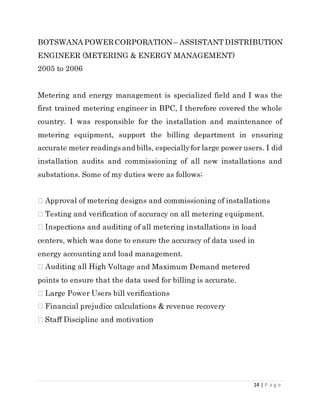
Metering and energy management is specialized field and I was the
first trained metering engineer in BPC, I therefore covered the whole
country. I was responsible for the installation and maintenance of
metering equipment, support the billing department in ensuring
accurate meter readings and bills, especiallyfor large power users. I did
installation audits and commissioning of all new installations and
substations. Some of my duties were as follows;
s
load
centers, which was done to ensure the accuracy of data used in
energy accounting and load management.
Voltage and Maximum Demand metered
points to ensure that the data used for billing is accurate.
15 | P a g e
BOTSWANA POWER CORPORATION – GRADUATE ENGINEER
2002 to 2005
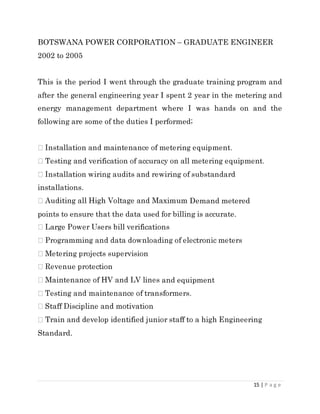
This is the period I went through the graduate training program and
after the general engineering year I spent 2 year in the metering and
energy management department where I was hands on and the
following are some of the duties I performed;
installations.
Demand metered
points to ensure that the data used for billing is accurate.
and equipment
Standard.
16 | P a g e
Conclusion
During the execution of these projects and others not mentioned here, I
have leant to asses risks and mitigate againstthem, I have leant to lead
teams to success through proper problem analysis, evaluation and
excising sound judgments. I have also gained valuable experience in
managing engineering projects and working with contractors. Lastly
proper communicationwith stakeholders has proved to work wonders in
ensuring a successful project delivery.
(2,901 Words)

Work Experience Report - Ganamotse

  • 1.
    REPORT ON POSTGRADUATE EXPERIENCE SUBMITTEDFOR REGISTRATION APPLICATION WITH THE ENGINEERS REGISTRATION BOARD BY: GAENAMELE M. GANAMOTSE Report word count is 2,901 Words
  • 2.
    1 | Pa g e EMPLOYMENT RECORD I joined Botswana Power Corporation as a Graduate Engineer in February 2002 where I went through a three year Graduate Training Program. The first year of this program was a general engineering training covering all business units and all departments of the corporation and the objective was to get a general over view of all operations of the company and how they are interrelated. In March 2003 I started a two year Directed Objective Training in Metering and Energy Management. This training had detailed objectives which I had to achieve before I could be appointed to a substantive position. The main objectives were; to attain the required competences in the design, operation and maintenance of the electrical network and the design, installation and commissioning of metering and energy management systems. Over and above that I was expected to undergo and pass training to do high voltage switching up to 66kV. I successfully completed this training in April 2005 and was appointed Assistant Distribution Engineer – Metering & Energy Management. In October 2007 I was promoted to the position of Area Supply Engineer for Maun, responsible for the operations and maintenance of the electrical network and equipment in the area and later transferred to
  • 3.
    2 | Pa g e Gaborone in September 2009 as Area Supply Engineer for Mochudi, Ramotswa & Molepolole. From August 2011 to June 2012 I was self-employed as an Energy ManagementConsultant. My job was to do energy audits, bill auditing and establishment of energy management programs. In June 2012 I joined BCL Mine as an Electrical Maintenance Superintendent where I was the legally appointed Electrical Engineer under section 13(1) of the Mines, Quarries, Works and Machinery Act, responsiblefor the operation and maintenance of the electrical network and associated production equipment. In October 2014 I joined Tati Nickel Mining Company as a Section Manager Electrical, responsible for the operation and maintenance of all electrical equipment in the mine lease area. I am also the legally appointed electrical engineer under regulation 13(1) of the Mines, Quarries, Works and Machinery Act.
  • 4.
    3 | Pa g e EXPERIENCE RECORD BCL LIMITED – ELECTRICAL SUPERINTENDENT June 2012 to Oct 2014 As an electrical superintendentfor metals production I was responsible for the day to day operations and maintenance of the plant electrical equipment to ensure plant availability for production. I was leading a team of three electrical foremen,one technician and fifteen artisans and I was directly responsible for daily planning and execution of planned tasks, decision making on the best problem diagnostics and repair methods.I was reporting to two managers;the production manager and the maintenance manager and I always had to account for production losses which were due to electrical breakdowns or delays in our daily maintenance tasks. Organogram My Position Manager Metal Support Services & maintenance Manager Hot metals Superintendent Electrical Electrical Foreman Feed Preparation Electrical Foreman Waste Heat Boiler Electrical Foreman Hot Metals
  • 5.
    4 | Pa g e Some of the critical tasks that I carried out on a daily basis as part of my responsibilities are as follows; 9MVA ELECTRIC FURNACE TRANSFORMER REPAIR Introduction This project involved the complete rewinding and modification of a 9MVA electric furnace transformer for the installation of a new VACUTAP VR VCRIII 400Y-72.5/C-18 35 3W On Load tap changer. Project Background BCL has three 9MVA transformers for the electric furnace. Two of these units are in operation while the third is a spare. The spare transformer had a faulty tap changer and needed to be repaired but these transformers are old and spares are no longer available in the market. The only option was to install a newer version tap changer which required a complete rewindingof the transformerand transformer tank modification for it to fit. My involvement with the project (MEA) I was the Project Initiator and Project Manager for this project. I did the project business case, project scope, project budget, application for expenditure which included project cash flow estimates and I was also part of the team that did the tender adjudications.
  • 6.
    5 | Pa g e (COM) After the project was awarded I held a project kickoff meeting with the contractor and other stakeholders and subsequent project progress meetings. I sent regular updates to management by email on the progress made and challenges encountered. After the repair was done I went for the factory inspection tests and approved the job as having been done properly. Project Challenges (EVA) The other challenge was that the mine was going to be left completely without a spare electric furnace transformer and should one of the two in service fail there was going to be some serious production losses and this was big risk. In mitigation I looked for a 9MVA furnace transformer in the market that we could hire but I could not find anything and it became evident that we will have to live with the risk, so I decided that we increase the frequency of maintenance on the in- service transformers from quarterly to monthly to try and manage the risk. 550V MCC BOARD REPLACEMENT I was the project manager for this project and the project scope was to design, manufacture, test, supply, deliver, install and commission a Motor Control Centre (MCC) to replace the old one in the Smelter 550V Substation CB507.The installation ofthese panels was to be done with minimal process plant interruptions.
  • 7.
    6 | Pa g e After the panels were manufactured, I sent a team for factory acceptance tests to ensure that the MCC panels were manufactured according to specification. The contractor could not come for the MCC installation their order did not include the installation part. (RFD) I made a decision to do the installation with internal resources without plant interruptions and I put up a team of technicians and artisans to start the project. I drew a project plan on how we are going to do the installation and I did a schedule and allocated people tasks and durations. It was difficult because no one believed we will manage including some in the team. My major challenge was to convince the team that the project was executable with proper planning and dedication. I was assisted by the fact that I had chosen a good team leader who wanted to see the project done. Our first task was to run temporaryalternative supplies to feed all the drives which were getting supply from this board.We then started dismantlingand removal of the old panels, rigging in and installation of the new panels, aligning the panels and connection of the bus bars and finally we started connection and termination of supply cables. During commissioning I personally supervised the teams to ensure that the change over from temporary supply to the new board was quick and safe and to assist in resolving commissioning problems in time. I had two teams’ working day and night shifts and I supervised both crews during commissioning.
  • 8.
    7 | Pa g e Challenges The main challenges were as follows;  The substation was located on the first floor of the plant making rigging very difficult as the Otis Lift which was to be used for lifting was far away from the substation entrance and the space to maneuver jack trollies was a challenge.  We had demolished the door to create enough space for the panels to go in and out and since the substation was on top of the electric furnaces which were running there was too much fumes and heat coming into the work area and making the area unbearable to work in.  Some cables had fallen down and were hanging above the furnace making accessing them very difficult without switching off the furnace.  There were stories going around suggesting that the project was going to fail and people will be fired and this demotivated the team. Solutions (COM)  I held daily progress meetings with my teams to address issues of safety and task allocations and review of progress made using Microsoft Project and Gantt chat  I led HIRA sessions every morning to identify risks and come up with mitigations in line with BCL safety procedures.  I encouraged the team to do continuous risk assessmentas the job progresses and new challenges arises
  • 9.
    8 | Pa g e  I constantly communicated progress and challenges by email to all stake holders including management and requested for plant stoppages when we needed it.  I constantly encouraged the team to believe in themselves and assured them that the project is going to be a success  I listened and addressed complaints about team members who were not putting enough effort and encouraged them to work hard, sometimes I redeployed them where they had interest and could be better utilized. (JUD)  I hired a local contractor to assist with rigging which was now delaying the project as the internal riggers were over stretched  I provided a suction fan to suck away the fumes from the substation.  I requested a mobile crane to lift the panels up the front of the substation entrance where there was enough space to pull them in to the substation with jack trollies. This project was completed successfullyand it came out in the company bulletin with a picture of the team with management.
  • 10.
    9 | Pa g e SELF EMPLOYED – ENERGY MANAGEMENT CONSULTANT August 2011 to May 2012 I have worked with a couple of companies as an energy management consultant but the highlight of my consultancy work was when I was engaged by CadburyBotswana to assist them with their electricity bills which were very high at the time. (PRO) I did a bill auditing where I analyzed their electricity bills for the past two years using Energy Lens software. I plotted their energy and maximum demand trends and I also looked at the load factor during the same period. I identified from the trends that the electricity bills for Cadbury were not consistent; they ranged from P113, 000.00 to P405, 000.00. I then looked at the production data and tried to correlate it with the energy consumption patterns butthere was no correlation.The next step I did an audit of the metering installation where I found that the multiplication factor as per the installation does not correspond with what is used for billing and the tariff category used for billing was also not in line with the installation. At this stage I had now identified the problem of the high bills as wrong multiplication factor applied and incorrect tariff category. (DDS) I now calculated the financial losses as a result of the errors and approached the utility company where I presented my findings, I met a lot of resistance which was mainly due to lack of understanding but I took them through my analytical methods and how I arrived at my
  • 11.
    10 | Pa g e conclusions. We also went to site and verified that tariff category and multiplication factor used for billing are not accurate. The errors were rectified and Cadbury was refunded close to One million pula. After the success of the bill auditingproject I was engaged as a resident energy managementconsultantto assist the company with sustainable energy management initiatives and some of the projects I carried out are as follows; Energy Management Initiatives Metering scheme design and installation of meters The first step in energy management is being able to see what is happening as you cannot manage what you can’t see. (PRO) I started by analyzingthe factory’s single line diagram to determine all significant loads and where they are fed from, I identified possible metering points for effective energy monitoring and accounting. I then designed metering circuits for all the identified points taking into account cable sizes, bus bar sizes, space in the panels and cable routes to come up with a project scope, material required and project estimates. A contractor was engaged to do the installation as per the specification and I was involved in the management of quality assurance, safety and project commissioning.
  • 12.
    11 | Pa g e Bill Verification (DDS) I did bill verification for CadburyBotswana onmonthlybases including their energy intensity. The verification involved taking monthly meter readings and calculation of the month’s bill using an Excel spreadsheet which I had designed for billing purposes. This calculated bill would then be used as the standard to test the accuracy of the electricity bill when it comes from the utility company. Any deviation would then be investigated by both the Cadbury and the utility company. I also calculated the company load factor to see how power was utilized per week and monthly. This data was very useful to management to take immediate and corrective action in the production process if the efficiency is low. I also did energy accounting which was to determine where and how the energy is used and then sit with production team managers to discuss how their areas performed in terms of energy consumption, why they performed like that and whatcan be done about it or what can be learnt from it if it’s a good performance.
  • 13.
    12 | Pa g e BOTSWANA POWER CORPORATION – AREA SUPPLY ENGINEER 2007 to July 2011 As an Area Supply Engineer Maun I was responsible for northern part of the country covering the whole of Ngamiland, Ghanzi and Okavango regions. I was leading the Maun, Gumare, Shakawe, Ghanzi and Charleshill service centers. I was responsible for the operation and maintenance of the network, customer service and human resources issues. The same applied when I was heading Molepolole, Mochudi and Ramotswa service centers and the following were some of what I did; Safe Work procedures (EVA) This job involved identifying the top 10 high risk jobs and developing Safe Work Procedures for those particular jobs. This is done after a thorough hazard identification and risk analysis. The Safe Work Procedure would ensure the job is done in a systematic manner to eliminate,reduce or manage the risks involved. My job was to come up with these safe work procedures,identifythe risk and mitigation factors and to enforce compliance to these procedures. I would go around work sites to do Planned Task Observations to ensure that employees work according to these procedures.
  • 14.
    13 | Pa g e Electrical Network Maintenance (MEA) As an Area Supply Engineer my job was to maintain a reliable supplyof power to our customers therefore network maintenance was very critical for supply reliability. I preferred predictive and preventive maintenance philosophy therefore I carried out thermography scans and transformeroil analysis to pick problems before failures happened. I then planned for these jobs and carried out maintenance at our convenience rather than attending to breakdowns. I also did periodic maintenance in overhead lines, battery units, circuit breaker maintenance and protection relay maintenance. (COM) When I was in Maun, part of my area was supplied from Nampower in Namibia so I was involved in a lot of cross border communication and liaison on maintenanceshutdowns,load sheddingand black outs due to faults. Every time Nampower wanted to do maintenance they would contact me and we both decide a suitable date for maintenance.
  • 15.
    14 | Pa g e BOTSWANA POWERCORPORATION– ASSISTANT DISTRIBUTION ENGINEER (METERING & ENERGY MANAGEMENT) 2005 to 2006 Metering and energy management is specialized field and I was the first trained metering engineer in BPC, I therefore covered the whole country. I was responsible for the installation and maintenance of metering equipment, support the billing department in ensuring accurate meter readings and bills, especiallyfor large power users. I did installation audits and commissioning of all new installations and substations. Some of my duties were as follows; s load centers, which was done to ensure the accuracy of data used in energy accounting and load management. Voltage and Maximum Demand metered points to ensure that the data used for billing is accurate.
  • 16.
    15 | Pa g e BOTSWANA POWER CORPORATION – GRADUATE ENGINEER 2002 to 2005 This is the period I went through the graduate training program and after the general engineering year I spent 2 year in the metering and energy management department where I was hands on and the following are some of the duties I performed; installations. Demand metered points to ensure that the data used for billing is accurate. and equipment Standard.
  • 17.
    16 | Pa g e Conclusion During the execution of these projects and others not mentioned here, I have leant to asses risks and mitigate againstthem, I have leant to lead teams to success through proper problem analysis, evaluation and excising sound judgments. I have also gained valuable experience in managing engineering projects and working with contractors. Lastly proper communicationwith stakeholders has proved to work wonders in ensuring a successful project delivery. (2,901 Words)