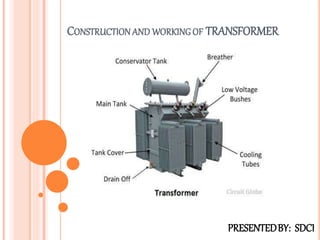
CONSTRUCTION AND WORKING OF TRANSFORMER
PRESENTEDBY: SDCI
CONTENT
 What is transformer
 Structure and working principle
 Construction of transformer
 Classification of transformer
 Losses in transformer
 Uses and application of transformer
WHAT IS TRANSFORMER
 A transformer is a static piece of apparatus by means of
which an electrical power is transferred from one
alternating current circuit to another electrical circuit
 There is no electrical contact between them
 The desire change in voltage or current without any
change in frequency
 Symbolically the transformer denoted as
NOTE :
Itworkson theprincipleof mutualinduction
STRUCTURE OF TRANSFORMER
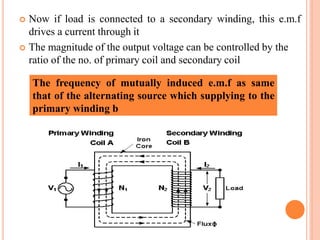
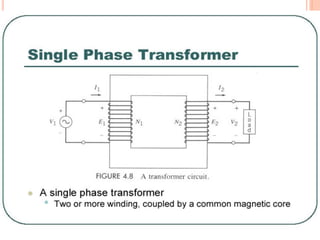
 The transformer two inductive coils ,these are electrical
separated but linked through a common magnetic current
circuit
 These two coils have a high mutual induction
 One of the two coils is connected of alternating voltage .this
coil in which electrical energy is fed with the help of source
called primary winding (P) shown in fig.
 The other winding is connected to a load the electrical energy
is transformed to this winding drawn out to the load .this
winding is called secondary winding(S) shown in fig.
 Now if load is connected to a secondary winding, this e.m.f
drives a current through it
 The magnitude of the output voltage can be controlled by the
ratio of the no. of primary coil and secondary coil
The frequency of mutually induced e.m.f as same
that of the alternating source which supplying to the
primary winding b
WORKINGPRINCIPLE
 The transformer works in the principle of mutual induction
“The principle of mutual induction states that when the two coils are
inductively coupled and if the current in coil change uniformly then the
e.m.f. induced in the other coils. This e.m.f can drive a current when a
closed path is provide to it.”
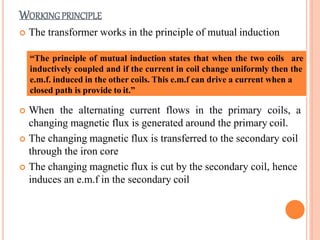
 When the alternating current flows in the primary coils, a
changing magnetic flux is generated around the primary coil.
 The changing magnetic flux is transferred to the secondary coil
through the iron core
 The changing magnetic flux is cut by the secondary coil, hence
induces an e.m.f in the secondary coil
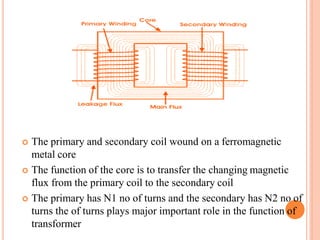
 The primary and secondary coil wound on a ferromagnetic
metal core
 The function of the core is to transfer the changing magnetic
flux from the primary coil to the secondary coil
 The primary has N1 no of turns and the secondary has N2 no of
turns the of turns plays major important role in the function of
transformer
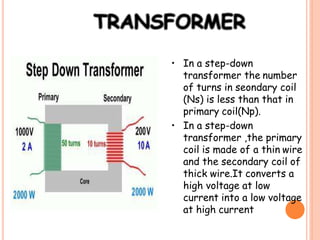
• In a step-down
transformer the number
of turns in seondary coil
(Ns) is less than that in
primary coil(Np).
• In a step-down
transformer ,the primary
coil is made of a thin wire
and the secondary coil of
thick wire.It converts a
high voltage at low
current into a low voltage
at high current
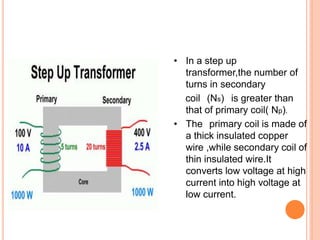
• In a step up
transformer,the number of
turns in secondary
coil (Ns) is greater than
that of primary coil( Np).
• The primary coil is made of
a thick insulated copper
wire ,while secondary coil of
thin insulated wire.It
converts low voltage at high
current into high voltage at
low current.
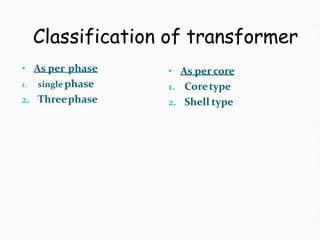
Classification of transformer
• As per phase
1. single phase
2. Threephase
• As per core
1. Coretype
2. Shell type
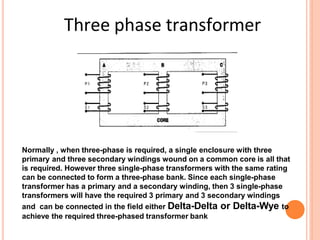
Three phase transformer
Normally , when three-phase is required, a single enclosure with three
primary and three secondary windings wound on a common core is all that
is required. However three single-phase transformers with the same rating
can be connected to form a three-phase bank. Since each single-phase
transformer has a primary and a secondary winding, then 3 single-phase
transformers will have the required 3 primary and 3 secondary windings
and can be connected in the field either Delta-Delta or Delta-Wye to
achieve the required three-phased transformer bank
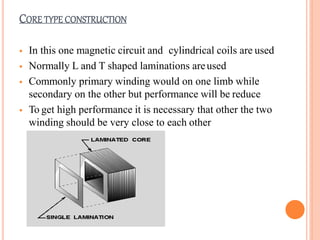
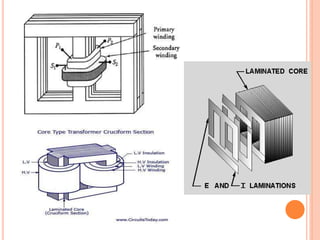
CORE TYPE CONSTRUCTION
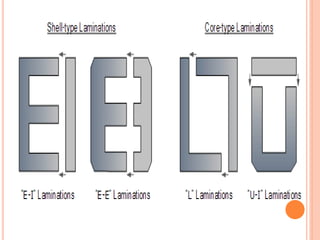
 In this one magnetic circuit and cylindrical coils are used
 Normally L and T shaped laminations areused
 Commonly primary winding would on one limb while
secondary on the other but performance will be reduce
 To get high performance it is necessary that other the two
winding should be very close to each other
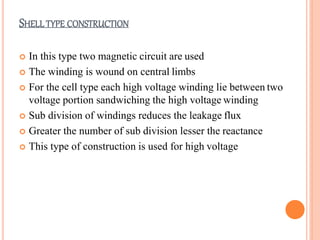
SHELL TYPE CONSTRUCTION
 In this type two magnetic circuit are used
 The winding is wound on central limbs
 For the cell type each high voltage winding lie between two
voltage portion sandwiching the high voltage winding
 Sub division of windings reduces the leakage flux
 Greater the number of sub division lesser the reactance
 This type of construction is used for high voltage
LOSSES IN TRANSFORMER
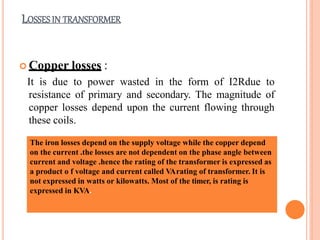
 Copper losses :
It is due to power wasted in the form of I2Rdue to
resistance of primary and secondary. The magnitude of
copper losses depend upon the current flowing through
these coils.
The iron losses depend on the supply voltage while the copper depend
on the current .the losses are not dependent on the phase angle between
current and voltage .hence the rating of the transformer is expressed as
a product o f voltage and current called VArating of transformer. It is
not expressed in watts or kilowatts. Most of the timer, is rating is
expressed in KVA.
Hysteresis loss :
During magnetization and demagnetization ,due to hysteresis
effect some energy losses in the core called hysteresis loss
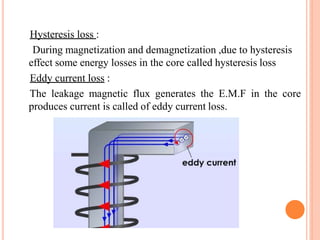
Eddy current loss :
The leakage magnetic flux generates the E.M.F in the core
produces current is called of eddy current loss.
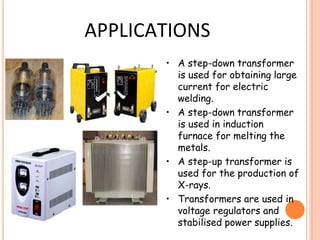
APPLICATIONS
• A step-down transformer
is used for obtaining large
current for electric
welding.
• A step-down transformer
is used in induction
furnace for melting the
metals.
• A step-up transformer is
used for the production of
X-rays.
• Transformers are used in
voltage regulators and
stabilised power supplies.
Thank
you

Transformer

  • 1.
    CONSTRUCTION AND WORKINGOF TRANSFORMER PRESENTEDBY: SDCI
  • 2.
    CONTENT  What istransformer  Structure and working principle  Construction of transformer  Classification of transformer  Losses in transformer  Uses and application of transformer
  • 3.
    WHAT IS TRANSFORMER A transformer is a static piece of apparatus by means of which an electrical power is transferred from one alternating current circuit to another electrical circuit  There is no electrical contact between them  The desire change in voltage or current without any change in frequency  Symbolically the transformer denoted as NOTE : Itworkson theprincipleof mutualinduction
  • 4.
    STRUCTURE OF TRANSFORMER The transformer two inductive coils ,these are electrical separated but linked through a common magnetic current circuit  These two coils have a high mutual induction  One of the two coils is connected of alternating voltage .this coil in which electrical energy is fed with the help of source called primary winding (P) shown in fig.  The other winding is connected to a load the electrical energy is transformed to this winding drawn out to the load .this winding is called secondary winding(S) shown in fig.
  • 5.
     Now ifload is connected to a secondary winding, this e.m.f drives a current through it  The magnitude of the output voltage can be controlled by the ratio of the no. of primary coil and secondary coil The frequency of mutually induced e.m.f as same that of the alternating source which supplying to the primary winding b
  • 6.
    WORKINGPRINCIPLE  The transformerworks in the principle of mutual induction “The principle of mutual induction states that when the two coils are inductively coupled and if the current in coil change uniformly then the e.m.f. induced in the other coils. This e.m.f can drive a current when a closed path is provide to it.”  When the alternating current flows in the primary coils, a changing magnetic flux is generated around the primary coil.  The changing magnetic flux is transferred to the secondary coil through the iron core  The changing magnetic flux is cut by the secondary coil, hence induces an e.m.f in the secondary coil
  • 7.
     The primaryand secondary coil wound on a ferromagnetic metal core  The function of the core is to transfer the changing magnetic flux from the primary coil to the secondary coil  The primary has N1 no of turns and the secondary has N2 no of turns the of turns plays major important role in the function of transformer
  • 8.
    • In astep-down transformer the number of turns in seondary coil (Ns) is less than that in primary coil(Np). • In a step-down transformer ,the primary coil is made of a thin wire and the secondary coil of thick wire.It converts a high voltage at low current into a low voltage at high current
  • 9.
    • In astep up transformer,the number of turns in secondary coil (Ns) is greater than that of primary coil( Np). • The primary coil is made of a thick insulated copper wire ,while secondary coil of thin insulated wire.It converts low voltage at high current into high voltage at low current.
  • 11.
    Classification of transformer •As per phase 1. single phase 2. Threephase • As per core 1. Coretype 2. Shell type
  • 13.
    Three phase transformer Normally, when three-phase is required, a single enclosure with three primary and three secondary windings wound on a common core is all that is required. However three single-phase transformers with the same rating can be connected to form a three-phase bank. Since each single-phase transformer has a primary and a secondary winding, then 3 single-phase transformers will have the required 3 primary and 3 secondary windings and can be connected in the field either Delta-Delta or Delta-Wye to achieve the required three-phased transformer bank
  • 14.
    CORE TYPE CONSTRUCTION In this one magnetic circuit and cylindrical coils are used  Normally L and T shaped laminations areused  Commonly primary winding would on one limb while secondary on the other but performance will be reduce  To get high performance it is necessary that other the two winding should be very close to each other
  • 16.
    SHELL TYPE CONSTRUCTION In this type two magnetic circuit are used  The winding is wound on central limbs  For the cell type each high voltage winding lie between two voltage portion sandwiching the high voltage winding  Sub division of windings reduces the leakage flux  Greater the number of sub division lesser the reactance  This type of construction is used for high voltage
  • 18.
    LOSSES IN TRANSFORMER Copper losses : It is due to power wasted in the form of I2Rdue to resistance of primary and secondary. The magnitude of copper losses depend upon the current flowing through these coils. The iron losses depend on the supply voltage while the copper depend on the current .the losses are not dependent on the phase angle between current and voltage .hence the rating of the transformer is expressed as a product o f voltage and current called VArating of transformer. It is not expressed in watts or kilowatts. Most of the timer, is rating is expressed in KVA.
  • 19.
    Hysteresis loss : Duringmagnetization and demagnetization ,due to hysteresis effect some energy losses in the core called hysteresis loss Eddy current loss : The leakage magnetic flux generates the E.M.F in the core produces current is called of eddy current loss.
  • 20.
    APPLICATIONS • A step-downtransformer is used for obtaining large current for electric welding. • A step-down transformer is used in induction furnace for melting the metals. • A step-up transformer is used for the production of X-rays. • Transformers are used in voltage regulators and stabilised power supplies.
  • 21.