EE8301 – ELECTRICAL MACHINES - I
Unit – II – TRANSFORMERS
By
Mr. D. Karthik Prabhu,
Assistant Professor,
Department of Electrical and Electronics Engineering.
Email: karthikprabhu@ritrjpm.ac.in 1
transformers
Transformer
• The transformer is a static piece of apparatus
by means of which an electrical power is
transformed from one alternating current
circuit to another with the desired change in
voltage and current, without any change in
the frequency.
Working principle
A transformer operates on the principle of mutual induction between
two inductively coupled coils.
The two windings are magnetically coupled, there is no electrical
connection between two winding.
Primary winding is energised by sinusoidal voltage. The secondary
winding feeds the load. The alternating current in the primary winding sets up
an alternating flux (Ф) in the core. The secondary winding is linked by most of
this flux and EMF is induced in the secondary winding.
TRANSFORMERS
Classification of Transformers
• (i) Duty they perform:
1. Power transformer – for transmission and
distribution purposes
2. Current transformer – instrument transformers
3. Potential transformers – instrument
transformers
• (ii) construction:
1. Core type transformer
2. Shell type transformer
3. Berry type transformer
Classification of Transformers
• (iii) Voltage output:
1. Step down transformer (Higher to lower)
2. Step up transformer (Lower to Higher)
3. Auto transformer (Variable from ‘0’ to rated
value)
• (iv) Application:
1. Welding transformer
2. Furnace transformer
Classification of Transformers
• (v) Cooling:
1. Duct type transformer (Air natural (or) Air blast)
2. Oil immersed
(a) Self cooled
(b) forced air cooled
(c) water cooled
(d) forced oil cooled
Classification of Transformers
• (vi) Input Supply:
1. Single phase transformer
2. Three phase transformer
(a) star – star
(b) star – Delta
(c) Delta – Delta
(d) Delta – Star
(e) Open – Delta
(f) Scott connection
Constructional Details
Constructional details of Transformer
1. Core
It is made up of high grade silicon steel.
Its function is to carry the flux providing low reluctance path. E
shaped , I shaped, L shaped cores are used
Windings:
The coils used are wound on the limbs and are insulated from each
other. The function of the windings is to carry current and produce the flux
necessary for the functioning of the transformer.
The different types of transformer windings are:
1. Concentric windings:
Cross-over, Helical, Disc
2. Sandwich windings:
Magnetic Core
Types of Transformer Core
• Core type
• Shell type
• Berry type
Core type
Core Type Transformer
Shell type
Shell type Transformer
Berry Type Transformer
Constructional Details of Transformer
Cooling arrangement in Transformers
• The various methods of cooling employed in a
transformer are
1. Oil immersed natural cooled transformers
2. Oil immersed forced air cooled transformers
3. Oil immersed water cooled transformers
4. Oil immersed forced oil cooled transformers
5. Air blast transformers
Core Type Shell Type
The winding encircles the core The core encircles most part of
the windings
The cylindrical type of coils are
used
Generally, multilayer disc type
or sandwich coils are used
As windings are distributed,
the natural cooling is more
effective
As windings are surrounded by
the core, the natural cooling
does not exist.
The coils can be easily
removed from maintenance
point of view
For removing any winding for
the maintenance, large
number of laminations are
required to be removed. This is
difficult.
Core Type Shell Type
The construction is preferred
for low voltage transformers.
The construction is used for
very high voltage
transformers
It has a single magnetic
circuit
It has a double magnetic
circuit
In a single phase type, the
core has two limbs
In single phase type, the core
has three limbs
Can D.C supply be used for Transformers
• The transformer works on principle of mutual
induction, for which current in one coil must
change uniformly. If dc supply is given, the
current will not change due to constant supply
and transformer will not work.
• Practically winding resistance is very small. For dc
the inductive reactance XL is zero as dc has no
frequency. So total impedance of winding is very
low for dc. Thus winding will draw very high
current if dc supply is given to it. This may cause
the burning of windings due to extra heat
generated and may cause permanent damage to
the transformer.
EMF Equation of a Transformer
• N1 – Number of primary turns
• N2 – Number of secondary turns
We know that T= 1/f, where f is the frequency in Hz
Average rate of change of flux = φm/(1/4f) wb/seconds
If we assume single turn coil, then according to Faradays
law of electromagnetic induction, the average value of
emf induced/turn = 4 f φm volt
Form factor = RMS Value/ Average Value
= 1.11 (since φm is sinusoidal)
RMS value = Form Factor × Average Value
RMS Value of emf induced/turn = (1.11)×(4 f φm )
= 4.44 f φm volts
RMS value of emf induced in the entire
primary winding E1 = 4.44 f φm × N1
E1 = 4.44 f Bm A × N1 Volts
Similarly RMS value of emf induced in the
secondary E2 = 4.44 f Bm A × N2 Volts
Transformation Ratio (K)
For an ideal transformer
V1 = E1 ; V2= E2;
V1I1 = V2I2
V2/V1 = I1/I2; E2/E1 = I1/I2
From transformer emf induced equation
E2/E1 = N2/N1
We have E2/E1 = N2/N1 = I1/I2= K
Where K is the transformation ratio.
If N2>N1 i.e. K>1, then transformer is a step up transformer.
If N2<N1 i.e. K<1, then transformer is a step down transformer
Voltage ratio = E2/E1 = K
Current ratio = I2/I1= 1/K
Ideal Transformer
The ideal transformer has the following
properties
• No winding resistance. i.e., purely inductive.
• No magnetic leakage flux.
• No I2 R loss i.e., no copper loss.
• No core loss.
Ideal Transformer
An ideal transformer consists of purely inductive
coil(winding) and loss free core. Windings are
wound on a core. It is shown in figure.
Ideal transformer
Ideal transformer
• Vector diagram
Practical Transformer on No-Load
• Active or working or iron loss or wattfull component
I w= Io cosφo
• Reactive or magnetizing or wattless component
Iµ = Io sinφo
• From above relations
From the above discussion, the following points are noted
1. The no-load primary current Io is very small as compared
to the full load primary current
2. As Io is very small, the no load primary copper loss is
negligible. This no-load input power is practically equal
to the iron or core loss of the transformer.
Transformer on load
Transformer on load
Transformer on load
Thus when the transformer is loaded
• The flux passing through core is same that at no load i.e., flux
is constant at no-load as well as loaded condition. That is why
transformer is also called a constant flux apparatus
• The total primary current (I1) will be vector sum of I0 and I’ 2
Transformer winding resistance
Transformer winding leakage reactance
Transformer winding resistances and
leakage reactance's
Vector diagram of transformer on load
• When such a transformer is assumed to have
no windings resistance and leakage reactances
• When the transformer has winding resistance
and leakage reactances.
Vector diagram of transformer on load
• Case (i):
no windings resistance and leakage reactances
Vector diagram of transformer on load
• no windings resistance and leakage reactances
• A) unity power factor:
Vector diagram of transformer on load
• no windings resistance and leakage reactances
• B) Lagging power factor:
Vector diagram of transformer on load
• no windings resistance and leakage reactances
• C) Leading power factor
Transformer with resistances and reactances
Vector diagram of transformer on load
• With winding resistance and reactances
• A) unity power factor:
Vector diagram of transformer on load
• With winding resistance and reactances
• B) Lagging power factor:
Vector diagram of transformer on load
• With winding resistance and reactances
• C) Leading power factor:
Shifting Impedances in a transformer
Equivalent Circuit of a Transformer
referred to Primary
Approximate Equivalent Circuit of a
Transformer referred to Primary
Approximate Equivalent Circuit of a
Transformer referred to Primary
Approximate Equivalent Circuit of a
Transformer referred to Secondary
Voltage Regulation of a Transformer
• Definition:
The regulation of a transformer is the arithmetic
difference between the no-load secondary
voltage and the secondary voltage on load
expressed as percentage of no-load voltage.
• For an ideal transformer, regulation is 0% since
voltage drops, due to R1,X1,R2,X2 are negligible.
Voltage Regulation of a Transformer
• Figure shows the approximate equivalent
circuit of a transformer. From the figure we
can draw vector diagram for different power
factors.
Voltage Regulation of a Transformer
• Lagging power factor:
Voltage Regulation of a Transformer
• Leading power factor:
Voltage Regulation of a Transformer
• Unity power factor:
Rating of a Transformer
• Voltage rating
• Current rating
• Power rating
Why transformer rating given in kVA?
• We have seen that copper loss depends on
current and iron loss on voltage. Hence the
total loss in a transformer depends upon volt-
ampere (VA) only and not on the phase angle
between voltage and current i.e., it is
independent of load power factor. That is why
the rating of a transformer is given in kVA and
not in kW.
Applications of Transformer
Transformers are used
• In Electrical power engineering for
transmission and distribution.
• As an instrument transformer for measuring
current (C.T) and measuring voltage (P.T).
• As a step down and step up transformer to get
reduced or increased output voltage.
• In Radio and TV circuits, telephone circuits
and instrumentation circuits.
• In Furnaces and welding transformer.
Losses in a Transformer
• Iron (or) Core loss (Hysteresis & eddy current)
• Copper loss (I1
2R1 & I2
2R2)
Efficiency of a Transformer
Transformer efficiency Ƞ:
Where, V2= secondary terminal voltage on load
I2= secondary current at load
cosφ = power factor of the load
Efficiency of a Transformer
Iron loss Pi = W0 determined from O.C. test
Cu loss Pcu = Ws determined from S.C. test at full load
Copper loss at a load n times the full load = n2 Pcu
Note: at full load n=1
at half load n= 1/2
Condition for Maximum Efficiency of a Transformer
If R02 is the total resistance of the transformer referred to
secondary, then
Condition for Maximum Efficiency of a Transformer
• Dividing both numerator and denominator by I2
• For maximum value of efficiency for given cosφ2 (pf)
the denominator must have the least value. The
condition for maximum efficiency is obtained by
differentiating the denominator and equating it to
zero.
Condition for Maximum Efficiency of a Transformer
• Iron loss = copper loss
• constant loss = variable loss
Hence efficiency of a transformer will be maximum
when copper losses are equal to iron losses.
From last equation the load current corresponding to
maximum efficiency
Condition for Maximum Efficiency of a
Transformer
If we are given iron loss and full load copper
loss, then the load corresponding to the
maximum efficiency is given by
Testing of Transformer
• Open circuit test (or) No load test
• Short circuit test (or) Impedance test
by using these two tests we can find
1. Circuit constants (R0,X0,R01,X01,R02 and X02)
2. Core loss and full load copper loss
3. Predetermine the efficiency and voltage
regulation
• Load test
• Sumpner’s test
Open Circuit test
It is useful to find
• No-load loss (or) core loss
• No load current I0 which is helpful in finding
out R0 and X0
Open Circuit test
Iron losses Pi = wattmeter reading = W0
No-load current = ammeter reading = I0
Applied voltage = voltmeter reading = V1
Input power W0= V1I0cosφ0
No-load power factor
No-load wattful component
No-load magnetising component
Open Circuit test
No-load resistance
No-load reactance
Thus open circuit test gives no load loss Pi, IW,
Iµ,R0 and X0
Short circuit test
It is useful to find
• Full-load copper loss
• Equivalent resistance and reactance referred
to metering side.
Short circuit test
Full-load cu loss Pcu=watt meter reading = Ws
Applied voltage = voltmeter reading = Vsc
Full load primary current = ammeter reading = I1
Where R01 is the total resistance of transformer
referred to primary.
Short circuit test
Total impedance referred to primary
Total leakage reactance referred to primary
Short circuit power factor
Thus short circuit test gives full load cu loss, R01,
X01 and cosφ0
Efficiency from OC and SC test
For any load (n)
Load Test on Transformer
Load test is helpful to determine the following
• Efficiency of the transformer
• Regulation of the transformer
Load test on Transformer
Ws=output power, Wp=input power
Efficiency
Sumpner Test or Back to Back Test
Advantages of Sumpner Test
• The power required to carry out the test is
small
• The transformers are tested under full-load
conditions
• The iron losses and full load copper losses are
measured simultaneously
• The temperature rise of the transformer can
be noted
Disadvantages of Sumpner Test
• Two identical transformers are required
• In practice exact identical transformers cannot
be obtained
• As two transformers are required, the test is
not economical
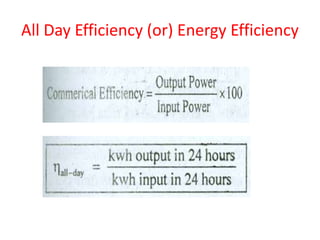
All Day Efficiency (or) Energy Efficiency
Auto Transformer (or) Variac
A transformer in which part of the winding is
common to both the primary and secondary is
known as an auto transformer. The primary is
electrically connected to the secondary, as
well as magnetically coupled to it.
Auto Transformer (or) Variac
Saving of copper:
The cross section of the conductor is proportional to
the current carried and the length of the conductor
in winding is proportional to number of turns. Hence
the weight of copper in a winding is proportional to
the product of number of turns and current to be
carried.
Weight of copper in section AC α (N1 – N2) I1
Weight of copper in section BC α (N2(I2-I1))
Total weight of copper in auto transformer α (N1 – N2) I1 + (N2(I2-I1))
Weight of the copper in ordinary transformer α (N1 I1 + N2I2)
Auto Transformer (or) Variac
Saving of copper:
Auto Transformer (or) Variac
Saving of copper:
Weight of cu in auto transformer = (1-K) ×
weight of cu in ordinary transformer (W0)
Saving in cu = W0 – Wa
= W0 – (1-K) W0
= KW0
Saving in cu = K × weight of copper in ordinary
transformer
Advantages of auto transformer
• Higher efficiency
• Small size
• Smaller exciting current
• Lower cost
• Better voltage regulation compared to
conventional two winding transformer
• Continuously varying voltage can be obtained
• Required less copper
Disadvantages of auto transformer
• If the ratio of transformation K differs for from unity,
the economic advantages of auto transformer over
two-winding transformer decrease.
• The main disadvantage of an auto transformer is due to
the direct electrical connection between low tension
and high tension sides. If primary is supplied at high
voltage, then an open circuit in the common winding
BC, would result in the appearance of dangerously high
voltage on the low voltage side. This high voltage may
be determined to the load and the persons working
there. Thus a suitable protection must be provided
against such an occurrence.
• The short circuit current in an autotransformer is
higher than that in a two winding transformer
Applications of auto transformer
• Autotransformers are used for starting of
induction motors and synchronous motors
• Continuously variable autotransformer finds
application in electrical testing laboratories
• Autotransformer are used as boosters to
increase the voltage in AC feeder
• As furnace transformers for getting a
convenient supply to suit the furnace winding
from 230V AC supply
Three Phase Transformers
Advantages Three Phase Transformers
• It occupies less space for same rating, compared
to a bank of three single phase transformers
• It has less weight
• The cost is also low
• Easy to handle
• It can be transported very easily
• The core is of a smaller size and hence less
material is required.
Three Phase Transformer connections
• Star-star connection
• Delta-delta connection
• Star-delta connection
• Delta-star connection
Star-star connection
Advantages of Star-star connection
• Less number of turns and less quality of
insulation is required because Vph = VL/√3
• Since Iph = IL, the current through the winding is
high. The windings must have a large cross
section and must be mechanically strong so that
they can bear heavy load and short circuit.
• There is no phase shift between the primary and
secondary voltages.
• It is suitable for three phase and four wire system
because of the presence of neutral point.
Disadvantages of Star-star connection
• The neutral point shifts due to unbalanced load
and performance is not satisfactory.
• Inspite of connecting neutral point to earth, the
third harmonic present in the alternator voltage
may appear and cause distortion of secondary
voltage.
Delta-delta connection
Advantages of Delta-delta connection
• This connection permits unbalanced loading also.
• If one transformer is inoperative, V-V operation is
still possible with reduced rating.
• No distortion in secondary voltage occurs
• For delta connection Ip=IL/√3 and cross section of
the winding is low which makes the connection
economical for low voltage transformers.
Disadvantages of Delta-delta connection
• It is not suitable for three phase four wire
system because neutral point is absent.
• This connection is generally used for low
voltage transformers.
Star-delta connection
Advantages of Star-delta connection
• Since primary is star connected, fewer number of
turns are required in primary which makes it
economical for high voltage, step-down power
transformer.
• The available neutral point on primary side can
be earthed to avoid distortion.
• It is possible to handle large, unbalanced load.
Disadvantages of Star-delta connection
• Since the secondary voltage is not inphase
with the primary, it is not possible to make it
parallel with star-star and delta-delta
transformers.
Delta-star connection
Advantages of Delta-star connection
• Since primary is delta connected, the winding
cross section is small.
• Since neutral is available on the secondary side,
three phase four wire supply can be carried out.
• No distortion occurs due to third harmonic
component.
• Saving in cost of insulation is possible due to
availability of star connection on secondary side.
Disadvantages of Delta-star connection
• Since the secondary voltage is not inphase
with primary, it is not possible to make it
parallel with star-star and delta-delta
transformers.
• Since secondary is connected in star, this type
of transformer is affected by unbalanced load.
Open-delta or V-V connection
Applications of Open-delta or V-V connection
• If one of the transformers in delta-delta bank is
inoperative, it is possible to continue service with
reduced capacity.
• If the three phase load is small, it is preferable to
use a V-V connection.
• If the load increases, in future, the open delta can
be closed to increase the rating.
Scott or T-T connection
Parallel operation of a transformer
• There are three principle reasons for connecting
transformers in parallel.
1. If one transformer fails, the continuity of supply
can be maintained through other transformer.
2. When the load on the sub station becomes more
than the capacity of the existing transformer,
another transformer can be added in parallel
3. Any transformer can be taken out of the circuit
for repair/routine maintenance without
interrupting supply to the consumers.
Conditions for satisfactory parallel operation
1. Transformers should be properly connected with
regard to their polarities.
2. The voltage ratings and voltage ratios of the
transformers should be the same
3. The per unit or percentage impedances of the
transformers should be equal.
4. The reactance/resistance ratios of the
transformers should be the same
Parallel operation of a transformer
• Condition (i)
Parallel operation of a transformer
• Condition (ii)
Circulating current, I c = (EA-EB)/(ZA+ZB)
assuming EA>EB
Parallel operation of a transformer
• Condition (iii)
• By inserting proper amount of resistance or reactance or
both in series with either primary or secondary.
• Condition (iv)
• If the reactance/resistance ratios of the two
transformers are not equal, the power factor of the load
supplied by the transformers will not be equal.
• In other wards, one transformer will be operating with a
higher and the other with a lower power factor than that
of the load.
• This may be improved by inserting external impedance
of proper value.
Single phase equal voltage ratio transformers in parallel
Single phase unequal voltage ratio transformers in parallel
Tap changing Transformer
Regulating the voltage of a transformer is a requirement that often
arises in a power application or power system.
In an application it may be needed
1. To supply a desired voltage to the load.
2. To counter the voltage drops due to loads.
3. To counter the input supply voltage changes on load.
Two Methods of tap changing
1. ON load Tap changer
2. OFF load Tap changer
Tappings are on HV side because of the
following reason:
1. It carries large number of turns , adjusting
number of turns is possible
2. Low voltage winding carries high current,
interruption of high current is impractical
3. LV winding is placed near the core, HV
winding is placed outside the core. Hence
practically It is easier to provide tappings
in HV winding.
Off load Tap changer
On load Tap changer
On load Tap changer
Tertiary Winding
In some high rating transformer, one winding in addition to its
primary and secondary winding is used. This additional winding, apart
from primary and secondary windings, is known as Tertiary winding of
transformer. Because of this third winding, the transformer
Advantages of teritary windings:
1.It reduces the unbalancing in the primary due to unbalancing in
three phase load.
2. It redistributes the flow of fault current.
3. As the tertiary winding is connected in delta formation in 3 winding
transformer, it assists in limitation of fault current in the event of a
short circuit from line to neutral.

UNIT - II Transformers.pptx

  • 1.
    EE8301 – ELECTRICALMACHINES - I Unit – II – TRANSFORMERS By Mr. D. Karthik Prabhu, Assistant Professor, Department of Electrical and Electronics Engineering. Email: karthikprabhu@ritrjpm.ac.in 1
  • 2.
  • 3.
    Transformer • The transformeris a static piece of apparatus by means of which an electrical power is transformed from one alternating current circuit to another with the desired change in voltage and current, without any change in the frequency.
  • 4.
    Working principle A transformeroperates on the principle of mutual induction between two inductively coupled coils. The two windings are magnetically coupled, there is no electrical connection between two winding. Primary winding is energised by sinusoidal voltage. The secondary winding feeds the load. The alternating current in the primary winding sets up an alternating flux (Ф) in the core. The secondary winding is linked by most of this flux and EMF is induced in the secondary winding.
  • 5.
  • 6.
    Classification of Transformers •(i) Duty they perform: 1. Power transformer – for transmission and distribution purposes 2. Current transformer – instrument transformers 3. Potential transformers – instrument transformers • (ii) construction: 1. Core type transformer 2. Shell type transformer 3. Berry type transformer
  • 7.
    Classification of Transformers •(iii) Voltage output: 1. Step down transformer (Higher to lower) 2. Step up transformer (Lower to Higher) 3. Auto transformer (Variable from ‘0’ to rated value) • (iv) Application: 1. Welding transformer 2. Furnace transformer
  • 8.
    Classification of Transformers •(v) Cooling: 1. Duct type transformer (Air natural (or) Air blast) 2. Oil immersed (a) Self cooled (b) forced air cooled (c) water cooled (d) forced oil cooled
  • 9.
    Classification of Transformers •(vi) Input Supply: 1. Single phase transformer 2. Three phase transformer (a) star – star (b) star – Delta (c) Delta – Delta (d) Delta – Star (e) Open – Delta (f) Scott connection
  • 11.
  • 12.
    Constructional details ofTransformer 1. Core It is made up of high grade silicon steel. Its function is to carry the flux providing low reluctance path. E shaped , I shaped, L shaped cores are used
  • 13.
    Windings: The coils usedare wound on the limbs and are insulated from each other. The function of the windings is to carry current and produce the flux necessary for the functioning of the transformer. The different types of transformer windings are: 1. Concentric windings: Cross-over, Helical, Disc 2. Sandwich windings:
  • 14.
  • 15.
    Types of TransformerCore • Core type • Shell type • Berry type
  • 16.
  • 17.
  • 18.
  • 19.
  • 20.
  • 21.
  • 24.
    Cooling arrangement inTransformers • The various methods of cooling employed in a transformer are 1. Oil immersed natural cooled transformers 2. Oil immersed forced air cooled transformers 3. Oil immersed water cooled transformers 4. Oil immersed forced oil cooled transformers 5. Air blast transformers
  • 27.
    Core Type ShellType The winding encircles the core The core encircles most part of the windings The cylindrical type of coils are used Generally, multilayer disc type or sandwich coils are used As windings are distributed, the natural cooling is more effective As windings are surrounded by the core, the natural cooling does not exist. The coils can be easily removed from maintenance point of view For removing any winding for the maintenance, large number of laminations are required to be removed. This is difficult.
  • 28.
    Core Type ShellType The construction is preferred for low voltage transformers. The construction is used for very high voltage transformers It has a single magnetic circuit It has a double magnetic circuit In a single phase type, the core has two limbs In single phase type, the core has three limbs
  • 29.
    Can D.C supplybe used for Transformers • The transformer works on principle of mutual induction, for which current in one coil must change uniformly. If dc supply is given, the current will not change due to constant supply and transformer will not work. • Practically winding resistance is very small. For dc the inductive reactance XL is zero as dc has no frequency. So total impedance of winding is very low for dc. Thus winding will draw very high current if dc supply is given to it. This may cause the burning of windings due to extra heat generated and may cause permanent damage to the transformer.
  • 30.
    EMF Equation ofa Transformer • N1 – Number of primary turns • N2 – Number of secondary turns
  • 33.
    We know thatT= 1/f, where f is the frequency in Hz Average rate of change of flux = φm/(1/4f) wb/seconds If we assume single turn coil, then according to Faradays law of electromagnetic induction, the average value of emf induced/turn = 4 f φm volt Form factor = RMS Value/ Average Value = 1.11 (since φm is sinusoidal) RMS value = Form Factor × Average Value RMS Value of emf induced/turn = (1.11)×(4 f φm ) = 4.44 f φm volts
  • 34.
    RMS value ofemf induced in the entire primary winding E1 = 4.44 f φm × N1 E1 = 4.44 f Bm A × N1 Volts Similarly RMS value of emf induced in the secondary E2 = 4.44 f Bm A × N2 Volts
  • 35.
    Transformation Ratio (K) Foran ideal transformer V1 = E1 ; V2= E2; V1I1 = V2I2 V2/V1 = I1/I2; E2/E1 = I1/I2 From transformer emf induced equation E2/E1 = N2/N1 We have E2/E1 = N2/N1 = I1/I2= K Where K is the transformation ratio. If N2>N1 i.e. K>1, then transformer is a step up transformer. If N2<N1 i.e. K<1, then transformer is a step down transformer Voltage ratio = E2/E1 = K Current ratio = I2/I1= 1/K
  • 36.
    Ideal Transformer The idealtransformer has the following properties • No winding resistance. i.e., purely inductive. • No magnetic leakage flux. • No I2 R loss i.e., no copper loss. • No core loss.
  • 37.
    Ideal Transformer An idealtransformer consists of purely inductive coil(winding) and loss free core. Windings are wound on a core. It is shown in figure.
  • 38.
  • 39.
  • 40.
  • 41.
    Practical Transformer onNo-Load • Active or working or iron loss or wattfull component I w= Io cosφo • Reactive or magnetizing or wattless component Iµ = Io sinφo • From above relations From the above discussion, the following points are noted 1. The no-load primary current Io is very small as compared to the full load primary current 2. As Io is very small, the no load primary copper loss is negligible. This no-load input power is practically equal to the iron or core loss of the transformer.
  • 42.
  • 43.
  • 44.
    Transformer on load Thuswhen the transformer is loaded • The flux passing through core is same that at no load i.e., flux is constant at no-load as well as loaded condition. That is why transformer is also called a constant flux apparatus • The total primary current (I1) will be vector sum of I0 and I’ 2
  • 45.
  • 46.
  • 47.
    Transformer winding resistancesand leakage reactance's
  • 48.
    Vector diagram oftransformer on load
  • 49.
    Vector diagram oftransformer on load • When such a transformer is assumed to have no windings resistance and leakage reactances • When the transformer has winding resistance and leakage reactances.
  • 50.
    Vector diagram oftransformer on load • Case (i): no windings resistance and leakage reactances
  • 51.
    Vector diagram oftransformer on load • no windings resistance and leakage reactances • A) unity power factor:
  • 52.
    Vector diagram oftransformer on load • no windings resistance and leakage reactances • B) Lagging power factor:
  • 53.
    Vector diagram oftransformer on load • no windings resistance and leakage reactances • C) Leading power factor
  • 54.
  • 55.
    Vector diagram oftransformer on load • With winding resistance and reactances • A) unity power factor:
  • 56.
    Vector diagram oftransformer on load • With winding resistance and reactances • B) Lagging power factor:
  • 57.
    Vector diagram oftransformer on load • With winding resistance and reactances • C) Leading power factor:
  • 58.
  • 59.
    Equivalent Circuit ofa Transformer
  • 60.
    Equivalent Circuit ofa Transformer
  • 61.
    Equivalent Circuit ofa Transformer referred to Primary
  • 62.
    Approximate Equivalent Circuitof a Transformer referred to Primary
  • 63.
    Approximate Equivalent Circuitof a Transformer referred to Primary
  • 64.
    Approximate Equivalent Circuitof a Transformer referred to Secondary
  • 65.
    Voltage Regulation ofa Transformer • Definition: The regulation of a transformer is the arithmetic difference between the no-load secondary voltage and the secondary voltage on load expressed as percentage of no-load voltage. • For an ideal transformer, regulation is 0% since voltage drops, due to R1,X1,R2,X2 are negligible.
  • 66.
    Voltage Regulation ofa Transformer • Figure shows the approximate equivalent circuit of a transformer. From the figure we can draw vector diagram for different power factors.
  • 67.
    Voltage Regulation ofa Transformer • Lagging power factor:
  • 68.
    Voltage Regulation ofa Transformer • Leading power factor:
  • 69.
    Voltage Regulation ofa Transformer • Unity power factor:
  • 70.
    Rating of aTransformer • Voltage rating • Current rating • Power rating
  • 71.
    Why transformer ratinggiven in kVA? • We have seen that copper loss depends on current and iron loss on voltage. Hence the total loss in a transformer depends upon volt- ampere (VA) only and not on the phase angle between voltage and current i.e., it is independent of load power factor. That is why the rating of a transformer is given in kVA and not in kW.
  • 72.
    Applications of Transformer Transformersare used • In Electrical power engineering for transmission and distribution. • As an instrument transformer for measuring current (C.T) and measuring voltage (P.T). • As a step down and step up transformer to get reduced or increased output voltage. • In Radio and TV circuits, telephone circuits and instrumentation circuits. • In Furnaces and welding transformer.
  • 73.
    Losses in aTransformer • Iron (or) Core loss (Hysteresis & eddy current) • Copper loss (I1 2R1 & I2 2R2)
  • 74.
    Efficiency of aTransformer Transformer efficiency Ƞ: Where, V2= secondary terminal voltage on load I2= secondary current at load cosφ = power factor of the load
  • 75.
    Efficiency of aTransformer Iron loss Pi = W0 determined from O.C. test Cu loss Pcu = Ws determined from S.C. test at full load Copper loss at a load n times the full load = n2 Pcu Note: at full load n=1 at half load n= 1/2
  • 76.
    Condition for MaximumEfficiency of a Transformer If R02 is the total resistance of the transformer referred to secondary, then
  • 77.
    Condition for MaximumEfficiency of a Transformer • Dividing both numerator and denominator by I2 • For maximum value of efficiency for given cosφ2 (pf) the denominator must have the least value. The condition for maximum efficiency is obtained by differentiating the denominator and equating it to zero.
  • 78.
    Condition for MaximumEfficiency of a Transformer • Iron loss = copper loss • constant loss = variable loss Hence efficiency of a transformer will be maximum when copper losses are equal to iron losses. From last equation the load current corresponding to maximum efficiency
  • 79.
    Condition for MaximumEfficiency of a Transformer If we are given iron loss and full load copper loss, then the load corresponding to the maximum efficiency is given by
  • 80.
    Testing of Transformer •Open circuit test (or) No load test • Short circuit test (or) Impedance test by using these two tests we can find 1. Circuit constants (R0,X0,R01,X01,R02 and X02) 2. Core loss and full load copper loss 3. Predetermine the efficiency and voltage regulation • Load test • Sumpner’s test
  • 81.
    Open Circuit test Itis useful to find • No-load loss (or) core loss • No load current I0 which is helpful in finding out R0 and X0
  • 82.
    Open Circuit test Ironlosses Pi = wattmeter reading = W0 No-load current = ammeter reading = I0 Applied voltage = voltmeter reading = V1 Input power W0= V1I0cosφ0 No-load power factor No-load wattful component No-load magnetising component
  • 83.
    Open Circuit test No-loadresistance No-load reactance Thus open circuit test gives no load loss Pi, IW, Iµ,R0 and X0
  • 84.
    Short circuit test Itis useful to find • Full-load copper loss • Equivalent resistance and reactance referred to metering side.
  • 85.
    Short circuit test Full-loadcu loss Pcu=watt meter reading = Ws Applied voltage = voltmeter reading = Vsc Full load primary current = ammeter reading = I1 Where R01 is the total resistance of transformer referred to primary.
  • 86.
    Short circuit test Totalimpedance referred to primary Total leakage reactance referred to primary Short circuit power factor Thus short circuit test gives full load cu loss, R01, X01 and cosφ0
  • 87.
    Efficiency from OCand SC test For any load (n)
  • 88.
    Load Test onTransformer Load test is helpful to determine the following • Efficiency of the transformer • Regulation of the transformer
  • 89.
    Load test onTransformer Ws=output power, Wp=input power Efficiency
  • 90.
    Sumpner Test orBack to Back Test
  • 91.
    Advantages of SumpnerTest • The power required to carry out the test is small • The transformers are tested under full-load conditions • The iron losses and full load copper losses are measured simultaneously • The temperature rise of the transformer can be noted
  • 92.
    Disadvantages of SumpnerTest • Two identical transformers are required • In practice exact identical transformers cannot be obtained • As two transformers are required, the test is not economical
  • 93.
    All Day Efficiency(or) Energy Efficiency
  • 94.
    Auto Transformer (or)Variac A transformer in which part of the winding is common to both the primary and secondary is known as an auto transformer. The primary is electrically connected to the secondary, as well as magnetically coupled to it.
  • 95.
    Auto Transformer (or)Variac Saving of copper: The cross section of the conductor is proportional to the current carried and the length of the conductor in winding is proportional to number of turns. Hence the weight of copper in a winding is proportional to the product of number of turns and current to be carried. Weight of copper in section AC α (N1 – N2) I1 Weight of copper in section BC α (N2(I2-I1)) Total weight of copper in auto transformer α (N1 – N2) I1 + (N2(I2-I1)) Weight of the copper in ordinary transformer α (N1 I1 + N2I2)
  • 96.
    Auto Transformer (or)Variac Saving of copper:
  • 97.
    Auto Transformer (or)Variac Saving of copper: Weight of cu in auto transformer = (1-K) × weight of cu in ordinary transformer (W0) Saving in cu = W0 – Wa = W0 – (1-K) W0 = KW0 Saving in cu = K × weight of copper in ordinary transformer
  • 98.
    Advantages of autotransformer • Higher efficiency • Small size • Smaller exciting current • Lower cost • Better voltage regulation compared to conventional two winding transformer • Continuously varying voltage can be obtained • Required less copper
  • 99.
    Disadvantages of autotransformer • If the ratio of transformation K differs for from unity, the economic advantages of auto transformer over two-winding transformer decrease. • The main disadvantage of an auto transformer is due to the direct electrical connection between low tension and high tension sides. If primary is supplied at high voltage, then an open circuit in the common winding BC, would result in the appearance of dangerously high voltage on the low voltage side. This high voltage may be determined to the load and the persons working there. Thus a suitable protection must be provided against such an occurrence. • The short circuit current in an autotransformer is higher than that in a two winding transformer
  • 100.
    Applications of autotransformer • Autotransformers are used for starting of induction motors and synchronous motors • Continuously variable autotransformer finds application in electrical testing laboratories • Autotransformer are used as boosters to increase the voltage in AC feeder • As furnace transformers for getting a convenient supply to suit the furnace winding from 230V AC supply
  • 101.
  • 102.
    Advantages Three PhaseTransformers • It occupies less space for same rating, compared to a bank of three single phase transformers • It has less weight • The cost is also low • Easy to handle • It can be transported very easily • The core is of a smaller size and hence less material is required.
  • 103.
    Three Phase Transformerconnections • Star-star connection • Delta-delta connection • Star-delta connection • Delta-star connection
  • 104.
  • 105.
    Advantages of Star-starconnection • Less number of turns and less quality of insulation is required because Vph = VL/√3 • Since Iph = IL, the current through the winding is high. The windings must have a large cross section and must be mechanically strong so that they can bear heavy load and short circuit. • There is no phase shift between the primary and secondary voltages. • It is suitable for three phase and four wire system because of the presence of neutral point.
  • 106.
    Disadvantages of Star-starconnection • The neutral point shifts due to unbalanced load and performance is not satisfactory. • Inspite of connecting neutral point to earth, the third harmonic present in the alternator voltage may appear and cause distortion of secondary voltage.
  • 107.
  • 108.
    Advantages of Delta-deltaconnection • This connection permits unbalanced loading also. • If one transformer is inoperative, V-V operation is still possible with reduced rating. • No distortion in secondary voltage occurs • For delta connection Ip=IL/√3 and cross section of the winding is low which makes the connection economical for low voltage transformers.
  • 109.
    Disadvantages of Delta-deltaconnection • It is not suitable for three phase four wire system because neutral point is absent. • This connection is generally used for low voltage transformers.
  • 110.
  • 111.
    Advantages of Star-deltaconnection • Since primary is star connected, fewer number of turns are required in primary which makes it economical for high voltage, step-down power transformer. • The available neutral point on primary side can be earthed to avoid distortion. • It is possible to handle large, unbalanced load.
  • 112.
    Disadvantages of Star-deltaconnection • Since the secondary voltage is not inphase with the primary, it is not possible to make it parallel with star-star and delta-delta transformers.
  • 113.
  • 114.
    Advantages of Delta-starconnection • Since primary is delta connected, the winding cross section is small. • Since neutral is available on the secondary side, three phase four wire supply can be carried out. • No distortion occurs due to third harmonic component. • Saving in cost of insulation is possible due to availability of star connection on secondary side.
  • 115.
    Disadvantages of Delta-starconnection • Since the secondary voltage is not inphase with primary, it is not possible to make it parallel with star-star and delta-delta transformers. • Since secondary is connected in star, this type of transformer is affected by unbalanced load.
  • 118.
  • 119.
    Applications of Open-deltaor V-V connection • If one of the transformers in delta-delta bank is inoperative, it is possible to continue service with reduced capacity. • If the three phase load is small, it is preferable to use a V-V connection. • If the load increases, in future, the open delta can be closed to increase the rating.
  • 120.
    Scott or T-Tconnection
  • 121.
    Scott or T-Tconnection
  • 122.
    Scott or T-Tconnection
  • 123.
    Parallel operation ofa transformer
  • 124.
    Parallel operation ofa transformer • There are three principle reasons for connecting transformers in parallel. 1. If one transformer fails, the continuity of supply can be maintained through other transformer. 2. When the load on the sub station becomes more than the capacity of the existing transformer, another transformer can be added in parallel 3. Any transformer can be taken out of the circuit for repair/routine maintenance without interrupting supply to the consumers.
  • 125.
    Conditions for satisfactoryparallel operation 1. Transformers should be properly connected with regard to their polarities. 2. The voltage ratings and voltage ratios of the transformers should be the same 3. The per unit or percentage impedances of the transformers should be equal. 4. The reactance/resistance ratios of the transformers should be the same
  • 126.
    Parallel operation ofa transformer • Condition (i)
  • 127.
    Parallel operation ofa transformer • Condition (ii) Circulating current, I c = (EA-EB)/(ZA+ZB) assuming EA>EB
  • 128.
    Parallel operation ofa transformer • Condition (iii) • By inserting proper amount of resistance or reactance or both in series with either primary or secondary. • Condition (iv) • If the reactance/resistance ratios of the two transformers are not equal, the power factor of the load supplied by the transformers will not be equal. • In other wards, one transformer will be operating with a higher and the other with a lower power factor than that of the load. • This may be improved by inserting external impedance of proper value.
  • 129.
    Single phase equalvoltage ratio transformers in parallel
  • 130.
    Single phase equalvoltage ratio transformers in parallel
  • 131.
    Single phase equalvoltage ratio transformers in parallel
  • 132.
    Single phase unequalvoltage ratio transformers in parallel
  • 133.
    Single phase unequalvoltage ratio transformers in parallel
  • 134.
    Single phase unequalvoltage ratio transformers in parallel
  • 135.
    Tap changing Transformer Regulatingthe voltage of a transformer is a requirement that often arises in a power application or power system. In an application it may be needed 1. To supply a desired voltage to the load. 2. To counter the voltage drops due to loads. 3. To counter the input supply voltage changes on load. Two Methods of tap changing 1. ON load Tap changer 2. OFF load Tap changer
  • 136.
    Tappings are onHV side because of the following reason: 1. It carries large number of turns , adjusting number of turns is possible 2. Low voltage winding carries high current, interruption of high current is impractical 3. LV winding is placed near the core, HV winding is placed outside the core. Hence practically It is easier to provide tappings in HV winding.
  • 137.
    Off load Tapchanger
  • 138.
    On load Tapchanger
  • 139.
    On load Tapchanger
  • 140.
    Tertiary Winding In somehigh rating transformer, one winding in addition to its primary and secondary winding is used. This additional winding, apart from primary and secondary windings, is known as Tertiary winding of transformer. Because of this third winding, the transformer Advantages of teritary windings: 1.It reduces the unbalancing in the primary due to unbalancing in three phase load. 2. It redistributes the flow of fault current. 3. As the tertiary winding is connected in delta formation in 3 winding transformer, it assists in limitation of fault current in the event of a short circuit from line to neutral.