
3-Phase Transformer Construction, Principal,
Working, Operation Advantages Over 1-Phase
Transformer
• Introduction
• Advantages
• Construction
• Principal
• Working
Introduction
• The generation of an electrical power is usually three
phase and at higher voltages like 13.2 KV, 22 KV or some
what higher.
• Similarly transmission of an electrical power is also at very
high voltages like 110 KV, 132 KV, 400 KV.
• To step up the generated voltages for transmission
purposes it is necessary to have three phase transformers.
Advantages
• Less space
• Weight Less
• Cost is Less
• Transported easily
• Core will be smaller size
• More efficient
• Structure, switchgear and installation of single three phase
unit is simpler
Principal of Operation
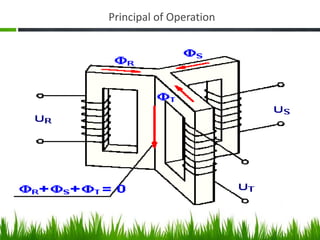
• The three cores are arranged at 120° from each other. Only
primary windings are shown on the cores for simplicity.
• The primaries are connected to the three phase supply.
• The three fluxes is also zero at any instant.
• Hence the centre leg does not carry any flux.
• So if centre leg is removed, any two legs provide the return
path for the current and hence the flux in the third leg.
• This is the general principal used in the design of three
phase core type transformers.
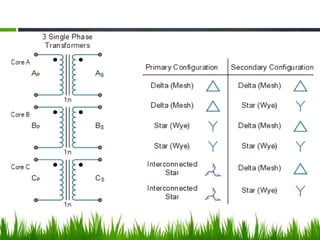
Three Phase Transformer Connections
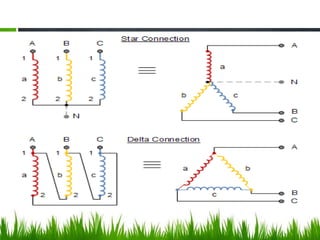
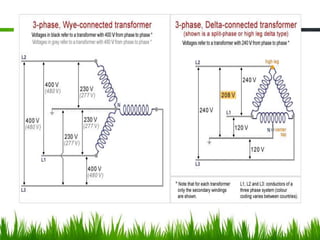
• The primary and secondary winding of three phase
transformers as three phase winding can be connected in
different ways such as in star or in delta. With suitable
connection the voltage can be raised or lowered.
• In this section some commonly used connections for three
phase transformers are discussed.
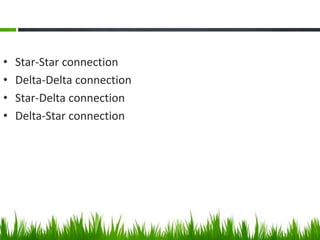
• Star-Star connection
• Delta-Delta connection
• Star-Delta connection
• Delta-Star connection
Parallel Operation of Three Phase Transformer
• The transformers are connected in parallel when load on
one of the transformers is more then it capacity
• The reliability is increased with parallel operation than to
have single larger unit.
• The Transformers connected in parallel must have same
polarity so that the resultant voltage around the local
loop is zero. With improper polarities there are chances of
dead short circuit.
• The relative phase displacements on the secondary sides
of the three phase transformers to be connected in
parallel must be zero. The transformers with same phase
group can be connected in parallel
• As the phase shift between the secondary voltages of a
star/delta and delta/star transformers is 30°, They cannot
be connected in parallel.
• But transformers with +30° and -30° phase shift can be
connected in parallel by reversing phase sequence of one
of them
• The voltage ratio of the two transformers must be same.
This prevents no load circulating current when the
transformers are in parallel on primary and secondary
sides.
• As the leakage impedance is less, with a small voltage
difference no load circulating current is high resulting in
large I2R losses.
Three phase transformers

Three phase transformers

  • 2.
    3-Phase Transformer Construction,Principal, Working, Operation Advantages Over 1-Phase Transformer • Introduction • Advantages • Construction • Principal • Working
  • 3.
    Introduction • The generationof an electrical power is usually three phase and at higher voltages like 13.2 KV, 22 KV or some what higher. • Similarly transmission of an electrical power is also at very high voltages like 110 KV, 132 KV, 400 KV. • To step up the generated voltages for transmission purposes it is necessary to have three phase transformers.
  • 4.
    Advantages • Less space •Weight Less • Cost is Less • Transported easily • Core will be smaller size • More efficient • Structure, switchgear and installation of single three phase unit is simpler
  • 5.
  • 6.
    • The threecores are arranged at 120° from each other. Only primary windings are shown on the cores for simplicity. • The primaries are connected to the three phase supply. • The three fluxes is also zero at any instant.
  • 7.
    • Hence thecentre leg does not carry any flux. • So if centre leg is removed, any two legs provide the return path for the current and hence the flux in the third leg. • This is the general principal used in the design of three phase core type transformers.
  • 8.
    Three Phase TransformerConnections • The primary and secondary winding of three phase transformers as three phase winding can be connected in different ways such as in star or in delta. With suitable connection the voltage can be raised or lowered. • In this section some commonly used connections for three phase transformers are discussed.
  • 9.
    • Star-Star connection •Delta-Delta connection • Star-Delta connection • Delta-Star connection
  • 13.
    Parallel Operation ofThree Phase Transformer • The transformers are connected in parallel when load on one of the transformers is more then it capacity • The reliability is increased with parallel operation than to have single larger unit.
  • 14.
    • The Transformersconnected in parallel must have same polarity so that the resultant voltage around the local loop is zero. With improper polarities there are chances of dead short circuit. • The relative phase displacements on the secondary sides of the three phase transformers to be connected in parallel must be zero. The transformers with same phase group can be connected in parallel
  • 15.
    • As thephase shift between the secondary voltages of a star/delta and delta/star transformers is 30°, They cannot be connected in parallel. • But transformers with +30° and -30° phase shift can be connected in parallel by reversing phase sequence of one of them
  • 16.
    • The voltageratio of the two transformers must be same. This prevents no load circulating current when the transformers are in parallel on primary and secondary sides. • As the leakage impedance is less, with a small voltage difference no load circulating current is high resulting in large I2R losses.