“ Transformative Learning” 27 January 08 www.bedspce.org.uk/adultlearning/
Transformative Learning Principally about  yourself  rather than an external subject… …so that you come to see yourself and your potential differently. 1 of 8
One definition "Transformative learning involves experiencing a  deep, structural shift in the basic premises of thought, feelings, and actions . It is a shift of consciousness that dramatically and irreversibly alters our way of being in the world. Such a shift involves our understanding of ourselves and our self-locations; our relationships with other humans and with the natural world; our understanding of relations of power in interlocking structures of class, race and gender; our body awarenesses, our visions of alternative approaches to living; and our sense of possibilities for social justice and peace and personal joy."  O’Sullivan (2003) 2 of 8
A view of its significance “ Perhaps even more central to adult learning than elaborating established meaning schemes is the process of  reflecting back on prior learning to determine whether what we have learned is justified under present circumstances.  This is a crucial learning process egregiously ignored by learning theorists.”  (Mezirow, 1990:5)   3 of 8
Perspective transformation "Perspective transformation is the process of becoming critically aware of how and why our presuppositions have come to constrain the way we perceive, understand, and feel about our world; of reformulating these assumptions to permit a more inclusive, discriminating, permeable and integrative perspective; and of making decisions or otherwise acting on these new understandings.  More inclusive, discriminating permeable and integrative perspectives are superior perspectives  that adults choose if they can because they are motivated to better understand the meaning of their experience."  (Mezirow, 1990:14 – my emphasis) 4 of 8
Mezirow’s stages A disorienting dilemma Self-examination with feelings of fear, anger, guilt, or shame A critical assessment of assumptions Recognition that one’s discontent and the process of transformation are shared Exploration of options for new roles, relationships, and actions Planning a course of action Acquiring knowledge and skills for implementing one’s plans Provisional trying of new roles Building competence and self-confidence in new roles and relationships A reintegration into one’s life on the basis of conditions dictated by one’s new perspective (Mezirow, 2000:22) 5 of 8
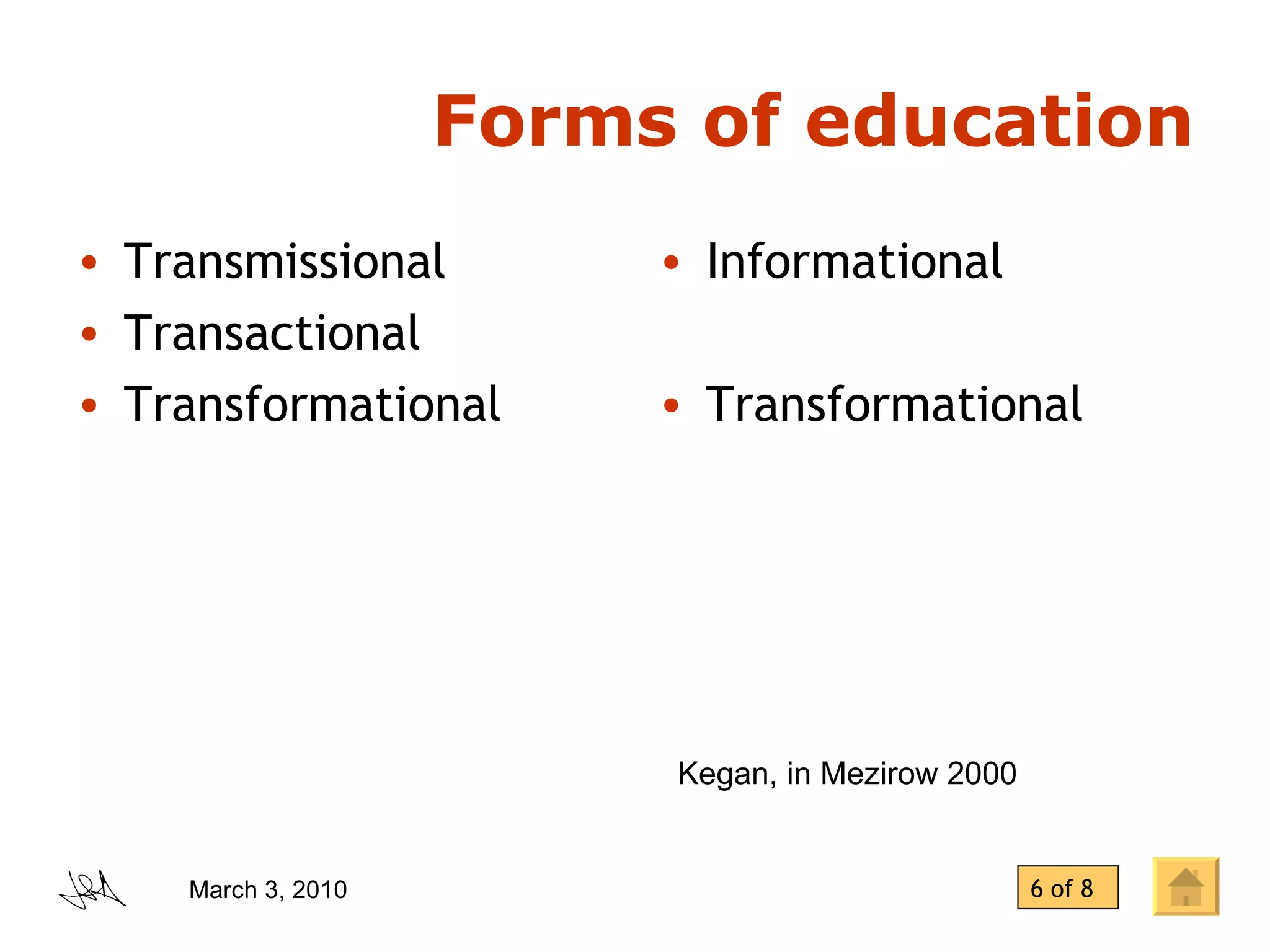
Forms of education Transmissional Transactional Transformational Informational Transformational Kegan, in Mezirow 2000 6 of 8
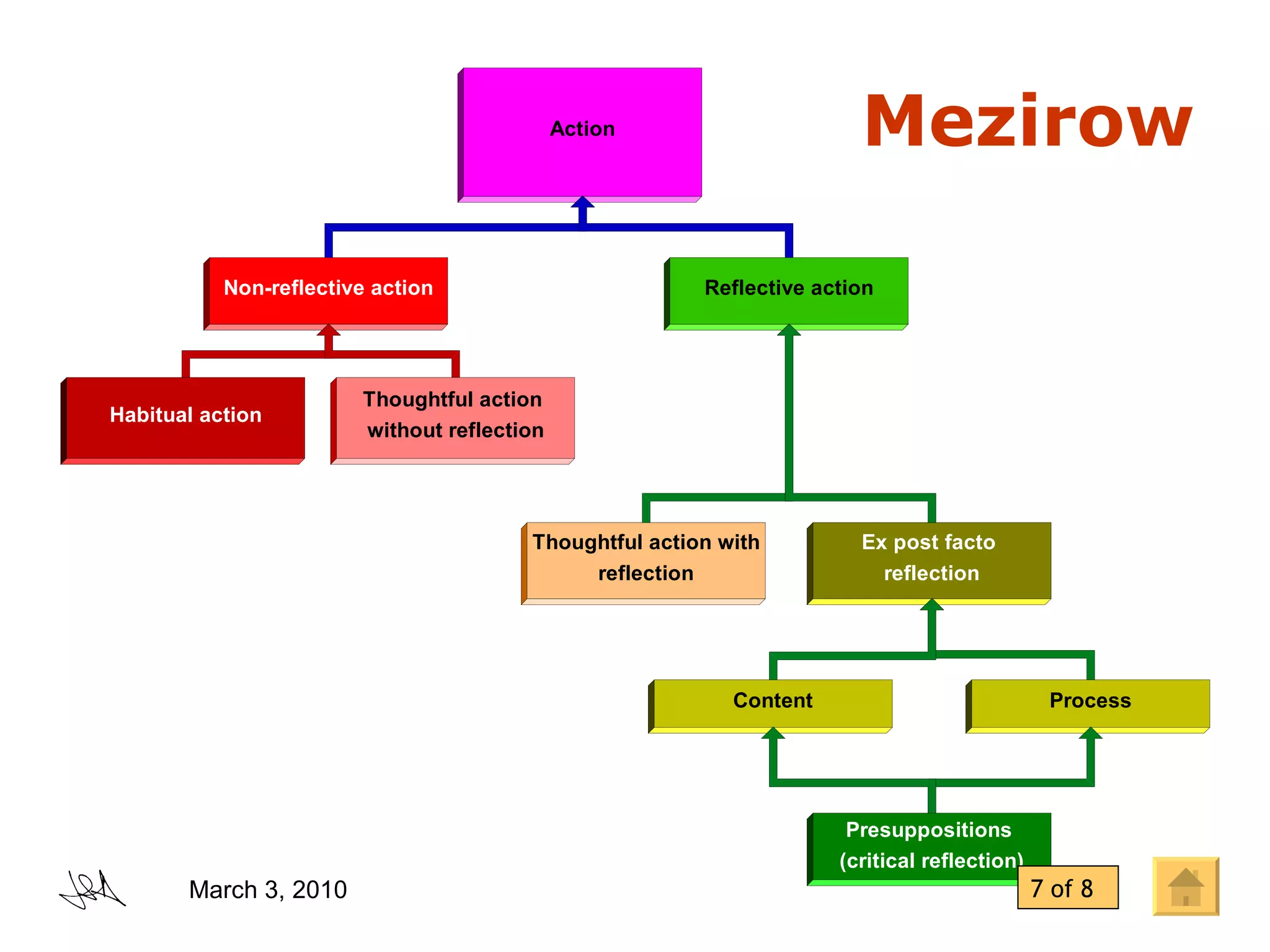
Mezirow 7 of 8
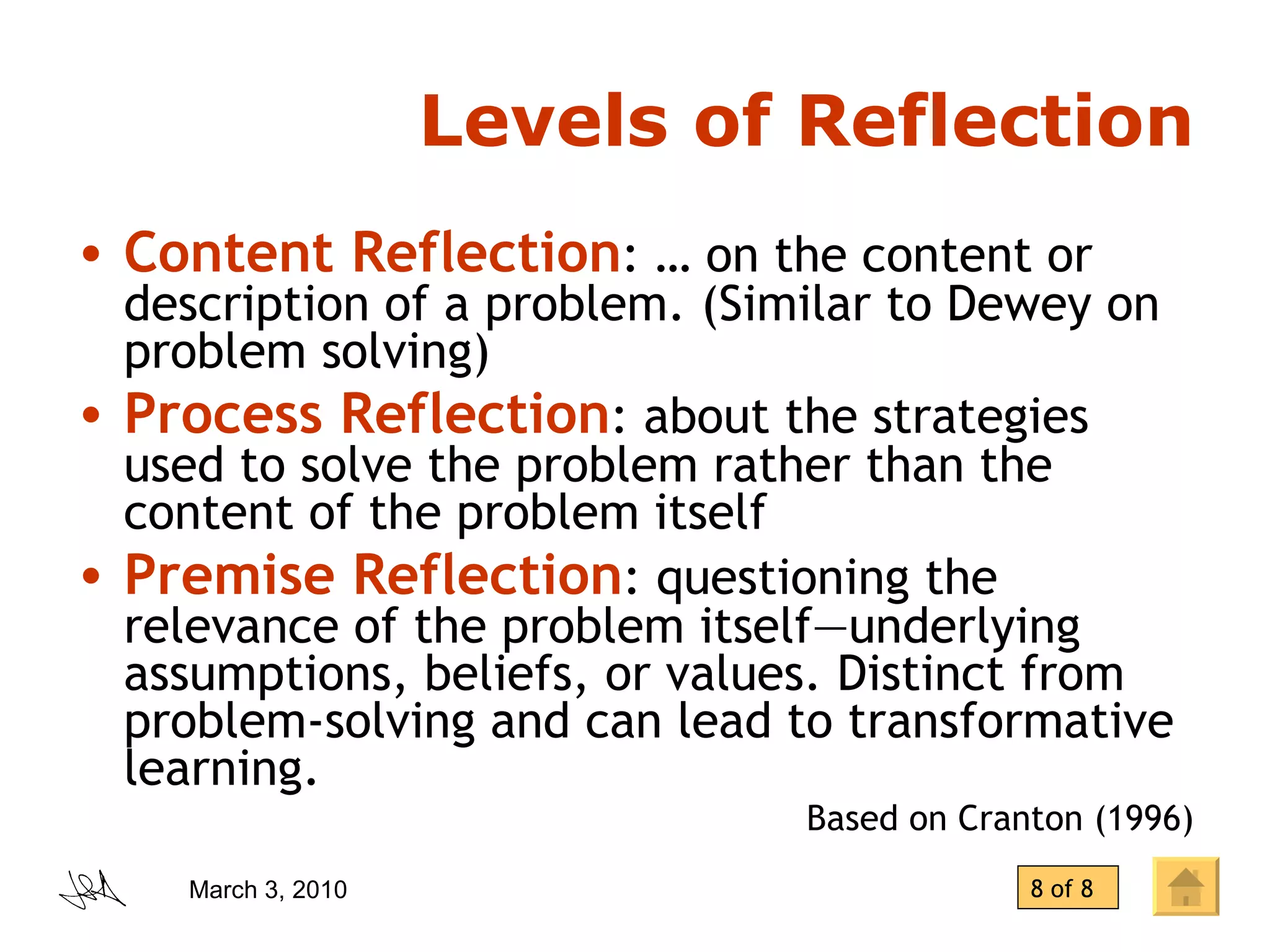
Levels of Reflection Content Reflection : … on the content or description of a problem. (Similar to Dewey on problem solving) Process Reflection : about the strategies used to solve the problem rather than the content of the problem itself Premise Reflection : questioning the relevance of the problem itself—underlying  assumptions, beliefs, or values. Distinct from problem-solving and can lead to transformative learning. Based on Cranton (1996) 8 of 8
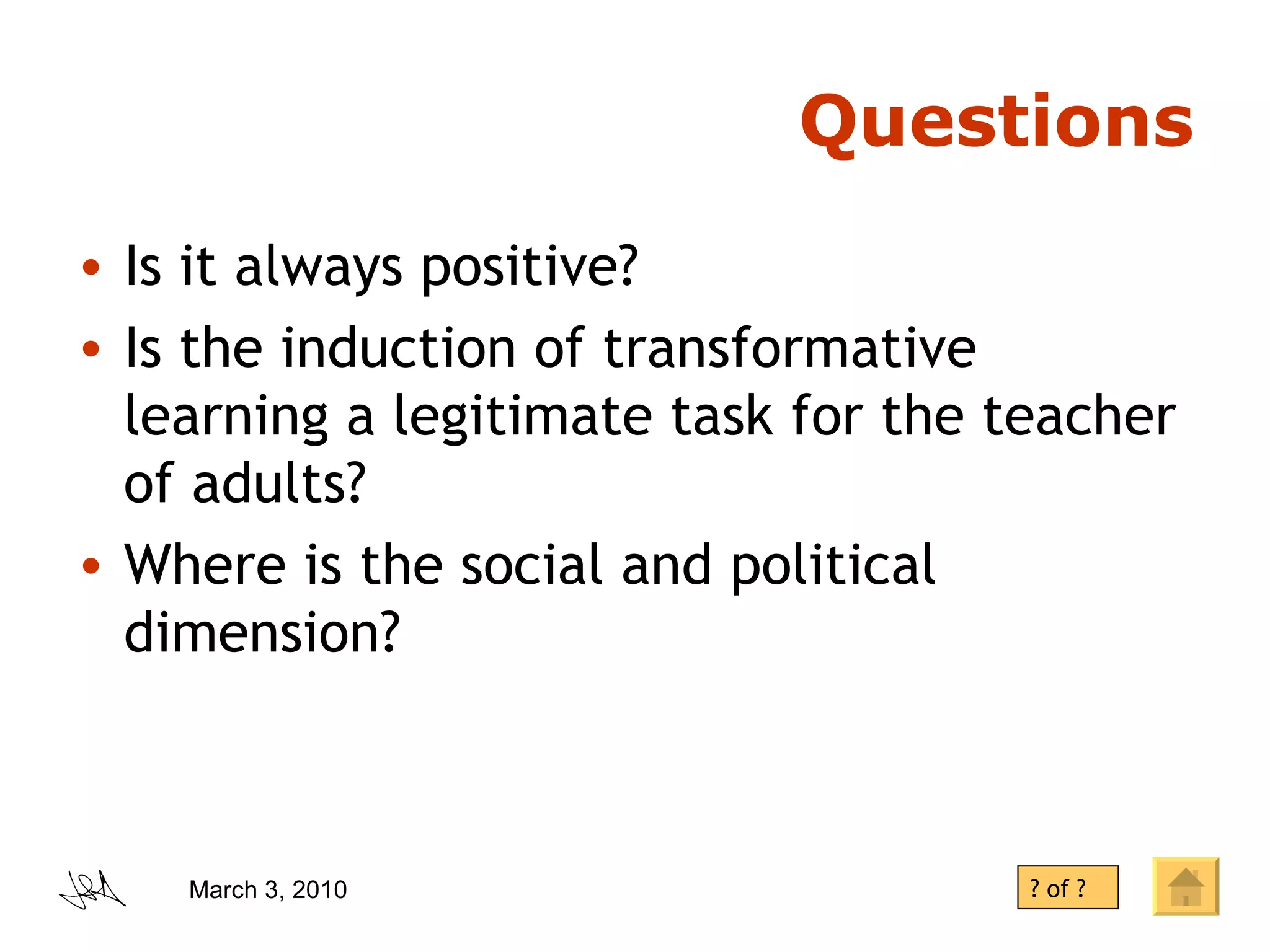
Questions Is it always positive? Is the induction of transformative learning a legitimate task for the teacher of adults? Where is the social and political dimension? ? of ?

Transformative Learning

  • 1.
    “ Transformative Learning”27 January 08 www.bedspce.org.uk/adultlearning/
  • 2.
    Transformative Learning Principallyabout yourself rather than an external subject… …so that you come to see yourself and your potential differently. 1 of 8
  • 3.
    One definition "Transformativelearning involves experiencing a deep, structural shift in the basic premises of thought, feelings, and actions . It is a shift of consciousness that dramatically and irreversibly alters our way of being in the world. Such a shift involves our understanding of ourselves and our self-locations; our relationships with other humans and with the natural world; our understanding of relations of power in interlocking structures of class, race and gender; our body awarenesses, our visions of alternative approaches to living; and our sense of possibilities for social justice and peace and personal joy." O’Sullivan (2003) 2 of 8
  • 4.
    A view ofits significance “ Perhaps even more central to adult learning than elaborating established meaning schemes is the process of reflecting back on prior learning to determine whether what we have learned is justified under present circumstances. This is a crucial learning process egregiously ignored by learning theorists.” (Mezirow, 1990:5) 3 of 8
  • 5.
    Perspective transformation "Perspectivetransformation is the process of becoming critically aware of how and why our presuppositions have come to constrain the way we perceive, understand, and feel about our world; of reformulating these assumptions to permit a more inclusive, discriminating, permeable and integrative perspective; and of making decisions or otherwise acting on these new understandings. More inclusive, discriminating permeable and integrative perspectives are superior perspectives that adults choose if they can because they are motivated to better understand the meaning of their experience." (Mezirow, 1990:14 – my emphasis) 4 of 8
  • 6.
    Mezirow’s stages Adisorienting dilemma Self-examination with feelings of fear, anger, guilt, or shame A critical assessment of assumptions Recognition that one’s discontent and the process of transformation are shared Exploration of options for new roles, relationships, and actions Planning a course of action Acquiring knowledge and skills for implementing one’s plans Provisional trying of new roles Building competence and self-confidence in new roles and relationships A reintegration into one’s life on the basis of conditions dictated by one’s new perspective (Mezirow, 2000:22) 5 of 8
  • 7.
    Forms of educationTransmissional Transactional Transformational Informational Transformational Kegan, in Mezirow 2000 6 of 8
  • 8.
  • 9.
    Levels of ReflectionContent Reflection : … on the content or description of a problem. (Similar to Dewey on problem solving) Process Reflection : about the strategies used to solve the problem rather than the content of the problem itself Premise Reflection : questioning the relevance of the problem itself—underlying assumptions, beliefs, or values. Distinct from problem-solving and can lead to transformative learning. Based on Cranton (1996) 8 of 8
  • 10.
    Questions Is italways positive? Is the induction of transformative learning a legitimate task for the teacher of adults? Where is the social and political dimension? ? of ?