Welcome to the
PGCE/Certificate in Education
(Post-Compulsory Education)

      Mentor Training
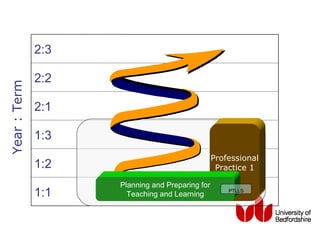
       10 November 2012
The course mantra:


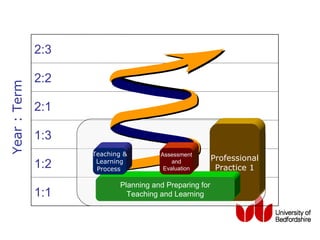
It’s in the (Mentors’) Handbook!
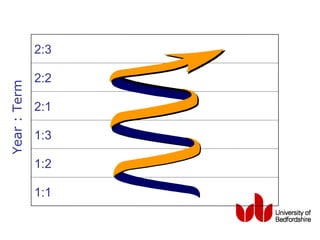
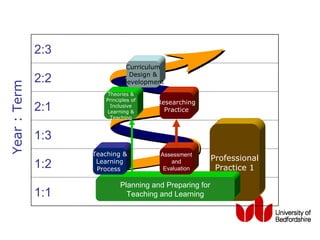
2:3

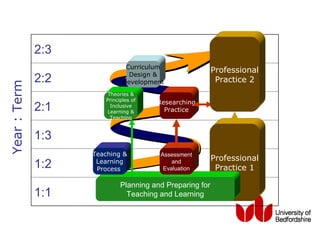
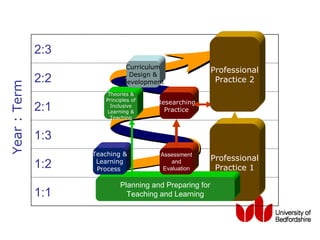
              2:2
Year : Term


              2:1

              1:3

              1:2

              1:1
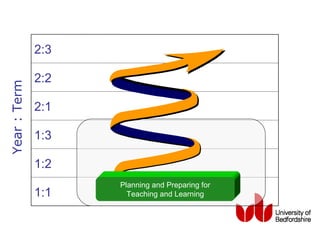
2:3

              2:2
Year : Term


              2:1

              1:3

              1:2
                    Planning and Preparing for
              1:1     Teaching and Learning
2:3

              2:2
Year : Term


              2:1

              1:3
                                                 Professional
              1:2                                 Practice 1

                    Planning and Preparing for
              1:1     Teaching and Learning
                                                     PTLLS
2:3

              2:2
Year : Term


              2:1

              1:3
                    Teaching &         Assessment
                                                         Professional
              1:2    Learning
                     Process
                                           and
                                        Evaluation        Practice 1

                            Planning and Preparing for
              1:1             Teaching and Learning
2:3
                               Curriculum
                                Design &
              2:2             Development
Year : Term


                        Theories &
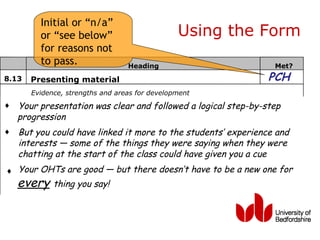
                       Principles of
                                       Researching
              2:1        Inclusive
                        Learning &       Practice
                         Teaching


              1:3
                    Teaching &          Assessment
                                                          Professional
              1:2    Learning
                     Process
                                            and
                                         Evaluation        Practice 1

                             Planning and Preparing for
              1:1              Teaching and Learning
2:3
                               Curriculum
                                                          Professional
                                Design &
              2:2             Development                  Practice 2
Year : Term


                        Theories &
                       Principles of
                                       Researching
              2:1        Inclusive
                        Learning &       Practice
                         Teaching


              1:3
                    Teaching &          Assessment
                                                          Professional
              1:2    Learning
                     Process
                                            and
                                         Evaluation        Practice 1

                             Planning and Preparing for
              1:1              Teaching and Learning
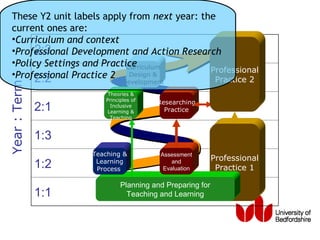
These Y2 unit labels apply from next year: the
  current ones are:
  •Curriculum and context
        2:3
  •Professional Development and Action Research
  •Policy Settings and Practice
                             Curriculum
                                               Professional
  •Professional Practice 2 Design &
        2:2                                     Practice 2
                              Development
Year : Term


                        Theories &
                       Principles of
                                       Researching
              2:1        Inclusive
                        Learning &       Practice
                         Teaching


              1:3
                    Teaching &          Assessment
                                                          Professional
              1:2    Learning
                     Process
                                            and
                                         Evaluation        Practice 1

                             Planning and Preparing for
              1:1              Teaching and Learning
Qualified Teacher:
                    Learning and Skills (QTLS)
•   The PGCE/Cert Ed is a qualification of the   University
    of Bedfordshire       (UK) but
Qualified Teacher:
                    Learning and Skills (QTLS)
•   The PGCE/Cert Ed is a qualification of the   University
    of Bedfordshire (UK) but
•   endorsed by the Learning and Skills
    Improvement Service (LSIS) and
Qualified Teacher:
                    Learning and Skills (QTLS)
•   The PGCE/Cert Ed is a qualification of the   University
    of Bedfordshire (UK) but
•   endorsed by the Learning and Skills
    Improvement Service (LSIS) and
•   the Institute for Learning (IfL) as a
•   Diploma in Teaching in the Lifelong Learning Sector
    (DTLLS).
Qualified Teacher:
                     Learning and Skills (QTLS)
•   The PGCE/Cert Ed is a qualification of the   University
    of Bedfordshire (UK) but
•   endorsed by the Learning and Skills
    Improvement Service (LSIS) and
•   the Institute for Learning (IfL) as a
•   Diploma in Teaching in the Lifelong Learning Sector
    (DTLLS).
to achieve QTLS you must gain the PGCE/Cert Ed      and
•   Be registered with IfL   and
•   complete a period of professional formation
Qualified Teacher:
                     Learning and Skills (QTLS)
•   The PGCE/Cert Ed is a qualification of the   University
    of Bedfordshire (UK) but
    endorsed by the Learning and Skills

                      ... all this
•
    Improvement Service (LSIS) and
•   the Institute for Learning (IfL) as a
•
    (DTLLS).
                is up in the air
    Diploma in Teaching in the Lifelong Learning Sector


to achieve QTLS you must gain the PGCE/Cert Ed      and
•
•
               at the moment.
    Be registered with IfL   and
    complete a period of professional formation
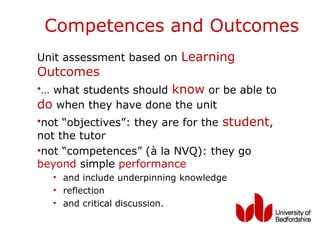
Competences and Outcomes
Unit assessment based on Learning
Outcomes
Competences and Outcomes
Unit assessment based on Learning
Outcomes
•… what students should know or be able to
do when they have done the unit
•not “objectives”: they are for the student,
not the tutor
Competences and Outcomes
Unit assessment based on Learning
Outcomes
•… what students should know or be able to
do when they have done the unit
•not “objectives”: they are for the student,
not the tutor
•not “competences” (à la NVQ): they go
beyond simple performance
  • and include underpinning knowledge
  • reflection
  • and critical discussion.
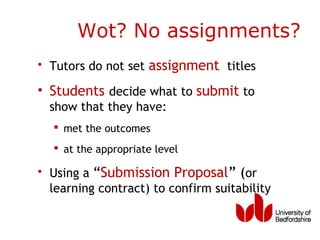
Wot? No assignments?
• Tutors do not set assignment titles
Wot? No assignments?
• Tutors do not set assignment titles

• Students decide what to submit to
  show that they have:
   met the outcomes
   at the appropriate level
Wot? No assignments?
• Tutors do not set assignment titles

• Students decide what to submit to
  show that they have:
   met the outcomes
   at the appropriate level

• Using a “Submission Proposal” (or
  learning contract) to confirm suitability
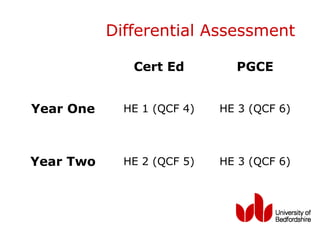
Differential Assessment

              Cert Ed         PGCE


Year One     HE 1 (QCF 4)   HE 3 (QCF 6)


Year Two     HE 2 (QCF 5)   HE 3 (QCF 6)
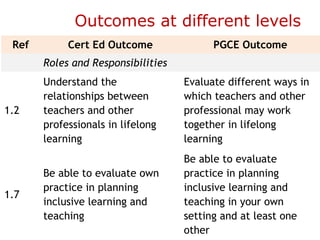
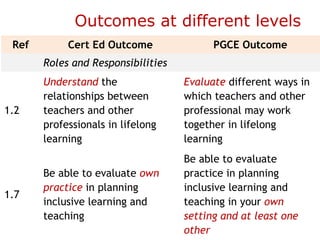
Outcomes at different levels
 Ref        Cert Ed Outcome               PGCE Outcome
       Roles and Responsibilities
       Understand the               Evaluate different ways in
       relationships between        which teachers and other
1.2    teachers and other           professional may work
       professionals in lifelong    together in lifelong
       learning                     learning
                                    Be able to evaluate
       Be able to evaluate own      practice in planning
       practice in planning         inclusive learning and
1.7
       inclusive learning and       teaching in your own
       teaching                     setting and at least one
                                    other
Outcomes at different levels
 Ref        Cert Ed Outcome               PGCE Outcome
       Roles and Responsibilities
       Understand the               Evaluate different ways in
       relationships between        which teachers and other
1.2    teachers and other           professional may work
       professionals in lifelong    together in lifelong
       learning                     learning
                                    Be able to evaluate
       Be able to evaluate own      practice in planning
       practice in planning         inclusive learning and
1.7
       inclusive learning and       teaching in your own
       teaching                     setting and at least one
                                    other
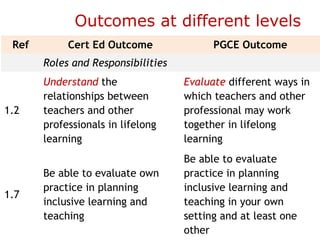
Outcomes at different levels
 Ref        Cert Ed Outcome               PGCE Outcome
       Roles and Responsibilities
       Understand the               Evaluate different ways in
       relationships between        which teachers and other
1.2    teachers and other           professional may work
       professionals in lifelong    together in lifelong
       learning                     learning
                                    Be able to evaluate
       Be able to evaluate own      practice in planning
       practice in planning         inclusive learning and
1.7
       inclusive learning and       teaching in your own
       teaching                     setting and at least one
                                    other
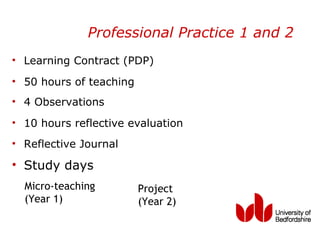
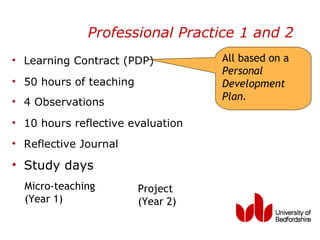
Professional Practice 1 and 2
• Learning Contract (PDP)
• 50 hours of teaching
• 4 Observations
• 10 hours reflective evaluation
• Reflective Journal

• Study days
  Micro-teaching         Project
  (Year 1)               (Year 2)
Professional Practice 1 and 2
• Learning Contract (PDP)           All based on a
                                    Personal
• 50 hours of teaching              Development
• 4 Observations                    Plan.

• 10 hours reflective evaluation
• Reflective Journal

• Study days
  Micro-teaching         Project
  (Year 1)               (Year 2)
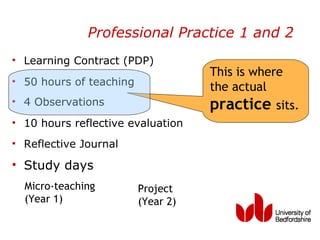
Professional Practice 1 and 2
• Learning Contract (PDP)
                                    This is where
• 50 hours of teaching
                                    the actual
• 4 Observations                    practice sits.
• 10 hours reflective evaluation
• Reflective Journal

• Study days
  Micro-teaching         Project
  (Year 1)               (Year 2)
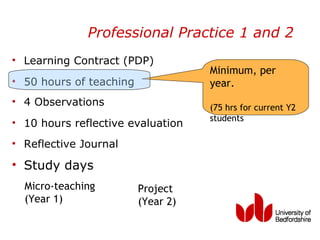
Professional Practice 1 and 2
• Learning Contract (PDP)
                                    Minimum, per
• 50 hours of teaching              year.
• 4 Observations
                                    (75 hrs for current Y2
                                    students
• 10 hours reflective evaluation
• Reflective Journal

• Study days
  Micro-teaching         Project
  (Year 1)               (Year 2)
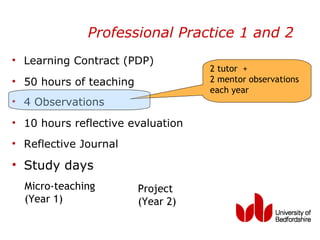
Professional Practice 1 and 2
• Learning Contract (PDP)
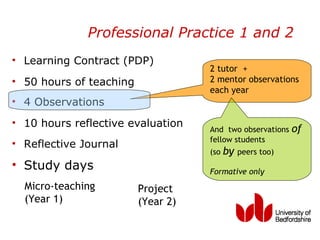
                                    2 tutor +
• 50 hours of teaching              2 mentor observations
                                    each year
• 4 Observations
• 10 hours reflective evaluation
• Reflective Journal

• Study days
  Micro-teaching         Project
  (Year 1)               (Year 2)
Professional Practice 1 and 2
• Learning Contract (PDP)
                                    2 tutor +
• 50 hours of teaching              2 mentor observations
                                    each year
• 4 Observations
• 10 hours reflective evaluation
                                    And two observations    of
                                    fellow students
• Reflective Journal
                                    (so   by   peers too)
• Study days                        Formative only
  Micro-teaching         Project
  (Year 1)               (Year 2)
Professional Practice 1 and 2
• Learning Contract (PDP)
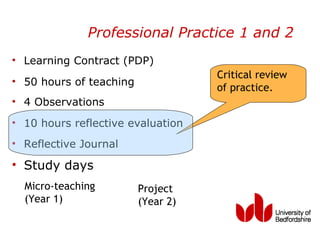
                                    Critical review
• 50 hours of teaching
                                    of practice.
• 4 Observations
• 10 hours reflective evaluation
• Reflective Journal

• Study days
  Micro-teaching         Project
  (Year 1)               (Year 2)
Professional Practice 1 and 2
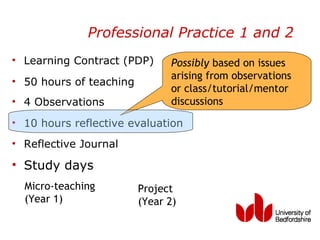
• Learning Contract (PDP)      Possibly based on issues
                               arising from observations
• 50 hours of teaching
                               or class/tutorial/mentor
• 4 Observations               discussions

• 10 hours reflective evaluation
• Reflective Journal

• Study days
  Micro-teaching         Project
  (Year 1)               (Year 2)
Professional Practice 1 and 2
• Learning Contract (PDP)
• 50 hours of teaching
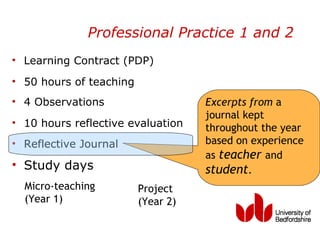
• 4 Observations                    Excerpts from a
                                    journal kept
• 10 hours reflective evaluation    throughout the year
• Reflective Journal                based on experience
                                    as teacher and
• Study days                        student.
  Micro-teaching         Project
  (Year 1)               (Year 2)
Professional Practice 1 and 2
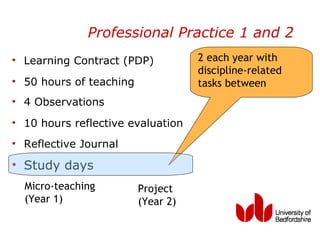
• Learning Contract (PDP)           2 each year with
                                    discipline-related
• 50 hours of teaching              tasks between
• 4 Observations
• 10 hours reflective evaluation
• Reflective Journal

• Study days
  Micro-teaching         Project
  (Year 1)               (Year 2)
Professional Practice 1 and 2
• Learning Contract (PDP)
• 50 hours of teaching
• 4 Observations
• 10 hours reflective evaluation
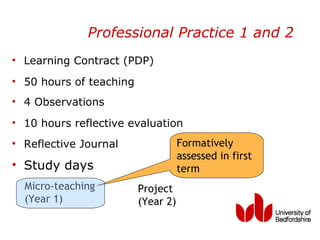
• Reflective Journal                Formatively
                                    assessed in first
• Study days                        term
  Micro-teaching         Project
  (Year 1)               (Year 2)
Professional Practice 1 and 2
• Learning Contract (PDP)
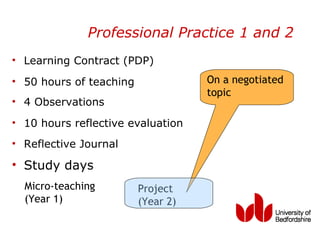
• 50 hours of teaching              On a negotiated
                                    topic
• 4 Observations
• 10 hours reflective evaluation
• Reflective Journal

• Study days
  Micro-teaching         Project
  (Year 1)               (Year 2)
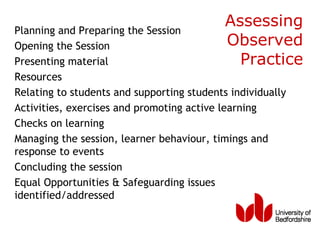
Planning and Preparing the Session
                                            Assessing
Opening the Session                         Observed
Presenting material                           Practice
Resources
Relating to students and supporting students individually
Activities, exercises and promoting active learning
Checks on learning
Managing the session, learner behaviour, timings and
response to events
Concluding the session
Equal Opportunities & Safeguarding issues
identified/addressed
Planning and Preparing the Session
                                           Assessing
Opening the Session                        Observed
Presenting material                          Practice
Resources
Relating to students and supporting students individually
Activities, exercises and promoting active learning
Checks on learning
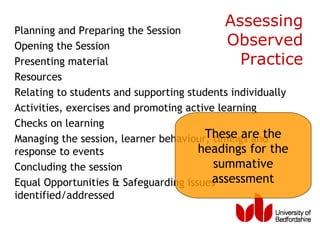
                                        These are the
Managing the session, learner behaviour, timings and
response to events                    headings for the
Concluding the session                    summative
Equal Opportunities & Safeguarding issues assessment
identified/addressed
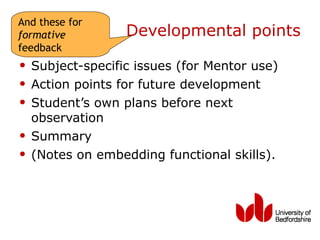
And these for
formative          Developmental points
feedback
• Subject-specific issues (for Mentor use)
• Action points for future development
• Student’s own plans before next
    observation
•   Summary
•   (Notes on embedding functional skills).
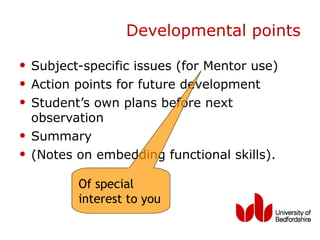
Developmental points

• Subject-specific issues (for Mentor use)
• Action points for future development
• Student’s own plans before next
    observation
•   Summary
•   (Notes on embedding functional skills).

           Of special
           interest to you
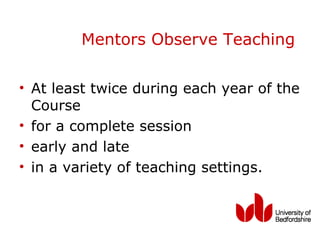
Mentors Observe Teaching

• At least twice during each year of the
  Course
• for a complete session
• early and late
• in a variety of teaching settings.
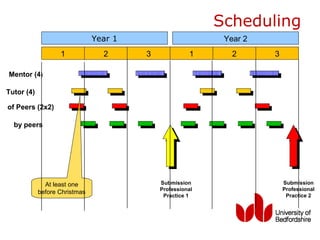
Scheduling
                               Year 1                       Year 2
                   1             2      3             1       2      3

Mentor (4)

Tutor (4)

of Peers (2x2)

  by peers


              At least one                  Submission                   Submission
                                            Professional                 Professional
            before Christmas
                                             Practice 1                   Practice 2
Before the Session
• Your mentee should provide you with
         a copy of the Observation schedule
         a lesson plan,
         scheme of work, and
         copies of any exercises or other materials (OHTs, etc.)
         the report from her previous observation
Before the Session
• Your mentee should provide you with
          a copy of the Observation schedule
          a lesson plan,
          scheme of work, and
          copies of any exercises or other materials (OHTs, etc.)
          the report from her previous observation
• Discuss the
          planning
          rationale,
          features of class,
          characteristics of the group
          action points from previous observation and
• Any points she wants you to concentrate on.
After the session
       some of the most effective
Can yield
learning in the entire Course
After the session
       some of the most effective
Can yield
learning in the entire Course
•Material is live,
•you have both shared it from your different
standpoints,
•and noticed different things —and it is
•the optimum time for feedback.
Using the Observation Schedule

• Familiarise yourself with the forms
  first
• Remember to note the evidence
• The forms are the Student’s
  responsibility
• Supplement them with your own
  comments and ideas.
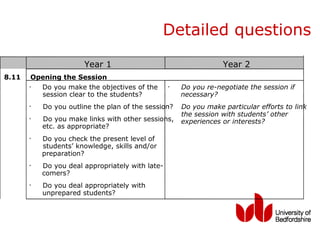
Detailed questions
                       Year 1                                     Year 2
8.11    Opening the Session
       ·  Do you make the objectives of the       ·   Do you re-negotiate the session if
          session clear to the students?              necessary?
       ·                                         ·
           Do you outline the plan of the session?    Do you make particular efforts to link
                                                      the session with students’ other
       ·   Do you make links with other sessions,     experiences or interests?
           etc. as appropriate?
       ·   Do you check the present level of
           students’ knowledge, skills and/or
           preparation?
       ·   Do you deal appropriately with late-
           comers?
       ·   Do you deal appropriately with
           unprepared students?
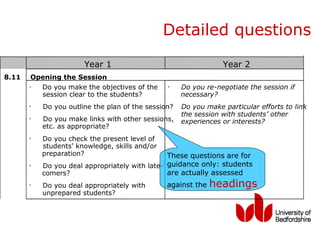
Detailed questions
                       Year 1                                    Year 2
8.11    Opening the Session
       ·  Do you make the objectives of the     ·    Do you re-negotiate the session if
          session clear to the students?             necessary?
       ·                                         ·
           Do you outline the plan of the session?   Do you make particular efforts to link
                                                     the session with students’ other
       ·   Do you make links with other sessions,    experiences or interests?
           etc. as appropriate?
       ·   Do you check the present level of
           students’ knowledge, skills and/or
           preparation?                         These questions are for
       ·   Do you deal appropriately with late- guidance only: students
           comers?                              are actually assessed
       ·   Do you deal appropriately with       against the   headings
           unprepared students?
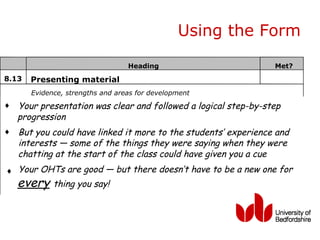
Using the Form

                                  Heading                        Met?
8.13   Presenting material
       Evidence, strengths and areas for development
♦   Your presentation was clear and followed a logical step-by-step
    progression
♦   But you could have linked it more to the students’ experience and
    interests — some of the things they were saying when they were
    chatting at the start of the class could have given you a cue
♦ Your OHTs are good — but there doesn’t have to be a new one for
    every thing you say!
Initial or “n/a”
         or “see below”                         Using the Form
         for reasons not
         to pass.                 Heading                        Met?
8.13   Presenting material                                      PCH
       Evidence, strengths and areas for development
♦   Your presentation was clear and followed a logical step-by-step
    progression
♦   But you could have linked it more to the students’ experience and
    interests — some of the things they were saying when they were
    chatting at the start of the class could have given you a cue
♦ Your OHTs are good — but there doesn’t have to be a new one for
    every thing you say!
We do   not   grade observations.
2:3
                               Curriculum
                                                          Professional
                                Design &
              2:2             Development                  Practice 2
Year : Term


                        Theories &
                       Principles of
                                       Researching
              2:1        Inclusive
                        Learning &       Practice
                         Teaching


              1:3
                    Teaching &          Assessment
                                                          Professional
              1:2    Learning
                     Process
                                            and
                                         Evaluation        Practice 1

                             Planning and Preparing for
              1:1              Teaching and Learning
Mentoring is ...

 Talking   to someone
  about their   work
        so as to

help them do it    better.
Talking...
Listening as much as talking.
 … helps them feel valued
 … to pick up subtle differences
  from your own experience
 … encourages them to talk.
Time…
Ideally:
 allow half-an-hour, or more if you
  can
 about once a fortnight
 somewhere without interruptions!
 And allow about fifteen minutes
 before and about half an hour
 after each teaching observation.
... about their work
 The agenda is usually and mainly up to
  the mentee
     it helps them to   own   the process
     may be based on their  Action Plan
   but they may need encouragement
   (and to be kept to the point).
The Learning Contract
                          and Mentoring
 For each Unit the student will draw up a
  Learning Contract (or “Submission
  Proposal”) with the help of her tutor
 including mentoring requests: please
    help her to draw up the Proposal;
    only sign your bit if you can meet the demands
     it may make on you. If they are not practicable,
     re-negotiate them
 It is important that the Proposal is a
  realistic working document           rather
  than merely a set of pious aspirations.
Recording Mentoring

 We suggest that any records are kept by
  the student
       for confidentiality reasons
       as part of their professional journal for
        the Professional Practice units
       and because writing it up also helps the
        learning process.
Web-site


http://www.bedspce.org.uk/mentor_material.htm

       for handbook and documentation on-line

Mentors 2012

  • 1.
    Welcome to the PGCE/Certificatein Education (Post-Compulsory Education) Mentor Training 10 November 2012
  • 2.
    The course mantra: It’sin the (Mentors’) Handbook!
  • 3.
    2:3 2:2 Year : Term 2:1 1:3 1:2 1:1
  • 4.
    2:3 2:2 Year : Term 2:1 1:3 1:2 Planning and Preparing for 1:1 Teaching and Learning
  • 5.
    2:3 2:2 Year : Term 2:1 1:3 Professional 1:2 Practice 1 Planning and Preparing for 1:1 Teaching and Learning PTLLS
  • 6.
    2:3 2:2 Year : Term 2:1 1:3 Teaching & Assessment Professional 1:2 Learning Process and Evaluation Practice 1 Planning and Preparing for 1:1 Teaching and Learning
  • 7.
    2:3 Curriculum Design & 2:2 Development Year : Term Theories & Principles of Researching 2:1 Inclusive Learning & Practice Teaching 1:3 Teaching & Assessment Professional 1:2 Learning Process and Evaluation Practice 1 Planning and Preparing for 1:1 Teaching and Learning
  • 8.
    2:3 Curriculum Professional Design & 2:2 Development Practice 2 Year : Term Theories & Principles of Researching 2:1 Inclusive Learning & Practice Teaching 1:3 Teaching & Assessment Professional 1:2 Learning Process and Evaluation Practice 1 Planning and Preparing for 1:1 Teaching and Learning
  • 9.
    These Y2 unitlabels apply from next year: the current ones are: •Curriculum and context 2:3 •Professional Development and Action Research •Policy Settings and Practice Curriculum Professional •Professional Practice 2 Design & 2:2 Practice 2 Development Year : Term Theories & Principles of Researching 2:1 Inclusive Learning & Practice Teaching 1:3 Teaching & Assessment Professional 1:2 Learning Process and Evaluation Practice 1 Planning and Preparing for 1:1 Teaching and Learning
  • 10.
    Qualified Teacher: Learning and Skills (QTLS) • The PGCE/Cert Ed is a qualification of the University of Bedfordshire (UK) but
  • 11.
    Qualified Teacher: Learning and Skills (QTLS) • The PGCE/Cert Ed is a qualification of the University of Bedfordshire (UK) but • endorsed by the Learning and Skills Improvement Service (LSIS) and
  • 12.
    Qualified Teacher: Learning and Skills (QTLS) • The PGCE/Cert Ed is a qualification of the University of Bedfordshire (UK) but • endorsed by the Learning and Skills Improvement Service (LSIS) and • the Institute for Learning (IfL) as a • Diploma in Teaching in the Lifelong Learning Sector (DTLLS).
  • 13.
    Qualified Teacher: Learning and Skills (QTLS) • The PGCE/Cert Ed is a qualification of the University of Bedfordshire (UK) but • endorsed by the Learning and Skills Improvement Service (LSIS) and • the Institute for Learning (IfL) as a • Diploma in Teaching in the Lifelong Learning Sector (DTLLS). to achieve QTLS you must gain the PGCE/Cert Ed and • Be registered with IfL and • complete a period of professional formation
  • 14.
    Qualified Teacher: Learning and Skills (QTLS) • The PGCE/Cert Ed is a qualification of the University of Bedfordshire (UK) but endorsed by the Learning and Skills ... all this • Improvement Service (LSIS) and • the Institute for Learning (IfL) as a • (DTLLS). is up in the air Diploma in Teaching in the Lifelong Learning Sector to achieve QTLS you must gain the PGCE/Cert Ed and • • at the moment. Be registered with IfL and complete a period of professional formation
  • 15.
    Competences and Outcomes Unitassessment based on Learning Outcomes
  • 16.
    Competences and Outcomes Unitassessment based on Learning Outcomes •… what students should know or be able to do when they have done the unit •not “objectives”: they are for the student, not the tutor
  • 17.
    Competences and Outcomes Unitassessment based on Learning Outcomes •… what students should know or be able to do when they have done the unit •not “objectives”: they are for the student, not the tutor •not “competences” (à la NVQ): they go beyond simple performance • and include underpinning knowledge • reflection • and critical discussion.
  • 18.
  • 19.
    Wot? No assignments? •Tutors do not set assignment titles
  • 20.
    Wot? No assignments? •Tutors do not set assignment titles • Students decide what to submit to show that they have:  met the outcomes  at the appropriate level
  • 21.
    Wot? No assignments? •Tutors do not set assignment titles • Students decide what to submit to show that they have:  met the outcomes  at the appropriate level • Using a “Submission Proposal” (or learning contract) to confirm suitability
  • 22.
    Differential Assessment Cert Ed PGCE Year One HE 1 (QCF 4) HE 3 (QCF 6) Year Two HE 2 (QCF 5) HE 3 (QCF 6)
  • 23.
    Outcomes at differentlevels Ref Cert Ed Outcome PGCE Outcome Roles and Responsibilities Understand the Evaluate different ways in relationships between which teachers and other 1.2 teachers and other professional may work professionals in lifelong together in lifelong learning learning Be able to evaluate Be able to evaluate own practice in planning practice in planning inclusive learning and 1.7 inclusive learning and teaching in your own teaching setting and at least one other
  • 24.
    Outcomes at differentlevels Ref Cert Ed Outcome PGCE Outcome Roles and Responsibilities Understand the Evaluate different ways in relationships between which teachers and other 1.2 teachers and other professional may work professionals in lifelong together in lifelong learning learning Be able to evaluate Be able to evaluate own practice in planning practice in planning inclusive learning and 1.7 inclusive learning and teaching in your own teaching setting and at least one other
  • 25.
    Outcomes at differentlevels Ref Cert Ed Outcome PGCE Outcome Roles and Responsibilities Understand the Evaluate different ways in relationships between which teachers and other 1.2 teachers and other professional may work professionals in lifelong together in lifelong learning learning Be able to evaluate Be able to evaluate own practice in planning practice in planning inclusive learning and 1.7 inclusive learning and teaching in your own teaching setting and at least one other
  • 26.
    Professional Practice 1and 2 • Learning Contract (PDP) • 50 hours of teaching • 4 Observations • 10 hours reflective evaluation • Reflective Journal • Study days Micro-teaching Project (Year 1) (Year 2)
  • 27.
    Professional Practice 1and 2 • Learning Contract (PDP) All based on a Personal • 50 hours of teaching Development • 4 Observations Plan. • 10 hours reflective evaluation • Reflective Journal • Study days Micro-teaching Project (Year 1) (Year 2)
  • 28.
    Professional Practice 1and 2 • Learning Contract (PDP) This is where • 50 hours of teaching the actual • 4 Observations practice sits. • 10 hours reflective evaluation • Reflective Journal • Study days Micro-teaching Project (Year 1) (Year 2)
  • 29.
    Professional Practice 1and 2 • Learning Contract (PDP) Minimum, per • 50 hours of teaching year. • 4 Observations (75 hrs for current Y2 students • 10 hours reflective evaluation • Reflective Journal • Study days Micro-teaching Project (Year 1) (Year 2)
  • 30.
    Professional Practice 1and 2 • Learning Contract (PDP) 2 tutor + • 50 hours of teaching 2 mentor observations each year • 4 Observations • 10 hours reflective evaluation • Reflective Journal • Study days Micro-teaching Project (Year 1) (Year 2)
  • 31.
    Professional Practice 1and 2 • Learning Contract (PDP) 2 tutor + • 50 hours of teaching 2 mentor observations each year • 4 Observations • 10 hours reflective evaluation And two observations of fellow students • Reflective Journal (so by peers too) • Study days Formative only Micro-teaching Project (Year 1) (Year 2)
  • 32.
    Professional Practice 1and 2 • Learning Contract (PDP) Critical review • 50 hours of teaching of practice. • 4 Observations • 10 hours reflective evaluation • Reflective Journal • Study days Micro-teaching Project (Year 1) (Year 2)
  • 33.
    Professional Practice 1and 2 • Learning Contract (PDP) Possibly based on issues arising from observations • 50 hours of teaching or class/tutorial/mentor • 4 Observations discussions • 10 hours reflective evaluation • Reflective Journal • Study days Micro-teaching Project (Year 1) (Year 2)
  • 34.
    Professional Practice 1and 2 • Learning Contract (PDP) • 50 hours of teaching • 4 Observations Excerpts from a journal kept • 10 hours reflective evaluation throughout the year • Reflective Journal based on experience as teacher and • Study days student. Micro-teaching Project (Year 1) (Year 2)
  • 35.
    Professional Practice 1and 2 • Learning Contract (PDP) 2 each year with discipline-related • 50 hours of teaching tasks between • 4 Observations • 10 hours reflective evaluation • Reflective Journal • Study days Micro-teaching Project (Year 1) (Year 2)
  • 36.
    Professional Practice 1and 2 • Learning Contract (PDP) • 50 hours of teaching • 4 Observations • 10 hours reflective evaluation • Reflective Journal Formatively assessed in first • Study days term Micro-teaching Project (Year 1) (Year 2)
  • 37.
    Professional Practice 1and 2 • Learning Contract (PDP) • 50 hours of teaching On a negotiated topic • 4 Observations • 10 hours reflective evaluation • Reflective Journal • Study days Micro-teaching Project (Year 1) (Year 2)
  • 38.
    Planning and Preparingthe Session Assessing Opening the Session Observed Presenting material Practice Resources Relating to students and supporting students individually Activities, exercises and promoting active learning Checks on learning Managing the session, learner behaviour, timings and response to events Concluding the session Equal Opportunities & Safeguarding issues identified/addressed
  • 39.
    Planning and Preparingthe Session Assessing Opening the Session Observed Presenting material Practice Resources Relating to students and supporting students individually Activities, exercises and promoting active learning Checks on learning These are the Managing the session, learner behaviour, timings and response to events headings for the Concluding the session summative Equal Opportunities & Safeguarding issues assessment identified/addressed
  • 40.
    And these for formative Developmental points feedback • Subject-specific issues (for Mentor use) • Action points for future development • Student’s own plans before next observation • Summary • (Notes on embedding functional skills).
  • 41.
    Developmental points • Subject-specificissues (for Mentor use) • Action points for future development • Student’s own plans before next observation • Summary • (Notes on embedding functional skills). Of special interest to you
  • 42.
    Mentors Observe Teaching •At least twice during each year of the Course • for a complete session • early and late • in a variety of teaching settings.
  • 43.
    Scheduling Year 1 Year 2 1 2 3 1 2 3 Mentor (4) Tutor (4) of Peers (2x2) by peers At least one Submission Submission Professional Professional before Christmas Practice 1 Practice 2
  • 44.
    Before the Session •Your mentee should provide you with  a copy of the Observation schedule  a lesson plan,  scheme of work, and  copies of any exercises or other materials (OHTs, etc.)  the report from her previous observation
  • 45.
    Before the Session •Your mentee should provide you with  a copy of the Observation schedule  a lesson plan,  scheme of work, and  copies of any exercises or other materials (OHTs, etc.)  the report from her previous observation • Discuss the  planning  rationale,  features of class,  characteristics of the group  action points from previous observation and • Any points she wants you to concentrate on.
  • 46.
    After the session some of the most effective Can yield learning in the entire Course
  • 47.
    After the session some of the most effective Can yield learning in the entire Course •Material is live, •you have both shared it from your different standpoints, •and noticed different things —and it is •the optimum time for feedback.
  • 48.
    Using the ObservationSchedule • Familiarise yourself with the forms first • Remember to note the evidence • The forms are the Student’s responsibility • Supplement them with your own comments and ideas.
  • 49.
    Detailed questions Year 1 Year 2 8.11 Opening the Session · Do you make the objectives of the · Do you re-negotiate the session if session clear to the students? necessary? · · Do you outline the plan of the session? Do you make particular efforts to link the session with students’ other · Do you make links with other sessions, experiences or interests? etc. as appropriate? · Do you check the present level of students’ knowledge, skills and/or preparation? · Do you deal appropriately with late- comers? · Do you deal appropriately with unprepared students?
  • 50.
    Detailed questions Year 1 Year 2 8.11 Opening the Session · Do you make the objectives of the · Do you re-negotiate the session if session clear to the students? necessary? · · Do you outline the plan of the session? Do you make particular efforts to link the session with students’ other · Do you make links with other sessions, experiences or interests? etc. as appropriate? · Do you check the present level of students’ knowledge, skills and/or preparation? These questions are for · Do you deal appropriately with late- guidance only: students comers? are actually assessed · Do you deal appropriately with against the headings unprepared students?
  • 51.
    Using the Form Heading Met? 8.13 Presenting material Evidence, strengths and areas for development ♦ Your presentation was clear and followed a logical step-by-step progression ♦ But you could have linked it more to the students’ experience and interests — some of the things they were saying when they were chatting at the start of the class could have given you a cue ♦ Your OHTs are good — but there doesn’t have to be a new one for every thing you say!
  • 52.
    Initial or “n/a” or “see below” Using the Form for reasons not to pass. Heading Met? 8.13 Presenting material PCH Evidence, strengths and areas for development ♦ Your presentation was clear and followed a logical step-by-step progression ♦ But you could have linked it more to the students’ experience and interests — some of the things they were saying when they were chatting at the start of the class could have given you a cue ♦ Your OHTs are good — but there doesn’t have to be a new one for every thing you say!
  • 53.
    We do not grade observations.
  • 54.
    2:3 Curriculum Professional Design & 2:2 Development Practice 2 Year : Term Theories & Principles of Researching 2:1 Inclusive Learning & Practice Teaching 1:3 Teaching & Assessment Professional 1:2 Learning Process and Evaluation Practice 1 Planning and Preparing for 1:1 Teaching and Learning
  • 55.
    Mentoring is ... Talking to someone about their work so as to help them do it better.
  • 56.
    Talking... Listening as muchas talking.  … helps them feel valued  … to pick up subtle differences from your own experience  … encourages them to talk.
  • 57.
    Time… Ideally:  allow half-an-hour,or more if you can  about once a fortnight  somewhere without interruptions!  And allow about fifteen minutes before and about half an hour after each teaching observation.
  • 58.
    ... about theirwork  The agenda is usually and mainly up to the mentee  it helps them to own the process  may be based on their Action Plan  but they may need encouragement  (and to be kept to the point).
  • 59.
    The Learning Contract and Mentoring  For each Unit the student will draw up a Learning Contract (or “Submission Proposal”) with the help of her tutor  including mentoring requests: please  help her to draw up the Proposal;  only sign your bit if you can meet the demands it may make on you. If they are not practicable, re-negotiate them  It is important that the Proposal is a realistic working document rather than merely a set of pious aspirations.
  • 60.
    Recording Mentoring  Wesuggest that any records are kept by the student  for confidentiality reasons  as part of their professional journal for the Professional Practice units  and because writing it up also helps the learning process.
  • 61.
    Web-site http://www.bedspce.org.uk/mentor_material.htm for handbook and documentation on-line