Adult Development and Andragogy in Online LearningTim Stafford, MS MADirector of Image Building/Instructional Design - Liberty Building Forensics Group
Introduction – GaryT. Marx and Futuring Education5 Profound Trends That will Impact Education in the FutureThe old are outnumbering the youngTechnology will continue to make everything faster and amplifiedEducation will be looked to for the release of human ingenuityA need for personal meaning is driving education to be transformativeA need for equilibrium will  demand the need for seasoned educators
Understanding the Aging MindMcClusky’s Theory of MarginIlleris’s Three Dimensional Learning ModelIntroduction to Epistemic IssuesJarvis’s Learning ProcessTransformative Learning
McClusky’s Theory of MarginThe adult seeks to strike a balance (L:P) between:The Load of Life (L) which acts like an independent variableThe Power of Life (P) which is the power to manage LImpact: Education becomes a load that can become dispensable if it becomes overwhelming to the power to perform.
Illeris’s Three Dimensional Learning ModelThe adult seeks to strike a balance (C:E:S) between:Cognition – The ability to understandEmotion – The ability to maintain balance with personal issuesSocial – The ability to ping ideas against cultural norms and more’s and reconcile them.Impact 1: Adults need to understand the Why of learningImpact 2: Adults need to understand how it will impact their world
Issues Surrounding EpistemologyDefining knowledge as a whole is difficultWhat can be absolutely known and what can only be understood given rational opinion?How is knowledge obtained?What is the role of skepticism in knowing or not knowing?How is knowledge valuable?
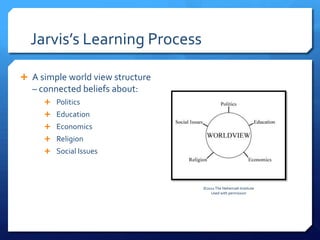
Jarvis’s Learning ProcessThe adult brings many qualified realities to the table:Prior KnowledgePrior ExperienceFlow of time with a history and present and a futureNoetic Structure: The basis of connected beliefsA filtering worldview
Jarvis’s Learning ProcessA simple world view structure – connected beliefs about:PoliticsEducationEconomicsReligionSocial Issues©2011 The Nehemiah Institute Used with permission
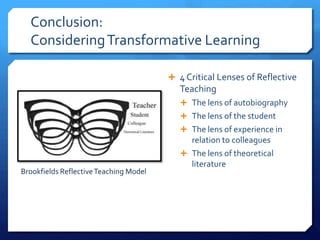
Conclusion: Considering Transformative Learning4 Critical Lenses of Reflective TeachingThe lens of autobiography The lens of the student The lens of experience in relation to colleagues The lens of theoretical literatureBrookfields Reflective Teaching Model
Conclusion: Considering Transformative LearningMeizrow and Chapman’s Principles of Transformative Learning:Adults exhibit two kinds of learning: instrumental (e.g., cause/effect)) and communicative (e.g., feelings)Learning involves change to meaning structures (perspectives and schemes). Change to meaning structures occurs through reflection about content, process or premises.Learning can involve: refining/elaborating meaning schemes, learning new schemes, transforming schemes, or transforming perspectives.
ReferencesBrookfield, S. D. (1995). Becoming a critically reflective teacher. San Francisco, CA: Jossey-Bass, Inc.Cashman, K. (1998). Leadership from the inside out: Becoming a leader for life. Minneapolis, MN: TCLC, llcLeaderSourceChapman, S. A. (2007). Adaptive leadership and transformative learning: A case study of leading by part time faculty. In J. F. Wergin (Ed.), Leadership in place (pp. 51-75). Boston: Anker Publishing Company, Inc.Chisholm, L. (2007). ee-Learning: The best road to adulthood? Innovate Journal of Online Education, 3(6), 1-13. Retrieved August 18, 2007, from Innovate Journal of Online Education Web site: http:/​/​www.innovateonline.infoGamoran, A. (2001). American schooling and educational inequality: A forecast for the 21st century.  Retrieved July 24, 2008, from Sociology of Education: Currents of Thought: Sociology of Education at the Dawn Web site: http:/​/​proquest.umi.com.library.capella.edu/​
ReferencesHartshorne, C. (1984). Creativity in American Philosophy. Albany, NY: State University of New York Press.Jarvis, P. (1987) 'Malcolm Knowles' in P. Jarvis (ed.) Twentieth Century Thinkers in Adult Education, London: Croom Helm.Lundt, J. C. (2006). Learning for ourselves: A new paradigm for education. The Futurist, 38(6), 18-22.Marx, G. (2006). Future-focused leadership: preparing schools, students, and communities for tomorrow's realities. Alexandria, VA: Association for Supervision and Curriculum Development.Marx, G. (2006). Sixteen trends, their profound impact on our future: Implications for students, education, communities, countries, and the whole of society. Alexandria, VA: Gary Marx and Educational Research Service.Maxwell, J. (2006). The difference maker: Making your attitude your greatest asset. Nashville, TN: Thomas Nelson Publishers, Inc.Meizrow, J. (1997). Transformation theory of adult learning. In P. Cranton (Ed.), In defense of the lifeworld (pp. 39-70). State University of New York Press. 
References Merriam, S. B., Caffarella, R. S., & Baumgartner, R. M. (2007). Learning in adulthood: A comprehensive guide (Third ed.). San Francisco: John Wiley & Sons, Inc.Morrison, G. R., Ross, S. M., Kemp, J. E., & Kalman, H. K. (2007). Designing effective instruction (5th edition). Hoboken, New Jersey: John Wiley and Sons, Inc.Plantinga, A., & Wolterstorff, N. (1984). Faith and rationality: Reason and belief in God. Notre Dame, Indiana: University of Notre Dame Press Reigeluth, C. M. (1999). What is instructional design theory? In C. M. Reigeluth (Ed.), Instructional-design theories and models (Vol. II, pp. 5-29). Mahwah, New Jersey: Lawrence Erlbaum Associates, Publishers.Storey, V. A., & Tebes, M. L. (2008). Instructor’s privacy in distance (online) teaching: Where do you draw the line? The Online Journal of Distance Learning Administration, 11(2), 1-10. Think scenarios. rethink education. (2006). Paris: Organisation for Economic Co-Operation and Development.Williams, M. (2001). Problems with knowledge: A critical introduction to epistemology. New York: Oxford University Press, Inc.Yankelovish, D. (2005). Ferment and change: Higher education in 2015. Chronicle of Higher Education, 52(14), B6-B9.

Adult Andragogy and E-learning

  • 1.
    Adult Development andAndragogy in Online LearningTim Stafford, MS MADirector of Image Building/Instructional Design - Liberty Building Forensics Group
  • 2.
    Introduction – GaryT.Marx and Futuring Education5 Profound Trends That will Impact Education in the FutureThe old are outnumbering the youngTechnology will continue to make everything faster and amplifiedEducation will be looked to for the release of human ingenuityA need for personal meaning is driving education to be transformativeA need for equilibrium will demand the need for seasoned educators
  • 3.
    Understanding the AgingMindMcClusky’s Theory of MarginIlleris’s Three Dimensional Learning ModelIntroduction to Epistemic IssuesJarvis’s Learning ProcessTransformative Learning
  • 4.
    McClusky’s Theory ofMarginThe adult seeks to strike a balance (L:P) between:The Load of Life (L) which acts like an independent variableThe Power of Life (P) which is the power to manage LImpact: Education becomes a load that can become dispensable if it becomes overwhelming to the power to perform.
  • 5.
    Illeris’s Three DimensionalLearning ModelThe adult seeks to strike a balance (C:E:S) between:Cognition – The ability to understandEmotion – The ability to maintain balance with personal issuesSocial – The ability to ping ideas against cultural norms and more’s and reconcile them.Impact 1: Adults need to understand the Why of learningImpact 2: Adults need to understand how it will impact their world
  • 6.
    Issues Surrounding EpistemologyDefiningknowledge as a whole is difficultWhat can be absolutely known and what can only be understood given rational opinion?How is knowledge obtained?What is the role of skepticism in knowing or not knowing?How is knowledge valuable?
  • 7.
    Jarvis’s Learning ProcessTheadult brings many qualified realities to the table:Prior KnowledgePrior ExperienceFlow of time with a history and present and a futureNoetic Structure: The basis of connected beliefsA filtering worldview
  • 8.
    Jarvis’s Learning ProcessAsimple world view structure – connected beliefs about:PoliticsEducationEconomicsReligionSocial Issues©2011 The Nehemiah Institute Used with permission
  • 9.
    Conclusion: Considering TransformativeLearning4 Critical Lenses of Reflective TeachingThe lens of autobiography The lens of the student The lens of experience in relation to colleagues The lens of theoretical literatureBrookfields Reflective Teaching Model
  • 10.
    Conclusion: Considering TransformativeLearningMeizrow and Chapman’s Principles of Transformative Learning:Adults exhibit two kinds of learning: instrumental (e.g., cause/effect)) and communicative (e.g., feelings)Learning involves change to meaning structures (perspectives and schemes). Change to meaning structures occurs through reflection about content, process or premises.Learning can involve: refining/elaborating meaning schemes, learning new schemes, transforming schemes, or transforming perspectives.
  • 11.
    ReferencesBrookfield, S. D.(1995). Becoming a critically reflective teacher. San Francisco, CA: Jossey-Bass, Inc.Cashman, K. (1998). Leadership from the inside out: Becoming a leader for life. Minneapolis, MN: TCLC, llcLeaderSourceChapman, S. A. (2007). Adaptive leadership and transformative learning: A case study of leading by part time faculty. In J. F. Wergin (Ed.), Leadership in place (pp. 51-75). Boston: Anker Publishing Company, Inc.Chisholm, L. (2007). ee-Learning: The best road to adulthood? Innovate Journal of Online Education, 3(6), 1-13. Retrieved August 18, 2007, from Innovate Journal of Online Education Web site: http:/​/​www.innovateonline.infoGamoran, A. (2001). American schooling and educational inequality: A forecast for the 21st century. Retrieved July 24, 2008, from Sociology of Education: Currents of Thought: Sociology of Education at the Dawn Web site: http:/​/​proquest.umi.com.library.capella.edu/​
  • 12.
    ReferencesHartshorne, C. (1984).Creativity in American Philosophy. Albany, NY: State University of New York Press.Jarvis, P. (1987) 'Malcolm Knowles' in P. Jarvis (ed.) Twentieth Century Thinkers in Adult Education, London: Croom Helm.Lundt, J. C. (2006). Learning for ourselves: A new paradigm for education. The Futurist, 38(6), 18-22.Marx, G. (2006). Future-focused leadership: preparing schools, students, and communities for tomorrow's realities. Alexandria, VA: Association for Supervision and Curriculum Development.Marx, G. (2006). Sixteen trends, their profound impact on our future: Implications for students, education, communities, countries, and the whole of society. Alexandria, VA: Gary Marx and Educational Research Service.Maxwell, J. (2006). The difference maker: Making your attitude your greatest asset. Nashville, TN: Thomas Nelson Publishers, Inc.Meizrow, J. (1997). Transformation theory of adult learning. In P. Cranton (Ed.), In defense of the lifeworld (pp. 39-70). State University of New York Press. 
  • 13.
    References Merriam, S. B.,Caffarella, R. S., & Baumgartner, R. M. (2007). Learning in adulthood: A comprehensive guide (Third ed.). San Francisco: John Wiley & Sons, Inc.Morrison, G. R., Ross, S. M., Kemp, J. E., & Kalman, H. K. (2007). Designing effective instruction (5th edition). Hoboken, New Jersey: John Wiley and Sons, Inc.Plantinga, A., & Wolterstorff, N. (1984). Faith and rationality: Reason and belief in God. Notre Dame, Indiana: University of Notre Dame Press Reigeluth, C. M. (1999). What is instructional design theory? In C. M. Reigeluth (Ed.), Instructional-design theories and models (Vol. II, pp. 5-29). Mahwah, New Jersey: Lawrence Erlbaum Associates, Publishers.Storey, V. A., & Tebes, M. L. (2008). Instructor’s privacy in distance (online) teaching: Where do you draw the line? The Online Journal of Distance Learning Administration, 11(2), 1-10. Think scenarios. rethink education. (2006). Paris: Organisation for Economic Co-Operation and Development.Williams, M. (2001). Problems with knowledge: A critical introduction to epistemology. New York: Oxford University Press, Inc.Yankelovish, D. (2005). Ferment and change: Higher education in 2015. Chronicle of Higher Education, 52(14), B6-B9.