Class Session 6
Transformative
Learning, continued
March 14, 2018
Agenda for Tonight
• The Process of TL – the Survey and Discussion
• Mezirow’s original view on how TL occurs
• Critical questions that can foster TL
• Ethical issues in fostering transformative learning:
your own experiences/views
• Authenticity and TL as an educator of adults
• TL during professional preparation
Transformative Learning
is a critically reflective process
by which we change our
assumptions, beliefs, values, or
perspectives, making them more
open, more integrative of
experience, and better justified
Transformative Learning
May be Activated by ….
 An experience that does not fit with expectations
 Encountering an alternative point of view
 Being challenged or questions
 A personal or traumatic event
Can be an epochal event or one in which meaning is
revised gradually, over time, as an accumulation of small
changes
Complete the Transformative
Learning Survey
https:/transformativelearningsurvey.com
You were asked to “Please think about one specific life-changing
experience that happened in your adult life. This should be an
event that altered your life in a deep and fundamental way.
Describe the event here.”
– What happened?
– When did it happen?
– Who was involved?
– Were did it happen?
Think about this now, if you haven’t done so already.
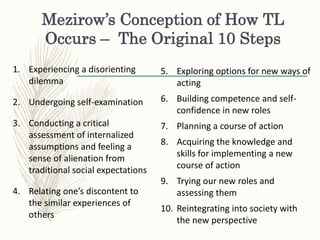
Mezirow’s Conception of How TL
Occurs – The Original 10 Steps
1. Experiencing a disorienting
dilemma
2. Undergoing self-examination
3. Conducting a critical
assessment of internalized
assumptions and feeling a
sense of alienation from
traditional social expectations
4. Relating one’s discontent to
the similar experiences of
others
5. Exploring options for new ways of
acting
6. Building competence and self-
confidence in new roles
7. Planning a course of action
8. Acquiring the knowledge and
skills for implementing a new
course of action
9. Trying our new roles and
assessing them
10. Reintegrating into society with
the new perspective
How closely does this
original description
mirror your own
experience?
Any missing steps?
Different steps?
Different progression?
The process of
transformation includes….
 Critical reflection and critical self-reflection
 Dialogue or discourse with others
 Imagination
 Problem solving
Two domains: INSTRUMENTAL or COMMUNICATIVE
learning; either can lead to emancipatory learning (by
definition, transformative)
Three Theoretical Stances of How
TL Occurs
Cognitive / Rational
– Critical reflection, Action, Experience, Disorienting Dilemma,
Discourse
Beyond Rational /extra-rational
– Arts-based, Dialogue, Emotional, Imaginal, Spiritual, “Soul
Work” (Jungian perspective – Dirkx)
Social critique (espoused by many critical theorists)
– Ideology critique, unveiling oppression, empowerment, social
action
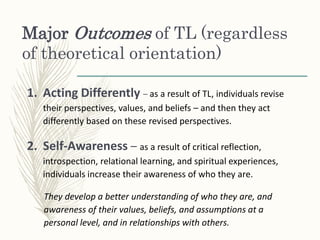
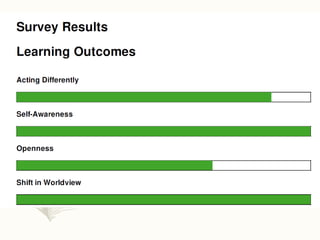
Major Outcomes of TL (regardless
of theoretical orientation)
1. Acting Differently – as a result of TL, individuals revise
their perspectives, values, and beliefs – and then they act
differently based on these revised perspectives.
2. Self-Awareness – as a result of critical reflection,
introspection, relational learning, and spiritual experiences,
individuals increase their awareness of who they are.
They develop a better understanding of who they are, and
awareness of their values, beliefs, and assumptions at a
personal level, and in relationships with others.
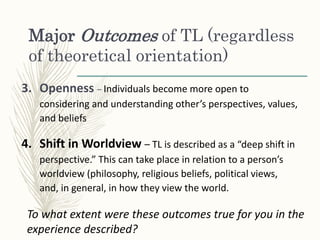
Major Outcomes of TL (regardless
of theoretical orientation)
3. Openness – Individuals become more open to
considering and understanding other’s perspectives, values,
and beliefs
4. Shift in Worldview – TL is described as a “deep shift in
perspective.” This can take place in relation to a person’s
worldview (philosophy, religious beliefs, political views,
and, in general, in how they view the world.
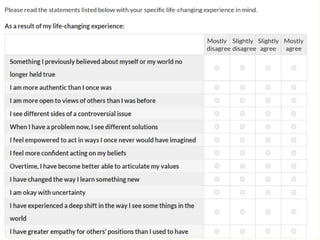
To what extent were these outcomes true for you in the
experience described?
Which of the processes comes
closest to your own experience?
Cognitive / Rational
– Critical reflection, Action, Experience, Disorienting Dilemma,
Discourse
Beyond Rational /extra-rational
– Arts-based, Dialogue, Emotional, Imaginal, Spiritual, “Soul
Work” (Jungian perspective – Dirkx)
Social critique (espoused by many critical theorists)
– Ideology critique, unveiling oppression, empowerment, social
action
What’s Your Role as an Educator?
Who is responsible for initiating transformative
learning?
What’s the educator’s role?
Do you see yourself as a “provocateur”?
How can you prepare learners for transformative
learning?
How can you assist those already engaged in it?
Critical Questions that Foster
Transformative Learning
Content Reflection - “What” questions
Process Reflection – “How” questions
Premise Reflection – “Why” questions
Critical questioning challenges learners to consider
some aspect of the situation under discussion in a
new way. Questioning sets up a sense of uncertainty.
Using the Examples
Provided in Class, Develop
Your Own Questions for
Learners and Share with a
Colleague
Content, Process, Premise
Authenticity in the
Educator Role
What does it mean to you?
How can it be achieved?
What opportunities do
you see for TL in
professional
preparation?
Your blog assignment next
week will explore this further

Class session 6 march 14, 2019

  • 1.
  • 2.
    Agenda for Tonight •The Process of TL – the Survey and Discussion • Mezirow’s original view on how TL occurs • Critical questions that can foster TL • Ethical issues in fostering transformative learning: your own experiences/views • Authenticity and TL as an educator of adults • TL during professional preparation
  • 3.
    Transformative Learning is acritically reflective process by which we change our assumptions, beliefs, values, or perspectives, making them more open, more integrative of experience, and better justified
  • 4.
    Transformative Learning May beActivated by ….  An experience that does not fit with expectations  Encountering an alternative point of view  Being challenged or questions  A personal or traumatic event Can be an epochal event or one in which meaning is revised gradually, over time, as an accumulation of small changes
  • 5.
    Complete the Transformative LearningSurvey https:/transformativelearningsurvey.com You were asked to “Please think about one specific life-changing experience that happened in your adult life. This should be an event that altered your life in a deep and fundamental way. Describe the event here.” – What happened? – When did it happen? – Who was involved? – Were did it happen? Think about this now, if you haven’t done so already.
  • 6.
    Mezirow’s Conception ofHow TL Occurs – The Original 10 Steps 1. Experiencing a disorienting dilemma 2. Undergoing self-examination 3. Conducting a critical assessment of internalized assumptions and feeling a sense of alienation from traditional social expectations 4. Relating one’s discontent to the similar experiences of others 5. Exploring options for new ways of acting 6. Building competence and self- confidence in new roles 7. Planning a course of action 8. Acquiring the knowledge and skills for implementing a new course of action 9. Trying our new roles and assessing them 10. Reintegrating into society with the new perspective
  • 7.
    How closely doesthis original description mirror your own experience? Any missing steps? Different steps? Different progression?
  • 8.
    The process of transformationincludes….  Critical reflection and critical self-reflection  Dialogue or discourse with others  Imagination  Problem solving Two domains: INSTRUMENTAL or COMMUNICATIVE learning; either can lead to emancipatory learning (by definition, transformative)
  • 9.
    Three Theoretical Stancesof How TL Occurs Cognitive / Rational – Critical reflection, Action, Experience, Disorienting Dilemma, Discourse Beyond Rational /extra-rational – Arts-based, Dialogue, Emotional, Imaginal, Spiritual, “Soul Work” (Jungian perspective – Dirkx) Social critique (espoused by many critical theorists) – Ideology critique, unveiling oppression, empowerment, social action
  • 10.
    Major Outcomes ofTL (regardless of theoretical orientation) 1. Acting Differently – as a result of TL, individuals revise their perspectives, values, and beliefs – and then they act differently based on these revised perspectives. 2. Self-Awareness – as a result of critical reflection, introspection, relational learning, and spiritual experiences, individuals increase their awareness of who they are. They develop a better understanding of who they are, and awareness of their values, beliefs, and assumptions at a personal level, and in relationships with others.
  • 11.
    Major Outcomes ofTL (regardless of theoretical orientation) 3. Openness – Individuals become more open to considering and understanding other’s perspectives, values, and beliefs 4. Shift in Worldview – TL is described as a “deep shift in perspective.” This can take place in relation to a person’s worldview (philosophy, religious beliefs, political views, and, in general, in how they view the world. To what extent were these outcomes true for you in the experience described?
  • 14.
    Which of theprocesses comes closest to your own experience? Cognitive / Rational – Critical reflection, Action, Experience, Disorienting Dilemma, Discourse Beyond Rational /extra-rational – Arts-based, Dialogue, Emotional, Imaginal, Spiritual, “Soul Work” (Jungian perspective – Dirkx) Social critique (espoused by many critical theorists) – Ideology critique, unveiling oppression, empowerment, social action
  • 15.
    What’s Your Roleas an Educator? Who is responsible for initiating transformative learning? What’s the educator’s role? Do you see yourself as a “provocateur”? How can you prepare learners for transformative learning? How can you assist those already engaged in it?
  • 16.
    Critical Questions thatFoster Transformative Learning Content Reflection - “What” questions Process Reflection – “How” questions Premise Reflection – “Why” questions Critical questioning challenges learners to consider some aspect of the situation under discussion in a new way. Questioning sets up a sense of uncertainty.
  • 17.
    Using the Examples Providedin Class, Develop Your Own Questions for Learners and Share with a Colleague Content, Process, Premise
  • 18.
    Authenticity in the EducatorRole What does it mean to you? How can it be achieved?
  • 19.
    What opportunities do yousee for TL in professional preparation? Your blog assignment next week will explore this further