Reported by: ERLMARIE P. CRASE
Who wants
to be an
Ateneo
Teacher?
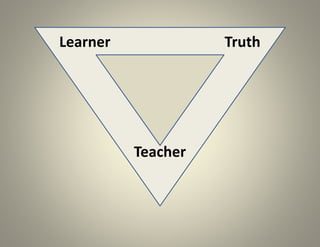
Learner Truth
Teacher
Facilitate the growing
relationships of learner
with truth
TEACHER’S
ROLE:
Photo Credits: ADDU & ADMU
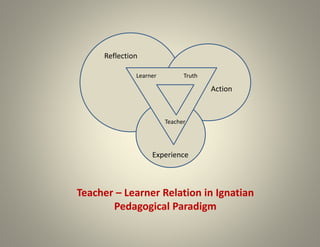
Reflection
Action
Experience
Learner Truth
Teacher
Teacher – Learner Relation in Ignatian
Pedagogical Paradigm
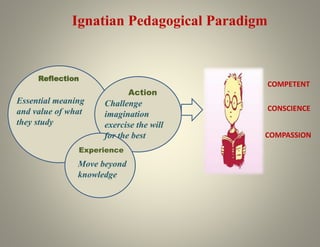
Ignatian Pedagogical Paradigm
Reflection
Action
Experience
Essential meaning
and value of what
they study
Challenge
imagination
exercise the will
for the best
Move beyond
knowledge
COMPETENT
CONSCIENCE
COMPASSION
Experience
Context
Reflection Action
Evaluation
1. Context
Students’ Life
Socio-economic
political and
cultural
Institutional
environment
of the school
Previously
acquired
concepts
Family life
Peers
Social situation
Face-to face faith community
Moral development
Religious Formation
Cultural environment
Feelings and attitudes
Values
2. Experience
To describe any activity in which in
addition to a cognitive grasp of
matter being considered, some
sensation of an affective nature
What is
this?
How does it
work?
I like this..
Its interesting
How do I
react…?
Im not good…
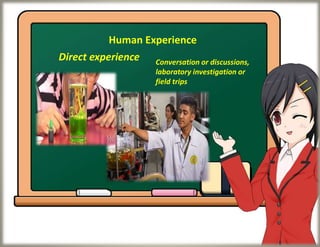
Human Experience
Direct experience Conversation or discussions,
laboratory investigation or
field trips
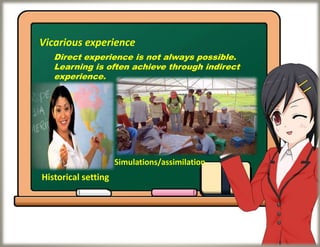
Vicarious experience
Direct experience is not always possible.
Learning is often achieve through indirect
experience.
Historical setting
Simulations/assimilation
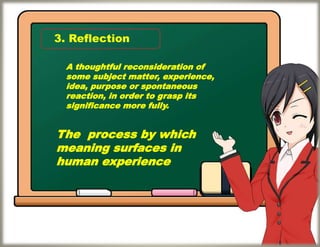
3. Reflection
A thoughtful reconsideration of
some subject matter, experience,
idea, purpose or spontaneous
reaction, in order to grasp its
significance more fully.
The process by which
meaning surfaces in
human experience
Are they Valid?
Are they fair?
Sources of sensation or
reactions I experience
Does it affect my
life? Why?
Implication of what
I have grasped for
myself and others
Does it interest
me? Why?
By achieving personal
insights into events,
ideas, truth or
distortion
My own lifestyle?
The things I take
for granted…..
By coming to
understanding of
WHO I AM?
What moves me & why?
Am I at peace with that
reaction in myself?
Why?
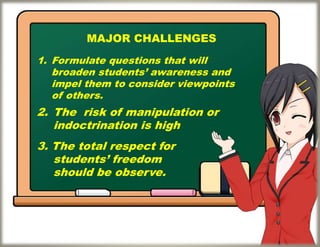
MAJOR CHALLENGES
1. Formulate questions that will
broaden students’ awareness and
impel them to consider viewpoints
of others.
3. The total respect for
students’ freedom
should be observe.
2. The risk of manipulation or
indoctrination is high
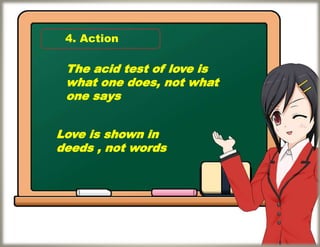
4. Action
The acid test of love is
what one does, not what
one says
Love is shown in
deeds , not words
St. Ignatius wants Jesuits
Schools to form young
people who could and
would contribute
intelligently and effective to
the welfare of the society
Ignatius Pedagogy
Affective/evaluative stage of learning
process
Respect human freedom , decision and
commitment for the magis is encourage
Magis the better service of God and our
sisters and brothers
2 Steps of Manifestation
1. Interiorized Choices – considers the
experience from a personal, human
point of view
Meanings perceive and judges
Choices are made
 when learner decides that truth is to be his
or her personal point of preference,
attitudes
or predispositions
2. Choices externally manifested
- to do something consistent with a
conviction. ( meaning positive)
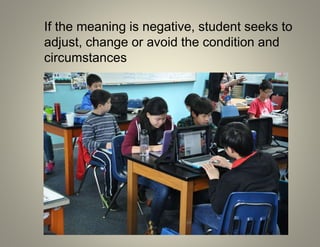
If the meaning is negative, student seeks to
adjust, change or avoid the condition and
circumstances
5. Evaluation
Concerned about
student’s well-rounded
growth as person for
others
It is important to evaluate a
student’s progress in academic
achievement.
Daily quizzes
Assess fuller human growth. Take
into account the age, talents and
developmental levels of each
student.
Mentoring, journals or voluntary
service to others
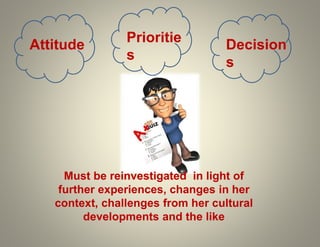
Attitude
Prioritie
s
Decision
s
Must be reinvestigated in light of
further experiences, changes in her
context, challenges from her cultural
developments and the like
Ignatian pedagogical paradigm

Ignatian pedagogical paradigm