PERENNIALISM
• Perennialism is the oldest and most
traditional educational philosophy.
• The word “perennial” means everlasting.
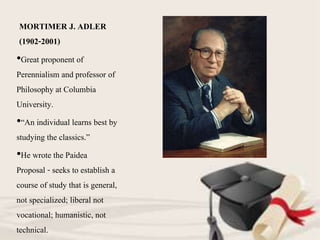
MORTIMER J. ADLER
(1902-2001)
•Great proponent of
Perennialism and professor of
Philosophy at Columbia
University.
•“An individual learns best by
studying the classics.”
•He wrote the Paidea
Proposal - seeks to establish a
course of study that is general,
not specialized; liberal not
vocational; humanistic, not
technical.
•“Education should adjust
man to the truth which is
eternal, while the
contemporary is not.”
•“Education implies
teaching. Teaching implies
knowledge. Knowledge is
truth. The truth everywhere is
the same. Hence, education
should be everywhere the
same.”
•“Education is not an
imitation of life but a
preparation for it.”
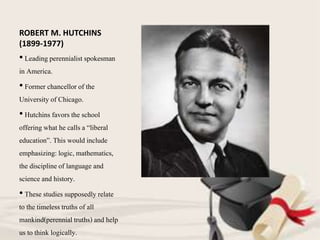
ROBERT M. HUTCHINS
(1899-1977)
• Leading perennialist spokesman
in America.
• Former chancellor of the
University of Chicago.
• Hutchins favors the school
offeringwhat he calls a “liberal
education”. This would include
emphasizing:logic, mathematics,
the disciplineof language and
science and history.
• These studies supposedly relate
to the timelesstruths of all
mankind(perennial truths) and help
us to think logically.
• Perennialism holds that education should be the
same everywhere, for everyone.
• The sources of knowledge are the Great Books.
–Example: Philosophical and religious works
of:
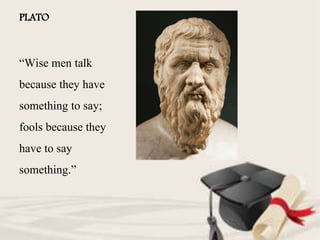
PLATO
“Wise men talk
because they have
something to say;
fools because they
have to say
something.”
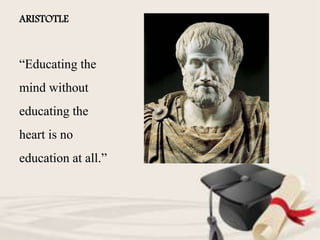
ARISTOTLE
“Educating the
mind without
educating the
heart is no
education at all.”
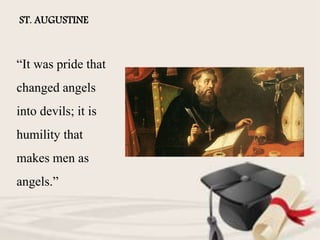
ST. AUGUSTINE
“It was pride that
changed angels
into devils; it is
humility that
makes men as
angels.”
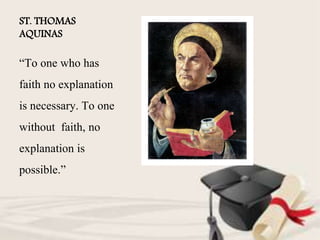
ST. THOMAS
AQUINAS
“To one who has
faith no explanation
is necessary. To one
without faith, no
explanation is
possible.”
• Perennialism believed that one should teach the
things that one believe to be of everlasting
importance to all people everywhere. Since
details of fact change constantly, these
cannot be the most important.
• Perennialism suggests that the focus of education
should be the ideas that have lasted over
centuries. They believe the ideas are as relevant
and meaningful today as when they were
written. They recommend that students learn from
reading and analyzing the works by history's
finest thinkers and writers.
• The educational focus of Perennialism is on the need to
return to the past, namely, to the universal truths and
absolutely reason and faith.
• Perennials believe that God and education goes
together hand in hand, and that education prepares a
person for life. They also believe that schooling may
come to an end but a person will never stop learning
throughout their life time.
• Perennialist generally prefer a past
orientation, because it tends to be based
on historical truth rather than the
conjecture about the present and guessing
about the future.
• The Theory of Perennialism also believe that the
environment plays a big role in teaching someone.
A person learns by experience. The philosophies
of idealism, realism are rooted in this theory. They
believe that having a relationship to a spiritual
being is necessary for understanding the or universe
• This philosophy is based on the view that reality
comes from fundamental fixed truths, especially
those related to God.
• It believes that people find truth through
reasoning and revelation and that goodness is
found in rational thinking.
• Teachers are tasked to develop the students’ inherent rational
powers through the use of oral exposition, lecture, and
explication.
• The learner’s need as well as social problems and issues are not
considered in curriculum planning on the assumption that the
learners do not know what is best for them.
• The teachers are the authority and sources of knowledge
because of their maturity, professional training, and expertise.
• Curriculum content must focus on past and permanent
studies which are timeless, such as philosophy, logic and
rhetoric, literature, religion, and values education.
• Content is learn through memorization, drill, repetition,
and mental discipline.
• Students are taught to reason through structured lessons
and drills.
Why should perennialism be applied in
teaching?
• Personal development of the students
through inculcating in them the principles that
have been passed from generation to
generation.
• These principles are likely to make one
develop a good personality and morality if
learned and applied in life.
• Will be useful in later life especially when
learners begin to appreciate the need to be
educated of the facts and knowledge .
ESSENTIALISM
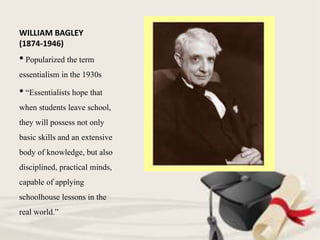
WILLIAM BAGLEY
(1874-1946)
• Popularized the term
essentialism in the 1930s
• “Essentialists hope that
when students leave school,
they will possess not only
basic skills and an extensive
body of knowledge, but also
disciplined, practical minds,
capable of applying
schoolhouse lessons in the
real world.”
• Essentialism surface in the 1930’s as an opposition
to the perceived relaxation of academic standards
by the progressivists.
• During the Cold War, it developed into a major
educational philosophy.
• The essentialist believed that a curriculum
based on student’s interest or an social issues is
wasteful in view of what they consider to be
the primary aim of education – intellectual
development.
• Essentialism is a traditional and conservative educational
philosophy which aims to develop cognitive growth and
mastery of subject.
• It is present-oriented, focusing on contemporary knowledge
written by experts in the field.
• The essential curriculum gives heavy emphasis on the three
Rs (Reading, Writing, Arithmetic), English, History, and
Science – subject areas that continue to fill general
education in present-day schools.
• It is a concept of universal education; the belief that
there is essential knowledge that everyone in a
given culture must have in order to be a
knowledgeable and fully participating member of
that culture.
• It is the school’s responsibility to provide that
knowledge.
• It states that the students should be provided with the
basic education so that it develops their knowledge as
well as helps in character building.
• Teacher centered Philosophy.
• Classrooms are oriented around the teacher, who serve
as an intellectual and moral role model for the students.
• Students are required to master a set of body of
information and basic techniques for their grade level
before they are promoted to a higher level.
* Grade one before grade two, English 1 before English 2, etc.
Essentialist believe:
• Students should learn from establishedfundamentals of
education.
• Students should study the sensible and wise subjects like
literature, philosophy,science and other subjectsrelated to the
great works
• The child is a learner to be shaped and developed
• Educationis a preparation for life, it is not an imitation of life
Why do the school needs essentialism in the
education system?
• For the students to acquire basic knowledge, skills, and
values
• To hopefully transmit the traditional moral values and
intellectual knowledge that students need to become
model citizens.
TEACHER’S ROLE
• As an expert
• Impart essential
knowledge
• Direct focused tasks
STUDENT’S ROLE
• Listen and learn
• Trust that the teacher knows
best
Thank you!
PS: Malapit na nating makuha yung ganto!

Perennialism and Essentialism

  • 1.
  • 2.
    • Perennialism isthe oldest and most traditional educational philosophy. • The word “perennial” means everlasting.
  • 3.
    MORTIMER J. ADLER (1902-2001) •Greatproponent of Perennialism and professor of Philosophy at Columbia University. •“An individual learns best by studying the classics.” •He wrote the Paidea Proposal - seeks to establish a course of study that is general, not specialized; liberal not vocational; humanistic, not technical.
  • 4.
    •“Education should adjust manto the truth which is eternal, while the contemporary is not.” •“Education implies teaching. Teaching implies knowledge. Knowledge is truth. The truth everywhere is the same. Hence, education should be everywhere the same.” •“Education is not an imitation of life but a preparation for it.”
  • 5.
    ROBERT M. HUTCHINS (1899-1977) •Leading perennialist spokesman in America. • Former chancellor of the University of Chicago. • Hutchins favors the school offeringwhat he calls a “liberal education”. This would include emphasizing:logic, mathematics, the disciplineof language and science and history. • These studies supposedly relate to the timelesstruths of all mankind(perennial truths) and help us to think logically.
  • 6.
    • Perennialism holdsthat education should be the same everywhere, for everyone. • The sources of knowledge are the Great Books. –Example: Philosophical and religious works of:
  • 7.
    PLATO “Wise men talk becausethey have something to say; fools because they have to say something.”
  • 8.
    ARISTOTLE “Educating the mind without educatingthe heart is no education at all.”
  • 9.
    ST. AUGUSTINE “It waspride that changed angels into devils; it is humility that makes men as angels.”
  • 10.
    ST. THOMAS AQUINAS “To onewho has faith no explanation is necessary. To one without faith, no explanation is possible.”
  • 11.
    • Perennialism believedthat one should teach the things that one believe to be of everlasting importance to all people everywhere. Since details of fact change constantly, these cannot be the most important.
  • 12.
    • Perennialism suggeststhat the focus of education should be the ideas that have lasted over centuries. They believe the ideas are as relevant and meaningful today as when they were written. They recommend that students learn from reading and analyzing the works by history's finest thinkers and writers.
  • 13.
    • The educationalfocus of Perennialism is on the need to return to the past, namely, to the universal truths and absolutely reason and faith. • Perennials believe that God and education goes together hand in hand, and that education prepares a person for life. They also believe that schooling may come to an end but a person will never stop learning throughout their life time.
  • 14.
    • Perennialist generallyprefer a past orientation, because it tends to be based on historical truth rather than the conjecture about the present and guessing about the future.
  • 15.
    • The Theoryof Perennialism also believe that the environment plays a big role in teaching someone. A person learns by experience. The philosophies of idealism, realism are rooted in this theory. They believe that having a relationship to a spiritual being is necessary for understanding the or universe
  • 16.
    • This philosophyis based on the view that reality comes from fundamental fixed truths, especially those related to God. • It believes that people find truth through reasoning and revelation and that goodness is found in rational thinking.
  • 17.
    • Teachers aretasked to develop the students’ inherent rational powers through the use of oral exposition, lecture, and explication. • The learner’s need as well as social problems and issues are not considered in curriculum planning on the assumption that the learners do not know what is best for them. • The teachers are the authority and sources of knowledge because of their maturity, professional training, and expertise.
  • 18.
    • Curriculum contentmust focus on past and permanent studies which are timeless, such as philosophy, logic and rhetoric, literature, religion, and values education. • Content is learn through memorization, drill, repetition, and mental discipline. • Students are taught to reason through structured lessons and drills.
  • 19.
    Why should perennialismbe applied in teaching? • Personal development of the students through inculcating in them the principles that have been passed from generation to generation. • These principles are likely to make one develop a good personality and morality if learned and applied in life.
  • 20.
    • Will beuseful in later life especially when learners begin to appreciate the need to be educated of the facts and knowledge .
  • 21.
  • 22.
    WILLIAM BAGLEY (1874-1946) • Popularizedthe term essentialism in the 1930s • “Essentialists hope that when students leave school, they will possess not only basic skills and an extensive body of knowledge, but also disciplined, practical minds, capable of applying schoolhouse lessons in the real world.”
  • 23.
    • Essentialism surfacein the 1930’s as an opposition to the perceived relaxation of academic standards by the progressivists. • During the Cold War, it developed into a major educational philosophy.
  • 24.
    • The essentialistbelieved that a curriculum based on student’s interest or an social issues is wasteful in view of what they consider to be the primary aim of education – intellectual development.
  • 25.
    • Essentialism isa traditional and conservative educational philosophy which aims to develop cognitive growth and mastery of subject. • It is present-oriented, focusing on contemporary knowledge written by experts in the field. • The essential curriculum gives heavy emphasis on the three Rs (Reading, Writing, Arithmetic), English, History, and Science – subject areas that continue to fill general education in present-day schools.
  • 26.
    • It isa concept of universal education; the belief that there is essential knowledge that everyone in a given culture must have in order to be a knowledgeable and fully participating member of that culture. • It is the school’s responsibility to provide that knowledge.
  • 27.
    • It statesthat the students should be provided with the basic education so that it develops their knowledge as well as helps in character building. • Teacher centered Philosophy. • Classrooms are oriented around the teacher, who serve as an intellectual and moral role model for the students.
  • 28.
    • Students arerequired to master a set of body of information and basic techniques for their grade level before they are promoted to a higher level. * Grade one before grade two, English 1 before English 2, etc.
  • 29.
    Essentialist believe: • Studentsshould learn from establishedfundamentals of education. • Students should study the sensible and wise subjects like literature, philosophy,science and other subjectsrelated to the great works • The child is a learner to be shaped and developed • Educationis a preparation for life, it is not an imitation of life
  • 30.
    Why do theschool needs essentialism in the education system? • For the students to acquire basic knowledge, skills, and values • To hopefully transmit the traditional moral values and intellectual knowledge that students need to become model citizens.
  • 31.
    TEACHER’S ROLE • Asan expert • Impart essential knowledge • Direct focused tasks STUDENT’S ROLE • Listen and learn • Trust that the teacher knows best
  • 32.
    Thank you! PS: Malapitna nating makuha yung ganto!