After completing this lesson students should be able to:
1. Define the term “Transformative Learning.”
2. Identify the theorists or proponents of the
Transformative Learning Theory.
3. Distinguish between the types of Transformative
Learning.
4. Outline the foundations of the Transformative
Learning theory.
QUICK QUESTION…?
Have you ever undergone a major change in your
understanding of a topic, world view, comfort zone or
through a particular learning experience/activities?
Then you are embarking on Transformational
Learning!
Activity
Using your personal experiences can you give an example of Transformative
Learning that you have experienced.
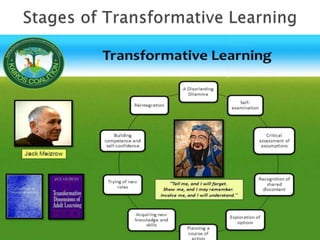
The Transformational Learning Theory originally
developed by Jack Mezirow is described as being…
“Constructivist, an orientation which holds that the way
learners interpret and reinterpret their sense experience is,
central to making meaning and hence learning”
(Mezirow, 1991).
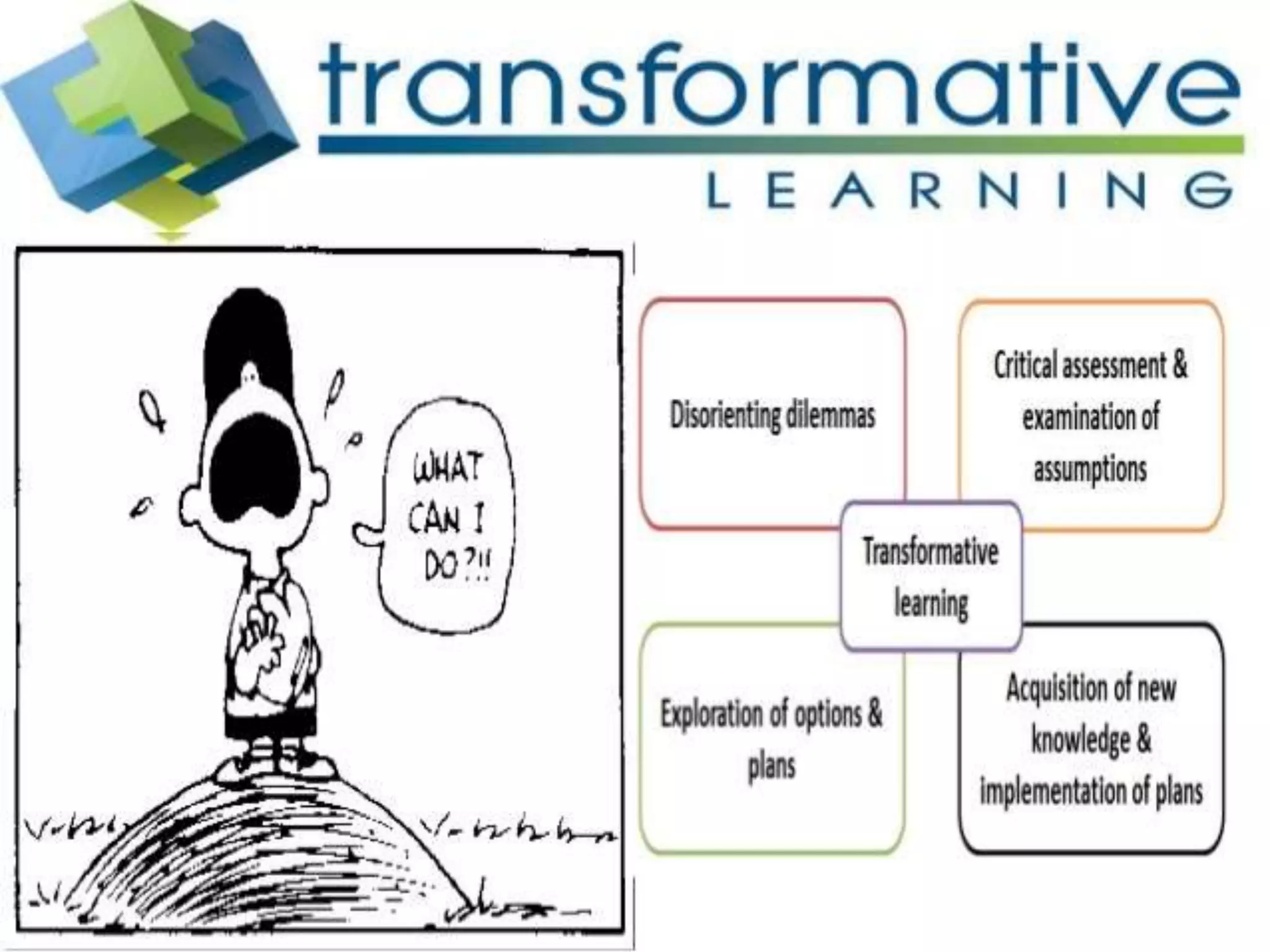
Transformative Learning is …
 “… The process of using a prior interpretation to
construe a new or revised interpretation of the meaning
of one’s experience in order to guide future action"
(Mezirow, 1996: 162)
 “… a deep, structural shift in basic premises of thought,
feelings and actions.”
(Transformative Learning Centre, 2004)
 “… is the expansion of consciousness through the
transformation of basic worldview and specific
capacities of the self”
(Elias, 1997)
 “… this idea of a fundamental change in perspective or
frame of reference”
(King, 2002)
 “… the idea of people changing the way they interpret
their experiences and their interactions with the world”
(Cranton, n.d.)
The Transformative Learning Theory has two (2)
basic kinds of learning:
1. Instrumental Learning
2. Communicative learning
This focuses on learning through task-
oriented problem solving and determination
of cause and effect relationships.
In instrumental learning, a response is
associated with a stimulus that follows it —
the instrumental response is associated with
the reward after they have been paired
repeatedly
Not all learning involves ‘learning to do’. Of even greater
significance to most adult learning is understanding the
meaning of what others communicate, concerning values,
ideals, feelings, moral decisions, and such concepts as
freedom, justice, love, labour, autonomy, commitment
and democracy.
Communicative learning focuses on achieving coherence
rather than on exercising more effective control over the
cause-effect relationship to improve performance, as in
instrumental learning.
The problem-solving process involved in instrumental
learning is the ‘hypothetico-deductive’ approach. In
communicative learning, the approach is one in which the
learner attempts to understand what is meant by another
through speech, writing, drama, art, or dance.
Communicative learning is less a matter of testing
hypotheses than of searching, often intuitively, for
themes and metaphors by which to fit
the unfamiliar into a meaning perspective, so that an
interpretation in context becomes possible.
Instrumental
(Cause/Effect) and
Communicative
(Feelings)
Learning involves change to
meaning structures
(perspectives and Schemes)
Change to meaning structure occurs
through reflection about content, process
and premises.
Learning can involve: refining/elaborating meaning
schemes, learning new schemes, transforming schemes,
or transforming perspectives.
 Although adults may developmentally acquire the
capabilities to become critically self-reflective and
exercise reflective judgment, the task of adult education
is to help the learner realize these capabilities by
developing the skills, insights, and dispositions
essential for their practice.
 Learners must acquire the skills, sensitivities, and
understandings essential to become critically reflective
of assumptions and to participate more fully and freely
in critical-dialectical discourse.
 Educators must foster the learner’s skills, habit of mind,
disposition, and will to become a more active and rational
learner. This involves becoming more critically reflective of
assumptions supporting one’s own beliefs and those of
others and more discriminating, open, and disposed to
transformative learning.
 Creating the conditions for and the skills of effective adult
reasoning and the disposition for transformative learning—
including critical reflection and dialectical discourse.
Experiential learning is any learning that supports
students in applying their knowledge and conceptual
understanding to real-world problems or situations where
the instructor directs and facilitates learning. The
classroom, laboratory, or studio can serve as a setting for
experiential learning through embedded activities such as
case and problem-based studies, guided inquiry,
simulations, experiments, or art projects
(Wurdinger & Carlson, 2010)
Transformative learning

Transformative learning

  • 2.
    After completing thislesson students should be able to: 1. Define the term “Transformative Learning.” 2. Identify the theorists or proponents of the Transformative Learning Theory. 3. Distinguish between the types of Transformative Learning. 4. Outline the foundations of the Transformative Learning theory.
  • 3.
    QUICK QUESTION…? Have youever undergone a major change in your understanding of a topic, world view, comfort zone or through a particular learning experience/activities? Then you are embarking on Transformational Learning! Activity Using your personal experiences can you give an example of Transformative Learning that you have experienced.
  • 4.
    The Transformational LearningTheory originally developed by Jack Mezirow is described as being… “Constructivist, an orientation which holds that the way learners interpret and reinterpret their sense experience is, central to making meaning and hence learning” (Mezirow, 1991).
  • 5.
    Transformative Learning is…  “… The process of using a prior interpretation to construe a new or revised interpretation of the meaning of one’s experience in order to guide future action" (Mezirow, 1996: 162)  “… a deep, structural shift in basic premises of thought, feelings and actions.” (Transformative Learning Centre, 2004)
  • 6.
     “… isthe expansion of consciousness through the transformation of basic worldview and specific capacities of the self” (Elias, 1997)  “… this idea of a fundamental change in perspective or frame of reference” (King, 2002)  “… the idea of people changing the way they interpret their experiences and their interactions with the world” (Cranton, n.d.)
  • 7.
    The Transformative LearningTheory has two (2) basic kinds of learning: 1. Instrumental Learning 2. Communicative learning
  • 8.
    This focuses onlearning through task- oriented problem solving and determination of cause and effect relationships. In instrumental learning, a response is associated with a stimulus that follows it — the instrumental response is associated with the reward after they have been paired repeatedly
  • 10.
    Not all learninginvolves ‘learning to do’. Of even greater significance to most adult learning is understanding the meaning of what others communicate, concerning values, ideals, feelings, moral decisions, and such concepts as freedom, justice, love, labour, autonomy, commitment and democracy. Communicative learning focuses on achieving coherence rather than on exercising more effective control over the cause-effect relationship to improve performance, as in instrumental learning.
  • 11.
    The problem-solving processinvolved in instrumental learning is the ‘hypothetico-deductive’ approach. In communicative learning, the approach is one in which the learner attempts to understand what is meant by another through speech, writing, drama, art, or dance. Communicative learning is less a matter of testing hypotheses than of searching, often intuitively, for themes and metaphors by which to fit the unfamiliar into a meaning perspective, so that an interpretation in context becomes possible.
  • 12.
    Instrumental (Cause/Effect) and Communicative (Feelings) Learning involveschange to meaning structures (perspectives and Schemes) Change to meaning structure occurs through reflection about content, process and premises. Learning can involve: refining/elaborating meaning schemes, learning new schemes, transforming schemes, or transforming perspectives.
  • 14.
     Although adultsmay developmentally acquire the capabilities to become critically self-reflective and exercise reflective judgment, the task of adult education is to help the learner realize these capabilities by developing the skills, insights, and dispositions essential for their practice.  Learners must acquire the skills, sensitivities, and understandings essential to become critically reflective of assumptions and to participate more fully and freely in critical-dialectical discourse.
  • 15.
     Educators mustfoster the learner’s skills, habit of mind, disposition, and will to become a more active and rational learner. This involves becoming more critically reflective of assumptions supporting one’s own beliefs and those of others and more discriminating, open, and disposed to transformative learning.  Creating the conditions for and the skills of effective adult reasoning and the disposition for transformative learning— including critical reflection and dialectical discourse.
  • 17.
    Experiential learning isany learning that supports students in applying their knowledge and conceptual understanding to real-world problems or situations where the instructor directs and facilitates learning. The classroom, laboratory, or studio can serve as a setting for experiential learning through embedded activities such as case and problem-based studies, guided inquiry, simulations, experiments, or art projects (Wurdinger & Carlson, 2010)