Theories and Models of
       Learning

 Constructivist
Aim and Objectives

• Aim – In the next 10 minutes for you to
  understand what Constructivism is in relation to
  teaching and learning
• Objectives
• Describe what Constructivism is
• Identify the model for a Constructivist approach
• Examine the differences between a traditional
  ‘classroom’ and a Constructivist one
• Identify some ways the Constructivist approach
  can be employed.
What is Constructivism?
• Constructivism is a philosophy of
  learning founded on the premise that,
  by reflecting on our experiences, we
  construct our own understanding of
  the world we live in. Each of us
  generates our own “rules” and “mental
  models,” which we use to make sense
  of our experiences.
• http://www.learning-theories.com/
Who are the theorists?,
     what did they say??
•   Kant’s 200 year old theory!
•   Piaget and Bruner
•   Vygotksy
•   Mezirow ( 1991 )


                           Jerome Bruner
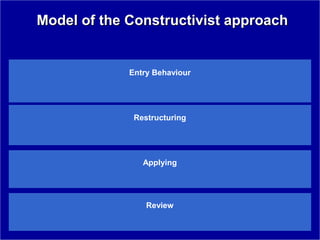
Model of the Constructivist approach


As teachers we tend to make assumptions about the entry behaviour. what does that
                               Entry Behaviour
mean? – we think that some learners have a smattering of knowledge, some have
    a wider range and some have none, this will differ from learner to learner


Modifying, adjusting, changing are all key elements in restructuring. This process
                                     Restructuring
is down to the learner but also falls upon the teacher to design, plan and execute their
                  lesson effectively to ensure this stage is successful


              Trying out ideas, concepts, working with different situations.
                                     Applying


 This is about reflection, looking at the changes, regarding ideas, views and concepts.
                                          Review
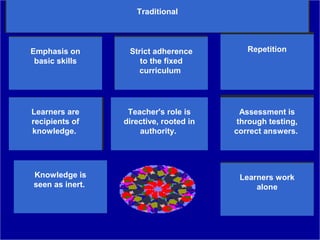
Traditional
                      Constructivist


Emphasis on the           Learner’s             Learning is
                                                 Repetition
  Emphasis on         Strict adherence
bigbasic skills
    concepts and       questions and            interactive,
                         to the fixed
expansion of the        interests are        building on what
                         curriculum
      parts                valued               the student
                                             already knows.


  Teachers help
   Learners are        Teacher's role is
                       Teacher's role is    Learner’s work,
                                               Assessment is
learners construct
   recipients of     directive, rooted in
                      interactive, rooted   observation,
                                              through testing,
     their own
   knowledge.           inauthority.
                           negotiation      Process answers.
                                             correct is
    knowledge.                              important


  Knowledge is
   Knowledge                                Students work
                                              Learners work
  seen as inert.
  dynamic, ever                             primarily in
                                                  alone
changing with our                           groups.
  experiences.
More ways of using a
      constructivist approach in
              learning
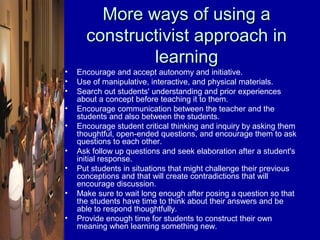
•   Encourage and accept autonomy and initiative.
•   Use of manipulative, interactive, and physical materials.
•   Search out students' understanding and prior experiences
    about a concept before teaching it to them.
•   Encourage communication between the teacher and the
    students and also between the students.
•   Encourage student critical thinking and inquiry by asking them
    thoughtful, open-ended questions, and encourage them to ask
    questions to each other.
•   Ask follow up questions and seek elaboration after a student's
    initial response.
•   Put students in situations that might challenge their previous
    conceptions and that will create contradictions that will
    encourage discussion.
•   Make sure to wait long enough after posing a question so that
    the students have time to think about their answers and be
    able to respond thoughtfully.
•   Provide enough time for students to construct their own
    meaning when learning something new.
• Reference List

•   Reece, I & Walker,S. ( 1997 ) Teaching, Training and Learning
    a practical guide: Business Education Publishers
•   Fry,H.,et al. ( 2003 ) A Handbook for Teaching and Learning in
    Higher Education: Kogan Page
•   Concept to Classroom (2004),Constructivism as a Paradigm for
    Teaching and Learning
    http://www.thirteen.org/edonline/concept2class/constructivism/index.ht
     ( Accessed 2nd October 2009 )
•   Kines,T. ( 2002 ), Jerome Bruner
    http://oaks.nvg.org/jerome-bruner.html ( Accessed 2nd October
    2009 )
•   Hein, G. Prof. ( 1991 ) ,Constructivist Learning Theory
    http://www.exploratorium.edu/ifi/resources/constructivistlearning
    .html ( Accessed 2nd October 2009 )
•   Atherton, J ( 2009 ), Constructivist Theory
    http://www.learningandteaching.info/learning/constructivism.htm
    ( Accessed 2nd October 2009 )
•   Learning Theories. ( 2008 ), Index of Learning Theories and
    Models http://www.learning-theories.com/
•   ( Accessed 4th October 2009 )
Simon Muir 2009
Simon Muir 2009

Constructivist learning theory

  • 1.
    Theories and Modelsof Learning Constructivist
  • 2.
    Aim and Objectives •Aim – In the next 10 minutes for you to understand what Constructivism is in relation to teaching and learning • Objectives • Describe what Constructivism is • Identify the model for a Constructivist approach • Examine the differences between a traditional ‘classroom’ and a Constructivist one • Identify some ways the Constructivist approach can be employed.
  • 3.
    What is Constructivism? •Constructivism is a philosophy of learning founded on the premise that, by reflecting on our experiences, we construct our own understanding of the world we live in. Each of us generates our own “rules” and “mental models,” which we use to make sense of our experiences. • http://www.learning-theories.com/
  • 4.
    Who are thetheorists?, what did they say?? • Kant’s 200 year old theory! • Piaget and Bruner • Vygotksy • Mezirow ( 1991 ) Jerome Bruner
  • 5.
    Model of theConstructivist approach As teachers we tend to make assumptions about the entry behaviour. what does that Entry Behaviour mean? – we think that some learners have a smattering of knowledge, some have a wider range and some have none, this will differ from learner to learner Modifying, adjusting, changing are all key elements in restructuring. This process Restructuring is down to the learner but also falls upon the teacher to design, plan and execute their lesson effectively to ensure this stage is successful Trying out ideas, concepts, working with different situations. Applying This is about reflection, looking at the changes, regarding ideas, views and concepts. Review
  • 6.
    Traditional Constructivist Emphasis on the Learner’s Learning is Repetition Emphasis on Strict adherence bigbasic skills concepts and questions and interactive, to the fixed expansion of the interests are building on what curriculum parts valued the student already knows. Teachers help Learners are Teacher's role is Teacher's role is Learner’s work, Assessment is learners construct recipients of directive, rooted in interactive, rooted observation, through testing, their own knowledge. inauthority. negotiation Process answers. correct is knowledge. important Knowledge is Knowledge Students work Learners work seen as inert. dynamic, ever primarily in alone changing with our groups. experiences.
  • 7.
    More ways ofusing a constructivist approach in learning • Encourage and accept autonomy and initiative. • Use of manipulative, interactive, and physical materials. • Search out students' understanding and prior experiences about a concept before teaching it to them. • Encourage communication between the teacher and the students and also between the students. • Encourage student critical thinking and inquiry by asking them thoughtful, open-ended questions, and encourage them to ask questions to each other. • Ask follow up questions and seek elaboration after a student's initial response. • Put students in situations that might challenge their previous conceptions and that will create contradictions that will encourage discussion. • Make sure to wait long enough after posing a question so that the students have time to think about their answers and be able to respond thoughtfully. • Provide enough time for students to construct their own meaning when learning something new.
  • 8.
    • Reference List • Reece, I & Walker,S. ( 1997 ) Teaching, Training and Learning a practical guide: Business Education Publishers • Fry,H.,et al. ( 2003 ) A Handbook for Teaching and Learning in Higher Education: Kogan Page • Concept to Classroom (2004),Constructivism as a Paradigm for Teaching and Learning http://www.thirteen.org/edonline/concept2class/constructivism/index.ht ( Accessed 2nd October 2009 ) • Kines,T. ( 2002 ), Jerome Bruner http://oaks.nvg.org/jerome-bruner.html ( Accessed 2nd October 2009 ) • Hein, G. Prof. ( 1991 ) ,Constructivist Learning Theory http://www.exploratorium.edu/ifi/resources/constructivistlearning .html ( Accessed 2nd October 2009 ) • Atherton, J ( 2009 ), Constructivist Theory http://www.learningandteaching.info/learning/constructivism.htm ( Accessed 2nd October 2009 ) • Learning Theories. ( 2008 ), Index of Learning Theories and Models http://www.learning-theories.com/ • ( Accessed 4th October 2009 )
  • 9.
  • 10.

Editor's Notes

  • #4 Sounds like a complicated word, or at least it feels like what should follow is a complex set of learning theory ideas set to bamboozle and bewilder..but in actual fact it’s a lot simpler concept than might be first imagined. Here are 4 descriptions of different learning theories, what I would like you to do is to have a go at determining which one you think is the correct description of constructivism This term is taken from quite a nice little website called ( REVEAL ) Now we need to move that meaning / definiton and see how it applies in an educational sense….
  • #5 Although many books, articles etc regarding constructivism were written within the last thirty or forty years we can actually go back over 200 years to see that Kant had theorised that our experiences lead to the formation of our general concepts ( i.e. our ideas, notions, our own theories, views etc ) and its these concepts or ‘constructs’ that become our models of reality. Leading on…. Piaget and Bruner are leading protagonists of more modern constructivist theory suggested that we all have past constructs ( we are not blank canvasses by any means! ) we possess our own experiences, but what is important in constructivism is that we fit new understanding ( what we are going to learn ) in with what we already know, so our new knowledge becomes an extension on what constructs we personally have experienced. Vygotksy – He came up with 2 definitions, "cognitive constructivism" which is about how the individual learner understands things, in terms of developmental stages and learning styles, and "social constructivism", which emphasises how meanings and understandings grow out of social encounters. In 1991 Mezirow was keen to tell us that it isnt simply adding more knowledge, that’s what the above description might be viewed as, a simple extension, it goes deeper, as a teacher it is important to consider how that change and transformation can take place, for example, what creative methods of teaching / learning can be employed to ensure understanding. And that should be better explained on the next slide……….
  • #6 Entry Behaviour – What does that mean? – it basically means learners already have assumptions, previous knoweledge, some may have plenty of knowledge about a subject, some learners may have very little - Misconceptions – It is important that learners do not have a misconception before they look at any new concept, constructivism says that as teachers we need to examine present ideas, modify and in some cases abandon an idea before new meanings can be constructed. Restructuring – When we talk about restructuring what do we mean?
  • #7 Emphasis on basic skills – Concentration on the AIMs and the OBJECTIVES. Strict adherence – Curriculum is still important, emphasis on what the learner knows, what they are interested in and what their values are. Repetition – Remember your schooldays!!, timetables, spellings etc!!, look at what the learner already knows, making learning as interactive and interesting as possible. Learners / recipients – In the traditional way we just are fed information, in the constructivist teachers are facilitators, helping learners to construct their own knowledge. Teachers role – Teacher engages learner interactively, there is negotiation. Assessment – Exam based, reliant etc, continual, learners progress as knowledge is built up, the process of getting there is paramount. Inert – Inert???, in this sense, staying the same, motionless, not changing Learners work alone – speaks for itself.
  • #8 On researching the subject I discovered a webiste called Concept to Classroom, there was an interesting discussion which revealed this gem, Constructivism is also often misconstrued as a learning theory that compels Learners to "reinvent the wheel." Learners do not reinvent the wheel but, rather, attempt to understand how it turns, how it functions. They become engaged by applying their existing knowledge and real-world experience, learning to hypothesize, testing their theories, and ultimately drawing conclusions from their findings.