Transformative Learning
Theory
Kevin Jelani and Jennifer Guerra
Executive Summary
 Transformative learning theory, according to Jack Mezirow focuses on “a critical
dimension of learning in adulthood that enables us to recognize and reassess the
structure of assumptions and expectations which frame our thinking, feeling and
acting.”
 Merriam and Bierema (2014) also cite Mezirow (1991) in defining what
transformative learning is, “Transformative learning involves an enhanced level of
awareness of the context of one’s beliefs and feelings, a critique of their
assumptions and particularly premises, an assessment of alternative perspectives, a
decision to negate an old perspective in favor of a new one or to make a synthesis
of old and new, an ability to take action based upon the new perspective, and a
desire to fit the new perspective into the broader context of one’s life” (p. 161).
(Mezirow, 2009)
Adult Learning Process
 The process through which adults learn and incorporate new information is as follows:
 1. Action Learning The process of cognitive thinking and awareness of material learned and the process of
learning itself.
 2. Experiential Learning Gaining knowledge and understanding through work performance and experience.
 3. Project Based Learning Furthering one’s knowledge through investigative questioning and active exploration of
existing knowledge.
 4. Self-Directed Learning An intrinsic drive triggered either by internal or external factors to further one’s
knowledge.
The experience of transformative learning
 Through life experiences combined with formal education, adults have a vast
amount of knowledge that affects their thinking, behavior, and approach on life.
 As adults begin to get back into the educational system, they use their past
experiences and existing knowledge and incorporate it with the new information.
 Critical thinking is also a vital element in the process of incorporating new skills,
knowledge, and understanding.
(Mezirow, 2009)
Mezirow’s 10 phases of Transformative
Learning
 1. A disorienting dilemma
 2. A self examination with the feelings of guilt or shame
 3. A critical assessment of assumptions
 4. Recognition that one’s discontent and the process of transformation
 5. Exploration of options for new roles, relationships, and actions
(Mezirow, 2009)
 6. Planning a course of action
 7. Acquisition of knowledge and skills for implementing one’s plan
 8. Provision trying of new roles
 9. Building of competence and self-confidence in new roles and relationships
 10. A reintegration into one’s life on the basis of conditions dictated by one’s
perspective
Mezirow’s 10 phases of Transformative
Learning
(Mezirow, 2009)
Disorienting Dilemma
 An experience within which a current understanding is found to be insufficient or
incorrect and the learner struggles with the resulting conflict of views
 A disorienting dilemma is the catalyst for perspective transformation.
 Dilemmas usually occur when people have experiences that do not fit their
expectations or make sense to them and they cannot resolve the situations without
some change in their views of the world.
Critical Reflection
 Criticos (1993) observed, what is valuable is not the experience itself but “the
intellectual growth that follows the process of reflecting on experience. Effective
learning does not follow from a positive experience but from effective reflection”
(p162)
 There are three ways that a person can reflect on an experience
 Content Reflection
 Process Reflection
 Premise Reflection
 Only Premise Reflection Will Result in Transformative Learning
Merriam, 2004
Rational or Reflective Discourse
 Specialized use of dialogue devoted to searching for a common understanding and
assessment of the justification of an interpretation or belief.
 Assessing reasons advanced by weighing the supporting evidence and arguments
and by examining alternative perspectives.
 Critical assessment of assumptions.
 It leads toward a clearer understanding by tapping collective experience to arrive at
a tentative best judgment.
(Mezirow, 2000, pp. 10-11)
Conditions For Rational Discourse
 Having Complete Information
 Being free from Self-deception
 Capability of evaluation of arguments
 The opportunity to participate in different roles in the discussion
(Merriam, 2004)
Evaluation of Transformation
 Mezirow’s theory is clear in the method for evaluation of transformative learning.
 The learners perspectives should be mapped and a comparison of the prior
perspective should be measured against the developed meaning
 Differences should include
 Change in meaning structure
 Growth of complexity and openness to new perspectives and actions
 The ability to participate in rational discourse
 Willingness to accept consensual validation
(Brooks, 2004)
Boyd’s Definition of Transformation
 “A fundamental change in one’s personality involving conjointly the resolution of a
personal dilemma and the expansion of consciousness resulting in greater
personality integration” (Boyd, 1989, p.459)
 Three activities for transformative learning
 Listening
 Recognizing the need to choose
 Emotional crisis
(Brooks, 2004)
Principles of Transformation
 There are foundational ideas of transformation that can be applied to individuals,
organizations, and societies
 These principles demonstrate a commonality between transformational learning
and transformational leadership
 Understanding of these principles can assist leaders with the process of
organizational change
(Poutiatine, 2009)
Principles of Transformation
 Transformation and change are not one in the same
 Change is continuous whereas transformation is discontinuous
 Change is rarely disruptive, transformation is
 Change is not initiated by the individual, transformation must be chosen
 We must be willing to transform
 A person can not be forced to transform
 It must begin as an internal process
 Transformation changes the way an individual or organization operates
 It demonstrates a new way of thinking, and a separation from the past
(Poutiatine, 2009)
Principles of Transformation
 Transformation is Irreversible
 Even though an individual can regress, they cannot go back to a state of not knowing
 There is no way to unlearn after a transformational shift
 Transformation requires letting go of control
 Question assumptions and world view
 New Uncertainties were previously certain
(Poutiatine, 2009)
Principles of Transformation
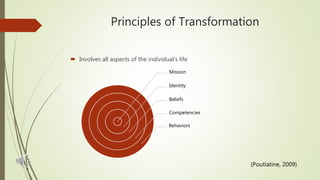
 Involves all aspects of the individual’s life
Mission
Identity
Beliefs
Competencies
Behaviors
(Poutiatine, 2009)
Principles of Transformation
 Some loss is experience
 Letting go of opinions, values, and beliefs
 Broadening scope of worldview
 Expansion of consciousness
 View the world more effectively
 Greater sense of identity
 New Sense of wholeness
(Poutiatine, 2009)
Resources
 Brooks, A. K. (2004). Transformational Learning Theory and Implications for Human
Resouce Development. Advances in Developing Human Resources 6 (2), 211-225.
 Merriam, S. B. (2004). The Role of Cognitive Development in Mezirow's
Transformational Learning Theory. Adult Education Quarterly 55 (1), 60-68.
 Mezirow, J. (1991). Transformative Dimensions of Adult Learning. San Francisco:
Jossey-Bass.
 Mezirow, J. (1996). Contemporary paradigms of learning. Adult Education Quarterly
46(3), 158-173.

Transformative learning powerpoint (4.1)

  • 1.
  • 2.
    Executive Summary  Transformativelearning theory, according to Jack Mezirow focuses on “a critical dimension of learning in adulthood that enables us to recognize and reassess the structure of assumptions and expectations which frame our thinking, feeling and acting.”  Merriam and Bierema (2014) also cite Mezirow (1991) in defining what transformative learning is, “Transformative learning involves an enhanced level of awareness of the context of one’s beliefs and feelings, a critique of their assumptions and particularly premises, an assessment of alternative perspectives, a decision to negate an old perspective in favor of a new one or to make a synthesis of old and new, an ability to take action based upon the new perspective, and a desire to fit the new perspective into the broader context of one’s life” (p. 161). (Mezirow, 2009)
  • 3.
    Adult Learning Process The process through which adults learn and incorporate new information is as follows:  1. Action Learning The process of cognitive thinking and awareness of material learned and the process of learning itself.  2. Experiential Learning Gaining knowledge and understanding through work performance and experience.  3. Project Based Learning Furthering one’s knowledge through investigative questioning and active exploration of existing knowledge.  4. Self-Directed Learning An intrinsic drive triggered either by internal or external factors to further one’s knowledge.
  • 4.
    The experience oftransformative learning  Through life experiences combined with formal education, adults have a vast amount of knowledge that affects their thinking, behavior, and approach on life.  As adults begin to get back into the educational system, they use their past experiences and existing knowledge and incorporate it with the new information.  Critical thinking is also a vital element in the process of incorporating new skills, knowledge, and understanding. (Mezirow, 2009)
  • 5.
    Mezirow’s 10 phasesof Transformative Learning  1. A disorienting dilemma  2. A self examination with the feelings of guilt or shame  3. A critical assessment of assumptions  4. Recognition that one’s discontent and the process of transformation  5. Exploration of options for new roles, relationships, and actions (Mezirow, 2009)
  • 6.
     6. Planninga course of action  7. Acquisition of knowledge and skills for implementing one’s plan  8. Provision trying of new roles  9. Building of competence and self-confidence in new roles and relationships  10. A reintegration into one’s life on the basis of conditions dictated by one’s perspective Mezirow’s 10 phases of Transformative Learning (Mezirow, 2009)
  • 7.
    Disorienting Dilemma  Anexperience within which a current understanding is found to be insufficient or incorrect and the learner struggles with the resulting conflict of views  A disorienting dilemma is the catalyst for perspective transformation.  Dilemmas usually occur when people have experiences that do not fit their expectations or make sense to them and they cannot resolve the situations without some change in their views of the world.
  • 8.
    Critical Reflection  Criticos(1993) observed, what is valuable is not the experience itself but “the intellectual growth that follows the process of reflecting on experience. Effective learning does not follow from a positive experience but from effective reflection” (p162)  There are three ways that a person can reflect on an experience  Content Reflection  Process Reflection  Premise Reflection  Only Premise Reflection Will Result in Transformative Learning Merriam, 2004
  • 9.
    Rational or ReflectiveDiscourse  Specialized use of dialogue devoted to searching for a common understanding and assessment of the justification of an interpretation or belief.  Assessing reasons advanced by weighing the supporting evidence and arguments and by examining alternative perspectives.  Critical assessment of assumptions.  It leads toward a clearer understanding by tapping collective experience to arrive at a tentative best judgment. (Mezirow, 2000, pp. 10-11)
  • 10.
    Conditions For RationalDiscourse  Having Complete Information  Being free from Self-deception  Capability of evaluation of arguments  The opportunity to participate in different roles in the discussion (Merriam, 2004)
  • 11.
    Evaluation of Transformation Mezirow’s theory is clear in the method for evaluation of transformative learning.  The learners perspectives should be mapped and a comparison of the prior perspective should be measured against the developed meaning  Differences should include  Change in meaning structure  Growth of complexity and openness to new perspectives and actions  The ability to participate in rational discourse  Willingness to accept consensual validation (Brooks, 2004)
  • 12.
    Boyd’s Definition ofTransformation  “A fundamental change in one’s personality involving conjointly the resolution of a personal dilemma and the expansion of consciousness resulting in greater personality integration” (Boyd, 1989, p.459)  Three activities for transformative learning  Listening  Recognizing the need to choose  Emotional crisis (Brooks, 2004)
  • 13.
    Principles of Transformation There are foundational ideas of transformation that can be applied to individuals, organizations, and societies  These principles demonstrate a commonality between transformational learning and transformational leadership  Understanding of these principles can assist leaders with the process of organizational change (Poutiatine, 2009)
  • 14.
    Principles of Transformation Transformation and change are not one in the same  Change is continuous whereas transformation is discontinuous  Change is rarely disruptive, transformation is  Change is not initiated by the individual, transformation must be chosen  We must be willing to transform  A person can not be forced to transform  It must begin as an internal process  Transformation changes the way an individual or organization operates  It demonstrates a new way of thinking, and a separation from the past (Poutiatine, 2009)
  • 15.
    Principles of Transformation Transformation is Irreversible  Even though an individual can regress, they cannot go back to a state of not knowing  There is no way to unlearn after a transformational shift  Transformation requires letting go of control  Question assumptions and world view  New Uncertainties were previously certain (Poutiatine, 2009)
  • 16.
    Principles of Transformation Involves all aspects of the individual’s life Mission Identity Beliefs Competencies Behaviors (Poutiatine, 2009)
  • 17.
    Principles of Transformation Some loss is experience  Letting go of opinions, values, and beliefs  Broadening scope of worldview  Expansion of consciousness  View the world more effectively  Greater sense of identity  New Sense of wholeness (Poutiatine, 2009)
  • 18.
    Resources  Brooks, A.K. (2004). Transformational Learning Theory and Implications for Human Resouce Development. Advances in Developing Human Resources 6 (2), 211-225.  Merriam, S. B. (2004). The Role of Cognitive Development in Mezirow's Transformational Learning Theory. Adult Education Quarterly 55 (1), 60-68.  Mezirow, J. (1991). Transformative Dimensions of Adult Learning. San Francisco: Jossey-Bass.  Mezirow, J. (1996). Contemporary paradigms of learning. Adult Education Quarterly 46(3), 158-173.

Editor's Notes

  • #9 Premise reflection, or critical reflection on assumptions, can be about assumptions we hold regarding the self (narrative), the cultural systems in which we live (systemic), our workplace (organizational), our ethical decision making (moral-ethical), or feelings and dispositions (therapeutic; Mezirow, 1998). The transformation process, according to Mezirow (1991), “always [italics added] involves critical reflection upon the distorted premises sustaining our structure of expectation”