Troublesome Thresholds and
    Limiting Liminality:
    issues in teaching in
    vocational education
                  James Atherton
                   Peter Hadfield
                 Peter Wolstencroft
  (formerly or currently of University of Bedfordshire UK)
Liminality as Liability


                James Atherton
                 Peter Hadfield
               Peter Wolstencroft
(formerly or currently of University of Bedfordshire UK)
Using the model/frame of
“defences against liminality”
as a way of understanding
the practice of teaching and learning
in vocational education (and beyond)


Intro
Based on…
• Professional Graduate Certificate in Education, and a
     non-grad version
• For teachers in post-compulsory education
• About 700 students enrolled: in 10 centres: with around
     40 staff
• Actively using ideas of TCs since 2007
• In a community of enquiry about how they work
     in this sector
•    Drawing on all possible sources (within ethical limits).
•    Guided and encouraged by the three authors


    Intro
Issue
Issue   EdExcel 2010
[...] I could see that she was following the required Scheme of Work […]
to the letter. The handout declared authoritatively that there are four theories [...]
and the teacher was supposed to "get through" these at the rate of ten minutes each,
and to test that they had been "learned" [...]

The students, rather sadly, were bored but compliant. They "researched"
allocated topics [...] , and paraphrased what they found and the relevant paragraph
from the handout. […] They spoke when spoken to, but volunteered nothing.
They exhibited a weary familiarity with yet more half-understood gobbets              of
information they were supposed to "learn", without a clue as to why.

The teacher told them they could “tick   off” their first Unit objective

[…] post-observation discussion. I checked on the academic/vocational level of
the programme (3; the next level below first-year undergraduate level). She agreed it
was dumbed-down to near meaninglessness, because that is seen as
the way to get the students to "achieve". The bottom line is that they
must not drop out.

  Issue                                                               (Atherton, 2010)
Issue
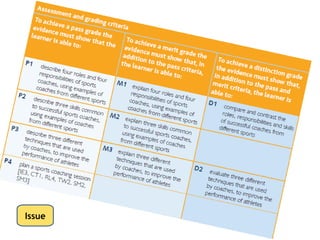
• [...] For an irrelevant reason, the teacher decides to address all
   the “P” level objectives first (for the whole syllabus), and then to
   revisit the “M” criteria and possibly the “D”s if there is time.
• [...] a student has encountered what is for him a
   threshold concept, and pipes up with, “But
   doesn’t that mean that...” and goes on to identify
   several more “functions of the firm” which go beyond
   the current topic but clearly now make sense to him.
• He is shut down, “We’re not doing that until next
   term—don’t confuse other people!”


Issue
Knowledge/ skill etc.


   y
Liminalit
 Time
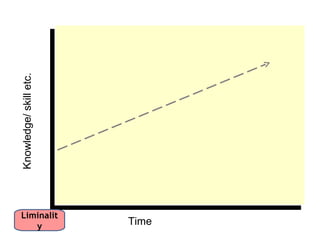
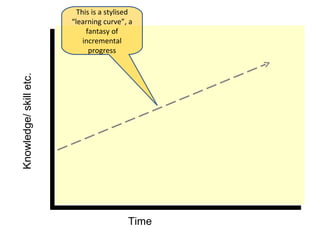
This is a stylised
                        “learning curve”, a
                             fantasy of
                            incremental
                              progress
Knowledge/ skill etc.


                                          Time
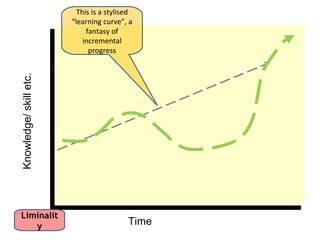
This is a stylised
                        “learning curve”, a
                             fantasy of
                            incremental
                              progress
Knowledge/ skill etc.


Liminalit
   y                                      Time
This is a stylised
                        “learning curve”, a
                             fantasy of
                            incremental
                              progress
Knowledge/ skill etc.


                                                 ...and this is the more
                                                      realistic curve
                                                     associated with
                                                  learning a threshold
                                                         concept

Liminalit
   y                                      Time
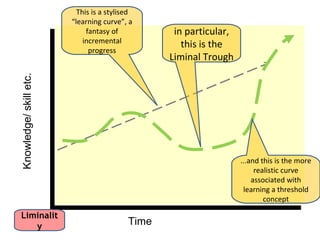
This is a stylised
                        “learning curve”, a
                             fantasy of           in particular,
                            incremental
                                                    this is the
                              progress
                                                 Liminal Trough
Knowledge/ skill etc.


                                                                   ...and this is the more
                                                                        realistic curve
                                                                       associated with
                                                                    learning a threshold
                                                                           concept

Liminalit
   y                                      Time
• Entry level ESOL class
• Trying “naked” teaching
• Changed rooms at last minute

“...almost
         visible cognitive processes going on as one
  learner [...] started to answer, fell silent, [...], I again
  opened it up to the rest of the group. No significant
  answer, lots of thinking and, crucially silence for a
  few moments until the original learner came up with
  “university” (albeit mispronounced). A lovely lovely moment,
  andit wouldn’t have happened if I’d leapt in and
  told him.”
                         Sam Shepherd’s blog: 14 June 2012 (his emphasis)
Liminalit
   y
Liminality is


            risky
             (and so are TCs)


Liminalit
   y
Risk is


            toxic
Liminalit
   y
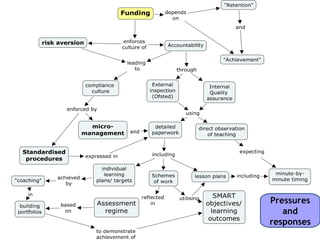
Pressures
   and
responses
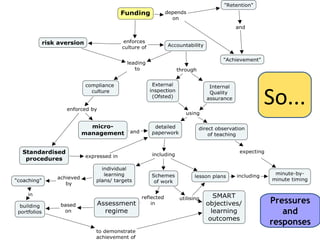
So...


Pressures
   and
responses
So...

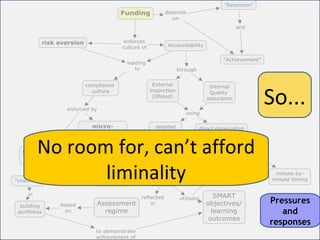
No room for, can’t afford
       liminality
                            Pressures
                               and
                            responses
which represents
loss of control


                   Pressures
                      and
                   responses
which represents
            loss of control
                and hence
           increasing   anxiety

  For             For         …and for
                                    Pressures
managers        teachers      studentsand
                                     responses
Isobel Menzies-Lyth investigated this
  general principle in a classic 1967 paper:
"A Case-study in the Functioning of
  Social Systems as a Defence against
  Anxiety”
which does what it says on the tin (based
 on nursing).
Trade-off


• Security vs. autonomy
• Risk reduction  stagnation
So what?

• Raising awareness of the normality of
 liminality (Cousin, 2008)


                                     Suggestions
So what?

• Raising awareness of the normality of
    liminality (Cousin, 2008)
•   Providing the language to “diagnose” it


                                       Suggestions
So what?

• Raising awareness of the normality of
    liminality (Cousin, 2008)
•   Providing the language to “diagnose” it
•   Pre-emptive re-assurance


                                       Suggestions
www.doceo.co.uk/tools/thresholds_11.htm

           james@doceo.co.uk
Selected References

•   Atherton J S (2010) Recent Reflection: On making learning more difficult by making it easier...
    http://recentreflection.blogspot.com/2010/12/on-making-learning-more-difficult-by.html#ixzz1yLm6CPEU
    accessed 20 June 2012
•   Keats John (1817) Letter to George and Thomas Keats (21 Dec 1817) in H. E. Rollins (ed.), (1958) Letters of
    John Keats, Vol. 1, 193
•   Land, R., Cousin, G., Meyer, J.H.F. and Davies, P. (2005), Threshold concepts and troublesome knowledge (3):
    implications for course design and evaluation, In: C. Rust (ed.), Improving Student Learning - diversity and
    inclusivity, Proceedings of the 12th Improving Student Learning Conference. Oxford: Oxford Centre for Staff
    and Learning Development (OCSLD), pp 53-64.
    [
    http://www.brookes.ac.uk/services/ocsld/isl/isl2004/abstracts/conceptual_papers/ISL04-pp53-64-Land-et-al.pdf
       last accessed 23 May 2012]
•   Menzies-Lyth I E P (1988) "A Case-study in the Functioning of Social Systems as a Defence against Anxiety"
    (1967) reprinted in Containing Anxiety in Institutions (Selected Essays vol I) London: Free Association Books
•   Perkins D (2010) “Threshold Experience” keynote given at 3rd Biennial Threshold Concepts Symposium, UNSW,
    Sydney 1-2 July 2010 (online, available http://www.thresholdconcepts2010.unsw.edu.au/speakers.html
    retrieved 14 November 2011
•   Shepherd S (2012) Sam Shepherd’s Blog http://samuelshep.wordpress.com/2012/06/14/unplugged-trousers/
    accessed 14 June 2012
•   Turner V (1969) The Ritual Process; structure and anti-structure London; Routledge and Kegan Paul
•   Van Gennep A (1909) The Rites of Passage (trans.) Chicago: University of Chicago Press, 1960
•   Wenger E (1998) Communities of Practice Cambridge; CUP


                       The original version of this presentation was given at the
                             4th International Threshold Concepts Conference,
                               held 28-29 June 2012 at Trinity College Dublin.

Liminality as liability

  • 1.
    Troublesome Thresholds and Limiting Liminality: issues in teaching in vocational education James Atherton Peter Hadfield Peter Wolstencroft (formerly or currently of University of Bedfordshire UK)
  • 2.
    Liminality as Liability James Atherton Peter Hadfield Peter Wolstencroft (formerly or currently of University of Bedfordshire UK)
  • 3.
    Using the model/frameof “defences against liminality” as a way of understanding the practice of teaching and learning in vocational education (and beyond) Intro
  • 4.
    Based on… • ProfessionalGraduate Certificate in Education, and a non-grad version • For teachers in post-compulsory education • About 700 students enrolled: in 10 centres: with around 40 staff • Actively using ideas of TCs since 2007 • In a community of enquiry about how they work in this sector • Drawing on all possible sources (within ethical limits). • Guided and encouraged by the three authors Intro
  • 5.
  • 6.
    Issue EdExcel 2010
  • 7.
    [...] I couldsee that she was following the required Scheme of Work […] to the letter. The handout declared authoritatively that there are four theories [...] and the teacher was supposed to "get through" these at the rate of ten minutes each, and to test that they had been "learned" [...] The students, rather sadly, were bored but compliant. They "researched" allocated topics [...] , and paraphrased what they found and the relevant paragraph from the handout. […] They spoke when spoken to, but volunteered nothing. They exhibited a weary familiarity with yet more half-understood gobbets of information they were supposed to "learn", without a clue as to why. The teacher told them they could “tick off” their first Unit objective […] post-observation discussion. I checked on the academic/vocational level of the programme (3; the next level below first-year undergraduate level). She agreed it was dumbed-down to near meaninglessness, because that is seen as the way to get the students to "achieve". The bottom line is that they must not drop out. Issue (Atherton, 2010)
  • 8.
  • 9.
    • [...] Foran irrelevant reason, the teacher decides to address all the “P” level objectives first (for the whole syllabus), and then to revisit the “M” criteria and possibly the “D”s if there is time. • [...] a student has encountered what is for him a threshold concept, and pipes up with, “But doesn’t that mean that...” and goes on to identify several more “functions of the firm” which go beyond the current topic but clearly now make sense to him. • He is shut down, “We’re not doing that until next term—don’t confuse other people!” Issue
  • 10.
    Knowledge/ skill etc. y Liminalit Time
  • 11.
    This is astylised “learning curve”, a fantasy of incremental progress Knowledge/ skill etc. Time
  • 12.
    This is astylised “learning curve”, a fantasy of incremental progress Knowledge/ skill etc. Liminalit y Time
  • 13.
    This is astylised “learning curve”, a fantasy of incremental progress Knowledge/ skill etc. ...and this is the more realistic curve associated with learning a threshold concept Liminalit y Time
  • 14.
    This is astylised “learning curve”, a fantasy of in particular, incremental this is the progress Liminal Trough Knowledge/ skill etc. ...and this is the more realistic curve associated with learning a threshold concept Liminalit y Time
  • 15.
    • Entry levelESOL class • Trying “naked” teaching • Changed rooms at last minute “...almost visible cognitive processes going on as one learner [...] started to answer, fell silent, [...], I again opened it up to the rest of the group. No significant answer, lots of thinking and, crucially silence for a few moments until the original learner came up with “university” (albeit mispronounced). A lovely lovely moment, andit wouldn’t have happened if I’d leapt in and told him.” Sam Shepherd’s blog: 14 June 2012 (his emphasis) Liminalit y
  • 16.
    Liminality is risky (and so are TCs) Liminalit y
  • 17.
    Risk is toxic Liminalit y
  • 18.
    Pressures and responses
  • 19.
    So... Pressures and responses
  • 20.
    So... No room for,can’t afford liminality Pressures and responses
  • 21.
    which represents loss ofcontrol Pressures and responses
  • 22.
    which represents loss of control and hence increasing anxiety For For …and for Pressures managers teachers studentsand responses
  • 23.
    Isobel Menzies-Lyth investigatedthis general principle in a classic 1967 paper: "A Case-study in the Functioning of Social Systems as a Defence against Anxiety” which does what it says on the tin (based on nursing).
  • 24.
    Trade-off • Security vs.autonomy • Risk reduction  stagnation
  • 25.
    So what? • Raisingawareness of the normality of liminality (Cousin, 2008) Suggestions
  • 26.
    So what? • Raisingawareness of the normality of liminality (Cousin, 2008) • Providing the language to “diagnose” it Suggestions
  • 27.
    So what? • Raisingawareness of the normality of liminality (Cousin, 2008) • Providing the language to “diagnose” it • Pre-emptive re-assurance Suggestions
  • 28.
  • 29.
    Selected References • Atherton J S (2010) Recent Reflection: On making learning more difficult by making it easier... http://recentreflection.blogspot.com/2010/12/on-making-learning-more-difficult-by.html#ixzz1yLm6CPEU accessed 20 June 2012 • Keats John (1817) Letter to George and Thomas Keats (21 Dec 1817) in H. E. Rollins (ed.), (1958) Letters of John Keats, Vol. 1, 193 • Land, R., Cousin, G., Meyer, J.H.F. and Davies, P. (2005), Threshold concepts and troublesome knowledge (3): implications for course design and evaluation, In: C. Rust (ed.), Improving Student Learning - diversity and inclusivity, Proceedings of the 12th Improving Student Learning Conference. Oxford: Oxford Centre for Staff and Learning Development (OCSLD), pp 53-64. [ http://www.brookes.ac.uk/services/ocsld/isl/isl2004/abstracts/conceptual_papers/ISL04-pp53-64-Land-et-al.pdf    last accessed 23 May 2012] • Menzies-Lyth I E P (1988) "A Case-study in the Functioning of Social Systems as a Defence against Anxiety" (1967) reprinted in Containing Anxiety in Institutions (Selected Essays vol I) London: Free Association Books • Perkins D (2010) “Threshold Experience” keynote given at 3rd Biennial Threshold Concepts Symposium, UNSW, Sydney 1-2 July 2010 (online, available http://www.thresholdconcepts2010.unsw.edu.au/speakers.html retrieved 14 November 2011 • Shepherd S (2012) Sam Shepherd’s Blog http://samuelshep.wordpress.com/2012/06/14/unplugged-trousers/ accessed 14 June 2012 • Turner V (1969) The Ritual Process; structure and anti-structure London; Routledge and Kegan Paul • Van Gennep A (1909) The Rites of Passage (trans.) Chicago: University of Chicago Press, 1960 • Wenger E (1998) Communities of Practice Cambridge; CUP The original version of this presentation was given at the 4th International Threshold Concepts Conference, held 28-29 June 2012 at Trinity College Dublin.

Editor's Notes

  • #8 In one case the teacher thoughtfully provided me with some of the course documentation including photocopies of pages from the "official" textbook which she was using as a handout. (Not best practice, but with a heavy timetable and no time to develop her own resources, understandable.) So I could see that she was following the required Scheme of Work almost to the letter. The handout declared authoritatively that there are four theories of such-and-such (well, it all depends... and two of the theories were simply variations on a third, but there was no acknowledgement of that), and the teacher was supposed to "get through" these at the rate of ten minutes each, and to test that they had been "learned" (whatever that means in this context). Being fair to her, again, she was not very familiar with the area she was teaching, and so she had to stick largely to what the book told her*. She offered few examples, because she was not confident they would be "correct". And I could tell that some of the information on the handout was misleading and even simply wrong. The students, rather sadly, were bored but compliant. They "researched" allocated topics (Googled them), and paraphrased what they found and the relevant paragraph from the handout, and two of them gave short presentations by the time the session ended. They spoke when spoken to, but volunteered nothing. They exhibited a weary familiarity with yet more half-understood gobbets of information they were supposed to "learn", without a clue as to why. At the end of the session the teacher told them they could “tick off” their first Unit objective The teacher and I had our post-observation discussion. I checked on the academic/vocational level of the programme (3; the next level below first-year undergraduate level). She agreed it was dumbed-down to near meaninglessness, because that is seen as the way to get the students to "achieve". The bottom line is that they must not drop out.
  • #10 This is illustrated clearly by an observation by PW, of a Business Studies class for 16-year-olds. The curriculum prescribes what knowledge etc. is required of a candidate for a Pass, Merit, or Distinction. For an irrelevant reason, the teacher decides to address all the “P” level objectives first (for the whole syllabus), and then to revisit the “M” criteria and possibly the “D”s if there is time. (This of course makes no sense in terms of the knowledge base.) But in this particular class, a student has encountered what is for him a threshold concept, and pipes up with, “But doesn’t that mean that...” and goes on to identify several more “functions of the firm” which go beyond the current topic but clearly now make sense to him. He is shut down, “We’re not doing that until next term—don’t confuse other people!”
  • #16 ...I had the vague idea to cover directions based on the fact we had changed classrooms, so opened with the question “Where are we?” assuming that the answer would be “college” from whence I thought I could whittle it down to “in the classroom”. Never assume! The answer I got was “school”. Again, I addressed the error with a questioning look, and got “college” from another student. “What’s the difference?” I asked. It was fascinating to watch the answers develop from hand signals to indicate small height, to “kids” and “children”, to “adults”. There was here another fascinating moment: in terms of the almost visible cognitive processes going on as one learner in particular started to answer, fell silent, and instead of filling the gap for him, I again opened it up to the rest of the group. No significant answer, lots of thinking and, crucially silence for a few moments until the original learner came up with “university” (albeit mispronounced). A lovely lovely moment, and it wouldn’t have happened if I’d leapt in and told him.