Transcription
Dr. Safaa Tayel
PROFESSOR OF MEDICAL BIOCHEMISTRY & MOLECULAR BIOLOGY
MENOUFIA UNIVERSITY- FACULTY OF MEDICINE
Objectives
 Description of Transcription Steps.
 The Prokaryotic Promoter.
 The Eukaryotic Promoters.
 The Prokaryotic and Eukaryotic RNA Polymerases.
 Rho Dependent Termination in Prokaryotes.
© John Wiley & Sons, Inc.
Introduction
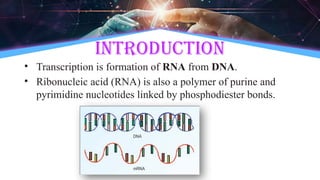
• Transcription is formation of RNA from DNA.
• Ribonucleic acid (RNA) is also a polymer of purine and
pyrimidine nucleotides linked by phosphodiester bonds.
Types of RNA
The major types of RNAs:
• Ribosomal RNA (rRNA)
• Transfer RNA (tRNA)
• Messenger RNA (mRNA).
• Small RNA
These types differ from one another in terms of
size, structure and function.
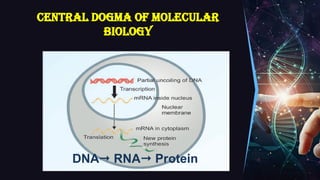
Central Dogma of Molecular
Biology
DNA RNA Protein
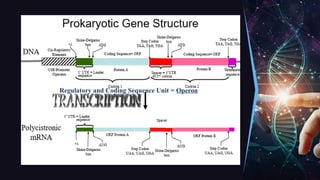
Regulatory and Coding Sequence Unit = Operon
Transcription
• Transcription is taking place all the time.
• Only certain areas of the DNA are copied
• This is like taking xerox copy of particular
page of the book.
• So, the genetic information of DNA is
transcribed (copied) to the messenger RNA
(mRNA).
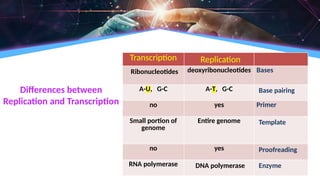
Differences between
Replication and Transcription
Transcription Replication
Ribonucleotides deoxyribonucleotides Bases
A-U, G-C A-T, G-C Base pairing
no yes Primer
Small portion of
genome
Entire genome Template
no yes Proofreading
RNA polymerase DNA polymerase Enzyme
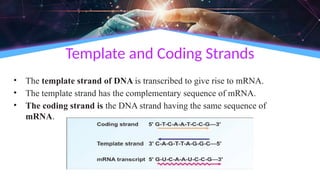
Template and Coding Strands
• The template strand of DNA is transcribed to give rise to mRNA.
• The template strand has the complementary sequence of mRNA.
• The coding strand is the DNA strand having the same sequence of
mRNA.
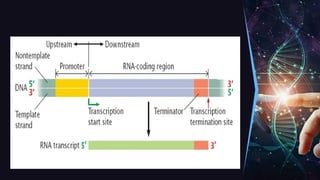
Transcription unit
•It is defined as that region of DNA that includes the signals
for transcription .
•It consists of
1. The promoter region
2. The transcribed region
3. The termination region
1-The promoter region
• Sequences in the DNA (the initial binding site
for RNA polymerase (RNAP).
• Usually at the start of gene just upstream of
transcription start site.
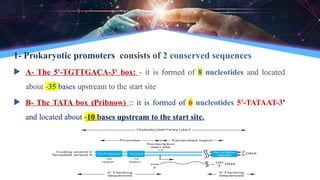
1- Prokaryotic promoters consists of 2 conserved sequences
 A- The 5'-TGTTGACA-3' box: - it is formed of 8 nucleotides and located
about -35 bases upstream to the start site
 B- The TATA box (Pribnow) :: it is formed of 6 nucleotides 5'-TATAAT-3'
and located about -10 bases upstream to the start site.
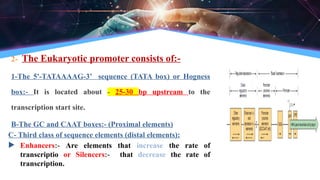
2- The Eukaryotic promoter consists of:-
1-The 5'-TATAAAAG-3’ sequence (TATA box) or Hogness
box:- It is located about - 25-30 bp upstream to the
transcription start site.
B-The GC and CAAT boxes:- (Proximal elements)
C- Third class of sequence elements (distal elements):
 Enhancers:- Are elements that increase the rate of
transcriptio or Silencers:- that decrease the rate of
transcription.
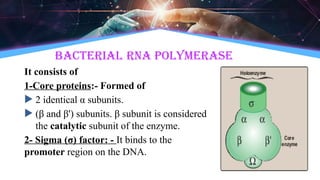
Bacterial RNA Polymerase
It consists of
1-Core proteins:- Formed of
 2 identical α subunits.
 (β and β') subunits. β subunit is considered
the catalytic subunit of the enzyme.
2- Sigma (σ) factor: - It binds to the
promoter region on the DNA.
Mammalian RNA polymerase
There are 3 types:
 RNAP I: - synthesizes the large rRNA (5.8s, 18s & 28s).
 RNAP II: - synthesizes the mRNA and snRNA.
 RNAP III: - synthesizes the tRNA and 5s rRNA.
Requirements for RNA synthesis
1. Transcription unit.
2. The 4 ribonucleotides (ATP, GTP, CTP and UTP).
3. RNA polymerase enzyme.
Steps of RNA synthesis
• 3 steps are involved: - initiation, elongation & termination.
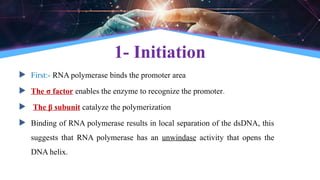
1- Initiation
 First:- RNA polymerase binds the promoter area
 The σ factor enables the enzyme to recognize the promoter.
 The β subunit catalyze the polymerization
 Binding of RNA polymerase results in local separation of the dsDNA, this
suggests that RNA polymerase has an unwindase activity that opens the
DNA helix.
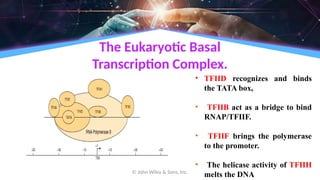
The Eukaryotic Basal
Transcription Complex.
© John Wiley & Sons, Inc.
• TFIID recognizes and binds
the TATA box,
• TFIIB act as a bridge to bind
RNAP/TFIIF.
• TFIIF brings the polymerase
to the promoter.
• The helicase activity of TFIIH
melts the DNA
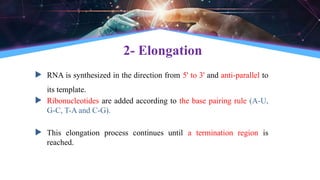
2- Elongation
 RNA is synthesized in the direction from 5' to 3' and anti-parallel to
its template.
 Ribonucleotides are added according to the base pairing rule (A-U,
G-C, T-A and C-G).
 This elongation process continues until a termination region is
reached.
© John Wiley & Sons, Inc.
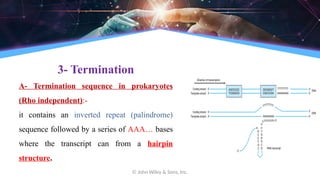
3- Termination
A- Termination sequence in prokaryotes
(Rho independent):-
it contains an inverted repeat (palindrome)
sequence followed by a series of AAA… bases
where the transcript can from a hairpin
structure.
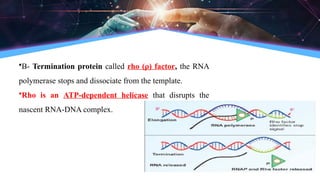
•B- Termination protein called rho (ρ) factor, the RNA
polymerase stops and dissociate from the template.
•Rho is an ATP-dependent helicase that disrupts the
nascent RNA-DNA complex.
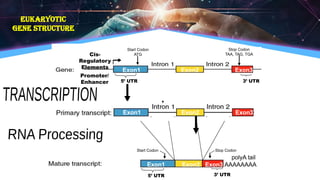
Eukaryotic
Gene Structure
Promoter/
Enhancer 5’ UTR
Cis-
Regulatory
Elements
Start Codon
ATG
Exon1 Exon2 Exon3
Stop Codon
TAA, TAG, TGA
3’ UTR
Exon1 Exon2 Exon3
AAAAAAAA
Exon1 Exon2 Exon3
5’ UTR 3’ UTR
Start Codon Stop Codon
polyA tail
Reference

Transcription In Prokaryotes & Eukaryotes.pptx

  • 1.
    Transcription Dr. Safaa Tayel PROFESSOROF MEDICAL BIOCHEMISTRY & MOLECULAR BIOLOGY MENOUFIA UNIVERSITY- FACULTY OF MEDICINE
  • 2.
    Objectives  Description ofTranscription Steps.  The Prokaryotic Promoter.  The Eukaryotic Promoters.  The Prokaryotic and Eukaryotic RNA Polymerases.  Rho Dependent Termination in Prokaryotes. © John Wiley & Sons, Inc.
  • 3.
    Introduction • Transcription isformation of RNA from DNA. • Ribonucleic acid (RNA) is also a polymer of purine and pyrimidine nucleotides linked by phosphodiester bonds.
  • 4.
    Types of RNA Themajor types of RNAs: • Ribosomal RNA (rRNA) • Transfer RNA (tRNA) • Messenger RNA (mRNA). • Small RNA These types differ from one another in terms of size, structure and function.
  • 5.
    Central Dogma ofMolecular Biology DNA RNA Protein
  • 6.
    Regulatory and CodingSequence Unit = Operon
  • 7.
    Transcription • Transcription istaking place all the time. • Only certain areas of the DNA are copied • This is like taking xerox copy of particular page of the book. • So, the genetic information of DNA is transcribed (copied) to the messenger RNA (mRNA).
  • 8.
    Differences between Replication andTranscription Transcription Replication Ribonucleotides deoxyribonucleotides Bases A-U, G-C A-T, G-C Base pairing no yes Primer Small portion of genome Entire genome Template no yes Proofreading RNA polymerase DNA polymerase Enzyme
  • 9.
    Template and CodingStrands • The template strand of DNA is transcribed to give rise to mRNA. • The template strand has the complementary sequence of mRNA. • The coding strand is the DNA strand having the same sequence of mRNA.
  • 10.
    Transcription unit •It isdefined as that region of DNA that includes the signals for transcription . •It consists of 1. The promoter region 2. The transcribed region 3. The termination region
  • 12.
    1-The promoter region •Sequences in the DNA (the initial binding site for RNA polymerase (RNAP). • Usually at the start of gene just upstream of transcription start site.
  • 13.
    1- Prokaryotic promotersconsists of 2 conserved sequences  A- The 5'-TGTTGACA-3' box: - it is formed of 8 nucleotides and located about -35 bases upstream to the start site  B- The TATA box (Pribnow) :: it is formed of 6 nucleotides 5'-TATAAT-3' and located about -10 bases upstream to the start site.
  • 14.
    2- The Eukaryoticpromoter consists of:- 1-The 5'-TATAAAAG-3’ sequence (TATA box) or Hogness box:- It is located about - 25-30 bp upstream to the transcription start site. B-The GC and CAAT boxes:- (Proximal elements) C- Third class of sequence elements (distal elements):  Enhancers:- Are elements that increase the rate of transcriptio or Silencers:- that decrease the rate of transcription.
  • 15.
    Bacterial RNA Polymerase Itconsists of 1-Core proteins:- Formed of  2 identical α subunits.  (β and β') subunits. β subunit is considered the catalytic subunit of the enzyme. 2- Sigma (σ) factor: - It binds to the promoter region on the DNA.
  • 16.
    Mammalian RNA polymerase Thereare 3 types:  RNAP I: - synthesizes the large rRNA (5.8s, 18s & 28s).  RNAP II: - synthesizes the mRNA and snRNA.  RNAP III: - synthesizes the tRNA and 5s rRNA.
  • 17.
    Requirements for RNAsynthesis 1. Transcription unit. 2. The 4 ribonucleotides (ATP, GTP, CTP and UTP). 3. RNA polymerase enzyme. Steps of RNA synthesis • 3 steps are involved: - initiation, elongation & termination.
  • 18.
    1- Initiation  First:-RNA polymerase binds the promoter area  The σ factor enables the enzyme to recognize the promoter.  The β subunit catalyze the polymerization  Binding of RNA polymerase results in local separation of the dsDNA, this suggests that RNA polymerase has an unwindase activity that opens the DNA helix.
  • 19.
    The Eukaryotic Basal TranscriptionComplex. © John Wiley & Sons, Inc. • TFIID recognizes and binds the TATA box, • TFIIB act as a bridge to bind RNAP/TFIIF. • TFIIF brings the polymerase to the promoter. • The helicase activity of TFIIH melts the DNA
  • 20.
    2- Elongation  RNAis synthesized in the direction from 5' to 3' and anti-parallel to its template.  Ribonucleotides are added according to the base pairing rule (A-U, G-C, T-A and C-G).  This elongation process continues until a termination region is reached.
  • 21.
    © John Wiley& Sons, Inc. 3- Termination A- Termination sequence in prokaryotes (Rho independent):- it contains an inverted repeat (palindrome) sequence followed by a series of AAA… bases where the transcript can from a hairpin structure.
  • 22.
    •B- Termination proteincalled rho (ρ) factor, the RNA polymerase stops and dissociate from the template. •Rho is an ATP-dependent helicase that disrupts the nascent RNA-DNA complex.
  • 23.
    Eukaryotic Gene Structure Promoter/ Enhancer 5’UTR Cis- Regulatory Elements Start Codon ATG Exon1 Exon2 Exon3 Stop Codon TAA, TAG, TGA 3’ UTR Exon1 Exon2 Exon3 AAAAAAAA Exon1 Exon2 Exon3 5’ UTR 3’ UTR Start Codon Stop Codon polyA tail
  • 24.