transcription
completed by
Vishal saxena
Faculty of science
What is Transcription?
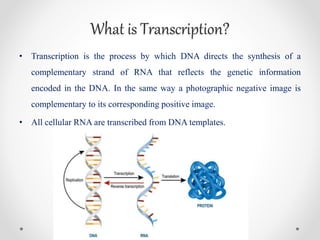
• Transcription is the process by which DNA directs the synthesis of a
complementary strand of RNA that reflects the genetic information
encoded in the DNA. In the same way a photographic negative image is
complementary to its corresponding positive image.
• All cellular RNA are transcribed from DNA templates.
Types of RNA
Cell contain three types of RNA
• Ribosomal RNA (r-RNA)- which constitutes two third
of the ribosomal mass.
• Transfer RNA (t-RNA)- a set of small compact
molecules that deliver amino acid to the ribosome for
assembly into protein.
• Messenger RNA (m-RNA)- whose nucleotide sequences
direct protein synthesis.
Transcription process in prokaryotes
Basicrequirement of transcription
• SS DNA as a template.
• DNA dependent RNA polymerase
 The transcription of DNA to RNA is carried out by RNA polymerase
enzyme (RNAPs) that operated as multi subunit complexes as do the DNA
polymerase that catalyze DNA replication.All cells contain RNAPs.
 RNAPs the enzyme responsible for the DNA directed synthesis of RNA
discovered independently in 1960 by Samuel Weiss and Jerard Hurwitz.
 The E.coli RNAPs holoenzyme is an -449 –KD protein with subunit
composition α2ββ'ωσ.
• Ribonucleoside tri phosphate
 all four ribonucleoside 5'-triphosphates (ATP, GTP, UTP, and CTP) as
precursors of the nucleotide units of RNA, as well as Mg2+.
Steps involved in transcription
There is three major steps in transcription
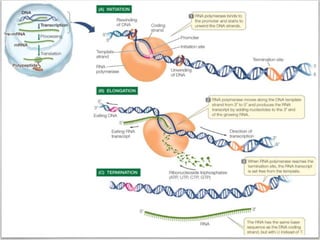
1. Initiation
2. Elongation
3. Termination and release
Initiation
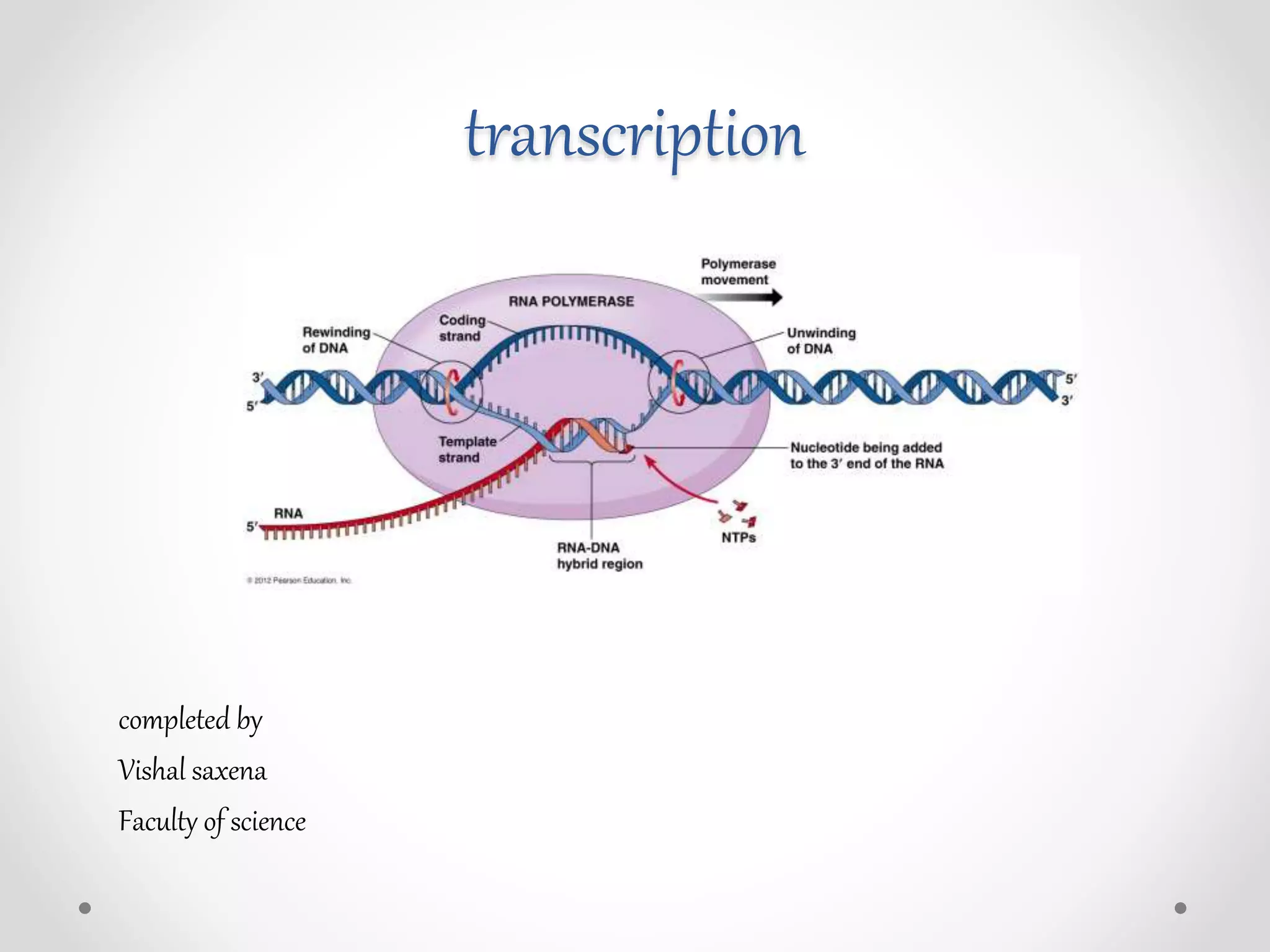
• The DNA strands that serves as a template during transcription is known as
the antisense or noncoding strand and the other strand which has the same
sequence as the transcribed RNA, is known as the sense or coding strand.
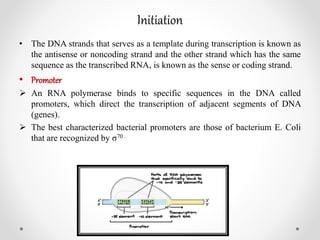
• Promoter
 An RNA polymerase binds to specific sequences in the DNA called
promoters, which direct the transcription of adjacent segments of DNA
(genes).
 The best characterized bacterial promoters are those of bacterium E. Coli
that are recognized by σ70 .
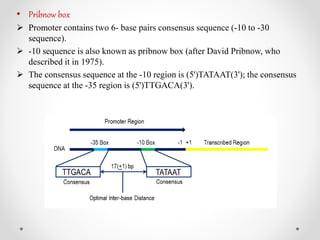
• Pribnow box
 Promoter contains two 6- base pairs consensus sequence (-10 to -30
sequence).
 -10 sequence is also known as pribnow box (after David Pribnow, who
described it in 1975).
 The consensus sequence at the -10 region is (5')TATAAT(3'); the consensus
sequence at the -35 region is (5')TTGACA(3').
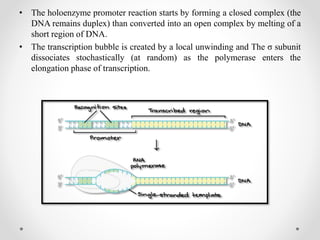
• The holoenzyme promoter reaction starts by forming a closed complex (the
DNA remains duplex) than converted into an open complex by melting of a
short region of DNA.
• The transcription bubble is created by a local unwinding and The σ subunit
dissociates stochastically (at random) as the polymerase enters the
elongation phase of transcription.
elongation
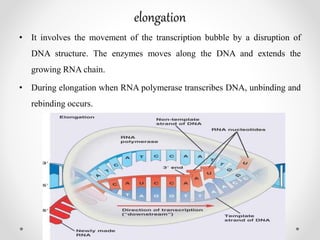
• It involves the movement of the transcription bubble by a disruption of
DNA structure. The enzymes moves along the DNA and extends the
growing RNA chain.
• During elongation when RNA polymerase transcribes DNA, unbinding and
rebinding occurs.
termination
• An encounter with certain DNA sequences results in a pause in RNA synthesis,
and at some of these sequences transcription is terminated.
• The sequence of DNA for these reaction is called terminator. At this point the
enzyme stops adding nucleotide to the growing RNA chain.
• Bacteria use two distinct strategies for termination.
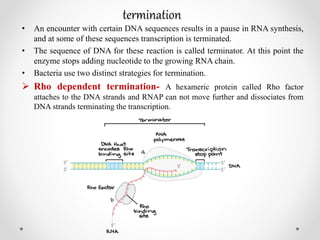
 Rho dependent termination- A hexameric protein called Rho factor
attaches to the DNA strands and RNAP can not move further and dissociates from
DNA strands terminating the transcription.
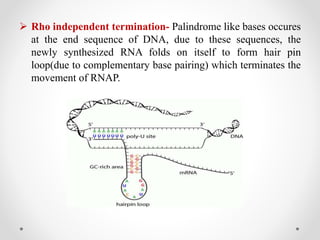
 Rho independent termination- Palindrome like bases occures
at the end sequence of DNA, due to these sequences, the
newly synthesized RNA folds on itself to form hair pin
loop(due to complementary base pairing) which terminates the
movement of RNAP.
Transcription process in eukaryotes
Basic requirment of transcription
• Eukaryotes have three different RNA polymerases, designated 1st, 2nd, and
3rd. each polymerase has a specific function.
 RNA polymerase 1st- It is responsible for the synthesis of only one type of
RNA, a transcribed called preribosomal RNA (pre r-RNA).
 RNA polymerase 2nd- It synthesizes m-RNA and the most of the sn-RNA.
 RNA polymerase 3rd- It synthesizes variety of small stable RNAs
including t-RNA, 5S r-RNA, U6 sn-RNA.
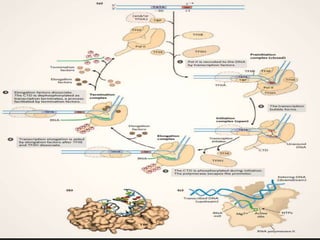
• 6 transcription factors- TFIID, TFIIA, TFIIB, TFIIE, TFIIF, TFIIH
Process of transcrition
Promoters of eukaryotes
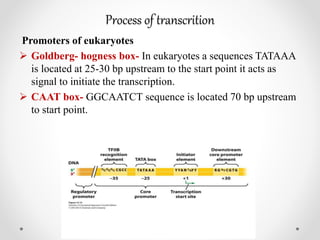
 Goldberg- hogness box- In eukaryotes a sequences TATAAA
is located at 25-30 bp upstream to the start point it acts as
signal to initiate the transcription.
 CAAT box- GGCAATCT sequence is located 70 bp upstream
to start point.
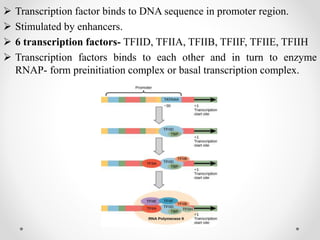
 Transcription factor binds to DNA sequence in promoter region.
 Stimulated by enhancers.
 6 transcription factors- TFIID, TFIIA, TFIIB, TFIIF, TFIIE, TFIIH
 Transcription factors binds to each other and in turn to enzyme
RNAP- form preinitiation complex or basal transcription complex.
 Enhancer- Increases gene expression by 100 folds.
• Enhancers binds to TFs to form activator.
• They have no promoter activity of their own but stimulate the
transcription gene.
• They can be present upstream downstream or within a gene.
 Silencers- DNA sequences which bind proteins that act to inhibit the
rate of transcription.
Post transcriptional modification
 5' capping
• 7-methylguanylate attached by a unusual 5'-5' triphosphate linkage
to the ribose at the 5' end.
• Addition of GTP part of the cap is catalyzed by nuclear enzyme
guanyltransferase.
• Methylation of terminal guanine occurs in the cytosol.
• Catalysed by guanine-7- methyl transferase.
• The cap binds mature m-RNA to the ribosome during protein
biosynthesis.
• Cap stablize m-RNA against digestion by ribonucleases.
• Eukaryotic m-RNAs lacking the cap are not translated efficiently.
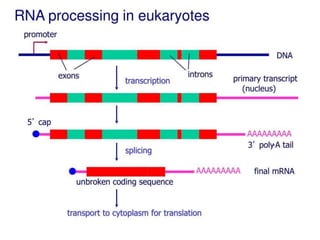
 Addition of poly A tail
• Virtually all eukaryotic m-RNAs have a series of up to 250 adenosine at
their 3' end called poly A tail.
• A single processing complex undertakes both the cutting and
polyadenylation.
• In mammals polyadenylation is directed by a signal sequence in the m-
RNA, almost invariably 5'-AAUAAA-3', which is located between 10 and
30 nucleotide upstream of the polyadenylation site.
• The polyadenylation reaction passes through two stages- first a rather short
oligo sequence is added to the 3' end.
• In the second phase the oligo tail is extended to the full 200 residues
length.
• The polyadenylate binding protein helps the polymerase to add the
adenosine possibly influence the length of the poly A tail.
Thank you

Trabscription vishal

  • 1.
  • 2.
    What is Transcription? •Transcription is the process by which DNA directs the synthesis of a complementary strand of RNA that reflects the genetic information encoded in the DNA. In the same way a photographic negative image is complementary to its corresponding positive image. • All cellular RNA are transcribed from DNA templates.
  • 3.
    Types of RNA Cellcontain three types of RNA • Ribosomal RNA (r-RNA)- which constitutes two third of the ribosomal mass. • Transfer RNA (t-RNA)- a set of small compact molecules that deliver amino acid to the ribosome for assembly into protein. • Messenger RNA (m-RNA)- whose nucleotide sequences direct protein synthesis.
  • 4.
  • 5.
    Basicrequirement of transcription •SS DNA as a template. • DNA dependent RNA polymerase  The transcription of DNA to RNA is carried out by RNA polymerase enzyme (RNAPs) that operated as multi subunit complexes as do the DNA polymerase that catalyze DNA replication.All cells contain RNAPs.  RNAPs the enzyme responsible for the DNA directed synthesis of RNA discovered independently in 1960 by Samuel Weiss and Jerard Hurwitz.  The E.coli RNAPs holoenzyme is an -449 –KD protein with subunit composition α2ββ'ωσ. • Ribonucleoside tri phosphate  all four ribonucleoside 5'-triphosphates (ATP, GTP, UTP, and CTP) as precursors of the nucleotide units of RNA, as well as Mg2+.
  • 6.
    Steps involved intranscription There is three major steps in transcription 1. Initiation 2. Elongation 3. Termination and release
  • 7.
    Initiation • The DNAstrands that serves as a template during transcription is known as the antisense or noncoding strand and the other strand which has the same sequence as the transcribed RNA, is known as the sense or coding strand. • Promoter  An RNA polymerase binds to specific sequences in the DNA called promoters, which direct the transcription of adjacent segments of DNA (genes).  The best characterized bacterial promoters are those of bacterium E. Coli that are recognized by σ70 .
  • 8.
    • Pribnow box Promoter contains two 6- base pairs consensus sequence (-10 to -30 sequence).  -10 sequence is also known as pribnow box (after David Pribnow, who described it in 1975).  The consensus sequence at the -10 region is (5')TATAAT(3'); the consensus sequence at the -35 region is (5')TTGACA(3').
  • 9.
    • The holoenzymepromoter reaction starts by forming a closed complex (the DNA remains duplex) than converted into an open complex by melting of a short region of DNA. • The transcription bubble is created by a local unwinding and The σ subunit dissociates stochastically (at random) as the polymerase enters the elongation phase of transcription.
  • 10.
    elongation • It involvesthe movement of the transcription bubble by a disruption of DNA structure. The enzymes moves along the DNA and extends the growing RNA chain. • During elongation when RNA polymerase transcribes DNA, unbinding and rebinding occurs.
  • 11.
    termination • An encounterwith certain DNA sequences results in a pause in RNA synthesis, and at some of these sequences transcription is terminated. • The sequence of DNA for these reaction is called terminator. At this point the enzyme stops adding nucleotide to the growing RNA chain. • Bacteria use two distinct strategies for termination.  Rho dependent termination- A hexameric protein called Rho factor attaches to the DNA strands and RNAP can not move further and dissociates from DNA strands terminating the transcription.
  • 12.
     Rho independenttermination- Palindrome like bases occures at the end sequence of DNA, due to these sequences, the newly synthesized RNA folds on itself to form hair pin loop(due to complementary base pairing) which terminates the movement of RNAP.
  • 14.
  • 15.
    Basic requirment oftranscription • Eukaryotes have three different RNA polymerases, designated 1st, 2nd, and 3rd. each polymerase has a specific function.  RNA polymerase 1st- It is responsible for the synthesis of only one type of RNA, a transcribed called preribosomal RNA (pre r-RNA).  RNA polymerase 2nd- It synthesizes m-RNA and the most of the sn-RNA.  RNA polymerase 3rd- It synthesizes variety of small stable RNAs including t-RNA, 5S r-RNA, U6 sn-RNA. • 6 transcription factors- TFIID, TFIIA, TFIIB, TFIIE, TFIIF, TFIIH
  • 16.
    Process of transcrition Promotersof eukaryotes  Goldberg- hogness box- In eukaryotes a sequences TATAAA is located at 25-30 bp upstream to the start point it acts as signal to initiate the transcription.  CAAT box- GGCAATCT sequence is located 70 bp upstream to start point.
  • 17.
     Transcription factorbinds to DNA sequence in promoter region.  Stimulated by enhancers.  6 transcription factors- TFIID, TFIIA, TFIIB, TFIIF, TFIIE, TFIIH  Transcription factors binds to each other and in turn to enzyme RNAP- form preinitiation complex or basal transcription complex.
  • 18.
     Enhancer- Increasesgene expression by 100 folds. • Enhancers binds to TFs to form activator. • They have no promoter activity of their own but stimulate the transcription gene. • They can be present upstream downstream or within a gene.  Silencers- DNA sequences which bind proteins that act to inhibit the rate of transcription.
  • 20.
    Post transcriptional modification 5' capping • 7-methylguanylate attached by a unusual 5'-5' triphosphate linkage to the ribose at the 5' end. • Addition of GTP part of the cap is catalyzed by nuclear enzyme guanyltransferase. • Methylation of terminal guanine occurs in the cytosol. • Catalysed by guanine-7- methyl transferase. • The cap binds mature m-RNA to the ribosome during protein biosynthesis. • Cap stablize m-RNA against digestion by ribonucleases. • Eukaryotic m-RNAs lacking the cap are not translated efficiently.
  • 21.
     Addition ofpoly A tail • Virtually all eukaryotic m-RNAs have a series of up to 250 adenosine at their 3' end called poly A tail. • A single processing complex undertakes both the cutting and polyadenylation. • In mammals polyadenylation is directed by a signal sequence in the m- RNA, almost invariably 5'-AAUAAA-3', which is located between 10 and 30 nucleotide upstream of the polyadenylation site. • The polyadenylation reaction passes through two stages- first a rather short oligo sequence is added to the 3' end. • In the second phase the oligo tail is extended to the full 200 residues length. • The polyadenylate binding protein helps the polymerase to add the adenosine possibly influence the length of the poly A tail.
  • 24.