• What is speech 
recognition?
 Speech recognition technology has recently 
reached a higher level of performance and 
robustness, allowing it to communicate to another 
user by talking . 
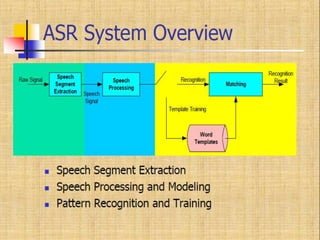
 Speech Recognization is process of decoding 
acoustic speech signal captured by microphone or 
telephone ,to a set of words. 
 And with the help of these it will recognize whole 
speech is recognized word by word .
 : speaker independent and speaker dependent. 
 Speaker independent models recognize the speech patterns of a 
large group of people. 
 Speaker dependent models recognize speech patterns from only 
one person. Both models use mathematical and statistical 
formulas to yield the best work match for speech. A third 
variation of speaker models is now emerging, called speaker 
adaptive. 
 Speaker adaptive systems usually begin with a speaker 
independent model and adjust these models more closely to 
each individual during a brief training period.
• Most Natural Form Of 
Communication 
• Differently abled people 
• Illiterate 
• Helplines 
• Cars
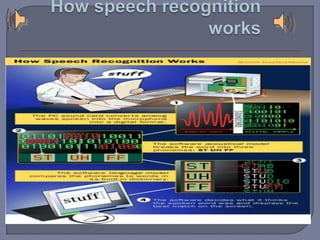
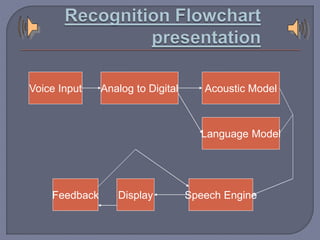
Voice Input Analog to Digital Acoustic Model 
Language Model 
Feedback Display Speech Engine
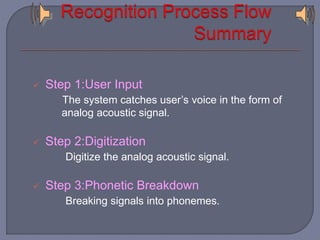
 Step 1:User Input 
The system catches user’s voice in the form of 
analog acoustic signal. 
 Step 2:Digitization 
Digitize the analog acoustic signal. 
 Step 3:Phonetic Breakdown 
Breaking signals into phonemes.
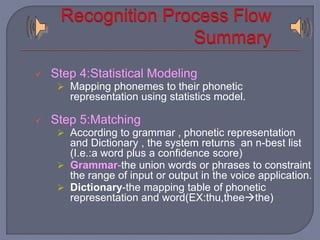
 Step 4:Statistical Modeling 
 Mapping phonemes to their phonetic 
representation using statistics model. 
 Step 5:Matching 
 According to grammar , phonetic representation 
and Dictionary , the system returns an n-best list 
(I.e.:a word plus a confidence score) 
 Grammar-the union words or phrases to constraint 
the range of input or output in the voice application. 
 Dictionary-the mapping table of phonetic 
representation and word(EX:thu,theethe)
13 
/3 
4 
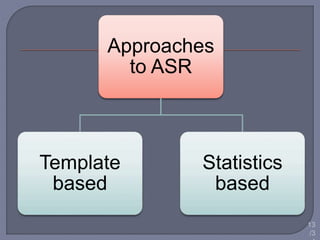
Approaches 
to ASR 
Template 
based 
Statistics 
based
Store examples of units (words, 
phonemes), then find the example that 
most closely fits the input 
Extract features from speech signal, then 
it’s “just” a complex similarity matching 
problem, using solutions developed for all 
sorts of applications 
OK for discrete utterances, and a single 
user 
14 
/3 
4
Hard to distinguish very similar templates 
And quickly degrades when input differs 
from templates 
Therefore needs techniques to mitigate 
this degradation: 
• More subtle matching techniques 
• Multiple templates which are aggregated 
 Taken together, these suggested … 
15 
/3 
4
Collect a large corpus of transcribed 
speech recordings 
Train the computer to learn the 
correspondences (“machine learning”) 
At run time, apply statistical processes to 
search through the space of all possible 
solutions, and pick the statistically most 
likely one 
16 
/3 
4
Acoustic and Lexical Models 
• Analyse training data in terms of relevant features 
• Learn from large amount of data different 
possibilities 
 different phone sequences for a given word 
 different combinations of elements of the speech signal 
for a given phone/phoneme 
• Combine these into a Hidden Markov Model 
expressing the probabilities 
17 
/3 
4
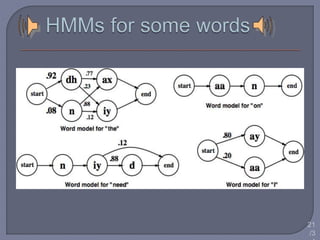
 Real-world has structures and processes which have (or 
produce) observable outputs: 
o Usually sequential (process unfolds over time) 
o Cannot see the event producing the output 
Example: speech signals
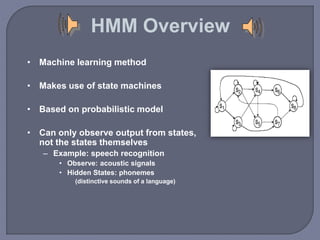
HMM Overview 
• Machine learning method 
• Makes use of state machines 
• Based on probabilistic model 
• Can only observe output from states, 
not the states themselves 
– Example: speech recognition 
• Observe: acoustic signals 
• Hidden States: phonemes 
(distinctive sounds of a language)
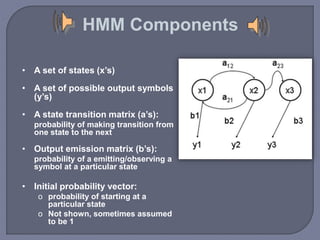
HMM Components 
• A set of states (x’s) 
• A set of possible output symbols 
(y’s) 
• A state transition matrix (a’s): 
probability of making transition from 
one state to the next 
• Output emission matrix (b’s): 
probability of a emitting/observing a 
symbol at a particular state 
• Initial probability vector: 
o probability of starting at a 
particular state 
o Not shown, sometimes assumed 
to be 1
21 
/3 
4
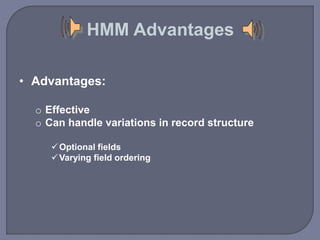
HMM Advantages 
• Advantages: 
o Effective 
o Can handle variations in record structure 
Optional fields 
Varying field ordering
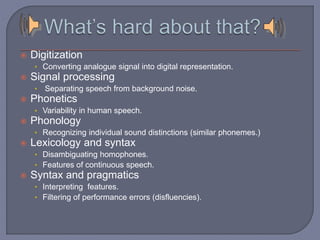
 Digitization 
• Converting analogue signal into digital representation. 
 Signal processing 
• Separating speech from background noise. 
 Phonetics 
• Variability in human speech. 
 Phonology 
• Recognizing individual sound distinctions (similar phonemes.) 
 Lexicology and syntax 
• Disambiguating homophones. 
• Features of continuous speech. 
 Syntax and pragmatics 
• Interpreting features. 
• Filtering of performance errors (disfluencies).
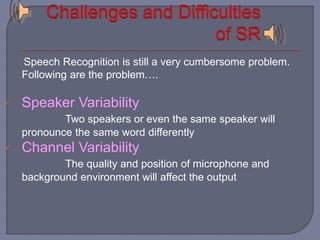
Speech Recognition is still a very cumbersome problem. 
Following are the problem…. 
 Speaker Variability 
Two speakers or even the same speaker will 
pronounce the same word differently 
 Channel Variability 
The quality and position of microphone and 
background environment will affect the output
 Speech recognition applications include 
 Voice dialling (e.g., "Call home"), 
 Call routing (e.g., "I would like to make a collect call"), 
 Simple data entry (e.g., entering a credit card number), 
 Preparation of structured documents (e.g., A radiology 
report), 
 Speech-to-text processing (e.g., word processors or emails), 
and 
 In aircraft cockpits (usually termed Direct Voice Input).
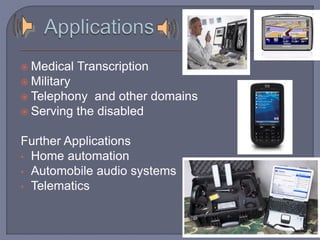
 Medical Transcription 
 Military 
 Telephony and other domains 
 Serving the disabled 
Further Applications 
• Home automation 
• Automobile audio systems 
• Telematics
 Faster than “hand-writing”. 
 Allows for better spelling, whether it be in 
text or documents. 
 Helpful for people with a mental or 
physical disability . 
 Hands-free capability .
 No program is 100% perfect 
 Factors that affect the accuracy of speech 
recognition are: slang, homonyms, signal-to- 
noise ratio, and overlapping speech 
 Can be expensive depending on the 
program
 http://en.wikipedia.org/wiki/Speech_recognition 
 https://www.scribd.com/doc/130376790/Speech- 
Recognition 
 "Speaker Independent Connected Speech Recognition- Fifth 
Generation Computer Corporation". Fifthgen.com. 
 http://books.google.co.in/books?hl=en&lr=&id=iDHgboYR 
zmgC&oi=fnd&pg=PA1&dq=speech+recognition+papers+ 
publications&ots=jb6NESTrjF&sig=oMKROIXccSgEyMGO 
Zmi5lkToJvM#v=onepage&q=speech%20recognition%20p 
apers%20publications&f=false 
 http://www.speechrecognition.com 
 https://www.google.co.in/?gfe_rd=cr&ei=GbHdU9f1MtKAo 
AOW64GADg&gws_rd=ssl
Speech recognition final presentation

Speech recognition final presentation

  • 4.
    • What isspeech recognition?
  • 5.
     Speech recognitiontechnology has recently reached a higher level of performance and robustness, allowing it to communicate to another user by talking .  Speech Recognization is process of decoding acoustic speech signal captured by microphone or telephone ,to a set of words.  And with the help of these it will recognize whole speech is recognized word by word .
  • 6.
     : speakerindependent and speaker dependent.  Speaker independent models recognize the speech patterns of a large group of people.  Speaker dependent models recognize speech patterns from only one person. Both models use mathematical and statistical formulas to yield the best work match for speech. A third variation of speaker models is now emerging, called speaker adaptive.  Speaker adaptive systems usually begin with a speaker independent model and adjust these models more closely to each individual during a brief training period.
  • 7.
    • Most NaturalForm Of Communication • Differently abled people • Illiterate • Helplines • Cars
  • 10.
    Voice Input Analogto Digital Acoustic Model Language Model Feedback Display Speech Engine
  • 11.
     Step 1:UserInput The system catches user’s voice in the form of analog acoustic signal.  Step 2:Digitization Digitize the analog acoustic signal.  Step 3:Phonetic Breakdown Breaking signals into phonemes.
  • 12.
     Step 4:StatisticalModeling  Mapping phonemes to their phonetic representation using statistics model.  Step 5:Matching  According to grammar , phonetic representation and Dictionary , the system returns an n-best list (I.e.:a word plus a confidence score)  Grammar-the union words or phrases to constraint the range of input or output in the voice application.  Dictionary-the mapping table of phonetic representation and word(EX:thu,theethe)
  • 13.
    13 /3 4 Approaches to ASR Template based Statistics based
  • 14.
    Store examples ofunits (words, phonemes), then find the example that most closely fits the input Extract features from speech signal, then it’s “just” a complex similarity matching problem, using solutions developed for all sorts of applications OK for discrete utterances, and a single user 14 /3 4
  • 15.
    Hard to distinguishvery similar templates And quickly degrades when input differs from templates Therefore needs techniques to mitigate this degradation: • More subtle matching techniques • Multiple templates which are aggregated  Taken together, these suggested … 15 /3 4
  • 16.
    Collect a largecorpus of transcribed speech recordings Train the computer to learn the correspondences (“machine learning”) At run time, apply statistical processes to search through the space of all possible solutions, and pick the statistically most likely one 16 /3 4
  • 17.
    Acoustic and LexicalModels • Analyse training data in terms of relevant features • Learn from large amount of data different possibilities  different phone sequences for a given word  different combinations of elements of the speech signal for a given phone/phoneme • Combine these into a Hidden Markov Model expressing the probabilities 17 /3 4
  • 18.
     Real-world hasstructures and processes which have (or produce) observable outputs: o Usually sequential (process unfolds over time) o Cannot see the event producing the output Example: speech signals
  • 19.
    HMM Overview •Machine learning method • Makes use of state machines • Based on probabilistic model • Can only observe output from states, not the states themselves – Example: speech recognition • Observe: acoustic signals • Hidden States: phonemes (distinctive sounds of a language)
  • 20.
    HMM Components •A set of states (x’s) • A set of possible output symbols (y’s) • A state transition matrix (a’s): probability of making transition from one state to the next • Output emission matrix (b’s): probability of a emitting/observing a symbol at a particular state • Initial probability vector: o probability of starting at a particular state o Not shown, sometimes assumed to be 1
  • 21.
  • 22.
    HMM Advantages •Advantages: o Effective o Can handle variations in record structure Optional fields Varying field ordering
  • 23.
     Digitization •Converting analogue signal into digital representation.  Signal processing • Separating speech from background noise.  Phonetics • Variability in human speech.  Phonology • Recognizing individual sound distinctions (similar phonemes.)  Lexicology and syntax • Disambiguating homophones. • Features of continuous speech.  Syntax and pragmatics • Interpreting features. • Filtering of performance errors (disfluencies).
  • 24.
    Speech Recognition isstill a very cumbersome problem. Following are the problem….  Speaker Variability Two speakers or even the same speaker will pronounce the same word differently  Channel Variability The quality and position of microphone and background environment will affect the output
  • 25.
     Speech recognitionapplications include  Voice dialling (e.g., "Call home"),  Call routing (e.g., "I would like to make a collect call"),  Simple data entry (e.g., entering a credit card number),  Preparation of structured documents (e.g., A radiology report),  Speech-to-text processing (e.g., word processors or emails), and  In aircraft cockpits (usually termed Direct Voice Input).
  • 26.
     Medical Transcription  Military  Telephony and other domains  Serving the disabled Further Applications • Home automation • Automobile audio systems • Telematics
  • 27.
     Faster than“hand-writing”.  Allows for better spelling, whether it be in text or documents.  Helpful for people with a mental or physical disability .  Hands-free capability .
  • 28.
     No programis 100% perfect  Factors that affect the accuracy of speech recognition are: slang, homonyms, signal-to- noise ratio, and overlapping speech  Can be expensive depending on the program
  • 29.
     http://en.wikipedia.org/wiki/Speech_recognition https://www.scribd.com/doc/130376790/Speech- Recognition  "Speaker Independent Connected Speech Recognition- Fifth Generation Computer Corporation". Fifthgen.com.  http://books.google.co.in/books?hl=en&lr=&id=iDHgboYR zmgC&oi=fnd&pg=PA1&dq=speech+recognition+papers+ publications&ots=jb6NESTrjF&sig=oMKROIXccSgEyMGO Zmi5lkToJvM#v=onepage&q=speech%20recognition%20p apers%20publications&f=false  http://www.speechrecognition.com  https://www.google.co.in/?gfe_rd=cr&ei=GbHdU9f1MtKAo AOW64GADg&gws_rd=ssl