MEDICAL AND SURGICAL NURSING

                                   TRACHEOSTOMY CARE

                           Lecturer: Mark Fredderick R. Abejo RN,MAN
                    __________________________________________________


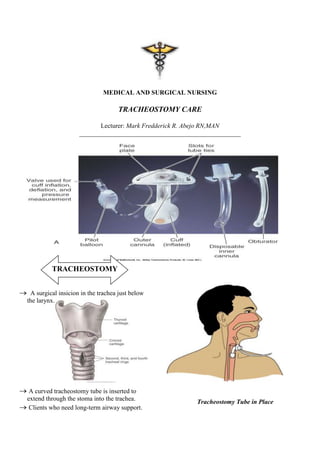
         TRACHEOSTOMY


 A surgical insicion in the trachea just below
the larynx.


 A curved tracheostomy tube is inserted to
extend through the stoma into the trachea.              Tracheostomy Tube in Place
 Clients who need long-term airway support.
Lecture Notes on Tracheostomy Care
Prepared By: Mark Fredderick R Abejo R.N, M.A.N
             Clinical Instructor


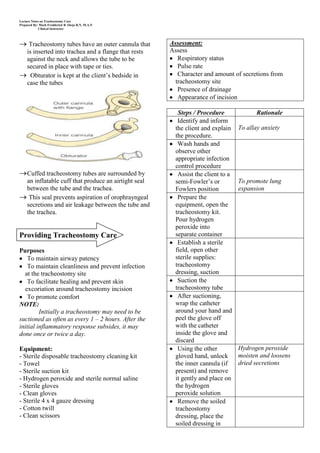
     Tracheostomy tubes have an outer cannula that     Assessment:
    is inserted into trachea and a flange that rests   Assess
    against the neck and allows the tube to be            Respiratory status
    secured in place with tape or ties.                   Pulse rate
      Obturator is kept at the client’s bedside in        Character and amount of secretions from
    case the tubes                                       tracheostomy site
                                                          Presence of drainage
                                                          Appearance of incision

                                                          Steps / Procedure               Rationale
                                                          Identify and inform
                                                         the client and explain    To allay anxiety
                                                         the procedure.
                                                          Wash hands and
                                                         observe other
                                                         appropriate infection
                                                         control procedure
    Cuffed tracheostomy tubes are surrounded by           Assist the client to a
    an inflatable cuff that produce an airtight seal     semi-Fowler’s or          To promote lung
    between the tube and the trachea.                    Fowlers position          expansion
     This seal prevents aspiration of orophrayngeal       Prepare the
    secretions and air leakage between the tube and      equipment, open the
    the trachea.                                         tracheostomy kit.
                                                         Pour hydrogen
                                                         peroxide into
Providing Tracheostomy Care                              separate container
                                                          Establish a sterile
Purposes                                                 field, open other
    To maintain airway patency                           sterile supplies:
    To maintain cleanliness and prevent infection        tracheostomy
  at the tracheostomy site                               dressing, suction
    To facilitate healing and prevent skin                Suction the
  excoriation around tracheostomy incision               tracheostomy tube
    To promote comfort                                    After suctioning,
NOTE:                                                    wrap the catheter
         Initially a tracheostomy may need to be         around your hand and
suctioned as often as every 1 – 2 hours. After the       peel the glove off
initial inflammatory response subsides, it may           with the catheter
done once or twice a day.                                inside the glove and
                                                         discard
Equipment:                                                Using the other          Hydrogen peroxide
- Sterile disposable tracheostomy cleaning kit           gloved hand, unlock       moisten and loosens
- Towel                                                  the inner cannula (if     dried secretions
- Sterile suction kit                                    present) and remove
- Hydrogen peroxide and sterile normal saline            it gently and place on
- Sterile gloves                                         the hydrogen
- Clean gloves                                           peroxide solution
- Sterile 4 x 4 gauze dressing                            Remove the soiled
- Cotton twill                                           tracheostomy
- Clean scissors                                         dressing, place the
                                                         soiled dressing in
Lecture Notes on Tracheostomy Care
Prepared By: Mark Fredderick R Abejo R.N, M.A.N
             Clinical Instructor


  your gloved hand and
  peel the glove off
  with the soiled
  dressing and discard
   Put on another
  sterile gloves. Keep
  dominant hand sterile
  during the procedure.
   Clean the inner
  cannula:
 Remove the inner
   cannula from the
   soaking solution
 Clean the lumen and
   entire cannula
   thoroughly using a
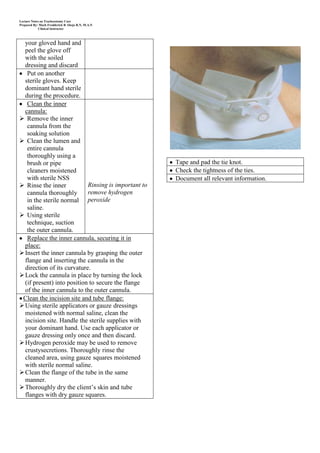
   brush or pipe                                      Tape and pad the tie knot.
   cleaners moistened                                 Check the tightness of the ties.
   with sterile NSS                                   Document all relevant information.
 Rinse the inner           Rinsing is important to
   cannula thoroughly       remove hydrogen
   in the sterile normal peroxide
   saline.
 Using sterile
   technique, suction
   the outer cannula.
   Replace the inner cannula, securing it in
  place:
 Insert the inner cannula by grasping the outer
  flange and inserting the cannula in the
  direction of its curvature.
 Lock the cannula in place by turning the lock
  (if present) into position to secure the flange
  of the inner cannula to the outer cannula.
 Clean the incision site and tube flange:
 Using sterile applicators or gauze dressings
  moistened with normal saline, clean the
  incision site. Handle the sterile supplies with
  your dominant hand. Use each applicator or
  gauze dressing only once and then discard.
 Hydrogen peroxide may be used to remove
  crustysecretions. Thoroughly rinse the
  cleaned area, using gauze squares moistened
  with sterile normal saline.
 Clean the flange of the tube in the same
  manner.
 Thoroughly dry the client’s skin and tube
  flanges with dry gauze squares.

Tracheostomy Care

  • 1.
    MEDICAL AND SURGICALNURSING TRACHEOSTOMY CARE Lecturer: Mark Fredderick R. Abejo RN,MAN __________________________________________________ TRACHEOSTOMY A surgical insicion in the trachea just below the larynx. A curved tracheostomy tube is inserted to extend through the stoma into the trachea. Tracheostomy Tube in Place Clients who need long-term airway support.
  • 2.
    Lecture Notes onTracheostomy Care Prepared By: Mark Fredderick R Abejo R.N, M.A.N Clinical Instructor Tracheostomy tubes have an outer cannula that Assessment: is inserted into trachea and a flange that rests Assess against the neck and allows the tube to be Respiratory status secured in place with tape or ties. Pulse rate Obturator is kept at the client’s bedside in Character and amount of secretions from case the tubes tracheostomy site Presence of drainage Appearance of incision Steps / Procedure Rationale Identify and inform the client and explain To allay anxiety the procedure. Wash hands and observe other appropriate infection control procedure Cuffed tracheostomy tubes are surrounded by Assist the client to a an inflatable cuff that produce an airtight seal semi-Fowler’s or To promote lung between the tube and the trachea. Fowlers position expansion This seal prevents aspiration of orophrayngeal Prepare the secretions and air leakage between the tube and equipment, open the the trachea. tracheostomy kit. Pour hydrogen peroxide into Providing Tracheostomy Care separate container Establish a sterile Purposes field, open other To maintain airway patency sterile supplies: To maintain cleanliness and prevent infection tracheostomy at the tracheostomy site dressing, suction To facilitate healing and prevent skin Suction the excoriation around tracheostomy incision tracheostomy tube To promote comfort After suctioning, NOTE: wrap the catheter Initially a tracheostomy may need to be around your hand and suctioned as often as every 1 – 2 hours. After the peel the glove off initial inflammatory response subsides, it may with the catheter done once or twice a day. inside the glove and discard Equipment: Using the other Hydrogen peroxide - Sterile disposable tracheostomy cleaning kit gloved hand, unlock moisten and loosens - Towel the inner cannula (if dried secretions - Sterile suction kit present) and remove - Hydrogen peroxide and sterile normal saline it gently and place on - Sterile gloves the hydrogen - Clean gloves peroxide solution - Sterile 4 x 4 gauze dressing Remove the soiled - Cotton twill tracheostomy - Clean scissors dressing, place the soiled dressing in
  • 3.
    Lecture Notes onTracheostomy Care Prepared By: Mark Fredderick R Abejo R.N, M.A.N Clinical Instructor your gloved hand and peel the glove off with the soiled dressing and discard Put on another sterile gloves. Keep dominant hand sterile during the procedure. Clean the inner cannula:  Remove the inner cannula from the soaking solution  Clean the lumen and entire cannula thoroughly using a brush or pipe Tape and pad the tie knot. cleaners moistened Check the tightness of the ties. with sterile NSS Document all relevant information.  Rinse the inner Rinsing is important to cannula thoroughly remove hydrogen in the sterile normal peroxide saline.  Using sterile technique, suction the outer cannula. Replace the inner cannula, securing it in place:  Insert the inner cannula by grasping the outer flange and inserting the cannula in the direction of its curvature.  Lock the cannula in place by turning the lock (if present) into position to secure the flange of the inner cannula to the outer cannula. Clean the incision site and tube flange:  Using sterile applicators or gauze dressings moistened with normal saline, clean the incision site. Handle the sterile supplies with your dominant hand. Use each applicator or gauze dressing only once and then discard.  Hydrogen peroxide may be used to remove crustysecretions. Thoroughly rinse the cleaned area, using gauze squares moistened with sterile normal saline.  Clean the flange of the tube in the same manner.  Thoroughly dry the client’s skin and tube flanges with dry gauze squares.