PREPARED BY
DR.SHALI B.S
PROFESSOR
MAMATA COLLEGE OF NURSING.KHAMMAM
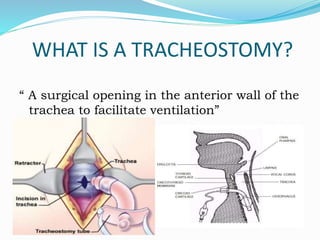
WHAT IS A TRACHEOSTOMY?
“ A surgical opening in the anterior wall of the
trachea to facilitate ventilation”
History
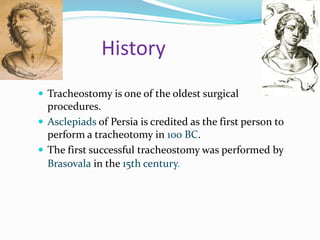
 Tracheostomy is one of the oldest surgical
procedures.
 Asclepiads of Persia is credited as the first person to
perform a tracheotomy in 100 BC.
 The first successful tracheostomy was performed by
Brasovala in the 15th century.
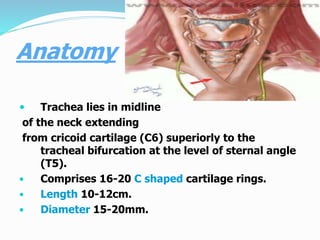
Anatomy
 Trachea lies in midline
of the neck extending
from cricoid cartilage (C6) superiorly to the
tracheal bifurcation at the level of sternal angle
(T5).
• Comprises 16-20 C shaped cartilage rings.
• Length 10-12cm.
• Diameter 15-20mm.
TYPES OF TRACHEOSTOMY
• Temporary
 Permanent
Types of Tubes
 Cuffed tubes
 Un-cuffed
 Fenestrated
 Inner cannula
Silver, Silicone and Rubber
 Mini Tracheostomies
Cuffed Tubes
 Allows ventilation and
prevents aspiration
Un-cuffed Tubes
 Maintains airway
 Increase airflow to the larynx
Fenestrated Tube
 Increases airflow to larynx
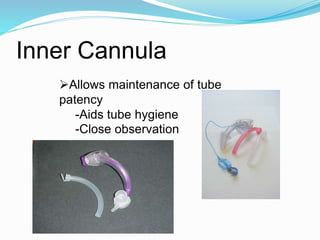
Inner Cannula
Allows maintenance of tube
patency
-Aids tube hygiene
-Close observation
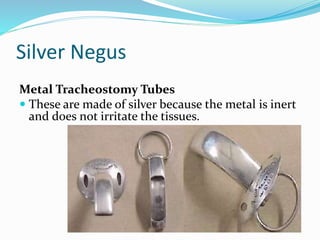
Silver Negus
Metal Tracheostomy Tubes
 These are made of silver because the metal is inert
and does not irritate the tissues.
Metal Tracheostomy Tubes
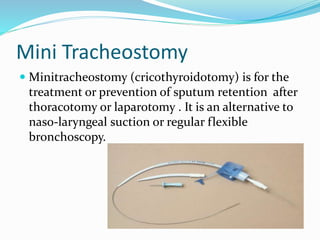
Mini Tracheostomy
 Minitracheostomy (cricothyroidotomy) is for the
treatment or prevention of sputum retention after
thoracotomy or laparotomy . It is an alternative to
naso-laryngeal suction or regular flexible
bronchoscopy.
PARTS
 The outer tube is remines held in place by a ribbon or
tie which is passed through the loop on the either side
of the opening of the tube.
 The obturator is used only to guide the outer tube
during insertion and is removed immediately after the
outer tube is placed .
 The inner cannula is fits in side the outer tube and
locked in place after the obturator is removed.
INDICATIONS FOR TRACHEOSTOMY
 To actual mechanical obstructions, including:
tumour, stenosis, oedema of the larynx and trachea
 Congenital abnormalities
 Inflammation or infection e.g...diphtheria, laryngitis,
tetanus etc.
 Trauma - accidental and surgical to the larynx and
trachea
 Severe burns around the face and neck
 Foreign bodies
 Impaired respiratory muscle function- paralysis
Cont…
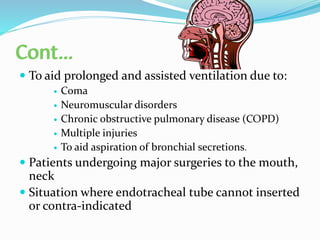
 To aid prolonged and assisted ventilation due to:
 Coma
 Neuromuscular disorders
 Chronic obstructive pulmonary disease (COPD)
 Multiple injuries
 To aid aspiration of bronchial secretions.
 Patients undergoing major surgeries to the mouth,
neck
 Situation where endotracheal tube cannot inserted
or contra-indicated
Cont…
NURSING CARE OF PATIENT WITH
TRACHEOSTOMY
EQUIPMENT
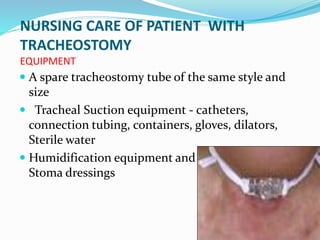
 A spare tracheostomy tube of the same style and
size
 Tracheal Suction equipment - catheters,
connection tubing, containers, gloves, dilators,
Sterile water
 Humidification equipment and Syringes and
Stoma dressings
Tube cleansing:-
 If re-usable, and for the same patient, inner and outer
tubes can be cleansed by soaking the parts in a cleansing
solution, such as a mild detergent, half-strength hydrogen
peroxide, normal saline or a weak solution of sodium
bicarbonate for a maximum of two hours.
 The lumen of silver tubes is cleaned with a soft bottle
brush under running water, but this practice should be
avoided with plastic tubes because brushing could damage
the tube.
 The tube should be stored dry. Silver parts can also be
autoclaved
Outer tube changing:-
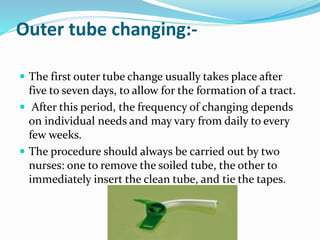
 The first outer tube change usually takes place after
five to seven days, to allow for the formation of a tract.
 After this period, the frequency of changing depends
on individual needs and may vary from daily to every
few weeks.
 The procedure should always be carried out by two
nurses: one to remove the soiled tube, the other to
immediately insert the clean tube, and tie the tapes.
Inner tube changing: -
 The inner tube should be changed at least twice daily.
Once it has been removed, a clean one should be
inserted immediately.
Stoma care:-
 The neck incision site must be cleaned twice a day
because tracheal secretions can easily infect it.
 During stoma toilet, the soiled dressing is removed
and the wound, under the tube flanges, is cleansed
using a moistened cotton wool applicator or swab.
 Normal saline is often the chosen cleansing
product and can be followed with the application
of a small amount of mild lubricant, such as white
soft paraffin, if the skin needs further protection
Cont..
 Avoid using powders, sprays, or
shaving cream around the tube.
 Avoid allowing water to enter the
opening during bathing
 Gauze squares are used to apply a small amount of
antibiotic ointment to help in wound healing
around the stoma
Suction
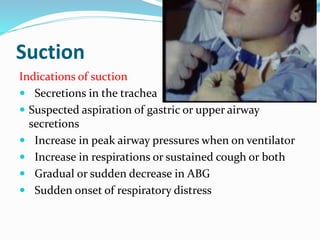
Indications of suction
 Secretions in the trachea
 Suspected aspiration of gastric or upper airway
secretions
 Increase in peak airway pressures when on ventilator
 Increase in respirations or sustained cough or both
 Gradual or sudden decrease in ABG
 Sudden onset of respiratory distress
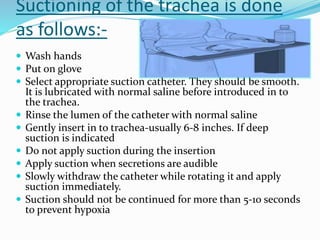
Suctioning of the trachea is done
as follows:-
 Wash hands
 Put on glove
 Select appropriate suction catheter. They should be smooth.
It is lubricated with normal saline before introduced in to
the trachea.
 Rinse the lumen of the catheter with normal saline
 Gently insert in to trachea-usually 6-8 inches. If deep
suction is indicated
 Do not apply suction during the insertion
 Apply suction when secretions are audible
 Slowly withdraw the catheter while rotating it and apply
suction immediately.
 Suction should not be continued for more than 5-10 seconds
to prevent hypoxia
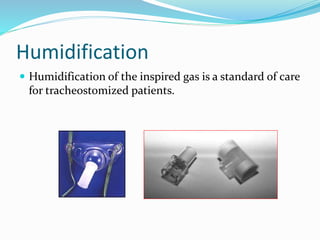
Humidification
 Humidification of the inspired gas is a standard of care
for tracheostomized patients.
RECORDING
DATE,TIME;
Descriptions of secretions
-watery (thin)
- Scant- small amounts.
- Copious ( large amounts)
-Frothy (with bubble)
Color - clear, white, yellow,
green, gray, brown, bloddy
Odor
COMPLICATION OF
TRACHEOSTOMY
 1. Displaced tubes ,
 2. Blocked tubes
 3. Emphysema
 4. Wound and respiratory tract infections
 5. Haemorrhage
 6. Tracheal stenosis.
 7. Tracheo-oesophageal fistula
CONCLUSION
 The most common indications for tracheostomy is
mechanical ventilation with prolonged tracheal
intubation.
 Tracheostomy: emergency and elective, improve
quality of life.
 Should maintain aseptic precautions
 Appropriate postoperative tracheostomy care to
reduce complications.
“SAVE ME WITH YOUR CARING
HANDS “
THANK YOU

Tracheostomy

  • 1.
  • 3.
    WHAT IS ATRACHEOSTOMY? “ A surgical opening in the anterior wall of the trachea to facilitate ventilation”
  • 4.
    History  Tracheostomy isone of the oldest surgical procedures.  Asclepiads of Persia is credited as the first person to perform a tracheotomy in 100 BC.  The first successful tracheostomy was performed by Brasovala in the 15th century.
  • 5.
    Anatomy  Trachea liesin midline of the neck extending from cricoid cartilage (C6) superiorly to the tracheal bifurcation at the level of sternal angle (T5). • Comprises 16-20 C shaped cartilage rings. • Length 10-12cm. • Diameter 15-20mm.
  • 6.
    TYPES OF TRACHEOSTOMY •Temporary  Permanent
  • 7.
    Types of Tubes Cuffed tubes  Un-cuffed  Fenestrated  Inner cannula Silver, Silicone and Rubber  Mini Tracheostomies
  • 8.
    Cuffed Tubes  Allowsventilation and prevents aspiration
  • 9.
    Un-cuffed Tubes  Maintainsairway  Increase airflow to the larynx
  • 10.
  • 11.
    Inner Cannula Allows maintenanceof tube patency -Aids tube hygiene -Close observation
  • 12.
    Silver Negus Metal TracheostomyTubes  These are made of silver because the metal is inert and does not irritate the tissues.
  • 13.
  • 14.
    Mini Tracheostomy  Minitracheostomy(cricothyroidotomy) is for the treatment or prevention of sputum retention after thoracotomy or laparotomy . It is an alternative to naso-laryngeal suction or regular flexible bronchoscopy.
  • 15.
    PARTS  The outertube is remines held in place by a ribbon or tie which is passed through the loop on the either side of the opening of the tube.  The obturator is used only to guide the outer tube during insertion and is removed immediately after the outer tube is placed .  The inner cannula is fits in side the outer tube and locked in place after the obturator is removed.
  • 16.
    INDICATIONS FOR TRACHEOSTOMY To actual mechanical obstructions, including: tumour, stenosis, oedema of the larynx and trachea  Congenital abnormalities  Inflammation or infection e.g...diphtheria, laryngitis, tetanus etc.  Trauma - accidental and surgical to the larynx and trachea  Severe burns around the face and neck  Foreign bodies  Impaired respiratory muscle function- paralysis
  • 17.
    Cont…  To aidprolonged and assisted ventilation due to:  Coma  Neuromuscular disorders  Chronic obstructive pulmonary disease (COPD)  Multiple injuries  To aid aspiration of bronchial secretions.  Patients undergoing major surgeries to the mouth, neck  Situation where endotracheal tube cannot inserted or contra-indicated Cont…
  • 18.
    NURSING CARE OFPATIENT WITH TRACHEOSTOMY EQUIPMENT  A spare tracheostomy tube of the same style and size  Tracheal Suction equipment - catheters, connection tubing, containers, gloves, dilators, Sterile water  Humidification equipment and Syringes and Stoma dressings
  • 19.
    Tube cleansing:-  Ifre-usable, and for the same patient, inner and outer tubes can be cleansed by soaking the parts in a cleansing solution, such as a mild detergent, half-strength hydrogen peroxide, normal saline or a weak solution of sodium bicarbonate for a maximum of two hours.  The lumen of silver tubes is cleaned with a soft bottle brush under running water, but this practice should be avoided with plastic tubes because brushing could damage the tube.  The tube should be stored dry. Silver parts can also be autoclaved
  • 20.
    Outer tube changing:- The first outer tube change usually takes place after five to seven days, to allow for the formation of a tract.  After this period, the frequency of changing depends on individual needs and may vary from daily to every few weeks.  The procedure should always be carried out by two nurses: one to remove the soiled tube, the other to immediately insert the clean tube, and tie the tapes.
  • 21.
    Inner tube changing:-  The inner tube should be changed at least twice daily. Once it has been removed, a clean one should be inserted immediately.
  • 22.
    Stoma care:-  Theneck incision site must be cleaned twice a day because tracheal secretions can easily infect it.  During stoma toilet, the soiled dressing is removed and the wound, under the tube flanges, is cleansed using a moistened cotton wool applicator or swab.  Normal saline is often the chosen cleansing product and can be followed with the application of a small amount of mild lubricant, such as white soft paraffin, if the skin needs further protection
  • 23.
    Cont..  Avoid usingpowders, sprays, or shaving cream around the tube.  Avoid allowing water to enter the opening during bathing  Gauze squares are used to apply a small amount of antibiotic ointment to help in wound healing around the stoma
  • 24.
    Suction Indications of suction Secretions in the trachea  Suspected aspiration of gastric or upper airway secretions  Increase in peak airway pressures when on ventilator  Increase in respirations or sustained cough or both  Gradual or sudden decrease in ABG  Sudden onset of respiratory distress
  • 25.
    Suctioning of thetrachea is done as follows:-  Wash hands  Put on glove  Select appropriate suction catheter. They should be smooth. It is lubricated with normal saline before introduced in to the trachea.  Rinse the lumen of the catheter with normal saline  Gently insert in to trachea-usually 6-8 inches. If deep suction is indicated  Do not apply suction during the insertion  Apply suction when secretions are audible  Slowly withdraw the catheter while rotating it and apply suction immediately.  Suction should not be continued for more than 5-10 seconds to prevent hypoxia
  • 27.
    Humidification  Humidification ofthe inspired gas is a standard of care for tracheostomized patients.
  • 28.
    RECORDING DATE,TIME; Descriptions of secretions -watery(thin) - Scant- small amounts. - Copious ( large amounts) -Frothy (with bubble) Color - clear, white, yellow, green, gray, brown, bloddy Odor
  • 29.
    COMPLICATION OF TRACHEOSTOMY  1.Displaced tubes ,  2. Blocked tubes  3. Emphysema  4. Wound and respiratory tract infections  5. Haemorrhage  6. Tracheal stenosis.  7. Tracheo-oesophageal fistula
  • 30.
    CONCLUSION  The mostcommon indications for tracheostomy is mechanical ventilation with prolonged tracheal intubation.  Tracheostomy: emergency and elective, improve quality of life.  Should maintain aseptic precautions  Appropriate postoperative tracheostomy care to reduce complications.
  • 31.
    “SAVE ME WITHYOUR CARING HANDS “
  • 32.