TRACHEOSTOMY CARE
BY:-
PREETI SHARMA
MSC. NSG. 1ST YEAR
INTRODUCTION
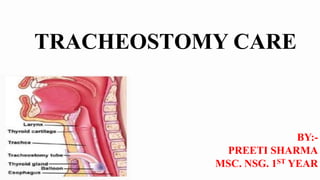
โ€ข A tracheostomy is an opening through the neck into the
trachea. A tracheostomy opens the airway and aidsbreathing.
โ€ข A tracheostomy may be done in an emergency, at the patientโ€™s
bedside or in an operating room. Anaesthesia may be used
before the procedure. Depending on the personโ€™s condition, the
tracheostomy may be temporary or permanent.
DEFINITION
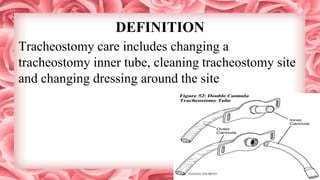
Tracheostomy care includes changing a
tracheostomy inner tube, cleaning tracheostomy site
and changing dressing around the site
PURPOSE
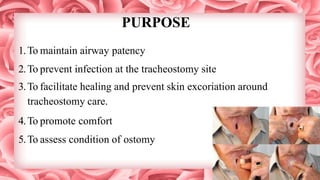
1.To maintain airway patency
2.To prevent infection at the tracheostomy site
3.To facilitate healing and prevent skin excoriation around
tracheostomy care.
4.To promote comfort
5.To assess condition of ostomy
INDICATION
๏ฑAcute Respiratory failure
๏ฑObstruction in the upper airway
๏ฑFacilitate the removal of respiratory secretions
๏ฑSubcutaneous emphysema
๏ฑNeck trauma that results in severe injury to the thyroid or
cricoids cartilages
CONTRAINDICATIONS
๏ฑRaised inter cranial pressure
๏ฑTracheo / Oesophageal fistula
๏ฑCancer in upper GI or respiratory tract
๏ฑOesophageal or high GI surgery
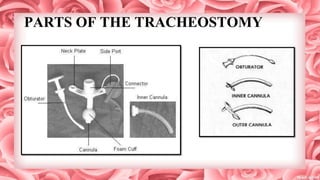
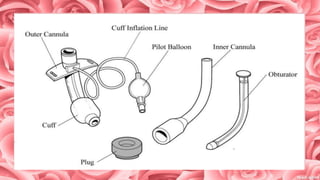
PARTS OF THE TRACHEOSTOMY
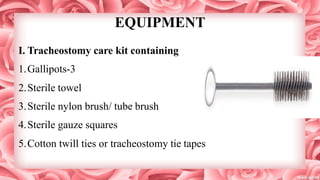
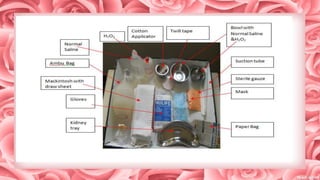
EQUIPMENT
I. Tracheostomy care kit containing
1.Gallipots-3
2.Sterile towel
3.Sterile nylon brush/ tube brush
4.Sterile gauze squares
5.Cotton twill ties or tracheostomy tie tapes
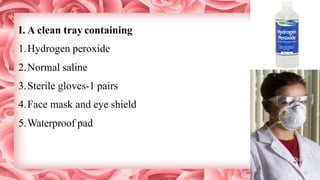
I. A clean tray containing
1.Hydrogen peroxide
2.Normal saline
3.Sterile gloves-1 pairs
4.Face mask and eye shield
5.Waterproof pad
PRELIMINARY ASSESSMENT
๏‚งCheck the physicianโ€™s order.
๏‚งExplain the procedure to patient include instruction to co-operate.
๏‚งEnsure patientโ€™s privacy.
๏‚งProvide the position which is comfort to patient. Usually semi-fowler
position is provided.
๏‚งMonitor heart rate, respiratory rate, temperature, pulse, blood pressure,
arterial blood pressure and arterial blood gases.
๏‚งCollect all the equipment and place in easy to take during the procedure.
๏‚งAuscultate chest sounds.
๏‚งCheck the function of suction apparatus and resuscitation bag.
๏‚งWash the hands, dry the hands and wear gloves.
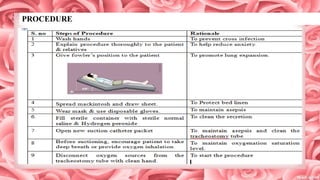
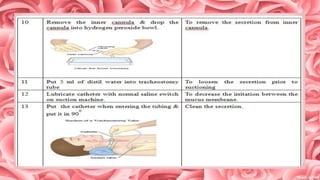
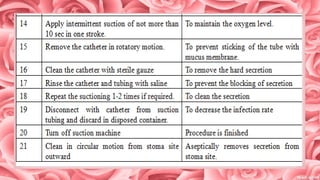
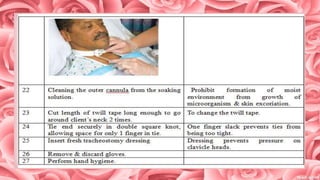
PROCEDURE
AFTER CARE
๏‚งRemove your gloves and throw them away.
๏‚งProvide comfort position to the patient.
๏‚งWash your hands with soap and warm water.
๏‚งWash the articles with soap and warm water.
๏‚งPut the used wash cloth & towel in the laundry.
๏‚งDiscard all the waste materials.
NURSES RESPONSIBILITY
1. Tracheostomy dressing should be done every 8 hours or whenever dressing is
soiled
2. If disposable inner cannula is present, then replace the one that is inside with a
new one.
3. If only single lumen is present, clean the neck plate and tracheostomy site.
4. Emphasize the importance of handwashing before performing tracheostomy
care.
5. proper way on how to remove, change, and replace the inner cannula.
6. Check and clean the tracheostomy stoma.
7. Assess for symptoms of infection .
SCIENTIFIC PRINCIPLES
1. ANATOMY & PHYSIOLOGY
โ€ขThe respiratory tract consists of nose, pharynx, larynx,
trachea, bronchi & lungs.
โ€ขThe trachea is in front of the oesophagus so that the tube
can go into the trachea therefore the nurse must watch
placement of the tube.
โ€ขSkin is a soft flexible, membranous covering & is
continuous at the natural orifices with the mucus membrane.
CONTโ€ฆ
2. MICROBIOLOGY
โ€ขThe nurse must wash her hands before & after procedure to
prevent cross infections.
โ€ขThe intact skin is impassable barrier to microorganisms.
โ€ขAll equipment used for the care should be clean. Seprate
articles may be kept for individual patient to prevent cross
infection.
CONTโ€ฆ
3. PHYSICS & CHEMISTRY
โ€ขSoap lowers the surface tension of water & helps it to unite
quickly.
โ€ขOxygen passes from the air to the tissues, carbon dioxide passes
from the tissues to the air.
โ€ขOxygen is used into the blood by means of respiratory system.
CONTโ€ฆ
4. PSYCHOLOGY
โ€ขRelieve the anxiety of the patient by explaining what the
procedure is, what she is going to do.
โ€ขProvide privacy by screening.
โ€ขNurses should do her work as skillfully as possible so that her
power has been done to give the patient comfort & relief.
HEALTH EDUCATION
๏ƒผCleaning the tube carefully at least once a day.
๏ƒผWash your hands before and after care.
๏ƒผPlace a pillow or rolled towel under your neck, it will help
open your airway.
๏ƒผChange wet or dirty ties.
๏ƒผCheck your skin everyday for signs of infection like
redness, pus, bleeding etc.
๏ƒผDrink plenty of fluids.
CONCLUSION
In addition to suctioning the tracheostomy the nurse is
responsible for either cleaning anon-disposable inner cannula or
replacing a disposable one because soiled dressing of
tracheostomy places the patient at risk for the development of
skin breakdown & infection regularly change dressing & ties.
Tracheostomycare ppt

Tracheostomycare ppt

  • 2.
  • 3.
    INTRODUCTION โ€ข A tracheostomyis an opening through the neck into the trachea. A tracheostomy opens the airway and aidsbreathing. โ€ข A tracheostomy may be done in an emergency, at the patientโ€™s bedside or in an operating room. Anaesthesia may be used before the procedure. Depending on the personโ€™s condition, the tracheostomy may be temporary or permanent.
  • 4.
    DEFINITION Tracheostomy care includeschanging a tracheostomy inner tube, cleaning tracheostomy site and changing dressing around the site
  • 5.
    PURPOSE 1.To maintain airwaypatency 2.To prevent infection at the tracheostomy site 3.To facilitate healing and prevent skin excoriation around tracheostomy care. 4.To promote comfort 5.To assess condition of ostomy
  • 6.
    INDICATION ๏ฑAcute Respiratory failure ๏ฑObstructionin the upper airway ๏ฑFacilitate the removal of respiratory secretions ๏ฑSubcutaneous emphysema ๏ฑNeck trauma that results in severe injury to the thyroid or cricoids cartilages
  • 7.
    CONTRAINDICATIONS ๏ฑRaised inter cranialpressure ๏ฑTracheo / Oesophageal fistula ๏ฑCancer in upper GI or respiratory tract ๏ฑOesophageal or high GI surgery
  • 8.
    PARTS OF THETRACHEOSTOMY
  • 9.
    EQUIPMENT I. Tracheostomy carekit containing 1.Gallipots-3 2.Sterile towel 3.Sterile nylon brush/ tube brush 4.Sterile gauze squares 5.Cotton twill ties or tracheostomy tie tapes
  • 10.
    I. A cleantray containing 1.Hydrogen peroxide 2.Normal saline 3.Sterile gloves-1 pairs 4.Face mask and eye shield 5.Waterproof pad
  • 13.
    PRELIMINARY ASSESSMENT ๏‚งCheck thephysicianโ€™s order. ๏‚งExplain the procedure to patient include instruction to co-operate. ๏‚งEnsure patientโ€™s privacy. ๏‚งProvide the position which is comfort to patient. Usually semi-fowler position is provided. ๏‚งMonitor heart rate, respiratory rate, temperature, pulse, blood pressure, arterial blood pressure and arterial blood gases. ๏‚งCollect all the equipment and place in easy to take during the procedure. ๏‚งAuscultate chest sounds. ๏‚งCheck the function of suction apparatus and resuscitation bag. ๏‚งWash the hands, dry the hands and wear gloves.
  • 14.
  • 18.
    AFTER CARE ๏‚งRemove yourgloves and throw them away. ๏‚งProvide comfort position to the patient. ๏‚งWash your hands with soap and warm water. ๏‚งWash the articles with soap and warm water. ๏‚งPut the used wash cloth & towel in the laundry. ๏‚งDiscard all the waste materials.
  • 19.
    NURSES RESPONSIBILITY 1. Tracheostomydressing should be done every 8 hours or whenever dressing is soiled 2. If disposable inner cannula is present, then replace the one that is inside with a new one. 3. If only single lumen is present, clean the neck plate and tracheostomy site. 4. Emphasize the importance of handwashing before performing tracheostomy care. 5. proper way on how to remove, change, and replace the inner cannula. 6. Check and clean the tracheostomy stoma. 7. Assess for symptoms of infection .
  • 20.
    SCIENTIFIC PRINCIPLES 1. ANATOMY& PHYSIOLOGY โ€ขThe respiratory tract consists of nose, pharynx, larynx, trachea, bronchi & lungs. โ€ขThe trachea is in front of the oesophagus so that the tube can go into the trachea therefore the nurse must watch placement of the tube. โ€ขSkin is a soft flexible, membranous covering & is continuous at the natural orifices with the mucus membrane.
  • 21.
    CONTโ€ฆ 2. MICROBIOLOGY โ€ขThe nursemust wash her hands before & after procedure to prevent cross infections. โ€ขThe intact skin is impassable barrier to microorganisms. โ€ขAll equipment used for the care should be clean. Seprate articles may be kept for individual patient to prevent cross infection.
  • 22.
    CONTโ€ฆ 3. PHYSICS &CHEMISTRY โ€ขSoap lowers the surface tension of water & helps it to unite quickly. โ€ขOxygen passes from the air to the tissues, carbon dioxide passes from the tissues to the air. โ€ขOxygen is used into the blood by means of respiratory system.
  • 23.
    CONTโ€ฆ 4. PSYCHOLOGY โ€ขRelieve theanxiety of the patient by explaining what the procedure is, what she is going to do. โ€ขProvide privacy by screening. โ€ขNurses should do her work as skillfully as possible so that her power has been done to give the patient comfort & relief.
  • 24.
    HEALTH EDUCATION ๏ƒผCleaning thetube carefully at least once a day. ๏ƒผWash your hands before and after care. ๏ƒผPlace a pillow or rolled towel under your neck, it will help open your airway. ๏ƒผChange wet or dirty ties. ๏ƒผCheck your skin everyday for signs of infection like redness, pus, bleeding etc. ๏ƒผDrink plenty of fluids.
  • 25.
    CONCLUSION In addition tosuctioning the tracheostomy the nurse is responsible for either cleaning anon-disposable inner cannula or replacing a disposable one because soiled dressing of tracheostomy places the patient at risk for the development of skin breakdown & infection regularly change dressing & ties.