
KHALID ARAB
RESPIRATORY
THERAPIST
• Review Definition,
• Components of Tracheostomy Tube
• Why Tracheostomy
• Tracheostomy Care Guidelines :
- Purposes
- Assessment
- Suctioning
- Tube Care ( Changing Cleaning Inner Cannula)
- Stoma Care
- Humidification
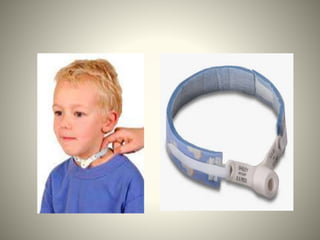
- Tracheostomy Ties
- Trach. Cuff Pressure
• Emergency Scenarios
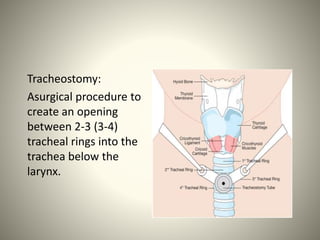
Tracheostomy:
Asurgical procedure to
create an opening
between 2-3 (3-4)
tracheal rings into the
trachea below the
larynx.
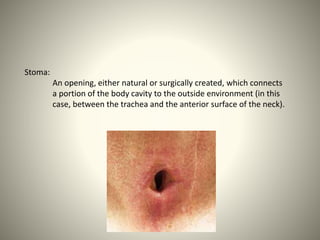
Stoma:
An opening, either natural or surgically created, which connects
a portion of the body cavity to the outside environment (in this
case, between the trachea and the anterior surface of the neck).
• Tracheostomy tube: A curved hollow tube of
rubber or plastic inserted into the
tracheostomy stoma to relieve airway
obstruction, facilitate mechanical ventilation
or the removal of tracheal secretions.
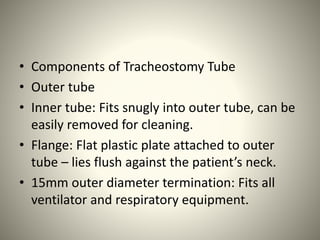
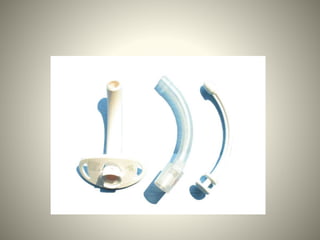
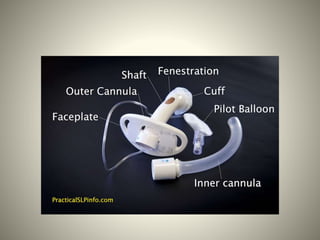
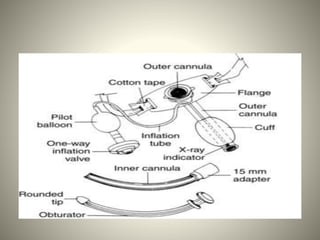
• Components of Tracheostomy Tube
• Outer tube
• Inner tube: Fits snugly into outer tube, can be
easily removed for cleaning.
• Flange: Flat plastic plate attached to outer
tube – lies flush against the patient’s neck.
• 15mm outer diameter termination: Fits all
ventilator and respiratory equipment.
Parts of a tracheostomy
• All remaining features are optional
• Cuff: Inflatable air reservoir (high volume, low pressure) –
helps anchor the tracheostomy tube in place and provides
maximum airway sealing with the least amount of local
compression. To inflate, air is injected via the…
• Air inlet valve: One way valve that prevents spontaneous
escape of the injected air.
• Air inlet line: Route for air from air inlet valve to cuff.
• Pilot cuff: Serves as an indicator of the amount of air in the
cuff
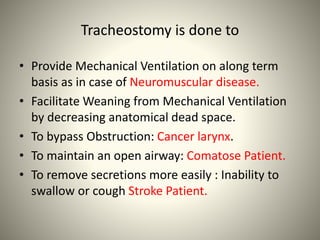
Tracheostomy is done to
• Provide Mechanical Ventilation on along term
basis as in case of Neuromuscular disease.
• Facilitate Weaning from Mechanical Ventilation
by decreasing anatomical dead space.
• To bypass Obstruction: Cancer larynx.
• To maintain an open airway: Comatose Patient.
• To remove secretions more easily : Inability to
swallow or cough Stroke Patient.
Providing Tracheostomy Care
Purposes
• To maintain airway patency by removing mucus and
encrusted secretions.
• To maintain cleanliness and prevent infection at the
tracheostomy site
• To facilitate healing and prevent skin excoriation
around the tracheostomy incision
• To promote comfort
• To prevent displacement
Providing Tracheostomy Care
Assessment
• Respiratory status (ease of breathing, rate, rhythm,
depth, lung sounds, and oxygen saturation level)
• Pulse rate
• Secretions from the tracheostomy site (character and
amount)
• Presence of drainage on tracheostomy dressing or ties
• Appearance of incision (redness, swelling, purulent
discharge, or odor)
Planning
• Tracheostomy care involves application of
scientific knowledge, sterile technique, and
problem solving, and therefore needs to be
performed by a nurse or respiratory therapist.
CARE OF THE PATIENT WITH TRACHEOSTOMY
1-Suctioning
2- Tube Care ( Changing Cleaning Inner Cannula)
3- Stoma Care
4- Humidification
5- Tracheostomy Ties
6- Trach. Cuff Pressure
Suctioning
• Frequency of Suctioning:
Perform tracheostomy suctioning at predetermined time points is
to be avoided.
Rationale:
A thorough assessment of the respiratory status should be done to
establish need for tracheal suctioning.
Suctioning should be performed based on the patient’s respiratory
status, the consistency of secretion and patient’s ability to cough and
clear secretions from his or her airway.
Applying suction is potentially a harmful procedure, which may cause
hypoxemia, bronchospasm, arrhythmias, bleeding, infection or
trauma. It should be performed when clinically indicated.
Suctioning
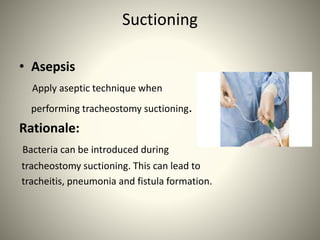
• Asepsis
Apply aseptic technique when
performing tracheostomy suctioning.
Rationale:
Bacteria can be introduced during
tracheostomy suctioning. This can lead to
tracheitis, pneumonia and fistula formation.
Suctioning
• Suction Catheters
• Choice of Catheter
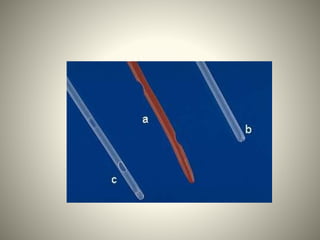
- Use multiple-eyed catheters
Rationale:
Catheters with multiple side holes appear to invaginate
mucosa less frequently than single side-hole catheters.
Multiple-eyed catheter causes less damage to the tracheal mucosa
than the single-eyed catheter because it dissipates the focus of
suction pressure, making it less likely for the mucosa to be suctioned
into the side holes.
(Griggs, 2008)
Suctioning
• Suction Catheters
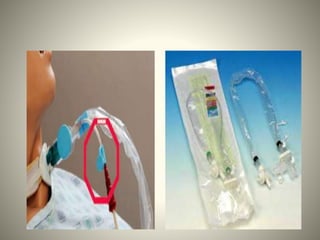
Use closed system suction catheter for
patients on ventilators.
• Rationale:
Closed system suction catheters allow ventilator pressures to
be maintained during suctioning of the critically ill patients.
Suctioning
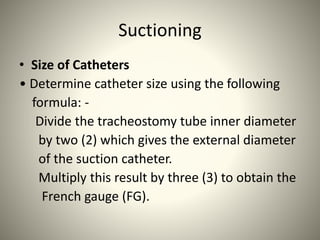
• Size of Catheters
• Determine catheter size using the following
formula: -
Divide the tracheostomy tube inner diameter
by two (2) which gives the external diameter
of the suction catheter.
Multiply this result by three (3) to obtain the
French gauge (FG).
Suctioning
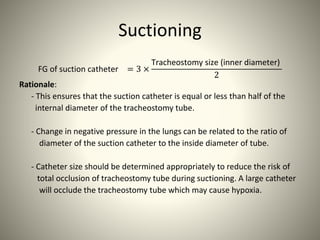
FG of suction catheter = 3 ×
Tracheostomy size (inner diameter)
2
Rationale:
- This ensures that the suction catheter is equal or less than half of the
internal diameter of the tracheostomy tube.
- Change in negative pressure in the lungs can be related to the ratio of
diameter of the suction catheter to the inside diameter of tube.
- Catheter size should be determined appropriately to reduce the risk of
total occlusion of tracheostomy tube during suctioning. A large catheter
will occlude the tracheostomy tube which may cause hypoxia.
Suctioning
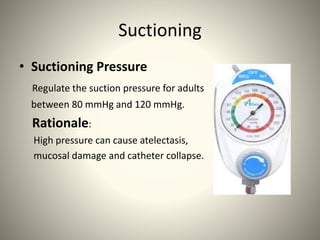
• Suctioning Pressure
Regulate the suction pressure for adults
between 80 mmHg and 120 mmHg.
Rationale:
High pressure can cause atelectasis,
mucosal damage and catheter collapse.
Suctioning
• Suctioning Duration
• Perform suctioning for not more than 15
seconds. (D/4 - JBI, 2000)
Rationale:
Prolonged suctioning increases the risk of
hypoxia and trauma.
(The Royal Free Hampstead NHS Trust, 2002; JBI, 2000; Kim and Julie, 2003)
Suctioning
• Preoxygenation
• Preoxygenate patient prior to performing
suctioning if necessary. (D/4 - JBI, 2000)
Rationale:
Preoxygenation prior to suctioning may
potentially minimise suctioning induced
hypoxaemia. (JBI, 2000)
Suctioning
• Normal Saline Instillation
Do not instil Normal Saline routinely to liquefy secretion.
Rationale
Normal Saline instillation provides no physiological benefits in
removing thick and tenacious secretions. Administering a bolus
of Normal Saline to liquefy secretion is not substantiated in the
literature.
Suctioning should be done with the intention to maximise the
quantity of secretions removed and minimize the hazards
associated with the procedure. Normal Saline does not help to
loosen and dislodge secretions.
Rather it stimulates cough thus dislodging secretion.
Inner Cannula Care
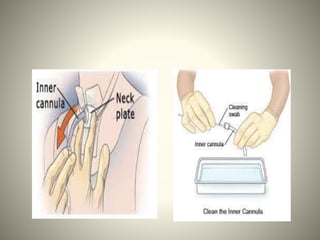
• Inspect the inner cannula at least six-hourly to ensure
patency.
• Clean the inner cannula using sterile water or as according
to manufacturer’s instruction prior to reinsertion.
• Rationale:
• The inner cannula is inspected at least six hourly to reduce
the risk of tube obstruction due to a build up of secretions.
(Kim and Julie, 2013)
• Respiratory equipment is not recommended to be rinsed
under tap water due to the risk of contamination and
increased risk of nosocomial pneumonia. (CDC, 2014)
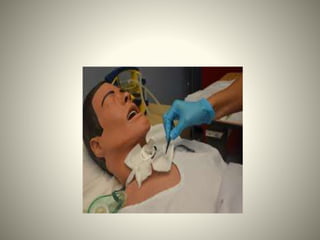
Stoma Care
• Frequency of Dressing Change :
Keep the dressing dry, change stoma dressing
and tapes daily and/or whenever soiled.
Rationale:
Dressings and tapes are changed daily or
whenever soiled to prevent maceration of the
skin, maintain skin integrity and minimise the
risk of infection. (Oxford Radcliffe NHS Hospitals Trust, 2005)
Stoma Care
• Stoma Infection
Observe for the following signs and symptoms of stoma
infection:
- excessive leakage of secretion –
- foul smell
- erythema around the stoma site
- erosion of stoma site
Rationale:
Early detection of stoma infection will help to maintain
integrity of the skin and thus preventing infection.
HUMIDIFICATION
• The Nose provides warmth, moisture and
filtration for the air we breath.
• Having atracheostomy tube by-passes these
mechanisms.
• So humidification must be provide to all Pt.
with tracheostomy.
HUMIDIFICATION
• Devices
• Humidify the inspired gas using one of the
following devices:
- Humidifier system – heated or non-heated
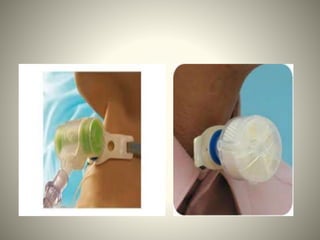
- Heat Moisture Exchanger (HME) Filter.
Rationale:
These devices provide humidification so as to
enhance normal respiratory tract function and
facilitate easy removal / clearance of secretions.
HUMIDIFICATION
• Methods of Humidification
Use the following criteria to determine the methods of
humidification:
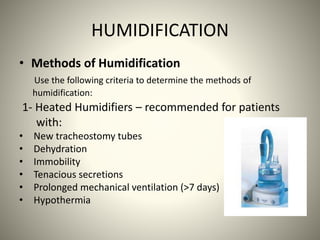
1- Heated Humidifiers – recommended for patients
with:
• New tracheostomy tubes
• Dehydration
• Immobility
• Tenacious secretions
• Prolonged mechanical ventilation (>7 days)
• Hypothermia
HUMIDIFICATION
2-Heat Moisture Exchanger (HME)
recommended for patient with:
- Adequate hydration
- Mobility
- Less copious secretions
- Anticipation for discharge
Contraindications for HME Not suitable for patients with:
Thick, copious or bloody secretions
An expired tidal volume less than 70% of delivered tidal volume and
patients with COPD condition
Weak respiratory muscles, who will be difficult to wean off the ventilator
HUMIDIFICATION
• Rationale:
• Thick, copious or bloody secretions increases
risk of occlusion of airway.
• There is an increased risk of augmented
airway resistance and dead space for patients
with COPD as they have weak respiratory
muscles and reduced lung reserve.
(St James’s Hospital/Royal Victoria Eye & Ear Hospital, 2000)
HUMIDIFICATION
• Heat Moisture Exchanger
Change HME daily, and whenever visibly soiled
or according to manufacturer’s
recommendation.
Rationale:
Secretions inside the HME can block the filter
and increase the work of breathing.
HUMIDIFICATION
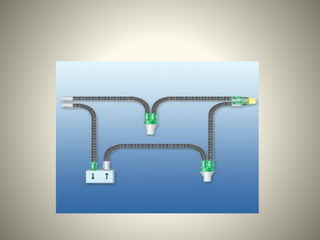
• Heated Humidification
Check, empty and discard condensate along the tubing of
the heated humidification system. Do not drain condensate
into the humidifier reservoir.
• Rationale:
Condensation along the tubing can obstruct the airflow
and is considered an infectious waste.
(AARC, 1992; CDC, 2004)
HUMIDIFICATION
• Humidifier Circuit Tubing
Change the circuit when it is visibly soiled.
• Rationale:
Soiled condensate in the circuit can be a
reservoir for infection.
HUMIDIFICATION
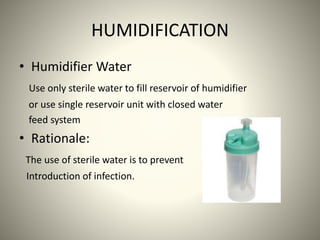
• Humidifier Water
Use only sterile water to fill reservoir of humidifier
or use single reservoir unit with closed water
feed system
• Rationale:
The use of sterile water is to prevent
Introduction of infection.
Tracheostomy Ties
• Ties are generally changed daily
• To lower the risk of accidental trach tube
coming out.
• To keep skin clean and dry
• Tie changes should be performed by two
RNRT or with new tie secured BEFOR old ties
are removed
Tracheostomy Ties
• Check the tightness of the ties.
• Frequently check the tightness of the
tracheostomy ties and position of the
tracheostomy tube.
• Rationale:
Swelling of the neck may cause the ties to become
too tight, interfering with coughing and circulation.
Ties can loosen in restless clients, allowing the
tracheostomy tube to extrude from the stoma.
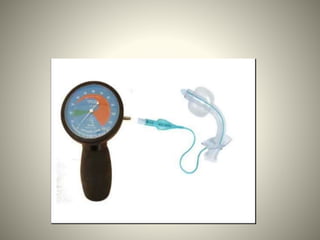
Cuff Pressure
• Cuff Pressure
Check the cuff pressure using a hand pressure gauge every shift
or a minimum of eight-hourly.
Maintain the cuff pressure between 15-25 cm H2O,
unless medically indicated.
• Rationale:
• Constant unchecked cuff pressure may cause mucosal necrosis or
stenosis. (Kim and Julie, 2003)
• Over inflation of the cuff can cause trauma to the tracheal mucosa.
• Under inflation of the cuff fails to make an adequate seal and the
patient is at risk of aspiration. (St George’s Healthcare NHS Trust, 2000)
Cuff Pressure
• Cuff Inflation
• Inflate cuff of tracheostomy tube only if
medically indicated (e.g. on positive
ventilation or high risk for aspiration).
• Rationale:
Cuff inflation may reduce risk of aspiration.
(Oxford Radcliffe NHS Hospital Trust, 2005)
TRACHEOSTOMY EMERGENCY
• Tube Dislodgement
Tube dislodgement is displacement of tracheostomy tube
by unintentional and unplanned tube removal.
The displacement or dislodgement can be a partial or
complete tube come out of the stoma or out of the trachea into
the soft tissue of the neck.
• Establish presence of spontaneous breathing when tube
dislodgement is confirmed.
• If breathing is present, ensure cuffed tube is deflated and provide
patent with supplement oxygen via facemask.
• Emergency oral intubation may be indicated if reinsertion of a new
tracheostomy tube fails.
Tube Dislodgement
• Rationale:
• Accidental tube dislodgement is a clinical
emergency especially if it occurs within the first 7
days post operatively.
• Establish presence or absence of breathing will
determine the subsequent management of
patient.
• Absence of spontaneous breathing indicates the
need to proceed with emergency airway
management. (Oxford Radcliffe NHS Hospital Trust, 2005)
Tube Dislodgement
• Provide oxygen via displaced tube may result in
ineffective oxygenation and ventilation of oxygen
into the surrounding tissue around the trachea.
• Deflating cuff is necessary to allow airflow
surrounding the displaced tube to the lower
airway to provide adequate oxygenation to
patient.
• If reinsertion of a new tracheostomy tube fails,
securing airway via oral intubation is essential to
prevent complication like hypoxia.
(The Royal Free Hampstead NHS Trust, 2002; Oxford Radcliffe NHS Hospital Trust, 2005)
Tube Obstruction
• Acute dyspnoea is commonly caused by
partial blockage or complete blockage of the
tracheostomy tube by a mucous plug.
• Ask the patient to cough.
• Remove inner cannula.
• Apply suctioning to remove the secretions.
Tube Obstruction
• Ventilate the patient (and secure airway
patency)
- Deflate the cuff tube (if this is in-situ), bag
and mask patient.
- Call for medical help.
- Prepare for change of tracheostomy tube or
oral intubation.
Tube Obstruction
• Rationale: The crust of mucus plug is usually attached
to the end of the inner or outer tube.
• A strong, vigorous cough may be all that is needed to
expel the secretions.
• Secretions that are stuck in the inner tube will be
automatically removed when the inner tube is taken
out.
• If coughing and removing the inner tube fails to
remove the blockage, suctioning is indicated to remove
secretions that are present at patient’s lower airway.
• Timely and optimal airway management is critical to
improve functional and survival outcome of patient.
• American Association for Respiratory Care. (1992). AARC clinical practice
guideline. Humidification during mechanical ventilation. Respiratory Care,
37(8), 887-890. [AARC, 1992]
• Carroll, P. (2003). Improve your suctioning technique. [On-line version].
RNWeb. Retrieved May 22, 2007, from
http://www.rnweb.com/rnweb/article/ articleDetail.jsp?id=107341.
• Centers for Disease Control and Prevention (CDC). (2004). Guidelines for
preventing health-care associated pneumonia 2003: Recommendations of
CDC and the Healthcare Infection Control Practices Advisory Committee.
MMWR 2004, 53(RR03), 1-36. [CDC, 2004]
• Elizabeth, T. (1999). Evaluating suitability for tracheostomy decannulation:
A critical evaluation of two management protocols.
• Journal of Medical Speech Language Pathology, 7(4), 273-281. Griggs, A.
(1998). Tracheostomy: Suctioning and humidification. Nursing Standard,
13(2), 49-53, 55-56. Hooper, M. (1996). N
Tracheostomy  care

Tracheostomy care

  • 1.
  • 2.
    • Review Definition, •Components of Tracheostomy Tube • Why Tracheostomy • Tracheostomy Care Guidelines : - Purposes - Assessment - Suctioning - Tube Care ( Changing Cleaning Inner Cannula) - Stoma Care - Humidification - Tracheostomy Ties - Trach. Cuff Pressure • Emergency Scenarios
  • 3.
    Tracheostomy: Asurgical procedure to createan opening between 2-3 (3-4) tracheal rings into the trachea below the larynx.
  • 4.
    Stoma: An opening, eithernatural or surgically created, which connects a portion of the body cavity to the outside environment (in this case, between the trachea and the anterior surface of the neck).
  • 5.
    • Tracheostomy tube:A curved hollow tube of rubber or plastic inserted into the tracheostomy stoma to relieve airway obstruction, facilitate mechanical ventilation or the removal of tracheal secretions.
  • 6.
    • Components ofTracheostomy Tube • Outer tube • Inner tube: Fits snugly into outer tube, can be easily removed for cleaning. • Flange: Flat plastic plate attached to outer tube – lies flush against the patient’s neck. • 15mm outer diameter termination: Fits all ventilator and respiratory equipment.
  • 8.
    Parts of atracheostomy • All remaining features are optional • Cuff: Inflatable air reservoir (high volume, low pressure) – helps anchor the tracheostomy tube in place and provides maximum airway sealing with the least amount of local compression. To inflate, air is injected via the… • Air inlet valve: One way valve that prevents spontaneous escape of the injected air. • Air inlet line: Route for air from air inlet valve to cuff. • Pilot cuff: Serves as an indicator of the amount of air in the cuff
  • 11.
    Tracheostomy is doneto • Provide Mechanical Ventilation on along term basis as in case of Neuromuscular disease. • Facilitate Weaning from Mechanical Ventilation by decreasing anatomical dead space. • To bypass Obstruction: Cancer larynx. • To maintain an open airway: Comatose Patient. • To remove secretions more easily : Inability to swallow or cough Stroke Patient.
  • 12.
    Providing Tracheostomy Care Purposes •To maintain airway patency by removing mucus and encrusted secretions. • To maintain cleanliness and prevent infection at the tracheostomy site • To facilitate healing and prevent skin excoriation around the tracheostomy incision • To promote comfort • To prevent displacement
  • 13.
    Providing Tracheostomy Care Assessment •Respiratory status (ease of breathing, rate, rhythm, depth, lung sounds, and oxygen saturation level) • Pulse rate • Secretions from the tracheostomy site (character and amount) • Presence of drainage on tracheostomy dressing or ties • Appearance of incision (redness, swelling, purulent discharge, or odor)
  • 14.
    Planning • Tracheostomy careinvolves application of scientific knowledge, sterile technique, and problem solving, and therefore needs to be performed by a nurse or respiratory therapist.
  • 15.
    CARE OF THEPATIENT WITH TRACHEOSTOMY 1-Suctioning 2- Tube Care ( Changing Cleaning Inner Cannula) 3- Stoma Care 4- Humidification 5- Tracheostomy Ties 6- Trach. Cuff Pressure
  • 16.
    Suctioning • Frequency ofSuctioning: Perform tracheostomy suctioning at predetermined time points is to be avoided. Rationale: A thorough assessment of the respiratory status should be done to establish need for tracheal suctioning. Suctioning should be performed based on the patient’s respiratory status, the consistency of secretion and patient’s ability to cough and clear secretions from his or her airway. Applying suction is potentially a harmful procedure, which may cause hypoxemia, bronchospasm, arrhythmias, bleeding, infection or trauma. It should be performed when clinically indicated.
  • 17.
    Suctioning • Asepsis Apply aseptictechnique when performing tracheostomy suctioning. Rationale: Bacteria can be introduced during tracheostomy suctioning. This can lead to tracheitis, pneumonia and fistula formation.
  • 18.
    Suctioning • Suction Catheters •Choice of Catheter - Use multiple-eyed catheters Rationale: Catheters with multiple side holes appear to invaginate mucosa less frequently than single side-hole catheters. Multiple-eyed catheter causes less damage to the tracheal mucosa than the single-eyed catheter because it dissipates the focus of suction pressure, making it less likely for the mucosa to be suctioned into the side holes. (Griggs, 2008)
  • 20.
    Suctioning • Suction Catheters Useclosed system suction catheter for patients on ventilators. • Rationale: Closed system suction catheters allow ventilator pressures to be maintained during suctioning of the critically ill patients.
  • 22.
    Suctioning • Size ofCatheters • Determine catheter size using the following formula: - Divide the tracheostomy tube inner diameter by two (2) which gives the external diameter of the suction catheter. Multiply this result by three (3) to obtain the French gauge (FG).
  • 23.
    Suctioning FG of suctioncatheter = 3 × Tracheostomy size (inner diameter) 2 Rationale: - This ensures that the suction catheter is equal or less than half of the internal diameter of the tracheostomy tube. - Change in negative pressure in the lungs can be related to the ratio of diameter of the suction catheter to the inside diameter of tube. - Catheter size should be determined appropriately to reduce the risk of total occlusion of tracheostomy tube during suctioning. A large catheter will occlude the tracheostomy tube which may cause hypoxia.
  • 24.
    Suctioning • Suctioning Pressure Regulatethe suction pressure for adults between 80 mmHg and 120 mmHg. Rationale: High pressure can cause atelectasis, mucosal damage and catheter collapse.
  • 25.
    Suctioning • Suctioning Duration •Perform suctioning for not more than 15 seconds. (D/4 - JBI, 2000) Rationale: Prolonged suctioning increases the risk of hypoxia and trauma. (The Royal Free Hampstead NHS Trust, 2002; JBI, 2000; Kim and Julie, 2003)
  • 26.
    Suctioning • Preoxygenation • Preoxygenatepatient prior to performing suctioning if necessary. (D/4 - JBI, 2000) Rationale: Preoxygenation prior to suctioning may potentially minimise suctioning induced hypoxaemia. (JBI, 2000)
  • 27.
    Suctioning • Normal SalineInstillation Do not instil Normal Saline routinely to liquefy secretion. Rationale Normal Saline instillation provides no physiological benefits in removing thick and tenacious secretions. Administering a bolus of Normal Saline to liquefy secretion is not substantiated in the literature. Suctioning should be done with the intention to maximise the quantity of secretions removed and minimize the hazards associated with the procedure. Normal Saline does not help to loosen and dislodge secretions. Rather it stimulates cough thus dislodging secretion.
  • 28.
    Inner Cannula Care •Inspect the inner cannula at least six-hourly to ensure patency. • Clean the inner cannula using sterile water or as according to manufacturer’s instruction prior to reinsertion. • Rationale: • The inner cannula is inspected at least six hourly to reduce the risk of tube obstruction due to a build up of secretions. (Kim and Julie, 2013) • Respiratory equipment is not recommended to be rinsed under tap water due to the risk of contamination and increased risk of nosocomial pneumonia. (CDC, 2014)
  • 30.
    Stoma Care • Frequencyof Dressing Change : Keep the dressing dry, change stoma dressing and tapes daily and/or whenever soiled. Rationale: Dressings and tapes are changed daily or whenever soiled to prevent maceration of the skin, maintain skin integrity and minimise the risk of infection. (Oxford Radcliffe NHS Hospitals Trust, 2005)
  • 31.
    Stoma Care • StomaInfection Observe for the following signs and symptoms of stoma infection: - excessive leakage of secretion – - foul smell - erythema around the stoma site - erosion of stoma site Rationale: Early detection of stoma infection will help to maintain integrity of the skin and thus preventing infection.
  • 33.
    HUMIDIFICATION • The Noseprovides warmth, moisture and filtration for the air we breath. • Having atracheostomy tube by-passes these mechanisms. • So humidification must be provide to all Pt. with tracheostomy.
  • 34.
    HUMIDIFICATION • Devices • Humidifythe inspired gas using one of the following devices: - Humidifier system – heated or non-heated - Heat Moisture Exchanger (HME) Filter. Rationale: These devices provide humidification so as to enhance normal respiratory tract function and facilitate easy removal / clearance of secretions.
  • 35.
    HUMIDIFICATION • Methods ofHumidification Use the following criteria to determine the methods of humidification: 1- Heated Humidifiers – recommended for patients with: • New tracheostomy tubes • Dehydration • Immobility • Tenacious secretions • Prolonged mechanical ventilation (>7 days) • Hypothermia
  • 36.
    HUMIDIFICATION 2-Heat Moisture Exchanger(HME) recommended for patient with: - Adequate hydration - Mobility - Less copious secretions - Anticipation for discharge Contraindications for HME Not suitable for patients with: Thick, copious or bloody secretions An expired tidal volume less than 70% of delivered tidal volume and patients with COPD condition Weak respiratory muscles, who will be difficult to wean off the ventilator
  • 38.
    HUMIDIFICATION • Rationale: • Thick,copious or bloody secretions increases risk of occlusion of airway. • There is an increased risk of augmented airway resistance and dead space for patients with COPD as they have weak respiratory muscles and reduced lung reserve. (St James’s Hospital/Royal Victoria Eye & Ear Hospital, 2000)
  • 39.
    HUMIDIFICATION • Heat MoistureExchanger Change HME daily, and whenever visibly soiled or according to manufacturer’s recommendation. Rationale: Secretions inside the HME can block the filter and increase the work of breathing.
  • 40.
    HUMIDIFICATION • Heated Humidification Check,empty and discard condensate along the tubing of the heated humidification system. Do not drain condensate into the humidifier reservoir. • Rationale: Condensation along the tubing can obstruct the airflow and is considered an infectious waste. (AARC, 1992; CDC, 2004)
  • 42.
    HUMIDIFICATION • Humidifier CircuitTubing Change the circuit when it is visibly soiled. • Rationale: Soiled condensate in the circuit can be a reservoir for infection.
  • 43.
    HUMIDIFICATION • Humidifier Water Useonly sterile water to fill reservoir of humidifier or use single reservoir unit with closed water feed system • Rationale: The use of sterile water is to prevent Introduction of infection.
  • 44.
    Tracheostomy Ties • Tiesare generally changed daily • To lower the risk of accidental trach tube coming out. • To keep skin clean and dry • Tie changes should be performed by two RNRT or with new tie secured BEFOR old ties are removed
  • 45.
    Tracheostomy Ties • Checkthe tightness of the ties. • Frequently check the tightness of the tracheostomy ties and position of the tracheostomy tube. • Rationale: Swelling of the neck may cause the ties to become too tight, interfering with coughing and circulation. Ties can loosen in restless clients, allowing the tracheostomy tube to extrude from the stoma.
  • 47.
    Cuff Pressure • CuffPressure Check the cuff pressure using a hand pressure gauge every shift or a minimum of eight-hourly. Maintain the cuff pressure between 15-25 cm H2O, unless medically indicated. • Rationale: • Constant unchecked cuff pressure may cause mucosal necrosis or stenosis. (Kim and Julie, 2003) • Over inflation of the cuff can cause trauma to the tracheal mucosa. • Under inflation of the cuff fails to make an adequate seal and the patient is at risk of aspiration. (St George’s Healthcare NHS Trust, 2000)
  • 48.
    Cuff Pressure • CuffInflation • Inflate cuff of tracheostomy tube only if medically indicated (e.g. on positive ventilation or high risk for aspiration). • Rationale: Cuff inflation may reduce risk of aspiration. (Oxford Radcliffe NHS Hospital Trust, 2005)
  • 50.
    TRACHEOSTOMY EMERGENCY • TubeDislodgement Tube dislodgement is displacement of tracheostomy tube by unintentional and unplanned tube removal. The displacement or dislodgement can be a partial or complete tube come out of the stoma or out of the trachea into the soft tissue of the neck. • Establish presence of spontaneous breathing when tube dislodgement is confirmed. • If breathing is present, ensure cuffed tube is deflated and provide patent with supplement oxygen via facemask. • Emergency oral intubation may be indicated if reinsertion of a new tracheostomy tube fails.
  • 51.
    Tube Dislodgement • Rationale: •Accidental tube dislodgement is a clinical emergency especially if it occurs within the first 7 days post operatively. • Establish presence or absence of breathing will determine the subsequent management of patient. • Absence of spontaneous breathing indicates the need to proceed with emergency airway management. (Oxford Radcliffe NHS Hospital Trust, 2005)
  • 52.
    Tube Dislodgement • Provideoxygen via displaced tube may result in ineffective oxygenation and ventilation of oxygen into the surrounding tissue around the trachea. • Deflating cuff is necessary to allow airflow surrounding the displaced tube to the lower airway to provide adequate oxygenation to patient. • If reinsertion of a new tracheostomy tube fails, securing airway via oral intubation is essential to prevent complication like hypoxia. (The Royal Free Hampstead NHS Trust, 2002; Oxford Radcliffe NHS Hospital Trust, 2005)
  • 53.
    Tube Obstruction • Acutedyspnoea is commonly caused by partial blockage or complete blockage of the tracheostomy tube by a mucous plug. • Ask the patient to cough. • Remove inner cannula. • Apply suctioning to remove the secretions.
  • 54.
    Tube Obstruction • Ventilatethe patient (and secure airway patency) - Deflate the cuff tube (if this is in-situ), bag and mask patient. - Call for medical help. - Prepare for change of tracheostomy tube or oral intubation.
  • 55.
    Tube Obstruction • Rationale:The crust of mucus plug is usually attached to the end of the inner or outer tube. • A strong, vigorous cough may be all that is needed to expel the secretions. • Secretions that are stuck in the inner tube will be automatically removed when the inner tube is taken out. • If coughing and removing the inner tube fails to remove the blockage, suctioning is indicated to remove secretions that are present at patient’s lower airway. • Timely and optimal airway management is critical to improve functional and survival outcome of patient.
  • 56.
    • American Associationfor Respiratory Care. (1992). AARC clinical practice guideline. Humidification during mechanical ventilation. Respiratory Care, 37(8), 887-890. [AARC, 1992] • Carroll, P. (2003). Improve your suctioning technique. [On-line version]. RNWeb. Retrieved May 22, 2007, from http://www.rnweb.com/rnweb/article/ articleDetail.jsp?id=107341. • Centers for Disease Control and Prevention (CDC). (2004). Guidelines for preventing health-care associated pneumonia 2003: Recommendations of CDC and the Healthcare Infection Control Practices Advisory Committee. MMWR 2004, 53(RR03), 1-36. [CDC, 2004] • Elizabeth, T. (1999). Evaluating suitability for tracheostomy decannulation: A critical evaluation of two management protocols. • Journal of Medical Speech Language Pathology, 7(4), 273-281. Griggs, A. (1998). Tracheostomy: Suctioning and humidification. Nursing Standard, 13(2), 49-53, 55-56. Hooper, M. (1996). N