ENDOCRINE
SYSTEM
MEDICAL AND
SURGICAL NURSING
Professor: Mark Fredderick Abejo, RN MAN
Mark Abejo
abejo
ENDOCRINE
SYSTEM
Mark Abejo
abejo
Mark Abejo
abejo
Mark Abejo
abejo
Mark Abejo
abejo
Mark Abejo
abejo
Mark Abejo
abejo
Mark Abejo
abejo
Mark Abejo
abejo
Mark Abejo
abejo
Mark Abejo
abejo
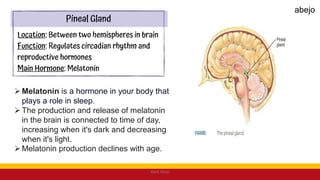
Melatonin is a hormone in your body that
plays a role in sleep.
The production and release of melatonin
in the brain is connected to time of day,
increasing when it's dark and decreasing
when it's light.
Melatonin production declines with age.
Mark Abejo
abejo
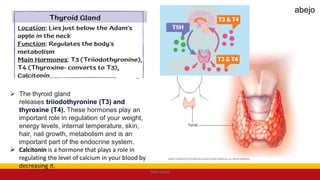
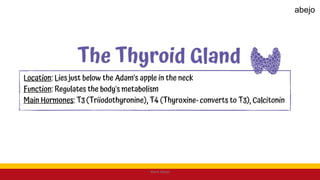
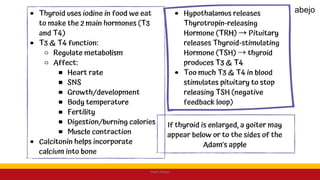
 The thyroid gland
releases triiodothyronine (T3) and
thyroxine (T4). These hormones play an
important role in regulation of your weight,
energy levels, internal temperature, skin,
hair, nail growth, metabolism and is an
important part of the endocrine system.
 Calcitonin is a hormone that plays a role in
regulating the level of calcium in your blood by
decreasing it.
Mark Abejo
abejo
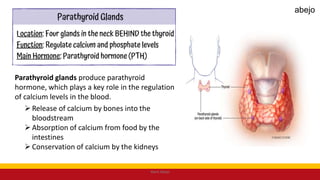
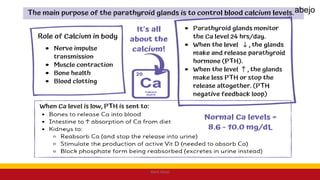
Parathyroid glands produce parathyroid
hormone, which plays a key role in the regulation
of calcium levels in the blood.
Release of calcium by bones into the
bloodstream
Absorption of calcium from food by the
intestines
Conservation of calcium by the kidneys
Mark Abejo
abejo
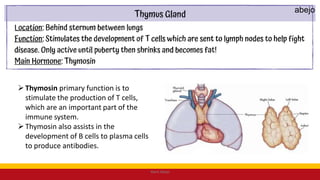
Thymosin primary function is to
stimulate the production of T cells,
which are an important part of the
immune system.
Thymosin also assists in the
development of B cells to plasma cells
to produce antibodies.
Mark Abejo
abejo
Mark Abejo
abejo
Mark Abejo
abejo
Mark Abejo
abejo
Mark Abejo
abejo
Mark Abejo
abejo
Mark Abejo
abejo
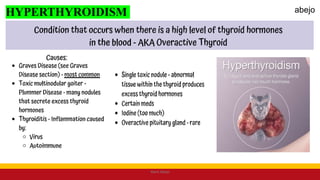
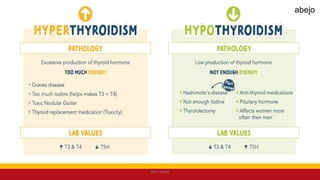
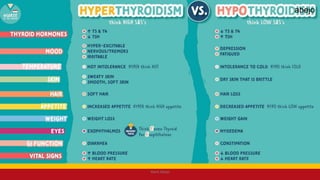
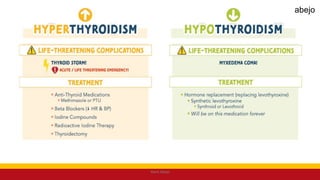
HYPERTHYROIDISM
Mark Abejo
abejo
Mark Abejo
abejo
Mark Abejo
abejo
Mark Abejo
abejo
Mark Abejo
abejo
Mark Abejo
abejo
Mark Abejo
abejo
Mark Abejo
abejo
Mark Abejo
abejo
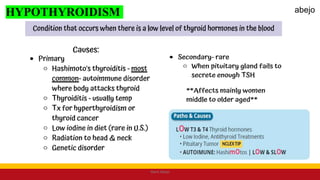
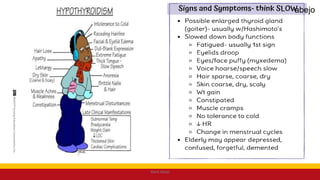
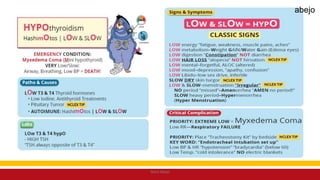
HYPOTHYROIDISM
Mark Abejo
abejo
Mark Abejo
abejo
Mark Abejo
abejo
Mark Abejo
abejo
Mark Abejo
abejo
Mark Abejo
abejo
While providing care for the client diagnosed with
hypothyroidism who is experiencing memory deficit,
poor attention span, and difficulty communicating,
which statement made by the client’s spouse requires
information and emotional support by the registered
nurse (RN)?
a) “I am working on asking our son to help us once we can be
discharged home.”
b) “I am trying to reorient my spouse to date and time throughout
the day.”
c) “I have set a goal to watch for any memory changes that may
occur each day.”
d) “There is no way I can handle these memory issues for the rest of
our lives together.”
Mark Abejo
abejo
d) “There is no way I can handle these
memory issues for the rest of our lives
together.”
This answer is correct because the statement “there is no way I can handle these memory issues for
the rest of our lives together” is the statement that requires the RN to provide further information
and emotional support. The RN will reinforce to the spouse that the memory changes will improve
after the client has been on thyroid hormone replacement therapy for 2 weeks. The RN will allow the
spouse time to verbalize fears, concerns, and feelings without judgment.
Mark Abejo
abejo
The nurse provides care for a pediatric client who
is prescribed radioactive iodine for the treatment
of hyperthyroidism. Which safety instruction
should the nurse include when providing education
to the child and caregivers? Select all that apply.
a) “Your child should flush the toilet twice after each use.”
b) “It is important for your child to stay away from pregnant
women.”
c) “It is important that your child not share washcloths and towels
with others.”
d) “Your child should not sleep in a room with other children or
family members.”
Mark Abejo
abejo
ALL ARE CORRECT
 Within a few days after treatment, the radioactive iodine will leave the client’s body in
the saliva and urine.
 The length of time in which it takes the radioactive iodine to exit the child’s body is
dependent on the client’s age and the prescribed dose.
 The child should be encouraged to drink plenty of fluids to assist the body in excreting
the radioactivity.
 To avoid exposing other people to radioactivity, it is important to follow the
practitioner’s safety instructions carefully.
 Instructions should include staying away from pregnant women; not sharing washcloths
and towels with others; limiting time in the car with the child to no more than one hour
at a time; sleeping alone; and double flushing the toilet after use.
Mark Abejo
abejo
The nurse provides care for an adult female
client who is prescribed radioactive iodine
(RAI) for the treatment of hyperthyroidism.
Which statement should the nurse include in
the medication teaching session for this
client? Select all that apply.
a) "Disposable eatery tools should be used for your meals.“
b) "Wash anything you use separately from the rest of the family.“
c) "You should use a different toilet from other family members.“
d) "You cannot have any visitors who may be pregnant."
Mark Abejo
abejo
ALL ARE CORRECT
 The nurse provides the client with education regarding the safe administration of
prescribed medications.
 Radioactive iodine (RAI) destroys the thyroid gland cells.
 Because RAI is excreted in the client’s body fluids, specific teaching is required to
enhance safety for those who come into contact with this client.
 Therefore, the nurse includes the following topics in the medication teaching session:
using disposable eatery tools; washing clothing separately from other family members;
using a different toilet from family members and double flushing; and avoiding visits
with children and anyone who is pregnant.
 Once teaching is presented, the nurse evaluates client understanding using the “teach-
back” method.
Mark Abejo
abejo
An older adult client who is diagnosed with
hypothyroidism is admitted to the hospital due to
acute confusion. The client’s current vital signs are as
follows: temperature: 95 F (35 C); blood pressure:
88/48 mm Hg; heart rate: 50 beats/min; respirations:
10 breaths/min; and SaO2: 84% on room air (RA).
Which is the priority action by the nurse in the
provision of care for this client?
a) Apply a convection temperature management system to the
client.
b) Give one dose of intravenous (IV) levothyroxine now and in 30
minutes.
c) Draw labs for serum TSH, triiodothyronine, and thyroxine.
d) Alert respiratory of the need for endotracheal (ET) intubation.
Mark Abejo
abejo
d) Alert respiratory of the need for
endotracheal (ET) intubation.
 Myxedema coma is a life-threatening complication of severe hypothyroidism.
 Clients who experience myxedema coma will display significantly lowered heart rate, blood
pressure, body temperature, and respirations.
 Ineffective breathing results in poor gas exchange.
 A respiratory rate of 10 breaths/minute and a pulse oximetry reading of 84% are signs of a
compromised airway and ineffective breathing; therefore, the most critical intervention is to
prepare for endotracheal tube (ET) intubation with mechanical ventilation.
Mark Abejo
abejo
The nurse is evaluating lab results of a client who
reports excessive fatigue for the past month. Labs
are as follows: thyroid-stimulating hormone (TSH)
is 8 U/L (Reference range: 0.4 to 4.2); total
triiodothyronine (T3) is 30 ng/dL (Reference range:
70 to 204; and free thyroxine (T4) is 0.2 ng/dL
(Reference range: 0.8 to 2.7). Which additional
clinical manifestation should the nurse anticipate
for this client? Select all that apply.
a) Inability to tolerate cold.
b) Difficulty having regular bowel movements.
c) Fragile, dry skin.
d) Hypotension.
Mark Abejo
abejo
ALL ARE CORRECT
 Primary hypothyroidism often occurs after autoimmune-regulated tissue damage or
trauma.
 Because thyroid hormones act in multiple body sites and increase metabolic function,
signs and symptoms experienced by the client are the result of a low metabolic state.
 The low metabolic state experienced by the client diagnosed with hypothyroidism
causes an intolerance to cold, constipation, decreases in heart rate and blood pressure,
delayed deep tendon reflexes, fatigue, slowed cognition, weakness, and weight gain.
 In addition, the client experiences fragile and dry skin, hoarseness, and myxedema (i.e.,
non pitting edema).
Mark Abejo
abejo
While providing care for the client recently
diagnosed with hyperthyroidism, which
intervention will the registered nurse (RN)
implement to provide client comfort? Select all
that apply.
a) Change damp bed linens promptly
b) Provide iced water for intake
c) Lower the room temperature
d) Provide extra blankets as needed
e) Provide warm showers as needed
Mark Abejo
abejo
a, b, c
 During the care of the client, the RN will provide basic care and comfort for the client.
 The RN identifies that the client diagnosed with hyperthyroidism experiences heat intolerance.
 To assist in maintaining client comfort the RN will implement interventions to reduce the
discomfort associated with heat intolerance.
 These interventions can include lowering the room temperature, providing iced water frequently,
assisting with cool baths, and changing damp bed linens promptly.
Mark Abejo
abejo
The nurse provides dietary instruction for a
client who is newly diagnosed with
hyperthyroidism. Which instruction should the
nurse include in the client’s teaching session?
Select all that apply.
a) Avoid caffeinated beverages and eating spicy foods.
b) Include protein in 3 meals and 3 snacks daily.
c) The need for a low-carbohydrate diet.
d) Consume a diet with 4000 to 5000 calories/day.
e) Increase high-soluble fiber in the diet.
Mark Abejo
abejo
a, b, d
 Hyperthyroidism is caused by hypersecretion of thyroid hormones.
 When teaching clients how to manage hyperthyroidism, the nurse focuses on methods to satisfy
hunger (e.g., increased calorie diet, consuming three full meals and at least three snacks daily)
to meet the increased metabolic needs of the body.
 These clients are taught to eat foods that are high in carbohydrates, minerals, protein, and
vitamins.
 Additional teaching should also include foods to avoid (e.g., stimulating substances, spicy
foods, high-fiber foods).
Mark Abejo
abejo
While providing care for the client that has
developed permanent exophthalmos related to
hyperthyroidism, which action will the
registered nurse (RN) implement when the
client states they must now wear sunglasses
forever?
a) Tell the client they are lucky to be alive as so many others are not
b) Allow the client the needed time to mourn this body image
change
c) Reinforce to the client that wearing sunglasses will help hide the
eyes
d) Stress to the client that it will not do any good to feel sad about
this body change
Mark Abejo
abejo
b) Allow the client the needed time to mourn
this body image change
 One of the many responsibilities of the registered nurse (RN) is to provide interventions to
maintain the client’s emotional, mental, and social wellbeing.
 The grieving process is not limited to the diagnosis of life-ending conditions.
 Grief can also occur when the client experiences a permanent life or body change related to
diseases or conditions.
 It is important that the RN explain to the client it is an expected response to mourn this
change/loss.
 The RN will provide support and care for the client as they work through the grief process of this
unexpected change.
Mark Abejo
abejo
While providing education to the client
diagnosed with hypothyroidism, what priority
education point will the registered nurse (RN)
stress to the client?
a) “Monitor weight weekly and report decrease.”
b) “Monitor for signs or hyperthyroidism.”
c) “Take your thyroid medications exactly as prescribed.”
d) “Keep all scheduled healthcare provider appointments.”
Mark Abejo
abejo
c) “Take your thyroid medications exactly as
prescribed.”
 This answer is correct because the statement “take your thyroid medications exactly as
prescribed” is the priority education the client will provide. It is of highest priority that the client
take the drug exactly as prescribed and not change the dose or drug schedule without consulting
the healthcare provider. This is the highest priority education for this client.
 The client should monitor daily, not weekly weights.
Mark Abejo
abejo
Mark Abejo
abejo
Mark Abejo
abejo
Mark Abejo
abejo
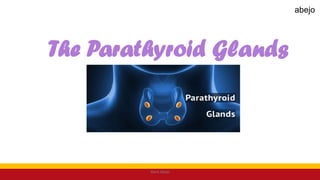
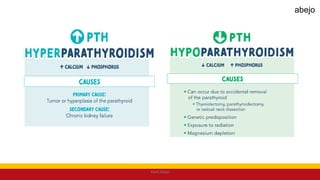
The Parathyroid Glands
Mark Abejo
abejo
Mark Abejo
abejo
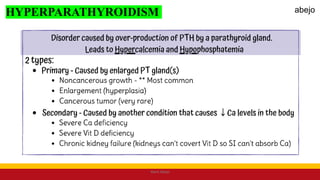
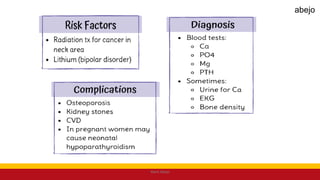
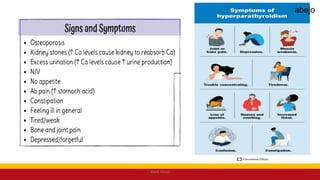
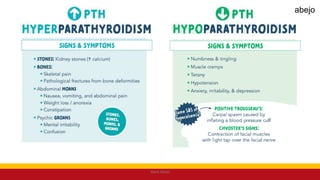
HYPERPARATHYROIDISM
Mark Abejo
abejo
Mark Abejo
abejo
Mark Abejo
abejo
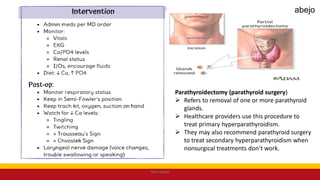
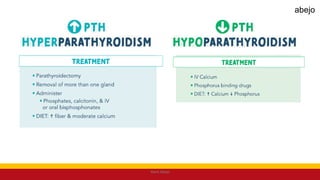
Parathyroidectomy (parathyroid surgery)
 Refers to removal of one or more parathyroid
glands.
 Healthcare providers use this procedure to
treat primary hyperparathyroidism.
 They may also recommend parathyroid surgery
to treat secondary hyperparathyroidism when
nonsurgical treatments don’t work.
Mark Abejo
abejo
Mark Abejo
abejo
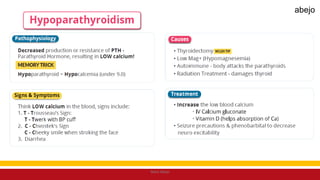
HYPOPARATHYROIDISM
Mark Abejo
abejo
Mark Abejo
abejo
A patient is recovering from a thyroidectomy.
The patient starts to complain of tingling and
numbness in the face, toes, and fingers. Which
of the following findings below warrants
attention?*
a) Ca+ level: 6 mg/dL
b) Na+ level: 145 mg/dL
c) K+ level: 3.5 mg/dL
d) Phosphate level: 4.3 mg/dL
Mark Abejo
abejo
a) Ca+ level: 6 mg/dL
Patients who've had a thyroidectomy are at risk for HYPOparathyroidism, and the symptoms listed
in the question are classic signs of hypocalcemia. A normal calcium level is 8.6 to 10.0 mg/dL.
Therefore, due to the patient's signs and symptoms and low calcium level of 6 mg/dL this warrants
a nursing intervention.
Mark Abejo
abejo
Which of the following patients are MOST at
risk for hypoparathyroidism?*
a) A 75 year-old female who is diabetic and takes Os-Cal daily.
b) A 59 year-old male with a Mg+ level of 0.9 mg/dL.
c) A 85 year-old female complaining of flank pain and constipation.
d) A 19 year-old male with a Ca+ level of 8.9 mg/dL.
Mark Abejo
abejo
b) A 59 year-old male with a Mg+ level of
0.9 mg/dL.
This patient is experiencing HYPOmagnesemia which is a cause of HYPOparathyroidism and is most
at risk for developing this condition.
Mark Abejo
abejo
A patient hospitalized with hypoparathyroidism
is about to order lunch. Which food selection is
best for this patient based on their dietary
needs at this time?*
a) Baked chicken, green beans, and boiled potatoes
b) Broccoli salad, cottage cheese, and peaches
c) Roast beef, carrots, and pinto beans
d) Hamburger, fries, and sorbet.
Mark Abejo
abejo
b) Broccoli salad, cottage cheese, and
peaches
Remember green leafy vegetables and cheeses are high in calcium. All the other options are high in
either protein, carbs, or fiber.
Mark Abejo
abejo
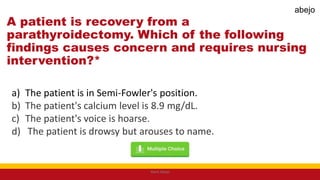
A patient is recovery from a
parathyroidectomy. Which of the following
findings causes concern and requires nursing
intervention?*
a) The patient is in Semi-Fowler's position.
b) The patient's calcium level is 8.9 mg/dL.
c) The patient's voice is hoarse.
d) The patient is drowsy but arouses to name.
Mark Abejo
abejo
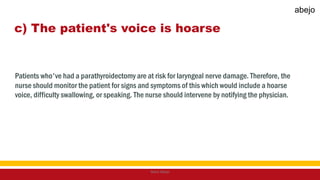
c) The patient's voice is hoarse
Patients who've had a parathyroidectomy are at risk for laryngeal nerve damage. Therefore, the
nurse should monitor the patient for signs and symptoms of this which would include a hoarse
voice, difficulty swallowing, or speaking. The nurse should intervene by notifying the physician.
Mark Abejo
abejo
Mark Abejo
abejo
Mark Abejo
abejo
Mark Abejo
abejo
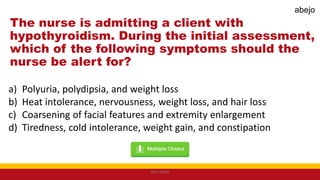
The nurse is admitting a client with
hypothyroidism. During the initial assessment,
which of the following symptoms should the
nurse be alert for?
a) Polyuria, polydipsia, and weight loss
b) Heat intolerance, nervousness, weight loss, and hair loss
c) Coarsening of facial features and extremity enlargement
d) Tiredness, cold intolerance, weight gain, and constipation
Mark Abejo
abejo
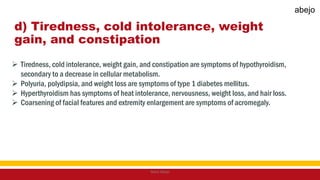
d) Tiredness, cold intolerance, weight
gain, and constipation
 Tiredness, cold intolerance, weight gain, and constipation are symptoms of hypothyroidism,
secondary to a decrease in cellular metabolism.
 Polyuria, polydipsia, and weight loss are symptoms of type 1 diabetes mellitus.
 Hyperthyroidism has symptoms of heat intolerance, nervousness, weight loss, and hair loss.
 Coarsening of facial features and extremity enlargement are symptoms of acromegaly.
Mark Abejo
abejo
Mark Abejo
abejo
The nurse is admitting a new client with a
diagnosis of myxedema. During the initial
assessment, the nurse is most concerned
when the client presents with which findings?
a) Hypertension and weight loss
b) Heat intolerance and emotional lability
c) Corneal ulcerations and increased appetite
d) Bradycardia and decreased intellectual function
Mark Abejo
abejo
d) Bradycardia and decreased intellectual
function
 Myxedema is caused by hypothyroidism. Signs and symptoms of hypothyroidism include slowing of
the heart rate and decreased intellectual functions, such as slurring speech, impaired memory,
and inattentiveness.
 Hypertension, weight loss, heat intolerance, emotional lability, and increased appetite are all signs
and symptoms of hyperthyroidism. Corneal ulcerations may be seen in hyperthyroidism due to
exophthalmos because edema behind the eye may prevent eyelids from closing completely.
Mark Abejo
abejo
A client presents with flushed skin,
exophthalmos, and perspiration and
states that he has been “irritable” and having
palpitations. The nurse interprets these
symptoms as indicating which disorder?
a) Hyperthyroidism
b) Hyperparathyroidism
c) Hypothyroidism
d) Type 1 diabetes mellitus
Mark Abejo
abejo
a) Hyperthyroidism
 Signs and symptoms of hyperthyroidism include nervousness, palpitations, irritability,
exophthalmos, heat intolerance, weight loss, and weakness.
 Hyperparathyroidism is characterized by weakness and anorexia.
 Signs and symptoms of hypothyroidism include fatigue, cool skin, and sensitivity to cold.
 Type 1 diabetes mellitus presents with polyuria, polydipsia, and weight loss.
Mark Abejo
abejo
Mark Abejo
abejo
The nurse is caring for a client who is 1 day
postoperative from a total thyroidectomy. The
nurse determines it is necessary to call the
rapid response team (RRT) when the client
displays which of the following?
a) Blood pressure of 150/92 mm Hg
b) Harsh, high-pitched respiratory sounds
c) Weak voice and/or hoarseness
d) Decreased deep tendon reflexes
Mark Abejo
abejo
b) Harsh, high-pitched respiratory sounds
 Stridor, or harsh, high-pitched respiratory sounds, indicates respiratory obstruction, which may be
caused by laryngeal spasms or swelling.
 A blood pressure of 150/92 mm Hg is high but not enough to call the RRT. A weak voice and/or
hoarseness may be expected if the laryngeal nerve is affected.
 Decreased deep tendon reflexes are not a concern. Hyperactive deep tendon reflexes would
indicate a low calcium level, which may occur with damage to the parathyroid glands.
Mark Abejo
abejo
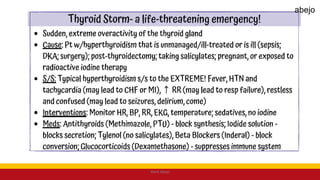
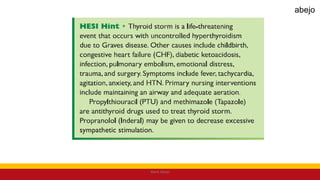
A client with hyperthyroidism develops a high
fever, extreme tachycardia, and systolic
hypertension. The nurse suspects which of the
following?
a) Hepatic coma
b) Thyroid storm
c) Myxedema
d) Laryngeal spasm
Mark Abejo
abejo
b) Thyroid storm
 Thyroid storm is a form of severe hyperthyroidism that can be precipitated by stress, injury, or
infection.
 Hepatic coma occurs in clients with profound liver failure.
 Myxedema is related to hypothyroidism.
 Laryngeal spasms are a possible complication that can occur after thyroid surgery and do not
involve fever or hypertension.
Mark Abejo
abejo
The nurse is caring for a middle-aged athletic
client with hyperparathyroidism. The client has
been further diagnosed with kidney stones. The
client is currently showing signs of apathy and
depression, and despite the client’s athleticism,
the nurse’s assessment finds flabby musculature.
Based on the diagnosis and signs and symptoms,
the nurse suspects which of the following
conditions?
a) Hypercalcemia
b) Hypocalcemia
c) Hypernatremia
d) Hyponatremia
Mark Abejo
abejo
a) Hypercalcemia
 An overactive parathyroid gland (hyperparathyroidism) produces an increased amount of
parathyroid hormone, which promotes the release of calcium from the bone and increases serum
calcium (which may cause kidney stones).
 The client is demonstrating signs/symptoms of hypercalcemia.
 Hypocalcemia would cause muscle cramps and possible tetany.
 Hyperparathyroidism does not directly affect sodium levels.
Mark Abejo
abejo
Mark Abejo
abejo
A client is admitted with a diagnosis of
hyperparathyroidism. The nurse anticipates
the client to present with which of the
following?
a) Exophthalmos
b) Renal calculi
c) Weight gain
d) Weight loss
Mark Abejo
abejo
b) Renal calculi
 Hyperparathyroidism is overproduction of parathyroid hormone, characterized by elevated serum
calcium, bone calcification, or renal calculi.
 Exophthalmos and weight loss are signs of hyperthyroidism, and weight gain is a sign of
hypothyroidism.
Mark Abejo
abejo
A client admitted with hypoparathyroidism is
being monitored for hypocalcemia. Which
finding would the nurse observe with
hypocalcemia?
a) Battle’s sign
b) Brudzinski’s sign
c) Chvostek’s sign
d) Homans’ sign
Mark Abejo
abejo
c) Chvostek’s sign
 Hypocalcemia can cause Chvostek’s sign, abnormal facial muscle and nerve spasms elicited when
the facial nerve is tapped.
 Battle’s sign is bruising over the temporal bone in the presence of a basilar skull fracture.
 Brudzinski’s sign is the flexion of the hips and knees in response to flexion of the head and neck
toward the chest, indicating meningeal irritation.
 A positive Homans’ sign indicates deep vein thrombosis.
Mark Abejo
abejo
Mark Abejo
abejo
Mark Abejo
abejo
Mark Abejo
abejo
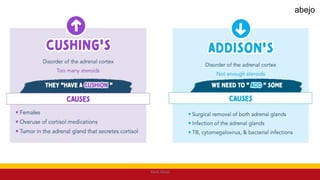
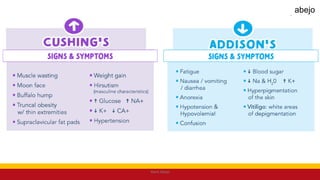
CUSHING’S SYNDROME
Mark Abejo
abejo
Mark Abejo
abejo
Mark Abejo
abejo
Mark Abejo
abejo
Mark Abejo
abejo
Mark Abejo
abejo
Mark Abejo
abejo
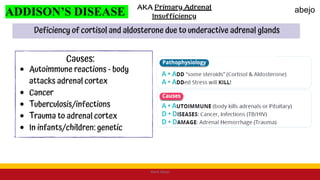
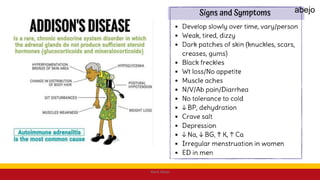
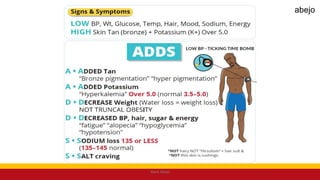
ADDISON’S DISEASE
Mark Abejo
abejo
Mark Abejo
abejo
Mark Abejo
abejo
Mark Abejo
abejo
Mark Abejo
abejo
Mark Abejo
abejo
Mark Abejo
abejo
Mark Abejo
abejo
A client who is diagnosed with Addison
disease is hospitalized for a broken left femur.
Which client data is most critical for the nurse
to report to the client’s healthcare provider
(HCP)?
a) A systolic blood pressure decline of 25 mm Hg.
b) Bronchovesicular breath sounds auscultated throughout the lung
fields.
c) Electrocardiogram (ECG) shows occasional premature ventricular
contractions (PVCs).
d) Report of stabbing pain of 8 in the left femur on a numeric scale of
1-10.
Mark Abejo
abejo
a) A systolic blood pressure decline of 25
mm Hg.
 Clinical manifestations of Addisonian crisis, often caused by stress (e.g., a femur fracture),
include altered levels of consciousness (e.g., confusion), hypovolemia (e.g., dehydration),
hyperthermia, increased serum potassium, decreased serum glucose, decreased serum sodium,
decreased blood pressure (i.e., hypotension), increased heart rate (i.e., tachycardia), and
generalized weakness.
 The drop in the client’s systolic blood pressure may indicate Addisonian crisis; therefore, the
nurse reports this finding to the HCP immediately.
Mark Abejo
abejo
Which clinical manifestation should the nurse
anticipate when providing care for a client who
is diagnosed with Cushing syndrome? Select
all that apply.
a) Easy bruising.
b) Increased blood glucose.
c) Increased blood pressure.
d) Increased potassium.
e) Increased abdominal girth.
f) Decreased weight.
Mark Abejo
abejo
a,b,c,e
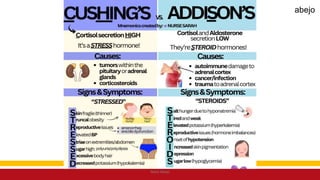
 Prolonged exposure to excess hormone secretion by the adrenal cortex can result in Cushing syndrome.
 Clinical manifestations vary for clients who are diagnosed with this syndrome but include dermatologic and
metabolic abnormalities and signs and symptoms associated with the hypersecretion of androgens and steroid
catabolism.
 Dermatologic abnormalities include thin skin, ecchymosis (i.e., bruising), and stretch marks.
 Metabolic abnormalities result in a full, rounded face; increases in both serum glucose and blood pressure; and
localized fat (e.g., abdomen, back of neck).
 The hypersecretion of androgens results in excessive hair growth, irregular menstruation, and skin inflammation
(e.g., acne).
 Finally steroid catabolism causes bone irregularities (e.g., osteoporosis) and weak muscles.
Mark Abejo
abejo
The nurse provides care for a client who is
diagnosed with Addison disease. Which
clinical manifestation does the nurse
anticipate for this client due to primary
adrenocortical insufficiency? Select all that
apply.
a) Skin color that is tanned in appearance.
b) Anorexia and weight loss.
c) Increased body or facial hair.
d) Orthostatic hypotension.
e) Purple or red striae on the abdomen.
Mark Abejo
abejo
a,b,d
 It is important for the nurse to know clinical manifestations associated with primary
adrenocortical insufficiency.
 The signs and symptoms experienced by the client are a direct result of the hypersecretion of
androgens, cortisol, and aldosterone by the adrenal cortex.
 In addition, clinical manifestations are also a result of the autoimmune component associated
with Addison disease.
 Common signs and symptoms include: anorexia, tanned pigmentation of the skin, orthostatic
blood pressure changes, and weight loss.
Mark Abejo
abejo
Which statement should the nurse include
when providing education to the client who is
diagnosed with Addison disease and
prescribed steroid therapy twice per day?
Select all that apply.
a) "You should check your blood sugar before meals and at bedtime.“
b) "During stressful times, the dosage may need to be decreased.“
c) "Have your eyes checked yearly while on hydrocortisone.“
d) "Immediately stop hydrocortisone if you feel emotional or
irritable.“
e) "Take your prescribed hydrocortisone by mouth with a meal."
Mark Abejo
abejo
a,c,e
 The nurse is responsible for providing the client with instructions regarding prescribed
medication therapies.
 The nurse includes why the medication is prescribed, safe administration directions, expected
side effects, and circumstances that necessitate healthcare provider notification.
 Topics that should be included in the teaching session for this client includes the following:
monitoring blood glucose levels; having yearly eye examinations; and taking the medication with
food.
 Once the teaching is complete, the nurse evaluates the client’s understanding using the teach-
back method.
Mark Abejo
abejo
A client is prescribed tapering doses of
prednisone for a week. Which condition should
the nurse explain is being prevented by
different daily doses?
a) Hypertension
b) Adrenal insufficiency
c) Hyperglycemia
d) Potassium deficiency
Mark Abejo
abejo
b) Adrenal insufficiency
 When steroids are discontinued abruptly, it can cause adrenal insufficiency, which can lead to
Addisonian crisis.
 During adrenal insufficiency, the adrenal glands stop working as it should and fail to produce
enough hormone in the body.
 This can become a life-threatening condition since the client may experience extreme
hypoglycemia, hypotension, and elevated potassium levels.
 Clients should be educated to not stop taking steroids, such as prednisone, abruptly. These
medication doses should be gradually tapered to prevent this serious condition.
Mark Abejo
abejo
In a detailed discussion about the etiology of
Cushing's Syndrome, Nurse Harper elaborates
on the potential causes. She outlines the
following possibilities:
a) It originates from consuming an excessive amount of fiber in the
diet.
b) The disorder stems from having an abnormally high concentration
of cortisol in the bloodstream.
c) The condition arises from engaging in unprotected sexual contact.
d) It is due to the presence of an excessive number of Y
chromosomes.
Mark Abejo
abejo
b) The disorder stems from having an
abnormally high concentration of cortisol
in the bloodstream.
 The disorder stems from having an abnormally high concentration of cortisol in the bloodstream.
 Cushing's Syndrome is characterized by an excessive amount of cortisol in the bloodstream.
 Cortisol, a hormone produced by the adrenal glands, plays a critical role in various bodily
functions, including managing stress, reducing inflammation, regulating blood sugar, and
controlling the sleep cycle.
 However, when too much cortisol circulates in the body, it can lead to a range of symptoms and
complications associated with Cushing's Syndrome.
Mark Abejo
abejo
Nurse Robert is evaluating a client who may have
Cushing's syndrome. He knows that certain
physical characteristics are commonly associated
with this condition. Based on his knowledge, what
would Nurse Robert expect to find in a client with
Cushing's syndrome?
a) Thick, coarse skin.
b) Accumulation of fatty tissue in the trunk and dorsocervical area
(upper back, often referred to as a "buffalo hump").
c) An increase in weight specifically in the arms and legs.
d) Low blood pressure (hypotension).
Mark Abejo
abejo
b) Accumulation of fatty tissue in the
trunk and dorsocervical area (upper back,
often referred to as a "buffalo hump").
 Accumulation of fatty tissue in the trunk and dorsocervical area (upper back, often referred to as
a "buffalo hump").
 Cushing's syndrome is a hormonal disorder caused by prolonged exposure of the body's tissues
to high levels of cortisol, a hormone produced by the adrenal glands.
 This distinct fat distribution pattern is due to the effects of excess cortisol, which promotes fat
deposition in certain areas of the body while other areas, like the arms and legs, may experience
muscle wasting, making the fat deposition in the trunk and upper back even more pronounced.
Mark Abejo
abejo
Mark Abejo
abejo
Mark Abejo
abejo
Mark Abejo
abejo
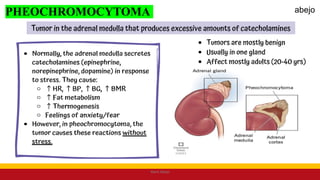
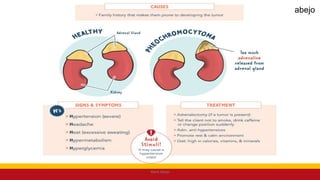
PHEOCHROMOCYTOMA
Mark Abejo
abejo
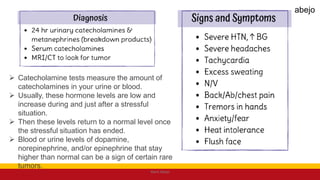
 Catecholamine tests measure the amount of
catecholamines in your urine or blood.
 Usually, these hormone levels are low and
increase during and just after a stressful
situation.
 Then these levels return to a normal level once
the stressful situation has ended.
 Blood or urine levels of dopamine,
norepinephrine, and/or epinephrine that stay
higher than normal can be a sign of certain rare
tumors.
Mark Abejo
abejo
Mark Abejo
abejo
Mark Abejo
abejo
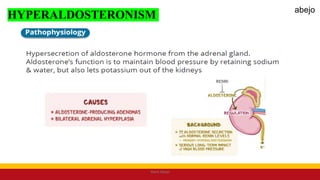
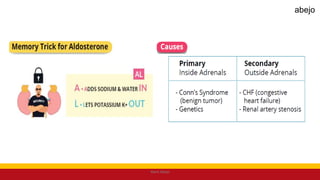
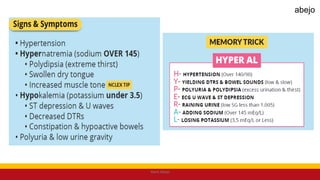
HYPERALDOSTERONISM
Mark Abejo
abejo
Mark Abejo
abejo
Mark Abejo
abejo
Mark Abejo
abejo
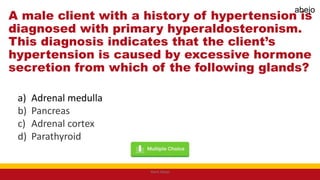
A male client with a history of hypertension is
diagnosed with primary hyperaldosteronism.
This diagnosis indicates that the client’s
hypertension is caused by excessive hormone
secretion from which of the following glands?
a) Adrenal medulla
b) Pancreas
c) Adrenal cortex
d) Parathyroid
Mark Abejo
abejo
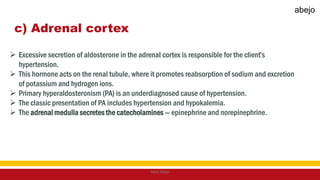
c) Adrenal cortex
 Excessive secretion of aldosterone in the adrenal cortex is responsible for the client’s
hypertension.
 This hormone acts on the renal tubule, where it promotes reabsorption of sodium and excretion
of potassium and hydrogen ions.
 Primary hyperaldosteronism (PA) is an underdiagnosed cause of hypertension.
 The classic presentation of PA includes hypertension and hypokalemia.
 The adrenal medulla secretes the catecholamines — epinephrine and norepinephrine.
Mark Abejo
abejo
A nurse assesses a client who potentially has
hyperaldosteronism. Which serum laboratory
values should the nurse associate with this
disorder? Select all that apply
a) Sodium: 150 mEq/L.
b) Sodium: 130 mEq/L
c) Potassium: 2.5 mEq/L
d) Potassium: 5.0 mEq/L
Mark Abejo
abejo
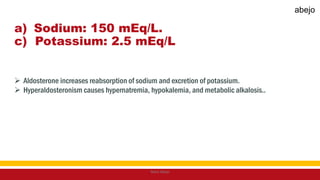
a) Sodium: 150 mEq/L.
c) Potassium: 2.5 mEq/L
 Aldosterone increases reabsorption of sodium and excretion of potassium.
 Hyperaldosteronism causes hypernatremia, hypokalemia, and metabolic alkalosis..
Mark Abejo
abejo
A client is admitted with pheochromocytoma.
The nurse assesses the client’s blood pressure
frequently because pheochromocytoma of the
adrenal medulla releases excessive amounts
of:
a) Renin.
b) Aldosterone.
c) Catecholamines.
d) Glucocorticoids.
Mark Abejo
abejo
c) Catecholamines.
 Pheochromocytomas release catecholamines, both epinephrine and norepinephrine.
 The excessive hormone secretion can be constant or episodic, producing constant or episodic
severe hypertension.
 The pheochromocytoma does not cause release of renin, aldosterone, or glucocorticoids.
Mark Abejo
abejo
A patient has excessive catecholamines in the
urine. Which of the following signs and
symptoms would the patient NOT exhibit?
SELECT ALL THAT APPLY:
a) Tachycardia
b) Anxiety
c) Hypoglycemia
d) Thermogenesis
e) Decreased Basal Metabolic Rate
Mark Abejo
abejo
c) Hypoglycemia
e) Decreased Basal Metabolic Rate
 The patient would have HYPERglycemia (not hypoglycemia) and INCREASED basal metabolic
rate (not decreased).
Mark Abejo
abejo
Mark Abejo
abejo
The nurse is caring for a client with newly
diagnosed Cushing’s disease. Which of the
following signs and/or symptoms would the
nurse expect to find on initial assessment?
a) Bruising and hypotension
b) Truncal obesity and petechiae
c) Hypertension and emaciation
d) Weight loss and moon face
Mark Abejo
abejo
b) Truncal obesity and petechiae
 Cushing’s disease causes truncal obesity due to fat redistribution and petechiae due to capillary
fragility. Other manifestations include hypertension and weight gain.
Mark Abejo
abejo
The nurse is providing education for a client
newly diagnosed with Addison’s disease who
is receiving a maintenance dose of steroids.
What is the most important information for the
nurse to include?
a) Importance of restricting fluids
b) Watching for signs of hypoglycemia
c) Taking steroids exactly as prescribed
d) Adjusting steroid doses based on dietary intake and exercise
Mark Abejo
abejo
c) Taking steroids exactly as prescribed
 A client with Addison’s disease needs more steroids than the body produces. Taking a lower dose
may trigger an addisonian crisis; taking a higher dose increases the effects of potassium
depletion, hyperglycemia, and fluid retention, leading to a life-threatening situation.
 Fluid restriction isn’t desirable and could cause dehydration.
 Steroids tend to increase, not decrease, blood sugar.
 Steroid doses aren’t adjusted for diet and exercise, although the client may need to administer
insulin and adjust insulin doses.
Mark Abejo
abejo
A 37-year-old client complains of muscle
weakness, anorexia, and darkening of his skin. The
nurse reviews his laboratory data and notes
findings of low serum sodium and high serum
potassium levels. The nurse recognizes that these
signs and symptoms are associated with which
condition?
a) Addison’s disease
b) Cushing’s disease
c) Diabetes insipidus
d) Thyrotoxic crisis
Mark Abejo
abejo
a) Addison’s disease
 The clinical picture of Addison’s disease includes muscle weakness, anorexia, darkening of the
skin’s pigmentation, low sodium level, and high potassium level.
 Cushing’s syndrome presents with obesity, “buffalo hump,” “moon face,” and thin extremities.
 Symptoms of diabetes insipidus include excretion of large volumes of dilute urine, leading to
hypernatremia and dehydration.
 Thyrotoxic crisis can occur with severe hyperthyroidism.
Mark Abejo
abejo
The nurse is planning care for a client who is
diagnosed with Cushing’s syndrome. Which of
the following nursing diagnoses would be
appropriate for this client?
a) Risk for fluid volume deficit
b) Risk for infection
c) Impaired gas exchange
d) Acute pain
Mark Abejo
abejo
b) Risk for infection
 High levels of corticosteroids cause reduced inflammatory and immune responses, putting the
client with Cushing’s syndrome at increased risk for infection.
 Sodium and water are retained, causing fluid overload.
 Problems with gas exchange are not associated with Cushing’s syndrome, nor is acute pain.
Mark Abejo
abejo
The nurse is admitting a client with newly
diagnosed Cushing’s syndrome. Which of the
following serum laboratory results might be
expected for this client?
a) Decreased sodium and decreased glucose
b) Decreased cortisol and increased glucose
c) Increased cortisol and decreased sodium
d) Increased cortisol and increased sodium
Mark Abejo
abejo
d) Increased cortisol and increased
sodium
 Increased cortisol, glucose, and sodium are found in clients with Cushing’s syndrome.
Mark Abejo
abejo
The nurse is caring for a client with Addison’s
disease. Which of the following serum laboratory
values indicates that the treatment being given is
effective?
a) Sodium of 147 mEq/L
b) Potassium of 2.9 mEq/L
c) Sodium of 142 mEq/L
d) Potassium of 6.0 mEq/L
Mark Abejo
abejo
c) Sodium of 142 mEq/L
 Adrenal insufficiency causes a low sodium level and a high potassium level. A sodium value of
142 mEq/L is within the normal range and indicates the therapy is effective. All of the other lab
values are outside of the normal range.
Mark Abejo
abejo
Mark Abejo
abejo
Mark Abejo
abejo
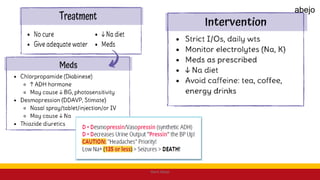
DIABETES INSIPIDUS
Mark Abejo
abejo
Mark Abejo
abejo
Mark Abejo
abejo
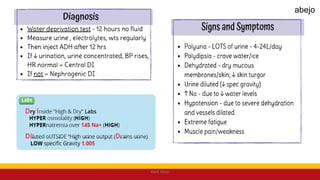
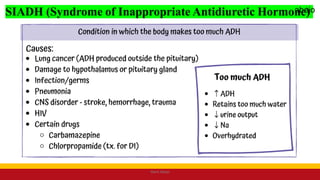
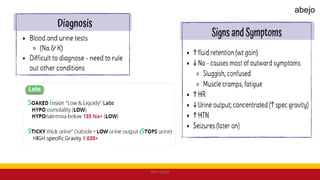
SIADH (Syndrome of Inappropriate Antidiuretic Hormone)
Mark Abejo
abejo
Mark Abejo
abejo
Mark Abejo
abejo
Mark Abejo
abejo
Mark Abejo
abejo
Mark Abejo
abejo
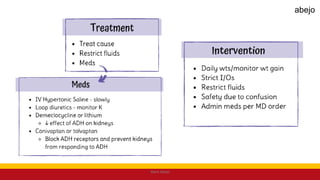
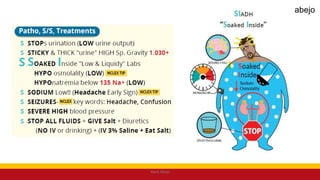
Which nursing action is appropriate in the
provision of care for a client who is newly
diagnosed with syndrome of inappropriate
antidiuretic hormone (SIADH)? Select all that
apply.
a) Monitoring the client's weight daily.
b) Administering the prescribed normal saline (NS) boluses to the
client.
c) Restricting the client's oral fluid intake.
d) Restricting the client's dietary sodium intake.
e) Initiating seizure precautions for the client.
f) Measuring the client's intake and output each shift.
Mark Abejo
abejo
a) Monitoring the client's weight daily.
c) Restricting the client's oral fluid intake.
e) Initiating seizure precautions for the client.
f) Measuring the client's intake and output each
shift.
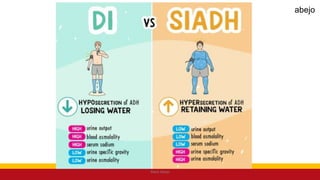
 Syndrome of inappropriate antidiuretic hormone (SIADH) leads to hypervolemia and dilutional
decreases in serum sodium levels.
 Neurologic symptoms associated with hyponatremia include confusion and seizure activity.
 Interventions for clients who are diagnosed with SIADH include daily weights, restriction of fluid
intake, documentation of intake and output, administration of salt tablets by mouth, and the
administration of 3% saline.
 Seizure precautions are implemented as the risk of seizure activity is caused by the client’s
dilutional hyponatremia.
Mark Abejo
abejo
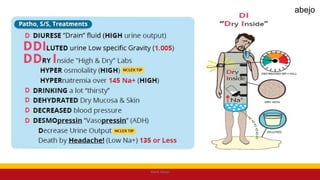
A male client with primary diabetes insipidus
is ready for discharge on desmopressin
(DDAVP). Which instruction should nurse Lina
provide?
a) “Administer desmopressin while the suspension is cold.”.
b) “Your condition isn’t chronic, so you won’t need to wear a
medical identification bracelet.”
c) “You may not be able to use desmopressin nasally if you have
nasal discharge or blockage.”
d) “You won’t need to monitor your fluid intake and output after you
start taking desmopressin.”
Mark Abejo
abejo
c) “You may not be able to use
desmopressin nasally if you have nasal
discharge or blockage.”
 The intranasal form of vasopressin is frequently a choice when administration occurs at home.
 Desmopressin may not be absorbed if the intranasal route is compromised. Desmopressin
administration can be utilized to distinguish between central vs. nephrogenic diabetes insipidus,
with a positive response noted in central diabetes insipidus, meaning the kidneys respond
appropriately to desmopressin with the expected concentration of the urine and increased
reabsorption of fluids, resulting in eutonic urine
Mark Abejo
abejo
The nurse is caring for a client who has been
admitted with a suspected diagnosis of
diabetes insipidus (DI). The nurse can expect
which of the following tests to confirm the
diagnosis?
a) Capillary blood glucose test
b) Fluid deprivation test
c) Serum ketone test
d) Urine glucose test
Mark Abejo
abejo
b) Fluid deprivation test
 The fluid deprivation test involves withholding water for 4 to 18 hours and checking urine output
for amount and specific gravity, weight, postural blood pressure, and urine osmolarity
periodically. Plasma osmolarity is also checked.
 A client with diabetes insipidus will have an increased serum osmolarity (of less than 300
mOsm/kg).
 Urine osmolarity won’t increase.
 The capillary blood glucose test allows a rapid measurement of glucose in whole blood.
 The serum ketone test documents diabetic ketoacidosis. The urine glucose test monitors glucose
levels in urine, but diabetes insipidus doesn’t affect urine glucose levels.
Mark Abejo
abejo
A nurse is caring for a client with diabetes
insipidus. Which laboratory value is most
important for the nurse to monitor?
a) Glucose
b) Hemoglobin
c) Creatinine
d) Sodium
Mark Abejo
abejo
d) Sodium
 Diabetes insipidus occurs as a result of decreased release of antidiuretic hormone, which
disturbs fluid and electrolyte balance, especially sodium. Clients need to be closely monitored
for hypernatremia.
Mark Abejo
abejo
Which of these signs suggests that a male
client with the syndrome of inappropriate
antidiuretic hormone (SIADH) secretion is
experiencing complications?
a) Tetanic contractions
b) Neck vein distention
c) Weight loss
d) Polyuria
Mark Abejo
abejo
b) Neck vein distention
 SIADH secretion causes antidiuretic hormone overproduction, which leads to fluid retention.
 Severe SIADH can cause such complications as vascular fluid overload, signaled by neck vein
distention.
 Physical examination should include assessment of volume status, as these patients are
typically euvolemic.
 Skin turgor and blood pressure are within the normal range.
 Moist mucous membranes with no evidence of jugular venous pulsation or edema typically
indicate euvolemia.
Mark Abejo
abejo
A client is receiving desmopressin acetate for
diabetes insipidus (DI). Which actions should
the nurse take when caring for this client?
Select all that apply.
a) Monitor intake and output.
b) Monitor neurologic and cardiovascular statuses
c) Monitor serum electrolytes
d) Monitor for hypotension
Mark Abejo
abejo
a) Monitor intake and output
b) Monitor neurologic and cardiovascular
statuses
c) Monitor serum electrolytes
d) Monitor for hypotension
 Client’s intake and output needs to be strictly monitored. Hallmark symptoms of DI include
extreme thirst and excessive urination.
 The decrease in overall circulating volume (hypovolemia) due to decreased ADH production can
cause hypotension and tachycardia.
 DI can quickly lead to severe fluid volume deficit and electrolyte imbalance if the fluid loss is not
replaced. Clients may experience abnormal serum sodium values.
Mark Abejo
abejo
While providing discharge instructions for the
client diagnosed with diabetes insipidus,
which priority education point will the
registered nurse (RN) stress?
a) Early signs of dehydration to closely monitor for
b) Technique for assessing urine specific gravity
c) Importance of increased daily fluid intake
d) How to measure urinary output on a daily basis
Mark Abejo
abejo
a) Early signs of dehydration to closely
monitor for
 During the care of the client, the RN will provide basic care and comfort for the client.
 While providing interventions to meet the client basic care needs, the RN will implement
interventions to reduce the client’s risk of potential health alterations.
 For the client diagnosed with diabetes insipidus (DI), it is important that the client have an
understanding of how to monitor for dehydration.
 Educating the client on self-care can assist in preventing potential risk of this disease.
 For this client close monitoring of elimination will assist in early detection of dehydration.
Mark Abejo
abejo
The nurse provides care for several assigned
clients. Which client is at risk for developing
syndrome of inappropriate antidiuretic
hormone (SIADH)?
a) A client who is diagnosed with rheumatoid arthritis (RA).
b) A client who is diagnosed with diabetes mellitus (DM).
c) A client with a long history of sciatica.
d) A client with small cell lung cancer.
Mark Abejo
abejo
d) A client with small cell lung cancer.
 Syndrome of inappropriate diuretic hormone (SIADH) results in fluid and electrolyte imbalances.
 Specifically, SIADH causes dilutional low serum sodium (i.e., hyponatremia), increased total
body water, and fluid retention.
 This disorder is caused by malfunction of the central nervous system (CNS), some medications,
cancers that produce and secrete ADH (e.g., small cell lung carcinoma), and respiratory
alterations.
Mark Abejo
abejo
The nurse provides care for a client who is
diagnosed with diabetes insipidus and prescribed
DDAVP (desmopressin acetate) tablets 0.1 mg PO.
Which assessment data indicates to the nurse that
the prescribed medication is working as expected?
a) Decreased appetite with a refusal of the dinner tray.
b) Decreased blood pressure of 60/70 mm Hg.
c) Decreased urine specific gravity from the initially elevated level.
d) Decreased urine output noted via strict monitoring of intake and
output.
Mark Abejo
abejo
d) Decreased urine output noted via strict
monitoring of intake and output.
 The nurse is responsible for administering prescribed medications to clients who are
hospitalized as a result of the exacerbation of symptoms caused by medical conditions.
 As part of the assessment process, the nurse monitors the client for manifestations indicating
prescribed medications are working as anticipated.
 The client who is prescribed desmopressin acetate for the treatment of DI should have their
intake and output (I&O) closely monitored to determine medication effectiveness.
 A decreased urine output noted via strict monitoring of I&O indicates to the nurse that the
medication is working as expected.
Mark Abejo
abejo
When caring for a client with a diagnosis of
diabetes insipidus, which nursing intervention
should be the priority?
a) Watching for signs and symptoms of septic shock
b) Maintaining adequate fluid intake
c) Checking weight every 3 days
d) Monitoring urine for specific gravity greater than 1.030
Mark Abejo
abejo
b) Maintaining adequate fluid intake
 In a client with diabetes insipidus, maintaining fluid intake is essential to prevent severe
dehydration.
 The client is at risk for developing hypovolemic shock because of increased urine output.
 Weight should be measured on a daily basis to check for adequate fluid balance.
 Urine specific gravity should be monitored for low osmolality, generally less than 1.005, due to
the body’s inability to concentrate urine.
Mark Abejo
abejo
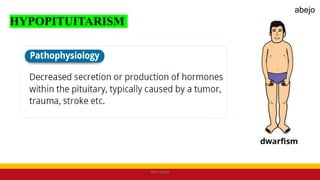
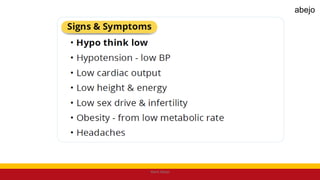
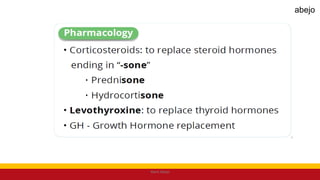
HYPOPITUITARISM
Mark Abejo
abejo
Mark Abejo
abejo
Mark Abejo
abejo
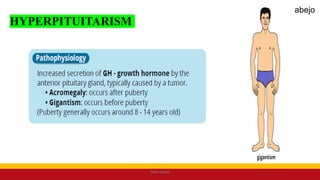
HYPERPITUITARISM
Mark Abejo
abejo
Mark Abejo
abejo
Mark Abejo
abejo
Mark Abejo
abejo
Mark Abejo
abejo
Mark Abejo
abejo
Mark Abejo
abejo
PREDIABETES
Mark Abejo
abejo
TYPE 1 DIABETES
Mark Abejo
abejo
Mark Abejo
abejo
TYPE 2 DIABETES
Mark Abejo
abejo
Mark Abejo
abejo
GESTATIONAL DIABETES
Mark Abejo
abejo
Mark Abejo
abejo
Mark Abejo
abejo
Mark Abejo
abejo
Mark Abejo
abejo
Mark Abejo
abejo
Mark Abejo
abejo
Mark Abejo
abejo
Mark Abejo
abejo
Mark Abejo
abejo
Mark Abejo
abejo
Mark Abejo
abejo
Mark Abejo
abejo
Mark Abejo
abejo
Mark Abejo
abejo
Mark Abejo
abejo
Mark Abejo
abejo
Mark Abejo
abejo
Mark Abejo
abejo
Mark Abejo
abejo
Mark Abejo
abejo
Mark Abejo
abejo
Mark Abejo
abejo
Mark Abejo
abejo
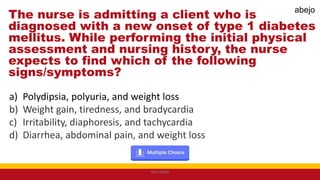
The nurse is admitting a client who is
diagnosed with a new onset of type 1 diabetes
mellitus. While performing the initial physical
assessment and nursing history, the nurse
expects to find which of the following
signs/symptoms?
a) Polydipsia, polyuria, and weight loss
b) Weight gain, tiredness, and bradycardia
c) Irritability, diaphoresis, and tachycardia
d) Diarrhea, abdominal pain, and weight loss
Mark Abejo
abejo
a) Polydipsia, polyuria, and weight loss
 Symptoms of diabetes mellitus (uncontrolled) include polydipsia, polyuria, and weight loss.
 Weight gain, tiredness, and bradycardia are symptoms of hypothyroidism.
 Irritability, diaphoresis, and tachycardia are symptoms of hypoglycemia.
 Symptoms of Crohn’s disease include diarrhea, abdominal pain, and weight loss.
Mark Abejo
abejo
A client presents with diaphoresis,
palpitations, jitters, and tachycardia
approximately 1.5 hours after taking his
regular morning insulin. What is the
most appropriate intervention by the nurse?
a) Check blood glucose level and administer carbohydrates.
b) Give nitroglycerin and perform an electrocardiogram (ECG).
c) Call the physician for additional insulin order.
d) Restrict salt, administer diuretics, and perform a paracentesis.
Mark Abejo
abejo
a) Check blood glucose level and administer
carbohydrates.
 The client is experiencing symptoms of hypoglycemia. Checking the blood glucose level and
administering carbohydrates will elevate blood glucose.
 ECG and nitroglycerin are treatments for myocardial infarction.
 This client has a low blood glucose; additional insulin will lower blood glucose further.
 Restricting salt, administering diuretics, and performing a paracentesis are treatments for
ascites.
Mark Abejo
abejo
The nurse is teaching a health promotion
class in the community. Which of the
following would the nurse encourage in order
to prevent type 2 diabetes mellitus?
a) A fat-free diet and nonimpact exercise three times weekly
b) Maintenance of ideal weight and participation in regular exercise
c) A very low–carbohydrate diet with moderate amounts of fat
d) Smoking cessation and a diet high in protein and fat
Mark Abejo
abejo
b) Maintenance of ideal weight and
participation in regular exercise
 Everyone should be encouraged to prevent type 2 diabetes by achieving and maintaining ideal
body weight and participating in regular exercise.
 A low-fat diet can be encouraged, but some fat is required in all diets.
 Carbohydrates should make up the majority of a healthy diet. Diets high in fat are never
encouraged.
Mark Abejo
abejo
The nurse is caring for a client with type 2
diabetes. One hour after taking an oral
diabetic drug, the client becomes nauseated
and vomits. Which nursing intervention
should be taken?
a) Give the oral diabetic drug again.
b) Give subcutaneous insulin and monitor blood glucose.
c) Monitor blood glucose closely and look for signs of hypoglycemia.
d) Monitor blood glucose and assess for symptoms of hyperglycemia.
Mark Abejo
abejo
c) Monitor blood glucose closely and look for
signs of hypoglycemia.
 When a client who has taken an oral antidiabetic agent vomits, the nurse should monitor glucose
and assess him frequently for signs of hypoglycemia.
 Most of the medication has probably been absorbed, and any food taken in may be lost.
Therefore, repeating the dose would further lower glucose levels later in the day.
 Giving insulin also will lower glucose levels, causing hypoglycemia.
 The client wouldn’t have hyperglycemia if most of the oral diabetic drug was absorbed.
Mark Abejo
abejo
When teaching a newly diagnosed diabetic
client about diet and exercise, what is the
most important information for the nurse to
provide?
a) Exercise will increase blood glucose.
b) Management of fluid, protein, and electrolytes
c) Reduction of calorie intake before exercising
d) Dietary goals, food consistency, and physical activity
Mark Abejo
abejo
d) Dietary goals, food consistency, and
physical activity
 Diabetic clients must be taught the relationship among dietary goals, consistency of food
composition, and regular physical activity.
 Exercise will usually decrease blood glucose.
 Management of fluids, proteins, and electrolytes is important for a client with acute renal failure.
 The diabetic client may need to intake additional calories before exercising.
Mark Abejo
abejo
A nurse is teaching a client with diabetes
mellitus about chronic complications
associated with the disease. Which
information should be included in the
teaching?
a) Buy shoes that are a half size larger.
b) Annual eye examinations are recommended.
c) Excessive exercise increases insulin resistance.
d) Podiatry visits are necessary every 5 years.
Mark Abejo
abejo
b) Annual eye examinations are recommended.
 Retinopathy is a chronic complication of diabetes mellitus. Therefore, yearly eye examinations
are recommended.
 Because of the risk of serious foot injuries, shoes should fit properly and be the correct size.
 Exercise decreases insulin resistance.
 A podiatrist should be seen on a yearly basis or more often, as needed.
Mark Abejo
abejo
The home health nurse is visiting a new type
1 diabetic client and finds the client lethargic
with very deep, rapid respirations. The client
reports nausea and abdominal pain. The
nurse observes dehydration, dry skin, and
weight loss. The nurse suspects which of the
following diabetic complications?
a) Hypoglycemia
b) Diabetes insipidus
c) Myxedema
d) Ketoacidosis
Mark Abejo
abejo
d) Ketoacidosis
 Classic symptoms of diabetic ketoacidosis include polyuria, weight loss, nausea and vomiting,
altered mental status, abdominal pain, and Kussmaul’s respirations (deep, rapid respirations
meant to correct acidosis).
 Hypoglycemia and diabetes insipidus do not cause Kussmaul’s respirations.
 Myxedema is caused by low thyroid function.
Mark Abejo
abejo
Mark Abejo
abejo

MSN Abejo Lecture - Endocrine Nursing.pdf

  • 1.
    ENDOCRINE SYSTEM MEDICAL AND SURGICAL NURSING Professor:Mark Fredderick Abejo, RN MAN Mark Abejo abejo
  • 2.
  • 3.
  • 4.
  • 5.
  • 6.
  • 7.
  • 8.
  • 9.
  • 10.
  • 11.
  • 12.
    Melatonin is ahormone in your body that plays a role in sleep. The production and release of melatonin in the brain is connected to time of day, increasing when it's dark and decreasing when it's light. Melatonin production declines with age. Mark Abejo abejo
  • 13.
     The thyroidgland releases triiodothyronine (T3) and thyroxine (T4). These hormones play an important role in regulation of your weight, energy levels, internal temperature, skin, hair, nail growth, metabolism and is an important part of the endocrine system.  Calcitonin is a hormone that plays a role in regulating the level of calcium in your blood by decreasing it. Mark Abejo abejo
  • 14.
    Parathyroid glands produceparathyroid hormone, which plays a key role in the regulation of calcium levels in the blood. Release of calcium by bones into the bloodstream Absorption of calcium from food by the intestines Conservation of calcium by the kidneys Mark Abejo abejo
  • 15.
    Thymosin primary functionis to stimulate the production of T cells, which are an important part of the immune system. Thymosin also assists in the development of B cells to plasma cells to produce antibodies. Mark Abejo abejo
  • 16.
  • 17.
  • 18.
  • 19.
  • 20.
  • 21.
  • 22.
  • 23.
  • 24.
  • 25.
  • 26.
  • 27.
  • 28.
  • 29.
  • 30.
  • 31.
  • 32.
  • 33.
  • 34.
  • 35.
  • 36.
  • 37.
    While providing carefor the client diagnosed with hypothyroidism who is experiencing memory deficit, poor attention span, and difficulty communicating, which statement made by the client’s spouse requires information and emotional support by the registered nurse (RN)? a) “I am working on asking our son to help us once we can be discharged home.” b) “I am trying to reorient my spouse to date and time throughout the day.” c) “I have set a goal to watch for any memory changes that may occur each day.” d) “There is no way I can handle these memory issues for the rest of our lives together.” Mark Abejo abejo
  • 38.
    d) “There isno way I can handle these memory issues for the rest of our lives together.” This answer is correct because the statement “there is no way I can handle these memory issues for the rest of our lives together” is the statement that requires the RN to provide further information and emotional support. The RN will reinforce to the spouse that the memory changes will improve after the client has been on thyroid hormone replacement therapy for 2 weeks. The RN will allow the spouse time to verbalize fears, concerns, and feelings without judgment. Mark Abejo abejo
  • 39.
    The nurse providescare for a pediatric client who is prescribed radioactive iodine for the treatment of hyperthyroidism. Which safety instruction should the nurse include when providing education to the child and caregivers? Select all that apply. a) “Your child should flush the toilet twice after each use.” b) “It is important for your child to stay away from pregnant women.” c) “It is important that your child not share washcloths and towels with others.” d) “Your child should not sleep in a room with other children or family members.” Mark Abejo abejo
  • 40.
    ALL ARE CORRECT Within a few days after treatment, the radioactive iodine will leave the client’s body in the saliva and urine.  The length of time in which it takes the radioactive iodine to exit the child’s body is dependent on the client’s age and the prescribed dose.  The child should be encouraged to drink plenty of fluids to assist the body in excreting the radioactivity.  To avoid exposing other people to radioactivity, it is important to follow the practitioner’s safety instructions carefully.  Instructions should include staying away from pregnant women; not sharing washcloths and towels with others; limiting time in the car with the child to no more than one hour at a time; sleeping alone; and double flushing the toilet after use. Mark Abejo abejo
  • 41.
    The nurse providescare for an adult female client who is prescribed radioactive iodine (RAI) for the treatment of hyperthyroidism. Which statement should the nurse include in the medication teaching session for this client? Select all that apply. a) "Disposable eatery tools should be used for your meals.“ b) "Wash anything you use separately from the rest of the family.“ c) "You should use a different toilet from other family members.“ d) "You cannot have any visitors who may be pregnant." Mark Abejo abejo
  • 42.
    ALL ARE CORRECT The nurse provides the client with education regarding the safe administration of prescribed medications.  Radioactive iodine (RAI) destroys the thyroid gland cells.  Because RAI is excreted in the client’s body fluids, specific teaching is required to enhance safety for those who come into contact with this client.  Therefore, the nurse includes the following topics in the medication teaching session: using disposable eatery tools; washing clothing separately from other family members; using a different toilet from family members and double flushing; and avoiding visits with children and anyone who is pregnant.  Once teaching is presented, the nurse evaluates client understanding using the “teach- back” method. Mark Abejo abejo
  • 43.
    An older adultclient who is diagnosed with hypothyroidism is admitted to the hospital due to acute confusion. The client’s current vital signs are as follows: temperature: 95 F (35 C); blood pressure: 88/48 mm Hg; heart rate: 50 beats/min; respirations: 10 breaths/min; and SaO2: 84% on room air (RA). Which is the priority action by the nurse in the provision of care for this client? a) Apply a convection temperature management system to the client. b) Give one dose of intravenous (IV) levothyroxine now and in 30 minutes. c) Draw labs for serum TSH, triiodothyronine, and thyroxine. d) Alert respiratory of the need for endotracheal (ET) intubation. Mark Abejo abejo
  • 44.
    d) Alert respiratoryof the need for endotracheal (ET) intubation.  Myxedema coma is a life-threatening complication of severe hypothyroidism.  Clients who experience myxedema coma will display significantly lowered heart rate, blood pressure, body temperature, and respirations.  Ineffective breathing results in poor gas exchange.  A respiratory rate of 10 breaths/minute and a pulse oximetry reading of 84% are signs of a compromised airway and ineffective breathing; therefore, the most critical intervention is to prepare for endotracheal tube (ET) intubation with mechanical ventilation. Mark Abejo abejo
  • 45.
    The nurse isevaluating lab results of a client who reports excessive fatigue for the past month. Labs are as follows: thyroid-stimulating hormone (TSH) is 8 U/L (Reference range: 0.4 to 4.2); total triiodothyronine (T3) is 30 ng/dL (Reference range: 70 to 204; and free thyroxine (T4) is 0.2 ng/dL (Reference range: 0.8 to 2.7). Which additional clinical manifestation should the nurse anticipate for this client? Select all that apply. a) Inability to tolerate cold. b) Difficulty having regular bowel movements. c) Fragile, dry skin. d) Hypotension. Mark Abejo abejo
  • 46.
    ALL ARE CORRECT Primary hypothyroidism often occurs after autoimmune-regulated tissue damage or trauma.  Because thyroid hormones act in multiple body sites and increase metabolic function, signs and symptoms experienced by the client are the result of a low metabolic state.  The low metabolic state experienced by the client diagnosed with hypothyroidism causes an intolerance to cold, constipation, decreases in heart rate and blood pressure, delayed deep tendon reflexes, fatigue, slowed cognition, weakness, and weight gain.  In addition, the client experiences fragile and dry skin, hoarseness, and myxedema (i.e., non pitting edema). Mark Abejo abejo
  • 47.
    While providing carefor the client recently diagnosed with hyperthyroidism, which intervention will the registered nurse (RN) implement to provide client comfort? Select all that apply. a) Change damp bed linens promptly b) Provide iced water for intake c) Lower the room temperature d) Provide extra blankets as needed e) Provide warm showers as needed Mark Abejo abejo
  • 48.
    a, b, c During the care of the client, the RN will provide basic care and comfort for the client.  The RN identifies that the client diagnosed with hyperthyroidism experiences heat intolerance.  To assist in maintaining client comfort the RN will implement interventions to reduce the discomfort associated with heat intolerance.  These interventions can include lowering the room temperature, providing iced water frequently, assisting with cool baths, and changing damp bed linens promptly. Mark Abejo abejo
  • 49.
    The nurse providesdietary instruction for a client who is newly diagnosed with hyperthyroidism. Which instruction should the nurse include in the client’s teaching session? Select all that apply. a) Avoid caffeinated beverages and eating spicy foods. b) Include protein in 3 meals and 3 snacks daily. c) The need for a low-carbohydrate diet. d) Consume a diet with 4000 to 5000 calories/day. e) Increase high-soluble fiber in the diet. Mark Abejo abejo
  • 50.
    a, b, d Hyperthyroidism is caused by hypersecretion of thyroid hormones.  When teaching clients how to manage hyperthyroidism, the nurse focuses on methods to satisfy hunger (e.g., increased calorie diet, consuming three full meals and at least three snacks daily) to meet the increased metabolic needs of the body.  These clients are taught to eat foods that are high in carbohydrates, minerals, protein, and vitamins.  Additional teaching should also include foods to avoid (e.g., stimulating substances, spicy foods, high-fiber foods). Mark Abejo abejo
  • 51.
    While providing carefor the client that has developed permanent exophthalmos related to hyperthyroidism, which action will the registered nurse (RN) implement when the client states they must now wear sunglasses forever? a) Tell the client they are lucky to be alive as so many others are not b) Allow the client the needed time to mourn this body image change c) Reinforce to the client that wearing sunglasses will help hide the eyes d) Stress to the client that it will not do any good to feel sad about this body change Mark Abejo abejo
  • 52.
    b) Allow theclient the needed time to mourn this body image change  One of the many responsibilities of the registered nurse (RN) is to provide interventions to maintain the client’s emotional, mental, and social wellbeing.  The grieving process is not limited to the diagnosis of life-ending conditions.  Grief can also occur when the client experiences a permanent life or body change related to diseases or conditions.  It is important that the RN explain to the client it is an expected response to mourn this change/loss.  The RN will provide support and care for the client as they work through the grief process of this unexpected change. Mark Abejo abejo
  • 53.
    While providing educationto the client diagnosed with hypothyroidism, what priority education point will the registered nurse (RN) stress to the client? a) “Monitor weight weekly and report decrease.” b) “Monitor for signs or hyperthyroidism.” c) “Take your thyroid medications exactly as prescribed.” d) “Keep all scheduled healthcare provider appointments.” Mark Abejo abejo
  • 54.
    c) “Take yourthyroid medications exactly as prescribed.”  This answer is correct because the statement “take your thyroid medications exactly as prescribed” is the priority education the client will provide. It is of highest priority that the client take the drug exactly as prescribed and not change the dose or drug schedule without consulting the healthcare provider. This is the highest priority education for this client.  The client should monitor daily, not weekly weights. Mark Abejo abejo
  • 55.
  • 56.
  • 57.
  • 58.
  • 59.
  • 60.
  • 61.
  • 62.
  • 63.
    Parathyroidectomy (parathyroid surgery) Refers to removal of one or more parathyroid glands.  Healthcare providers use this procedure to treat primary hyperparathyroidism.  They may also recommend parathyroid surgery to treat secondary hyperparathyroidism when nonsurgical treatments don’t work. Mark Abejo abejo
  • 64.
  • 65.
  • 66.
  • 67.
    A patient isrecovering from a thyroidectomy. The patient starts to complain of tingling and numbness in the face, toes, and fingers. Which of the following findings below warrants attention?* a) Ca+ level: 6 mg/dL b) Na+ level: 145 mg/dL c) K+ level: 3.5 mg/dL d) Phosphate level: 4.3 mg/dL Mark Abejo abejo
  • 68.
    a) Ca+ level:6 mg/dL Patients who've had a thyroidectomy are at risk for HYPOparathyroidism, and the symptoms listed in the question are classic signs of hypocalcemia. A normal calcium level is 8.6 to 10.0 mg/dL. Therefore, due to the patient's signs and symptoms and low calcium level of 6 mg/dL this warrants a nursing intervention. Mark Abejo abejo
  • 69.
    Which of thefollowing patients are MOST at risk for hypoparathyroidism?* a) A 75 year-old female who is diabetic and takes Os-Cal daily. b) A 59 year-old male with a Mg+ level of 0.9 mg/dL. c) A 85 year-old female complaining of flank pain and constipation. d) A 19 year-old male with a Ca+ level of 8.9 mg/dL. Mark Abejo abejo
  • 70.
    b) A 59year-old male with a Mg+ level of 0.9 mg/dL. This patient is experiencing HYPOmagnesemia which is a cause of HYPOparathyroidism and is most at risk for developing this condition. Mark Abejo abejo
  • 71.
    A patient hospitalizedwith hypoparathyroidism is about to order lunch. Which food selection is best for this patient based on their dietary needs at this time?* a) Baked chicken, green beans, and boiled potatoes b) Broccoli salad, cottage cheese, and peaches c) Roast beef, carrots, and pinto beans d) Hamburger, fries, and sorbet. Mark Abejo abejo
  • 72.
    b) Broccoli salad,cottage cheese, and peaches Remember green leafy vegetables and cheeses are high in calcium. All the other options are high in either protein, carbs, or fiber. Mark Abejo abejo
  • 73.
    A patient isrecovery from a parathyroidectomy. Which of the following findings causes concern and requires nursing intervention?* a) The patient is in Semi-Fowler's position. b) The patient's calcium level is 8.9 mg/dL. c) The patient's voice is hoarse. d) The patient is drowsy but arouses to name. Mark Abejo abejo
  • 74.
    c) The patient'svoice is hoarse Patients who've had a parathyroidectomy are at risk for laryngeal nerve damage. Therefore, the nurse should monitor the patient for signs and symptoms of this which would include a hoarse voice, difficulty swallowing, or speaking. The nurse should intervene by notifying the physician. Mark Abejo abejo
  • 75.
  • 76.
  • 77.
  • 78.
    The nurse isadmitting a client with hypothyroidism. During the initial assessment, which of the following symptoms should the nurse be alert for? a) Polyuria, polydipsia, and weight loss b) Heat intolerance, nervousness, weight loss, and hair loss c) Coarsening of facial features and extremity enlargement d) Tiredness, cold intolerance, weight gain, and constipation Mark Abejo abejo
  • 79.
    d) Tiredness, coldintolerance, weight gain, and constipation  Tiredness, cold intolerance, weight gain, and constipation are symptoms of hypothyroidism, secondary to a decrease in cellular metabolism.  Polyuria, polydipsia, and weight loss are symptoms of type 1 diabetes mellitus.  Hyperthyroidism has symptoms of heat intolerance, nervousness, weight loss, and hair loss.  Coarsening of facial features and extremity enlargement are symptoms of acromegaly. Mark Abejo abejo
  • 80.
  • 81.
    The nurse isadmitting a new client with a diagnosis of myxedema. During the initial assessment, the nurse is most concerned when the client presents with which findings? a) Hypertension and weight loss b) Heat intolerance and emotional lability c) Corneal ulcerations and increased appetite d) Bradycardia and decreased intellectual function Mark Abejo abejo
  • 82.
    d) Bradycardia anddecreased intellectual function  Myxedema is caused by hypothyroidism. Signs and symptoms of hypothyroidism include slowing of the heart rate and decreased intellectual functions, such as slurring speech, impaired memory, and inattentiveness.  Hypertension, weight loss, heat intolerance, emotional lability, and increased appetite are all signs and symptoms of hyperthyroidism. Corneal ulcerations may be seen in hyperthyroidism due to exophthalmos because edema behind the eye may prevent eyelids from closing completely. Mark Abejo abejo
  • 83.
    A client presentswith flushed skin, exophthalmos, and perspiration and states that he has been “irritable” and having palpitations. The nurse interprets these symptoms as indicating which disorder? a) Hyperthyroidism b) Hyperparathyroidism c) Hypothyroidism d) Type 1 diabetes mellitus Mark Abejo abejo
  • 84.
    a) Hyperthyroidism  Signsand symptoms of hyperthyroidism include nervousness, palpitations, irritability, exophthalmos, heat intolerance, weight loss, and weakness.  Hyperparathyroidism is characterized by weakness and anorexia.  Signs and symptoms of hypothyroidism include fatigue, cool skin, and sensitivity to cold.  Type 1 diabetes mellitus presents with polyuria, polydipsia, and weight loss. Mark Abejo abejo
  • 85.
  • 86.
    The nurse iscaring for a client who is 1 day postoperative from a total thyroidectomy. The nurse determines it is necessary to call the rapid response team (RRT) when the client displays which of the following? a) Blood pressure of 150/92 mm Hg b) Harsh, high-pitched respiratory sounds c) Weak voice and/or hoarseness d) Decreased deep tendon reflexes Mark Abejo abejo
  • 87.
    b) Harsh, high-pitchedrespiratory sounds  Stridor, or harsh, high-pitched respiratory sounds, indicates respiratory obstruction, which may be caused by laryngeal spasms or swelling.  A blood pressure of 150/92 mm Hg is high but not enough to call the RRT. A weak voice and/or hoarseness may be expected if the laryngeal nerve is affected.  Decreased deep tendon reflexes are not a concern. Hyperactive deep tendon reflexes would indicate a low calcium level, which may occur with damage to the parathyroid glands. Mark Abejo abejo
  • 88.
    A client withhyperthyroidism develops a high fever, extreme tachycardia, and systolic hypertension. The nurse suspects which of the following? a) Hepatic coma b) Thyroid storm c) Myxedema d) Laryngeal spasm Mark Abejo abejo
  • 89.
    b) Thyroid storm Thyroid storm is a form of severe hyperthyroidism that can be precipitated by stress, injury, or infection.  Hepatic coma occurs in clients with profound liver failure.  Myxedema is related to hypothyroidism.  Laryngeal spasms are a possible complication that can occur after thyroid surgery and do not involve fever or hypertension. Mark Abejo abejo
  • 90.
    The nurse iscaring for a middle-aged athletic client with hyperparathyroidism. The client has been further diagnosed with kidney stones. The client is currently showing signs of apathy and depression, and despite the client’s athleticism, the nurse’s assessment finds flabby musculature. Based on the diagnosis and signs and symptoms, the nurse suspects which of the following conditions? a) Hypercalcemia b) Hypocalcemia c) Hypernatremia d) Hyponatremia Mark Abejo abejo
  • 91.
    a) Hypercalcemia  Anoveractive parathyroid gland (hyperparathyroidism) produces an increased amount of parathyroid hormone, which promotes the release of calcium from the bone and increases serum calcium (which may cause kidney stones).  The client is demonstrating signs/symptoms of hypercalcemia.  Hypocalcemia would cause muscle cramps and possible tetany.  Hyperparathyroidism does not directly affect sodium levels. Mark Abejo abejo
  • 92.
  • 93.
    A client isadmitted with a diagnosis of hyperparathyroidism. The nurse anticipates the client to present with which of the following? a) Exophthalmos b) Renal calculi c) Weight gain d) Weight loss Mark Abejo abejo
  • 94.
    b) Renal calculi Hyperparathyroidism is overproduction of parathyroid hormone, characterized by elevated serum calcium, bone calcification, or renal calculi.  Exophthalmos and weight loss are signs of hyperthyroidism, and weight gain is a sign of hypothyroidism. Mark Abejo abejo
  • 95.
    A client admittedwith hypoparathyroidism is being monitored for hypocalcemia. Which finding would the nurse observe with hypocalcemia? a) Battle’s sign b) Brudzinski’s sign c) Chvostek’s sign d) Homans’ sign Mark Abejo abejo
  • 96.
    c) Chvostek’s sign Hypocalcemia can cause Chvostek’s sign, abnormal facial muscle and nerve spasms elicited when the facial nerve is tapped.  Battle’s sign is bruising over the temporal bone in the presence of a basilar skull fracture.  Brudzinski’s sign is the flexion of the hips and knees in response to flexion of the head and neck toward the chest, indicating meningeal irritation.  A positive Homans’ sign indicates deep vein thrombosis. Mark Abejo abejo
  • 97.
  • 98.
  • 99.
  • 100.
  • 101.
  • 102.
  • 103.
  • 104.
  • 105.
  • 106.
  • 107.
  • 108.
  • 109.
  • 110.
  • 111.
  • 112.
  • 113.
  • 114.
  • 115.
    A client whois diagnosed with Addison disease is hospitalized for a broken left femur. Which client data is most critical for the nurse to report to the client’s healthcare provider (HCP)? a) A systolic blood pressure decline of 25 mm Hg. b) Bronchovesicular breath sounds auscultated throughout the lung fields. c) Electrocardiogram (ECG) shows occasional premature ventricular contractions (PVCs). d) Report of stabbing pain of 8 in the left femur on a numeric scale of 1-10. Mark Abejo abejo
  • 116.
    a) A systolicblood pressure decline of 25 mm Hg.  Clinical manifestations of Addisonian crisis, often caused by stress (e.g., a femur fracture), include altered levels of consciousness (e.g., confusion), hypovolemia (e.g., dehydration), hyperthermia, increased serum potassium, decreased serum glucose, decreased serum sodium, decreased blood pressure (i.e., hypotension), increased heart rate (i.e., tachycardia), and generalized weakness.  The drop in the client’s systolic blood pressure may indicate Addisonian crisis; therefore, the nurse reports this finding to the HCP immediately. Mark Abejo abejo
  • 117.
    Which clinical manifestationshould the nurse anticipate when providing care for a client who is diagnosed with Cushing syndrome? Select all that apply. a) Easy bruising. b) Increased blood glucose. c) Increased blood pressure. d) Increased potassium. e) Increased abdominal girth. f) Decreased weight. Mark Abejo abejo
  • 118.
    a,b,c,e  Prolonged exposureto excess hormone secretion by the adrenal cortex can result in Cushing syndrome.  Clinical manifestations vary for clients who are diagnosed with this syndrome but include dermatologic and metabolic abnormalities and signs and symptoms associated with the hypersecretion of androgens and steroid catabolism.  Dermatologic abnormalities include thin skin, ecchymosis (i.e., bruising), and stretch marks.  Metabolic abnormalities result in a full, rounded face; increases in both serum glucose and blood pressure; and localized fat (e.g., abdomen, back of neck).  The hypersecretion of androgens results in excessive hair growth, irregular menstruation, and skin inflammation (e.g., acne).  Finally steroid catabolism causes bone irregularities (e.g., osteoporosis) and weak muscles. Mark Abejo abejo
  • 119.
    The nurse providescare for a client who is diagnosed with Addison disease. Which clinical manifestation does the nurse anticipate for this client due to primary adrenocortical insufficiency? Select all that apply. a) Skin color that is tanned in appearance. b) Anorexia and weight loss. c) Increased body or facial hair. d) Orthostatic hypotension. e) Purple or red striae on the abdomen. Mark Abejo abejo
  • 120.
    a,b,d  It isimportant for the nurse to know clinical manifestations associated with primary adrenocortical insufficiency.  The signs and symptoms experienced by the client are a direct result of the hypersecretion of androgens, cortisol, and aldosterone by the adrenal cortex.  In addition, clinical manifestations are also a result of the autoimmune component associated with Addison disease.  Common signs and symptoms include: anorexia, tanned pigmentation of the skin, orthostatic blood pressure changes, and weight loss. Mark Abejo abejo
  • 121.
    Which statement shouldthe nurse include when providing education to the client who is diagnosed with Addison disease and prescribed steroid therapy twice per day? Select all that apply. a) "You should check your blood sugar before meals and at bedtime.“ b) "During stressful times, the dosage may need to be decreased.“ c) "Have your eyes checked yearly while on hydrocortisone.“ d) "Immediately stop hydrocortisone if you feel emotional or irritable.“ e) "Take your prescribed hydrocortisone by mouth with a meal." Mark Abejo abejo
  • 122.
    a,c,e  The nurseis responsible for providing the client with instructions regarding prescribed medication therapies.  The nurse includes why the medication is prescribed, safe administration directions, expected side effects, and circumstances that necessitate healthcare provider notification.  Topics that should be included in the teaching session for this client includes the following: monitoring blood glucose levels; having yearly eye examinations; and taking the medication with food.  Once the teaching is complete, the nurse evaluates the client’s understanding using the teach- back method. Mark Abejo abejo
  • 123.
    A client isprescribed tapering doses of prednisone for a week. Which condition should the nurse explain is being prevented by different daily doses? a) Hypertension b) Adrenal insufficiency c) Hyperglycemia d) Potassium deficiency Mark Abejo abejo
  • 124.
    b) Adrenal insufficiency When steroids are discontinued abruptly, it can cause adrenal insufficiency, which can lead to Addisonian crisis.  During adrenal insufficiency, the adrenal glands stop working as it should and fail to produce enough hormone in the body.  This can become a life-threatening condition since the client may experience extreme hypoglycemia, hypotension, and elevated potassium levels.  Clients should be educated to not stop taking steroids, such as prednisone, abruptly. These medication doses should be gradually tapered to prevent this serious condition. Mark Abejo abejo
  • 125.
    In a detaileddiscussion about the etiology of Cushing's Syndrome, Nurse Harper elaborates on the potential causes. She outlines the following possibilities: a) It originates from consuming an excessive amount of fiber in the diet. b) The disorder stems from having an abnormally high concentration of cortisol in the bloodstream. c) The condition arises from engaging in unprotected sexual contact. d) It is due to the presence of an excessive number of Y chromosomes. Mark Abejo abejo
  • 126.
    b) The disorderstems from having an abnormally high concentration of cortisol in the bloodstream.  The disorder stems from having an abnormally high concentration of cortisol in the bloodstream.  Cushing's Syndrome is characterized by an excessive amount of cortisol in the bloodstream.  Cortisol, a hormone produced by the adrenal glands, plays a critical role in various bodily functions, including managing stress, reducing inflammation, regulating blood sugar, and controlling the sleep cycle.  However, when too much cortisol circulates in the body, it can lead to a range of symptoms and complications associated with Cushing's Syndrome. Mark Abejo abejo
  • 127.
    Nurse Robert isevaluating a client who may have Cushing's syndrome. He knows that certain physical characteristics are commonly associated with this condition. Based on his knowledge, what would Nurse Robert expect to find in a client with Cushing's syndrome? a) Thick, coarse skin. b) Accumulation of fatty tissue in the trunk and dorsocervical area (upper back, often referred to as a "buffalo hump"). c) An increase in weight specifically in the arms and legs. d) Low blood pressure (hypotension). Mark Abejo abejo
  • 128.
    b) Accumulation offatty tissue in the trunk and dorsocervical area (upper back, often referred to as a "buffalo hump").  Accumulation of fatty tissue in the trunk and dorsocervical area (upper back, often referred to as a "buffalo hump").  Cushing's syndrome is a hormonal disorder caused by prolonged exposure of the body's tissues to high levels of cortisol, a hormone produced by the adrenal glands.  This distinct fat distribution pattern is due to the effects of excess cortisol, which promotes fat deposition in certain areas of the body while other areas, like the arms and legs, may experience muscle wasting, making the fat deposition in the trunk and upper back even more pronounced. Mark Abejo abejo
  • 129.
  • 130.
  • 131.
  • 132.
  • 133.
     Catecholamine testsmeasure the amount of catecholamines in your urine or blood.  Usually, these hormone levels are low and increase during and just after a stressful situation.  Then these levels return to a normal level once the stressful situation has ended.  Blood or urine levels of dopamine, norepinephrine, and/or epinephrine that stay higher than normal can be a sign of certain rare tumors. Mark Abejo abejo
  • 134.
  • 135.
  • 136.
  • 137.
  • 138.
  • 139.
  • 140.
    A male clientwith a history of hypertension is diagnosed with primary hyperaldosteronism. This diagnosis indicates that the client’s hypertension is caused by excessive hormone secretion from which of the following glands? a) Adrenal medulla b) Pancreas c) Adrenal cortex d) Parathyroid Mark Abejo abejo
  • 141.
    c) Adrenal cortex Excessive secretion of aldosterone in the adrenal cortex is responsible for the client’s hypertension.  This hormone acts on the renal tubule, where it promotes reabsorption of sodium and excretion of potassium and hydrogen ions.  Primary hyperaldosteronism (PA) is an underdiagnosed cause of hypertension.  The classic presentation of PA includes hypertension and hypokalemia.  The adrenal medulla secretes the catecholamines — epinephrine and norepinephrine. Mark Abejo abejo
  • 142.
    A nurse assessesa client who potentially has hyperaldosteronism. Which serum laboratory values should the nurse associate with this disorder? Select all that apply a) Sodium: 150 mEq/L. b) Sodium: 130 mEq/L c) Potassium: 2.5 mEq/L d) Potassium: 5.0 mEq/L Mark Abejo abejo
  • 143.
    a) Sodium: 150mEq/L. c) Potassium: 2.5 mEq/L  Aldosterone increases reabsorption of sodium and excretion of potassium.  Hyperaldosteronism causes hypernatremia, hypokalemia, and metabolic alkalosis.. Mark Abejo abejo
  • 144.
    A client isadmitted with pheochromocytoma. The nurse assesses the client’s blood pressure frequently because pheochromocytoma of the adrenal medulla releases excessive amounts of: a) Renin. b) Aldosterone. c) Catecholamines. d) Glucocorticoids. Mark Abejo abejo
  • 145.
    c) Catecholamines.  Pheochromocytomasrelease catecholamines, both epinephrine and norepinephrine.  The excessive hormone secretion can be constant or episodic, producing constant or episodic severe hypertension.  The pheochromocytoma does not cause release of renin, aldosterone, or glucocorticoids. Mark Abejo abejo
  • 146.
    A patient hasexcessive catecholamines in the urine. Which of the following signs and symptoms would the patient NOT exhibit? SELECT ALL THAT APPLY: a) Tachycardia b) Anxiety c) Hypoglycemia d) Thermogenesis e) Decreased Basal Metabolic Rate Mark Abejo abejo
  • 147.
    c) Hypoglycemia e) DecreasedBasal Metabolic Rate  The patient would have HYPERglycemia (not hypoglycemia) and INCREASED basal metabolic rate (not decreased). Mark Abejo abejo
  • 148.
  • 149.
    The nurse iscaring for a client with newly diagnosed Cushing’s disease. Which of the following signs and/or symptoms would the nurse expect to find on initial assessment? a) Bruising and hypotension b) Truncal obesity and petechiae c) Hypertension and emaciation d) Weight loss and moon face Mark Abejo abejo
  • 150.
    b) Truncal obesityand petechiae  Cushing’s disease causes truncal obesity due to fat redistribution and petechiae due to capillary fragility. Other manifestations include hypertension and weight gain. Mark Abejo abejo
  • 151.
    The nurse isproviding education for a client newly diagnosed with Addison’s disease who is receiving a maintenance dose of steroids. What is the most important information for the nurse to include? a) Importance of restricting fluids b) Watching for signs of hypoglycemia c) Taking steroids exactly as prescribed d) Adjusting steroid doses based on dietary intake and exercise Mark Abejo abejo
  • 152.
    c) Taking steroidsexactly as prescribed  A client with Addison’s disease needs more steroids than the body produces. Taking a lower dose may trigger an addisonian crisis; taking a higher dose increases the effects of potassium depletion, hyperglycemia, and fluid retention, leading to a life-threatening situation.  Fluid restriction isn’t desirable and could cause dehydration.  Steroids tend to increase, not decrease, blood sugar.  Steroid doses aren’t adjusted for diet and exercise, although the client may need to administer insulin and adjust insulin doses. Mark Abejo abejo
  • 153.
    A 37-year-old clientcomplains of muscle weakness, anorexia, and darkening of his skin. The nurse reviews his laboratory data and notes findings of low serum sodium and high serum potassium levels. The nurse recognizes that these signs and symptoms are associated with which condition? a) Addison’s disease b) Cushing’s disease c) Diabetes insipidus d) Thyrotoxic crisis Mark Abejo abejo
  • 154.
    a) Addison’s disease The clinical picture of Addison’s disease includes muscle weakness, anorexia, darkening of the skin’s pigmentation, low sodium level, and high potassium level.  Cushing’s syndrome presents with obesity, “buffalo hump,” “moon face,” and thin extremities.  Symptoms of diabetes insipidus include excretion of large volumes of dilute urine, leading to hypernatremia and dehydration.  Thyrotoxic crisis can occur with severe hyperthyroidism. Mark Abejo abejo
  • 155.
    The nurse isplanning care for a client who is diagnosed with Cushing’s syndrome. Which of the following nursing diagnoses would be appropriate for this client? a) Risk for fluid volume deficit b) Risk for infection c) Impaired gas exchange d) Acute pain Mark Abejo abejo
  • 156.
    b) Risk forinfection  High levels of corticosteroids cause reduced inflammatory and immune responses, putting the client with Cushing’s syndrome at increased risk for infection.  Sodium and water are retained, causing fluid overload.  Problems with gas exchange are not associated with Cushing’s syndrome, nor is acute pain. Mark Abejo abejo
  • 157.
    The nurse isadmitting a client with newly diagnosed Cushing’s syndrome. Which of the following serum laboratory results might be expected for this client? a) Decreased sodium and decreased glucose b) Decreased cortisol and increased glucose c) Increased cortisol and decreased sodium d) Increased cortisol and increased sodium Mark Abejo abejo
  • 158.
    d) Increased cortisoland increased sodium  Increased cortisol, glucose, and sodium are found in clients with Cushing’s syndrome. Mark Abejo abejo
  • 159.
    The nurse iscaring for a client with Addison’s disease. Which of the following serum laboratory values indicates that the treatment being given is effective? a) Sodium of 147 mEq/L b) Potassium of 2.9 mEq/L c) Sodium of 142 mEq/L d) Potassium of 6.0 mEq/L Mark Abejo abejo
  • 160.
    c) Sodium of142 mEq/L  Adrenal insufficiency causes a low sodium level and a high potassium level. A sodium value of 142 mEq/L is within the normal range and indicates the therapy is effective. All of the other lab values are outside of the normal range. Mark Abejo abejo
  • 161.
  • 162.
  • 163.
  • 164.
  • 165.
  • 166.
    SIADH (Syndrome ofInappropriate Antidiuretic Hormone) Mark Abejo abejo
  • 167.
  • 168.
  • 169.
  • 170.
  • 171.
  • 172.
    Which nursing actionis appropriate in the provision of care for a client who is newly diagnosed with syndrome of inappropriate antidiuretic hormone (SIADH)? Select all that apply. a) Monitoring the client's weight daily. b) Administering the prescribed normal saline (NS) boluses to the client. c) Restricting the client's oral fluid intake. d) Restricting the client's dietary sodium intake. e) Initiating seizure precautions for the client. f) Measuring the client's intake and output each shift. Mark Abejo abejo
  • 173.
    a) Monitoring theclient's weight daily. c) Restricting the client's oral fluid intake. e) Initiating seizure precautions for the client. f) Measuring the client's intake and output each shift.  Syndrome of inappropriate antidiuretic hormone (SIADH) leads to hypervolemia and dilutional decreases in serum sodium levels.  Neurologic symptoms associated with hyponatremia include confusion and seizure activity.  Interventions for clients who are diagnosed with SIADH include daily weights, restriction of fluid intake, documentation of intake and output, administration of salt tablets by mouth, and the administration of 3% saline.  Seizure precautions are implemented as the risk of seizure activity is caused by the client’s dilutional hyponatremia. Mark Abejo abejo
  • 174.
    A male clientwith primary diabetes insipidus is ready for discharge on desmopressin (DDAVP). Which instruction should nurse Lina provide? a) “Administer desmopressin while the suspension is cold.”. b) “Your condition isn’t chronic, so you won’t need to wear a medical identification bracelet.” c) “You may not be able to use desmopressin nasally if you have nasal discharge or blockage.” d) “You won’t need to monitor your fluid intake and output after you start taking desmopressin.” Mark Abejo abejo
  • 175.
    c) “You maynot be able to use desmopressin nasally if you have nasal discharge or blockage.”  The intranasal form of vasopressin is frequently a choice when administration occurs at home.  Desmopressin may not be absorbed if the intranasal route is compromised. Desmopressin administration can be utilized to distinguish between central vs. nephrogenic diabetes insipidus, with a positive response noted in central diabetes insipidus, meaning the kidneys respond appropriately to desmopressin with the expected concentration of the urine and increased reabsorption of fluids, resulting in eutonic urine Mark Abejo abejo
  • 176.
    The nurse iscaring for a client who has been admitted with a suspected diagnosis of diabetes insipidus (DI). The nurse can expect which of the following tests to confirm the diagnosis? a) Capillary blood glucose test b) Fluid deprivation test c) Serum ketone test d) Urine glucose test Mark Abejo abejo
  • 177.
    b) Fluid deprivationtest  The fluid deprivation test involves withholding water for 4 to 18 hours and checking urine output for amount and specific gravity, weight, postural blood pressure, and urine osmolarity periodically. Plasma osmolarity is also checked.  A client with diabetes insipidus will have an increased serum osmolarity (of less than 300 mOsm/kg).  Urine osmolarity won’t increase.  The capillary blood glucose test allows a rapid measurement of glucose in whole blood.  The serum ketone test documents diabetic ketoacidosis. The urine glucose test monitors glucose levels in urine, but diabetes insipidus doesn’t affect urine glucose levels. Mark Abejo abejo
  • 178.
    A nurse iscaring for a client with diabetes insipidus. Which laboratory value is most important for the nurse to monitor? a) Glucose b) Hemoglobin c) Creatinine d) Sodium Mark Abejo abejo
  • 179.
    d) Sodium  Diabetesinsipidus occurs as a result of decreased release of antidiuretic hormone, which disturbs fluid and electrolyte balance, especially sodium. Clients need to be closely monitored for hypernatremia. Mark Abejo abejo
  • 180.
    Which of thesesigns suggests that a male client with the syndrome of inappropriate antidiuretic hormone (SIADH) secretion is experiencing complications? a) Tetanic contractions b) Neck vein distention c) Weight loss d) Polyuria Mark Abejo abejo
  • 181.
    b) Neck veindistention  SIADH secretion causes antidiuretic hormone overproduction, which leads to fluid retention.  Severe SIADH can cause such complications as vascular fluid overload, signaled by neck vein distention.  Physical examination should include assessment of volume status, as these patients are typically euvolemic.  Skin turgor and blood pressure are within the normal range.  Moist mucous membranes with no evidence of jugular venous pulsation or edema typically indicate euvolemia. Mark Abejo abejo
  • 182.
    A client isreceiving desmopressin acetate for diabetes insipidus (DI). Which actions should the nurse take when caring for this client? Select all that apply. a) Monitor intake and output. b) Monitor neurologic and cardiovascular statuses c) Monitor serum electrolytes d) Monitor for hypotension Mark Abejo abejo
  • 183.
    a) Monitor intakeand output b) Monitor neurologic and cardiovascular statuses c) Monitor serum electrolytes d) Monitor for hypotension  Client’s intake and output needs to be strictly monitored. Hallmark symptoms of DI include extreme thirst and excessive urination.  The decrease in overall circulating volume (hypovolemia) due to decreased ADH production can cause hypotension and tachycardia.  DI can quickly lead to severe fluid volume deficit and electrolyte imbalance if the fluid loss is not replaced. Clients may experience abnormal serum sodium values. Mark Abejo abejo
  • 184.
    While providing dischargeinstructions for the client diagnosed with diabetes insipidus, which priority education point will the registered nurse (RN) stress? a) Early signs of dehydration to closely monitor for b) Technique for assessing urine specific gravity c) Importance of increased daily fluid intake d) How to measure urinary output on a daily basis Mark Abejo abejo
  • 185.
    a) Early signsof dehydration to closely monitor for  During the care of the client, the RN will provide basic care and comfort for the client.  While providing interventions to meet the client basic care needs, the RN will implement interventions to reduce the client’s risk of potential health alterations.  For the client diagnosed with diabetes insipidus (DI), it is important that the client have an understanding of how to monitor for dehydration.  Educating the client on self-care can assist in preventing potential risk of this disease.  For this client close monitoring of elimination will assist in early detection of dehydration. Mark Abejo abejo
  • 186.
    The nurse providescare for several assigned clients. Which client is at risk for developing syndrome of inappropriate antidiuretic hormone (SIADH)? a) A client who is diagnosed with rheumatoid arthritis (RA). b) A client who is diagnosed with diabetes mellitus (DM). c) A client with a long history of sciatica. d) A client with small cell lung cancer. Mark Abejo abejo
  • 187.
    d) A clientwith small cell lung cancer.  Syndrome of inappropriate diuretic hormone (SIADH) results in fluid and electrolyte imbalances.  Specifically, SIADH causes dilutional low serum sodium (i.e., hyponatremia), increased total body water, and fluid retention.  This disorder is caused by malfunction of the central nervous system (CNS), some medications, cancers that produce and secrete ADH (e.g., small cell lung carcinoma), and respiratory alterations. Mark Abejo abejo
  • 188.
    The nurse providescare for a client who is diagnosed with diabetes insipidus and prescribed DDAVP (desmopressin acetate) tablets 0.1 mg PO. Which assessment data indicates to the nurse that the prescribed medication is working as expected? a) Decreased appetite with a refusal of the dinner tray. b) Decreased blood pressure of 60/70 mm Hg. c) Decreased urine specific gravity from the initially elevated level. d) Decreased urine output noted via strict monitoring of intake and output. Mark Abejo abejo
  • 189.
    d) Decreased urineoutput noted via strict monitoring of intake and output.  The nurse is responsible for administering prescribed medications to clients who are hospitalized as a result of the exacerbation of symptoms caused by medical conditions.  As part of the assessment process, the nurse monitors the client for manifestations indicating prescribed medications are working as anticipated.  The client who is prescribed desmopressin acetate for the treatment of DI should have their intake and output (I&O) closely monitored to determine medication effectiveness.  A decreased urine output noted via strict monitoring of I&O indicates to the nurse that the medication is working as expected. Mark Abejo abejo
  • 190.
    When caring fora client with a diagnosis of diabetes insipidus, which nursing intervention should be the priority? a) Watching for signs and symptoms of septic shock b) Maintaining adequate fluid intake c) Checking weight every 3 days d) Monitoring urine for specific gravity greater than 1.030 Mark Abejo abejo
  • 191.
    b) Maintaining adequatefluid intake  In a client with diabetes insipidus, maintaining fluid intake is essential to prevent severe dehydration.  The client is at risk for developing hypovolemic shock because of increased urine output.  Weight should be measured on a daily basis to check for adequate fluid balance.  Urine specific gravity should be monitored for low osmolality, generally less than 1.005, due to the body’s inability to concentrate urine. Mark Abejo abejo
  • 192.
  • 193.
  • 194.
  • 195.
  • 196.
  • 197.
  • 198.
  • 199.
  • 200.
  • 201.
  • 202.
  • 203.
  • 204.
  • 205.
  • 206.
  • 207.
  • 208.
  • 209.
  • 210.
  • 211.
  • 212.
  • 213.
  • 214.
  • 215.
  • 216.
  • 217.
  • 218.
  • 219.
  • 220.
  • 221.
  • 222.
  • 223.
  • 224.
  • 225.
  • 226.
  • 227.
  • 228.
  • 229.
  • 230.
  • 231.
    The nurse isadmitting a client who is diagnosed with a new onset of type 1 diabetes mellitus. While performing the initial physical assessment and nursing history, the nurse expects to find which of the following signs/symptoms? a) Polydipsia, polyuria, and weight loss b) Weight gain, tiredness, and bradycardia c) Irritability, diaphoresis, and tachycardia d) Diarrhea, abdominal pain, and weight loss Mark Abejo abejo
  • 232.
    a) Polydipsia, polyuria,and weight loss  Symptoms of diabetes mellitus (uncontrolled) include polydipsia, polyuria, and weight loss.  Weight gain, tiredness, and bradycardia are symptoms of hypothyroidism.  Irritability, diaphoresis, and tachycardia are symptoms of hypoglycemia.  Symptoms of Crohn’s disease include diarrhea, abdominal pain, and weight loss. Mark Abejo abejo
  • 233.
    A client presentswith diaphoresis, palpitations, jitters, and tachycardia approximately 1.5 hours after taking his regular morning insulin. What is the most appropriate intervention by the nurse? a) Check blood glucose level and administer carbohydrates. b) Give nitroglycerin and perform an electrocardiogram (ECG). c) Call the physician for additional insulin order. d) Restrict salt, administer diuretics, and perform a paracentesis. Mark Abejo abejo
  • 234.
    a) Check bloodglucose level and administer carbohydrates.  The client is experiencing symptoms of hypoglycemia. Checking the blood glucose level and administering carbohydrates will elevate blood glucose.  ECG and nitroglycerin are treatments for myocardial infarction.  This client has a low blood glucose; additional insulin will lower blood glucose further.  Restricting salt, administering diuretics, and performing a paracentesis are treatments for ascites. Mark Abejo abejo
  • 235.
    The nurse isteaching a health promotion class in the community. Which of the following would the nurse encourage in order to prevent type 2 diabetes mellitus? a) A fat-free diet and nonimpact exercise three times weekly b) Maintenance of ideal weight and participation in regular exercise c) A very low–carbohydrate diet with moderate amounts of fat d) Smoking cessation and a diet high in protein and fat Mark Abejo abejo
  • 236.
    b) Maintenance ofideal weight and participation in regular exercise  Everyone should be encouraged to prevent type 2 diabetes by achieving and maintaining ideal body weight and participating in regular exercise.  A low-fat diet can be encouraged, but some fat is required in all diets.  Carbohydrates should make up the majority of a healthy diet. Diets high in fat are never encouraged. Mark Abejo abejo
  • 237.
    The nurse iscaring for a client with type 2 diabetes. One hour after taking an oral diabetic drug, the client becomes nauseated and vomits. Which nursing intervention should be taken? a) Give the oral diabetic drug again. b) Give subcutaneous insulin and monitor blood glucose. c) Monitor blood glucose closely and look for signs of hypoglycemia. d) Monitor blood glucose and assess for symptoms of hyperglycemia. Mark Abejo abejo
  • 238.
    c) Monitor bloodglucose closely and look for signs of hypoglycemia.  When a client who has taken an oral antidiabetic agent vomits, the nurse should monitor glucose and assess him frequently for signs of hypoglycemia.  Most of the medication has probably been absorbed, and any food taken in may be lost. Therefore, repeating the dose would further lower glucose levels later in the day.  Giving insulin also will lower glucose levels, causing hypoglycemia.  The client wouldn’t have hyperglycemia if most of the oral diabetic drug was absorbed. Mark Abejo abejo
  • 239.
    When teaching anewly diagnosed diabetic client about diet and exercise, what is the most important information for the nurse to provide? a) Exercise will increase blood glucose. b) Management of fluid, protein, and electrolytes c) Reduction of calorie intake before exercising d) Dietary goals, food consistency, and physical activity Mark Abejo abejo
  • 240.
    d) Dietary goals,food consistency, and physical activity  Diabetic clients must be taught the relationship among dietary goals, consistency of food composition, and regular physical activity.  Exercise will usually decrease blood glucose.  Management of fluids, proteins, and electrolytes is important for a client with acute renal failure.  The diabetic client may need to intake additional calories before exercising. Mark Abejo abejo
  • 241.
    A nurse isteaching a client with diabetes mellitus about chronic complications associated with the disease. Which information should be included in the teaching? a) Buy shoes that are a half size larger. b) Annual eye examinations are recommended. c) Excessive exercise increases insulin resistance. d) Podiatry visits are necessary every 5 years. Mark Abejo abejo
  • 242.
    b) Annual eyeexaminations are recommended.  Retinopathy is a chronic complication of diabetes mellitus. Therefore, yearly eye examinations are recommended.  Because of the risk of serious foot injuries, shoes should fit properly and be the correct size.  Exercise decreases insulin resistance.  A podiatrist should be seen on a yearly basis or more often, as needed. Mark Abejo abejo
  • 243.
    The home healthnurse is visiting a new type 1 diabetic client and finds the client lethargic with very deep, rapid respirations. The client reports nausea and abdominal pain. The nurse observes dehydration, dry skin, and weight loss. The nurse suspects which of the following diabetic complications? a) Hypoglycemia b) Diabetes insipidus c) Myxedema d) Ketoacidosis Mark Abejo abejo
  • 244.
    d) Ketoacidosis  Classicsymptoms of diabetic ketoacidosis include polyuria, weight loss, nausea and vomiting, altered mental status, abdominal pain, and Kussmaul’s respirations (deep, rapid respirations meant to correct acidosis).  Hypoglycemia and diabetes insipidus do not cause Kussmaul’s respirations.  Myxedema is caused by low thyroid function. Mark Abejo abejo
  • 245.