University of Babylon
Faculty Of Nursing
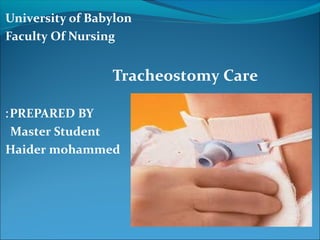
Tracheostomy Care
PREPARED BY:
Master Student
Haider mohammed
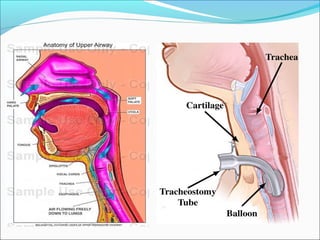
ANATOMY
Tracheostomy
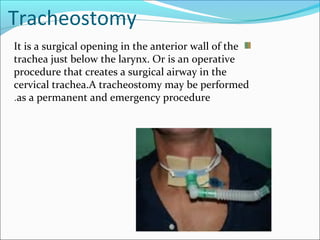
It is a surgical opening in the anterior wall of the
trachea just below the larynx. Or is an operative
procedure that creates a surgical airway in the
cervical trachea.A tracheostomy may be performed
as a permanent and emergency procedure.
INDICATIONS:-
1-To provide and maintain patent airway.
2-To enable the removal of tracheo-bronchial
secretions.
3-To permit long term positive pressur ventilation.
4-To improve patient comfort.
5-To decrease the work of breathing and increase
volume of air entering the lungs
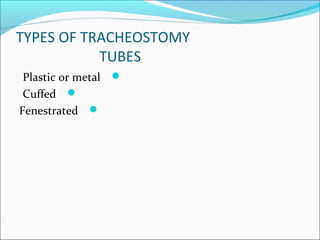
TYPES OF TRACHEOSTOMY
TUBES
Plastic or metal
Cuffed
Fenestrated
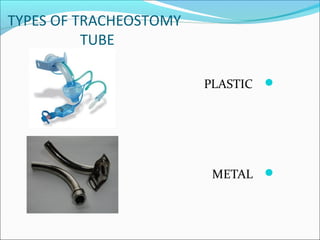
TYPES OF TRACHEOSTOMY
TUBE
PLASTIC
METAL
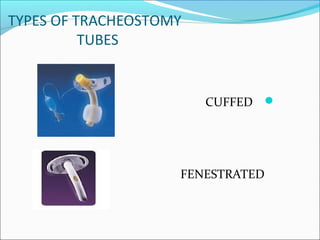
TYPES OF TRACHEOSTOMY
TUBES
CUFFED
FENESTRATED
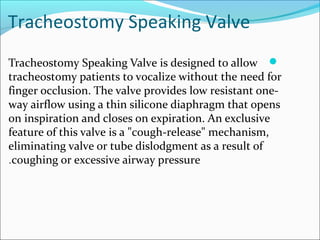
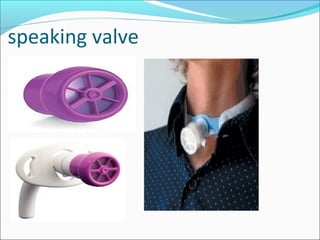
Tracheostomy Speaking Valve
Tracheostomy Speaking Valve is designed to allow
tracheostomy patients to vocalize without the need for
finger occlusion. The valve provides low resistant one-
way airflow using a thin silicone diaphragm that opens
on inspiration and closes on expiration. An exclusive
feature of this valve is a "cough-release" mechanism,
eliminating valve or tube dislodgment as a result of
coughing or excessive airway pressure.
Indications For use as a one-way speaking valve
on a tracheostomy tube
Features
1-Easy to use and maintain
2-Low resistance to inspired airflow
3-Exclusive cough-release feature
speaking valve
Contraindications.
1-Suspected CSF leak (BOS fracture) or raised inter
cranial pressure.
2-Tracheo/oesophageal fistula.
3-Cancer in upper GI or respiratory tract.
4-Oesophageal or high GI surgery.
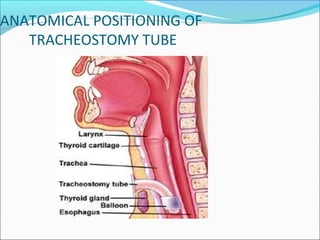
ANATOMICAL POSITIONING OF
TRACHEOSTOMY TUBE
COMPLICATIONS
Immediate
1-Hemorrhage
2-Hypoxia
3-Trauma to recurrent laryngeal nerve
4-Damage to esophagus
5-Pneumothorax
6-Infection
7-Subcutaneous emphysema
COMPLICATIONS
Early
1-Tube obstruction or displacement
2-Pooling of secretions leading to aspiration
3-Bleeding from tracheostomy site
4-Infection
COMPLICATIONS
Late
1-Airway obstruction with aspiration
2-Damage to larynx (Stenosis(
3-Tracheal stenosis
4-Tracheomalacia
5-Aspiration and pneumonia
6-Fistula formation .eg. Tracheo- cutaneous or
tracheo-oesopheal
CARE OF THE PATIENT WITH
TRACHEOSTOMY
Stoma care
1-care towards hygiene and asepsis is necessary.
2-Remember the skin surrounding the stoma is
also prone to irritation.
3-as per hospital policy and barrier cream
applied to the local skin cotton wool should
be avoided.
CARE OF THE PATIENT WITH
TRACHEOSTOMY
Tube care
1-Tubes need to be cleaned.
2-The area should be cleaned with normal saline {In
double cannula the inner cannula will need to be
removed and to be cleaned.
3-For cuffed tracheostomy tubes the pressure should
be measured in every shift{ as per hospital policy.{
CARE OF THE PATIENT WITH
TRACHEOSTOMY
Suctioning
1-Suctioning should be done PRN ,after chest PT and
Nebulization
2-Use the lowest pressure needed ,usually less than
120 mmHg and definitely not beyond 200mmHg.
3-Suctioning should be performed less than
10seconds.
Hazards Of Suctioning
1-Patient anxiety.
2-Changes in ICP.
3-Trauma.
4-Infection.
5-Pneumothorax.
6-Hypoxia.
7-Cardiac hazard.
CARE OF THE PATIENT WITH
TRACHEOSTOMY
Humidification
1-The normal humidification and air filtration system
is bypassed if the tracheostomy is in situate
2-Keep patients well hydrated- otherwise secretion
will become thicker and will lead to infection.
Nursing Diagnosis
1-Risk of ineffective air way clearance
related to increase secretion secondary to
tracheostomy.
2-Risk for infection related to excessive
polling of secretion.
3-Impaired verbal communication related
to inability to produce speech secondary to
tracheostomy.
Nursing Management
1-The patient and all hospital staff will
demonstrate and apply hand washing technique
through hospitalization.
2-the nurse educate the patient and his family
about transmission of infection after discharge.
3-assess and maintain for adequate humidity of
inspired air every two hours.
4-keep stoma free from any debris or mucous
build up as needed
5-check body vital sings.
6-keep patient with comfortable position.
7-give analgesic medication as order.
THINGS TO REMEMBER
DON’T PANIC
STERILE TECHNIQUE
SAFTEY FIRST
CRITICAL THINKING
NUTRITION
COMMUNICATION
Tracheostomy care

Tracheostomy care

  • 1.
    University of Babylon FacultyOf Nursing Tracheostomy Care PREPARED BY: Master Student Haider mohammed
  • 2.
  • 3.
    Tracheostomy It is asurgical opening in the anterior wall of the trachea just below the larynx. Or is an operative procedure that creates a surgical airway in the cervical trachea.A tracheostomy may be performed as a permanent and emergency procedure.
  • 4.
    INDICATIONS:- 1-To provide andmaintain patent airway. 2-To enable the removal of tracheo-bronchial secretions. 3-To permit long term positive pressur ventilation. 4-To improve patient comfort. 5-To decrease the work of breathing and increase volume of air entering the lungs
  • 5.
    TYPES OF TRACHEOSTOMY TUBES Plasticor metal Cuffed Fenestrated
  • 6.
  • 7.
  • 8.
    Tracheostomy Speaking Valve TracheostomySpeaking Valve is designed to allow tracheostomy patients to vocalize without the need for finger occlusion. The valve provides low resistant one- way airflow using a thin silicone diaphragm that opens on inspiration and closes on expiration. An exclusive feature of this valve is a "cough-release" mechanism, eliminating valve or tube dislodgment as a result of coughing or excessive airway pressure.
  • 9.
    Indications For useas a one-way speaking valve on a tracheostomy tube Features 1-Easy to use and maintain 2-Low resistance to inspired airflow 3-Exclusive cough-release feature
  • 10.
  • 11.
    Contraindications. 1-Suspected CSF leak(BOS fracture) or raised inter cranial pressure. 2-Tracheo/oesophageal fistula. 3-Cancer in upper GI or respiratory tract. 4-Oesophageal or high GI surgery.
  • 12.
  • 13.
    COMPLICATIONS Immediate 1-Hemorrhage 2-Hypoxia 3-Trauma to recurrentlaryngeal nerve 4-Damage to esophagus 5-Pneumothorax 6-Infection 7-Subcutaneous emphysema
  • 14.
    COMPLICATIONS Early 1-Tube obstruction ordisplacement 2-Pooling of secretions leading to aspiration 3-Bleeding from tracheostomy site 4-Infection
  • 15.
    COMPLICATIONS Late 1-Airway obstruction withaspiration 2-Damage to larynx (Stenosis( 3-Tracheal stenosis 4-Tracheomalacia 5-Aspiration and pneumonia 6-Fistula formation .eg. Tracheo- cutaneous or tracheo-oesopheal
  • 16.
    CARE OF THEPATIENT WITH TRACHEOSTOMY Stoma care 1-care towards hygiene and asepsis is necessary. 2-Remember the skin surrounding the stoma is also prone to irritation. 3-as per hospital policy and barrier cream applied to the local skin cotton wool should be avoided.
  • 17.
    CARE OF THEPATIENT WITH TRACHEOSTOMY Tube care 1-Tubes need to be cleaned. 2-The area should be cleaned with normal saline {In double cannula the inner cannula will need to be removed and to be cleaned. 3-For cuffed tracheostomy tubes the pressure should be measured in every shift{ as per hospital policy.{
  • 18.
    CARE OF THEPATIENT WITH TRACHEOSTOMY Suctioning 1-Suctioning should be done PRN ,after chest PT and Nebulization 2-Use the lowest pressure needed ,usually less than 120 mmHg and definitely not beyond 200mmHg. 3-Suctioning should be performed less than 10seconds.
  • 19.
    Hazards Of Suctioning 1-Patientanxiety. 2-Changes in ICP. 3-Trauma. 4-Infection. 5-Pneumothorax. 6-Hypoxia. 7-Cardiac hazard.
  • 20.
    CARE OF THEPATIENT WITH TRACHEOSTOMY Humidification 1-The normal humidification and air filtration system is bypassed if the tracheostomy is in situate 2-Keep patients well hydrated- otherwise secretion will become thicker and will lead to infection.
  • 21.
    Nursing Diagnosis 1-Risk ofineffective air way clearance related to increase secretion secondary to tracheostomy. 2-Risk for infection related to excessive polling of secretion. 3-Impaired verbal communication related to inability to produce speech secondary to tracheostomy.
  • 22.
    Nursing Management 1-The patientand all hospital staff will demonstrate and apply hand washing technique through hospitalization. 2-the nurse educate the patient and his family about transmission of infection after discharge. 3-assess and maintain for adequate humidity of inspired air every two hours. 4-keep stoma free from any debris or mucous build up as needed 5-check body vital sings. 6-keep patient with comfortable position. 7-give analgesic medication as order.
  • 23.
    THINGS TO REMEMBER DON’TPANIC STERILE TECHNIQUE SAFTEY FIRST CRITICAL THINKING NUTRITION COMMUNICATION