




Changing  Tracheostomy Dressing & Tie Tapes1
ObjectivesDefine Tracheostomy Procedure.Discuss changing tracheostomy dressing and tie tapes thoroughly utilizing video presentation and demonstration.Perform the procedure through return -  demonstration correctly.2
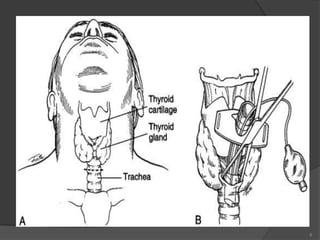
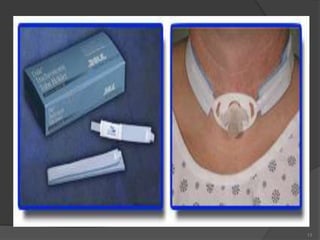
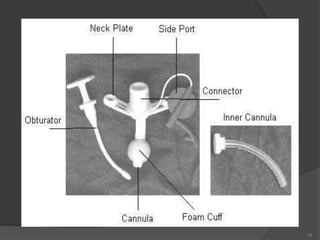
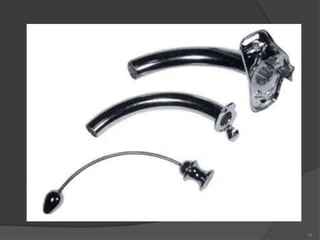
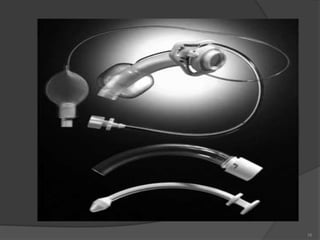
TracheostomyA surgical incision in the trachea just below the larynx. A curved tracheostomy tube is inserted to extend through the stoma into the trachea.Tracheostomy tubes may either be plastic or metal and are available in different sizes.3
4
6
Tracheostomy Care Video 7
Demonstration8
ProcedureVerify the doctor’s order.Apply alcohol based hand rub upon entering the client’s room.9
Prepare the client.Introduce self to the patient.Check the patient’s identification. Explain the procedure.Position the patient in Semi-Fowler’s position.10
ProcedurePrepare the equipment.Disposable face mask Clean gloves Moisture – resistant bagNormal saline solutionHydrogen peroxideBandage scissors Equipment & supplies for suctioning and for mouth care11
For Cleaning a Non – Disposable Inner Cannula and Providing Site CarePrepackaged commercial tracheostomy care setSterile pads  (sterile field and patient’s chest)Sterile nylon brushSterile glovesDisposable pick – up forcepsSterile 6” (15cm) pipe cleaners Cotton applicatorTrache tie - twice the neck circumference plus 4 inches of tracheostomy twill tape 4” x 4” gauze padsPre – cut 4” x 4” gauze dressing12
13
14
15
16
ProcedureWear face mask.Prepare a moisture-resistant bag.  Open a pre - packaged commercial tracheostomy care kit.Discard few drops of  the hydrogen peroxide and sterile normal saline solution pour them in each container. 17
ProcedurePut on clean gloves.Remove the dressing and check the site for signs of infection and maceration.Remove and soak the inner cannula.Unlock the inner cannula by rotating it in a counter clockwise direction while your other hand supports the faceplate of the outer cannula.Gently remove the inner cannula by pulling it toward you in line with its curvature.Soak the inner cannula in the hydrogen peroxide solution .18
ProcedureChange to sterile gloves and clean the cannula.Place each of the sterile pads across the patient’s chest and on the table.Remove the cannula from the soaking solution. (Use disposable pick-up forceps, if available)Clean the lumen and the entire inner cannula thoroughly using the nylon brush moistened with sterile saline. Inspect the cannula for cleanliness. If encrustations are evident, repeat cleaning.19
ProcedureRinse the cannula thoroughly by agitating in the sterile saline solution.After rinsing, gently tap it against the inside edge of the sterile solution container.20
ProcedureDry the lumen of the cannula using the pipe cleaners.Insert the inner cannula and secure it.Grasp the outer flange of the inner cannula, and insert the cannula in the direction of its curvature.Lock the inner cannula in place by turning the lock in clockwise direction.Gently pull the inner cannula to ensure that is secure.21
ProcedurePour out the sterile normal saline solution in the receptacle. If using the same solution from the same container, this may be omittedClean the incision site.Clean around the incision site with applicator sticks dampened with sterile normal saline. Start from inner to outer.
Dry gently by wiping the area with gauze pad.22
ProcedureApply a sterile dressing.Use a commercially prepared sterile dressing if available or open and refold a  4X4 gauze.Avoid using a cotton-filled gauze squares, and avoid cutting the 4x4 gauze. While applying the dressing, ensure that the tracheostomy tube is securely supported.23
Change the tie tapes.Fasten the clean ties before removing the soiled ties.Apply the tie tape as follows…24
Apply the tie tape as followsThread one end of the tape into the upper half of the slot on one side.Bring both ends of the tape together, and take them around the client’s neck, keeping them flat and untwisted.Ask the client to flex the neck, if conscious and coherent.25
Apply the tie tape as followsThread one piece of tape closest to the client’s neck from back to front through the other slot.Place one finger underneath the tie tape before tying.Tie it with a double -  square knot.Cut off any long ends and the old trache tie.Check for tautness of the tracheostomy site.26
ProcedurePerform after care.Document all relevant information.Date, time and size of tracheaCharacteristics of secretions (color, odor, amount, and consistency)Patient’s tolerance to procedureTeaching and the patient’s level of understanding.27

Tracheostomy site care procedure

  • 1.
    Changing TracheostomyDressing & Tie Tapes1
  • 2.
    ObjectivesDefine Tracheostomy Procedure.Discusschanging tracheostomy dressing and tie tapes thoroughly utilizing video presentation and demonstration.Perform the procedure through return - demonstration correctly.2
  • 3.
    TracheostomyA surgical incisionin the trachea just below the larynx. A curved tracheostomy tube is inserted to extend through the stoma into the trachea.Tracheostomy tubes may either be plastic or metal and are available in different sizes.3
  • 4.
  • 6.
  • 7.
  • 8.
  • 9.
    ProcedureVerify the doctor’sorder.Apply alcohol based hand rub upon entering the client’s room.9
  • 10.
    Prepare the client.Introduceself to the patient.Check the patient’s identification. Explain the procedure.Position the patient in Semi-Fowler’s position.10
  • 11.
    ProcedurePrepare the equipment.Disposableface mask Clean gloves Moisture – resistant bagNormal saline solutionHydrogen peroxideBandage scissors Equipment & supplies for suctioning and for mouth care11
  • 12.
    For Cleaning aNon – Disposable Inner Cannula and Providing Site CarePrepackaged commercial tracheostomy care setSterile pads (sterile field and patient’s chest)Sterile nylon brushSterile glovesDisposable pick – up forcepsSterile 6” (15cm) pipe cleaners Cotton applicatorTrache tie - twice the neck circumference plus 4 inches of tracheostomy twill tape 4” x 4” gauze padsPre – cut 4” x 4” gauze dressing12
  • 13.
  • 14.
  • 15.
  • 16.
  • 17.
    ProcedureWear face mask.Preparea moisture-resistant bag. Open a pre - packaged commercial tracheostomy care kit.Discard few drops of the hydrogen peroxide and sterile normal saline solution pour them in each container. 17
  • 18.
    ProcedurePut on cleangloves.Remove the dressing and check the site for signs of infection and maceration.Remove and soak the inner cannula.Unlock the inner cannula by rotating it in a counter clockwise direction while your other hand supports the faceplate of the outer cannula.Gently remove the inner cannula by pulling it toward you in line with its curvature.Soak the inner cannula in the hydrogen peroxide solution .18
  • 19.
    ProcedureChange to sterilegloves and clean the cannula.Place each of the sterile pads across the patient’s chest and on the table.Remove the cannula from the soaking solution. (Use disposable pick-up forceps, if available)Clean the lumen and the entire inner cannula thoroughly using the nylon brush moistened with sterile saline. Inspect the cannula for cleanliness. If encrustations are evident, repeat cleaning.19
  • 20.
    ProcedureRinse the cannulathoroughly by agitating in the sterile saline solution.After rinsing, gently tap it against the inside edge of the sterile solution container.20
  • 21.
    ProcedureDry the lumenof the cannula using the pipe cleaners.Insert the inner cannula and secure it.Grasp the outer flange of the inner cannula, and insert the cannula in the direction of its curvature.Lock the inner cannula in place by turning the lock in clockwise direction.Gently pull the inner cannula to ensure that is secure.21
  • 22.
    ProcedurePour out thesterile normal saline solution in the receptacle. If using the same solution from the same container, this may be omittedClean the incision site.Clean around the incision site with applicator sticks dampened with sterile normal saline. Start from inner to outer.
  • 23.
    Dry gently bywiping the area with gauze pad.22
  • 24.
    ProcedureApply a steriledressing.Use a commercially prepared sterile dressing if available or open and refold a 4X4 gauze.Avoid using a cotton-filled gauze squares, and avoid cutting the 4x4 gauze. While applying the dressing, ensure that the tracheostomy tube is securely supported.23
  • 25.
    Change the tietapes.Fasten the clean ties before removing the soiled ties.Apply the tie tape as follows…24
  • 26.
    Apply the tietape as followsThread one end of the tape into the upper half of the slot on one side.Bring both ends of the tape together, and take them around the client’s neck, keeping them flat and untwisted.Ask the client to flex the neck, if conscious and coherent.25
  • 27.
    Apply the tietape as followsThread one piece of tape closest to the client’s neck from back to front through the other slot.Place one finger underneath the tie tape before tying.Tie it with a double - square knot.Cut off any long ends and the old trache tie.Check for tautness of the tracheostomy site.26
  • 28.
    ProcedurePerform after care.Documentall relevant information.Date, time and size of tracheaCharacteristics of secretions (color, odor, amount, and consistency)Patient’s tolerance to procedureTeaching and the patient’s level of understanding.27

Editor's Notes

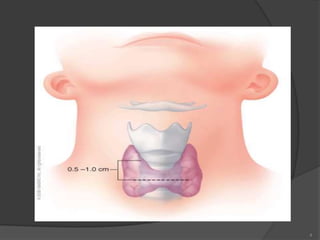
  • #5 Incision 1 cm below the cricoid or halfway between the cricoid and the sternal notch.
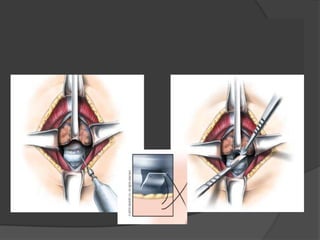
  • #6 The thyroid isthmus lies in the field of the dissection.Typically, the isthmus is 5 to 10 mm in its vertical dimension, mobilize it away from the trachea and retract it, then place the tracheal incision in the second or third tracheal interspace