TPM – Total Productive Maintenance
 TPM is for improving productivity by making
processes more reliable and less wasteful.
 The objective of TPM is to maintain the plant or
equipment in good condition.
 To achieve this objective, preventive and predictive
maintenance is required.
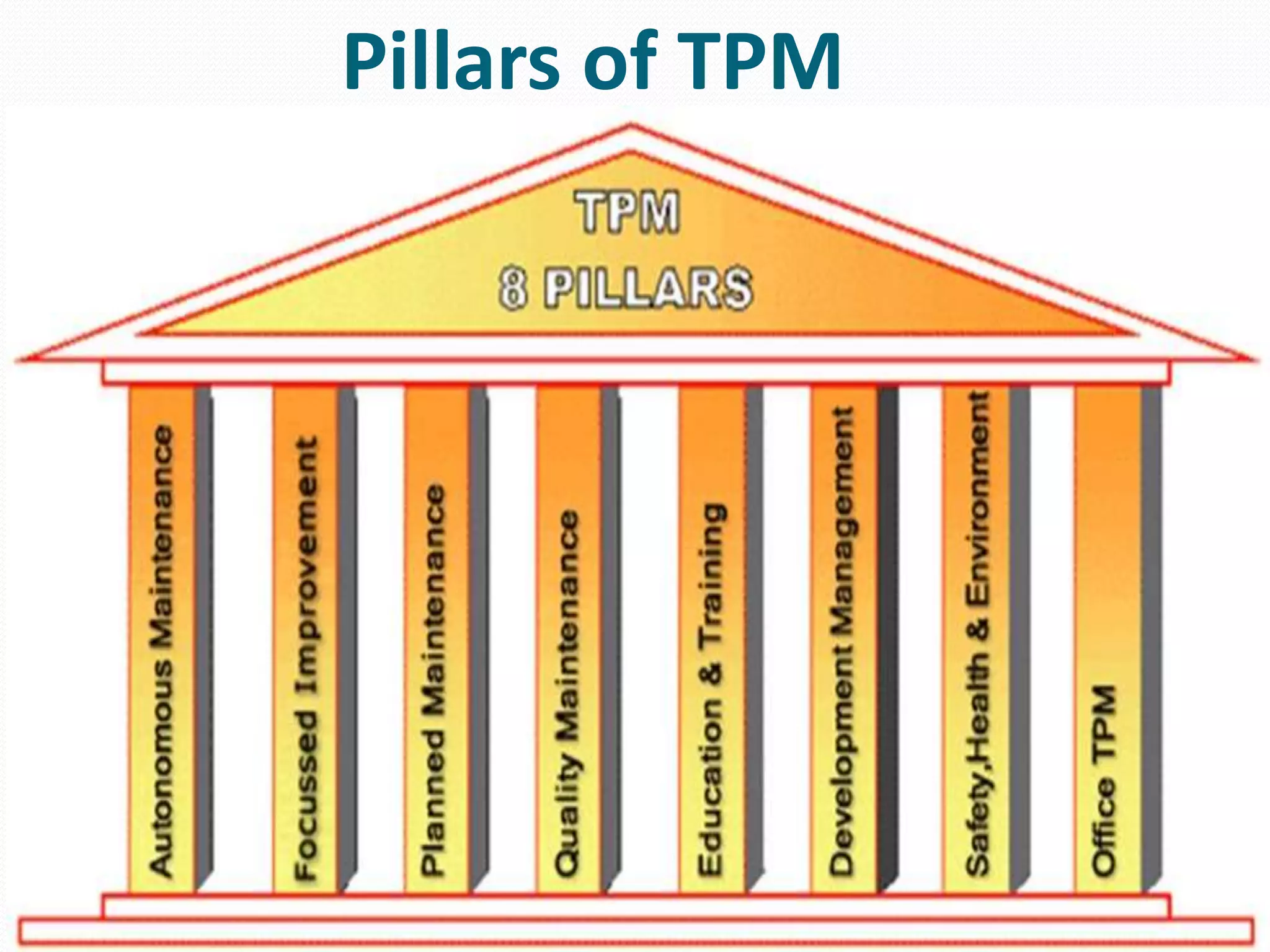
Pillars of TPM
TPM – Total Productive Maintenance
 Autonomous Maintenance, one of the features of
TPM.
 The operator has a better understanding of the how
the equipment works and can tell :
 if an issue is appearing,
 if quality is decreasing,
TPM – Total Productive Maintenance .
Operators are Trained and Motivated to :
Develop ownership attitude toward their equipment
They are encouraged to :
 Perform initial cleaning
 Remove the causes and effects of dirt and dust
 Conduct general inspection
 Lubricating periodically
 Workplace management.
TPM – Total Productive Maintenance
 Maintenance group makes changes that lead to
maintenance prevention.
 Thus preventive maintenance along with maintenance
prevention grouped as Productive Maintenance
TPM – Total Productive Maintenance .
TPM has 3 goals :
 Zero Product Defects
 Zero Equipment Failures
 Zero Accidents.
 Note : On the surface this may seem impossible, but if
it can be run without accident for an hour, it can
be done for two hours, a shift, a day, and so on.
TPM – Total Productive Maintenance .
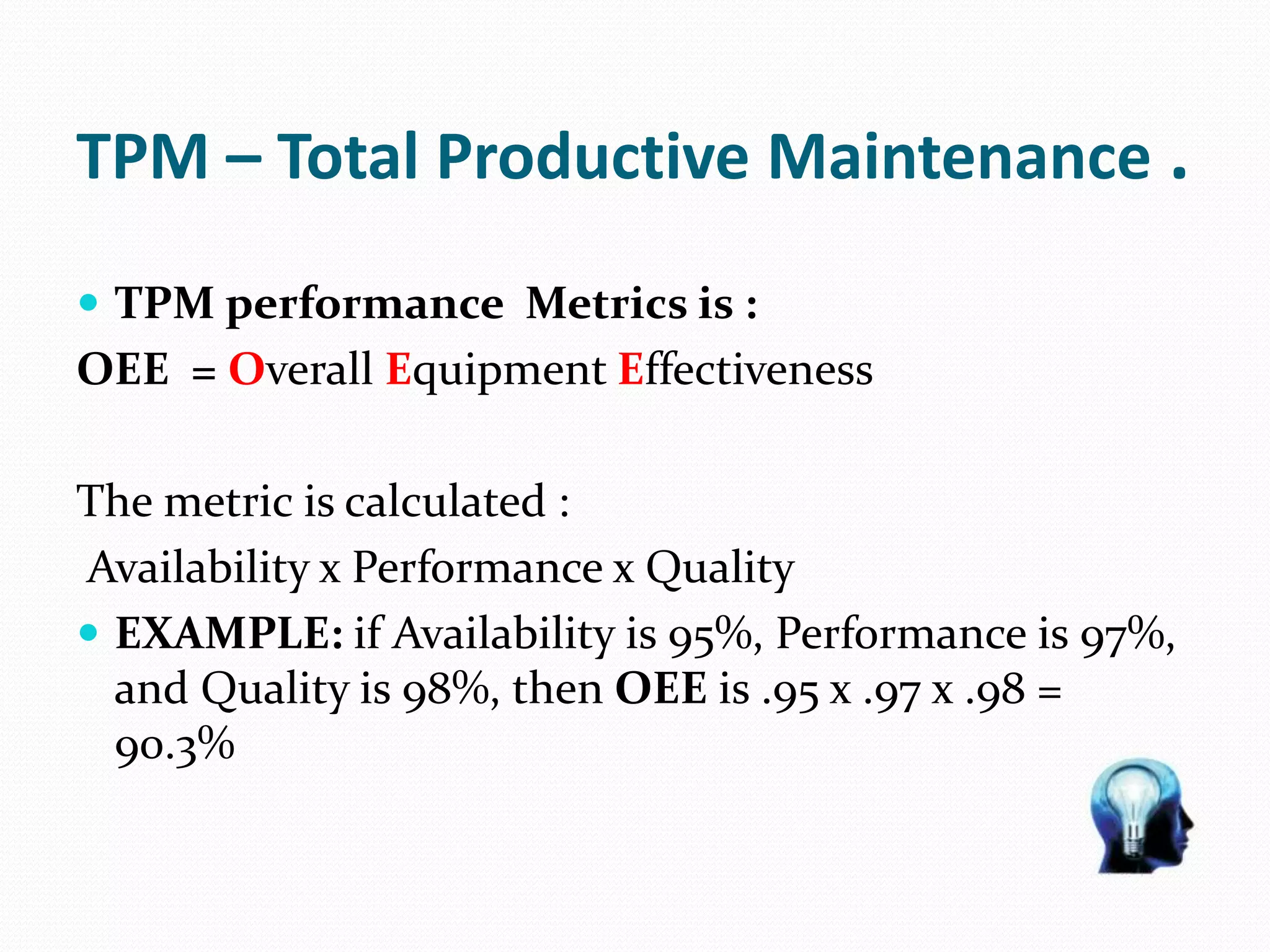
 TPM performance Metrics is :
OEE = Overall Equipment Effectiveness
The metric is calculated :
Availability x Performance x Quality
 EXAMPLE: if Availability is 95%, Performance is 97%,
and Quality is 98%, then OEE is .95 x .97 x .98 =
90.3%
TPM – Total Productive Maintenance .
 TPM identifies the 6 losses (types of waste)
 Set-up and initial adjustment time,
 Equipment breakdown time,
 Idling and minor losses,
 Speed (cycle time) losses,
 Start-up quality losses, and
 Process quality losses,
TPM – Total Productive Maintenance .
The Base for the TPM Activity is 5S
 Seiri (Sort)
 Seition (Set-in-Order/Arrange)
 Seiso (Shine/Clean)
 Seiketsu (Standard)
 Shitsuke (Sustain)
S -Shift
 Shift unnecessary items to stores or dump ( if
obsolete)
 Separate those which are necessary for the job from
those which are not.
 Single out priority items, keep them as close as
possible and at convenient location.
 Label up (tag) all equipment to returned to stores or
dumped.
S -Shine
 Sweep and shine the work place
 Spring clean the work place
 Secure safety and health
 Stop leaks
S - Sort
 Secure a place for everything and store everything in
its place like
 Tools
 Consumables
 Shop floor material
 Clearly identify work areas, equipment and routes
S - Standardize
 Operating procedures in pictures and photos and not
words
 Simplify the usage instructions
 Store contents of cupboards visibly
 Keep the place tidy, clean and organized
S - Stick to Rules
 Support the process throughout
 Seek to eliminate root cause of the problem
 Conduct audit
 Make the improvements visible so that everyone gets
motivated.
TPM – Total Productive Maintenance .
Results in:
 Equipment condition is known at all times
 Unexpected breakdowns are minimized.
 Corrosion is prevented; wear is delayed; machine life is
extended.
 Spare parts need is reduced.
 Knowledge of the machine is increased
 Machine operation ration is improved
TPM – Total Productive Maintenance .
 Benefits of effective TPM include the following:
 Safer Working Environment
 Improved Equipment Reliability - Uptime
 Increased Capacity
 Increased Productivity
 Improved Quality
 Company Financial Performance and Job Security
‘s Experience
“5S is the starting point for any improvement
Our experience shows about 40% productivity improves
by just getting organized”.

Tpm performance measure

  • 1.
    TPM – TotalProductive Maintenance  TPM is for improving productivity by making processes more reliable and less wasteful.  The objective of TPM is to maintain the plant or equipment in good condition.  To achieve this objective, preventive and predictive maintenance is required.
  • 2.
  • 3.
    TPM – TotalProductive Maintenance  Autonomous Maintenance, one of the features of TPM.  The operator has a better understanding of the how the equipment works and can tell :  if an issue is appearing,  if quality is decreasing,
  • 4.
    TPM – TotalProductive Maintenance . Operators are Trained and Motivated to : Develop ownership attitude toward their equipment They are encouraged to :  Perform initial cleaning  Remove the causes and effects of dirt and dust  Conduct general inspection  Lubricating periodically  Workplace management.
  • 5.
    TPM – TotalProductive Maintenance  Maintenance group makes changes that lead to maintenance prevention.  Thus preventive maintenance along with maintenance prevention grouped as Productive Maintenance
  • 6.
    TPM – TotalProductive Maintenance . TPM has 3 goals :  Zero Product Defects  Zero Equipment Failures  Zero Accidents.  Note : On the surface this may seem impossible, but if it can be run without accident for an hour, it can be done for two hours, a shift, a day, and so on.
  • 7.
    TPM – TotalProductive Maintenance .  TPM performance Metrics is : OEE = Overall Equipment Effectiveness The metric is calculated : Availability x Performance x Quality  EXAMPLE: if Availability is 95%, Performance is 97%, and Quality is 98%, then OEE is .95 x .97 x .98 = 90.3%
  • 8.
    TPM – TotalProductive Maintenance .  TPM identifies the 6 losses (types of waste)  Set-up and initial adjustment time,  Equipment breakdown time,  Idling and minor losses,  Speed (cycle time) losses,  Start-up quality losses, and  Process quality losses,
  • 9.
    TPM – TotalProductive Maintenance . The Base for the TPM Activity is 5S  Seiri (Sort)  Seition (Set-in-Order/Arrange)  Seiso (Shine/Clean)  Seiketsu (Standard)  Shitsuke (Sustain)
  • 11.
    S -Shift  Shiftunnecessary items to stores or dump ( if obsolete)  Separate those which are necessary for the job from those which are not.  Single out priority items, keep them as close as possible and at convenient location.  Label up (tag) all equipment to returned to stores or dumped.
  • 12.
    S -Shine  Sweepand shine the work place  Spring clean the work place  Secure safety and health  Stop leaks
  • 13.
    S - Sort Secure a place for everything and store everything in its place like  Tools  Consumables  Shop floor material  Clearly identify work areas, equipment and routes
  • 14.
    S - Standardize Operating procedures in pictures and photos and not words  Simplify the usage instructions  Store contents of cupboards visibly  Keep the place tidy, clean and organized
  • 15.
    S - Stickto Rules  Support the process throughout  Seek to eliminate root cause of the problem  Conduct audit  Make the improvements visible so that everyone gets motivated.
  • 16.
    TPM – TotalProductive Maintenance . Results in:  Equipment condition is known at all times  Unexpected breakdowns are minimized.  Corrosion is prevented; wear is delayed; machine life is extended.  Spare parts need is reduced.  Knowledge of the machine is increased  Machine operation ration is improved
  • 17.
    TPM – TotalProductive Maintenance .  Benefits of effective TPM include the following:  Safer Working Environment  Improved Equipment Reliability - Uptime  Increased Capacity  Increased Productivity  Improved Quality  Company Financial Performance and Job Security
  • 18.
    ‘s Experience “5S isthe starting point for any improvement Our experience shows about 40% productivity improves by just getting organized”.