Lean Tools and Methods: Total
Productive Maintenance (TPM)
Presented By:
Md Muzahid Khan
Intekhab Islam
Ashik Takvir
1
Agenda
2
Conclusion
TPM
Implemen
tation
Pillars of
TPM
5S
Foundatio
n
Objectives
of TPM
TPM
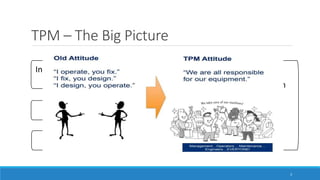
TPM – The Big Picture
Involving employees to maintain
their own equipment
Emphasizing proactive
maintenance
Emphasizing preventive
maintenance
• Improved production
• Fewer breakdowns
• Fewer stops
• Less defects
3
TPM – The Big Picture
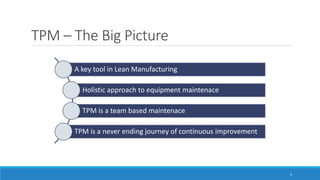
A key tool in Lean Manufacturing
Holistic approach to equipment maintenace
TPM is a team based maintenace
TPM is a never ending journey of continuous improvement
4
History of TPM
Introduced in Japan in 1951 First company to obtain TPM certification
5
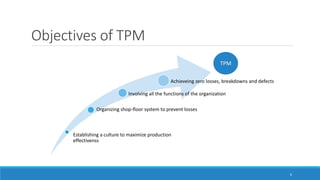
Objectives of TPM
Establishing a culture to maximize production
effectivenss
Organizing shop-floor system to prevent losses
Involving all the functions of the organization
Achieveing zero losses, breakdowns and defects
TPM
6
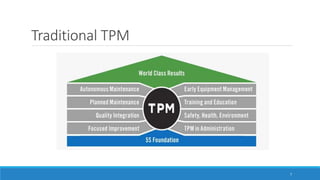
Traditional TPM
7
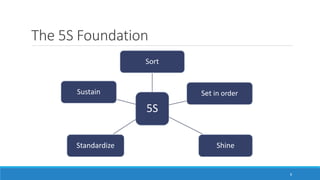
The 5S Foundation
5S
Sort
Set in order
ShineStandardize
Sustain
8
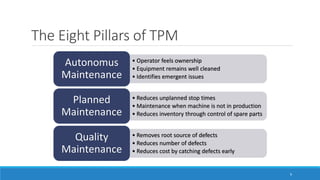
The Eight Pillars of TPM
• Operator feels ownership
• Equipment remains well cleaned
• Identifies emergent issues
Autonomus
Maintenance
• Reduces unplanned stop times
• Maintenance when machine is not in production
• Reduces inventory through control of spare parts
Planned
Maintenance
• Removes root source of defects
• Reduces number of defects
• Reduces cost by catching defects early
Quality
Maintenance
9
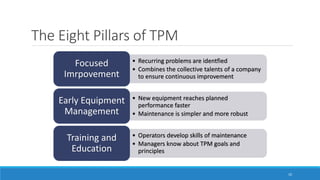
The Eight Pillars of TPM
• Recurring problems are identfied
• Combines the collective talents of a company
to ensure continuous improvement
Focused
Imrpovement
• New equipment reaches planned
performance faster
• Maintenance is simpler and more robust
Early Equipment
Management
• Operators develop skills of maintenance
• Managers know about TPM goals and
principles
Training and
Education
10
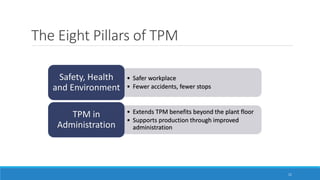
The Eight Pillars of TPM
• Safer workplace
• Fewer accidents, fewer stops
Safety, Health
and Environment
• Extends TPM benefits beyond the plant floor
• Supports production through improved
administration
TPM in
Administration
11
Roadmap for TPM ImplementationStepOne
Identify
Pilot
Area
Easiest to
improve
Constraint/
Bottleneck
Most
problematic
12
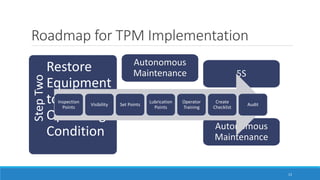
Roadmap for TPM ImplementationStepTwo
Restore
Equipment
to Prime
Operating
Condition
5S
Autonomous
Maintenance
Inspection
Points
Visibility Set Points
Lubrication
Points
Operator
Training
Create
Checklist
Audit
Autonomous
Maintenance
13
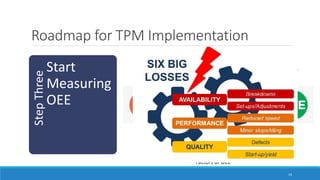
Roadmap for TPM ImplementationStepThree
Start
Measuring
OEE
OEE stands for Overall Equipment Effectivenss
• Gold standard for measuring manufactruing productivity
• Measuring OEE is a manufacturing best practice
OEE
Availabilty
PerformanceQuality
Factors of OEE
14
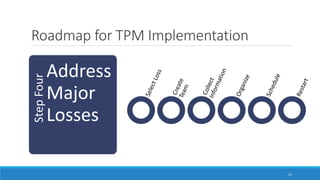
Roadmap for TPM ImplementationStepFour
Address
Major
Losses
15
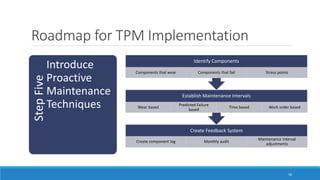
Roadmap for TPM ImplementationStepFive
Introduce
Proactive
Maintenance
Techniques
Create Feedback System
Create component log Monthly audit
Maintenance interval
adjustments
Establish Maintenance Intervals
Wear based
Predicted Failure
based
Time based Work order based
Identify Components
Components that wear Components that fail Stress points
16
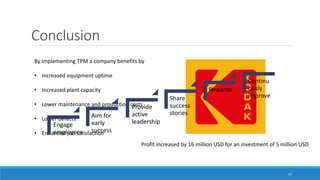
Conclusion
By implementing TPM a company benefits by
• Increased equipment uptime
• Increased plant capacity
• Lower maintenance and production costs
• Lower defects
• Enhanced job satisfaction
Profit increased by 16 million USD for an investment of 5 million USD
Engage
employees
Aim for
early
success
Provide
active
leadership
Share
success
stories
Rewards
Continu
ously
improve
17
18
References
19
• http://www.leanexpertise.com/TPMONLINE/articles_on_total_productive_maintenance/tpm/tpmroberts.htm
• https://www.oee.com/calculating-oee.html
• https://www.leanproduction.com/tpm.html
• https://www.slideshare.net/oeconsulting/total-productive-maintenance-tpm-maximizing-equipment-
effectiveness-for-operational-excellence-by-allan-ung-operational-excellence-consulting?next_slideshow=1
• https://www.slideshare.net/centenvir/presentation-on-total-productive-maintenance
• https://hashllp.wordpress.com/2017/02/03/the-eight-pillars-of-tpm/

Total Productive Maintenance

  • 1.
    Lean Tools andMethods: Total Productive Maintenance (TPM) Presented By: Md Muzahid Khan Intekhab Islam Ashik Takvir 1
  • 2.
  • 3.
    TPM – TheBig Picture Involving employees to maintain their own equipment Emphasizing proactive maintenance Emphasizing preventive maintenance • Improved production • Fewer breakdowns • Fewer stops • Less defects 3
  • 4.
    TPM – TheBig Picture A key tool in Lean Manufacturing Holistic approach to equipment maintenace TPM is a team based maintenace TPM is a never ending journey of continuous improvement 4
  • 5.
    History of TPM Introducedin Japan in 1951 First company to obtain TPM certification 5
  • 6.
    Objectives of TPM Establishinga culture to maximize production effectivenss Organizing shop-floor system to prevent losses Involving all the functions of the organization Achieveing zero losses, breakdowns and defects TPM 6
  • 7.
  • 8.
    The 5S Foundation 5S Sort Setin order ShineStandardize Sustain 8
  • 9.
    The Eight Pillarsof TPM • Operator feels ownership • Equipment remains well cleaned • Identifies emergent issues Autonomus Maintenance • Reduces unplanned stop times • Maintenance when machine is not in production • Reduces inventory through control of spare parts Planned Maintenance • Removes root source of defects • Reduces number of defects • Reduces cost by catching defects early Quality Maintenance 9
  • 10.
    The Eight Pillarsof TPM • Recurring problems are identfied • Combines the collective talents of a company to ensure continuous improvement Focused Imrpovement • New equipment reaches planned performance faster • Maintenance is simpler and more robust Early Equipment Management • Operators develop skills of maintenance • Managers know about TPM goals and principles Training and Education 10
  • 11.
    The Eight Pillarsof TPM • Safer workplace • Fewer accidents, fewer stops Safety, Health and Environment • Extends TPM benefits beyond the plant floor • Supports production through improved administration TPM in Administration 11
  • 12.
    Roadmap for TPMImplementationStepOne Identify Pilot Area Easiest to improve Constraint/ Bottleneck Most problematic 12
  • 13.
    Roadmap for TPMImplementationStepTwo Restore Equipment to Prime Operating Condition 5S Autonomous Maintenance Inspection Points Visibility Set Points Lubrication Points Operator Training Create Checklist Audit Autonomous Maintenance 13
  • 14.
    Roadmap for TPMImplementationStepThree Start Measuring OEE OEE stands for Overall Equipment Effectivenss • Gold standard for measuring manufactruing productivity • Measuring OEE is a manufacturing best practice OEE Availabilty PerformanceQuality Factors of OEE 14
  • 15.
    Roadmap for TPMImplementationStepFour Address Major Losses 15
  • 16.
    Roadmap for TPMImplementationStepFive Introduce Proactive Maintenance Techniques Create Feedback System Create component log Monthly audit Maintenance interval adjustments Establish Maintenance Intervals Wear based Predicted Failure based Time based Work order based Identify Components Components that wear Components that fail Stress points 16
  • 17.
    Conclusion By implementing TPMa company benefits by • Increased equipment uptime • Increased plant capacity • Lower maintenance and production costs • Lower defects • Enhanced job satisfaction Profit increased by 16 million USD for an investment of 5 million USD Engage employees Aim for early success Provide active leadership Share success stories Rewards Continu ously improve 17
  • 18.
  • 19.
    References 19 • http://www.leanexpertise.com/TPMONLINE/articles_on_total_productive_maintenance/tpm/tpmroberts.htm • https://www.oee.com/calculating-oee.html •https://www.leanproduction.com/tpm.html • https://www.slideshare.net/oeconsulting/total-productive-maintenance-tpm-maximizing-equipment- effectiveness-for-operational-excellence-by-allan-ung-operational-excellence-consulting?next_slideshow=1 • https://www.slideshare.net/centenvir/presentation-on-total-productive-maintenance • https://hashllp.wordpress.com/2017/02/03/the-eight-pillars-of-tpm/