

ISO 14000 INTRODUCTION
 In the present day, environmental matter is not
limited only in one country or specific area. The
environmental impact effects everywhere and leads
to problem all over the world.
 Environmental conservation has become so
complicated that it causes pressure to all business
organizations.
 The International Organization for Standardization
had led to the development of the International
Standard for environmental management system
series (ISO 14000).
ISO 14000 INTRODUCTION
•After the success of the ISO9000 series of quality
standards in 1987, the International Standards
Organization is nearing completion and publication of a
comprehensive set of standards for environmental
management.
•This series of standards is designed to cover the whole
area of environmental issues for organizations in the
global marketplace.
Continues..
 The structure of the standards is as follows:
 Environmental Management Systems (EMS)
 Environmental Auditing and Related Environmental
Investigations (EA)
 Environmental Labeling (EL)
 Environmental Performance Evaluation (EPE)
 Life Cycle Assessment (LCA)
 Terms and Definitions (T&D)
 ISO 14000 Series is the set of standards relating to
environmental management system.
 Generally, the standard used for certification is
 ISO 14001 Environmental Management Systems -
Specifications with Guidance for Use.
ISO 14000 SERIES
 The ISO 14000 series is a set of standards
concerning EMS including the activities of
designing, producing, delivering and
servicing.
 The concept of the standard is to enable the
organization to continually develop and
improve its EMS.
 Although the series comprises of many
standards, the standard ISO 14001 is used
as the direction for EMS certification.
WHO SHOULD
IMPLEMENT ISO 14000
 Any organization: manufacturers and service
organizations.
 Any activities of each organization may cause the
environmental aspects and impacts such as noise, dust,
waste, contaminants in manufacturing process and
ineffectively resources consumption in servicing. These
can be minimized by implementing EMS.
 Although each country has already had her own
environmental regulations, organizations are able to apply
ISO 14000 series effectively within their system on
voluntary basis and the benefit obtained is not only for
organizations themselves but their society also.
WHAT IS ISO 14000?
 ISO 14000 is a series of voluntary
international standards pertaining to
environmental issues.
 They are designed to reduce the
environmental effects from all aspects of
business activities. It is believed that higher
efficiency would be realized and "the cost of
doing business" would also be reduced , by
minimizing business exposure to
environmental issues.
What is not ISO 14000
 Is not a PRODUCT and PERFORMANCE standard.
 Does not establish levels of pollutants or performance.
 Does not establish test standards.
 Does not involve initial performance testing.
 Does not requires or establish final performance goal.
 Does not require the meeting of zero emissions.
 Does not mandate best practice technology.
 Does not require disclosure of performance levels.
 Does not require disclosure of audit results.
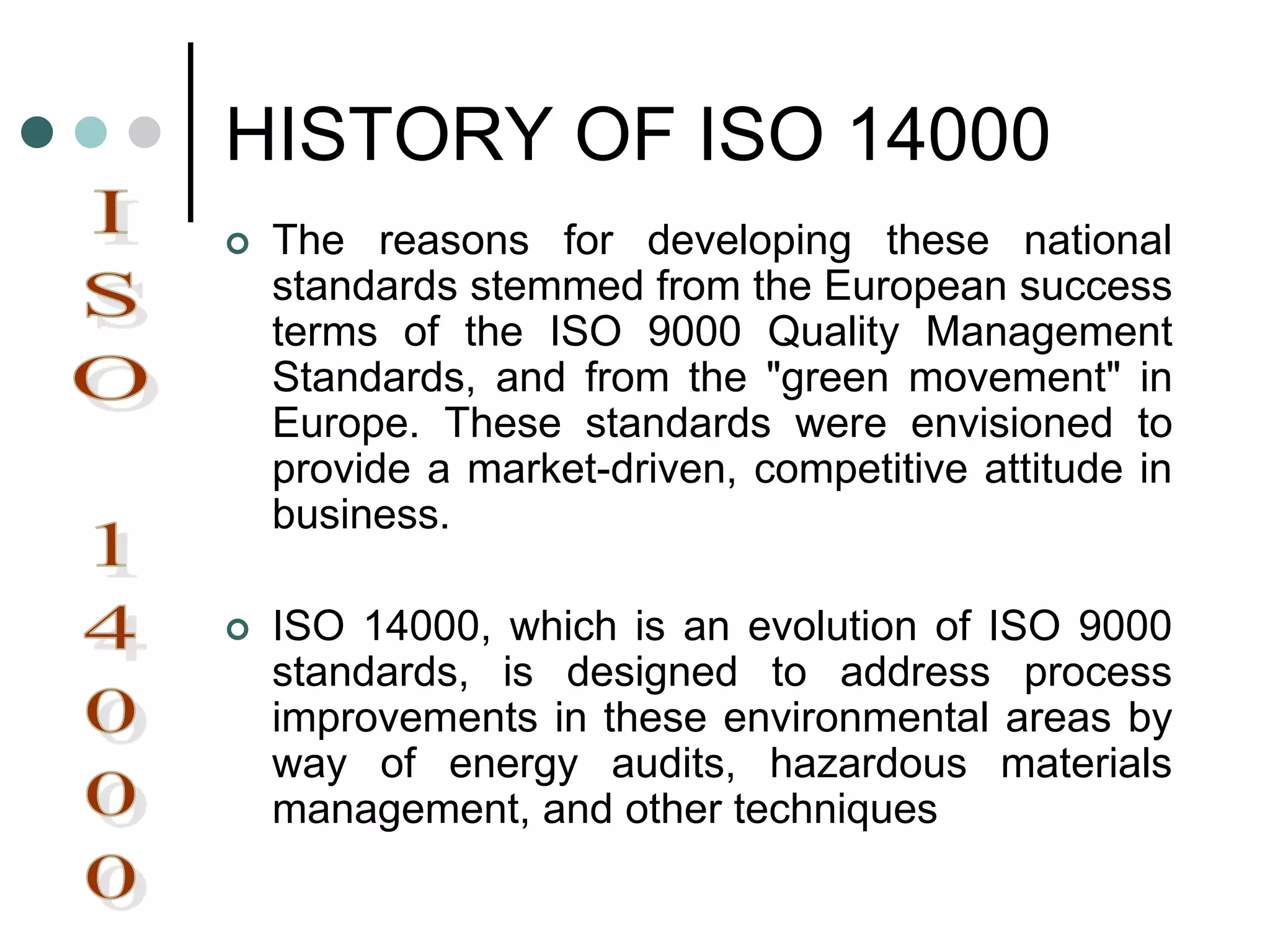
HISTORY OF ISO 14000
 The reasons for developing these national
standards stemmed from the European success
terms of the ISO 9000 Quality Management
Standards, and from the "green movement" in
Europe. These standards were envisioned to
provide a market-driven, competitive attitude in
business.
 ISO 14000, which is an evolution of ISO 9000
standards, is designed to address process
improvements in these environmental areas by
way of energy audits, hazardous materials
management, and other techniques
 ISO 14000 holds great promise for reduced
waste and higher material quality because it
emphasizes the elimination of waste early in the
procurement process, especially in industries
such as coatings where there are significant
amounts of raw material input.
 ISO 14000 identifies and eliminates all waste
that enters production through current
procurement practices before it enters the
manufacturing environment.
 When ISO 9000 quality management systems
are integrated with ISO 14000 environmental
systems, the two processes support each other.
Opportunities for better quality practices exist in
the quest for better environmental practices,
and better environmental processes are often
the result of improved quality.
 A merged system, which is currently available,
is often the answer for companies seeking
improvement in both areas.
 Historically, document disarray and
communication redundancies have made
implementation of ISO 9000 and ISO 14000
slow and costly. .
 The advent of new Web-based technologies,
however, makes it possible for companies to
host entire documentation, project
management, and training systems for the
implementation of ISO 9000 and ISO 14000
standards, significantly reducing the cost of
each individual component and minimizing the
time to implementation.
ISO 14000 SERIES
 Organizational evaluation standards are
operational and effective because, the focus
was on the process rather than the product.
 The development and acceptance of
product evaluation standards will be much
more difficult.
Organizational
Evaluation Standards
Product Evaluation
Standards
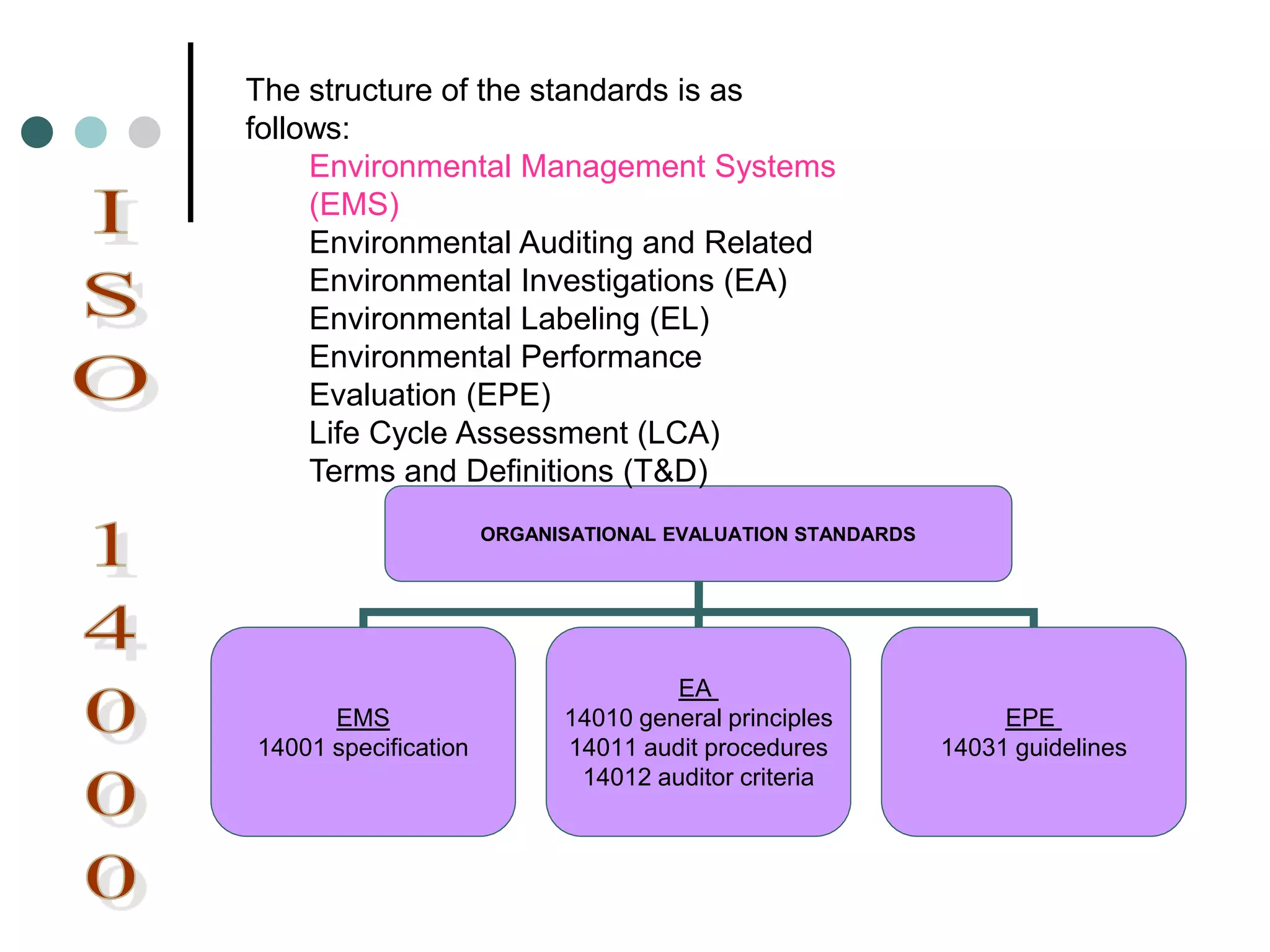
ORGANISATIONAL EVALUATION STANDARDS
EMS
14001 specification
EA
14010 general principles
14011 audit procedures
14012 auditor criteria
EPE
14031 guidelines
The structure of the standards is as
follows:
Environmental Management Systems
(EMS)
Environmental Auditing and Related
Environmental Investigations (EA)
Environmental Labeling (EL)
Environmental Performance
Evaluation (EPE)
Life Cycle Assessment (LCA)
Terms and Definitions (T&D)
PRODUCT EVALUATION STANDARDS
Environmental Aspects in
Product Standards
Guide 64 EAPS Guide
Environmental Labeling
14020 Basic Principles
14021 Self Discipline
14022 Symbols
14023 Testing
and Verification
14024 Third Party
Life Cycle Assessment
14040 principles Framework
14041 Goals and Definition
14042 Impact Assessment
14043 Improvement Assessment
ISO 14000 FAMILY
ISO 14000
Standard
Title General Description Thrust Area
14001:1996 Environmental
Management
Systems—
Specification with
Guidance for Use
Main organizational
environmental standard
and the ISO standard to
which an EMS is formally
registered
Organizational
14004:1996 Environmental
Management
Systems—
General Guidelines
on Principles,
Systems and
Supporting
Techniques
Complementary document
to ISO 14001 which
provides more information
and assistance in
understanding and
implementing the EMS
standard.
Organizational
14010:1996 Guidelines for
Environmental
Auditing—General
Principles
Covers the concepts of
environmental auditing
which can be used
separately to create an
organizational
environmental audit
program or is used to
implement a program in
support of the ISO 14001
EMS audit requirements
Organizational
ISO 14000
Standard
Title General Description Thrust Area
14011:1996 Guidelines for
Environmental Auditing—
Audit Procedures: Auditing
of Environmental
Management Systems
Provides additional detail
into the auditing of an EMS.
Organizational
14012:1996 Guidelines for
Environmental Auditing:
Qualification Criteria for
Environmental Auditors
Presents the consensus
international requirements for
certification as an
environmental auditor; each
national registration
accreditation organization is
charged with developing and
implementing the program
for registering auditors to the
national program.
Organizational
14020-
14025 :1998
Environmental Labeling Series that includes
requirements for self-
declaration, testing and
validation and symbols used
Product
specific
ISO 14000
Standard
Title General Description Thrust Area
14031:2000 Guidelines on
Environmental
Performance Evaluation
Presents methods for
monitoring and measuring the
environmental performance of
an organization or elements
within the organization
Organizational
14040:1997
14041:1998
14042:1999
14043:1999
Life Cycle Assessment Provides principles and
framework, inventory analysis,
impact assessment and
interpretation of the
environmental aspects
associated with specific
products or services including
the design, manufacture,
distribution, inventory, use .
Product-
specific
14050:1998 Terms and
Definitions
Details the
terminology and
use of ISO 14000
specific language
for consistency of
meaning to support
the efforts of
developing and
implementing the
standards
Overall
ISO Guide 64:1997
(formerly 14060)
Guide for the
Inclusion of
Environmental
Aspects
in Product
Standards
Provides guidelines
to specification
writers to consider
and incorporate
environmental
aspects.
Product-specific
ISO 14000 POLICY
 Prevention of pollution.
 Continual Environmental Improvement.
 Commitment to comply with
Environmental Laws and Regulations
 Applicable in size and scope.
 Establish framework for setting and
reviewing objectives and targets
 Documented, implemented,
maintained, and communicated to
employees.
 Available to the public
ISO 14000 Policy, Continued
 ISO-14001, outlines 18 elements that must be
followed if a facility wishes to be in conformance.
 The 18 elements are divided into six clauses
 Six clauses are
4.1 General Requirements
4.2 Environmental Policy
4.3 Planning
4.4 Implementation & Operation
4.5 Checking & Corrective action
4.6 Management review
ELEMENTS OF ISO 14001
4.2: ENVIRONMENTAL POLICY.
Ensure commitment to the EMS and
define policy that:
 Is based on company’s mission and values.
 is appropriate to the nature, scale and
environmental impacts of the business
 includes a commitment to continual
improvement
 includes a commitment to comply with
relevant environmental legislation and
regulations
 is documented, maintained and
communicated to all employees
 is available to public
Environmental aspects of activities, products, or
services that the organization can control must be
established, maintained, and kept up to date, in
order to determine which can have significant
impacts on the environment.
The organization shall insure that the aspects
related to these significant impacts are considered
in setting its environmental objectives.
4.3.1: ENVIRONMENTALASPECTS
Define Scope
Define Process
Gather Data
Assemble
appropriate people
Identify
Environmental
Aspects
Identify
Environmental
Impacts
Evaluate
Impacts
Record Results
Periodically
Review and
Update
PROCESS OF IDENTIFYING
ENVIRONMENTALASPECTS
Activity Aspect Potential
Impact
Regulated Rating
MSW
Combustion
Air Emissions
(Nox, SO2,
metals,
dioxin, CO)
Air quality
degradation,
smog, acid
deposition
Yes 51
Residuals
Handling
Residuals
(ash)
Disposal
Land/water
contamination
Yes 51
Boiler water
production
Chemical
spills/release
s
Land/water
contamination
Yes 30
Recyclables
Receiving
Windblown
Litter
Aesthetics Yes 36
Example: Environmental Aspects
Procedures to ensure that the company can identify
legal and other environments requirements are
required to be established and maintained.
It is also required to know how the organization
 Access and identify legal and other requirements
 Keep track of changes to legal and other
requirements
Communicate relevant information about legal and
other requirements to employees
4.3.2: LEGALAND OTHER
REQUIREMENTS.
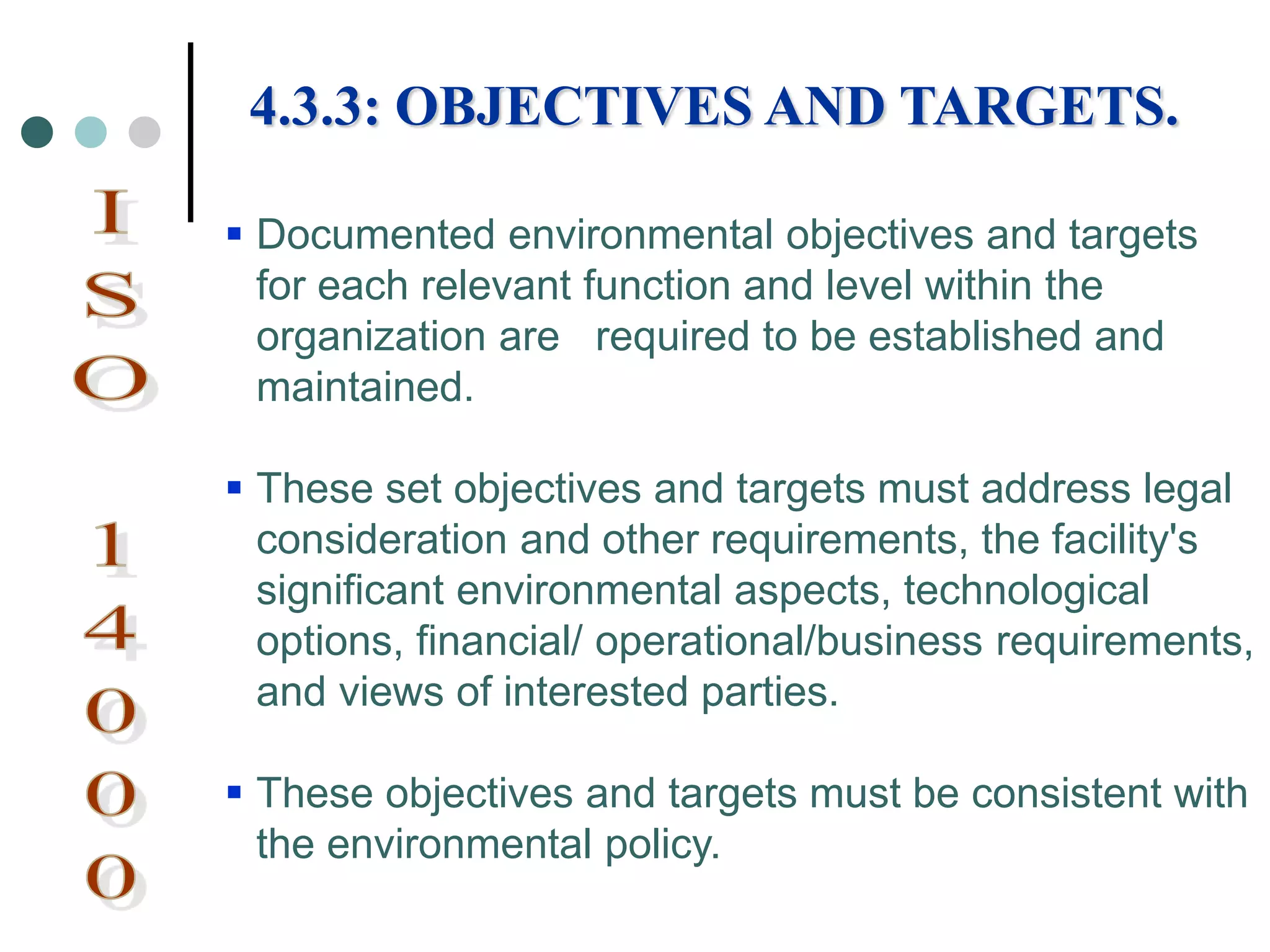
 Documented environmental objectives and targets
for each relevant function and level within the
organization are required to be established and
maintained.
 These set objectives and targets must address legal
consideration and other requirements, the facility's
significant environmental aspects, technological
options, financial/ operational/business requirements,
and views of interested parties.
 These objectives and targets must be consistent with
the environmental policy.
4.3.3: OBJECTIVES AND TARGETS.
 A program(s) for achieving set objectives and targets
is required to be established and maintained.
 The program must include designated responsible
parties for achieving objectives and targets at each
relevant function and level of the organization and the
means and timeframe by which the objectives and
targets are to be achieved.
 In addition, the program must be amended as needed
to ensure that the environmental management program
applies to new developments and new or modified
activities, products, or services.
4.3.4: ENVIRONMENTAL
MANAGEMENT PROGRAM(S).
 Roles, responsibilities, and authorities are required to be
defined, documented, and communicated to facilitate
effective environmental management.
 Sufficient resources must be provided to implement and
control the environmental management system.
 A specific management representative(s) must be appointed
to ensure that EMS requirements are established,
implemented, and maintain in accordance with the standard.
 The management representative must have defined roles,
responsibilities, and authority for reporting on EMS
performance to top management
4.4.1: STRUCTURE AND
RESPONSIBILITY.
Appropriate training for all personnel whose work
may create a significant impact on the environment
must be identified.
Procedures are required to be established and
maintained to make employees aware of:
 The importance of conformance with the
environmental policy and procedures and with EMS
requirements,
 The potential environmental impacts of work
activities
Roles and responsibilities in achieving
conformance with policy, procedures, EMS
requirements
4.4.2: TRAINING AWARENESS AND
COMPETENCE.
 Procedures for internal communication between
levels and functions of the company are required to
be established and maintained.
 Procedures must also be developed for receiving,
documenting and responding to relevant
communication from external parties.
 Finally, processes for external communications
must be considered and the decision recorded.
4.4.3: COMMUNICATION.
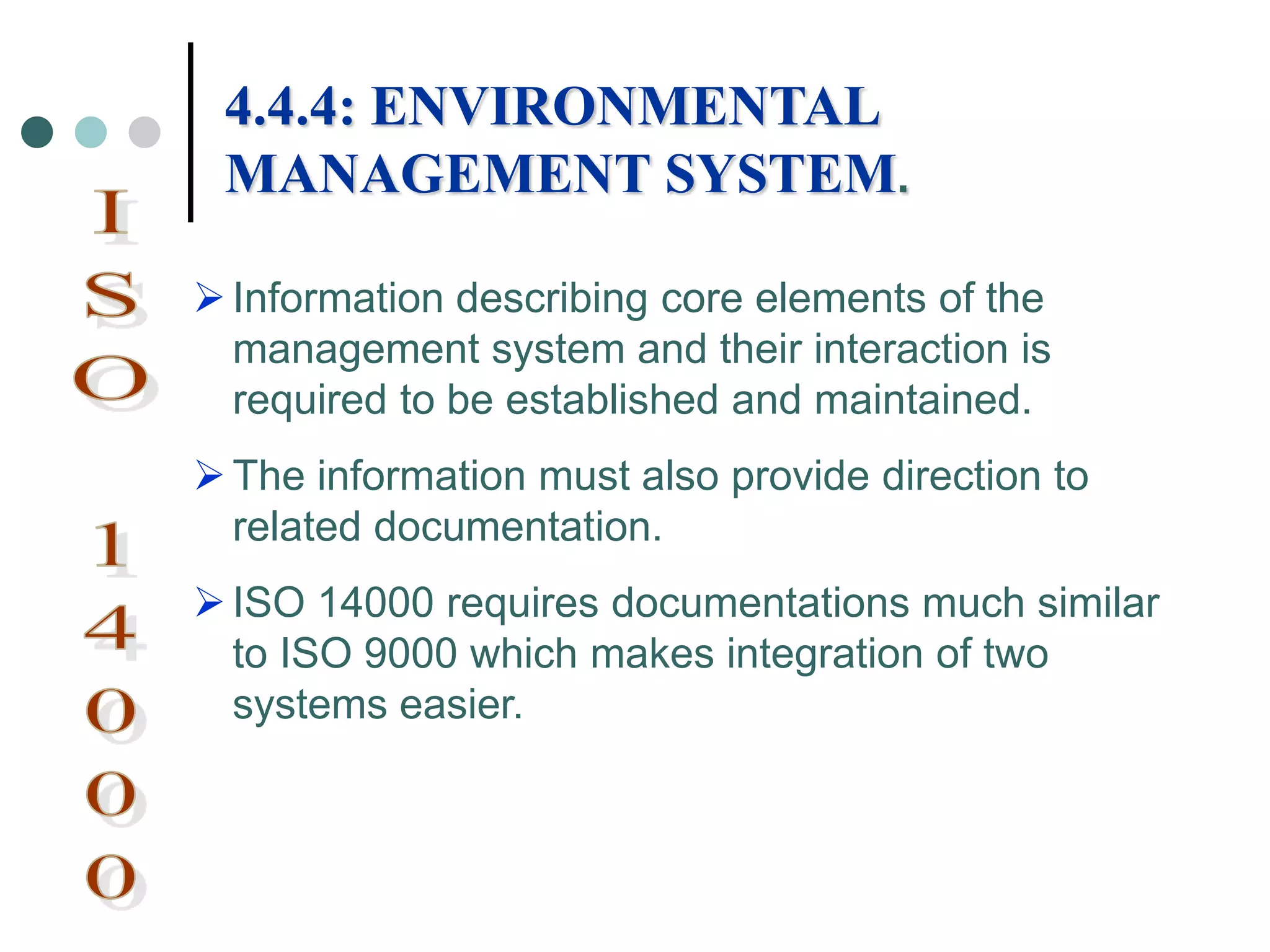
Information describing core elements of the
management system and their interaction is
required to be established and maintained.
The information must also provide direction to
related documentation.
ISO 14000 requires documentations much similar
to ISO 9000 which makes integration of two
systems easier.
4.4.4: ENVIRONMENTAL
MANAGEMENT SYSTEM.
Procedures for controlling all documents required
by the standard are required to be established and
maintained.
These procedures must ensure the following:
 The documents can be located ,
 The documents are periodically reviewed,and
approved by authorized personnel,
 The current versions are available at locations
where operations essential to the functioning of
EMS are done.
 Obsolete documents are promptly removed
 Further, documentation must be legible,
4.4.5: DOCUMENT CONTROL.
Operations and activities associated with the
significant environmental aspects are required to be
identified.
These activities must be planned,and an
organization must:
 establish and maintain documented procedures to
cover situations where their absence could lead to
deviations from the environmental policy and the
objectives and targets,
 stipulate criteria in the operational procedures, and
 establish and maintain procedures related to the
environmental aspects and communicating those
relevant procedures and requirements to suppliers
and contractors
4.4.6: OPERATIONAL CONTROL.
 Procedures to identify potential for and respond to
accidents and emergency situations, are required to
be established and maintained.
 In addition, the emergency procedures must be
reviewed and revised, when necessary, especially
after an accident or emergency situation.
 Where practicable, it is required that these
procedures are periodically tested through drills,
exercises, etc.
4.4.7: EMERGENCY PREPAREDNESS
AND RESPONSE.
 Develop and maintain procedures to regularly
monitor and measure performance against objectives
and targets
 Maintain and document program for calibrating
monitoring equipment
 Identify and investigate non-conformance and
implement corrective and preventative action
 Establish and maintain program to conduct periodic
internal audits
 The organization must also maintain a documented
procedure for periodically evaluating compliance with
relevant environmental laws and regulations
4.5.1: MONITORING AND
MEASUREMENT
Procedures for defining responsibility and authority for
handling and investigating nonconformance, taking
action to mitigate any environmental impacts, and for
corrective and preventive action completion, are
required to be established and maintained.
 Environmental incidents includes emission, chemical
spills
 All environmental incidents require full evaluation of
root cause, initial response, and identification and
implementation of corrective and/or preventative
action
4.5.2: NONCONFORMANCE &
CORRECTIVE AND PREVENTIVE
ACTION.
Procedures for identification, maintenance, and
disposition of environmental records are required to
be established and maintained.
The records must be legible, identifiable and
traceable to the activity involved.
The records must be stored/maintained so that they
are readily retrievable and protected against damage,
deterioration, or loss.
Retention times must be established and recorded.
Records must be maintained, as appropriate, to
demonstrate conformance to the standard.
4.5.3: RECORDS.
The audit program/procedures must:
 determine whether the EMS conforms to
requirements of the standard and has been
properly implemented and maintained
 ensure that information on the audit results are
provided to management
4.5.4: ENVIRONMENTAL
MANAGEMENT SYSTEM AUDIT.
A program and procedures for conducting periodic
environmental system audits are required to be
established and maintained.
The audit program/procedures must:
 be based on the environmental importance of the
activity concerned and results of previous audits
 cover audit scope, frequency, methodologies, and
responsibilities and requirements for conducting
audits, and reporting results.
4.5.4: ENVIRONMENTAL
MANAGEMENT SYSTEM AUDIT.
Review is to involve the top management in the EMS
continuous improvement process.
Conduct Annual (at least) Management Review of
EMS to ensure:
 Its continuing suitability, adequacy and
effectiveness
 Adequate information is collected to perform
the management review
 Address the need for changes to policy,
environmental aspects, objectives,elements of
the environmental management system.
4.6: MANAGEMENT REVIEW.
EMS
A continual cycle of planning, implementing,
reviewing and improving the actions that an
organization takes to meet its environmental
obligations.
• Serves as a tool to improve environmental performance
• Provides a systematic way of managing an organization’s
environmental affairs
• Is the aspect of the organization’s overall management structure
that addresses immediate and long-term impacts of its products,
services and processes on the environment
• Gives order and consistency for organizations to address
environmental concerns through the allocation of resources,
assignment of responsibility and ongoing evaluation of practices,
procedures and processes
• Focuses on continual improvement of the system
Environmental Management System
An EMS follows a Plan-Do-Check-Act Cycle, or PDCA. The diagram
shows the process of first developing an environmental policy,
planning the EMS, and then implementing it.
The process also includes checking the system and acting on it. The
model is continuous because an EMS is a process of continual
improvement in which an organization is constantly reviewing and
revising the system.
This is a model that can be used by a wide range of
organizations — from manufacturing facilities to
service industries and government agencies
Environmental Management System
1. Environmental policy
Initially, the organization’s top management should have
commitment and define the policy on EMS which is used for the
direction of implementing and improving its EMS.
2. Planning
In order to achieve environmental policy, at least, the organization
should :
• Identify the environmental aspects of its activities and specify
those which have significant impacts on the environment.
Identify legal and other requirements to which the organization
involved.
Establish objectives and targets of its activities having impacts to
environment.
Establish environmental programs for achieving its objectives
and targets.
Environmental management system model
 3. Implementation
 In order to achieve environmental planning, at least, the
organization should :
• Define roles, responsibilities and authorities for facilitating EMS
effectively.
• Communicate to the staffs at each level for the importance of
conformance to the environmental policy; provide appropriate
training to personnel performing the tasks to gain their knowledge
and competence.
• Establish and control documentation relating to EMS.
• Control operations and activities to meet the specified objectives
and targets.
• Identify potential accidents and emergency situations for
preventing and mitigating the environmental impacts that may be
associated with them and periodically test such procedures where
practicable.
4. Checking and corrective action
To ensure that the organization is performing in accordance
with the stated EMS programmes, at least, the organization
should:
• Monitor and measure its operations and activities against
the organization’s plans.
• Identify non-conformance and take action to mitigate any
impact caused.
• Record the on-going activities of the EMS.
• Conduct periodic EMS audits.
5. Management review
The organization’s top management should review and
continually improve its EMS, with the objective of improving
its overall environmental performance.
Environmental management system model
ISO 14000 Concepts
The basic concept underlying the ISO 14000 series is that in
order to consistently meet environmental performance
expectations, an organization must implement and maintain an
effective environmental management system.
While the system cannot guarantee that environmental
incidents will never occur,
--it is intended to minimize the likelihood and severity of
their occurrence
-- it can guarantee that when they occur, there is a
mechanism in place to investigate the causes and to take
corrective and preventive action.
Key EMS concepts
 Continual improvement
- It is to note that an effective EMS doesn’t just happen.
An effective EMS needs ongoing management support.
This endorses the concept of continual improvement.
- The concept of continual improvement recognizes that
problems will occur, but a committed organization learns
from its mistakes and prevents similar problems from
occurring in the future.
- ISO 14000 Continuous improvement model begins with
top mgmt’s commitment to corporate governance by a
set of overarching principle’s including:
• Environmental protection as one of the highest
corporate priorities with clear assignment of
responsibilities and accountabilities to all
employees.
 Compliance with all environmental laws and regulations applicable to
the organization’s activities, products and services.
 Ongoing communication on environmental commitment and
performance with all stakeholders.
 Strategic planning that sets forth environmental performance
objectives and targets, implemented through a disciplined mgmt
process.
 Periodic performance measurement, as well as systems audits and
mgmt reviews, to achieve continual improvement wherever possible.
 Employee involvement
- Getting employee involvement in designing and implementing
the EMS demonstrates the organization’s commitment to the
environment. So to build and achieve an effective EMS mgmt
should communicate the importance of:
• Conviction and commitment towards effective environmental
mgmt for organization’s survival.
• Building environmental mgmt in all aspects of orgznal oprns-
product and process development.
• Addressing environmental problems as opportunities.
 Flexibility
- Dynamicity in EMS will :
1. Allow the organization to adapt to rapidly changing business
environment
2. Help making the formulated EMS understandable to all
concerned who must implement it.
3. Allow assessment of how organization manages environmental
obligations and finds cost-effective solutions.
Some unique and important characteristics
of ISO 14001 are:
It is comprehensive: all members of the
organization participate in environmental
protection, the EMS considers all stakeholders,
and there are processes to identify all
environmental impacts.
It is proactive: it focuses on forward thinking
and action instead of reacting to command and
control policies.
It is a systems approach: it stresses improving
environmental protection by using a single
environmental management system across all
functions of the organization.
Legal and other requirement
• Compliance to laws and regulations
• Issuance of consent and permit conditions
• Organization – specific codes and
programmes that it voluntarily subscribes.
• Standards and guidelines in the regions
where the organization undertakes business.
Monitoring and
Measurement
Non Conformance,
Corrective and
Preventive Actions
Records
EMS Audits
ISO Explanation
 The ISO 14001,4.5.1- Monitoring and
Measurement, requires that the organization
shall establish and maintain documented
procedures to monitor and measure , on a
regular basis, the key characteristics of its
operations and activities that can have a
significant impact on the environment
 This shall include the recording of information
to track performance,relevant operational
controls and conformance with the
organization’s environmental objectives and
targets
PURPOSE…….
 To assess how well the EMS is working
 Helps to Manage a Business better
 Identify the performance indicators to monitor
the EMS
 To gauge the Environmental Performance
 Analyze root causes of Problems
 Identify areas where corrective action is
needed
 Improve performance and increase
efficiency of the organization
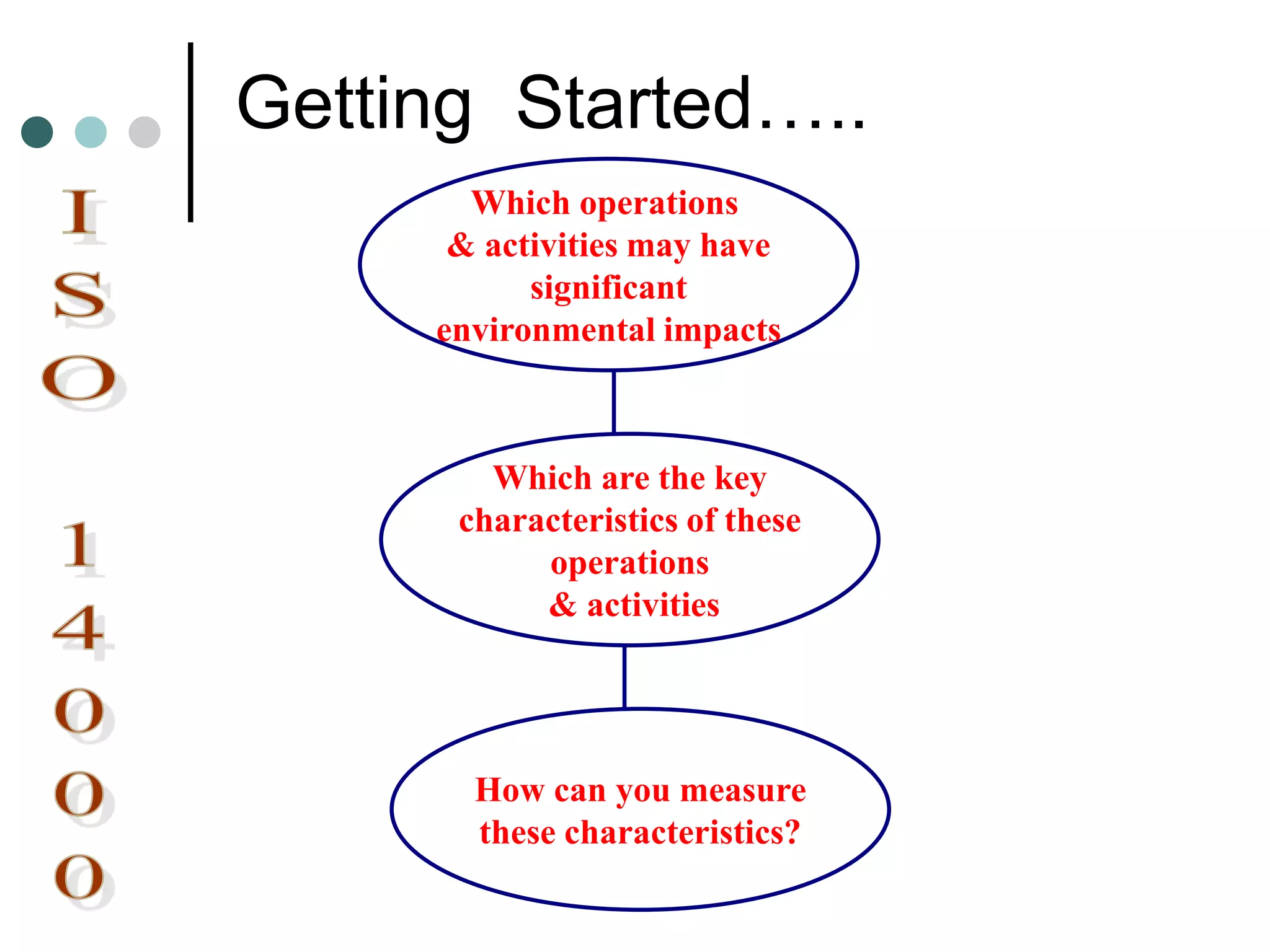
Getting Started…..
Which operations
& activities may have
significant
environmental impacts
Which are the key
characteristics of these
operations
& activities
How can you measure
these characteristics?
Procedure for Performing Monitoring and
Measurement
 Key Process Characteristics
 Process and Outcome Measures
 Equipment Calibration
 Regulatory Compliance
 Environmental Performance
 Audit versus Performance Evaluation
 Linkages of Environmental Information
Auditing and EPE
Periodic
Sample of data
Independent
Verify Conformance
Ongoing
Frequent
Line Function
Assess Performance
AUDIT EPE
ISO Explanation
 ISO 14001,4.5.2 - Nonconformance and
corrective and preventive action , requires
that the organization shall establish and
maintain procedures for defining
responsibility and authority for
handling and investigating non
conformance , taking corrective action
to mitigate any impact caused, and for
initiating and completing corrective and
preventive action
Purpose
Management
Review
System
Audit
Corrective
Action
Typical Causes of EMS
Problems
Getting Started
 The results of monitoring and measurements,audit
findings and other systemic reviews should be
documented and reviewed and must lead to corrective
actions.If the organization already has an ISO 9000 QMS
,a corrective and preventive action process already
exists.The same model may be used for EMS purposes.
 For a documented problem . The root cause of the
systematic failure should be determined.The
organization must be committed to implementing
corrective actions as quickly as possible. The corrective
and Preventive action process should specify
responsibilities and schedules.Progress should be
reviewed regularly and any deficiencies followed up
Contd...
 The extent of planning and documentation
required for corrective and preventive actions
may vary with the severity of the problem(and
its potential environmental impacts).An
appropriate suggestion is “A simple method
always works better”
 It should be ensured that adequate data and
information is collected to determine why a
problem has occurred and what corrective
actions may be necessary.
EMS Elements that Lead to corrective Action and Management
Reviews
Monitoring Audits
Employee
Involvement
Corrective
Action
Process
Management
Review
Hints that should not be Ignored!
 Workers on the shop floor are in the best position to
see problems and suggest solutions.
 All employees should be informed that it is their
responsibility to identify and perform corrective
actions. This would include reporting nonconformance
of operational and procedural natures.It should also be
well communicated to all employees that everyone is
responsible for solving nonconformance as well.
 A suitable system improvement process e.g.., via
suggestion boxes,incentive programmes should be
employed for greater employee participation.
 In small companies same employees might have been
engaged in multiple function,including management
review and corrective action processes..A strong link
should exist between the processes for better EMS
effectiveness...
ISO Explanation
 ISO 14001,4.5.3 - Records, states that the
organization shall establish and maintain
procedures for the identification,
maintenance and disposition of
environmental records. These records
shall include training records and the
results of audits and reviews
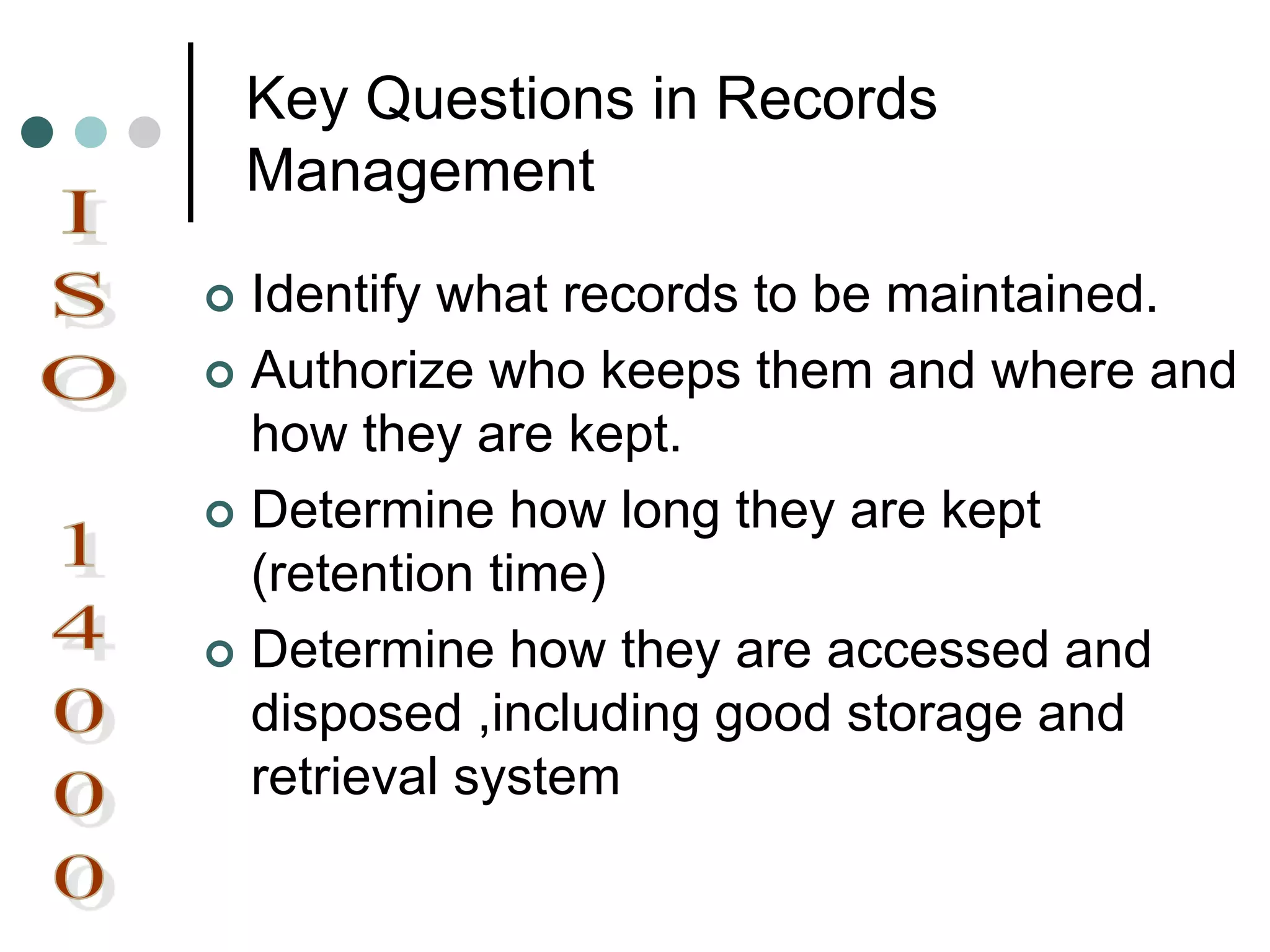
Key Questions in Records
Management
 Identify what records to be maintained.
 Authorize who keeps them and where and
how they are kept.
 Determine how long they are kept
(retention time)
 Determine how they are accessed and
disposed ,including good storage and
retrieval system
Purpose...
 Records Management under ISO14001 must be
able to prove that the organization is actually doing
what it says!
 To prove that the organization is actually
implementing the EMS as designed,one should
have a system for managing EMS records.
 While records have value internally over time one
may need to provide evidence of EMS
implementation to external parties (such as
customers, a registrar , or the public).
 For records Management, the organization shall
develop procedures to maintain, identify,collect,
index and store records.
TYPES OF RECORDS
 Environmental aspects determination documentation
 Legal and other regulatory requirements and records of
regulatory violations.
 Permits consents, licenses and other approvals
 Progress reports towards meeting objectives and targets.
 Hazardous material spills, other incident reports and follow
ups.
 MSDS
 Sampling and monitoring data
 Maintenance records
 Calibration and maintenance records for instrumentation
 Training records
 EMS audit and regulatory compliance audit reports
 Management review documentation
Intro...
 EMS audit refers to a systematic and
documented verification process to
determine whether an organization’s
EMS conforms to the audit criteria set
by the organization and for the
communication of the audit results to
the top Management.
Purpose
 To determine whether or not EMS conforms to planned
arrangements for environmental management including
the requirements of this International Standards and
has been properly implemented and maintained
 Provide information on the results of audits to
Management
 Results of EMS audits should be linked to the
corrective and preventive actions.
 Systematic identification and reporting of EMS
deficiencies provides a great opportunity for the
Management functions to focus on the environment
and ensure its cost effectiveness
 External Auditing is suggested
Getting Started
 The organization should have an
 Audit Procedure describing
 Audit Scope
 Audit Frequency
 Audit Methods
 Key responsibilities
 Reporting Mechanism
AUDIT FREQUENCY
The nature of the Operations
The significant Environmental aspects/impacts identified
The results of the monitoring programme
Findings of Previous audits
audited at least annually
AUDITING METHODS - Internal,External auditors
The number will depend on the size and
complexity of the organizational functions
Auditing Techniques ,Management System Concepts
Quality systems,Legal compliance etc
Linkages between EMS audits,Corrective Action and
Management Reviews
Periodic EMS
audits
Corrective
Action
Process
Management
Review
EMS
Established
Intro
 Management reviews ensure how the
EMS will remain viable.
 It can be used to demonstrate top
management’s ongoing support for the
environmental issues.
 It shall address the possible need for
changes to policy, objectives, and other
elements of the EMS.
MR Considers
 Progress on objectives and targets towards
continuing suitability,adequacy and EMS
effectiveness
 New standards legislation and regulations
 Audit results
 Environmental Performance measures
 Reports of emergencies (e.g, spills,leaks, other
incidents)
 New scientific/technical data on products,
materials and processes used
 Internal and External Communications etc
Getting Started
 It should involve- those who have the right information
and knowledge and who have the authority to make
decisions.
 Schedule and frequency for Management reviews
should be determined, typically once or twice in a year.
 It should assess whether different organizational
functions have complied with policy and procedures
using audit reports.
 It should be determined if Capital and other resources ,
including information management systems are adequate
to support the EMS requirements of the Organization.
Contd….
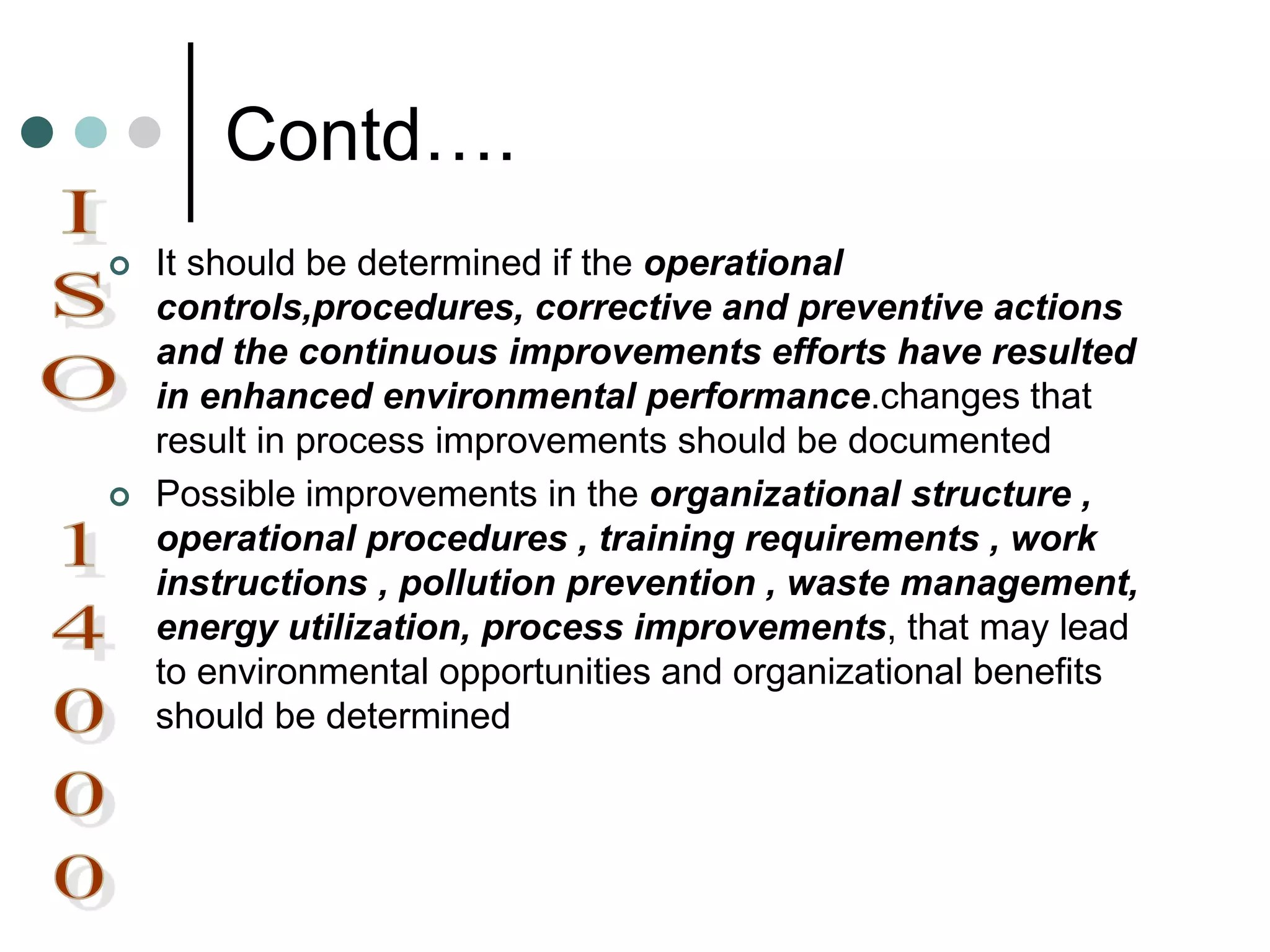
 It should be determined if the operational
controls,procedures, corrective and preventive actions
and the continuous improvements efforts have resulted
in enhanced environmental performance.changes that
result in process improvements should be documented
 Possible improvements in the organizational structure ,
operational procedures , training requirements , work
instructions , pollution prevention , waste management,
energy utilization, process improvements, that may lead
to environmental opportunities and organizational benefits
should be determined
Business Transformation Through
ISO 14000
Case Studies
Bharat Heavy Electricals Limited
A. Water Conservation Measures
Reuse of wastewater generated from filter press operation for
other miscellaneous uses and recirculation of cooling water at
jiggering and kiln areas.
B. Energy Conservation Measures
Optimise Kiln loading, insulation of ducts, Process flow
improvement by introduction of capacitor bank, use of high
efficiency motors and variable speed drives.
C. Air pollution control measures
Introduction of wet scrubber for standardised glazing Dust
Extraction System, reconditioning of Dust Extraction System of
Shot blasting machine at foundry
Case Studies
Bharat Heavy Electricals Limited…Contd.
D. Waste Minimisation Programmes
Recovery of solid waste generated at grid washing
Crushing and reuse of rejected ceramic tiles
E. Mitigation of Green house Gases
Energy efficiency studies have been conducted on kilns furnaces,
dryers & boilers and implemented efficiency improvement
programme to reduce specific fuel consumption, which in turn
reduces green house gases emission.
Case Studies
Bharat Heavy Electricals Limited…Contd.
Cost Benefit Analysis for Implementing ISO 14000 System
Costs Annual Cost (in Rs. Lacs)
Consultancy Fee 3.64
Training fee 2.02
Certification fee (per 3 years) 2.48
Investment on Environmental Pollution control Equip. 11.05
Miscellaneous Costs 0.65
Total Rs. 19.84 Lacs
Quantified Benefits Annual Savings( in Rs
Lacs )
Power Savings 15.0
Fuel Savings 14.0
Lubricants Savings Rs. 00.6
Savings in Waste disposal costs 00.2
Resource Savings 40.0
Savings through Recycling 30.3
Total Rs. 100.1 Lacs per year
Copley Square Hotel
 A prominent hotel created an aggressive
environmental program that provides a foundation
for ISO 14001 registration. The hotel is an historic
one with an upscale clientele. Their aggressive
approach to reducing their impact on the
environment helped them identify many ongoing
benefits. The major benefit areas were: recycling,
energy use reduction, and water use reduction.
The following are the major actions and their
results:
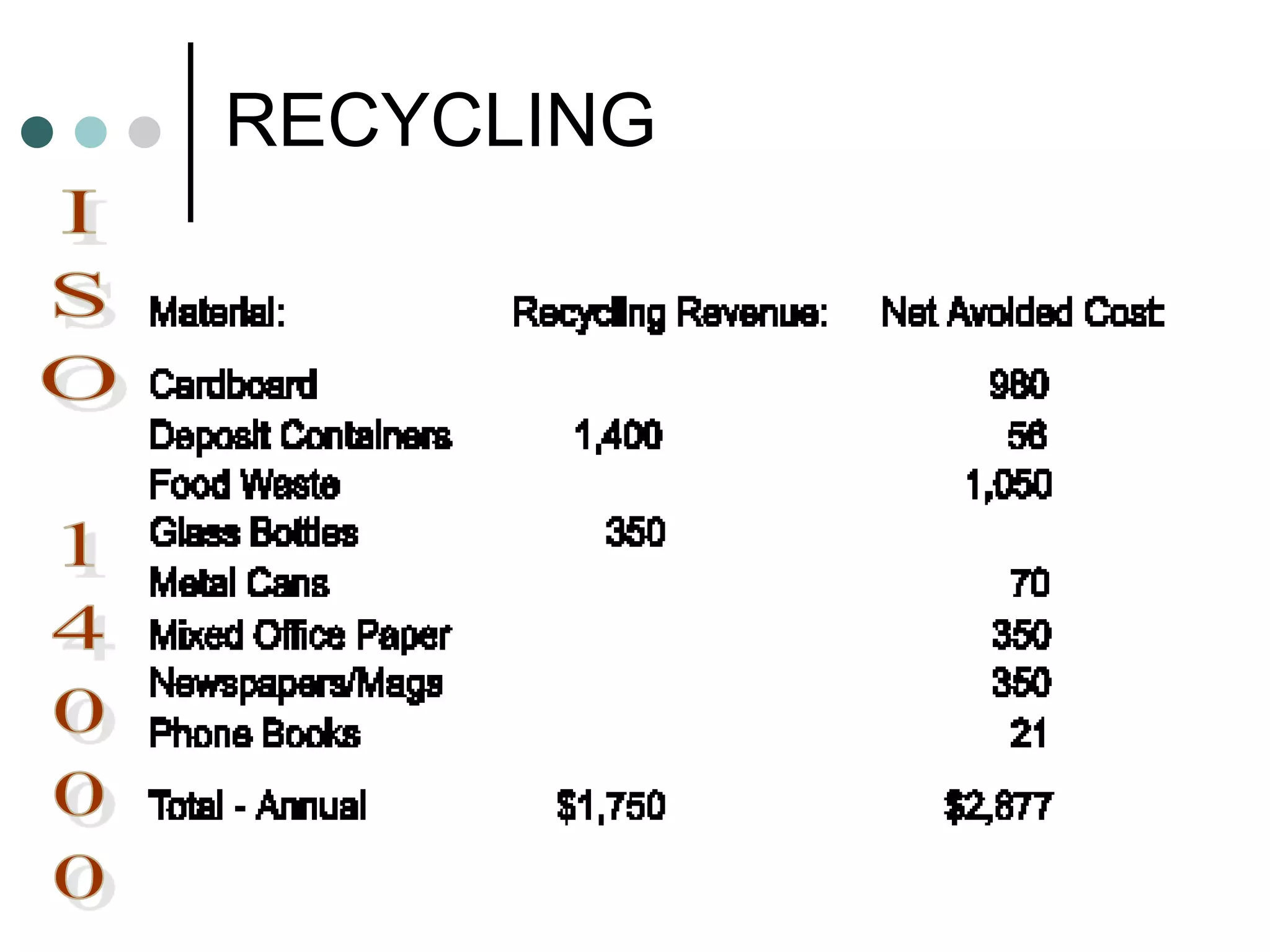
RECYCLING
 :

 Energy Use Reduction:
 • Energy efficient lighting was installed in public areas which are
light 24 hours per day. 60 watt incandescent corridor ceiling lights
were replaced 15 watt compact fluorescent lights: savings equal
$3,622 annually plus 90% reduction in labor costs. 90 watt
incandescent lights in table lamps in the lobby and elevator
landings were replaced with 22 watt compact fluorescent lights:
savings equal $1,540 annually and reduced labor costs. 30 watt
exit sign lights were replaced with 1.8 watt LED exit signs: savings
equal $1,179 annually.
 • Install compact fluorescent bulbs in guest room table lamps and
hanging lamps: predicted payback equal 1.81 years.
 • Install compact fluorescent bulbs in back areas which are lit 24
hours: savings equal to $59.57 per bulb.
 • Remind employees to turn off all energy using devices that are
not being used: no estimate of savings.
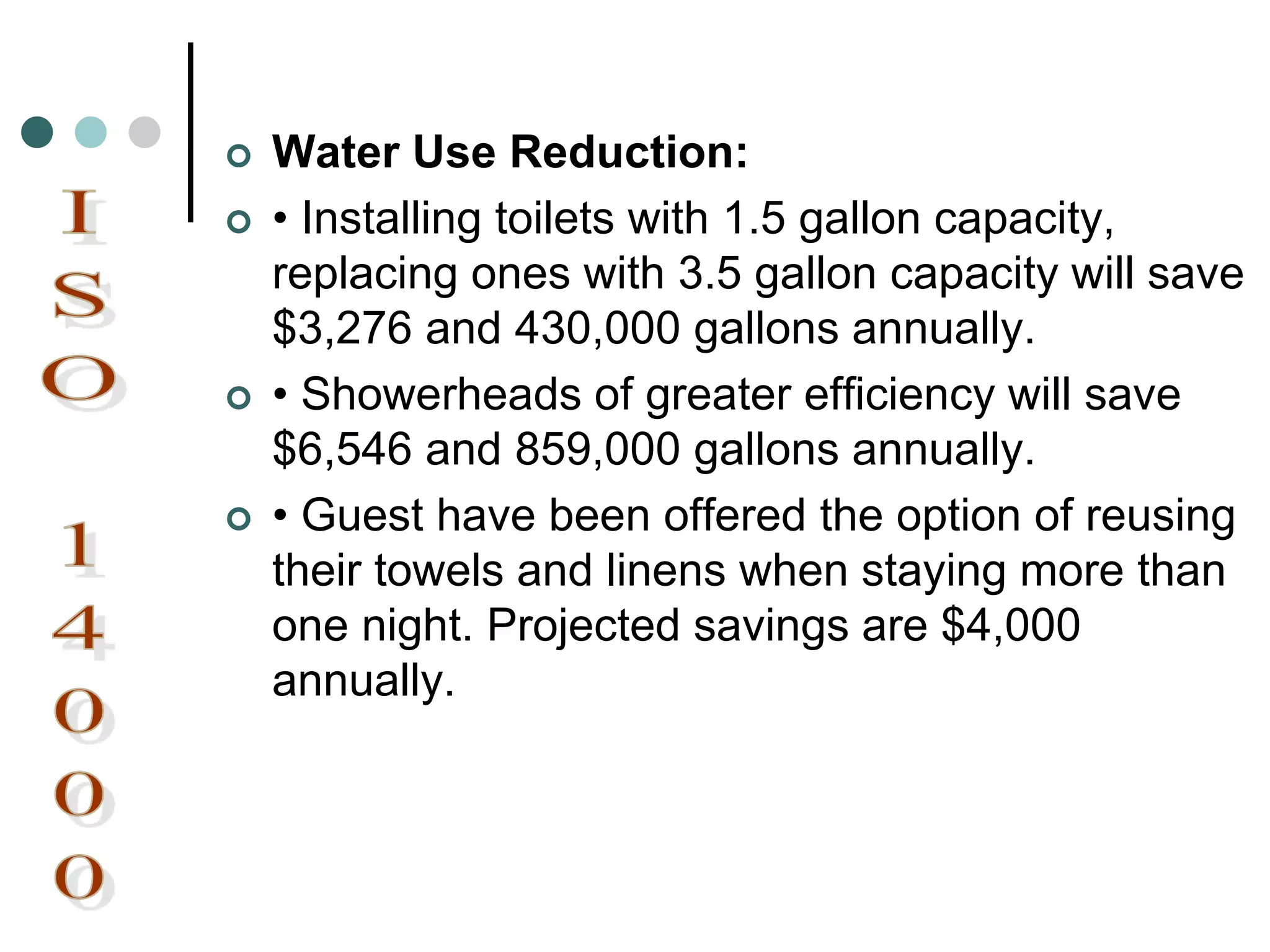
 Water Use Reduction:
 • Installing toilets with 1.5 gallon capacity,
replacing ones with 3.5 gallon capacity will save
$3,276 and 430,000 gallons annually.
 • Showerheads of greater efficiency will save
$6,546 and 859,000 gallons annually.
 • Guest have been offered the option of reusing
their towels and linens when staying more than
one night. Projected savings are $4,000
annually.
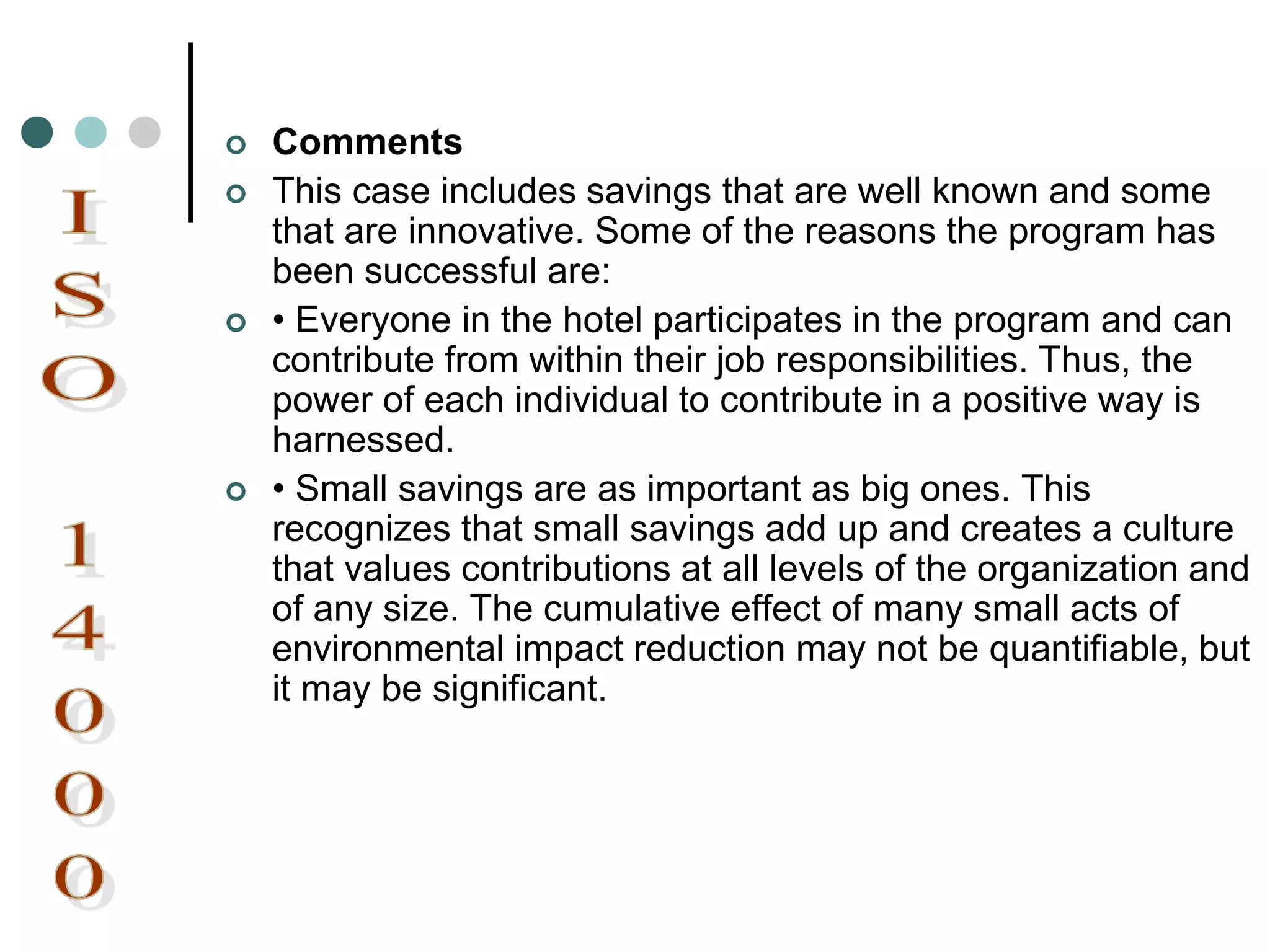
 Comments
 This case includes savings that are well known and some
that are innovative. Some of the reasons the program has
been successful are:
 • Everyone in the hotel participates in the program and can
contribute from within their job responsibilities. Thus, the
power of each individual to contribute in a positive way is
harnessed.
 • Small savings are as important as big ones. This
recognizes that small savings add up and creates a culture
that values contributions at all levels of the organization and
of any size. The cumulative effect of many small acts of
environmental impact reduction may not be quantifiable, but
it may be significant.
ISO 14000-SERIES
BENEFITS AND OTHER ISSUES
REASONS FOR
IMPLEMENTING ISO 14000
 Recognition
 Bottom-line benefits
 Trade
 Regulatory
 Financial sector
INDUSTRY ACCEPTANCE OF
ISO 14000 SERIES
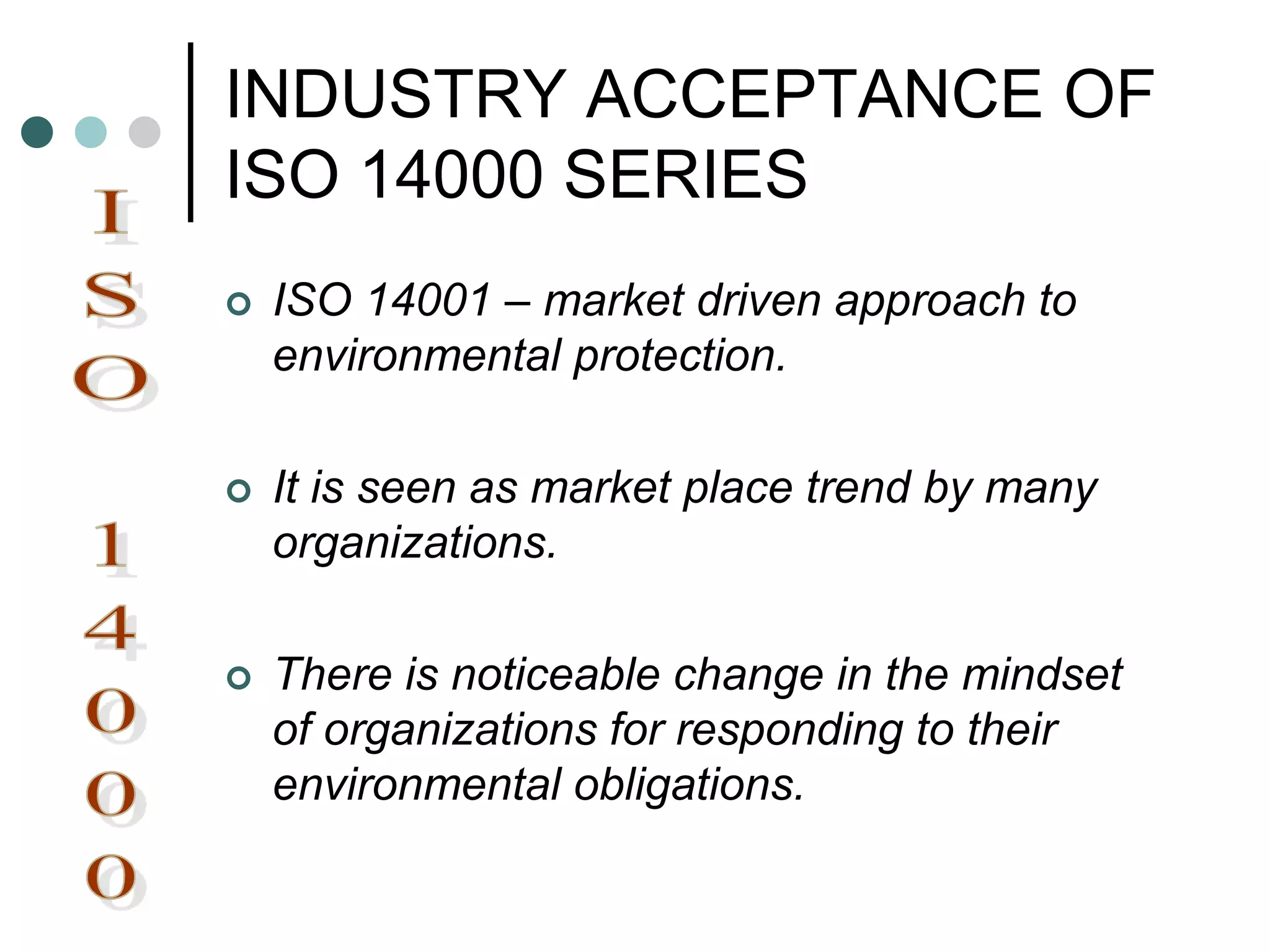
 ISO 14001 – market driven approach to
environmental protection.
 It is seen as market place trend by many
organizations.
 There is noticeable change in the mindset
of organizations for responding to their
environmental obligations.
ISO-14000 IN SMALL
ORGANISATIONS
 ISO 14001 is flexible to fit into any size,
industry or facility.
ADVANTAGES:
 Lines of communication are short
 Organizational structure and climate are
less complex
 People often perform multiple functions
COST ESTIMATES
COST INCLUDES :
 Staff/ employee time,
 Consultant expenses and
 Training of personnel.
COST ESTIMATES
 Total implementation time can usually be
estimated as one workday per employee.
 12 to 14 months to fully implement ISO
14001's 62 elements
 Implementation costs can range from
$20,000 to $250,000
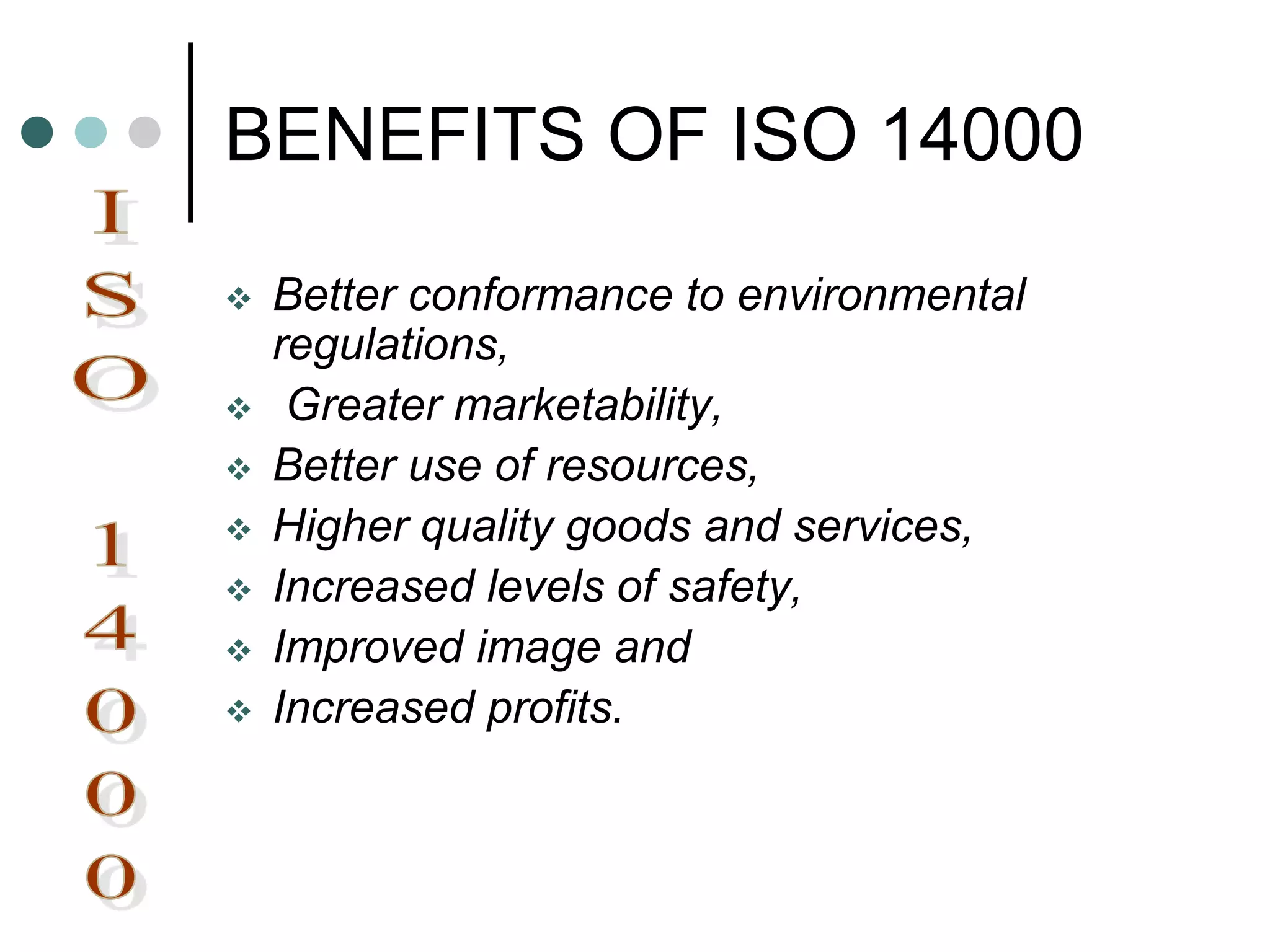
BENEFITS OF ISO 14000
 Better conformance to environmental
regulations,
 Greater marketability,
 Better use of resources,
 Higher quality goods and services,
 Increased levels of safety,
 Improved image and
 Increased profits.
SOME ISSUES RELATED TO
ISO 14000
 There is no guarantee that certification
will result in increased profits for a company.
 ISO 14000 which is stricter than ISO 9000.
 Multisite registration of subsidiaries is
permitted only if there is a common
management and central control of each site
ISO 14000 AND ISO 9000
SIMILARITIES AND DIFFERENCES
SIMILARITIES BETWEEN ISO
14000 AND ISO 9000
• Policy and Defined organization and responsibilities
• Defined and documented standard practices
• Control of critical operations
• Document control Training
• Records system
• Internal audits
• Corrective action system
• Management review for continual improvement
DIFFERENCES BETWEEN ISO
14000 AND ISO 9000
ISO 9000 ISO 14000
1.Encourage organizations to
institute quality assurance
management programs.
1.Deals with the management of
the environmental effects of an
organization
2.The major system requirements
are defined by customers
2.Customers as well as many
additional stakeholders
3.Includes evaluation of suppliers
and review of customer contracts.
3.Include methods of evaluating
environmental impacts and
systems
4.The goals of a
quality system are generally quite
clear
4.The situation for environmental
systems is not so straightforward
OTHER EMS STANDARDS
British Standard 7750 (BS 7750) -the
world's first standard for environmental
management systems (EMS) and
The European Eco-Management and Audit
Scheme (EMAS) -European Union
INTEGRATING SYSTEMS FOR
BUSINESS
INTEGRATING SYSTEMS
FOR BUSINESS
 Develop and maintain a comprehensive
business management system -quality and
environmental requirements
 Must be based firmly in the needs and
values of the Business itself
 Each new requirement that emerges can be
carefully considered and integrated into the
existing systems
framework.
INTEGRATING SYSTEMS
FOR BUSINESS-
CONTINUES….
 Companies that are registered to ISO 9001 already
have a head start.
 These systems satisfy internal business needs as well
as the external requirements
 Systems which are non-value adding should be closely
examined and improved
INTEGRATING SYSTEMS
FOR BUSINESS-
CONTINUES….
 Conduct a gap analysis to determine which system
elements are in place and which elements need to be
improved or developed
 Use ISO 14001 as a guideline or model of a
comprehensive EMS.
 Examine the company's existing environmental
systems, as well as quality systems
 Determine the business' priorities for improving
existing systems and developing new systems.
Iso 14000

Iso 14000

  • 3.
    ISO 14000 INTRODUCTION In the present day, environmental matter is not limited only in one country or specific area. The environmental impact effects everywhere and leads to problem all over the world.  Environmental conservation has become so complicated that it causes pressure to all business organizations.  The International Organization for Standardization had led to the development of the International Standard for environmental management system series (ISO 14000).
  • 4.
    ISO 14000 INTRODUCTION •Afterthe success of the ISO9000 series of quality standards in 1987, the International Standards Organization is nearing completion and publication of a comprehensive set of standards for environmental management. •This series of standards is designed to cover the whole area of environmental issues for organizations in the global marketplace.
  • 5.
    Continues..  The structureof the standards is as follows:  Environmental Management Systems (EMS)  Environmental Auditing and Related Environmental Investigations (EA)  Environmental Labeling (EL)  Environmental Performance Evaluation (EPE)  Life Cycle Assessment (LCA)  Terms and Definitions (T&D)  ISO 14000 Series is the set of standards relating to environmental management system.  Generally, the standard used for certification is  ISO 14001 Environmental Management Systems - Specifications with Guidance for Use.
  • 6.
    ISO 14000 SERIES The ISO 14000 series is a set of standards concerning EMS including the activities of designing, producing, delivering and servicing.  The concept of the standard is to enable the organization to continually develop and improve its EMS.  Although the series comprises of many standards, the standard ISO 14001 is used as the direction for EMS certification.
  • 7.
    WHO SHOULD IMPLEMENT ISO14000  Any organization: manufacturers and service organizations.  Any activities of each organization may cause the environmental aspects and impacts such as noise, dust, waste, contaminants in manufacturing process and ineffectively resources consumption in servicing. These can be minimized by implementing EMS.  Although each country has already had her own environmental regulations, organizations are able to apply ISO 14000 series effectively within their system on voluntary basis and the benefit obtained is not only for organizations themselves but their society also.
  • 8.
    WHAT IS ISO14000?  ISO 14000 is a series of voluntary international standards pertaining to environmental issues.  They are designed to reduce the environmental effects from all aspects of business activities. It is believed that higher efficiency would be realized and "the cost of doing business" would also be reduced , by minimizing business exposure to environmental issues.
  • 9.
    What is notISO 14000  Is not a PRODUCT and PERFORMANCE standard.  Does not establish levels of pollutants or performance.  Does not establish test standards.  Does not involve initial performance testing.  Does not requires or establish final performance goal.  Does not require the meeting of zero emissions.  Does not mandate best practice technology.  Does not require disclosure of performance levels.  Does not require disclosure of audit results.
  • 10.
    HISTORY OF ISO14000  The reasons for developing these national standards stemmed from the European success terms of the ISO 9000 Quality Management Standards, and from the "green movement" in Europe. These standards were envisioned to provide a market-driven, competitive attitude in business.  ISO 14000, which is an evolution of ISO 9000 standards, is designed to address process improvements in these environmental areas by way of energy audits, hazardous materials management, and other techniques
  • 11.
     ISO 14000holds great promise for reduced waste and higher material quality because it emphasizes the elimination of waste early in the procurement process, especially in industries such as coatings where there are significant amounts of raw material input.  ISO 14000 identifies and eliminates all waste that enters production through current procurement practices before it enters the manufacturing environment.
  • 12.
     When ISO9000 quality management systems are integrated with ISO 14000 environmental systems, the two processes support each other. Opportunities for better quality practices exist in the quest for better environmental practices, and better environmental processes are often the result of improved quality.  A merged system, which is currently available, is often the answer for companies seeking improvement in both areas.
  • 13.
     Historically, documentdisarray and communication redundancies have made implementation of ISO 9000 and ISO 14000 slow and costly. .  The advent of new Web-based technologies, however, makes it possible for companies to host entire documentation, project management, and training systems for the implementation of ISO 9000 and ISO 14000 standards, significantly reducing the cost of each individual component and minimizing the time to implementation.
  • 14.
    ISO 14000 SERIES Organizational evaluation standards are operational and effective because, the focus was on the process rather than the product.  The development and acceptance of product evaluation standards will be much more difficult. Organizational Evaluation Standards Product Evaluation Standards
  • 15.
    ORGANISATIONAL EVALUATION STANDARDS EMS 14001specification EA 14010 general principles 14011 audit procedures 14012 auditor criteria EPE 14031 guidelines The structure of the standards is as follows: Environmental Management Systems (EMS) Environmental Auditing and Related Environmental Investigations (EA) Environmental Labeling (EL) Environmental Performance Evaluation (EPE) Life Cycle Assessment (LCA) Terms and Definitions (T&D)
  • 16.
    PRODUCT EVALUATION STANDARDS EnvironmentalAspects in Product Standards Guide 64 EAPS Guide Environmental Labeling 14020 Basic Principles 14021 Self Discipline 14022 Symbols 14023 Testing and Verification 14024 Third Party Life Cycle Assessment 14040 principles Framework 14041 Goals and Definition 14042 Impact Assessment 14043 Improvement Assessment
  • 17.
    ISO 14000 FAMILY ISO14000 Standard Title General Description Thrust Area 14001:1996 Environmental Management Systems— Specification with Guidance for Use Main organizational environmental standard and the ISO standard to which an EMS is formally registered Organizational 14004:1996 Environmental Management Systems— General Guidelines on Principles, Systems and Supporting Techniques Complementary document to ISO 14001 which provides more information and assistance in understanding and implementing the EMS standard. Organizational 14010:1996 Guidelines for Environmental Auditing—General Principles Covers the concepts of environmental auditing which can be used separately to create an organizational environmental audit program or is used to implement a program in support of the ISO 14001 EMS audit requirements Organizational
  • 18.
    ISO 14000 Standard Title GeneralDescription Thrust Area 14011:1996 Guidelines for Environmental Auditing— Audit Procedures: Auditing of Environmental Management Systems Provides additional detail into the auditing of an EMS. Organizational 14012:1996 Guidelines for Environmental Auditing: Qualification Criteria for Environmental Auditors Presents the consensus international requirements for certification as an environmental auditor; each national registration accreditation organization is charged with developing and implementing the program for registering auditors to the national program. Organizational 14020- 14025 :1998 Environmental Labeling Series that includes requirements for self- declaration, testing and validation and symbols used Product specific
  • 19.
    ISO 14000 Standard Title GeneralDescription Thrust Area 14031:2000 Guidelines on Environmental Performance Evaluation Presents methods for monitoring and measuring the environmental performance of an organization or elements within the organization Organizational 14040:1997 14041:1998 14042:1999 14043:1999 Life Cycle Assessment Provides principles and framework, inventory analysis, impact assessment and interpretation of the environmental aspects associated with specific products or services including the design, manufacture, distribution, inventory, use . Product- specific
  • 20.
    14050:1998 Terms and Definitions Detailsthe terminology and use of ISO 14000 specific language for consistency of meaning to support the efforts of developing and implementing the standards Overall ISO Guide 64:1997 (formerly 14060) Guide for the Inclusion of Environmental Aspects in Product Standards Provides guidelines to specification writers to consider and incorporate environmental aspects. Product-specific
  • 21.
    ISO 14000 POLICY Prevention of pollution.  Continual Environmental Improvement.  Commitment to comply with Environmental Laws and Regulations  Applicable in size and scope.
  • 22.
     Establish frameworkfor setting and reviewing objectives and targets  Documented, implemented, maintained, and communicated to employees.  Available to the public ISO 14000 Policy, Continued
  • 23.
     ISO-14001, outlines18 elements that must be followed if a facility wishes to be in conformance.  The 18 elements are divided into six clauses  Six clauses are 4.1 General Requirements 4.2 Environmental Policy 4.3 Planning 4.4 Implementation & Operation 4.5 Checking & Corrective action 4.6 Management review ELEMENTS OF ISO 14001
  • 24.
    4.2: ENVIRONMENTAL POLICY. Ensurecommitment to the EMS and define policy that:  Is based on company’s mission and values.  is appropriate to the nature, scale and environmental impacts of the business  includes a commitment to continual improvement  includes a commitment to comply with relevant environmental legislation and regulations  is documented, maintained and communicated to all employees  is available to public
  • 25.
    Environmental aspects ofactivities, products, or services that the organization can control must be established, maintained, and kept up to date, in order to determine which can have significant impacts on the environment. The organization shall insure that the aspects related to these significant impacts are considered in setting its environmental objectives. 4.3.1: ENVIRONMENTALASPECTS
  • 26.
    Define Scope Define Process GatherData Assemble appropriate people Identify Environmental Aspects Identify Environmental Impacts Evaluate Impacts Record Results Periodically Review and Update PROCESS OF IDENTIFYING ENVIRONMENTALASPECTS
  • 27.
    Activity Aspect Potential Impact RegulatedRating MSW Combustion Air Emissions (Nox, SO2, metals, dioxin, CO) Air quality degradation, smog, acid deposition Yes 51 Residuals Handling Residuals (ash) Disposal Land/water contamination Yes 51 Boiler water production Chemical spills/release s Land/water contamination Yes 30 Recyclables Receiving Windblown Litter Aesthetics Yes 36 Example: Environmental Aspects
  • 28.
    Procedures to ensurethat the company can identify legal and other environments requirements are required to be established and maintained. It is also required to know how the organization  Access and identify legal and other requirements  Keep track of changes to legal and other requirements Communicate relevant information about legal and other requirements to employees 4.3.2: LEGALAND OTHER REQUIREMENTS.
  • 29.
     Documented environmentalobjectives and targets for each relevant function and level within the organization are required to be established and maintained.  These set objectives and targets must address legal consideration and other requirements, the facility's significant environmental aspects, technological options, financial/ operational/business requirements, and views of interested parties.  These objectives and targets must be consistent with the environmental policy. 4.3.3: OBJECTIVES AND TARGETS.
  • 30.
     A program(s)for achieving set objectives and targets is required to be established and maintained.  The program must include designated responsible parties for achieving objectives and targets at each relevant function and level of the organization and the means and timeframe by which the objectives and targets are to be achieved.  In addition, the program must be amended as needed to ensure that the environmental management program applies to new developments and new or modified activities, products, or services. 4.3.4: ENVIRONMENTAL MANAGEMENT PROGRAM(S).
  • 31.
     Roles, responsibilities,and authorities are required to be defined, documented, and communicated to facilitate effective environmental management.  Sufficient resources must be provided to implement and control the environmental management system.  A specific management representative(s) must be appointed to ensure that EMS requirements are established, implemented, and maintain in accordance with the standard.  The management representative must have defined roles, responsibilities, and authority for reporting on EMS performance to top management 4.4.1: STRUCTURE AND RESPONSIBILITY.
  • 32.
    Appropriate training forall personnel whose work may create a significant impact on the environment must be identified. Procedures are required to be established and maintained to make employees aware of:  The importance of conformance with the environmental policy and procedures and with EMS requirements,  The potential environmental impacts of work activities Roles and responsibilities in achieving conformance with policy, procedures, EMS requirements 4.4.2: TRAINING AWARENESS AND COMPETENCE.
  • 33.
     Procedures forinternal communication between levels and functions of the company are required to be established and maintained.  Procedures must also be developed for receiving, documenting and responding to relevant communication from external parties.  Finally, processes for external communications must be considered and the decision recorded. 4.4.3: COMMUNICATION.
  • 34.
    Information describing coreelements of the management system and their interaction is required to be established and maintained. The information must also provide direction to related documentation. ISO 14000 requires documentations much similar to ISO 9000 which makes integration of two systems easier. 4.4.4: ENVIRONMENTAL MANAGEMENT SYSTEM.
  • 35.
    Procedures for controllingall documents required by the standard are required to be established and maintained. These procedures must ensure the following:  The documents can be located ,  The documents are periodically reviewed,and approved by authorized personnel,  The current versions are available at locations where operations essential to the functioning of EMS are done.  Obsolete documents are promptly removed  Further, documentation must be legible, 4.4.5: DOCUMENT CONTROL.
  • 36.
    Operations and activitiesassociated with the significant environmental aspects are required to be identified. These activities must be planned,and an organization must:  establish and maintain documented procedures to cover situations where their absence could lead to deviations from the environmental policy and the objectives and targets,  stipulate criteria in the operational procedures, and  establish and maintain procedures related to the environmental aspects and communicating those relevant procedures and requirements to suppliers and contractors 4.4.6: OPERATIONAL CONTROL.
  • 37.
     Procedures toidentify potential for and respond to accidents and emergency situations, are required to be established and maintained.  In addition, the emergency procedures must be reviewed and revised, when necessary, especially after an accident or emergency situation.  Where practicable, it is required that these procedures are periodically tested through drills, exercises, etc. 4.4.7: EMERGENCY PREPAREDNESS AND RESPONSE.
  • 38.
     Develop andmaintain procedures to regularly monitor and measure performance against objectives and targets  Maintain and document program for calibrating monitoring equipment  Identify and investigate non-conformance and implement corrective and preventative action  Establish and maintain program to conduct periodic internal audits  The organization must also maintain a documented procedure for periodically evaluating compliance with relevant environmental laws and regulations 4.5.1: MONITORING AND MEASUREMENT
  • 39.
    Procedures for definingresponsibility and authority for handling and investigating nonconformance, taking action to mitigate any environmental impacts, and for corrective and preventive action completion, are required to be established and maintained.  Environmental incidents includes emission, chemical spills  All environmental incidents require full evaluation of root cause, initial response, and identification and implementation of corrective and/or preventative action 4.5.2: NONCONFORMANCE & CORRECTIVE AND PREVENTIVE ACTION.
  • 40.
    Procedures for identification,maintenance, and disposition of environmental records are required to be established and maintained. The records must be legible, identifiable and traceable to the activity involved. The records must be stored/maintained so that they are readily retrievable and protected against damage, deterioration, or loss. Retention times must be established and recorded. Records must be maintained, as appropriate, to demonstrate conformance to the standard. 4.5.3: RECORDS.
  • 41.
    The audit program/proceduresmust:  determine whether the EMS conforms to requirements of the standard and has been properly implemented and maintained  ensure that information on the audit results are provided to management 4.5.4: ENVIRONMENTAL MANAGEMENT SYSTEM AUDIT. A program and procedures for conducting periodic environmental system audits are required to be established and maintained.
  • 42.
    The audit program/proceduresmust:  be based on the environmental importance of the activity concerned and results of previous audits  cover audit scope, frequency, methodologies, and responsibilities and requirements for conducting audits, and reporting results. 4.5.4: ENVIRONMENTAL MANAGEMENT SYSTEM AUDIT.
  • 43.
    Review is toinvolve the top management in the EMS continuous improvement process. Conduct Annual (at least) Management Review of EMS to ensure:  Its continuing suitability, adequacy and effectiveness  Adequate information is collected to perform the management review  Address the need for changes to policy, environmental aspects, objectives,elements of the environmental management system. 4.6: MANAGEMENT REVIEW.
  • 44.
    EMS A continual cycleof planning, implementing, reviewing and improving the actions that an organization takes to meet its environmental obligations.
  • 45.
    • Serves asa tool to improve environmental performance • Provides a systematic way of managing an organization’s environmental affairs • Is the aspect of the organization’s overall management structure that addresses immediate and long-term impacts of its products, services and processes on the environment • Gives order and consistency for organizations to address environmental concerns through the allocation of resources, assignment of responsibility and ongoing evaluation of practices, procedures and processes • Focuses on continual improvement of the system Environmental Management System
  • 46.
    An EMS followsa Plan-Do-Check-Act Cycle, or PDCA. The diagram shows the process of first developing an environmental policy, planning the EMS, and then implementing it. The process also includes checking the system and acting on it. The model is continuous because an EMS is a process of continual improvement in which an organization is constantly reviewing and revising the system. This is a model that can be used by a wide range of organizations — from manufacturing facilities to service industries and government agencies Environmental Management System
  • 48.
    1. Environmental policy Initially,the organization’s top management should have commitment and define the policy on EMS which is used for the direction of implementing and improving its EMS. 2. Planning In order to achieve environmental policy, at least, the organization should : • Identify the environmental aspects of its activities and specify those which have significant impacts on the environment. Identify legal and other requirements to which the organization involved. Establish objectives and targets of its activities having impacts to environment. Establish environmental programs for achieving its objectives and targets. Environmental management system model
  • 49.
     3. Implementation In order to achieve environmental planning, at least, the organization should : • Define roles, responsibilities and authorities for facilitating EMS effectively. • Communicate to the staffs at each level for the importance of conformance to the environmental policy; provide appropriate training to personnel performing the tasks to gain their knowledge and competence. • Establish and control documentation relating to EMS. • Control operations and activities to meet the specified objectives and targets. • Identify potential accidents and emergency situations for preventing and mitigating the environmental impacts that may be associated with them and periodically test such procedures where practicable.
  • 50.
    4. Checking andcorrective action To ensure that the organization is performing in accordance with the stated EMS programmes, at least, the organization should: • Monitor and measure its operations and activities against the organization’s plans. • Identify non-conformance and take action to mitigate any impact caused. • Record the on-going activities of the EMS. • Conduct periodic EMS audits. 5. Management review The organization’s top management should review and continually improve its EMS, with the objective of improving its overall environmental performance.
  • 51.
  • 52.
    ISO 14000 Concepts Thebasic concept underlying the ISO 14000 series is that in order to consistently meet environmental performance expectations, an organization must implement and maintain an effective environmental management system. While the system cannot guarantee that environmental incidents will never occur, --it is intended to minimize the likelihood and severity of their occurrence -- it can guarantee that when they occur, there is a mechanism in place to investigate the causes and to take corrective and preventive action.
  • 53.
    Key EMS concepts Continual improvement - It is to note that an effective EMS doesn’t just happen. An effective EMS needs ongoing management support. This endorses the concept of continual improvement. - The concept of continual improvement recognizes that problems will occur, but a committed organization learns from its mistakes and prevents similar problems from occurring in the future. - ISO 14000 Continuous improvement model begins with top mgmt’s commitment to corporate governance by a set of overarching principle’s including: • Environmental protection as one of the highest corporate priorities with clear assignment of responsibilities and accountabilities to all employees.
  • 54.
     Compliance withall environmental laws and regulations applicable to the organization’s activities, products and services.  Ongoing communication on environmental commitment and performance with all stakeholders.  Strategic planning that sets forth environmental performance objectives and targets, implemented through a disciplined mgmt process.  Periodic performance measurement, as well as systems audits and mgmt reviews, to achieve continual improvement wherever possible.  Employee involvement - Getting employee involvement in designing and implementing the EMS demonstrates the organization’s commitment to the environment. So to build and achieve an effective EMS mgmt should communicate the importance of: • Conviction and commitment towards effective environmental mgmt for organization’s survival. • Building environmental mgmt in all aspects of orgznal oprns- product and process development. • Addressing environmental problems as opportunities.
  • 55.
     Flexibility - Dynamicityin EMS will : 1. Allow the organization to adapt to rapidly changing business environment 2. Help making the formulated EMS understandable to all concerned who must implement it. 3. Allow assessment of how organization manages environmental obligations and finds cost-effective solutions.
  • 56.
    Some unique andimportant characteristics of ISO 14001 are: It is comprehensive: all members of the organization participate in environmental protection, the EMS considers all stakeholders, and there are processes to identify all environmental impacts. It is proactive: it focuses on forward thinking and action instead of reacting to command and control policies. It is a systems approach: it stresses improving environmental protection by using a single environmental management system across all functions of the organization.
  • 57.
    Legal and otherrequirement • Compliance to laws and regulations • Issuance of consent and permit conditions • Organization – specific codes and programmes that it voluntarily subscribes. • Standards and guidelines in the regions where the organization undertakes business.
  • 59.
    Monitoring and Measurement Non Conformance, Correctiveand Preventive Actions Records EMS Audits
  • 61.
    ISO Explanation  TheISO 14001,4.5.1- Monitoring and Measurement, requires that the organization shall establish and maintain documented procedures to monitor and measure , on a regular basis, the key characteristics of its operations and activities that can have a significant impact on the environment  This shall include the recording of information to track performance,relevant operational controls and conformance with the organization’s environmental objectives and targets
  • 62.
    PURPOSE…….  To assesshow well the EMS is working  Helps to Manage a Business better  Identify the performance indicators to monitor the EMS  To gauge the Environmental Performance  Analyze root causes of Problems  Identify areas where corrective action is needed  Improve performance and increase efficiency of the organization
  • 63.
    Getting Started….. Which operations &activities may have significant environmental impacts Which are the key characteristics of these operations & activities How can you measure these characteristics?
  • 64.
    Procedure for PerformingMonitoring and Measurement  Key Process Characteristics  Process and Outcome Measures  Equipment Calibration  Regulatory Compliance  Environmental Performance  Audit versus Performance Evaluation  Linkages of Environmental Information
  • 65.
    Auditing and EPE Periodic Sampleof data Independent Verify Conformance Ongoing Frequent Line Function Assess Performance AUDIT EPE
  • 67.
    ISO Explanation  ISO14001,4.5.2 - Nonconformance and corrective and preventive action , requires that the organization shall establish and maintain procedures for defining responsibility and authority for handling and investigating non conformance , taking corrective action to mitigate any impact caused, and for initiating and completing corrective and preventive action
  • 68.
  • 69.
    Typical Causes ofEMS Problems
  • 70.
    Getting Started  Theresults of monitoring and measurements,audit findings and other systemic reviews should be documented and reviewed and must lead to corrective actions.If the organization already has an ISO 9000 QMS ,a corrective and preventive action process already exists.The same model may be used for EMS purposes.  For a documented problem . The root cause of the systematic failure should be determined.The organization must be committed to implementing corrective actions as quickly as possible. The corrective and Preventive action process should specify responsibilities and schedules.Progress should be reviewed regularly and any deficiencies followed up
  • 71.
    Contd...  The extentof planning and documentation required for corrective and preventive actions may vary with the severity of the problem(and its potential environmental impacts).An appropriate suggestion is “A simple method always works better”  It should be ensured that adequate data and information is collected to determine why a problem has occurred and what corrective actions may be necessary.
  • 72.
    EMS Elements thatLead to corrective Action and Management Reviews Monitoring Audits Employee Involvement Corrective Action Process Management Review
  • 73.
    Hints that shouldnot be Ignored!  Workers on the shop floor are in the best position to see problems and suggest solutions.  All employees should be informed that it is their responsibility to identify and perform corrective actions. This would include reporting nonconformance of operational and procedural natures.It should also be well communicated to all employees that everyone is responsible for solving nonconformance as well.  A suitable system improvement process e.g.., via suggestion boxes,incentive programmes should be employed for greater employee participation.  In small companies same employees might have been engaged in multiple function,including management review and corrective action processes..A strong link should exist between the processes for better EMS effectiveness...
  • 75.
    ISO Explanation  ISO14001,4.5.3 - Records, states that the organization shall establish and maintain procedures for the identification, maintenance and disposition of environmental records. These records shall include training records and the results of audits and reviews
  • 76.
    Key Questions inRecords Management  Identify what records to be maintained.  Authorize who keeps them and where and how they are kept.  Determine how long they are kept (retention time)  Determine how they are accessed and disposed ,including good storage and retrieval system
  • 77.
    Purpose...  Records Managementunder ISO14001 must be able to prove that the organization is actually doing what it says!  To prove that the organization is actually implementing the EMS as designed,one should have a system for managing EMS records.  While records have value internally over time one may need to provide evidence of EMS implementation to external parties (such as customers, a registrar , or the public).  For records Management, the organization shall develop procedures to maintain, identify,collect, index and store records.
  • 78.
    TYPES OF RECORDS Environmental aspects determination documentation  Legal and other regulatory requirements and records of regulatory violations.  Permits consents, licenses and other approvals  Progress reports towards meeting objectives and targets.  Hazardous material spills, other incident reports and follow ups.  MSDS  Sampling and monitoring data  Maintenance records  Calibration and maintenance records for instrumentation  Training records  EMS audit and regulatory compliance audit reports  Management review documentation
  • 80.
    Intro...  EMS auditrefers to a systematic and documented verification process to determine whether an organization’s EMS conforms to the audit criteria set by the organization and for the communication of the audit results to the top Management.
  • 81.
    Purpose  To determinewhether or not EMS conforms to planned arrangements for environmental management including the requirements of this International Standards and has been properly implemented and maintained  Provide information on the results of audits to Management  Results of EMS audits should be linked to the corrective and preventive actions.  Systematic identification and reporting of EMS deficiencies provides a great opportunity for the Management functions to focus on the environment and ensure its cost effectiveness  External Auditing is suggested
  • 82.
    Getting Started  Theorganization should have an  Audit Procedure describing  Audit Scope  Audit Frequency  Audit Methods  Key responsibilities  Reporting Mechanism
  • 83.
    AUDIT FREQUENCY The natureof the Operations The significant Environmental aspects/impacts identified The results of the monitoring programme Findings of Previous audits audited at least annually AUDITING METHODS - Internal,External auditors The number will depend on the size and complexity of the organizational functions Auditing Techniques ,Management System Concepts Quality systems,Legal compliance etc
  • 84.
    Linkages between EMSaudits,Corrective Action and Management Reviews Periodic EMS audits Corrective Action Process Management Review EMS Established
  • 87.
    Intro  Management reviewsensure how the EMS will remain viable.  It can be used to demonstrate top management’s ongoing support for the environmental issues.  It shall address the possible need for changes to policy, objectives, and other elements of the EMS.
  • 88.
    MR Considers  Progresson objectives and targets towards continuing suitability,adequacy and EMS effectiveness  New standards legislation and regulations  Audit results  Environmental Performance measures  Reports of emergencies (e.g, spills,leaks, other incidents)  New scientific/technical data on products, materials and processes used  Internal and External Communications etc
  • 90.
    Getting Started  Itshould involve- those who have the right information and knowledge and who have the authority to make decisions.  Schedule and frequency for Management reviews should be determined, typically once or twice in a year.  It should assess whether different organizational functions have complied with policy and procedures using audit reports.  It should be determined if Capital and other resources , including information management systems are adequate to support the EMS requirements of the Organization.
  • 91.
    Contd….  It shouldbe determined if the operational controls,procedures, corrective and preventive actions and the continuous improvements efforts have resulted in enhanced environmental performance.changes that result in process improvements should be documented  Possible improvements in the organizational structure , operational procedures , training requirements , work instructions , pollution prevention , waste management, energy utilization, process improvements, that may lead to environmental opportunities and organizational benefits should be determined
  • 92.
  • 93.
    Case Studies Bharat HeavyElectricals Limited A. Water Conservation Measures Reuse of wastewater generated from filter press operation for other miscellaneous uses and recirculation of cooling water at jiggering and kiln areas. B. Energy Conservation Measures Optimise Kiln loading, insulation of ducts, Process flow improvement by introduction of capacitor bank, use of high efficiency motors and variable speed drives. C. Air pollution control measures Introduction of wet scrubber for standardised glazing Dust Extraction System, reconditioning of Dust Extraction System of Shot blasting machine at foundry
  • 94.
    Case Studies Bharat HeavyElectricals Limited…Contd. D. Waste Minimisation Programmes Recovery of solid waste generated at grid washing Crushing and reuse of rejected ceramic tiles E. Mitigation of Green house Gases Energy efficiency studies have been conducted on kilns furnaces, dryers & boilers and implemented efficiency improvement programme to reduce specific fuel consumption, which in turn reduces green house gases emission.
  • 95.
    Case Studies Bharat HeavyElectricals Limited…Contd. Cost Benefit Analysis for Implementing ISO 14000 System Costs Annual Cost (in Rs. Lacs) Consultancy Fee 3.64 Training fee 2.02 Certification fee (per 3 years) 2.48 Investment on Environmental Pollution control Equip. 11.05 Miscellaneous Costs 0.65 Total Rs. 19.84 Lacs Quantified Benefits Annual Savings( in Rs Lacs ) Power Savings 15.0 Fuel Savings 14.0 Lubricants Savings Rs. 00.6 Savings in Waste disposal costs 00.2 Resource Savings 40.0 Savings through Recycling 30.3 Total Rs. 100.1 Lacs per year
  • 96.
    Copley Square Hotel A prominent hotel created an aggressive environmental program that provides a foundation for ISO 14001 registration. The hotel is an historic one with an upscale clientele. Their aggressive approach to reducing their impact on the environment helped them identify many ongoing benefits. The major benefit areas were: recycling, energy use reduction, and water use reduction. The following are the major actions and their results:
  • 97.
  • 98.
     Energy UseReduction:  • Energy efficient lighting was installed in public areas which are light 24 hours per day. 60 watt incandescent corridor ceiling lights were replaced 15 watt compact fluorescent lights: savings equal $3,622 annually plus 90% reduction in labor costs. 90 watt incandescent lights in table lamps in the lobby and elevator landings were replaced with 22 watt compact fluorescent lights: savings equal $1,540 annually and reduced labor costs. 30 watt exit sign lights were replaced with 1.8 watt LED exit signs: savings equal $1,179 annually.  • Install compact fluorescent bulbs in guest room table lamps and hanging lamps: predicted payback equal 1.81 years.  • Install compact fluorescent bulbs in back areas which are lit 24 hours: savings equal to $59.57 per bulb.  • Remind employees to turn off all energy using devices that are not being used: no estimate of savings.
  • 99.
     Water UseReduction:  • Installing toilets with 1.5 gallon capacity, replacing ones with 3.5 gallon capacity will save $3,276 and 430,000 gallons annually.  • Showerheads of greater efficiency will save $6,546 and 859,000 gallons annually.  • Guest have been offered the option of reusing their towels and linens when staying more than one night. Projected savings are $4,000 annually.
  • 100.
     Comments  Thiscase includes savings that are well known and some that are innovative. Some of the reasons the program has been successful are:  • Everyone in the hotel participates in the program and can contribute from within their job responsibilities. Thus, the power of each individual to contribute in a positive way is harnessed.  • Small savings are as important as big ones. This recognizes that small savings add up and creates a culture that values contributions at all levels of the organization and of any size. The cumulative effect of many small acts of environmental impact reduction may not be quantifiable, but it may be significant.
  • 101.
  • 102.
    REASONS FOR IMPLEMENTING ISO14000  Recognition  Bottom-line benefits  Trade  Regulatory  Financial sector
  • 103.
    INDUSTRY ACCEPTANCE OF ISO14000 SERIES  ISO 14001 – market driven approach to environmental protection.  It is seen as market place trend by many organizations.  There is noticeable change in the mindset of organizations for responding to their environmental obligations.
  • 104.
    ISO-14000 IN SMALL ORGANISATIONS ISO 14001 is flexible to fit into any size, industry or facility. ADVANTAGES:  Lines of communication are short  Organizational structure and climate are less complex  People often perform multiple functions
  • 105.
    COST ESTIMATES COST INCLUDES:  Staff/ employee time,  Consultant expenses and  Training of personnel.
  • 106.
    COST ESTIMATES  Totalimplementation time can usually be estimated as one workday per employee.  12 to 14 months to fully implement ISO 14001's 62 elements  Implementation costs can range from $20,000 to $250,000
  • 107.
    BENEFITS OF ISO14000  Better conformance to environmental regulations,  Greater marketability,  Better use of resources,  Higher quality goods and services,  Increased levels of safety,  Improved image and  Increased profits.
  • 108.
    SOME ISSUES RELATEDTO ISO 14000  There is no guarantee that certification will result in increased profits for a company.  ISO 14000 which is stricter than ISO 9000.  Multisite registration of subsidiaries is permitted only if there is a common management and central control of each site
  • 109.
    ISO 14000 ANDISO 9000 SIMILARITIES AND DIFFERENCES
  • 110.
    SIMILARITIES BETWEEN ISO 14000AND ISO 9000 • Policy and Defined organization and responsibilities • Defined and documented standard practices • Control of critical operations • Document control Training • Records system • Internal audits • Corrective action system • Management review for continual improvement
  • 111.
    DIFFERENCES BETWEEN ISO 14000AND ISO 9000 ISO 9000 ISO 14000 1.Encourage organizations to institute quality assurance management programs. 1.Deals with the management of the environmental effects of an organization 2.The major system requirements are defined by customers 2.Customers as well as many additional stakeholders 3.Includes evaluation of suppliers and review of customer contracts. 3.Include methods of evaluating environmental impacts and systems 4.The goals of a quality system are generally quite clear 4.The situation for environmental systems is not so straightforward
  • 112.
    OTHER EMS STANDARDS BritishStandard 7750 (BS 7750) -the world's first standard for environmental management systems (EMS) and The European Eco-Management and Audit Scheme (EMAS) -European Union
  • 113.
  • 114.
    INTEGRATING SYSTEMS FOR BUSINESS Develop and maintain a comprehensive business management system -quality and environmental requirements  Must be based firmly in the needs and values of the Business itself  Each new requirement that emerges can be carefully considered and integrated into the existing systems framework.
  • 115.
    INTEGRATING SYSTEMS FOR BUSINESS- CONTINUES…. Companies that are registered to ISO 9001 already have a head start.  These systems satisfy internal business needs as well as the external requirements  Systems which are non-value adding should be closely examined and improved
  • 116.
    INTEGRATING SYSTEMS FOR BUSINESS- CONTINUES…. Conduct a gap analysis to determine which system elements are in place and which elements need to be improved or developed  Use ISO 14001 as a guideline or model of a comprehensive EMS.  Examine the company's existing environmental systems, as well as quality systems  Determine the business' priorities for improving existing systems and developing new systems.