INTRODUCTION TO TOTAL PRODUCTIVE MAINTENANCE AND TEROTECHNOLOGY
NAME :- GOHEL DEVEN MUKESHBHAI
ENROLLMENT NUMBER :- 19BT02004
SUBJECT :- TOTAL QUALITY MANAGEMENT
GUIDED BY :- DR. GHANSHYAM TEJANI
WHAT IS TPM?
• TPM (Total Productive Maintenance) is a holistic approach to equipment maintenance that strives to achieve perfect
production:
 No Breakdowns
 No Small Stops or Slow Running
 No Defects
In addition it values a safe working environment:
 No Accidents
• TPM emphasizes proactive and preventative maintenance to maximize the operational efficiency of equipment.
• It blurs the distinction between the roles of production and maintenance by placing a strong emphasis on
empowering operators to help maintain their equipment.
• The implementation of a TPM program creates a shared responsibility for equipment that encourages greater
involvement by plant floor workers. In the right environment this can be very effective in improving productivity
(increasing up time, reducing cycle times, and eliminating defects).
Goals ( Why we need TPM? )
1. Increase production while, at the same time, increasing employee morale and job satisfaction.
2. Hold emergency & unscheduled maintenance to a minimum.
3. Maintenance is no – longer regarded as a Non – Profit activity.
4. Avoid wastage in quickly changing environment.
5. Reduce Cost of Manufacturing.
6. Produce a low batch quantity at the earliest possible time.
7. Goods send to Customers must be “ non – defective”.
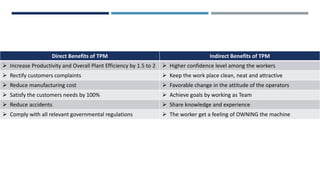
Direct Benefits of TPM Indirect Benefits of TPM
 Increase Productivity and Overall Plant Efficiency by 1.5 to 2  Higher confidence level among the workers
 Rectify customers complaints  Keep the work place clean, neat and attractive
 Reduce manufacturing cost  Favorable change in the attitude of the operators
 Satisfy the customers needs by 100%  Achieve goals by working as Team
 Reduce accidents  Share knowledge and experience
 Comply with all relevant governmental regulations  The worker get a feeling of OWNING the machine
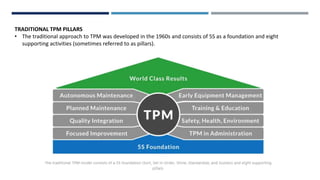
TRADITIONAL TPM PILLARS
• The traditional approach to TPM was developed in the 1960s and consists of 5S as a foundation and eight
supporting activities (sometimes referred to as pillars).
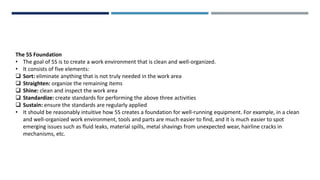
The 5S Foundation
• The goal of 5S is to create a work environment that is clean and well-organized.
• It consists of five elements:
 Sort: eliminate anything that is not truly needed in the work area
 Straighten: organize the remaining items
 Shine: clean and inspect the work area
 Standardize: create standards for performing the above three activities
 Sustain: ensure the standards are regularly applied
• It should be reasonably intuitive how 5S creates a foundation for well-running equipment. For example, in a clean
and well-organized work environment, tools and parts are much easier to find, and it is much easier to spot
emerging issues such as fluid leaks, material spills, metal shavings from unexpected wear, hairline cracks in
mechanisms, etc.
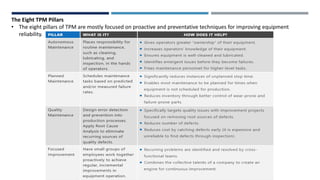
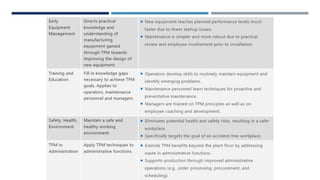
The Eight TPM Pillars
• The eight pillars of TPM are mostly focused on proactive and preventative techniques for improving equipment
reliability.
OEE AND THE SIX BIG LOSSES
Introduction to OEE
• OEE (Overall Equipment Effectiveness) is a metric that identifies the percentage of planned production time that is
truly productive. It was developed to support TPM initiatives by accurately tracking progress towards achieving
“perfect production”.
 An OEE score of 100% is perfect production.
 An OEE score of 85% is world class for discrete manufacturers.
 An OEE score of 60% is fairly typical for discrete manufacturers.
 An OEE score of 40% is not uncommon for manufacturers without TPM and/or lean programs.
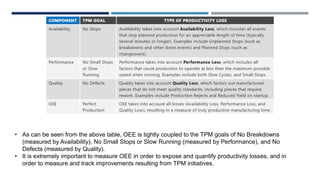
• OEE consists of three underlying components, each of which maps to one of the TPM goals set out at the beginning of
this topic, and each of which takes into account a different type of productivity loss.
• As can be seen from the above table, OEE is tightly coupled to the TPM goals of No Breakdowns
(measured by Availability), No Small Stops or Slow Running (measured by Performance), and No
Defects (measured by Quality).
• It is extremely important to measure OEE in order to expose and quantify productivity losses, and in
order to measure and track improvements resulting from TPM initiatives.
WHAT IS TEROTECHNOLOGY?
• Terotechnology (/ˌtɪəroʊtɛkˈnɒlədʒi ˌtɛr-/; from Greek τηρεῖν tērein "to care for" and technology) is the technology
of installation, including the efficient use and management of equipment.
• It also involves the use of technology to carry out maintenance functions in a bid to reduce cost and increase
productivity.
Definition
• The term goes back to the 1970s. Terotechnology is a system for the care of equipment. It includes the
management, engineering, and financial expertise working together to improve the installation and operations.
In practice
• It involves the reliability and maintainability of physical equipment regarding installation, operation, maintenance,
or replacement. Decisions are influenced by feedback throughout the life cycle of a project.
THANK YOU

19BT02004.pptx

  • 1.
    INTRODUCTION TO TOTALPRODUCTIVE MAINTENANCE AND TEROTECHNOLOGY NAME :- GOHEL DEVEN MUKESHBHAI ENROLLMENT NUMBER :- 19BT02004 SUBJECT :- TOTAL QUALITY MANAGEMENT GUIDED BY :- DR. GHANSHYAM TEJANI
  • 2.
    WHAT IS TPM? •TPM (Total Productive Maintenance) is a holistic approach to equipment maintenance that strives to achieve perfect production:  No Breakdowns  No Small Stops or Slow Running  No Defects In addition it values a safe working environment:  No Accidents • TPM emphasizes proactive and preventative maintenance to maximize the operational efficiency of equipment. • It blurs the distinction between the roles of production and maintenance by placing a strong emphasis on empowering operators to help maintain their equipment. • The implementation of a TPM program creates a shared responsibility for equipment that encourages greater involvement by plant floor workers. In the right environment this can be very effective in improving productivity (increasing up time, reducing cycle times, and eliminating defects).
  • 3.
    Goals ( Whywe need TPM? ) 1. Increase production while, at the same time, increasing employee morale and job satisfaction. 2. Hold emergency & unscheduled maintenance to a minimum. 3. Maintenance is no – longer regarded as a Non – Profit activity. 4. Avoid wastage in quickly changing environment. 5. Reduce Cost of Manufacturing. 6. Produce a low batch quantity at the earliest possible time. 7. Goods send to Customers must be “ non – defective”.
  • 4.
    Direct Benefits ofTPM Indirect Benefits of TPM  Increase Productivity and Overall Plant Efficiency by 1.5 to 2  Higher confidence level among the workers  Rectify customers complaints  Keep the work place clean, neat and attractive  Reduce manufacturing cost  Favorable change in the attitude of the operators  Satisfy the customers needs by 100%  Achieve goals by working as Team  Reduce accidents  Share knowledge and experience  Comply with all relevant governmental regulations  The worker get a feeling of OWNING the machine
  • 5.
    TRADITIONAL TPM PILLARS •The traditional approach to TPM was developed in the 1960s and consists of 5S as a foundation and eight supporting activities (sometimes referred to as pillars).
  • 6.
    The 5S Foundation •The goal of 5S is to create a work environment that is clean and well-organized. • It consists of five elements:  Sort: eliminate anything that is not truly needed in the work area  Straighten: organize the remaining items  Shine: clean and inspect the work area  Standardize: create standards for performing the above three activities  Sustain: ensure the standards are regularly applied • It should be reasonably intuitive how 5S creates a foundation for well-running equipment. For example, in a clean and well-organized work environment, tools and parts are much easier to find, and it is much easier to spot emerging issues such as fluid leaks, material spills, metal shavings from unexpected wear, hairline cracks in mechanisms, etc.
  • 7.
    The Eight TPMPillars • The eight pillars of TPM are mostly focused on proactive and preventative techniques for improving equipment reliability.
  • 9.
    OEE AND THESIX BIG LOSSES Introduction to OEE • OEE (Overall Equipment Effectiveness) is a metric that identifies the percentage of planned production time that is truly productive. It was developed to support TPM initiatives by accurately tracking progress towards achieving “perfect production”.  An OEE score of 100% is perfect production.  An OEE score of 85% is world class for discrete manufacturers.  An OEE score of 60% is fairly typical for discrete manufacturers.  An OEE score of 40% is not uncommon for manufacturers without TPM and/or lean programs. • OEE consists of three underlying components, each of which maps to one of the TPM goals set out at the beginning of this topic, and each of which takes into account a different type of productivity loss.
  • 10.
    • As canbe seen from the above table, OEE is tightly coupled to the TPM goals of No Breakdowns (measured by Availability), No Small Stops or Slow Running (measured by Performance), and No Defects (measured by Quality). • It is extremely important to measure OEE in order to expose and quantify productivity losses, and in order to measure and track improvements resulting from TPM initiatives.
  • 11.
    WHAT IS TEROTECHNOLOGY? •Terotechnology (/ˌtɪəroʊtɛkˈnɒlədʒi ˌtɛr-/; from Greek τηρεῖν tērein "to care for" and technology) is the technology of installation, including the efficient use and management of equipment. • It also involves the use of technology to carry out maintenance functions in a bid to reduce cost and increase productivity. Definition • The term goes back to the 1970s. Terotechnology is a system for the care of equipment. It includes the management, engineering, and financial expertise working together to improve the installation and operations. In practice • It involves the reliability and maintainability of physical equipment regarding installation, operation, maintenance, or replacement. Decisions are influenced by feedback throughout the life cycle of a project.
  • 12.