DATA ENCRYPTION STANDARD(DES)
Md Fazle Rabbi
ID:16CSE057
CONTENTS
 What is DES?
 DES Features
 DES Rounds
 Key length in DES
 Festal Rounds
 DES “f(•)” Function
 S-boxes
 DES weak keys
 DES Analysis
1
WHAT IS DES?
 The Data Encryption Standard is a block cipher,
meaning a cryptographic key and algorithm are
applied to a block of data simultaneously rather
than one bit at a time.
 DES uses a 64-bit key, but eight of those bits are
used for parity checks, effectively limiting the key to
56-bits.
DES FEATURES
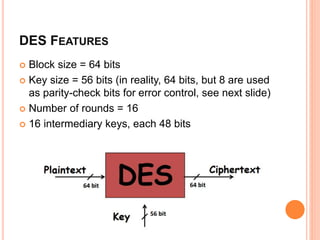
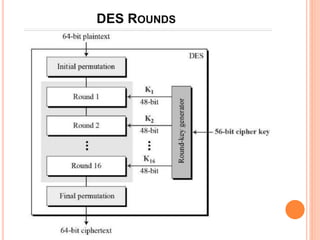
 Block size = 64 bits
 Key size = 56 bits (in reality, 64 bits, but 8 are used
as parity-check bits for error control, see next slide)
 Number of rounds = 16
 16 intermediary keys, each 48 bits
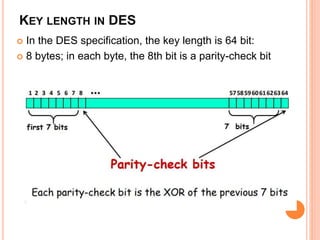
KEY LENGTH IN DES
 In the DES specification, the key length is 64 bit:
 8 bytes; in each byte, the 8th bit is a parity-check bit
DES ROUNDS
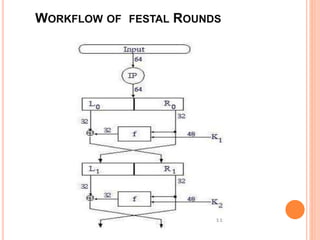
WORKFLOW OF FESTAL ROUNDS
DES “f(•)” Function
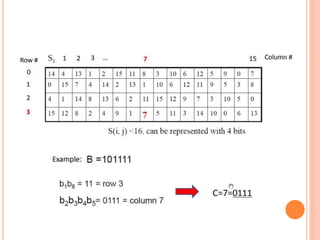
S-BOXES
• S = matrix 4x16, values from 0 to 15
• B (6 bit long) = b1b2b3b4b5b6
– b1b6 r = row of the matrix (2 bits: 0,1,2,3)
– b2b3b4b5 c = column of the matrix(4bits:0,1,…15)
• C (4 bit long) = Binary representation of S(r, c)
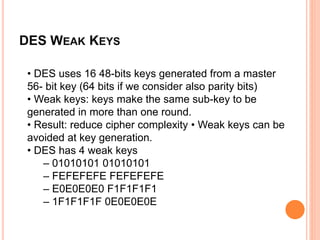
DES WEAK KEYS
• DES uses 16 48-bits keys generated from a master
56- bit key (64 bits if we consider also parity bits)
• Weak keys: keys make the same sub-key to be
generated in more than one round.
• Result: reduce cipher complexity • Weak keys can be
avoided at key generation.
• DES has 4 weak keys
– 01010101 01010101
– FEFEFEFE FEFEFEFE
– E0E0E0E0 F1F1F1F1
– 1F1F1F1F 0E0E0E0E
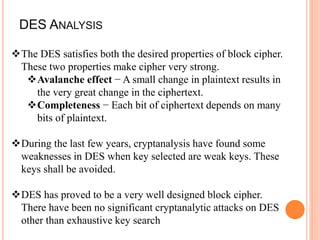
DES ANALYSIS
The DES satisfies both the desired properties of block cipher.
These two properties make cipher very strong.
Avalanche effect − A small change in plaintext results in
the very great change in the ciphertext.
Completeness − Each bit of ciphertext depends on many
bits of plaintext.
During the last few years, cryptanalysis have found some
weaknesses in DES when key selected are weak keys. These
keys shall be avoided.
DES has proved to be a very well designed block cipher.
There have been no significant cryptanalytic attacks on DES
other than exhaustive key search
THE END

Topic4 data encryption standard(des)

  • 1.
    DATA ENCRYPTION STANDARD(DES) MdFazle Rabbi ID:16CSE057
  • 2.
    CONTENTS  What isDES?  DES Features  DES Rounds  Key length in DES  Festal Rounds  DES “f(•)” Function  S-boxes  DES weak keys  DES Analysis 1
  • 3.
    WHAT IS DES? The Data Encryption Standard is a block cipher, meaning a cryptographic key and algorithm are applied to a block of data simultaneously rather than one bit at a time.  DES uses a 64-bit key, but eight of those bits are used for parity checks, effectively limiting the key to 56-bits.
  • 4.
    DES FEATURES  Blocksize = 64 bits  Key size = 56 bits (in reality, 64 bits, but 8 are used as parity-check bits for error control, see next slide)  Number of rounds = 16  16 intermediary keys, each 48 bits
  • 5.
    KEY LENGTH INDES  In the DES specification, the key length is 64 bit:  8 bytes; in each byte, the 8th bit is a parity-check bit
  • 6.
  • 7.
  • 8.
  • 9.
    S-BOXES • S =matrix 4x16, values from 0 to 15 • B (6 bit long) = b1b2b3b4b5b6 – b1b6 r = row of the matrix (2 bits: 0,1,2,3) – b2b3b4b5 c = column of the matrix(4bits:0,1,…15) • C (4 bit long) = Binary representation of S(r, c)
  • 11.
    DES WEAK KEYS •DES uses 16 48-bits keys generated from a master 56- bit key (64 bits if we consider also parity bits) • Weak keys: keys make the same sub-key to be generated in more than one round. • Result: reduce cipher complexity • Weak keys can be avoided at key generation. • DES has 4 weak keys – 01010101 01010101 – FEFEFEFE FEFEFEFE – E0E0E0E0 F1F1F1F1 – 1F1F1F1F 0E0E0E0E
  • 12.
    DES ANALYSIS The DESsatisfies both the desired properties of block cipher. These two properties make cipher very strong. Avalanche effect − A small change in plaintext results in the very great change in the ciphertext. Completeness − Each bit of ciphertext depends on many bits of plaintext. During the last few years, cryptanalysis have found some weaknesses in DES when key selected are weak keys. These keys shall be avoided. DES has proved to be a very well designed block cipher. There have been no significant cryptanalytic attacks on DES other than exhaustive key search
  • 13.