1
Data Encryption Standard (DES)
Aniket Uttam
CS 4th
year
Roll No:-1450510004
Allenhouse Institute of Technology
2
Outline

History

Encryption

Initial Permutation

DES Round Structure

DES Key Schedule

DES Decryption

Strength of DES
3
Data Encryption Standard (DES)
• Most widely used block cipher in world.
• Adopted in 1977 by NBS (now NIST)
– as FIPS PUB 46.
• Encrypts 64-bit data using 56-bit key.
• Has widespread use.
• Has been considerable controversy over
its security.
4
DES History
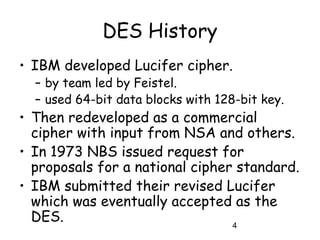
• IBM developed Lucifer cipher.
– by team led by Feistel.
– used 64-bit data blocks with 128-bit key.
• Then redeveloped as a commercial
cipher with input from NSA and others.
• In 1973 NBS issued request for
proposals for a national cipher standard.
• IBM submitted their revised Lucifer
which was eventually accepted as the
DES.
5
DES Design Controversy
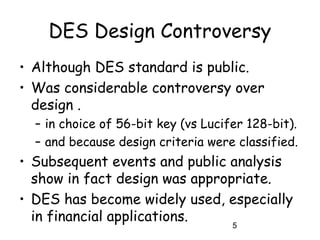
• Although DES standard is public.
• Was considerable controversy over
design .
– in choice of 56-bit key (vs Lucifer 128-bit).
– and because design criteria were classified.
• Subsequent events and public analysis
show in fact design was appropriate.
• DES has become widely used, especially
in financial applications.
6
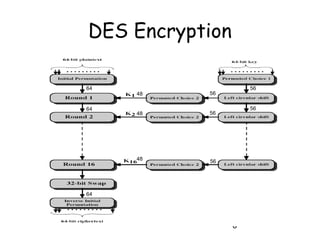
DES Encryption
64
48
56
56
56
5648
64
48 56
64
7
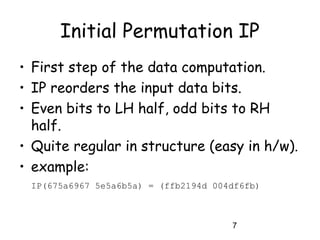
Initial Permutation IP
• First step of the data computation.
• IP reorders the input data bits.
• Even bits to LH half, odd bits to RH
half.
• Quite regular in structure (easy in h/w).
• example:
IP(675a6967 5e5a6b5a) = (ffb2194d 004df6fb)
8
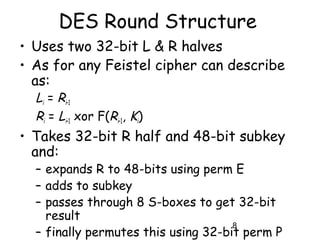
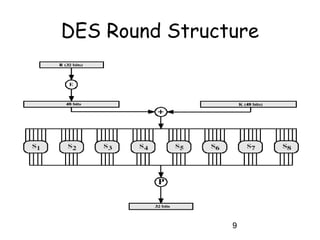
DES Round Structure
• Uses two 32-bit L & R halves
• As for any Feistel cipher can describe
as:
Li = Ri–1
Ri = Li–1 xor F(Ri–1, Ki)
• Takes 32-bit R half and 48-bit subkey
and:
– expands R to 48-bits using perm E
– adds to subkey
– passes through 8 S-boxes to get 32-bit
result
– finally permutes this using 32-bit perm P
9
DES Round Structure
10
Substitution Boxes S
• Have eight S-boxes which map 6 to 4
bits.
• Each S-box is actually 4 little 4 bit
boxes.
– outer bits 1 & 6 (row bits) select one rows.
– inner bits 2-5 (col bits) are substituted.
– result is 8 lots of 4 bits, or 32 bits.
• Row selection depends on both data &
key.
– feature known as autoclaving (autokeying).
• Example:
S(18 09 12 3d 11 17 38 39) = 5fd25e03
11
DES Key Schedule
• Forms subkeys used in each round.
• Consists of:
– Initial permutation of the key (PC1) which
selects 56-bits in two 28-bit halves.
– 16 stages consisting of:
• Selecting 24-bits from each half.
• Permuting them by PC2 for use in function f.
• Rotating each half separately either 1 or 2
places depending on the key rotation schedule
K.
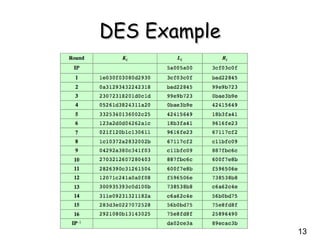
DES ExampleDES Example
13
13
DES Decryption
• Decrypt must unwind steps of data
computation .
• With Feistel design, do encryption steps
again.
• Using subkeys in reverse order (SK16 … SK1).
• Note that IP undoes final FP step of
encryption.
• 1st round with SK16 undoes 16th encrypt
round.
• 16th round with SK1 undoes 1st encrypt
round.
• Then final FP undoes initial encryption IP.
• Thus recovering original data value.
14
Avalanche Effect
• Key desirable property of encryption
algorithm.
• Where a change of one input or key bit
results in changing approx half output
bits.
• Making attempts to “home-in” by
guessing keys impossible.
• DES exhibits strong avalanche.
15
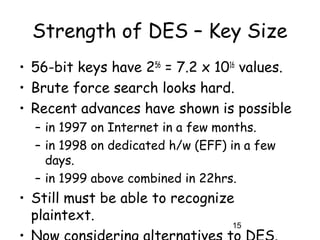
Strength of DES – Key Size
• 56-bit keys have 256
= 7.2 x 10¹⁶
values.
• Brute force search looks hard.
• Recent advances have shown is possible
– in 1997 on Internet in a few months.
– in 1998 on dedicated h/w (EFF) in a few
days.
– in 1999 above combined in 22hrs.
• Still must be able to recognize
plaintext.
16
Strength of DES – Timing
Attacks
• Attacks actual implementation of
cipher.
• Use knowledge of consequences of
implementation to derive knowledge of
some/all subkey bits.
• Specifically use fact that calculations
can take varying times depending on the
value of the inputs to it.
• Particularly problematic on smartcards.
17
Thanks You
Any Query?

Des lecture

  • 1.
    1 Data Encryption Standard(DES) Aniket Uttam CS 4th year Roll No:-1450510004 Allenhouse Institute of Technology
  • 2.
    2 Outline  History  Encryption  Initial Permutation  DES RoundStructure  DES Key Schedule  DES Decryption  Strength of DES
  • 3.
    3 Data Encryption Standard(DES) • Most widely used block cipher in world. • Adopted in 1977 by NBS (now NIST) – as FIPS PUB 46. • Encrypts 64-bit data using 56-bit key. • Has widespread use. • Has been considerable controversy over its security.
  • 4.
    4 DES History • IBMdeveloped Lucifer cipher. – by team led by Feistel. – used 64-bit data blocks with 128-bit key. • Then redeveloped as a commercial cipher with input from NSA and others. • In 1973 NBS issued request for proposals for a national cipher standard. • IBM submitted their revised Lucifer which was eventually accepted as the DES.
  • 5.
    5 DES Design Controversy •Although DES standard is public. • Was considerable controversy over design . – in choice of 56-bit key (vs Lucifer 128-bit). – and because design criteria were classified. • Subsequent events and public analysis show in fact design was appropriate. • DES has become widely used, especially in financial applications.
  • 6.
  • 7.
    7 Initial Permutation IP •First step of the data computation. • IP reorders the input data bits. • Even bits to LH half, odd bits to RH half. • Quite regular in structure (easy in h/w). • example: IP(675a6967 5e5a6b5a) = (ffb2194d 004df6fb)
  • 8.
    8 DES Round Structure •Uses two 32-bit L & R halves • As for any Feistel cipher can describe as: Li = Ri–1 Ri = Li–1 xor F(Ri–1, Ki) • Takes 32-bit R half and 48-bit subkey and: – expands R to 48-bits using perm E – adds to subkey – passes through 8 S-boxes to get 32-bit result – finally permutes this using 32-bit perm P
  • 9.
  • 10.
    10 Substitution Boxes S •Have eight S-boxes which map 6 to 4 bits. • Each S-box is actually 4 little 4 bit boxes. – outer bits 1 & 6 (row bits) select one rows. – inner bits 2-5 (col bits) are substituted. – result is 8 lots of 4 bits, or 32 bits. • Row selection depends on both data & key. – feature known as autoclaving (autokeying). • Example: S(18 09 12 3d 11 17 38 39) = 5fd25e03
  • 11.
    11 DES Key Schedule •Forms subkeys used in each round. • Consists of: – Initial permutation of the key (PC1) which selects 56-bits in two 28-bit halves. – 16 stages consisting of: • Selecting 24-bits from each half. • Permuting them by PC2 for use in function f. • Rotating each half separately either 1 or 2 places depending on the key rotation schedule K.
  • 12.
  • 13.
    13 DES Decryption • Decryptmust unwind steps of data computation . • With Feistel design, do encryption steps again. • Using subkeys in reverse order (SK16 … SK1). • Note that IP undoes final FP step of encryption. • 1st round with SK16 undoes 16th encrypt round. • 16th round with SK1 undoes 1st encrypt round. • Then final FP undoes initial encryption IP. • Thus recovering original data value.
  • 14.
    14 Avalanche Effect • Keydesirable property of encryption algorithm. • Where a change of one input or key bit results in changing approx half output bits. • Making attempts to “home-in” by guessing keys impossible. • DES exhibits strong avalanche.
  • 15.
    15 Strength of DES– Key Size • 56-bit keys have 256 = 7.2 x 10¹⁶ values. • Brute force search looks hard. • Recent advances have shown is possible – in 1997 on Internet in a few months. – in 1998 on dedicated h/w (EFF) in a few days. – in 1999 above combined in 22hrs. • Still must be able to recognize plaintext.
  • 16.
    16 Strength of DES– Timing Attacks • Attacks actual implementation of cipher. • Use knowledge of consequences of implementation to derive knowledge of some/all subkey bits. • Specifically use fact that calculations can take varying times depending on the value of the inputs to it. • Particularly problematic on smartcards.
  • 17.