Key Management and Distribution
Presented by
Syed Bahadur Shah
1
PRESENTATION CONTENTS
1. Key Management
2. Key Generation
3. Type of Keys
4. Key Distribution
5. Types of Key Distribution
6. Public Key Infrastructure
7. Question & Answer Section
2
What is Key Management?
3
What is Key Management?
Key management is the set of techniques and procedures
supporting the establishment and maintenance of keying
relationships between authorized parties.
4
What is Key Generation/Establishment?
5
What is Key Generation/Establishment?
Key generation is the process of generating keys for
cryptography. The key is used to encrypt and decrypt
data whatever the data is being encrypted or
decrypted.
6
Types of Keys in Cryptography
7
Types of Keys in Cryptography
1. Symmetric Key
2. Asymmetric Key
8
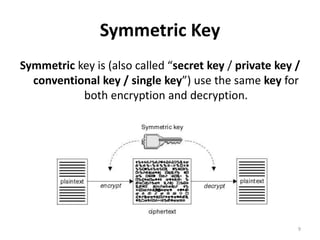
Symmetric Key
Symmetric key is (also called “secret key / private key /
conventional key / single key”) use the same key for
both encryption and decryption.
9
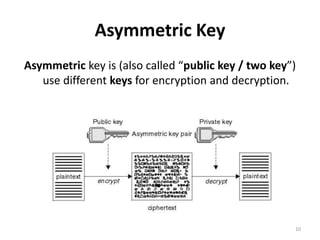
Asymmetric Key
Asymmetric key is (also called “public key / two key”)
use different keys for encryption and decryption.
10
Symmetric Key Encryption & Decryption
11
Symmetric Key Encryption & Decryption
An algorithm in which the sender and receiver of a
message share a single, common key that is used
to encrypt and decrypt the message.
12
Asymmetric Key Encryption & Decryption
13
Asymmetric Key Encryption & Decryption
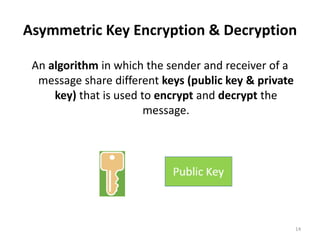
An algorithm in which the sender and receiver of a
message share different keys (public key & private
key) that is used to encrypt and decrypt the
message.
14
What is Key Distribution?
15
What is Key Distribution?
Key distribution in cryptography is a system that is responsible
for providing keys to the users in a network that shares sensitive
or private data.
16
Types of Key Distribution
17
Types of Key Distribution
 Public Key Distribution
1. Public Announcement
2. Publically Available Directory
3. Public Key Authority
4. Public Key Certificate
 Private Key Distribution
1. Simple Secret Key
2. Secret Key with Confidentiality & Authentication
18
Public Key Distribution
19
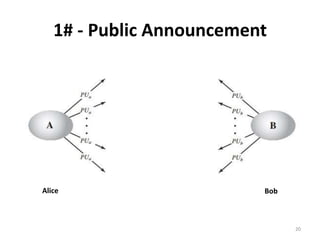
1# - Public Announcement
20
Alice Bob
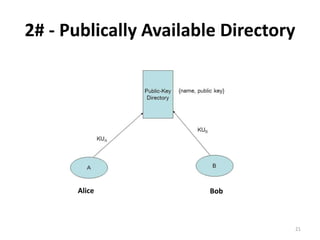
2# - Publically Available Directory
21
Alice Bob
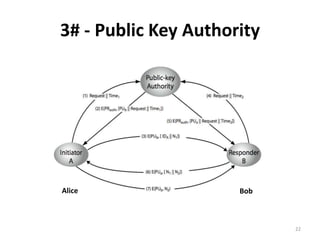
3# - Public Key Authority
22
Alice Bob
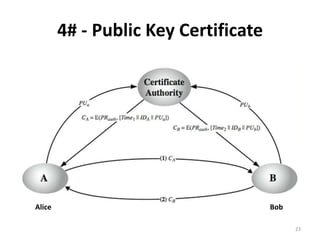
4# - Public Key Certificate
23
Alice Bob
Alice Bob
Private Key Distribution
24
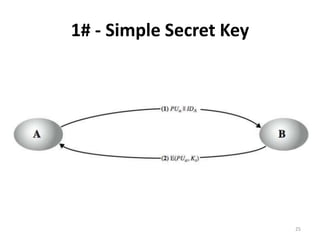
1# - Simple Secret Key
25
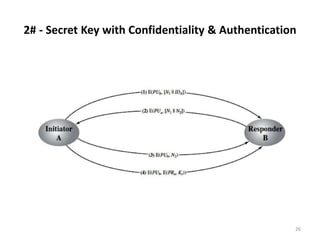
2# - Secret Key with Confidentiality & Authentication
26
What is Public Key Infrastructure?
27
What is Public Key Infrastructure?
28
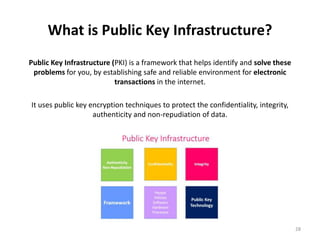
Public Key Infrastructure (PKI) is a framework that helps identify and solve these
problems for you, by establishing safe and reliable environment for electronic
transactions in the internet.
It uses public key encryption techniques to protect the confidentiality, integrity,
authenticity and non-repudiation of data.
How Public Key Infrastructure Works?
29
How Public Key Infrastructure Works?
30
AliceBob
How Public Key Infrastructure Works? (Cont:)
31
Question & Answer Section
32

Key Management and Distribution

  • 1.
    Key Management andDistribution Presented by Syed Bahadur Shah 1
  • 2.
    PRESENTATION CONTENTS 1. KeyManagement 2. Key Generation 3. Type of Keys 4. Key Distribution 5. Types of Key Distribution 6. Public Key Infrastructure 7. Question & Answer Section 2
  • 3.
    What is KeyManagement? 3
  • 4.
    What is KeyManagement? Key management is the set of techniques and procedures supporting the establishment and maintenance of keying relationships between authorized parties. 4
  • 5.
    What is KeyGeneration/Establishment? 5
  • 6.
    What is KeyGeneration/Establishment? Key generation is the process of generating keys for cryptography. The key is used to encrypt and decrypt data whatever the data is being encrypted or decrypted. 6
  • 7.
    Types of Keysin Cryptography 7
  • 8.
    Types of Keysin Cryptography 1. Symmetric Key 2. Asymmetric Key 8
  • 9.
    Symmetric Key Symmetric keyis (also called “secret key / private key / conventional key / single key”) use the same key for both encryption and decryption. 9
  • 10.
    Asymmetric Key Asymmetric keyis (also called “public key / two key”) use different keys for encryption and decryption. 10
  • 11.
    Symmetric Key Encryption& Decryption 11
  • 12.
    Symmetric Key Encryption& Decryption An algorithm in which the sender and receiver of a message share a single, common key that is used to encrypt and decrypt the message. 12
  • 13.
  • 14.
    Asymmetric Key Encryption& Decryption An algorithm in which the sender and receiver of a message share different keys (public key & private key) that is used to encrypt and decrypt the message. 14
  • 15.
    What is KeyDistribution? 15
  • 16.
    What is KeyDistribution? Key distribution in cryptography is a system that is responsible for providing keys to the users in a network that shares sensitive or private data. 16
  • 17.
    Types of KeyDistribution 17
  • 18.
    Types of KeyDistribution  Public Key Distribution 1. Public Announcement 2. Publically Available Directory 3. Public Key Authority 4. Public Key Certificate  Private Key Distribution 1. Simple Secret Key 2. Secret Key with Confidentiality & Authentication 18
  • 19.
  • 20.
    1# - PublicAnnouncement 20 Alice Bob
  • 21.
    2# - PublicallyAvailable Directory 21 Alice Bob
  • 22.
    3# - PublicKey Authority 22 Alice Bob
  • 23.
    4# - PublicKey Certificate 23 Alice Bob Alice Bob
  • 24.
  • 25.
    1# - SimpleSecret Key 25
  • 26.
    2# - SecretKey with Confidentiality & Authentication 26
  • 27.
    What is PublicKey Infrastructure? 27
  • 28.
    What is PublicKey Infrastructure? 28 Public Key Infrastructure (PKI) is a framework that helps identify and solve these problems for you, by establishing safe and reliable environment for electronic transactions in the internet. It uses public key encryption techniques to protect the confidentiality, integrity, authenticity and non-repudiation of data.
  • 29.
    How Public KeyInfrastructure Works? 29
  • 30.
    How Public KeyInfrastructure Works? 30 AliceBob
  • 31.
    How Public KeyInfrastructure Works? (Cont:) 31
  • 32.