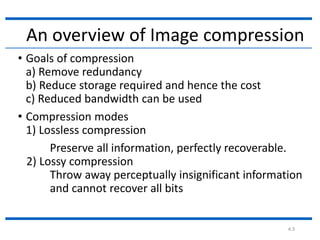
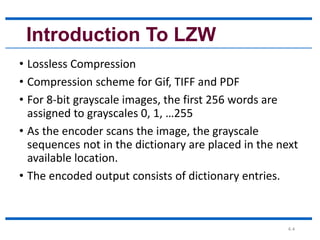
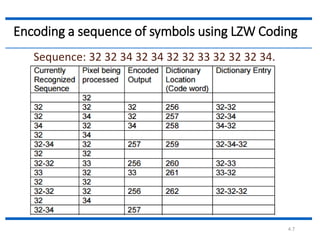
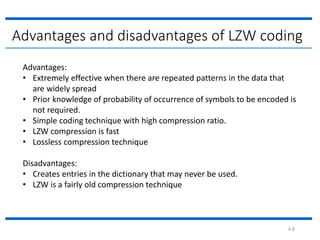
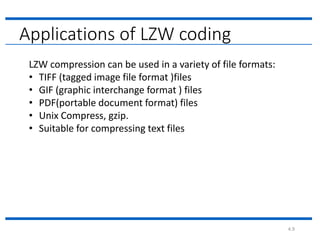
This document provides an overview of LZW coding technique for image compression. It discusses that LZW coding is a lossless compression scheme used for formats like GIF, TIFF, and PDF. It works by assigning the first 256 values (0-255) in an 8-bit grayscale image to a dictionary, and then adding new sequences encountered in the image to the dictionary. As the image is scanned, the encoded output consists of dictionary entries. The document provides an example and illustrates the encoding process. It notes advantages like high compression ratios without needing probability knowledge, and disadvantages like potential unused dictionary entries. It concludes that LZW can be used to compress files like TIFF, GIF, PDF, and text files.