Data Encryption Standard (DES)
• The Data Encryption Standard (DES) is a
symmetric-key block cipher published by the
National Institute of Standards and Technology
(NIST).
• DES is an implementation of a Feistel Cipher. It
uses 16 round Feistel structure.
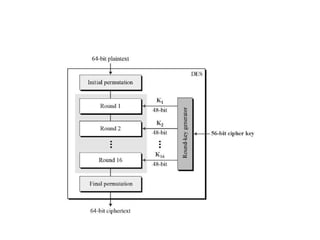
• The block size is 64-bit. Though, key length is
64-bit, DES has an effective key length of 56
bits, since 8 of the 64 bits of the key are not
used by the encryption algorithm (function as
check bits only).
• General Structure of DES is depicted in the
following illustration −
Since DES is based on the Feistel Cipher, all that
is required to specify DES is −
• Round function
• Key schedule
• Any additional processing − Initial and final
permutation
Initial and Final Permutation
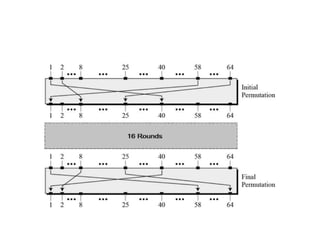
• The initial and final permutations are straight
Permutation boxes (P-boxes) that are inverses
of each other.
• They have no cryptography significance in DES.
• The initial and final permutations are shown
as follows −
Round Function
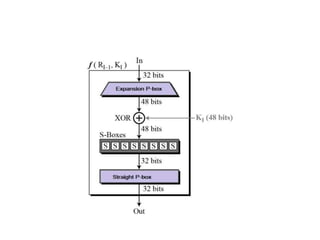
• The heart of this cipher is the DES function, f.
• The DES function applies a 48-bit key to the
rightmost 32 bits to produce a 32-bit output.
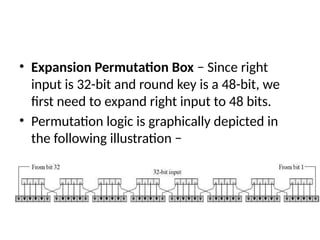
• Expansion Permutation Box − Since right
input is 32-bit and round key is a 48-bit, we
first need to expand right input to 48 bits.
• Permutation logic is graphically depicted in
the following illustration −
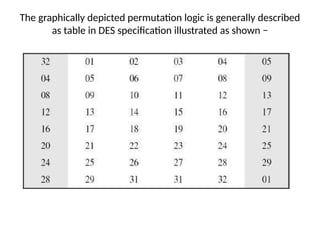
The graphically depicted permutation logic is generally described
as table in DES specification illustrated as shown −
• XOR (Whitener). − After the expansion
permutation, DES does XOR operation on the
expanded right section and the round key. The
round key is used only in this operation.
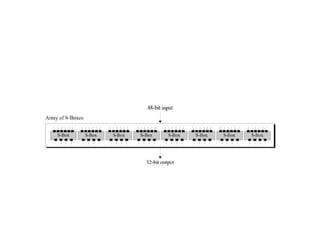
• Substitution Boxes. − The S-boxes carry out
the real mixing (confusion). DES uses 8 S-
boxes, each with a 6-bit input and a 4-bit
output. Refer the following illustration −
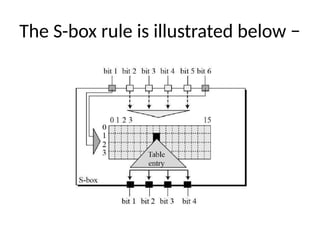
The S-box rule is illustrated below −
• There are a total of eight S-box tables. The
output of all eight s-boxes is then combined in
to 32 bit section.
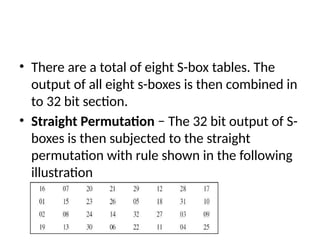
• Straight Permutation − The 32 bit output of S-
boxes is then subjected to the straight
permutation with rule shown in the following
illustration
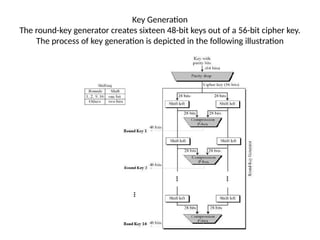
Key Generation
The round-key generator creates sixteen 48-bit keys out of a 56-bit cipher key.
The process of key generation is depicted in the following illustration
DES Analysis
The DES satisfies both the desired properties of
block cipher. These two properties make
cipher very strong.
• Avalanche effect − A small change in plaintext
results in the very great change in the
ciphertext.
• Completeness − Each bit of ciphertext
depends on many bits of plaintext.
• During the last few years, cryptanalysis have
found some weaknesses in DES when key
selected are weak keys. These keys shall be
avoided.
• DES has proved to be a very well designed
block cipher. There have been no significant
cryptanalytic attacks on DES other than
exhaustive key search.
Triple DES
• The speed of exhaustive key searches against
DES after 1990 began to cause discomfort
amongst users of DES.
• However, users did not want to replace DES as
it takes an enormous amount of time and
money to change encryption algorithms that
are widely adopted and embedded in large
security architectures.
• The pragmatic approach was not to abandon
the DES completely, but to change the manner
in which DES is used. This led to the modified
schemes of Triple DES (sometimes known as
3DES).
• Incidentally, there are two variants of Triple
DES known as 3-key Triple DES (3TDES) and 2-
key Triple DES (2TDES).
3-KEY Triple DES
• Before using 3TDES, user first generate and
distribute a 3TDES key K, which consists of
three different DES keys K1, K2 and K3.
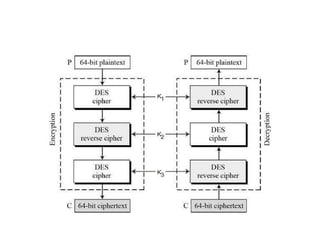
• This means that the actual 3TDES key has
length 3×56 = 168 bits. The encryption scheme
is illustrated as follows −
The encryption-decryption process is as follows −
• Encrypt the plaintext blocks using single DES with key K1.
• Now decrypt the output of step 1 using single DES with
key K2.
• Finally, encrypt the output of step 2 using single DES
with key K3.
• The output of step 3 is the ciphertext.
• Decryption of a ciphertext is a reverse process. User first
decrypt using K3, then encrypt with K2, and finally decrypt
with K1.
• Due to this design of Triple DES as an encrypt–
decrypt–encrypt process, it is possible to use a
3TDES (hardware) implementation for single
DES by setting K1, K2, and K3 to be the same
value. This provides backwards compatibility
with DES.
• Second variant of Triple DES (2TDES) is identical to
3TDES except that K3is replaced by K1.
• In other words, user encrypt plaintext blocks with
key K1, then decrypt with key K2, and finally encrypt
with K1 again.
• Therefore, 2TDES has a key length of 112 bits.
• Triple DES systems are significantly more secure
than single DES, but these are clearly a much slower
process than encryption using single DES.
Advanced Encryption Standard
• The more popular and widely adopted symmetric
encryption algorithm likely to be encountered
nowadays is the Advanced Encryption Standard (AES).
• It is found at least six time faster than triple DES.
• A replacement for DES was needed as its key size was
too small.
• With increasing computing power, it was considered
vulnerable against exhaustive key search attack.
• Triple DES was designed to overcome this drawback but
it was found slow.
Criteria
• Security
The main emphasis was on security. Because NIST explicitly
demanded a 128- bit Key. , this criterion focused on
resistance to cryptanalysis attacks other than brute-force
attack.
• Cost
The second criterion was cost, which covers the
computational efficiency and storage requirement for
different implementation such as hardware, software or
smart cards.
• Implementation
This criterion included the requirement that the
algorithm must have flexibility and simplicity.
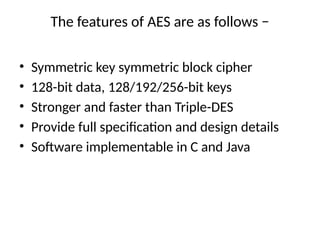
The features of AES are as follows −
• Symmetric key symmetric block cipher
• 128-bit data, 128/192/256-bit keys
• Stronger and faster than Triple-DES
• Provide full specification and design details
• Software implementable in C and Java
Operation of AES
• AES is an iterative rather than Feistel cipher. It
is based on ‘substitution–permutation
network’.
• It comprises of a series of linked operations,
some of which involve replacing inputs by
specific outputs (substitutions) and others
involve shuffling bits around (permutations).
• Interestingly, AES performs all its
computations on bytes rather than bits.
Hence, AES treats the 128 bits of a plaintext
block as 16 bytes.
• These 16 bytes are arranged in four columns
and four rows for processing as a matrix −
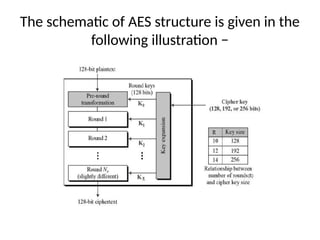
• Unlike DES, the number of rounds in AES is
variable and depends on the length of the key.
• AES uses 10 rounds for 128-bit keys, 12
rounds for 192-bit keys and 14 rounds for 256-
bit keys.
• Each of these rounds uses a different 128-bit
round key, which is calculated from the
original AES key.
The schematic of AES structure is given in the
following illustration −
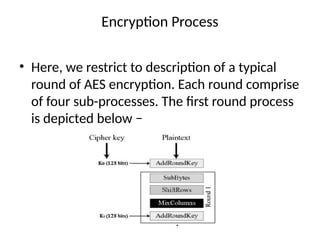
Encryption Process
• Here, we restrict to description of a typical
round of AES encryption. Each round comprise
of four sub-processes. The first round process
is depicted below −
Byte Substitution (SubBytes)
• The 16 input bytes are substituted by looking
up a fixed table (S-box) given in design. The
result is in a matrix of four rows and four
columns.
Shift rows
• Each of the four rows of the matrix is shifted to
the left. Any entries that ‘fall off’ are re-
inserted on the right side of row. Shift is
carried out as follows −
• First row is not shifted.
• Second row is shifted one (byte) position to
the left.
• Third row is shifted two positions to the left.
• Fourth row is shifted three positions to the
left.
• The result is a new matrix consisting of the
same 16 bytes but shifted with respect to each
other.
MixColumns
• Each column of four bytes is now transformed
using a special mathematical function.
• This function takes as input the four bytes of one
column and outputs four completely new bytes,
which replace the original column.
• The result is another new matrix consisting of 16
new bytes. It should be noted that this step is
not performed in the last round.
Addroundkey
• The 16 bytes of the matrix are now considered as
128 bits and are XORed to the 128 bits of the
round key.
• If this is the last round then the output is the
ciphertext.
• Otherwise, the resulting 128 bits are interpreted
as 16 bytes and we begin another similar round.
Decryption Process
The process of decryption of an AES ciphertext is
similar to the encryption process in the
reverse order. Each round consists of the four
processes conducted in the reverse order −
• Add round key
• Mix columns
• Shift rows
• Byte substitution
• Since sub-processes in each round are in
reverse manner, unlike for a Feistel Cipher, the
encryption and decryption algorithms needs
to be separately implemented, although they
are very closely related.
AES Analysis
• In present day cryptography, AES is widely adopted and
supported in both hardware and software.
• Till date, no practical cryptanalytic attacks against AES has
been discovered.
• Additionally, AES has built-in flexibility of key length,
which allows a degree of ‘future-proofing’ against
progress in the ability to perform exhaustive key searches.
• However, just as for DES, the AES security is assured only if
it is correctly implemented and good key management is
employed.
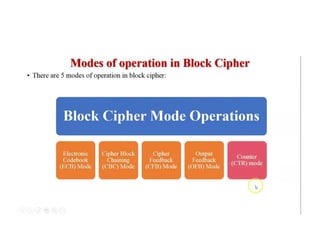
Block Cipher Modes of Operation
• In this chapter, we will discuss the different
modes of operation of a block cipher.
• These are procedural rules for a generic block
cipher. Interestingly, the different modes
result in different properties being achieved
which add to the security of the underlying
block cipher.
• A block cipher processes the data blocks of
fixed size.
• Usually, the size of a message is larger than
the block size.
• Hence, the long message is divided into a
series of sequential message blocks, and the
cipher operates on these blocks one at a time.
Electronic Code Book (ECB) Mode
• This mode is a most straightforward way of processing
a series of sequentially listed message blocks.
Operation
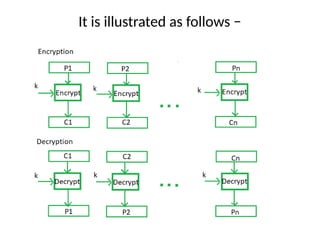
• The user takes the first block of plaintext and encrypts
it with the key to produce the first block of ciphertext.
• He then takes the second block of plaintext and
follows the same process with same key and so on so
forth.
• The ECB mode is deterministic, that is, if
plaintext block P1, P2,…, Pm are encrypted
twice under the same key, the output
ciphertext blocks will be the same.
• In fact, for a given key technically we can
create a codebook of ciphertexts for all
possible plaintext blocks.
• Encryption would then entail only looking up
for required plaintext and select the
corresponding ciphertext.
• Thus, the operation is analogous to the
assignment of code words in a codebook, and
hence gets an official name − Electronic
Codebook mode of operation (ECB).
It is illustrated as follows −
Analysis of ECB Mode
• In reality, any application data usually have
partial information which can be guessed.
• For example, the range of salary can be
guessed.
• A ciphertext from ECB can allow an attacker to
guess the plaintext by trial-and-error if the
plaintext message is within predictable.
• For example, if a ciphertext from the ECB
mode is known to encrypt a salary figure, then
a small number of trials will allow an attacker
to recover the figure.
• In general, we do not wish to use a
deterministic cipher, and hence the ECB mode
should not be used in most applications.
Cipher Block Chaining (CBC) Mode
• CBC mode of operation provides message dependence
for generating ciphertext and makes the system non-
deterministic.
Operation
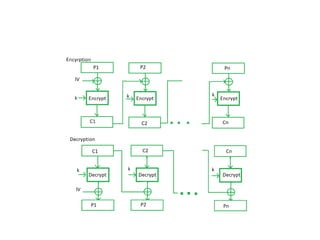
• The operation of CBC mode is depicted in the following
illustration. The steps are as follows −
• Load the n-bit Initialization Vector (IV) in the top
register.
• XOR the n-bit plaintext block with data value in top
register.
• Encrypt the result of XOR operation with
underlying block cipher with key K.
• Feed ciphertext block into top register and
continue the operation till all plaintext blocks
are processed.
• For decryption, IV data is XORed with first
ciphertext block decrypted. The first ciphertext
block is also fed into to register replacing IV for
decrypting next ciphertext block.
Analysis of CBC Mode
• In CBC mode, the current plaintext block is
added to the previous ciphertext block, and
then the result is encrypted with the key.
• Decryption is thus the reverse process, which
involves decrypting the current ciphertext and
then adding the previous ciphertext block to
the result.
• Advantage of CBC over ECB is that changing IV
results in different ciphertext for identical
message.
• On the drawback side, the error in
transmission gets propagated to few further
block during decryption due to chaining effect.
• It is worth mentioning that CBC mode forms
the basis for a well-known data origin
authentication mechanism.
• Thus, it has an advantage for those
applications that require both symmetric
encryption and data origin authentication.
Cipher Feedback (CFB) Mode
• In this mode, each ciphertext block gets ‘fed back’ into
the encryption process in order to encrypt the
Operation
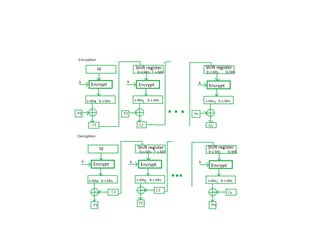
• The operation of CFB mode is depicted in the
following illustration. For example, in the present
system, a message block has a size ‘s’ bits where 1 < s
< n.
• The CFB mode requires an initialization vector (IV) as
the initial random n-bit input block. The IV need not
be secret.
Steps of operation are −
• Load the IV in the top register.
• Encrypt the data value in top register with
underlying block cipher with key K.
• Take only ‘s’ number of most significant bits
(left bits) of output of encryption process and
XOR them with ‘s’ bit plaintext message block
to generate ciphertext block.
• next plaintext block.
• Feed ciphertext block into top register by shifting
already present data to the left and continue the
operation till all plaintext blocks are processed.
• Essentially, the previous ciphertext block is
encrypted with the key, and then the result is
XORed to the current plaintext block.
• Similar steps are followed for decryption. Pre-
decided IV is initially loaded at the start of
decryption.
Analysis of CFB Mode
• CFB mode differs significantly from ECB mode, the
ciphertext corresponding to a given plaintext block
depends not just on that plaintext block and the key,
but also on the previous ciphertext block. In other
words, the ciphertext block is dependent of message.
• CFB has a very strange feature. In this mode, user
decrypts the ciphertext using only the encryption
process of the block cipher.
• The decryption algorithm of the underlying block
cipher is never used.
• Apparently, CFB mode is converting a block
cipher into a type of stream cipher.
• The encryption algorithm is used as a key-
stream generator to produce key-stream that
is placed in the bottom register.
• This key stream is then XORed with the
plaintext as in case of stream cipher.
• By converting a block cipher into a stream
cipher, CFB mode provides some of the
advantageous properties of a stream cipher
while retaining the advantageous properties
of a block cipher.
• On the flip side, the error of transmission gets
propagated due to changing of blocks.
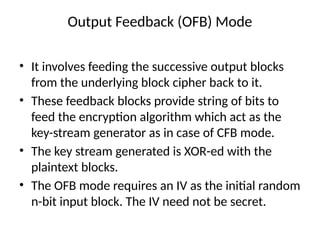
Output Feedback (OFB) Mode
• It involves feeding the successive output blocks
from the underlying block cipher back to it.
• These feedback blocks provide string of bits to
feed the encryption algorithm which act as the
key-stream generator as in case of CFB mode.
• The key stream generated is XOR-ed with the
plaintext blocks.
• The OFB mode requires an IV as the initial random
n-bit input block. The IV need not be secret.
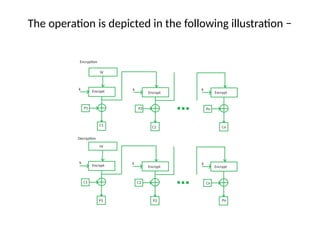
The operation is depicted in the following illustration −
Counter (CTR) Mode
• It can be considered as a counter-based version
of CFB mode without the feedback.
• In this mode, both the sender and receiver
need to access to a reliable counter, which
computes a new shared value each time a
ciphertext block is exchanged.
• This shared counter is not necessarily a secret
value, but challenge is that both sides must
keep the counter synchronized.
Operation
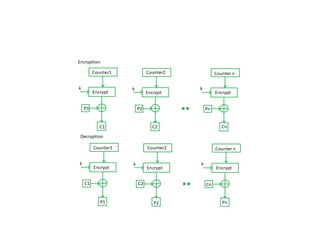
• Both encryption and decryption in CTR mode are
depicted in the following illustration. Steps in
operation are −
• Load the initial counter value in the top register is
the same for both the sender and the receiver. It
plays the same role as the IV in CFB (and CBC) mode.
• Encrypt the contents of the counter with the key and
place the result in the bottom register.
• Take the first plaintext block P1 and XOR this to the contents of
the bottom register.
• The result of this is C1. Send C1 to the receiver and update the
counter. The counter update replaces the ciphertext feedback in
CFB mode.
• Continue in this manner until the last plaintext block has been
encrypted.
• The decryption is the reverse process. The ciphertext block is
XORed with the output of encrypted contents of counter value.
• After decryption of each ciphertext block counter is updated as
in case of encryption.
Analysis of Counter Mode
• It does not have message dependency and hence a
ciphertext block does not depend on the previous
plaintext blocks.
• Like CFB mode, CTR mode does not involve the
decryption process of the block cipher.
• This is because the CTR mode is really using the block
cipher to generate a key-stream, which is encrypted
using the XOR function.
• In other words, CTR mode also converts a block cipher
to a stream cipher.
• The serious disadvantage of CTR mode is that
it requires a synchronous counter at sender
and receiver. Loss of synchronization leads to
incorrect recovery of plaintext.
• However, CTR mode has almost all advantages
of CFB mode. In addition, it does not
propagate error of transmission at all.
Software EngineeringModule 2 (Complete).pptx

Software EngineeringModule 2 (Complete).pptx

  • 1.
  • 2.
    • The DataEncryption Standard (DES) is a symmetric-key block cipher published by the National Institute of Standards and Technology (NIST). • DES is an implementation of a Feistel Cipher. It uses 16 round Feistel structure.
  • 3.
    • The blocksize is 64-bit. Though, key length is 64-bit, DES has an effective key length of 56 bits, since 8 of the 64 bits of the key are not used by the encryption algorithm (function as check bits only). • General Structure of DES is depicted in the following illustration −
  • 5.
    Since DES isbased on the Feistel Cipher, all that is required to specify DES is − • Round function • Key schedule • Any additional processing − Initial and final permutation
  • 6.
    Initial and FinalPermutation • The initial and final permutations are straight Permutation boxes (P-boxes) that are inverses of each other. • They have no cryptography significance in DES. • The initial and final permutations are shown as follows −
  • 8.
    Round Function • Theheart of this cipher is the DES function, f. • The DES function applies a 48-bit key to the rightmost 32 bits to produce a 32-bit output.
  • 10.
    • Expansion PermutationBox − Since right input is 32-bit and round key is a 48-bit, we first need to expand right input to 48 bits. • Permutation logic is graphically depicted in the following illustration −
  • 11.
    The graphically depictedpermutation logic is generally described as table in DES specification illustrated as shown −
  • 12.
    • XOR (Whitener).− After the expansion permutation, DES does XOR operation on the expanded right section and the round key. The round key is used only in this operation. • Substitution Boxes. − The S-boxes carry out the real mixing (confusion). DES uses 8 S- boxes, each with a 6-bit input and a 4-bit output. Refer the following illustration −
  • 14.
    The S-box ruleis illustrated below −
  • 15.
    • There area total of eight S-box tables. The output of all eight s-boxes is then combined in to 32 bit section. • Straight Permutation − The 32 bit output of S- boxes is then subjected to the straight permutation with rule shown in the following illustration
  • 16.
    Key Generation The round-keygenerator creates sixteen 48-bit keys out of a 56-bit cipher key. The process of key generation is depicted in the following illustration
  • 17.
    DES Analysis The DESsatisfies both the desired properties of block cipher. These two properties make cipher very strong. • Avalanche effect − A small change in plaintext results in the very great change in the ciphertext. • Completeness − Each bit of ciphertext depends on many bits of plaintext.
  • 18.
    • During thelast few years, cryptanalysis have found some weaknesses in DES when key selected are weak keys. These keys shall be avoided. • DES has proved to be a very well designed block cipher. There have been no significant cryptanalytic attacks on DES other than exhaustive key search.
  • 19.
    Triple DES • Thespeed of exhaustive key searches against DES after 1990 began to cause discomfort amongst users of DES. • However, users did not want to replace DES as it takes an enormous amount of time and money to change encryption algorithms that are widely adopted and embedded in large security architectures.
  • 20.
    • The pragmaticapproach was not to abandon the DES completely, but to change the manner in which DES is used. This led to the modified schemes of Triple DES (sometimes known as 3DES). • Incidentally, there are two variants of Triple DES known as 3-key Triple DES (3TDES) and 2- key Triple DES (2TDES).
  • 21.
    3-KEY Triple DES •Before using 3TDES, user first generate and distribute a 3TDES key K, which consists of three different DES keys K1, K2 and K3. • This means that the actual 3TDES key has length 3×56 = 168 bits. The encryption scheme is illustrated as follows −
  • 23.
    The encryption-decryption processis as follows − • Encrypt the plaintext blocks using single DES with key K1. • Now decrypt the output of step 1 using single DES with key K2. • Finally, encrypt the output of step 2 using single DES with key K3. • The output of step 3 is the ciphertext. • Decryption of a ciphertext is a reverse process. User first decrypt using K3, then encrypt with K2, and finally decrypt with K1.
  • 24.
    • Due tothis design of Triple DES as an encrypt– decrypt–encrypt process, it is possible to use a 3TDES (hardware) implementation for single DES by setting K1, K2, and K3 to be the same value. This provides backwards compatibility with DES.
  • 25.
    • Second variantof Triple DES (2TDES) is identical to 3TDES except that K3is replaced by K1. • In other words, user encrypt plaintext blocks with key K1, then decrypt with key K2, and finally encrypt with K1 again. • Therefore, 2TDES has a key length of 112 bits. • Triple DES systems are significantly more secure than single DES, but these are clearly a much slower process than encryption using single DES.
  • 26.
    Advanced Encryption Standard •The more popular and widely adopted symmetric encryption algorithm likely to be encountered nowadays is the Advanced Encryption Standard (AES). • It is found at least six time faster than triple DES. • A replacement for DES was needed as its key size was too small. • With increasing computing power, it was considered vulnerable against exhaustive key search attack. • Triple DES was designed to overcome this drawback but it was found slow.
  • 27.
    Criteria • Security The mainemphasis was on security. Because NIST explicitly demanded a 128- bit Key. , this criterion focused on resistance to cryptanalysis attacks other than brute-force attack. • Cost The second criterion was cost, which covers the computational efficiency and storage requirement for different implementation such as hardware, software or smart cards.
  • 28.
    • Implementation This criterionincluded the requirement that the algorithm must have flexibility and simplicity.
  • 29.
    The features ofAES are as follows − • Symmetric key symmetric block cipher • 128-bit data, 128/192/256-bit keys • Stronger and faster than Triple-DES • Provide full specification and design details • Software implementable in C and Java
  • 30.
    Operation of AES •AES is an iterative rather than Feistel cipher. It is based on ‘substitution–permutation network’. • It comprises of a series of linked operations, some of which involve replacing inputs by specific outputs (substitutions) and others involve shuffling bits around (permutations).
  • 31.
    • Interestingly, AESperforms all its computations on bytes rather than bits. Hence, AES treats the 128 bits of a plaintext block as 16 bytes. • These 16 bytes are arranged in four columns and four rows for processing as a matrix −
  • 32.
    • Unlike DES,the number of rounds in AES is variable and depends on the length of the key. • AES uses 10 rounds for 128-bit keys, 12 rounds for 192-bit keys and 14 rounds for 256- bit keys. • Each of these rounds uses a different 128-bit round key, which is calculated from the original AES key.
  • 33.
    The schematic ofAES structure is given in the following illustration −
  • 34.
    Encryption Process • Here,we restrict to description of a typical round of AES encryption. Each round comprise of four sub-processes. The first round process is depicted below −
  • 35.
    Byte Substitution (SubBytes) •The 16 input bytes are substituted by looking up a fixed table (S-box) given in design. The result is in a matrix of four rows and four columns. Shift rows • Each of the four rows of the matrix is shifted to the left. Any entries that ‘fall off’ are re- inserted on the right side of row. Shift is carried out as follows − • First row is not shifted.
  • 36.
    • Second rowis shifted one (byte) position to the left. • Third row is shifted two positions to the left. • Fourth row is shifted three positions to the left. • The result is a new matrix consisting of the same 16 bytes but shifted with respect to each other.
  • 37.
    MixColumns • Each columnof four bytes is now transformed using a special mathematical function. • This function takes as input the four bytes of one column and outputs four completely new bytes, which replace the original column. • The result is another new matrix consisting of 16 new bytes. It should be noted that this step is not performed in the last round.
  • 38.
    Addroundkey • The 16bytes of the matrix are now considered as 128 bits and are XORed to the 128 bits of the round key. • If this is the last round then the output is the ciphertext. • Otherwise, the resulting 128 bits are interpreted as 16 bytes and we begin another similar round.
  • 39.
    Decryption Process The processof decryption of an AES ciphertext is similar to the encryption process in the reverse order. Each round consists of the four processes conducted in the reverse order − • Add round key • Mix columns • Shift rows • Byte substitution
  • 40.
    • Since sub-processesin each round are in reverse manner, unlike for a Feistel Cipher, the encryption and decryption algorithms needs to be separately implemented, although they are very closely related.
  • 41.
    AES Analysis • Inpresent day cryptography, AES is widely adopted and supported in both hardware and software. • Till date, no practical cryptanalytic attacks against AES has been discovered. • Additionally, AES has built-in flexibility of key length, which allows a degree of ‘future-proofing’ against progress in the ability to perform exhaustive key searches. • However, just as for DES, the AES security is assured only if it is correctly implemented and good key management is employed.
  • 42.
    Block Cipher Modesof Operation • In this chapter, we will discuss the different modes of operation of a block cipher. • These are procedural rules for a generic block cipher. Interestingly, the different modes result in different properties being achieved which add to the security of the underlying block cipher.
  • 44.
    • A blockcipher processes the data blocks of fixed size. • Usually, the size of a message is larger than the block size. • Hence, the long message is divided into a series of sequential message blocks, and the cipher operates on these blocks one at a time.
  • 45.
    Electronic Code Book(ECB) Mode • This mode is a most straightforward way of processing a series of sequentially listed message blocks. Operation • The user takes the first block of plaintext and encrypts it with the key to produce the first block of ciphertext. • He then takes the second block of plaintext and follows the same process with same key and so on so forth.
  • 46.
    • The ECBmode is deterministic, that is, if plaintext block P1, P2,…, Pm are encrypted twice under the same key, the output ciphertext blocks will be the same. • In fact, for a given key technically we can create a codebook of ciphertexts for all possible plaintext blocks.
  • 47.
    • Encryption wouldthen entail only looking up for required plaintext and select the corresponding ciphertext. • Thus, the operation is analogous to the assignment of code words in a codebook, and hence gets an official name − Electronic Codebook mode of operation (ECB).
  • 48.
    It is illustratedas follows −
  • 49.
    Analysis of ECBMode • In reality, any application data usually have partial information which can be guessed. • For example, the range of salary can be guessed. • A ciphertext from ECB can allow an attacker to guess the plaintext by trial-and-error if the plaintext message is within predictable.
  • 50.
    • For example,if a ciphertext from the ECB mode is known to encrypt a salary figure, then a small number of trials will allow an attacker to recover the figure. • In general, we do not wish to use a deterministic cipher, and hence the ECB mode should not be used in most applications.
  • 51.
    Cipher Block Chaining(CBC) Mode • CBC mode of operation provides message dependence for generating ciphertext and makes the system non- deterministic. Operation • The operation of CBC mode is depicted in the following illustration. The steps are as follows − • Load the n-bit Initialization Vector (IV) in the top register. • XOR the n-bit plaintext block with data value in top register.
  • 52.
    • Encrypt theresult of XOR operation with underlying block cipher with key K. • Feed ciphertext block into top register and continue the operation till all plaintext blocks are processed. • For decryption, IV data is XORed with first ciphertext block decrypted. The first ciphertext block is also fed into to register replacing IV for decrypting next ciphertext block.
  • 54.
    Analysis of CBCMode • In CBC mode, the current plaintext block is added to the previous ciphertext block, and then the result is encrypted with the key. • Decryption is thus the reverse process, which involves decrypting the current ciphertext and then adding the previous ciphertext block to the result.
  • 55.
    • Advantage ofCBC over ECB is that changing IV results in different ciphertext for identical message. • On the drawback side, the error in transmission gets propagated to few further block during decryption due to chaining effect.
  • 56.
    • It isworth mentioning that CBC mode forms the basis for a well-known data origin authentication mechanism. • Thus, it has an advantage for those applications that require both symmetric encryption and data origin authentication.
  • 57.
    Cipher Feedback (CFB)Mode • In this mode, each ciphertext block gets ‘fed back’ into the encryption process in order to encrypt the Operation • The operation of CFB mode is depicted in the following illustration. For example, in the present system, a message block has a size ‘s’ bits where 1 < s < n. • The CFB mode requires an initialization vector (IV) as the initial random n-bit input block. The IV need not be secret.
  • 58.
    Steps of operationare − • Load the IV in the top register. • Encrypt the data value in top register with underlying block cipher with key K. • Take only ‘s’ number of most significant bits (left bits) of output of encryption process and XOR them with ‘s’ bit plaintext message block to generate ciphertext block. • next plaintext block.
  • 59.
    • Feed ciphertextblock into top register by shifting already present data to the left and continue the operation till all plaintext blocks are processed. • Essentially, the previous ciphertext block is encrypted with the key, and then the result is XORed to the current plaintext block. • Similar steps are followed for decryption. Pre- decided IV is initially loaded at the start of decryption.
  • 61.
    Analysis of CFBMode • CFB mode differs significantly from ECB mode, the ciphertext corresponding to a given plaintext block depends not just on that plaintext block and the key, but also on the previous ciphertext block. In other words, the ciphertext block is dependent of message. • CFB has a very strange feature. In this mode, user decrypts the ciphertext using only the encryption process of the block cipher. • The decryption algorithm of the underlying block cipher is never used.
  • 62.
    • Apparently, CFBmode is converting a block cipher into a type of stream cipher. • The encryption algorithm is used as a key- stream generator to produce key-stream that is placed in the bottom register. • This key stream is then XORed with the plaintext as in case of stream cipher.
  • 63.
    • By convertinga block cipher into a stream cipher, CFB mode provides some of the advantageous properties of a stream cipher while retaining the advantageous properties of a block cipher. • On the flip side, the error of transmission gets propagated due to changing of blocks.
  • 64.
    Output Feedback (OFB)Mode • It involves feeding the successive output blocks from the underlying block cipher back to it. • These feedback blocks provide string of bits to feed the encryption algorithm which act as the key-stream generator as in case of CFB mode. • The key stream generated is XOR-ed with the plaintext blocks. • The OFB mode requires an IV as the initial random n-bit input block. The IV need not be secret.
  • 65.
    The operation isdepicted in the following illustration −
  • 66.
    Counter (CTR) Mode •It can be considered as a counter-based version of CFB mode without the feedback. • In this mode, both the sender and receiver need to access to a reliable counter, which computes a new shared value each time a ciphertext block is exchanged. • This shared counter is not necessarily a secret value, but challenge is that both sides must keep the counter synchronized.
  • 67.
    Operation • Both encryptionand decryption in CTR mode are depicted in the following illustration. Steps in operation are − • Load the initial counter value in the top register is the same for both the sender and the receiver. It plays the same role as the IV in CFB (and CBC) mode. • Encrypt the contents of the counter with the key and place the result in the bottom register.
  • 68.
    • Take thefirst plaintext block P1 and XOR this to the contents of the bottom register. • The result of this is C1. Send C1 to the receiver and update the counter. The counter update replaces the ciphertext feedback in CFB mode. • Continue in this manner until the last plaintext block has been encrypted. • The decryption is the reverse process. The ciphertext block is XORed with the output of encrypted contents of counter value. • After decryption of each ciphertext block counter is updated as in case of encryption.
  • 70.
    Analysis of CounterMode • It does not have message dependency and hence a ciphertext block does not depend on the previous plaintext blocks. • Like CFB mode, CTR mode does not involve the decryption process of the block cipher. • This is because the CTR mode is really using the block cipher to generate a key-stream, which is encrypted using the XOR function. • In other words, CTR mode also converts a block cipher to a stream cipher.
  • 71.
    • The seriousdisadvantage of CTR mode is that it requires a synchronous counter at sender and receiver. Loss of synchronization leads to incorrect recovery of plaintext. • However, CTR mode has almost all advantages of CFB mode. In addition, it does not propagate error of transmission at all.