Data
Encryption
Standard (DES)
and
Alternatives
Introduction
What is Encryption?
Definition: Encryption is the process of converting plaintext (readable data) into ciphertext (encoded
data) to prevent unauthorized access.
Purpose: The primary goal of encryption is to ensure confidentiality, integrity, and authenticity of
data during transmission or storage.
Importance of Encryption in Digital Communication:
o With the rapid growth of digital communication, the need for secure data transfer has become
paramount.
o Encryption protects sensitive information such as personal data, financial transactions, and
classified documents from cyber threats and unauthorized access.
Symmetric Key Cryptography:
Definition: A type of encryption where the same key is used for both encryption and decryption.
Key Sharing: Both the sender and receiver must securely share the secret key before communication.
•Efficiency: Symmetric key algorithms are generally faster and require less computational power
compared to asymmetric key algorithms.
A Simplified DES-Type Algorithm
 Suppose that a message has 12 bits and is written as L0R0 , where
L0 consists of the first 6 bits and R0 consists of the last 6 bits.
 The key K has 9 bits. The ith round of the algorithm transforms
an input Li-1Ri-1 to the output LiRi using an 8-bit key Ki derived
from K.
 The main part of the encryption process is a function f(Ri-1,Ki)
that takes a 6-bit input Ri-1 and an 8-bit input Ki and produces a 6-
bit output which will be described later.
The output of the ith round is defined as:
Li = Ri-1 and Ri = Li-1 XOR f(Ri-1,Ki)
The decryption is the reverse of encryption.
[Ln] [Rn XOR f(Ln, Kn)] = … =[Rn-1] [Ln-1]
History
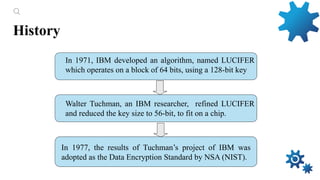
In 1971, IBM developed an algorithm, named LUCIFER
which operates on a block of 64 bits, using a 128-bit key
Walter Tuchman, an IBM researcher, refined LUCIFER
and reduced the key size to 56-bit, to fit on a chip.
In 1977, the results of Tuchman’s project of IBM was
adopted as the Data Encryption Standard by NSA (NIST).
The Operations of f Function
 E(Li)=E(011001)=E(01010101) (Expander)
 S-boxes
S1 101 010 001 110 011 100 111 000
001 100 110 010 000 111 101 011
S2 100 000 110 101 111 001 011 010
101 011 000 111 110 010 001 100
The input for an S-box has 4 bits. The first
bit specifies which row will be used: 0 for
1st
 The other 3 bits represent a binary number that specifies the column: 000 for
the 1st column, 001 for the 2nd column, … 111 for the 7th column. For
example, an input 1010 for S1 box will yield the output 110.
 The key K consists of 9 bits. Ki is the key for the ith round starting with the ith
bit of K. Let K=010011001, then K4=01100101.
 Ri-1=100110 and Ki=01100101
 E(Ri-1) XOR Ki =10101010 XOR 01100101
= 11001111
S1(1100)=000
S2(1111)=100
Thus, Ri = f(Ri-1,Ki)=000100, Li =Ri-1 =100110
Li-1Ri-1 = 011100100110 (
→ ?) LiRi
The Operations of f Function
Key Features of Data Encryption
Standard (DES)
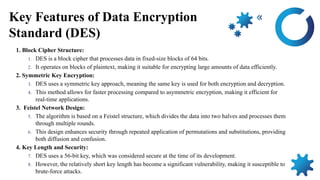
1. Block Cipher Structure:
1. DES is a block cipher that processes data in fixed-size blocks of 64 bits.
2. It operates on blocks of plaintext, making it suitable for encrypting large amounts of data efficiently.
2. Symmetric Key Encryption:
3. DES uses a symmetric key approach, meaning the same key is used for both encryption and decryption.
4. This method allows for faster processing compared to asymmetric encryption, making it efficient for
real-time applications.
3. Feistel Network Design:
5. The algorithm is based on a Feistel structure, which divides the data into two halves and processes them
through multiple rounds.
6. This design enhances security through repeated application of permutations and substitutions, providing
both diffusion and confusion.
4. Key Length and Security:
7. DES uses a 56-bit key, which was considered secure at the time of its development.
8. However, the relatively short key length has become a significant vulnerability, making it susceptible to
brute-force attacks.
Key Features of Data Encryption
Standard (DES)
5. 16 Rounds of Processing:
1. The encryption process consists of 16 rounds, each involving complex operations such as expansion,
substitution, and permutation.
2. This multi-round approach increases the difficulty of cryptanalysis, enhancing the overall security of the
algorithm.
6 Initial and Final Permutations:
3. DES includes an initial permutation (IP) and a final permutation (IP ¹) that rearranges the bits of the input and
⁻
output.
4. These permutations contribute to the diffusion of the plaintext, ensuring that small changes in the input result in
significant changes in the output.
7. Vulnerabilities and Limitations:
5. Despite its widespread use, DES has several vulnerabilities:
1. Brute-Force Attacks: The 56-bit key length is no longer considered secure against modern computational
power.
2. Cryptanalysis Techniques: Advances in cryptanalysis, such as differential and linear cryptanalysis, have
exposed weaknesses in DES.
6. As a result, DES has been largely replaced by more secure algorithms, such as AES.
Encryption
Encryption (cont.)
Inversion of Initial Permutation (IP-1
)
Key i
64-bit plaintext (X)
32-bit Switch (SW)
Initial Permutation (IP)
Round (i)
64-bit ciphertext (Y)
Key Generation (KeyGen)
64-bit key (K)
1
( ( ( ( ), )))
i i
Y IP SW Round IP X Key


Encryption (cont.)
 Plaintext: X
 Initial Permutation: IP( )
 Roundi: 1 i 16
≤ ≤
 32-bit switch: SW( )
 Inverse IP: IP-1
( )
 Ciphertext: Y
Encryption (IP, IP-1
)
Bit 0 1 2 3 4 5 6 7
1 58 50 42 34 26 18 10 2
9 60 52 44 36 28 20 12 4
17 62 54 46 38 30 22 14 6
25 64 56 48 40 32 24 16 8
33 57 49 41 33 25 17 9 1
41 59 51 43 35 27 19 11 3
49 61 53 45 37 29 21 13 5
57 63 55 47 39 31 23 15 7
• IP
Bit 0 1 2 3 4 5 6 7
1 40 8 48 16 56 24 64 32
9 39 7 47 15 55 23 63 31
17 38 6 46 14 54 22 62 30
25 37 5 45 13 53 21 61 29
33 36 4 44 12 52 20 60 28
41 35 3 43 11 51 19 59 27
49 34 2 42 10 50 18 58 26
57 33 1 41 9 49 17 57 25
 IP-1
 Note: IP(IP-1
) = IP-1
(IP) = I
Encryption (Round) structure
[
1
(Key
Generation)
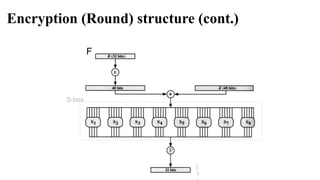
Li
Permutation (P)
Expansion/permutation (E_table)
Substitution/choice (S-box)
XOR
Ri
Li-1 Ri-1
XOR Ki
F
Encryption (Round) structure (cont.)
F
S-box
[
1
Encryption (Round) structure (cont.)
 Separate plaintext as L0R0
L0: left half 32 bits of plaintext
R0: right half 32 bits of plaintext
 Expansion/permutation: E( )
 Substitution/choice: S-box( )
 Permutation: P( )


1 1
( _ ( ( ) ~ ))
~ i
i i i
R L P S box E R Key
 

1
i i
L R 

 F
Strength of DES
Criticism
Reduction in key size of 72 bits
Too short to withstand with brute-force attack
S-boxes were classified.
Weak points enable NSA to decipher without key.
56-bit keys have 256
= 7.2 x 10¹⁶
values
Brute force search looks hard.
A machine performing one DES encryption per microsecond would
take more than a thousand year to break the cipher.
Strength of DES
 Avalanche effect in DES
 If a small change in either the
plaintext or the key, the
ciphertext should change
markedly.
 DES exhibits a strong
avalanche effect.
1. William Stallings, Cryptography and Network Security, 1999.
2. Darian, Bjorn. A shortest-path algorithm for unbounded-error quantum computation. Quantum 3(157).
3. Geisel, T., Kır, M. Discussion on a quantum solution of the DES challenge. Quantum Inf Process 21, 41.
4. Hesse, A., Lütkenhaus, N. Quantum key distribution: foundations and determinism. Quantum Inf
Process.
5. Marques, N. & Almeida, M. Fault-tolerant pharmaceutical drug discovery using quantum annealers.
Quantum Inf Process 21, 23.
6. Mishra, T. Quantum ECC & VPN: A primer. Quantum Inf Process 21, 55.
References
Thank you

Data Encryption Standard (DES) and Alternatives.pptx

  • 1.
  • 2.
    Introduction What is Encryption? Definition:Encryption is the process of converting plaintext (readable data) into ciphertext (encoded data) to prevent unauthorized access. Purpose: The primary goal of encryption is to ensure confidentiality, integrity, and authenticity of data during transmission or storage. Importance of Encryption in Digital Communication: o With the rapid growth of digital communication, the need for secure data transfer has become paramount. o Encryption protects sensitive information such as personal data, financial transactions, and classified documents from cyber threats and unauthorized access. Symmetric Key Cryptography: Definition: A type of encryption where the same key is used for both encryption and decryption. Key Sharing: Both the sender and receiver must securely share the secret key before communication. •Efficiency: Symmetric key algorithms are generally faster and require less computational power compared to asymmetric key algorithms.
  • 3.
    A Simplified DES-TypeAlgorithm  Suppose that a message has 12 bits and is written as L0R0 , where L0 consists of the first 6 bits and R0 consists of the last 6 bits.  The key K has 9 bits. The ith round of the algorithm transforms an input Li-1Ri-1 to the output LiRi using an 8-bit key Ki derived from K.  The main part of the encryption process is a function f(Ri-1,Ki) that takes a 6-bit input Ri-1 and an 8-bit input Ki and produces a 6- bit output which will be described later. The output of the ith round is defined as: Li = Ri-1 and Ri = Li-1 XOR f(Ri-1,Ki) The decryption is the reverse of encryption. [Ln] [Rn XOR f(Ln, Kn)] = … =[Rn-1] [Ln-1]
  • 4.
    History In 1971, IBMdeveloped an algorithm, named LUCIFER which operates on a block of 64 bits, using a 128-bit key Walter Tuchman, an IBM researcher, refined LUCIFER and reduced the key size to 56-bit, to fit on a chip. In 1977, the results of Tuchman’s project of IBM was adopted as the Data Encryption Standard by NSA (NIST).
  • 5.
    The Operations off Function  E(Li)=E(011001)=E(01010101) (Expander)  S-boxes S1 101 010 001 110 011 100 111 000 001 100 110 010 000 111 101 011 S2 100 000 110 101 111 001 011 010 101 011 000 111 110 010 001 100 The input for an S-box has 4 bits. The first bit specifies which row will be used: 0 for 1st
  • 6.
     The other3 bits represent a binary number that specifies the column: 000 for the 1st column, 001 for the 2nd column, … 111 for the 7th column. For example, an input 1010 for S1 box will yield the output 110.  The key K consists of 9 bits. Ki is the key for the ith round starting with the ith bit of K. Let K=010011001, then K4=01100101.  Ri-1=100110 and Ki=01100101  E(Ri-1) XOR Ki =10101010 XOR 01100101 = 11001111 S1(1100)=000 S2(1111)=100 Thus, Ri = f(Ri-1,Ki)=000100, Li =Ri-1 =100110 Li-1Ri-1 = 011100100110 ( → ?) LiRi The Operations of f Function
  • 7.
    Key Features ofData Encryption Standard (DES) 1. Block Cipher Structure: 1. DES is a block cipher that processes data in fixed-size blocks of 64 bits. 2. It operates on blocks of plaintext, making it suitable for encrypting large amounts of data efficiently. 2. Symmetric Key Encryption: 3. DES uses a symmetric key approach, meaning the same key is used for both encryption and decryption. 4. This method allows for faster processing compared to asymmetric encryption, making it efficient for real-time applications. 3. Feistel Network Design: 5. The algorithm is based on a Feistel structure, which divides the data into two halves and processes them through multiple rounds. 6. This design enhances security through repeated application of permutations and substitutions, providing both diffusion and confusion. 4. Key Length and Security: 7. DES uses a 56-bit key, which was considered secure at the time of its development. 8. However, the relatively short key length has become a significant vulnerability, making it susceptible to brute-force attacks.
  • 8.
    Key Features ofData Encryption Standard (DES) 5. 16 Rounds of Processing: 1. The encryption process consists of 16 rounds, each involving complex operations such as expansion, substitution, and permutation. 2. This multi-round approach increases the difficulty of cryptanalysis, enhancing the overall security of the algorithm. 6 Initial and Final Permutations: 3. DES includes an initial permutation (IP) and a final permutation (IP ¹) that rearranges the bits of the input and ⁻ output. 4. These permutations contribute to the diffusion of the plaintext, ensuring that small changes in the input result in significant changes in the output. 7. Vulnerabilities and Limitations: 5. Despite its widespread use, DES has several vulnerabilities: 1. Brute-Force Attacks: The 56-bit key length is no longer considered secure against modern computational power. 2. Cryptanalysis Techniques: Advances in cryptanalysis, such as differential and linear cryptanalysis, have exposed weaknesses in DES. 6. As a result, DES has been largely replaced by more secure algorithms, such as AES.
  • 9.
  • 10.
    Encryption (cont.) Inversion ofInitial Permutation (IP-1 ) Key i 64-bit plaintext (X) 32-bit Switch (SW) Initial Permutation (IP) Round (i) 64-bit ciphertext (Y) Key Generation (KeyGen) 64-bit key (K)
  • 11.
    1 ( ( (( ), ))) i i Y IP SW Round IP X Key   Encryption (cont.)  Plaintext: X  Initial Permutation: IP( )  Roundi: 1 i 16 ≤ ≤  32-bit switch: SW( )  Inverse IP: IP-1 ( )  Ciphertext: Y
  • 12.
    Encryption (IP, IP-1 ) Bit0 1 2 3 4 5 6 7 1 58 50 42 34 26 18 10 2 9 60 52 44 36 28 20 12 4 17 62 54 46 38 30 22 14 6 25 64 56 48 40 32 24 16 8 33 57 49 41 33 25 17 9 1 41 59 51 43 35 27 19 11 3 49 61 53 45 37 29 21 13 5 57 63 55 47 39 31 23 15 7 • IP Bit 0 1 2 3 4 5 6 7 1 40 8 48 16 56 24 64 32 9 39 7 47 15 55 23 63 31 17 38 6 46 14 54 22 62 30 25 37 5 45 13 53 21 61 29 33 36 4 44 12 52 20 60 28 41 35 3 43 11 51 19 59 27 49 34 2 42 10 50 18 58 26 57 33 1 41 9 49 17 57 25  IP-1  Note: IP(IP-1 ) = IP-1 (IP) = I
  • 13.
  • 14.
    Li Permutation (P) Expansion/permutation (E_table) Substitution/choice(S-box) XOR Ri Li-1 Ri-1 XOR Ki F Encryption (Round) structure (cont.)
  • 15.
  • 16.
    Encryption (Round) structure(cont.)  Separate plaintext as L0R0 L0: left half 32 bits of plaintext R0: right half 32 bits of plaintext  Expansion/permutation: E( )  Substitution/choice: S-box( )  Permutation: P( )   1 1 ( _ ( ( ) ~ )) ~ i i i i R L P S box E R Key    1 i i L R    F
  • 17.
    Strength of DES Criticism Reductionin key size of 72 bits Too short to withstand with brute-force attack S-boxes were classified. Weak points enable NSA to decipher without key. 56-bit keys have 256 = 7.2 x 10¹⁶ values Brute force search looks hard. A machine performing one DES encryption per microsecond would take more than a thousand year to break the cipher.
  • 18.
    Strength of DES Avalanche effect in DES  If a small change in either the plaintext or the key, the ciphertext should change markedly.  DES exhibits a strong avalanche effect.
  • 19.
    1. William Stallings,Cryptography and Network Security, 1999. 2. Darian, Bjorn. A shortest-path algorithm for unbounded-error quantum computation. Quantum 3(157). 3. Geisel, T., Kır, M. Discussion on a quantum solution of the DES challenge. Quantum Inf Process 21, 41. 4. Hesse, A., Lütkenhaus, N. Quantum key distribution: foundations and determinism. Quantum Inf Process. 5. Marques, N. & Almeida, M. Fault-tolerant pharmaceutical drug discovery using quantum annealers. Quantum Inf Process 21, 23. 6. Mishra, T. Quantum ECC & VPN: A primer. Quantum Inf Process 21, 55. References
  • 20.