Different types of
simulations for
appropriate systems
By
Md. Fazle Rabbi
16CSE057
4.2
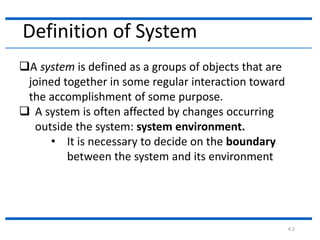
A system is defined as a groups of objects that are
joined together in some regular interaction toward
the accomplishment of some purpose.
 A system is often affected by changes occurring
outside the system: system environment.
• It is necessary to decide on the boundary
between the system and its environment
Definition of System
4.3
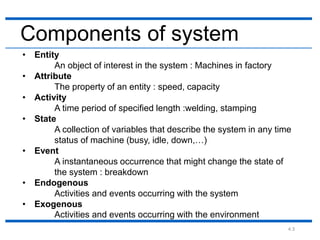
Components of system
• Entity
An object of interest in the system : Machines in factory
• Attribute
The property of an entity : speed, capacity
• Activity
A time period of specified length :welding, stamping
• State
A collection of variables that describe the system in any time
status of machine (busy, idle, down,…)
• Event
A instantaneous occurrence that might change the state of
the system : breakdown
• Endogenous
Activities and events occurring with the system
• Exogenous
Activities and events occurring with the environment
4.4
System can be categorized into
1. Discrete System
2. Continuous System
System
4.5
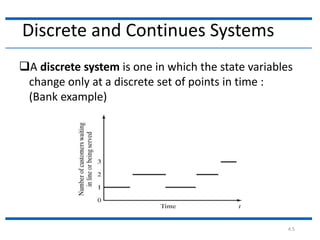
A discrete system is one in which the state variables
change only at a discrete set of points in time :
(Bank example)
Discrete and Continues Systems
4.6
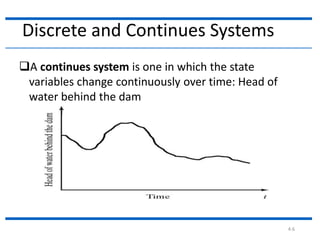
A continues system is one in which the state
variables change continuously over time: Head of
water behind the dam
Discrete and Continues Systems
4.7
Models can be classified as
mathematical, physical & Process
• A mathematical model uses symbolic notations and
mathematical equations to represent a system.
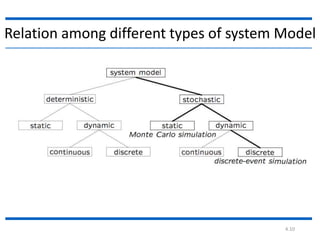
System-Model may be further classified:
• STATIC OR DYNAMIC
• DETEMINISTIC OR STOCHASTIC
• DISCRETE OR CONTINUOUS
Types of Model & System Models
4.8
 A STATIC SYSTEM MODEL
represents a system at a particular point in time.
 DYNAMIC SYSTEM MODEL
represents a system as it change over time.
STATIC & DYNAMIC System-model
4.9
System models that contain no random variables
are classified as deterministic
A stochastic system model has one or more
random variables as input.
DERERMINISTIC & STOCHASTIC System-model
4.10
System models that contain no random variables
are classified as deterministic
A stochastic system model has one or more
random variables as input.
Relation among different types of system Model
4.11
Thank you

3. different types of simulations for appropriate systems

  • 1.
    Different types of simulationsfor appropriate systems By Md. Fazle Rabbi 16CSE057
  • 2.
    4.2 A system isdefined as a groups of objects that are joined together in some regular interaction toward the accomplishment of some purpose.  A system is often affected by changes occurring outside the system: system environment. • It is necessary to decide on the boundary between the system and its environment Definition of System
  • 3.
    4.3 Components of system •Entity An object of interest in the system : Machines in factory • Attribute The property of an entity : speed, capacity • Activity A time period of specified length :welding, stamping • State A collection of variables that describe the system in any time status of machine (busy, idle, down,…) • Event A instantaneous occurrence that might change the state of the system : breakdown • Endogenous Activities and events occurring with the system • Exogenous Activities and events occurring with the environment
  • 4.
    4.4 System can becategorized into 1. Discrete System 2. Continuous System System
  • 5.
    4.5 A discrete systemis one in which the state variables change only at a discrete set of points in time : (Bank example) Discrete and Continues Systems
  • 6.
    4.6 A continues systemis one in which the state variables change continuously over time: Head of water behind the dam Discrete and Continues Systems
  • 7.
    4.7 Models can beclassified as mathematical, physical & Process • A mathematical model uses symbolic notations and mathematical equations to represent a system. System-Model may be further classified: • STATIC OR DYNAMIC • DETEMINISTIC OR STOCHASTIC • DISCRETE OR CONTINUOUS Types of Model & System Models
  • 8.
    4.8  A STATICSYSTEM MODEL represents a system at a particular point in time.  DYNAMIC SYSTEM MODEL represents a system as it change over time. STATIC & DYNAMIC System-model
  • 9.
    4.9 System models thatcontain no random variables are classified as deterministic A stochastic system model has one or more random variables as input. DERERMINISTIC & STOCHASTIC System-model
  • 10.
    4.10 System models thatcontain no random variables are classified as deterministic A stochastic system model has one or more random variables as input. Relation among different types of system Model
  • 11.