Cyber Security (IT750)
Class - 1
Date 9th February 2021 Tuesday
Time 9:45AM-10:15AM
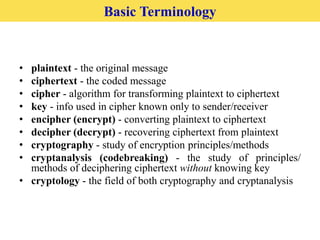
• plaintext - the original message
• ciphertext - the coded message
• cipher - algorithm for transforming plaintext to ciphertext
• key - info used in cipher known only to sender/receiver
• encipher (encrypt) - converting plaintext to ciphertext
• decipher (decrypt) - recovering ciphertext from plaintext
• cryptography - study of encryption principles/methods
• cryptanalysis (codebreaking) - the study of principles/
methods of deciphering ciphertext without knowing key
• cryptology - the field of both cryptography and cryptanalysis
Basic Terminology
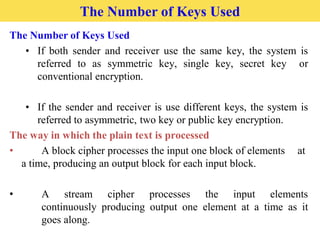
The Number of Keys Used
• If both sender and receiver use the same key, the system is
referred to as symmetric key, single key, secret key or
conventional encryption.
• If the sender and receiver is use different keys, the system is
referred to asymmetric, two key or public key encryption.
The way in which the plain text is processed
• A block cipher processes the input one block of elements at
a time, producing an output block for each input block.
• A stream cipher processes the input elements
continuously producing output one element at a time as it
goes along.
• Conventional / Private-key / Single-key.
• Sender and Recipient share a common key.
• All classical encryption algorithms are private-key.
• It was only type prior to invention of public-key in
1970’s.
Symmetric Encryption
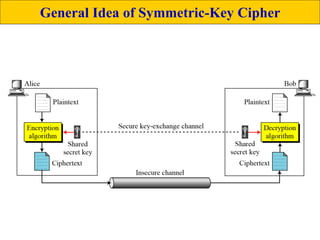
General Idea of Symmetric-Key Cipher
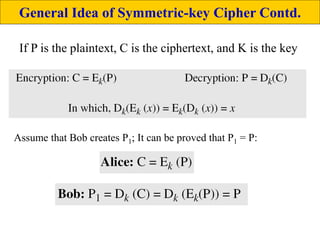
General Idea of Symmetric-key Cipher Contd.
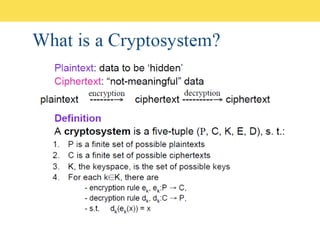
If P is the plaintext, C is the ciphertext, and K is the key
Assume that Bob creates P1; It can be proved that P1 = P:
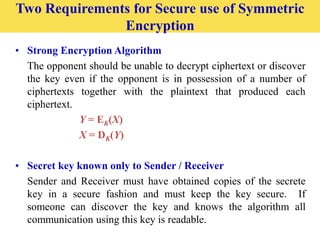
• Strong Encryption Algorithm
The opponent should be unable to decrypt ciphertext or discover
the key even if the opponent is in possession of a number of
ciphertexts together with the plaintext that produced each
ciphertext.
Y = EK(X)
X = DK(Y)
• Secret key known only to Sender / Receiver
Sender and Receiver must have obtained copies of the secrete
key in a secure fashion and must keep the key secure. If
someone can discover the key and knows the algorithm all
communication using this key is readable.
Two Requirements for Secure use of Symmetric
Encryption
DES History
• In 1973, NBS (NIST) issues a public request for proposals for a national
cipher standard, which must be
– Secure
– Public
– Completely specified
– Easy to understand
– Available to all users
– Economic and efficient in hardware
– Able to be validated
– Exportable
• IBM submitted LUCIFER (Feistel) (which was redesigned to become
the DES)
• In 1977, adopted by NBS (NIST) as DES (Data Encryption Standard,
Federal Information Processing Standard 46 (FIPS PUB 46))
DES History
• Chronolgy
• 1973: NBS publishes a first request for a standard encryption algorithm
• 1974: NBS publishes a second request for encryption algorithms
• 1975: DES is published in the Federal Register for comment
• 1976: First and second workshop on DES
• 1976: DES is approved as a standard
• 1977: DES is published as a FIPS standard FIPS PUB 46
• 1983: DES reaffirmed for the first time
• 1986: Videocipher II, a TV satellite scrambling system based upon DES
begins use by HBO
• 1988: DES is reaffirmed for the second time as FIPS 46-1, superseding
FIPS PUB 46
• 1992: Biham and Shamir publish the first theoretical attack with less
complexity than brute force: differential cryptanalysis. However, it requires
an unrealistic 247 chosen plaintexts
• 1993: DES is reaffirmed for the third time as FIPS 46-2
DES History
• 1994: The first experimental cryptanalysis of DES is performed using
linear cryptanalysis (Matsui, 1994)
• 1997: The DESCHALL Project breaks a message encrypted with DES for
the first time in public
• 1998: The Electronic Frontier Foundation (EFF)’s DES cracker (Deep Crack)
breaks a DES key in 56 hours
• 1999: Together, Deep Crack and distributed.net break a DES key in 22 hours
and 15 minutes
• 1999: DES is reaffirmed for for the fourth time as FIPS 46-3, which
specifies the preferred use of Triple DES, with single DES permitted only in
legacy systems
• 2001: The Advanced Encryption Standard is published in FIPS 197
• 2002: The AES standard becomes effective
• 2004: The withdrawal of FIPS 46-3 (and a couple of related standards) is
proposed in the Federal Register
• 2005: NIST withdraws FIPS 46-3
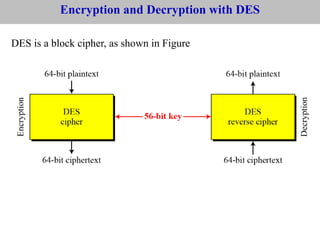
DES is a block cipher, as shown in Figure
Encryption and Decryption with DES
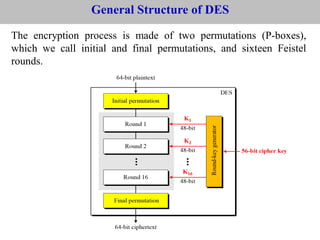
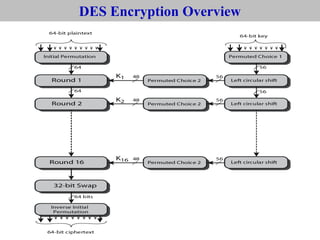
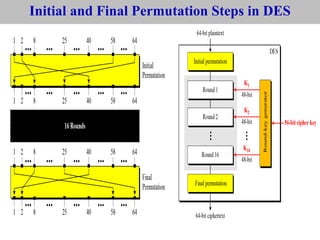
The encryption process is made of two permutations (P-boxes),
which we call initial and final permutations, and sixteen Feistel
rounds.
General Structure of DES
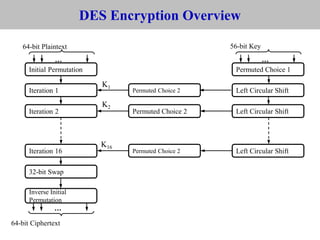
DES Encryption Overview
…
64-bit Ciphertext
…
64-bit Plaintext
…
Initial Permutation
Iteration 1
Iteration 2
Iteration 16
32-bit Swap
Inverse Initial
Permutation
Permuted Choice 2
Permuted Choice 2
Permuted Choice 1
Left Circular Shift
Left Circular Shift
Permuted Choice 2 Left Circular Shift
K1
K2
K16
56-bit Key
DES Encryption Overview
Initial and Final Permutation Steps in DES
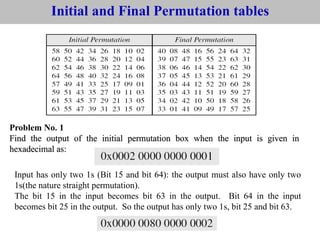
Initial and Final Permutation tables
Problem No. 1
Find the output of the initial permutation box when the input is given in
hexadecimal as:
Input has only two 1s (Bit 15 and bit 64): the output must also have only two
1s(the nature straight permutation).
The bit 15 in the input becomes bit 63 in the output. Bit 64 in the input
becomes bit 25 in the output. So the output has only two 1s, bit 25 and bit 63.
6.2.1 Continued
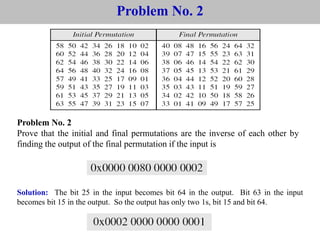
Problem No. 2
Problem No. 2
Prove that the initial and final permutations are the inverse of each other by
finding the output of the final permutation if the input is
Solution: The bit 25 in the input becomes bit 64 in the output. Bit 63 in the input
becomes bit 15 in the output. So the output has only two 1s, bit 15 and bit 64.
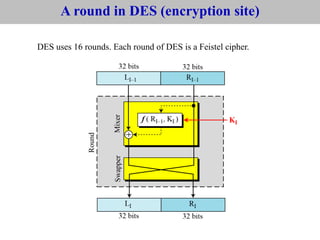
DES uses 16 rounds. Each round of DES is a Feistel cipher.
A round in DES (encryption site)
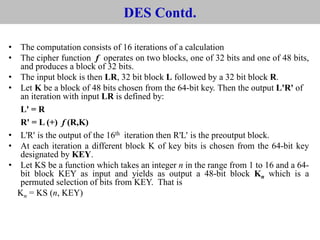
DES Contd.
• The computation consists of 16 iterations of a calculation
• The cipher function f operates on two blocks, one of 32 bits and one of 48 bits,
and produces a block of 32 bits.
• The input block is then LR, 32 bit block L followed by a 32 bit block R.
• Let K be a block of 48 bits chosen from the 64-bit key. Then the output L'R' of
an iteration with input LR is defined by:
L' = R
R' = L (+) f (R,K)
• L'R' is the output of the 16th iteration then R'L' is the preoutput block.
• At each iteration a different block K of key bits is chosen from the 64-bit key
designated by KEY.
• Let KS be a function which takes an integer n in the range from 1 to 16 and a 64-
bit block KEY as input and yields as output a 48-bit block Kn which is a
permuted selection of bits from KEY. That is
Kn = KS (n, KEY)
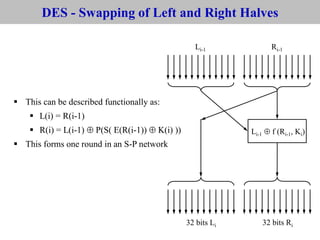
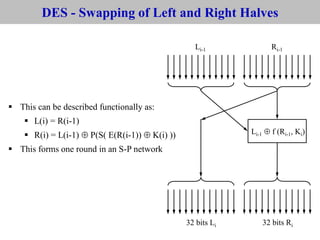
DES - Swapping of Left and Right Halves
▪ This can be described functionally as:
▪ L(i) = R(i-1)
▪ R(i) = L(i-1)  P(S( E(R(i-1))  K(i) ))
▪ This forms one round in an S-P network
Li-1  f (Ri-1, Ki)
Li-1 Ri-1
32 bits Li 32 bits Ri
DES - Swapping of Left and Right Halves
▪ This can be described functionally as:
▪ L(i) = R(i-1)
▪ R(i) = L(i-1)  P(S( E(R(i-1))  K(i) ))
▪ This forms one round in an S-P network
Li-1  f (Ri-1, Ki)
Li-1 Ri-1
32 bits Li 32 bits Ri
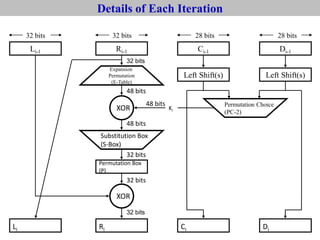
Details of Each Iteration
Li-1 Ri-1 Ci-1 Di-1
Li Ri Ci Di
Permutation Choice
(PC-2)
Expansion
Permutation
(E-Table)
Substitution Box
(S-Box)
XOR
XOR
Permutation Box
(P)
Left Shift(s) Left Shift(s)
48 bits
48 bits
32 bits
32 bits
32 bits
32 bits
48 bits
Ki
32 bits 32 bits 28 bits 28 bits
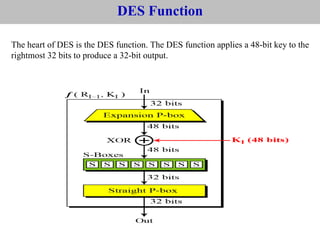
The heart of DES is the DES function. The DES function applies a 48-bit key to the
rightmost 32 bits to produce a 32-bit output.
6.2.2 Continued
DES Function
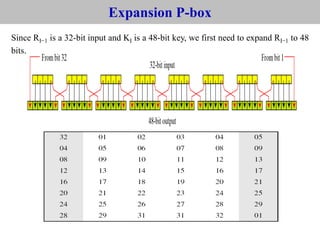
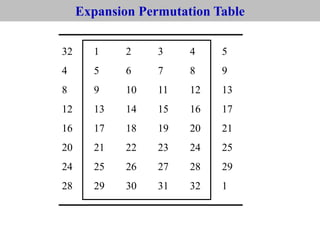
Since RI−1 is a 32-bit input and KI is a 48-bit key, we first need to expand RI−1 to 48
bits.
6.2.2 Continue
Expansion P-box
Expansion Permutation Table
32 1 2 3 4 5
4 5 6 7 8 9
8 9 10 11 12 13
12 13 14 15 16 17
16 17 18 19 20 21
20 21 22 23 24 25
24 25 26 27 28 29
28 29 30 31 32 1
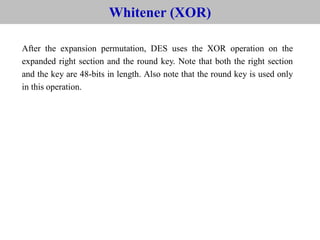
After the expansion permutation, DES uses the XOR operation on the
expanded right section and the round key. Note that both the right section
and the key are 48-bits in length. Also note that the round key is used only
in this operation.
6.2.2 Continue
Whitener (XOR)
6.28
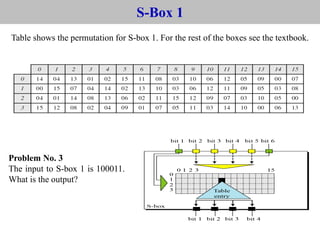
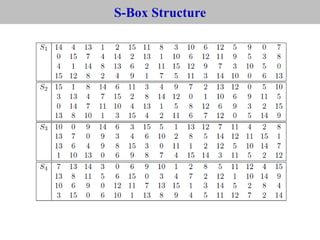
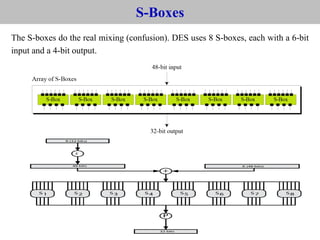
The S-boxes do the real mixing (confusion). DES uses 8 S-boxes, each with a 6-bit
input and a 4-bit output.
S-Boxes
Table shows the permutation for S-box 1. For the rest of the boxes see the textbook.
S-Box 1
Problem No. 3
The input to S-box 1 is 100011.
What is the output?
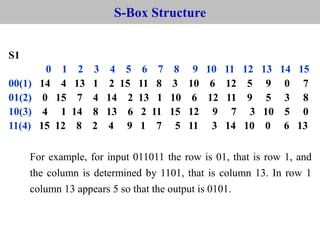
S-Box Structure
S1
0 1 2 3 4 5 6 7 8 9 10 11 12 13 14 15
00(1) 14 4 13 1 2 15 11 8 3 10 6 12 5 9 0 7
01(2) 0 15 7 4 14 2 13 1 10 6 12 11 9 5 3 8
10(3) 4 1 14 8 13 6 2 11 15 12 9 7 3 10 5 0
11(4) 15 12 8 2 4 9 1 7 5 11 3 14 10 0 6 13
For example, for input 011011 the row is 01, that is row 1, and
the column is determined by 1101, that is column 13. In row 1
column 13 appears 5 so that the output is 0101.
S-Box Structure

1 DES.pdf

  • 1.
    Cyber Security (IT750) Class- 1 Date 9th February 2021 Tuesday Time 9:45AM-10:15AM
  • 3.
    • plaintext -the original message • ciphertext - the coded message • cipher - algorithm for transforming plaintext to ciphertext • key - info used in cipher known only to sender/receiver • encipher (encrypt) - converting plaintext to ciphertext • decipher (decrypt) - recovering ciphertext from plaintext • cryptography - study of encryption principles/methods • cryptanalysis (codebreaking) - the study of principles/ methods of deciphering ciphertext without knowing key • cryptology - the field of both cryptography and cryptanalysis Basic Terminology
  • 4.
    The Number ofKeys Used The Number of Keys Used • If both sender and receiver use the same key, the system is referred to as symmetric key, single key, secret key or conventional encryption. • If the sender and receiver is use different keys, the system is referred to asymmetric, two key or public key encryption. The way in which the plain text is processed • A block cipher processes the input one block of elements at a time, producing an output block for each input block. • A stream cipher processes the input elements continuously producing output one element at a time as it goes along.
  • 5.
    • Conventional /Private-key / Single-key. • Sender and Recipient share a common key. • All classical encryption algorithms are private-key. • It was only type prior to invention of public-key in 1970’s. Symmetric Encryption
  • 6.
    General Idea ofSymmetric-Key Cipher
  • 7.
    General Idea ofSymmetric-key Cipher Contd. If P is the plaintext, C is the ciphertext, and K is the key Assume that Bob creates P1; It can be proved that P1 = P:
  • 8.
    • Strong EncryptionAlgorithm The opponent should be unable to decrypt ciphertext or discover the key even if the opponent is in possession of a number of ciphertexts together with the plaintext that produced each ciphertext. Y = EK(X) X = DK(Y) • Secret key known only to Sender / Receiver Sender and Receiver must have obtained copies of the secrete key in a secure fashion and must keep the key secure. If someone can discover the key and knows the algorithm all communication using this key is readable. Two Requirements for Secure use of Symmetric Encryption
  • 9.
    DES History • In1973, NBS (NIST) issues a public request for proposals for a national cipher standard, which must be – Secure – Public – Completely specified – Easy to understand – Available to all users – Economic and efficient in hardware – Able to be validated – Exportable • IBM submitted LUCIFER (Feistel) (which was redesigned to become the DES) • In 1977, adopted by NBS (NIST) as DES (Data Encryption Standard, Federal Information Processing Standard 46 (FIPS PUB 46))
  • 10.
    DES History • Chronolgy •1973: NBS publishes a first request for a standard encryption algorithm • 1974: NBS publishes a second request for encryption algorithms • 1975: DES is published in the Federal Register for comment • 1976: First and second workshop on DES • 1976: DES is approved as a standard • 1977: DES is published as a FIPS standard FIPS PUB 46 • 1983: DES reaffirmed for the first time • 1986: Videocipher II, a TV satellite scrambling system based upon DES begins use by HBO • 1988: DES is reaffirmed for the second time as FIPS 46-1, superseding FIPS PUB 46 • 1992: Biham and Shamir publish the first theoretical attack with less complexity than brute force: differential cryptanalysis. However, it requires an unrealistic 247 chosen plaintexts • 1993: DES is reaffirmed for the third time as FIPS 46-2
  • 11.
    DES History • 1994:The first experimental cryptanalysis of DES is performed using linear cryptanalysis (Matsui, 1994) • 1997: The DESCHALL Project breaks a message encrypted with DES for the first time in public • 1998: The Electronic Frontier Foundation (EFF)’s DES cracker (Deep Crack) breaks a DES key in 56 hours • 1999: Together, Deep Crack and distributed.net break a DES key in 22 hours and 15 minutes • 1999: DES is reaffirmed for for the fourth time as FIPS 46-3, which specifies the preferred use of Triple DES, with single DES permitted only in legacy systems • 2001: The Advanced Encryption Standard is published in FIPS 197 • 2002: The AES standard becomes effective • 2004: The withdrawal of FIPS 46-3 (and a couple of related standards) is proposed in the Federal Register • 2005: NIST withdraws FIPS 46-3
  • 12.
    DES is ablock cipher, as shown in Figure Encryption and Decryption with DES
  • 13.
    The encryption processis made of two permutations (P-boxes), which we call initial and final permutations, and sixteen Feistel rounds. General Structure of DES
  • 14.
    DES Encryption Overview … 64-bitCiphertext … 64-bit Plaintext … Initial Permutation Iteration 1 Iteration 2 Iteration 16 32-bit Swap Inverse Initial Permutation Permuted Choice 2 Permuted Choice 2 Permuted Choice 1 Left Circular Shift Left Circular Shift Permuted Choice 2 Left Circular Shift K1 K2 K16 56-bit Key
  • 15.
  • 16.
    Initial and FinalPermutation Steps in DES
  • 17.
    Initial and FinalPermutation tables Problem No. 1 Find the output of the initial permutation box when the input is given in hexadecimal as: Input has only two 1s (Bit 15 and bit 64): the output must also have only two 1s(the nature straight permutation). The bit 15 in the input becomes bit 63 in the output. Bit 64 in the input becomes bit 25 in the output. So the output has only two 1s, bit 25 and bit 63.
  • 18.
    6.2.1 Continued Problem No.2 Problem No. 2 Prove that the initial and final permutations are the inverse of each other by finding the output of the final permutation if the input is Solution: The bit 25 in the input becomes bit 64 in the output. Bit 63 in the input becomes bit 15 in the output. So the output has only two 1s, bit 15 and bit 64.
  • 19.
    DES uses 16rounds. Each round of DES is a Feistel cipher. A round in DES (encryption site)
  • 20.
    DES Contd. • Thecomputation consists of 16 iterations of a calculation • The cipher function f operates on two blocks, one of 32 bits and one of 48 bits, and produces a block of 32 bits. • The input block is then LR, 32 bit block L followed by a 32 bit block R. • Let K be a block of 48 bits chosen from the 64-bit key. Then the output L'R' of an iteration with input LR is defined by: L' = R R' = L (+) f (R,K) • L'R' is the output of the 16th iteration then R'L' is the preoutput block. • At each iteration a different block K of key bits is chosen from the 64-bit key designated by KEY. • Let KS be a function which takes an integer n in the range from 1 to 16 and a 64- bit block KEY as input and yields as output a 48-bit block Kn which is a permuted selection of bits from KEY. That is Kn = KS (n, KEY)
  • 21.
    DES - Swappingof Left and Right Halves ▪ This can be described functionally as: ▪ L(i) = R(i-1) ▪ R(i) = L(i-1)  P(S( E(R(i-1))  K(i) )) ▪ This forms one round in an S-P network Li-1  f (Ri-1, Ki) Li-1 Ri-1 32 bits Li 32 bits Ri
  • 22.
    DES - Swappingof Left and Right Halves ▪ This can be described functionally as: ▪ L(i) = R(i-1) ▪ R(i) = L(i-1)  P(S( E(R(i-1))  K(i) )) ▪ This forms one round in an S-P network Li-1  f (Ri-1, Ki) Li-1 Ri-1 32 bits Li 32 bits Ri
  • 23.
    Details of EachIteration Li-1 Ri-1 Ci-1 Di-1 Li Ri Ci Di Permutation Choice (PC-2) Expansion Permutation (E-Table) Substitution Box (S-Box) XOR XOR Permutation Box (P) Left Shift(s) Left Shift(s) 48 bits 48 bits 32 bits 32 bits 32 bits 32 bits 48 bits Ki 32 bits 32 bits 28 bits 28 bits
  • 24.
    The heart ofDES is the DES function. The DES function applies a 48-bit key to the rightmost 32 bits to produce a 32-bit output. 6.2.2 Continued DES Function
  • 25.
    Since RI−1 isa 32-bit input and KI is a 48-bit key, we first need to expand RI−1 to 48 bits. 6.2.2 Continue Expansion P-box
  • 26.
    Expansion Permutation Table 321 2 3 4 5 4 5 6 7 8 9 8 9 10 11 12 13 12 13 14 15 16 17 16 17 18 19 20 21 20 21 22 23 24 25 24 25 26 27 28 29 28 29 30 31 32 1
  • 27.
    After the expansionpermutation, DES uses the XOR operation on the expanded right section and the round key. Note that both the right section and the key are 48-bits in length. Also note that the round key is used only in this operation. 6.2.2 Continue Whitener (XOR)
  • 28.
    6.28 The S-boxes dothe real mixing (confusion). DES uses 8 S-boxes, each with a 6-bit input and a 4-bit output. S-Boxes
  • 29.
    Table shows thepermutation for S-box 1. For the rest of the boxes see the textbook. S-Box 1 Problem No. 3 The input to S-box 1 is 100011. What is the output?
  • 30.
    S-Box Structure S1 0 12 3 4 5 6 7 8 9 10 11 12 13 14 15 00(1) 14 4 13 1 2 15 11 8 3 10 6 12 5 9 0 7 01(2) 0 15 7 4 14 2 13 1 10 6 12 11 9 5 3 8 10(3) 4 1 14 8 13 6 2 11 15 12 9 7 3 10 5 0 11(4) 15 12 8 2 4 9 1 7 5 11 3 14 10 0 6 13 For example, for input 011011 the row is 01, that is row 1, and the column is determined by 1101, that is column 13. In row 1 column 13 appears 5 so that the output is 0101.
  • 31.